
Argumentation The Art of Civil Advocacy Larry Underberg
Argumentation: The Art of Civil Advocacy Larry Underberg and Heather Norton Chapter 1 The Process of Argument 1
Every day, people work in communities to make sound decisions in ways that value their relationships. Underberg, Argumentation. SAGE Publishing, 2018. 2
Arguing is part of our nature • Humans are reflective creatures. • Critical reflection and questioning help us understand others’ opinions. • “Why? ” is a good question. Underberg, Argumentation. SAGE Publishing, 2018. 3
What is argument? • Argument is: the communication process through which the reasons that inform our statements are explored. Underberg, Argumentation. SAGE Publishing, 2018. 4
What is argument? • Argument is a Process • We have arguments when we explain or evaluate the reasons that inform claims. • The particular circumstances of the argument are important. • The process is best when information is freely shared and evaluated. Underberg, Argumentation. SAGE Publishing, 2018. 5
What is argument? • Argument is a Product • We make arguments. • Arguments are constructed by adding reasons to the claims they inform. • We make arguments while having arguments. Underberg, Argumentation. SAGE Publishing, 2018. 6
Why should we argue? • To determine how to believe or act • To be an engaged citizen (i. e. , be a part of the decisions made in our communities) Underberg, Argumentation. SAGE Publishing, 2018. 7
Arguing productively • Argument can be a destructive force. Question for Discussion: What examples have you seen of argument being destructive? Underberg, Argumentation. SAGE Publishing, 2018. 8
Arguing productively • Keeping Our Ego in Check • “You Don’t Know. I Do!” • Matt Lauer and Tom Cruise Questions for Discussion: 1. What is Lauer’s goal? 2. What is Cruise’s goal? 3. What factors are influencing this interaction (forum, format, roles, speaker reputation, etc. ) 4. What did you learn about the issue in this encounter? 5. Is this interaction successful? Underberg, Argumentation. SAGE Publishing, 2018. 9
Arguing productively • Keeping our ego in check • Admit that argument is risky • Reconsider what it means to “win” or “lose” an argument • Afford others respect and expect it • Detaching oneself from one’s ideas can be helpful • Attend to obligations as listeners Underberg, Argumentation. SAGE Publishing, 2018. 10
Arguing productively Keeping our egos in check • Questions for Discussion: • When is it easiest to keep our ego in check? • When is it most difficult? Underberg, Argumentation. SAGE Publishing, 2018. 11
Arguing productively • Controlling competitive juices • We are conditioned to compete. – competition is ingrained in U. S. society – competition is not an inherent part of being human (Alfie Kohn, 1992) • We often judge our accomplishments by measuring them against others. Underberg, Argumentation. SAGE Publishing, 2018. 12
Arguing productively • Controlling competitive juices • A competitive mindset: – does not necessarily enhance performance, motivation, or build character (Kohn) – can damage relationships – tricks us into zero-sum thinking with structural competition (Kohn) – creates attitudes that make us work hard not to be “bested” with intentional competition (Kohn) Underberg, Argumentation. SAGE Publishing, 2018. 13
Arguing productively • A cooperative mindset provides a better path to problem-solving: – positions problem-solving above ego enhancement – allows advocates to work together to find solutions – preserves relationships Underberg, Argumentation. SAGE Publishing, 2018. 14
Arguing productively • Questions for Discussion – Where have you seen cooperative mindset in action? – What about the cooperative mindset can you envision being the most difficult to adopt? Why? – Where do you see potential in this mindset —how might it help your own interactions with others? Underberg, Argumentation. SAGE Publishing, 2018. 15
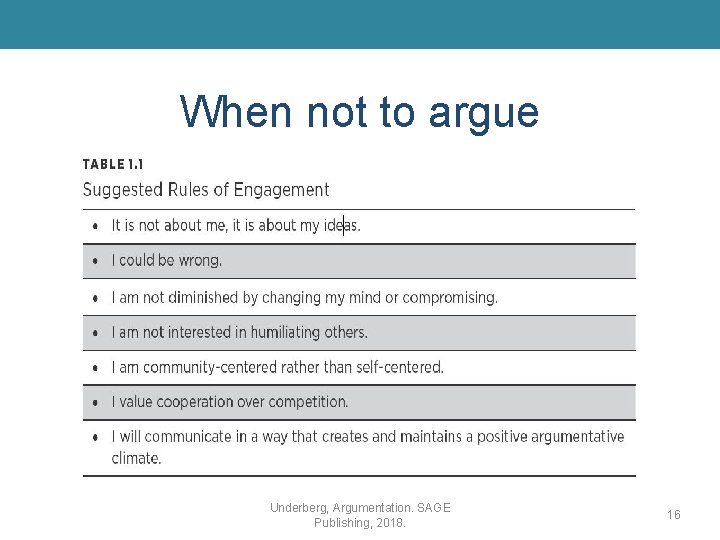
When not to argue Underberg, Argumentation. SAGE Publishing, 2018. 16
When not to argue • This text assumes that there exist situations in which one might be better off NOT arguing. • Note: the authors understand that you might find that odd—but it is true. Underberg, Argumentation. SAGE Publishing, 2018. 17
When not to argue • You are not sufficiently prepared. – Absent an informed opinion on an issue we might need to defer (at least until we have done our homework) • Argument will not make a difference/ – rare in occurrence and opportunities to build understanding Underberg, Argumentation. SAGE Publishing, 2018. 18
When not to argue • The issue is not worth arguing about. – arguing about trivial matters is tiresome and erodes an advocates credibility— and likeability. • Arguing unnecessarily could jeopardize an important relationship. – a pyrrhic victory could result Underberg, Argumentation. SAGE Publishing, 2018. 19
When not to argue • Questions for Discussion: • What factors do you consider when choosing to argue or not? • Can you think of any exceptions to the list of when not to argue? • What situations would you add to the list? Underberg, Argumentation. SAGE Publishing, 2018. 20
Conclusion • The media and politics often are not examples to emulate. • A more cooperative approach to argument can improve our arguments by attending to relationships. Underberg, Argumentation. SAGE Publishing, 2018. 21
- Slides: 21