
Argumentation Make your point Erin Webster Garrett Radford
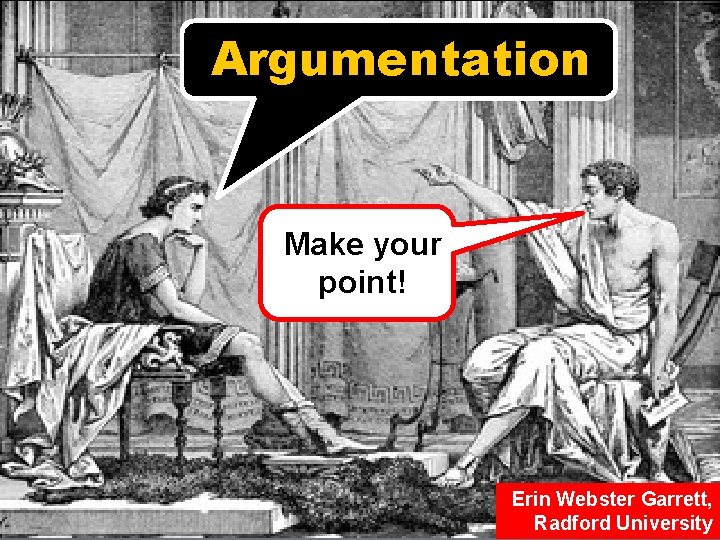
Argumentation Make your point! Erin Webster Garrett, Radford University

Argumentation: What is it? It is a reasoned, logical way of asserting the soundness of a position, belief, or conclusion. Erin Webster Garrett, Radford University

Argumentation: What is it? It takes a stand—supported by logical, structured evidence—and urges people to share the writer’s perspective and insights. Erin Webster Garrett,
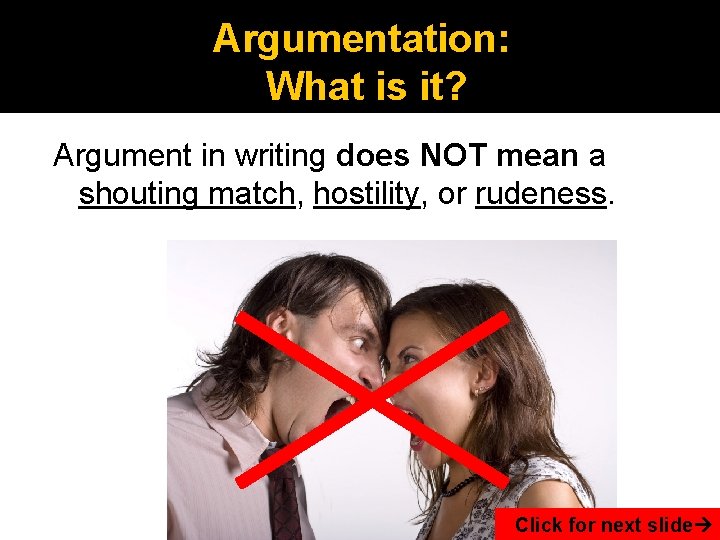
Argumentation: What is it? Argument in writing does NOT mean a shouting match, hostility, or rudeness. Click for next slide
Argumentation: Purposes 1. Purpose: To convince other people to accept—or at least accept the validity of—your position Click for next slide
Argumentation: Purposes 2. Purpose: To defend your position, even if others cannot be convinced to agree I must defend my position! Click for next slide
Argumentation: Purposes 3. Purpose: To question a position you believe to be misguided, untrue, or dangerous without necessarily offering an alternative. Click for next slide
Purposes Continued To achieve these purposes, argumentation has a formal structure which evolves according to a writer’s interpretation and presentation of evidence. Click for next slide
Arguments… Use APPEALS Present EVIDENCE Treat Audiences FAIRLY Click for next slide
APPEALS Arguments use 3 APPEALS – or approaches to presenting evidence. Click for next slide
Appeal #1: Logical Click for next slide
Appeal #1: Logical LOGICAL Appeal: appealing to the audience with: Facts Statistics Expert testimony Measurable data �Sometimes referred to as “Logos” Click for next slide
Appeal #1: Logical Examples of Logical Appeal include: scientific studies expert opinions statistics historical narratives process explanations Click for next slide
Appeal #2: Emotional Click for next slide
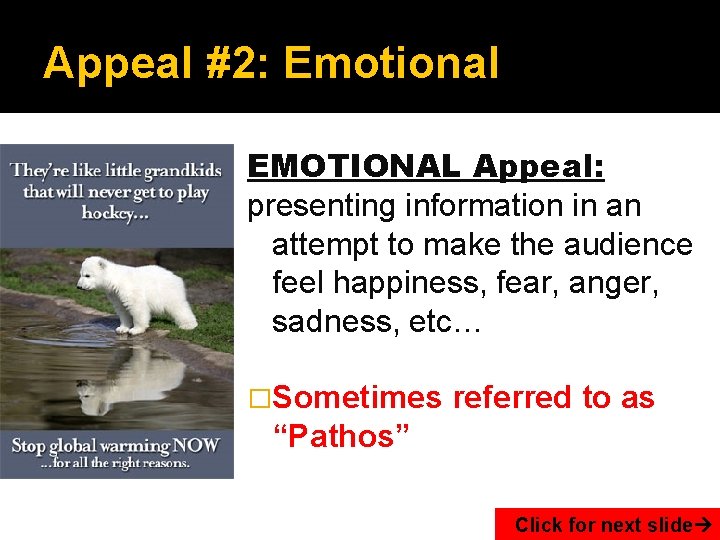
Appeal #2: Emotional EMOTIONAL Appeal: presenting information in an attempt to make the audience feel happiness, fear, anger, sadness, etc… �Sometimes referred to as “Pathos” Click for next slide
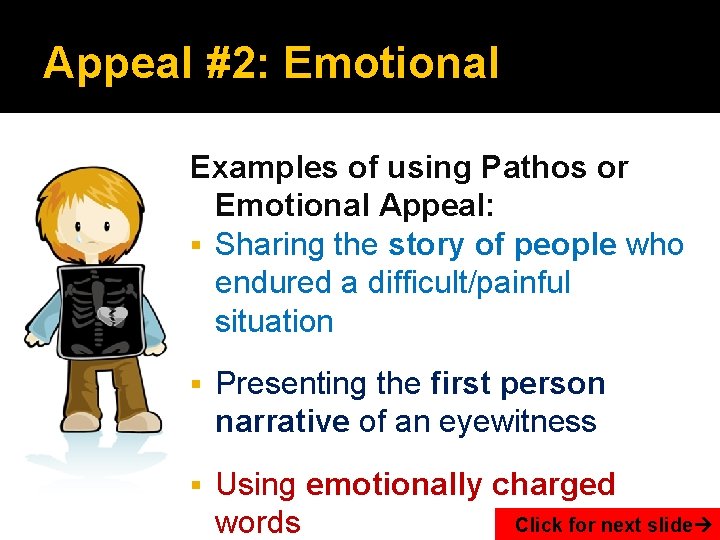
Appeal #2: Emotional Examples of using Pathos or Emotional Appeal: Sharing the story of people who endured a difficult/painful situation Presenting the first person narrative of an eyewitness Using emotionally charged Click for next slide words
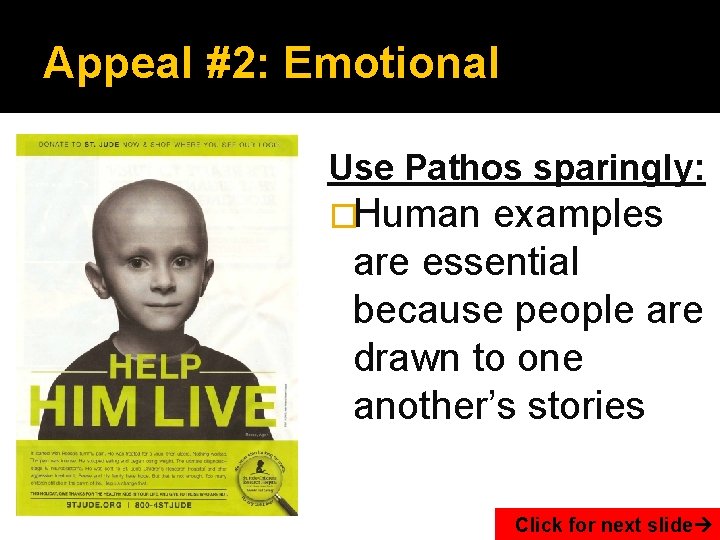
Appeal #2: Emotional Use Pathos sparingly: �Human examples are essential because people are drawn to one another’s stories Click for next slide
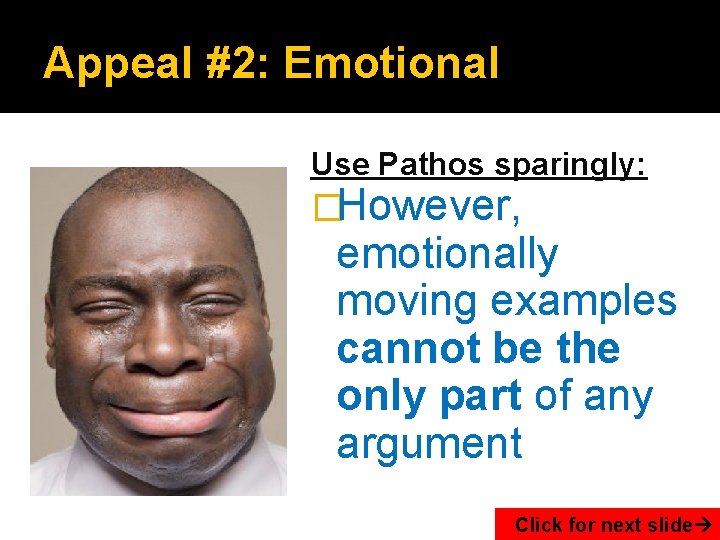
Appeal #2: Emotional Use Pathos sparingly: �However, emotionally moving examples cannot be the only part of any argument Click for next slide
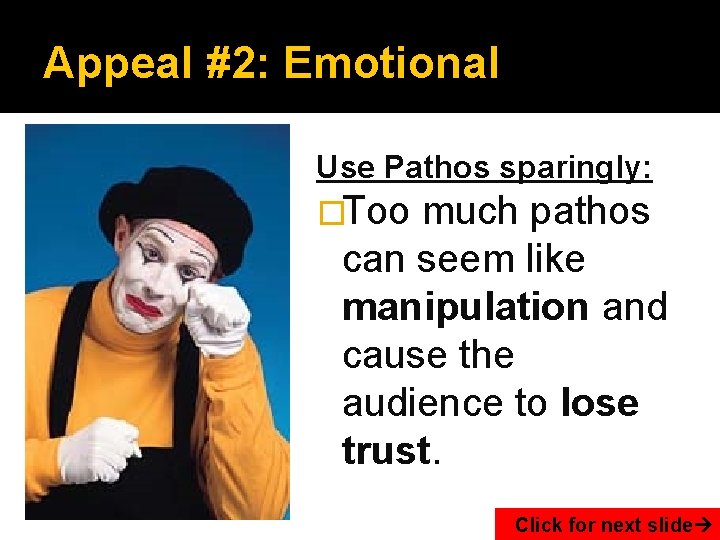
Appeal #2: Emotional Use Pathos sparingly: �Too much pathos can seem like manipulation and cause the audience to lose trust. Click for next slide
Appeal #3: Ethical Click for next slide
Appeal #3: Ethical ETHICAL Appeal: maintaining a fair, calm, and logical tone, acknowledging dissent and opposition’s views, & not relying on fallacies. �Sometimes referred to as “Ethos” Click for next slide
Appeal #3: Ethical Using Ethos or Ethical appeal: Acknowledge & give credit to your opponent’s valid points Use neutral words whenever possible Point out what you and your opponent have in common
Appeal #3: Ethical The Ethical Appeal is especially important when refuting the opposition. You should not appear angry, abusive, closedminded, or impulsive when arguing against your opponent’s ideas. Click for next slide
Arguments… Use APPEALS Present EVIDENCE Treat Audiences FAIRLY Click for next slide
Evidence A good argument must present evidence Click for next slide
Effective Evidence must be Relevant: evidence should support the essay’s thesis and be pertinent to the argument being made. Click for next slide
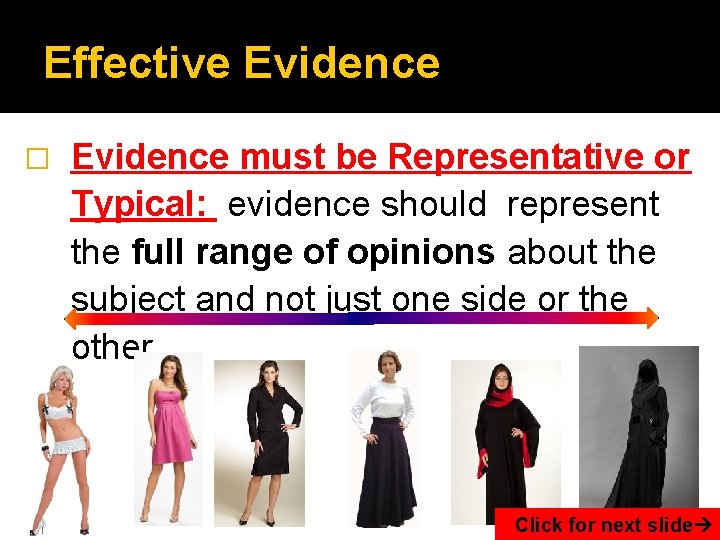
Effective Evidence � Evidence must be Representative or Typical: evidence should represent the full range of opinions about the subject and not just one side or the other. Click for next slide
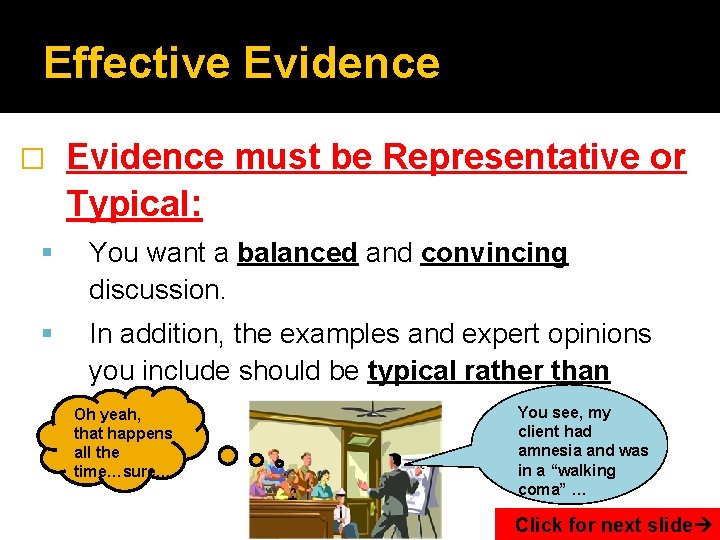
Effective Evidence � Evidence must be Representative or Typical: You want a balanced and convincing discussion. In addition, the examples and expert opinions you include should be typical rather than You see, my Ohextreme. yeah, that happens all the time…sure… client had amnesia and was in a “walking coma” … Click for next slide
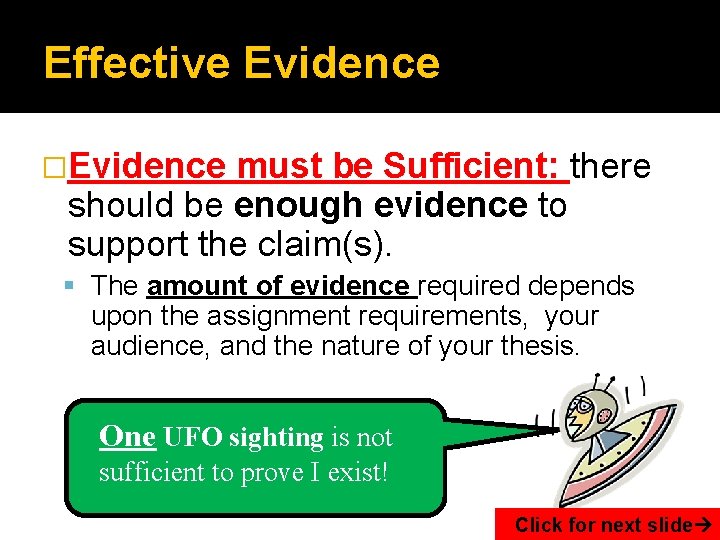
Effective Evidence �Evidence must be Sufficient: there should be enough evidence to support the claim(s). The amount of evidence required depends upon the assignment requirements, your audience, and the nature of your thesis. One UFO sighting is not sufficient to prove I exist! Click for next slide
Effective Evidence �Evidence must be Accurate: Data should not be used unless it is accurate, up-todate, and from credible sources.
Arguments… Use APPEALS Present EVIDENCE Treat Audiences FAIRLY Click for next slide
Audience When writing to or analyzing an audience for an argument, keep the following in mind… Click for next slide
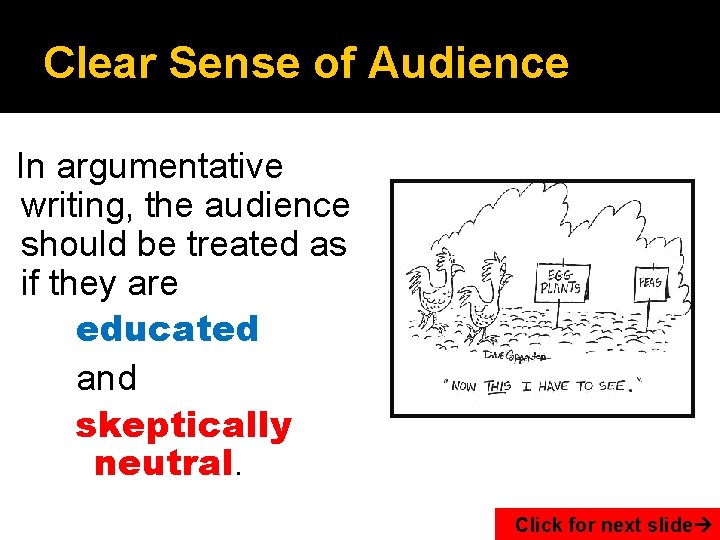
Clear Sense of Audience In argumentative writing, the audience should be treated as if they are educated and skeptically neutral. Click for next slide
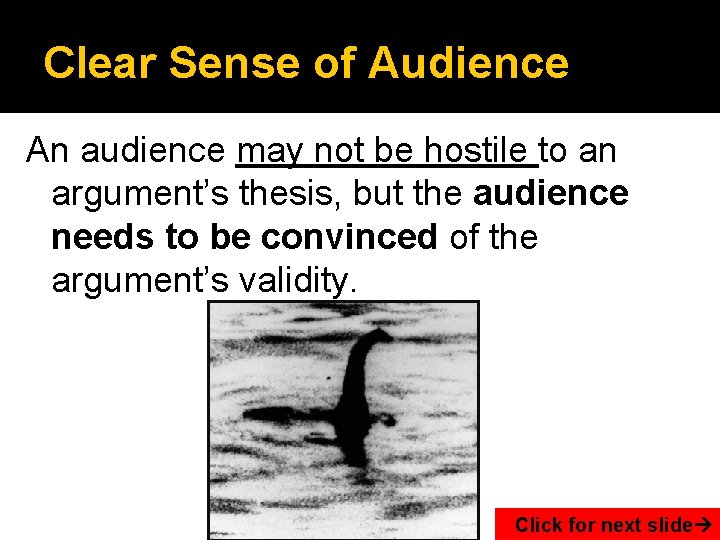
Clear Sense of Audience An audience may not be hostile to an argument’s thesis, but the audience needs to be convinced of the argument’s validity. Click for next slide
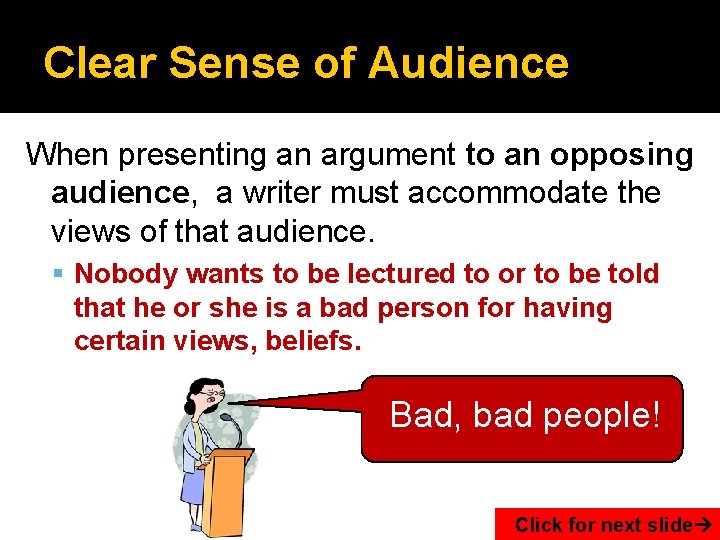
Clear Sense of Audience When presenting an argument to an opposing audience, a writer must accommodate the views of that audience. Nobody wants to be lectured to or to be told that he or she is a bad person for having certain views, beliefs. Bad, bad people! Click for next slide
Inappropriate Appeals Always problematic in an argument… Click for next slide
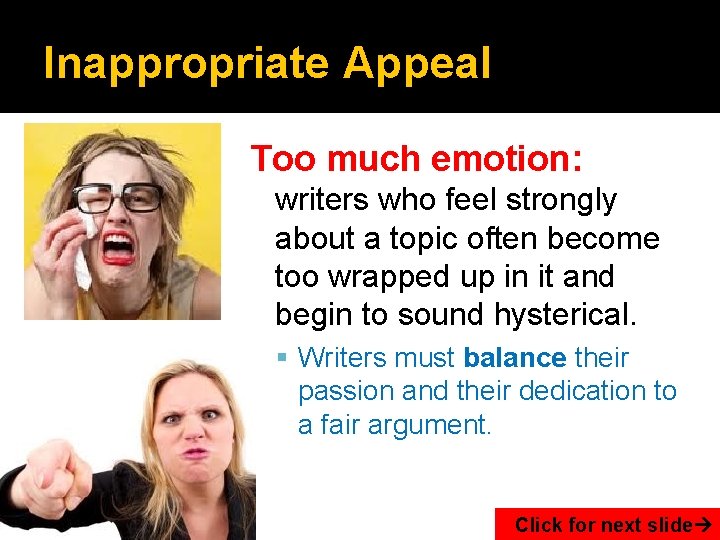
Inappropriate Appeal Too much emotion: writers who feel strongly about a topic often become too wrapped up in it and begin to sound hysterical. Writers must balance their passion and their dedication to a fair argument. Click for next slide
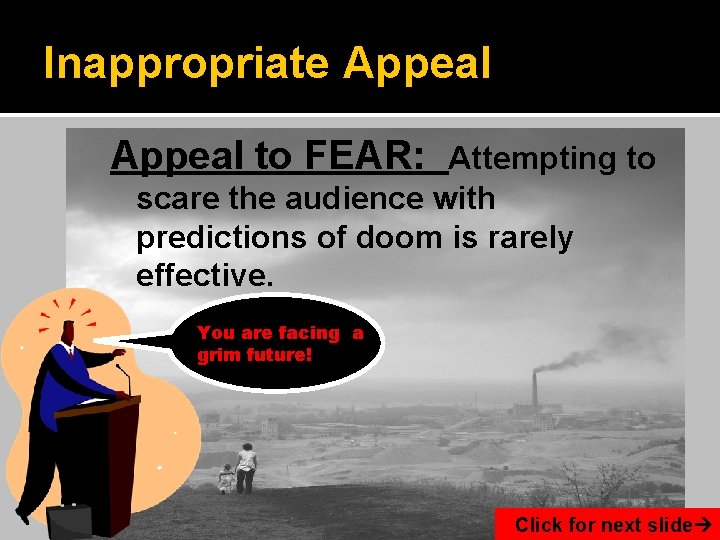
Inappropriate Appeal to FEAR: Attempting to scare the audience with predictions of doom is rarely effective. You are facing a grim future! Click for next slide
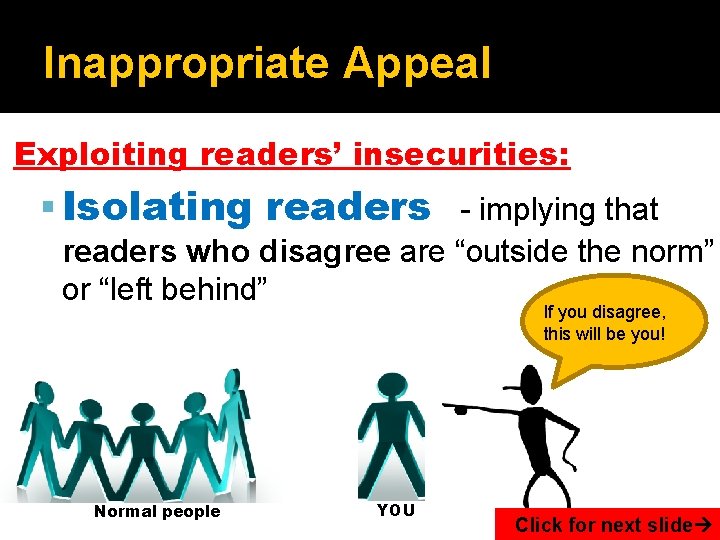
Inappropriate Appeal Exploiting readers’ insecurities: Isolating readers - implying that readers who disagree are “outside the norm” or “left behind” If you disagree, this will be you! Normal people YOU Click for next slide
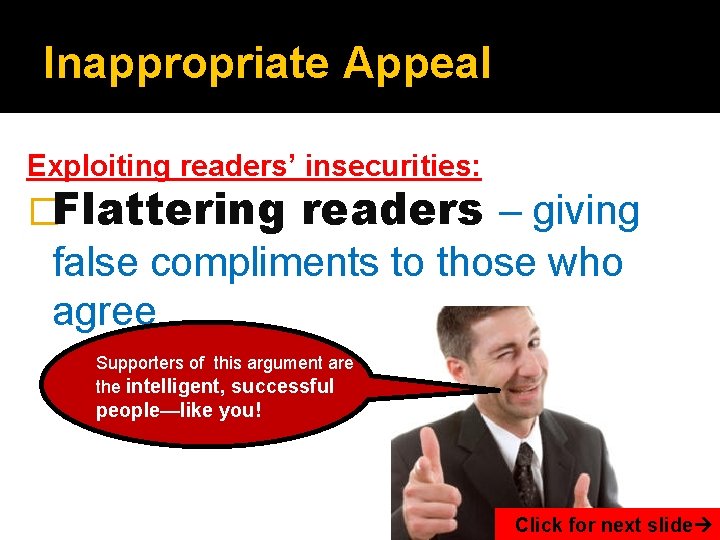
Inappropriate Appeal Exploiting readers’ insecurities: �Flattering readers – giving false compliments to those who agree Supporters of this argument are the intelligent, successful people—like you! Click for next slide
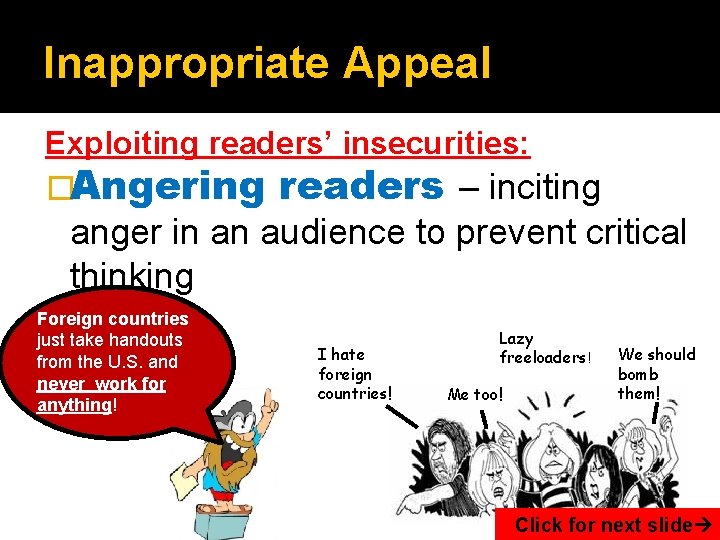
Inappropriate Appeal Exploiting readers’ insecurities: �Angering readers – inciting anger in an audience to prevent critical thinking Foreign countries just take handouts from the U. S. and never work for anything! I hate foreign countries! Lazy freeloaders! Me too! We should bomb them! Click for next slide
Inappropriate Appeal Presenting fallacies as evidence: �Please be familiar with the Fallacies of Argument – Recognize them in others’ arguments and avoid them in your own! Click for next slide
Review – Arguments… Use APPEALS Present EVIDENCE Treat Audiences FAIRLY End of Presentation.
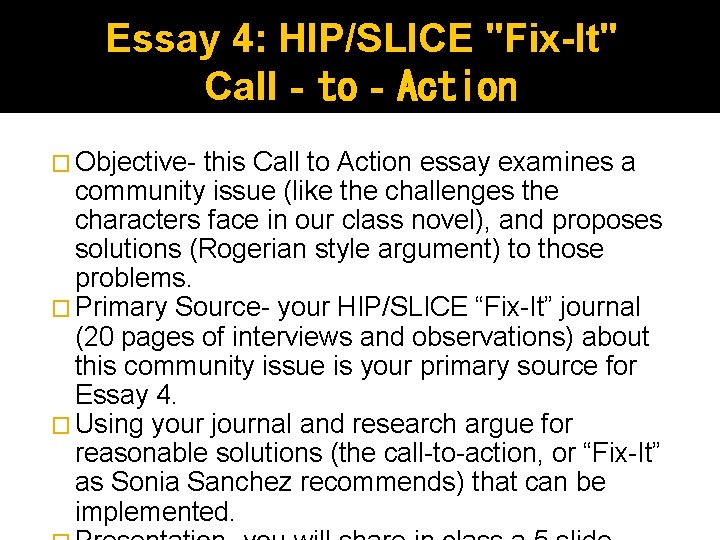
Essay 4: HIP/SLICE "Fix-It" Call‐to‐Action � Objective- this Call to Action essay examines a community issue (like the challenges the characters face in our class novel), and proposes solutions (Rogerian style argument) to those problems. � Primary Source- your HIP/SLICE “Fix-It” journal (20 pages of interviews and observations) about this community issue is your primary source for Essay 4. � Using your journal and research argue for reasonable solutions (the call-to-action, or “Fix-It” as Sonia Sanchez recommends) that can be implemented.

Outline Thesis statement- clearly specify the crisis (problem) and your call-to-action (proposed solutions) � Supporting paragraphs- organized subject by subject or alternating style. � One half of the essay should explain the crisis: � What is the problem? What or who is most affected? problem? � What are the causes? Who might not see it as a The other half of the essay should include your call to action: What are the possible solutions? What are the benefits of the solutions? What are possible limitations of the solutions? How much will the solutions cost? Who will pay for them? Who might best solve the problem? Individuals, government, businesses, or a combination?
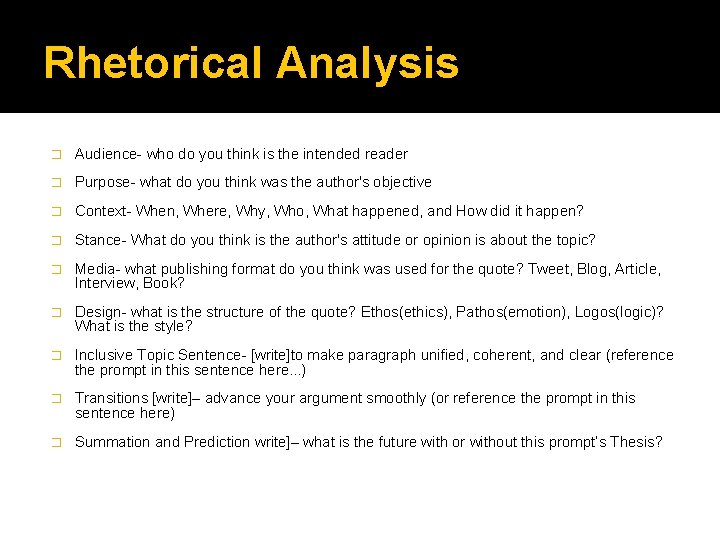
Rhetorical Analysis � Audience- who do you think is the intended reader � Purpose- what do you think was the author's objective � Context- When, Where, Why, Who, What happened, and How did it happen? � Stance- What do you think is the author's attitude or opinion is about the topic? � Media- what publishing format do you think was used for the quote? Tweet, Blog, Article, Interview, Book? � Design- what is the structure of the quote? Ethos(ethics), Pathos(emotion), Logos(logic)? What is the style? � Inclusive Topic Sentence- [write]to make paragraph unified, coherent, and clear (reference the prompt in this sentence here. . . ) � Transitions [write]– advance your argument smoothly (or reference the prompt in this sentence here) � Summation and Prediction write]– what is the future with or without this prompt’s Thesis?
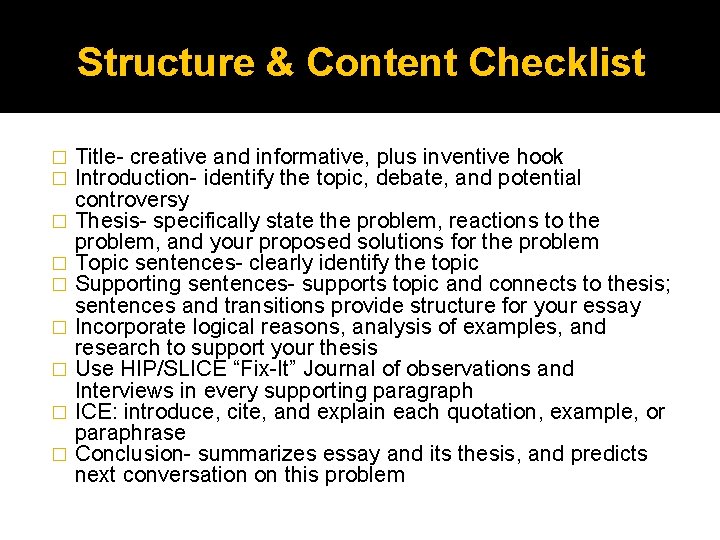
Structure & Content Checklist � � � � � Title- creative and informative, plus inventive hook Introduction- identify the topic, debate, and potential controversy Thesis- specifically state the problem, reactions to the problem, and your proposed solutions for the problem Topic sentences- clearly identify the topic Supporting sentences- supports topic and connects to thesis; sentences and transitions provide structure for your essay Incorporate logical reasons, analysis of examples, and research to support your thesis Use HIP/SLICE “Fix-It” Journal of observations and Interviews in every supporting paragraph ICE: introduce, cite, and explain each quotation, example, or paraphrase Conclusion- summarizes essay and its thesis, and predicts next conversation on this problem
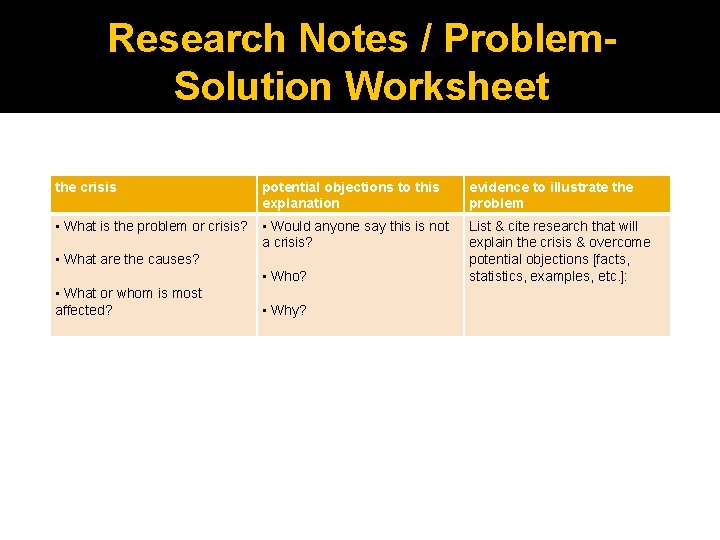
Research Notes / Problem. Solution Worksheet the crisis potential objections to this explanation • What is the problem or crisis? • Would anyone say this is not a crisis? • What are the causes? • Who? • What or whom is most affected? • Why? evidence to illustrate the problem List & cite research that will explain the crisis & overcome potential objections [facts, statistics, examples, etc. ]:
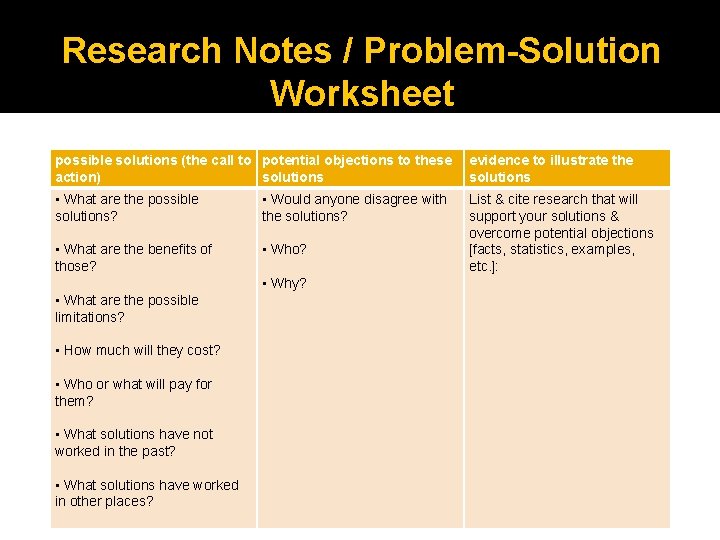
Research Notes / Problem-Solution Worksheet possible solutions (the call to potential objections to these action) solutions evidence to illustrate the solutions • What are the possible solutions? • Would anyone disagree with the solutions? • What are the benefits of those? • Who? List & cite research that will support your solutions & overcome potential objections [facts, statistics, examples, etc. ]: • Why? • What are the possible limitations? • How much will they cost? • Who or what will pay for them? • What solutions have not worked in the past? • What solutions have worked in other places?
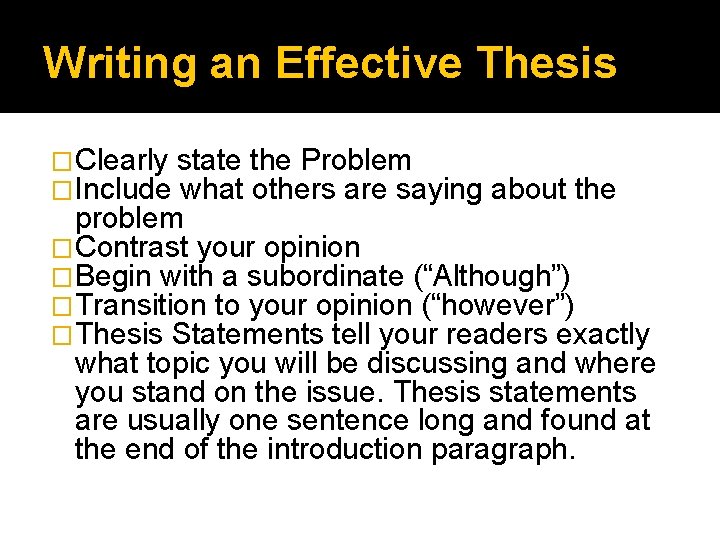
Writing an Effective Thesis �Clearly state the Problem �Include what others are saying about the problem �Contrast your opinion �Begin with a subordinate (“Although”) �Transition to your opinion (“however”) �Thesis Statements tell your readers exactly what topic you will be discussing and where you stand on the issue. Thesis statements are usually one sentence long and found at the end of the introduction paragraph.
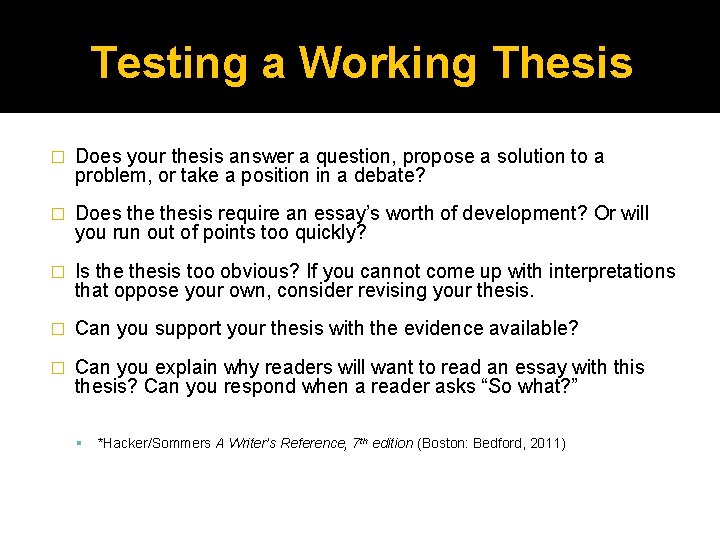
Testing a Working Thesis � Does your thesis answer a question, propose a solution to a problem, or take a position in a debate? � Does thesis require an essay’s worth of development? Or will you run out of points too quickly? � Is thesis too obvious? If you cannot come up with interpretations that oppose your own, consider revising your thesis. � Can you support your thesis with the evidence available? � Can you explain why readers will want to read an essay with this thesis? Can you respond when a reader asks “So what? ” *Hacker/Sommers A Writer’s Reference, 7 th edition (Boston: Bedford, 2011)
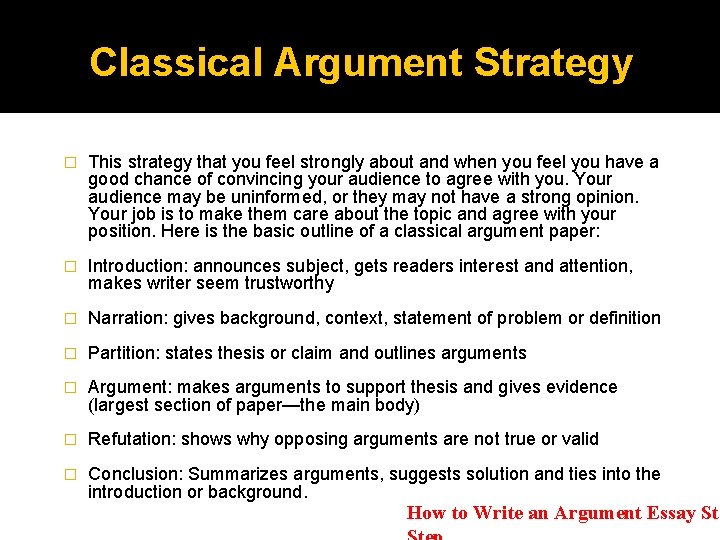
Classical Argument Strategy � This strategy that you feel strongly about and when you feel you have a good chance of convincing your audience to agree with you. Your audience may be uninformed, or they may not have a strong opinion. Your job is to make them care about the topic and agree with your position. Here is the basic outline of a classical argument paper: � Introduction: announces subject, gets readers interest and attention, makes writer seem trustworthy � Narration: gives background, context, statement of problem or definition � Partition: states thesis or claim and outlines arguments � Argument: makes arguments to support thesis and gives evidence (largest section of paper—the main body) � Refutation: shows why opposing arguments are not true or valid � Conclusion: Summarizes arguments, suggests solution and ties into the introduction or background. How to Write an Argument Essay Ste
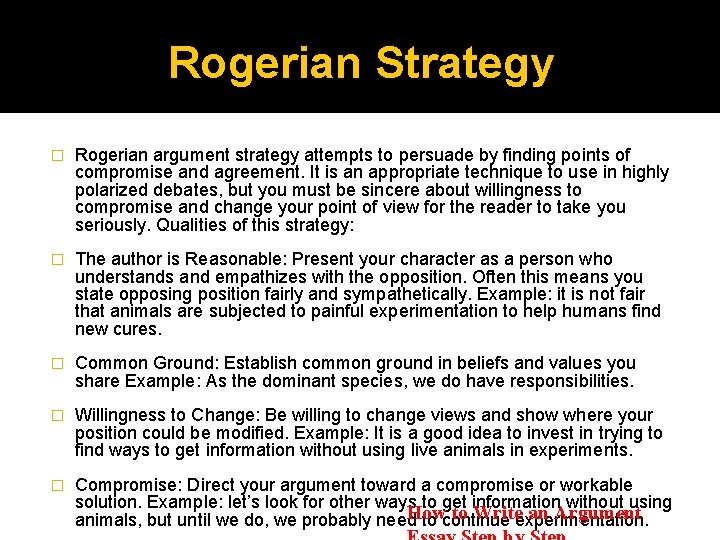
Rogerian Strategy � Rogerian argument strategy attempts to persuade by finding points of compromise and agreement. It is an appropriate technique to use in highly polarized debates, but you must be sincere about willingness to compromise and change your point of view for the reader to take you seriously. Qualities of this strategy: � The author is Reasonable: Present your character as a person who understands and empathizes with the opposition. Often this means you state opposing position fairly and sympathetically. Example: it is not fair that animals are subjected to painful experimentation to help humans find new cures. � Common Ground: Establish common ground in beliefs and values you share Example: As the dominant species, we do have responsibilities. � Willingness to Change: Be willing to change views and show where your position could be modified. Example: It is a good idea to invest in trying to find ways to get information without using live animals in experiments. � Compromise: Direct your argument toward a compromise or workable solution. Example: let’s look for other ways to get information without using How to Writeexperimentation. an Argument animals, but until we do, we probably need to continue
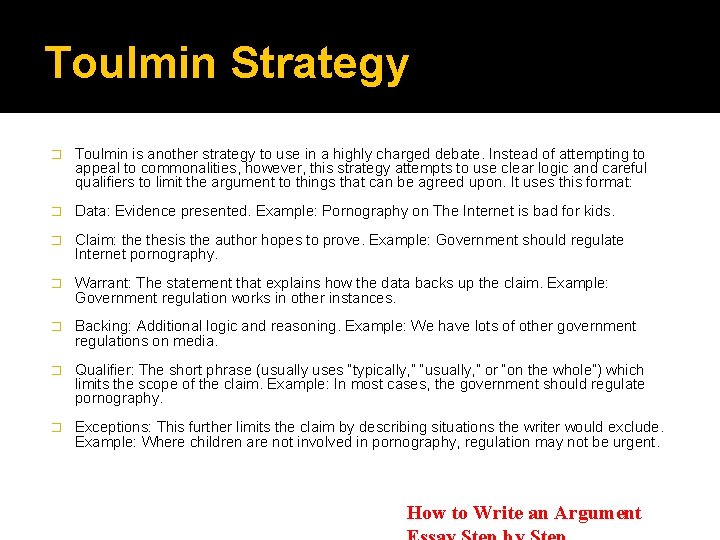
Toulmin Strategy � Toulmin is another strategy to use in a highly charged debate. Instead of attempting to appeal to commonalities, however, this strategy attempts to use clear logic and careful qualifiers to limit the argument to things that can be agreed upon. It uses this format: � Data: Evidence presented. Example: Pornography on The Internet is bad for kids. � Claim: thesis the author hopes to prove. Example: Government should regulate Internet pornography. � Warrant: The statement that explains how the data backs up the claim. Example: Government regulation works in other instances. � Backing: Additional logic and reasoning. Example: We have lots of other government regulations on media. � Qualifier: The short phrase (usually uses “typically, ” “usually, ” or “on the whole”) which limits the scope of the claim. Example: In most cases, the government should regulate pornography. � Exceptions: This further limits the claim by describing situations the writer would exclude. Example: Where children are not involved in pornography, regulation may not be urgent. How to Write an Argument
- Slides: 54