
Argumentation and Critical Decision Making Chapter 5 Analysis


- Slides: 40
Argumentation and Critical Decision Making Chapter 5
Analysis in Argumentation • Analysis of argument is necessary, no matter at what point one enters the argumentation process. • It may be one’s intention to seek the adherence of someone else to a claim, to refute another’s claim, or to evaluate one’s own or someone else’s argumentation. • Analysis should be undertaken systematically and in advance of presenting arguments to decision makers. • Analysis is not just acquiring knowledge, but It is a process in which all the constituents of the argumentative situation are examined to gain adherence is revealed. • With careful analysis, one can develop effective arguments supported by evidence, values, and credibility. And even more, analysis involves learning about the others with whom one will argue. What arguments might they make that could damage one’s position with the appropriate decision makers? • Analysis, therefore, requires that one looks at one’s own and opposing arguments with equal care. 2
Analysis in Argumentation Analysis has two somewhat distinctive parts: 1. One part deals with developing a proposition from a problem that requires resolution but one is not sure what is that resolution (a “feeling of doubt”) 2. The second part is used after the proposition has been identified. Then, the objective of analysis is to find the crucial issues, understand their relative importance, and examine the claims to see what one must prove to decision makers. • These two can overlap and interact when changes are made in a proposition. • A single analysis may move back and forth from one to the other, but we will treat them separately because they are 3 rather different approaches.
Critical Analysis to Find a Proposition • Overcoming the “feeling of doubt” accomplished through critical decision making by helping one discover the proposition one will argue. • If one only express one’s feeling of doubt, one may gain the adherence of some others who are also equally frustrated • However, to solve the problem one needs a clearer statement of a proposition that provides a resolution. 4
Example Statements • Statements such as the following have to be refined into propositions to which decision makers can respond: - How serious is sexual harassment on this campus? - Is global warming a serious threat to the planet? - How should we deal with illegal immigration? - Can we make good medical care available to all Americans? 5
Critical Analysis to Find a Proposition • There are stages that individuals, groups, and even whole societies go through to analyze a problem. • Beginning with the problem, one moves through the stages in critical analysis is intended to determine a proposition. 6
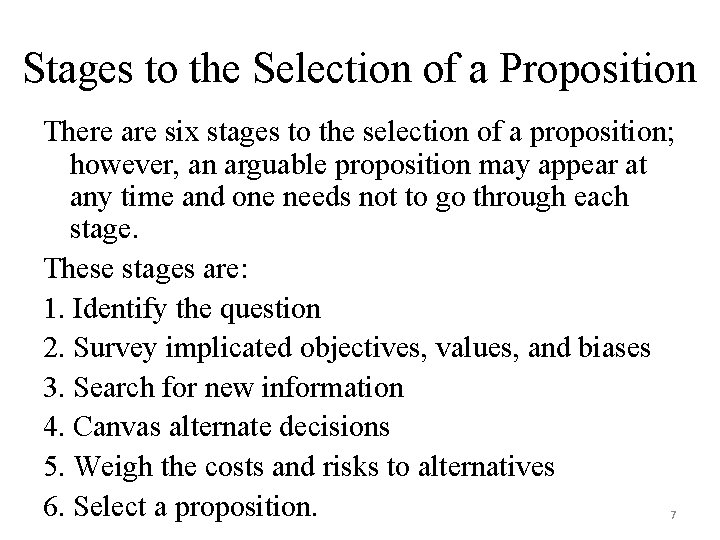
Stages to the Selection of a Proposition There are six stages to the selection of a proposition; however, an arguable proposition may appear at any time and one needs not to go through each stage. These stages are: 1. Identify the question 2. Survey implicated objectives, values, and biases 3. Search for new information 4. Canvas alternate decisions 5. Weigh the costs and risks to alternatives 6. Select a proposition. 7
Identify the Question • The feeling of doubt that one has needs to be refined into a clearly stated question that represents the problem. • To do this, one must entertain genuine doubt • One must identify and face squarely the question that represents that feeling of doubt (The example used is that of global warming) 8
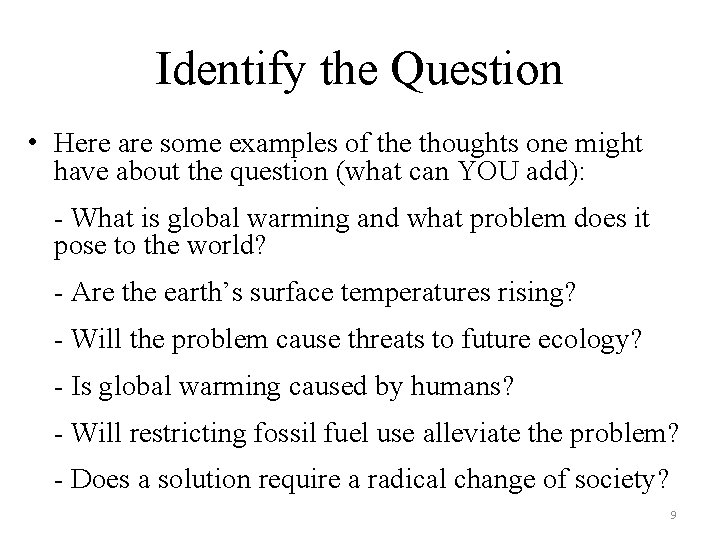
Identify the Question • Here are some examples of the thoughts one might have about the question (what can YOU add): - What is global warming and what problem does it pose to the world? - Are the earth’s surface temperatures rising? - Will the problem cause threats to future ecology? - Is global warming caused by humans? - Will restricting fossil fuel use alleviate the problem? - Does a solution require a radical change of society? 9
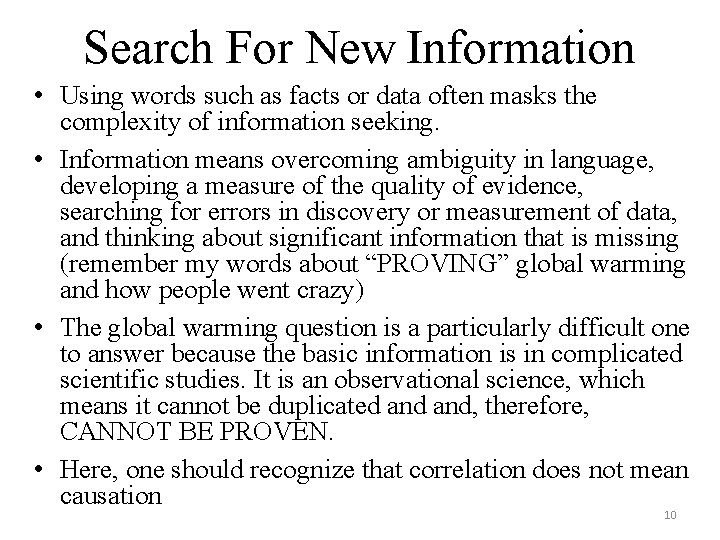
Search For New Information • Using words such as facts or data often masks the complexity of information seeking. • Information means overcoming ambiguity in language, developing a measure of the quality of evidence, searching for errors in discovery or measurement of data, and thinking about significant information that is missing (remember my words about “PROVING” global warming and how people went crazy) • The global warming question is a particularly difficult one to answer because the basic information is in complicated scientific studies. It is an observational science, which means it cannot be duplicated and, therefore, CANNOT BE PROVEN. • Here, one should recognize that correlation does not mean causation 10
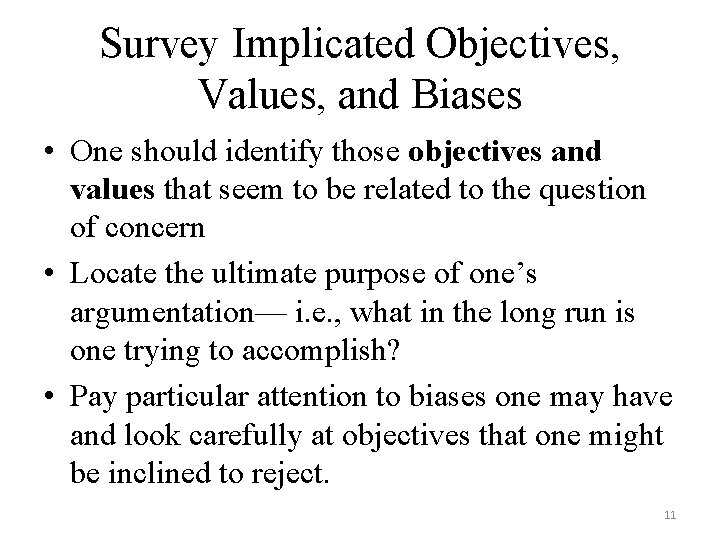
Survey Implicated Objectives, Values, and Biases • One should identify those objectives and values that seem to be related to the question of concern • Locate the ultimate purpose of one’s argumentation— i. e. , what in the long run is one trying to accomplish? • Pay particular attention to biases one may have and look carefully at objectives that one might be inclined to reject. 11
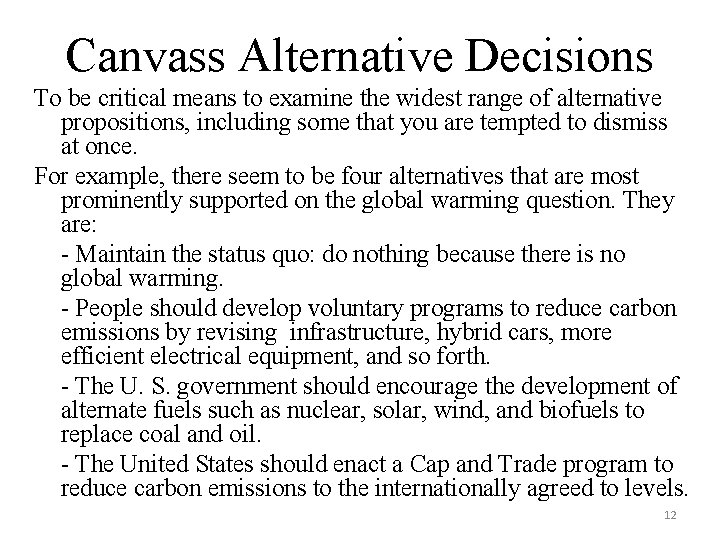
Canvass Alternative Decisions To be critical means to examine the widest range of alternative propositions, including some that you are tempted to dismiss at once. For example, there seem to be four alternatives that are most prominently supported on the global warming question. They are: - Maintain the status quo: do nothing because there is no global warming. - People should develop voluntary programs to reduce carbon emissions by revising infrastructure, hybrid cars, more efficient electrical equipment, and so forth. - The U. S. government should encourage the development of alternate fuels such as nuclear, solar, wind, and biofuels to replace coal and oil. - The United States should enact a Cap and Trade program to reduce carbon emissions to the internationally agreed to levels. 12
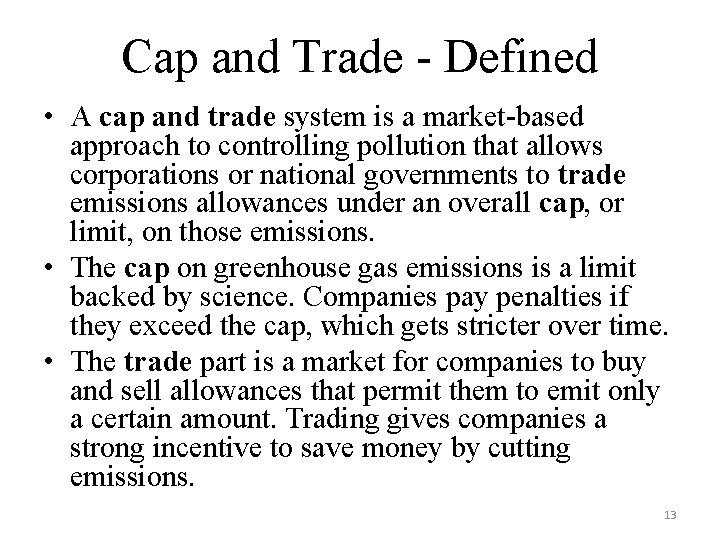
Cap and Trade - Defined • A cap and trade system is a market-based approach to controlling pollution that allows corporations or national governments to trade emissions allowances under an overall cap, or limit, on those emissions. • The cap on greenhouse gas emissions is a limit backed by science. Companies pay penalties if they exceed the cap, which gets stricter over time. • The trade part is a market for companies to buy and sell allowances that permit them to emit only a certain amount. Trading gives companies a strong incentive to save money by cutting emissions. 13
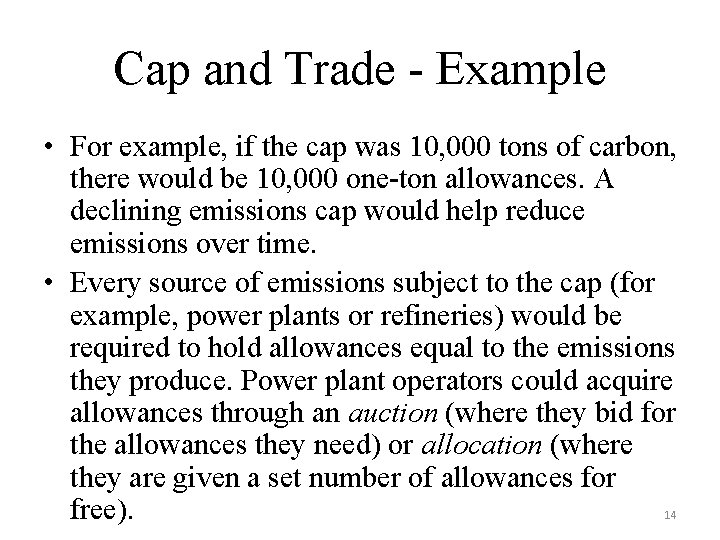
Cap and Trade - Example • For example, if the cap was 10, 000 tons of carbon, there would be 10, 000 one-ton allowances. A declining emissions cap would help reduce emissions over time. • Every source of emissions subject to the cap (for example, power plants or refineries) would be required to hold allowances equal to the emissions they produce. Power plant operators could acquire allowances through an auction (where they bid for the allowances they need) or allocation (where they are given a set number of allowances for free). 14
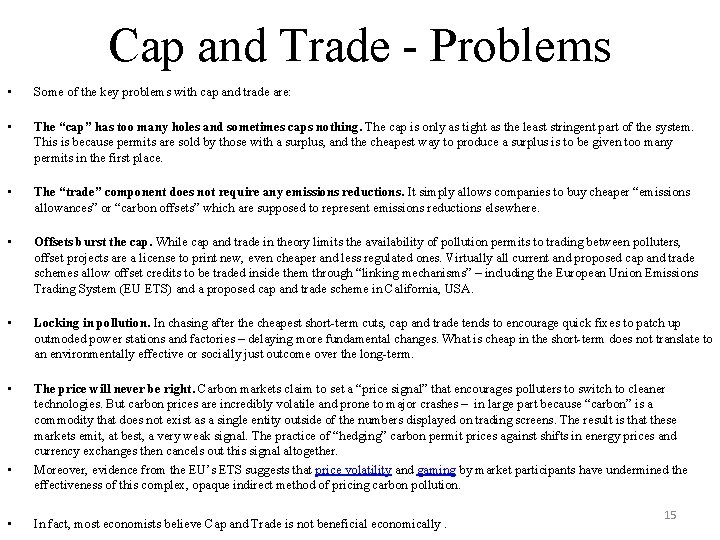
Cap and Trade - Problems • Some of the key problems with cap and trade are: • The “cap” has too many holes and sometimes caps nothing. The cap is only as tight as the least stringent part of the system. This is because permits are sold by those with a surplus, and the cheapest way to produce a surplus is to be given too many permits in the first place. • The “trade” component does not require any emissions reductions. It simply allows companies to buy cheaper “emissions allowances” or “carbon offsets” which are supposed to represent emissions reductions elsewhere. • Offsets burst the cap. While cap and trade in theory limits the availability of pollution permits to trading between polluters, offset projects are a license to print new, even cheaper and less regulated ones. Virtually all current and proposed cap and trade schemes allow offset credits to be traded inside them through “linking mechanisms” – including the European Union Emissions Trading System (EU ETS) and a proposed cap and trade scheme in California, USA. • Locking in pollution. In chasing after the cheapest short-term cuts, cap and trade tends to encourage quick fixes to patch up outmoded power stations and factories – delaying more fundamental changes. What is cheap in the short-term does not translate to an environmentally effective or socially just outcome over the long-term. • The price will never be right. Carbon markets claim to set a “price signal” that encourages polluters to switch to cleaner technologies. But carbon prices are incredibly volatile and prone to major crashes – in large part because “carbon” is a commodity that does not exist as a single entity outside of the numbers displayed on trading screens. The result is that these markets emit, at best, a very weak signal. The practice of “hedging” carbon permit prices against shifts in energy prices and currency exchanges then cancels out this signal altogether. Moreover, evidence from the EU’s ETS suggests that price volatility and gaming by market participants have undermined the effectiveness of this complex, opaque indirect method of pricing carbon pollution. • • In fact, most economists believe Cap and Trade is not beneficial economically. 15
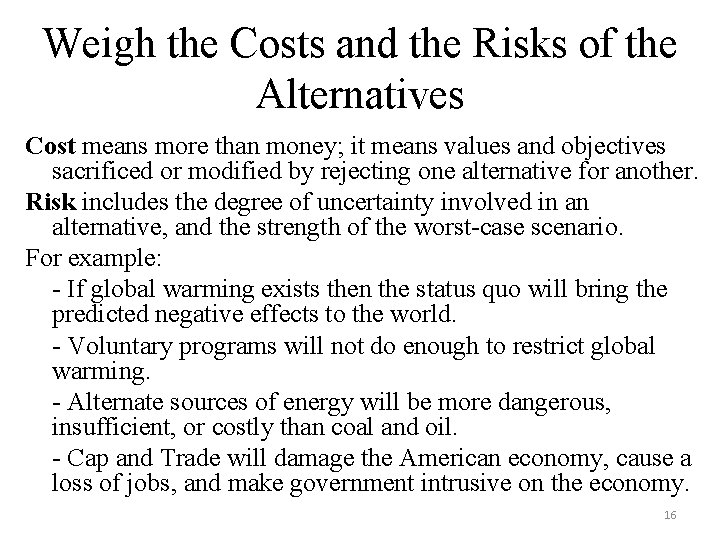
Weigh the Costs and the Risks of the Alternatives Cost means more than money; it means values and objectives sacrificed or modified by rejecting one alternative for another. Risk includes the degree of uncertainty involved in an alternative, and the strength of the worst-case scenario. For example: - If global warming exists then the status quo will bring the predicted negative effects to the world. - Voluntary programs will not do enough to restrict global warming. - Alternate sources of energy will be more dangerous, insufficient, or costly than coal and oil. - Cap and Trade will damage the American economy, cause a loss of jobs, and make government intrusive on the economy. 16
Select a Proposition Note that it is not a matter of selecting the “true” or “only” solution one is looking for the proposition that has the greatest probability of solving the problem. • There will still be claims that can be advanced against the proposition but one is looking for the most probable one (often this is satisficing). • Also, one may modify one’s proposition as new information comes forward. • Traditionally, after one has selected a proposition, one is expected to consider three other steps: (1) Make plans to implement the proposition, (2) Prepare contingency plans, and (3) Build a case for your decision. (covered next week) 17
Select a Proposition (continued) For example, each of the four possible propositions identified advanced as one or more groups in the political spectrum advocated alternate decisions at the time of President Obama’s election in 2008. Cap and Trade was selected as the preferred proposition because of its broader base of support (at least with his political party), its alleged less intrusive methods, and its claimed ability to deal with the problem with less risk to the economy than some others. • Consequently, we will use it as the example of the critical analysis of a proposition. 18
Critical Analysis of a Proposition • Propositions are analyzed by identifying the various claims (fact, value, and policy) that are available to support or oppose it. • State the claims that are both expressed and implied. • And when you match up opposing claims one can find the crucial issues, as these issues are generated by looking to the engagement of arguments, as in a debate. • Not all argumentative situations are debates, but each is potentially a debate. • If one wishes to advance arguments, one must be prepared to answer objections to them. • One needs to meet even unstated objections that are likely to be known by decision makers 19
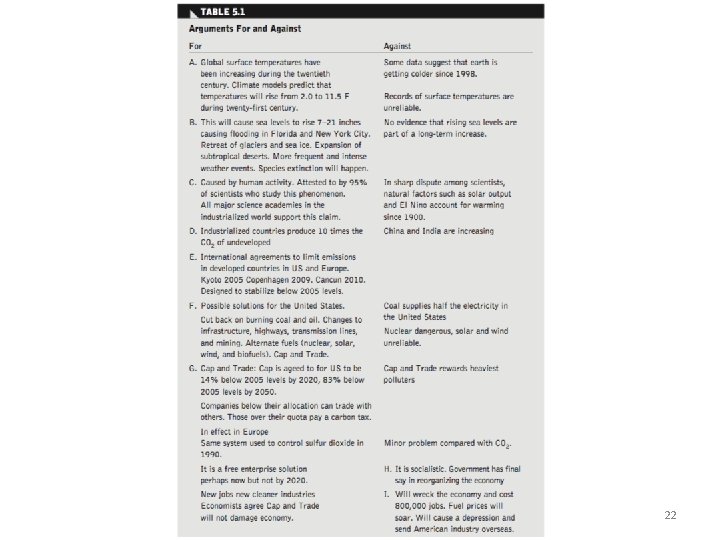
Determining the Issues • Make a list of arguments for and against the proposition and then match them up (see Table 5. 1). • E. g. , Should the United States adopt a Cap and Trade program to reduce carbon emissions to the internationally agreed to levels? • These arguments, matched up for and against, are organized to determine issues—the places where opposing claims come together. • First, look at the opposing claims that do not suggest an issue because they agree with one another (these claims are called uncontroversial matter). • In the example, one subclaim appears to be an uncontroversial matter: • E. g. , There are international agreements to limit emissions in developed countries. • Although this claim is not contested, it may be used, as seen here, to support the proposition that the United States should adopt a Cap and Trade system, or It might also be part an issue over the seriousness of the problem. • Uncontroversial matter may be used to respond to issues but it does not 20 constitute the basis of an issue on its own.
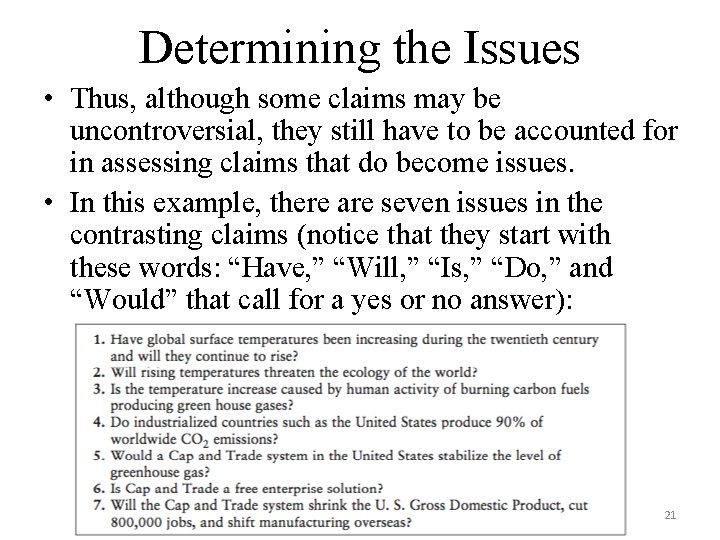
Determining the Issues • Thus, although some claims may be uncontroversial, they still have to be accounted for in assessing claims that do become issues. • In this example, there are seven issues in the contrasting claims (notice that they start with these words: “Have, ” “Will, ” “Is, ” “Do, ” and “Would” that call for a yes or no answer): 21
Example 22
Rank-Order Issues • • • The first stage in is to rank-order them based on their significance—degree of involvement and disagreement—among decision makers. E. g. , the argument about global warming is an extremely complex question based on scientific analysis (though observational only) rooted in cause and effect that is always more difficult to prove. If an arguer could prove to the satisfaction of decision makers that (Issue 10) global temperatures are not increasing then none the subsequent issues would be important. The problem, however, is that neither side can “prove” its case scientifically because it cannot follow scientific method because it is not duplicable There would be no need to consider the effect of rising temperatures (Issue 20) or cause (issues 3 and 4) or a Cap and Trade system to control surface temperatures (Issues 5– 7) if there is no rise in surface temperatures. Many in the scientific community claim that global warming is a hoax. However, the overwhelming worldwide concern would make issue 1 difficult to argue against. A similar situation exists with issues 2 and 4. It seems difficult to argue against the science that says the rising temperatures will threaten the ecology of the world or that industrial countries produce the most CO 2. However, issue 3 (Is the temperature increase caused by human activity of burning carbon fuels producing greenhouse gases? ) is a more controversial point. To a significant extent, this is caused by the fact 23 that it is impossible to prove cause.
Rank-Order Issues • • • Issue 5 is interesting because it stands at the crossroad between arguments about the nature and cause of global warming, and the possible solution. Arguments that claim Cap and Trade will seriously damage the American economy make it a vital issue of comparative advantage. If a Cap and Trade system in the United States would stabilize the greenhouse gas situation, then we would avoid the damage to the world ecology that proponents claim in Issue 3. At the same time, it might bring on the negative effects on the United States claimed in Issue 7. This makes Issue 5 central to a comparative advantage case, which will be discussed in Chapter 6 (Case Building). It is central to an argument not about what is right or wrong but what is more (or less) advantageous. It would seem that the first four issues, though still debatable, have stronger evidence to support them than some others. As for Issue 5, a Cap and Trade system might or might not stabilize the levels of greenhouse gasses. Issue 6 about free enterprise and socialism is an issue held important by a relatively small group of people, although some hold feverishly to the issue. It is probably the least important. The combination of questions about the extent and cause of global warming together with the fact that there are other proposed solutions pushes issue 7 to the head of the list. Even though Issue 5 points at the ultimate purpose of the debate—to protect the world from the effects of greenhouse gasses—it is the claimed disadvantage that Cap and Trade would damage the American economy that arouses the most controversy and demands the most serious search for evidence. 24 So, Issue 7 is ranked first because of those factors
Rank-Order Issues • Rank-ordering the issues requires one to consider not only what one believes (or what an opponent might think), but also the preconceptions of the decision makers. E. g. : • Issue 7, first in significance: Would a Cap and Trade system significantly damage (or help) the American economy? • Issue 5, second in significance: Would a Cap and Trade system in the United States stabilize the level of greenhouse gases? • Issue 3, third in importance: Is the temperature increase caused by human activity? • Issue 1, fourth in significance: Have global temperatures been increasing during the twentieth century (will they continue to rise)? Issue 2, fifth in significance: Will rising temperatures threaten the ecology of the world? • Issue 4, sixth in significance: Do industrialized countries such as the United States produce 90% of worldwide CO 2 emissions? • Issue 6, seventh in significance: Is Cap and Trade a free enterprise (or socialistic) solution? 25
Rank-Order Issues • This is not the sequence in which one would address these issues, but rather where one would need the most developed argument and evidence to overcome the opposition with decision maker • Assessing the audience (i. e. , the decision makers) is of vital importance • E. g. , if the decision makers were more conservative, issues about free enterprise and socialism might be more powerful and an argument for Cap and Trade might require you to spend more time showing the free enterprise aspects of it. 26
What Critical Values Will be Applied? Five generic values usually relevant to decision making that can guide one’s analysis of each situation: 1. Clarity 2. Significance 3. Relevance (or Salience) 4. Inherency 5. Consistency 27
Clarity • Language meaning is socially based (Especially English, one cannot even pronounce some words unless they are given context [e. g. , wind, tear, lead, and so forth]) • What I say versus what you hear may be two different things • One needs to understand what interpretative strategies are typical of these decision makers, and then try to express one’s arguments so that they will be clear in a joint sense— satisfying you and them. • I. e. , align the message with the audience. • It is also to one’s advantage to look at opposition arguments in the same way so that one can counter them. 28
Significance • What is highly significant to one may be less so to one’s decision makers. • Each has his or her hierarchies of concerns. • Special interest groups such as environmentalists or abortion opponents often seem to believe that everyone shares their fervor, which is often not the case. • For example, if someone asks you whether global warming is significant to you, you may say it is, but not significant enough to donate money to the cause or attend a conference. • It helps to have an idea of where your significance coincides or does not coincide with that of the decision makers. 29
Relevance (or Salience) • I. e. , what is relevant (what some call salient) to the decision makers. • E. g. , there are related ecological issues about clean air, clean water, mercury pollution of lakes and streams, and so forth, but will these be considered relevant to the issue of the cost of global warming? • One needs to be aware of decision makers’ understanding of what is relevant and either adapt to it or strengthen your argument to accommodate it. 30
Inherency • Decision makers might agree with an argument one makes but be less inclined to follow one’s position because they do not believe that one has identified a problem that is inherent in the system. • Inherency means that a weakness is a permanent attribute or characteristic of something. • For example, in arguing for action on global warming, one would need to claim that the weaknesses in the status quo are inherent. • They are so deeply imbedded that no minor modifications such as changing light bulbs and buying a hybrid car can solve them. Inherency puts a powerful obligation on an arguer, much more than significance or relevancy. • One should try to estimate how the decision makers perceive one’s arguments and the arguments that oppose on inherency. 31
Consistency • “In our culture, there is a clear notion that the charge of inconsistency is a winning argument” (i. e. , do not waffle) • Unfortunately, one person’s consistency is another’s confusion as different argument elements are identified as needing to be consistent with one another. • Although one wants one’s decision makers to believe concepts one argues are consistent with one another, it will be important for one to learn the decision makers’ standards of consistency. • Remember that inconsistencies can be used against a position only if they exist in the decision makers’ minds or are pointed out by the arguer. • For example, in the campaign leading up to the 2012 presidential election, Mitt Romney was charged with inconsistency in attacking President Obama’s health care plan because as Governor of Massachusetts he had developed a state plan based on the same principles. 32
Analysis of Claims • When the proposition is reduced to a workable series of issues of fact and value, the most significant identified, and the values by which they will be tested observed, one must further refine one’s analysis by focusing on each fact or value claim used to support or oppose the proposition. • One’s objective is to look closely at your ultimate purpose: • What is one trying to accomplish with one’s proposition? • E. g. , the most significant claim may be about the ability of a Cap and Trade system to stabilize the level of greenhouse gasses because that is the ultimate purpose of the debate, but the opposition claims that Cap and Trade would significantly damage the American economy will probably generate the most intense scrutiny. 33
Clarify What Each Claim Asserts • Next is to analyze each of them to locate the specific nature of the issue. • Need to establish criteria for evaluating each claim and then finding the point at which the claim is most vulnerable to rebuttal. • Disagreements may arise over the criteria themselves, the relationship of the claim to the criteria, or the relationship of the support to the criteria. • Each claim has a subject term and a judgment term. • For example, on the claim “Rising temperatures threaten the ecology of the world, ’’ there is little difficulty in understanding the subject term. • The subject of the sentence is rising temperatures. • However, the judgment term, threaten the ecology of the world, presents a problem in definition. • That is where the criteria come in. • Does “threaten the ecology of the world’’ mean retreat of glaciers and sea ice, expansion of subtropical deserts, more frequent weather events, flooding, or all of these and more? 34
Locate the Points of Disagreement • To evaluate a claim one must locate the points of disagreement over it. • Note four locations for disagreement: • LOCATION I: By what criteria should the claim be judged? • LOCATION II: Which criteria are the most important? • LOCATION III: To what extent does the claim satisfy the criteria? • LOCATION IV: What is the strength of support for the claim? 35
By What Criteria Should the Claim Be Judged? E. g. , assuming that in arguing for a U. S. Cap and Trade emissions program one chooses the following criteria: • It must reduce CO 2 levels 14% below 2005 levels by 2020. • It must not unduly damage the American economy. • It must allow for flexibility in a company’s response. 36
Locate the Points of Disagreement • The criteria in this case seem all inclusive. • They ask for a plan to recognize the objections both the scientists, the governments of the world, and the skeptical agencies who speak for American industries. • But what if the opposition argued that no industry would be hurt by this plan? In that case, one would have an argument over criteria. • The second criterion about damage to the economy is different from protecting each industry (coal, oil, and mining). 37
Which Criteria Are the Most Important? • Even when criteria are agreed on, there can still be a disagreement over which criterion is most important. • For example, suppose that proponents and opponents agree on three criteria as identified previously. • They still could disagree over which criterion is most important. • Those who support the proposition probably believe that reducing the CO 2 levels is the most important criterion. • Opponents probably believe that the second criterion is the most important because of the damage to the economy. • So, there is an issue over which criterion is most important. 38
To What Extent Does the Claim Satisfy the Criteria? • Even if both sides agree to the criteria for an acceptable government system, they still can disagree that Cap and Trade can satisfy the criteria. • The program by these criteria will be so extensive as to strengthen other arguments against it such as bureaucracy and costs in taxes. • Opponents might claim that Cap and Trade based on these criteria will break the U. S. economy and cost as much as 800, 000 jobs in the manufacturing sector alone. • This is probably in which the main issue would exist in this question. • Opponents would accept the criteria of the proponents not because they want the claim to succeed but because these criteria can be used to support their arguments about costs, 39 bureaucracy, and socialism.
What Is the Strength of Support for the Claim? • Every argument must ultimately rest on some kind of support (evidence, values, or credibility). • The arguments that have been stated them are not supported. • To fully argue either for or against, there must be more than assertion. • Therefore, it is necessary to find the available support and evaluate it as a part of the case. • Particularly on factual claims, the support necessary will usually emphasize evidence (examples, statistics, and testimony). • An arguer needs to find the strongest possible evidence for a position. • Although values and credibility can be strong bases to support arguments, they are most effective when linked to evidence. • What evidence is most trustworthy to decision makers on the global warming question: Personal examples? Scientific studies? Testimony of experts? 40