
Argument and Persuasion What do we mean by
Argument and Persuasion
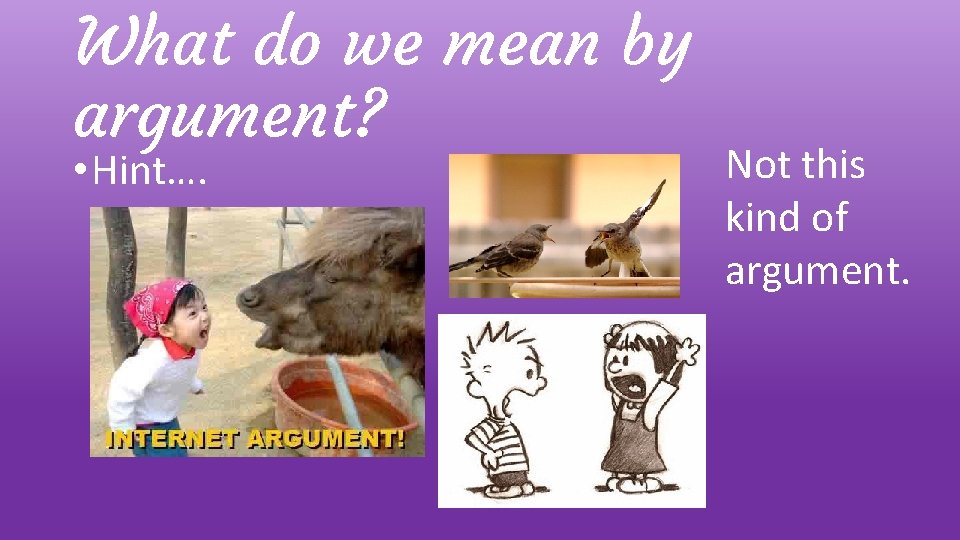
What do we mean by argument? • Hint…. Not this kind of argument.
• The purpose of an argument is to persuade the audience in some way. This might include a number of things, including: • Convincing the audience to change their opinion about a topic • Convincing the audience to stop doing something • Convincing the audience to start doing something • Convincing the audience to buy something • Convincing the audience to support an idea • A valid argument contains logic, solid evidence, or clear reasons and examples.
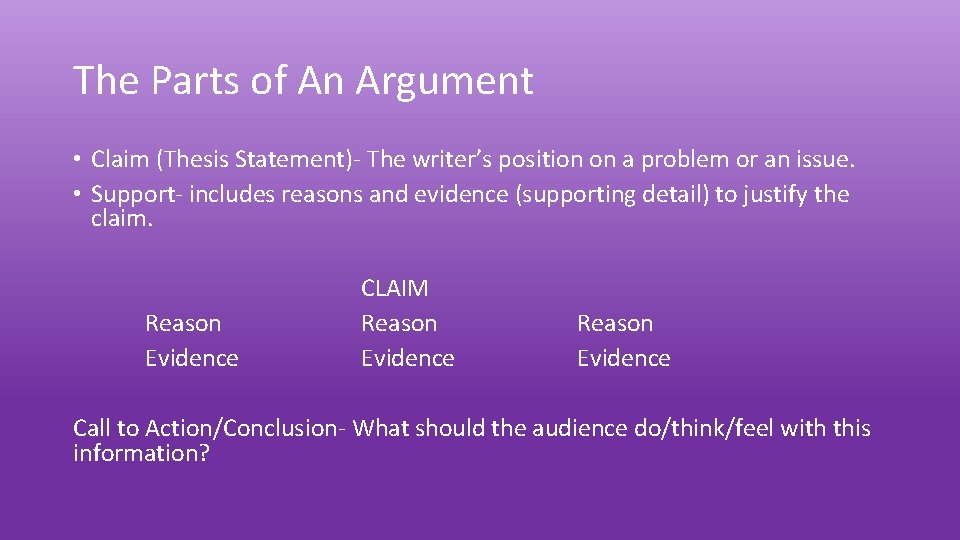
The Parts of An Argument • Claim (Thesis Statement)- The writer’s position on a problem or an issue. • Support- includes reasons and evidence (supporting detail) to justify the claim. Reason Evidence CLAIM Reason Evidence Call to Action/Conclusion- What should the audience do/think/feel with this information?
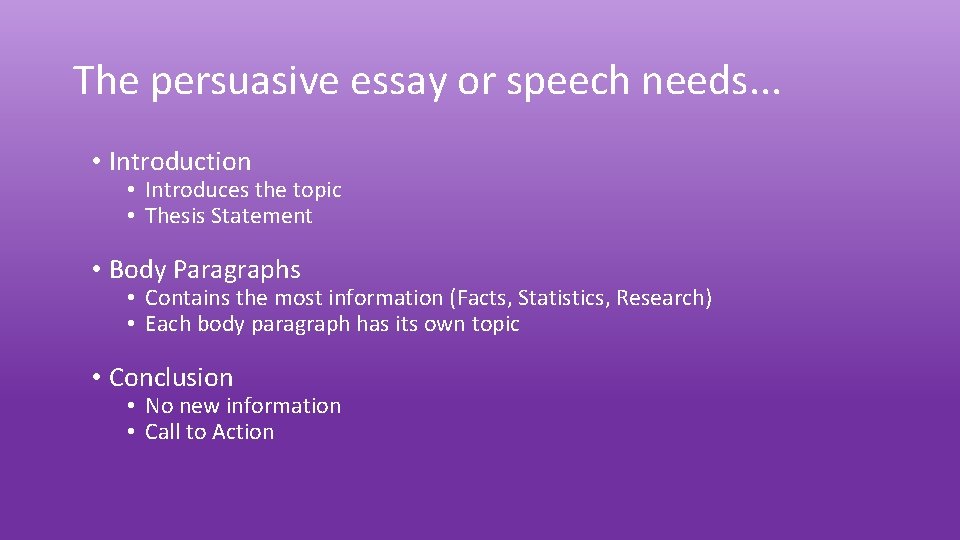
The persuasive essay or speech needs. . . • Introduction • Introduces the topic • Thesis Statement • Body Paragraphs • Contains the most information (Facts, Statistics, Research) • Each body paragraph has its own topic • Conclusion • No new information • Call to Action
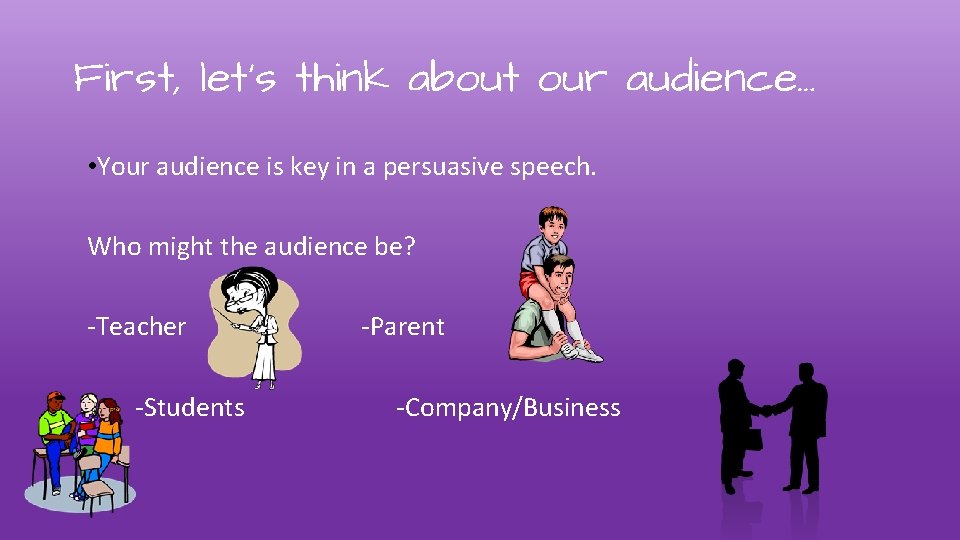
First, let’s think about our audience… • Your audience is key in a persuasive speech. Who might the audience be? -Teacher -Students -Parent -Company/Business
Introduction • Think of your introduction as a first impression • Make sure to state your reason for the speech. • The introduction will contain your thesis, or argument.
Thesis/Argument • Your thesis statement, or argument, should contain the main idea of your speech. • This is the main point that you are trying to get across. • Your thesis should also include three points to support your argument.
For example… • Thesis: Our family should purchase a Netflix account rather than a Hulu account because Netflix has a wide variety of streaming options, it has thousands of movies and TV shows, and there is something for the whole family. • Argument: Our family should purchase a Netflix account rather than a Hulu account. • Point 1: It has a wide variety of streaming options • Point 2: It has thousands of movies and TV shows • Point 3: There is something for the whole family
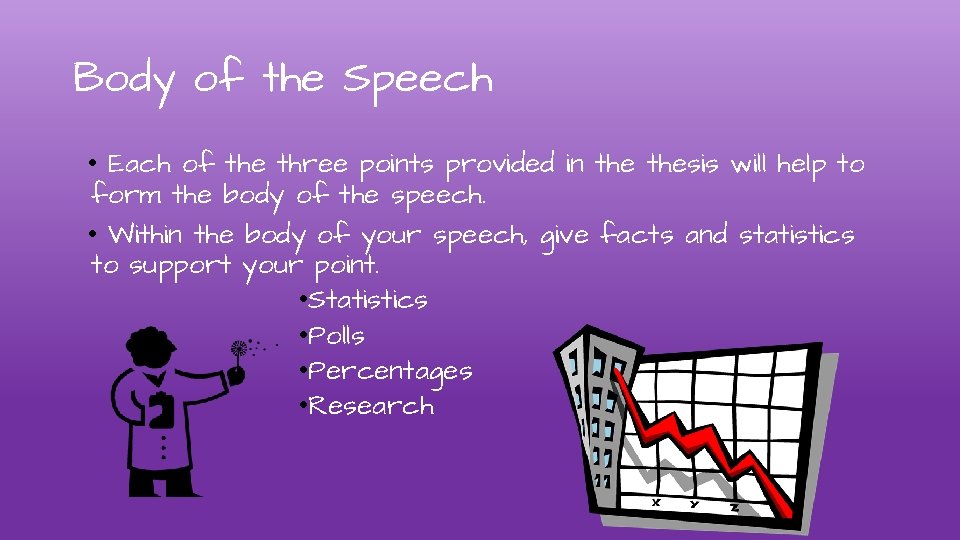
Body of the Speech • Each of the three points provided in thesis will help to form the body of the speech. • Within the body of your speech, give facts and statistics to support your point. • Statistics • Polls • Percentages • Research
For Example… • It has a wide variety of streaming options. –Netflix may be viewed on gaming consoles, phones, computers, televisions, and more. –All of these streaming options mean quieter road trips. • It has thousands of movies and TV shows. –Netflix has approximately 14, 000 titles in its collection (including DVD rental options). –Netflix has a wide variety of educational documentaries. –Netflix has several exclusive series that may only be viewed by those with a subscription. • There is something for the whole family. –The Netflix library contains many different genres, including children’s movies, drama, comedy, action adventure, and more. –All of these options means that there are titles the entire family will enjoy- meaning more family time spent together.
Not All Points are Created Equal • Order of Importance • Start with the least important point and work up to your most important. • Argument: People should take time to exercise every day. • Point 1: Exercise helps to improve a person’s mood. • Point 2: Exercise helps to boost energy. • Point 3: Exercise may help to extend a person’s life by combating disease.
Transition Words • Transition words can be used to guide the reader from one point to the next. Transition Words Also Another Besides Finally First Second for example in the first place in the second place in the same way likewise to begin with moreover furthermore in addition more important most important similarily
Conclusion • The conclusion should summarize your thesis and your three main points. • The conclusion also contains your “call to action”- what do you want the audience to DO? • Do not put any new information in your conclusion.

Language • Be sure to use respectful language in your speech. • Do not insult or attack the individual. • Try to use positive language in your speech. “Jeremy should be prohibited from bringing his giraffe to school because it is unsafe for his classmates. ” Instead of… “Jeremy should not be allowed to bring his giraffe to school because he is a big ignoramous. ”
Fact vs. Opinion • Opinion cannot be proven, and is not necessarily based upon fact or knowledge. • Fact can be proven, and is based upon knowledge. – You should use FACTS to back up your points.
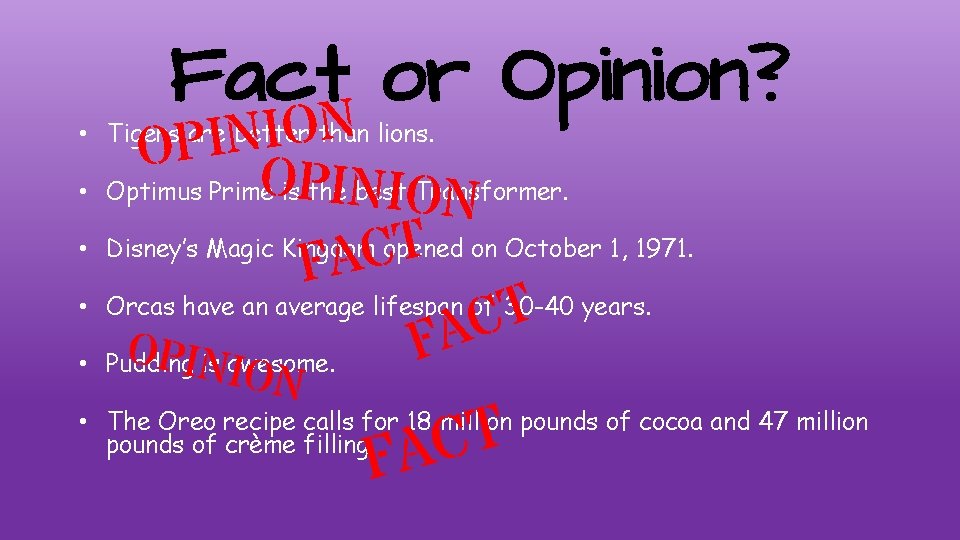
Fact or Opinion? N O I N OPI Ois. Pthe. IN Optimus Prime best IOTransformer. N Disney’s Magic Kingdom. C opened on October 1, 1971. T FA Orcas have an average lifespan of 30 -40 years. T C FA O • Tigers are better than lions. • • • PINIO • Pudding is awesome. N T C FA • The Oreo recipe calls for 18 million pounds of cocoa and 47 million pounds of crème filling.
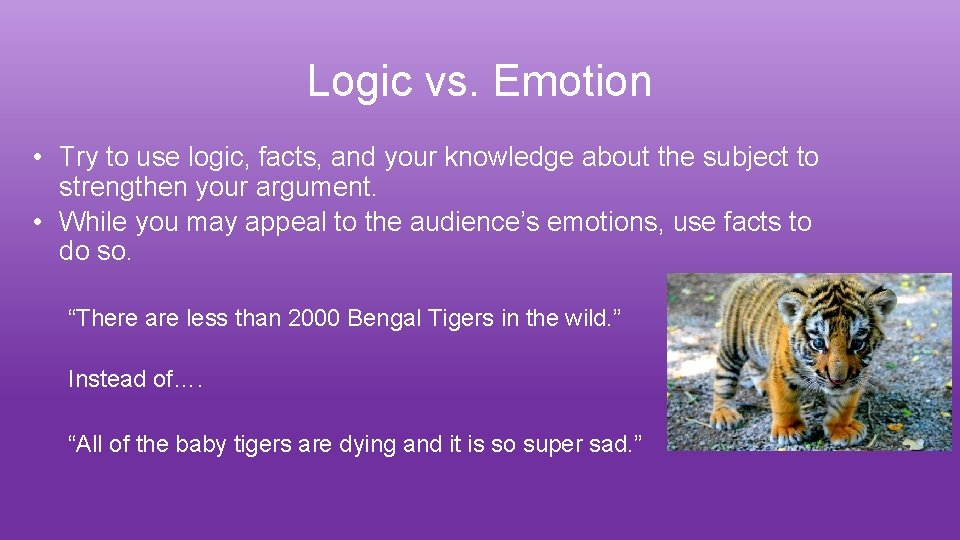
Logic vs. Emotion • Try to use logic, facts, and your knowledge about the subject to strengthen your argument. • While you may appeal to the audience’s emotions, use facts to do so. “There are less than 2000 Bengal Tigers in the wild. ” Instead of…. “All of the baby tigers are dying and it is so super sad. ”
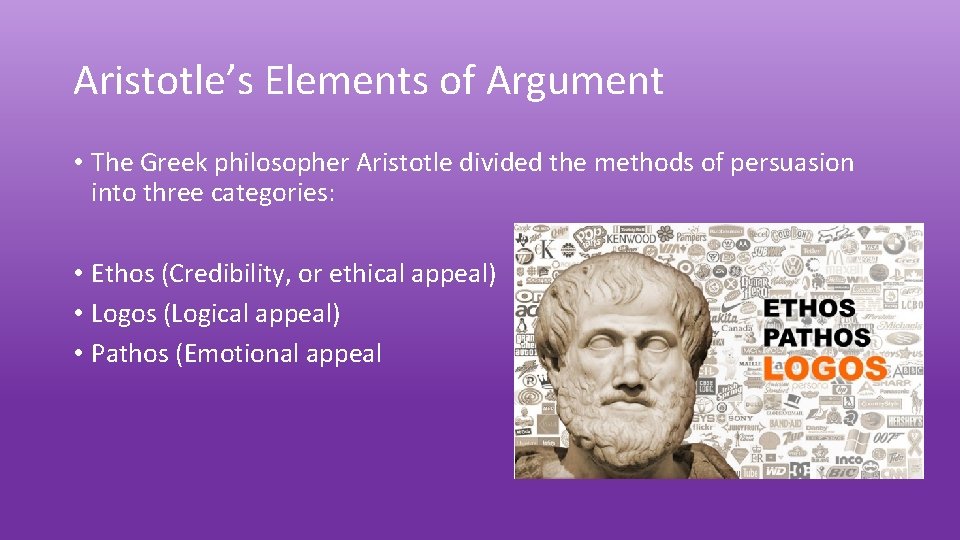
Aristotle’s Elements of Argument • The Greek philosopher Aristotle divided the methods of persuasion into three categories: • Ethos (Credibility, or ethical appeal) • Logos (Logical appeal) • Pathos (Emotional appeal
Ethos (Ethical Appeal) • Trustworthiness or credibility of the writer or speaker Ethos is often conveyed with: • Tone or style of writing • The way the writer or speaker addresses differing views • Appropriate language for the topic and audience • Sounding fair and unbiased • The author or speaker’s experience in the field.
Logos (Logical Appeal) • Persuading by the use of logic or reasoning • The most valued appeal in academic writing Logos may be conveyed with: • Citing facts and statistics (very important) • Using analogies (examples) • Constructing logical arguments
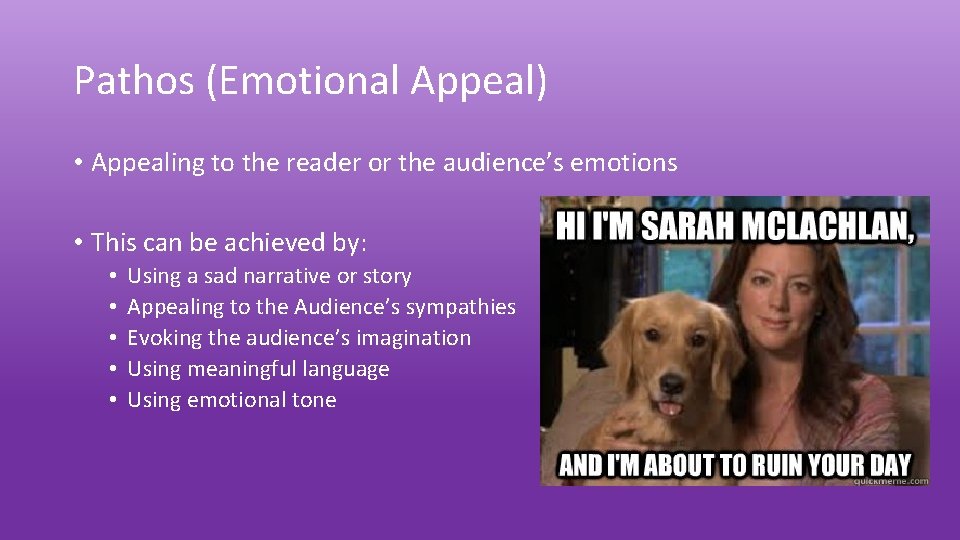
Pathos (Emotional Appeal) • Appealing to the reader or the audience’s emotions • This can be achieved by: • • • Using a sad narrative or story Appealing to the Audience’s sympathies Evoking the audience’s imagination Using meaningful language Using emotional tone
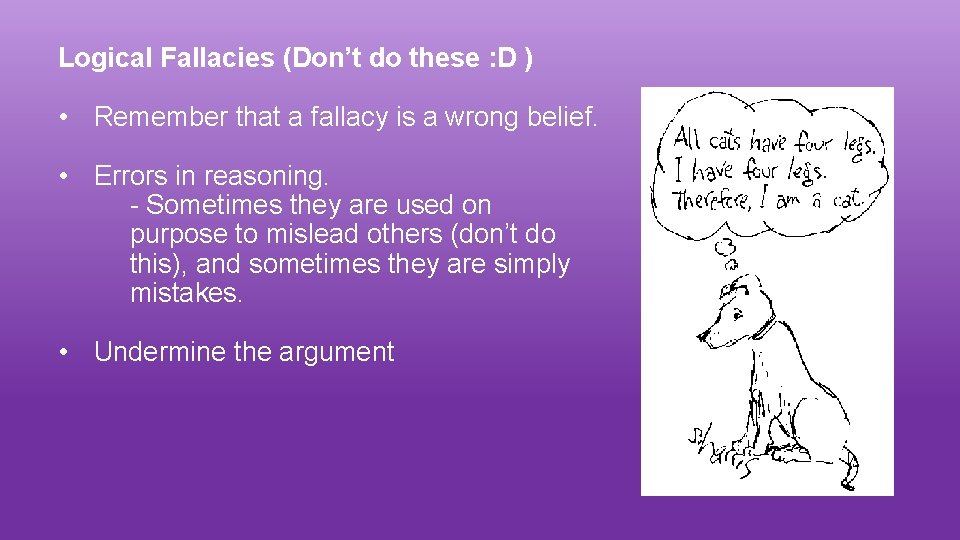
Logical Fallacies (Don’t do these : D ) • Remember that a fallacy is a wrong belief. • Errors in reasoning. - Sometimes they are used on purpose to mislead others (don’t do this), and sometimes they are simply mistakes. • Undermine the argument
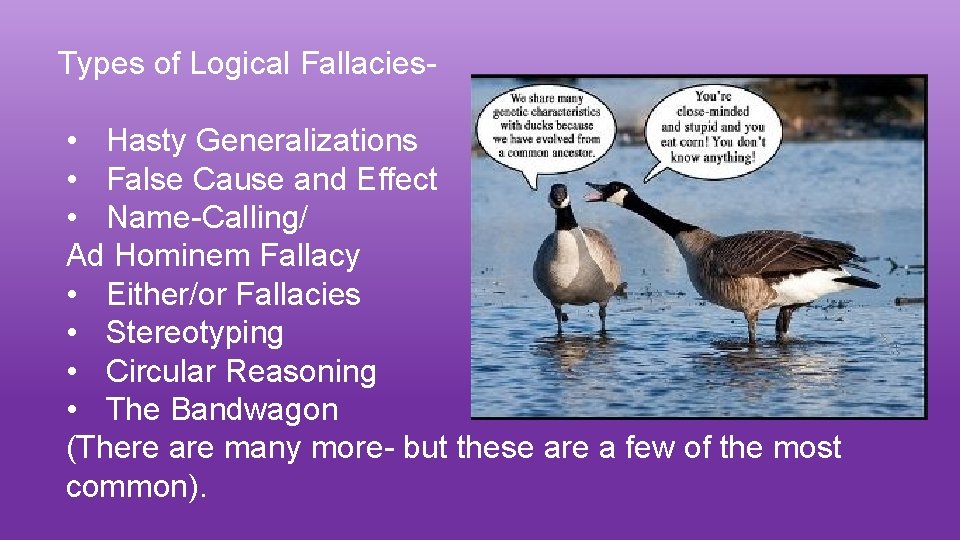
Types of Logical Fallacies- • Hasty Generalizations • False Cause and Effect • Name-Calling/ Ad Hominem Fallacy • Either/or Fallacies • Stereotyping • Circular Reasoning • The Bandwagon (There are many more- but these are a few of the most common).
Hasty Generalizations -Broad statements that apply to many individuals or situations. -These statements are too broad, do not apply in all cases, are not true, or are not based on enough evidence.
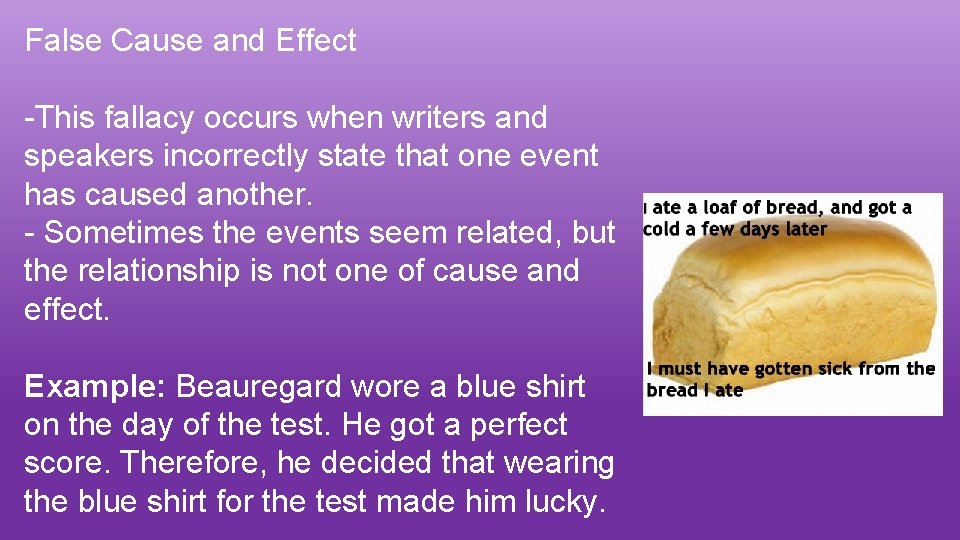
False Cause and Effect -This fallacy occurs when writers and speakers incorrectly state that one event has caused another. - Sometimes the events seem related, but the relationship is not one of cause and effect. Example: Beauregard wore a blue shirt on the day of the test. He got a perfect score. Therefore, he decided that wearing the blue shirt for the test made him lucky.
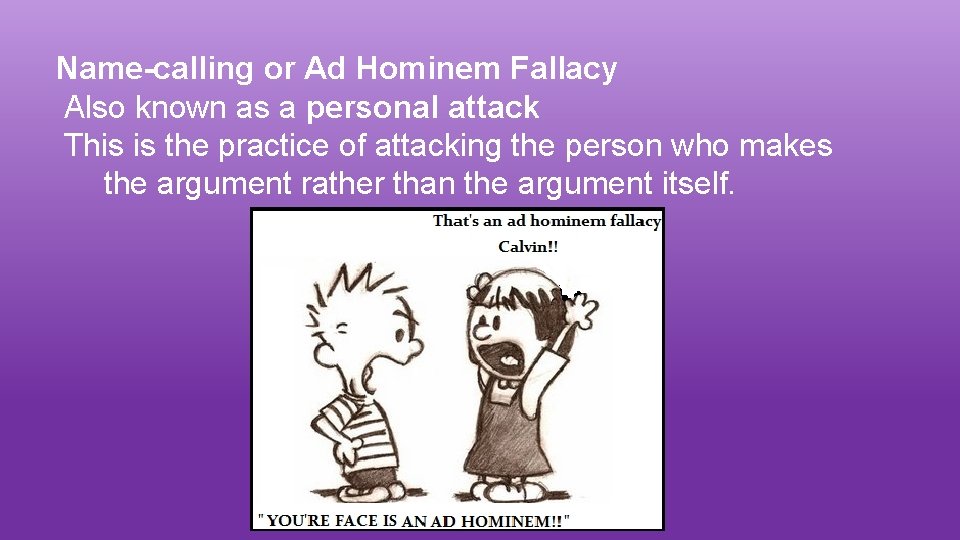
Name-calling or Ad Hominem Fallacy Also known as a personal attack This is the practice of attacking the person who makes the argument rather than the argument itself.
Either/Or Fallacies - An either/or fallacy provides only two possible choices or outcomes of a situation, even if there are many. By giving audiences only two extreme choices, writers and speakers ignore other points of view and experiences. Example: Either you come and volunteer at the soup kitchen this Saturday, or you kick puppies and hate America. Example #2: Either you wear a skimpy bathing suit to the beach, or a sweat suit. Example #3: If you don’t play sports, then you just sit around and do nothing.


Stereotyping Making generalizations about an entire group of individuals based on misinformation, misconceptions, or insufficient evidence. A good way to spot stereotyping is the use of the words all, always, none, or never. https: //www. youtube. com/watch? v=qeilx. Klu. TCU
Circular Reasoning This is restating an opinion or conclusion in different words and trying to pass it off as a reason or as evidence. Example: Jessica is the smartest girl in school because she is the most intelligent.
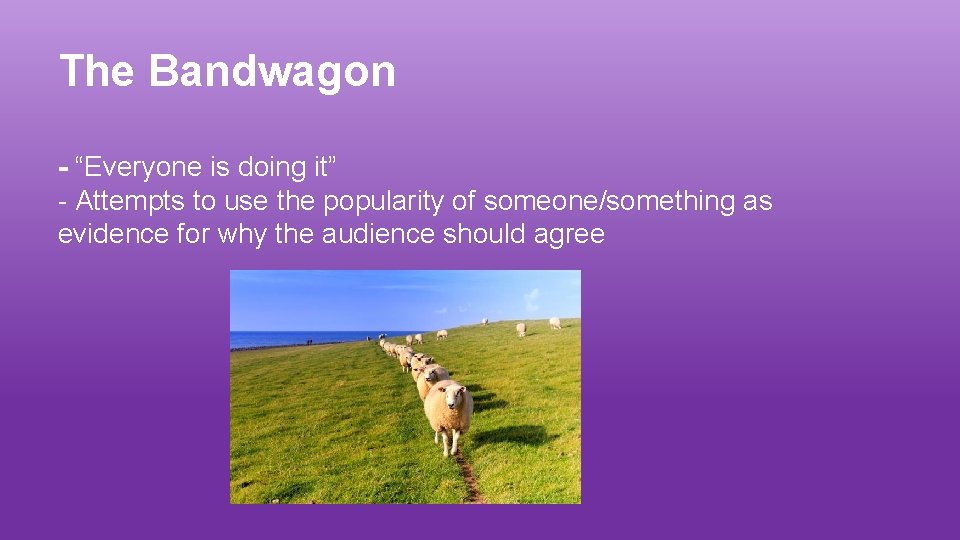
The Bandwagon - “Everyone is doing it” - Attempts to use the popularity of someone/something as evidence for why the audience should agree
Speech Tips • • Practice beforehand Use transitions Speak clearly Avoid leaning or fidgeting Avoid “fillers” Eye contact Relax!
- Slides: 34