
ARGOYBJ Measurement of the Cosmic Ray energy spectra
ARGO-YBJ Measurement of the Cosmic Ray energy spectra by the ARGO-YBJ experiment A. Surdo Istituto Nazionale di Fisica Nucleare Sezione di Lecce, Italy (on behalf of the ARGO-YBJ Collaboration)
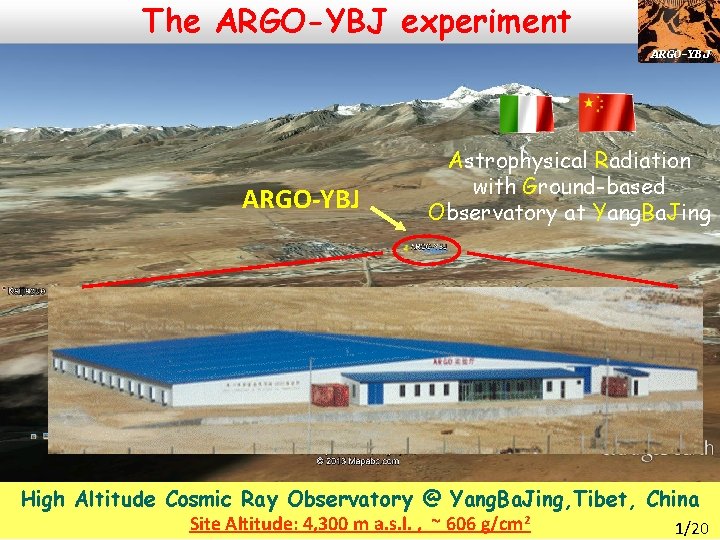
The ARGO-YBJ experiment ARGO-YBJ Astrophysical Radiation with Ground-based Observatory at Yang. Ba. Jing High Altitude Cosmic Ray Observatory @ Yang. Ba. Jing, Tibet, China Site Altitude: 4, 300 m a. s. l. , ~ 606 g/cm 2 1/20
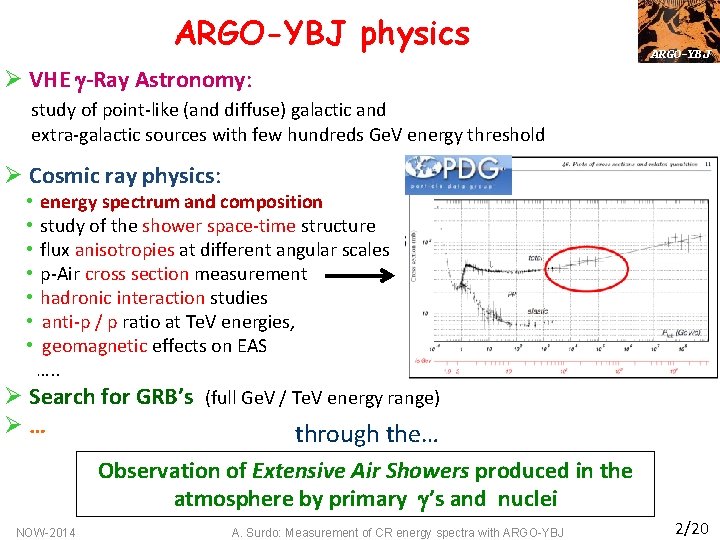
ARGO-YBJ physics ARGO-YBJ Ø VHE g-Ray Astronomy: study of point-like (and diffuse) galactic and extra-galactic sources with few hundreds Ge. V energy threshold Ø Cosmic ray physics: energy spectrum and composition study of the shower space-time structure flux anisotropies at different angular scales p-Air cross section measurement hadronic interaction studies anti-p / p ratio at Te. V energies, geomagnetic effects on EAS …. . Ø Search for GRB’s (full Ge. V / Te. V energy range) • • Ø… through the… Observation of Extensive Air Showers produced in the atmosphere by primary g’s and nuclei NOW-2014 A. Surdo: Measurement of CR energy spectra with ARGO-YBJ 2/20
ARGO-YBJ detector ARGO-YBJ RPC NOW-2014 A. Surdo: Measurement of CR energy spectra with ARGO-YBJ
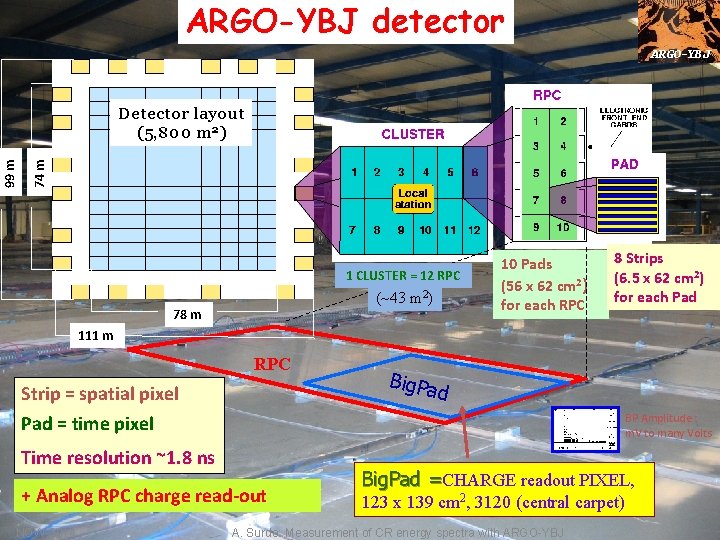
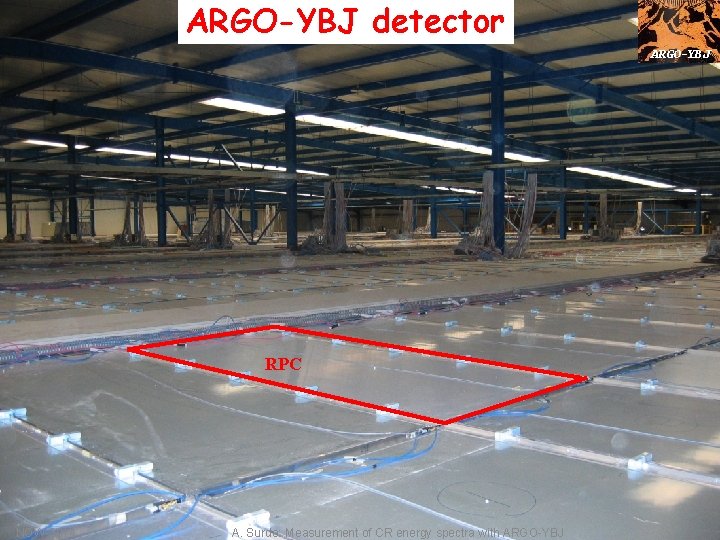
ARGO-YBJ detector ARGO-YBJ 74 m 99 m Detector layout (5, 800 m 2) 1 CLUSTER = 12 RPC ( 43 m 2) 78 m 10 Pads (56 x 62 cm 2) for each RPC 8 Strips (6. 5 x 62 cm 2) for each Pad 111 m RPC Strip = spatial pixel Big. Pa d BP Amplitude : m. V to many Volts Pad = time pixel Time resolution ~1. 8 ns + Analog RPC charge read-out NOW-2014 Big. Pad =CHARGE readout PIXEL, 123 x 139 cm 2, 3120 (central carpet) A. Surdo: Measurement of CR energy spectra with ARGO-YBJ
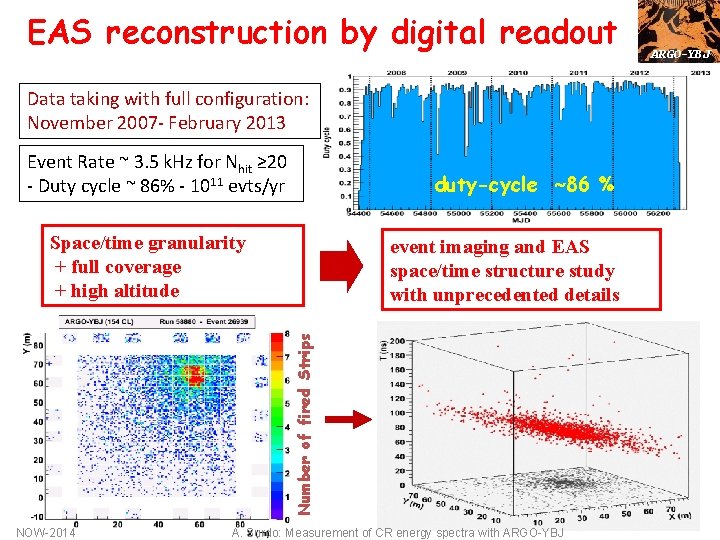
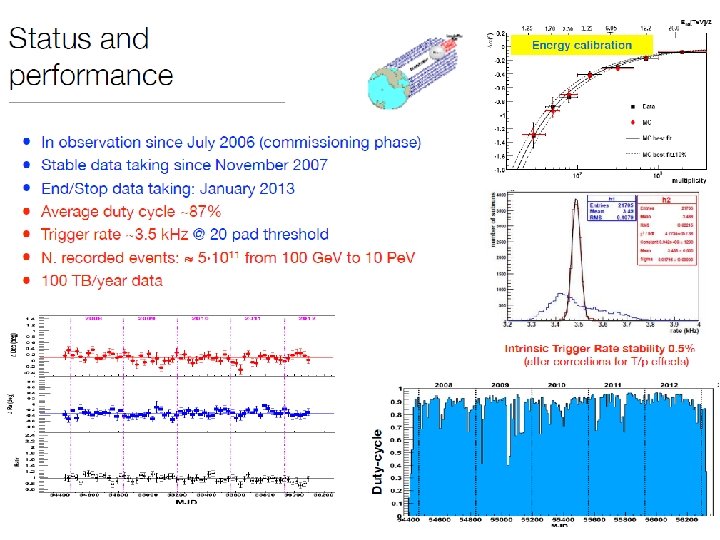
EAS reconstruction by digital readout Data taking with full configuration: November 2007 - February 2013 Event Rate ~ 3. 5 k. Hz for Nhit ≥ 20 - Duty cycle ~ 86% - 1011 evts/yr duty-cycle 86 % Space/time granularity + full coverage + high altitude Number of fired Strips event imaging and EAS space/time structure study with unprecedented details NOW-2014 A. Surdo: Measurement of CR energy spectra with ARGO-YBJ
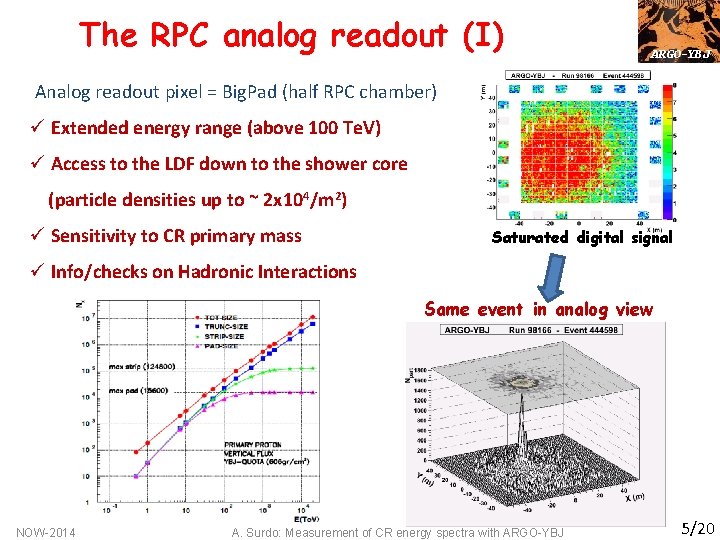
The RPC analog readout (I) ARGO-YBJ Analog readout pixel = Big. Pad (half RPC chamber) ü Extended energy range (above 100 Te. V) ü Access to the LDF down to the shower core (particle densities up to ~ 2 x 10⁴/m 2) ü Sensitivity to CR primary mass Saturated digital signal ü Info/checks on Hadronic Interactions Same event in analog view NOW-2014 A. Surdo: Measurement of CR energy spectra with ARGO-YBJ 5/20
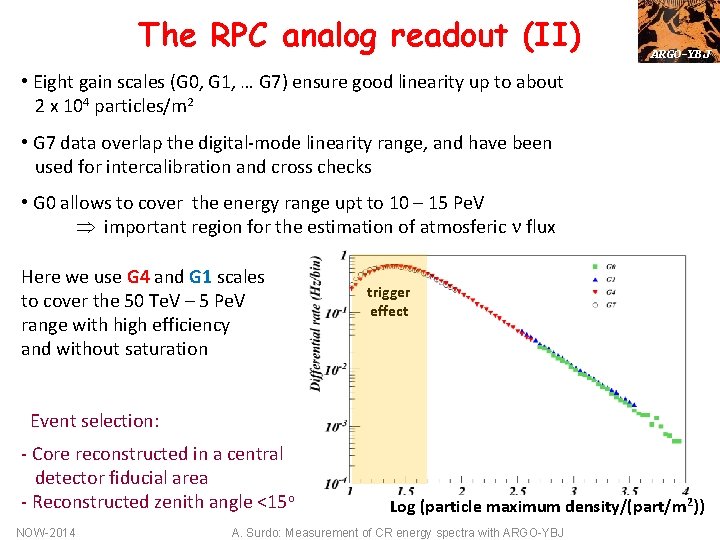
The RPC analog readout (II) ARGO-YBJ • Eight gain scales (G 0, G 1, … G 7) ensure good linearity up to about 2 x 10⁴ particles/m 2 • G 7 data overlap the digital-mode linearity range, and have been used for intercalibration and cross checks • G 0 allows to cover the energy range upt to 10 – 15 Pe. V important region for the estimation of atmosferic n flux Here we use G 4 and G 1 scales to cover the 50 Te. V – 5 Pe. V range with high efficiency and without saturation trigger effect Event selection: - Core reconstructed in a central detector fiducial area - Reconstructed zenith angle <15 o NOW-2014 Log (particle maximum density/(part/m 2)) A. Surdo: Measurement of CR energy spectra with ARGO-YBJ
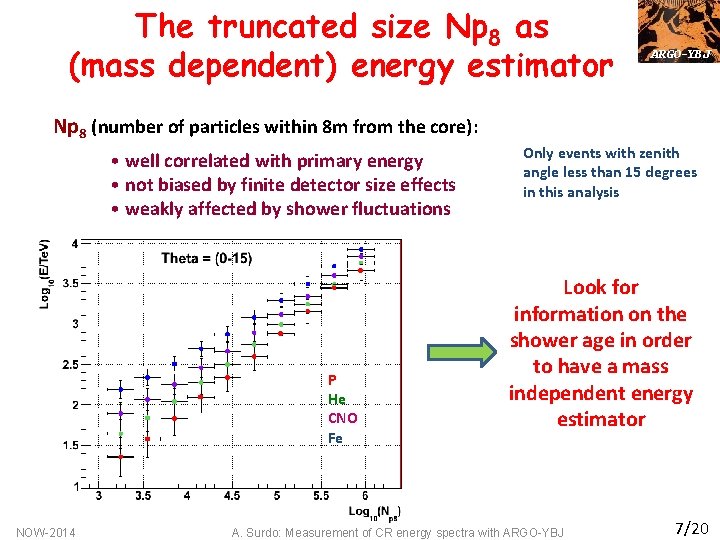
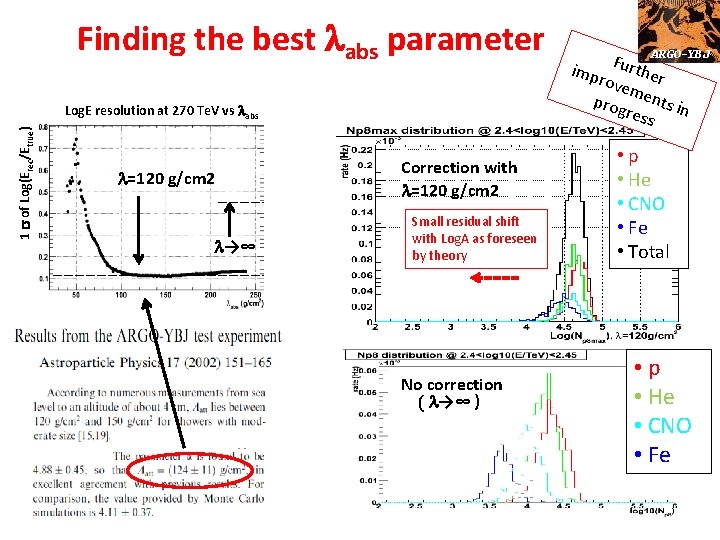
The truncated size Np 8 as (mass dependent) energy estimator ARGO-YBJ Np 8 (number of particles within 8 m from the core): • well correlated with primary energy • not biased by finite detector size effects • weakly affected by shower fluctuations P He CNO Fe NOW-2014 Only events with zenith angle less than 15 degrees in this analysis Look for information on the shower age in order to have a mass independent energy estimator A. Surdo: Measurement of CR energy spectra with ARGO-YBJ 7/20
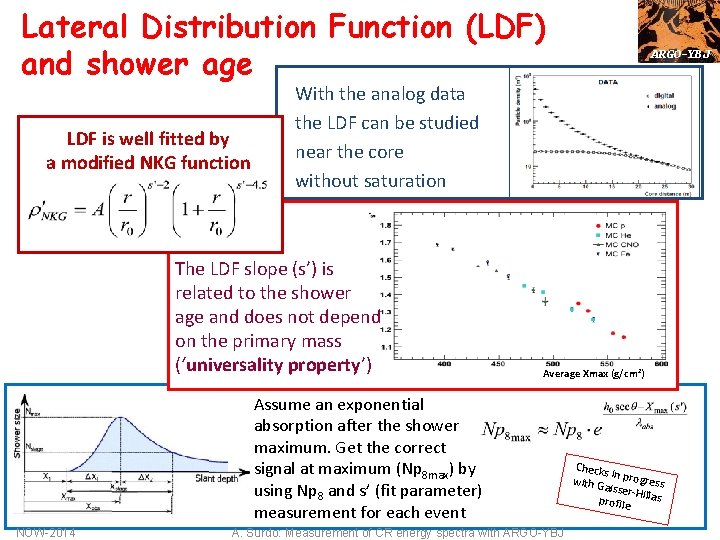
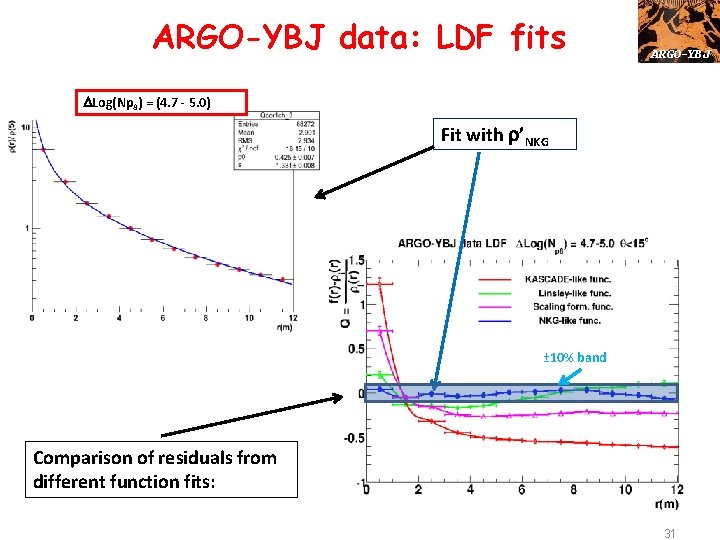
Lateral Distribution Function (LDF) and shower age LDF is well fitted by a modified NKG function With the analog data the LDF can be studied near the core without saturation The LDF slope (s’) is related to the shower age and does not depend on the primary mass (‘universality property’) Average Xmax (g/cm 2) Assume an exponential absorption after the shower maximum. Get the correct signal at maximum (Np 8 max) by using Np 8 and s’ (fit parameter) measurement for each event NOW-2014 ARGO-YBJ A. Surdo: Measurement of CR energy spectra with ARGO-YBJ Checks in prog r with G aisser- ess Hi profile llas
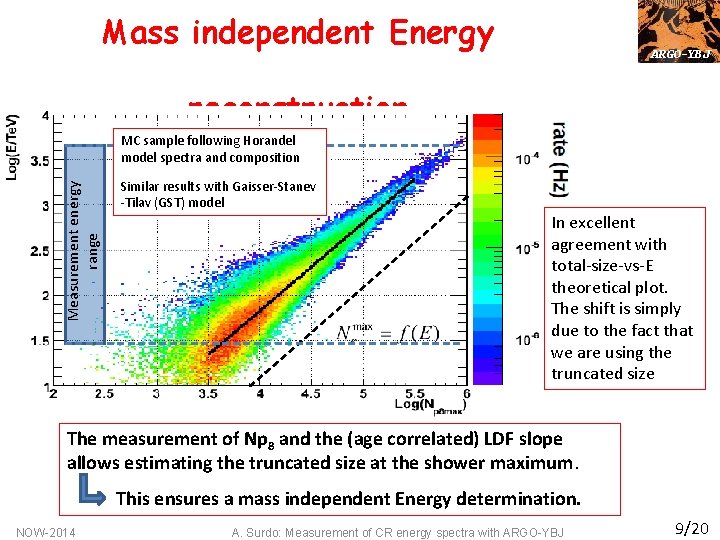
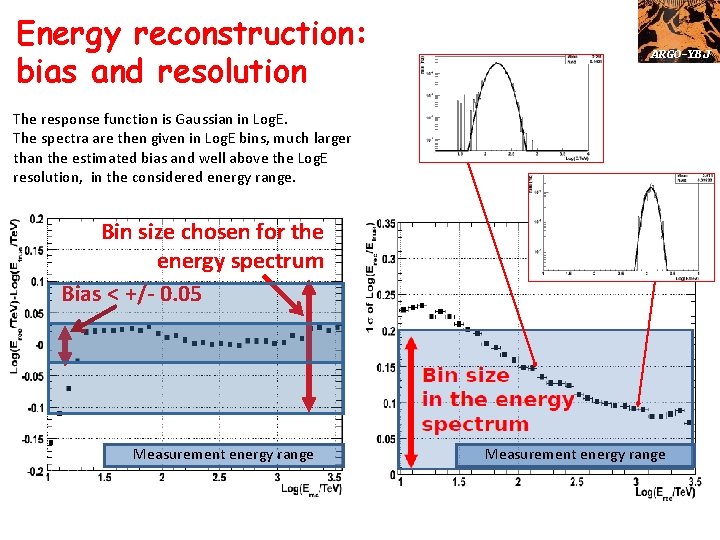
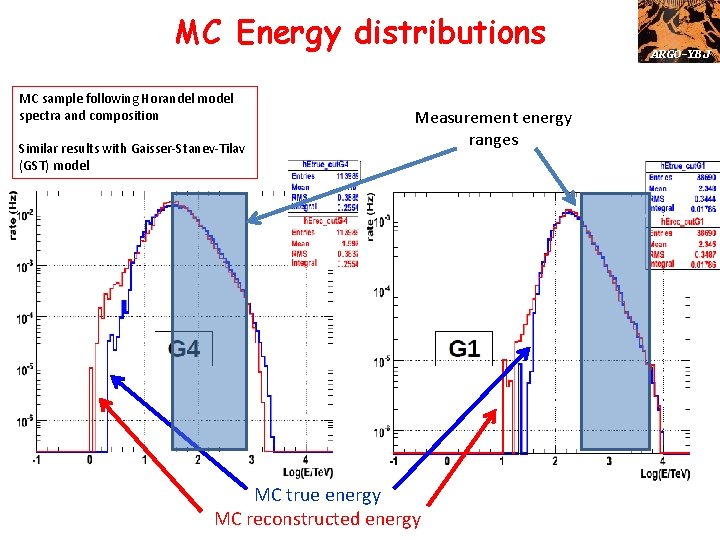
Mass independent Energy ARGO-YBJ reconstruction Measurement energy range MC sample following Horandel model spectra and composition Similar results with Gaisser-Stanev -Tilav (GST) model In excellent agreement with total-size-vs-E theoretical plot. The shift is simply due to the fact that we are using the truncated size The measurement of Np 8 and the (age correlated) LDF slope allows estimating the truncated size at the shower maximum. This ensures a mass independent Energy determination. NOW-2014 A. Surdo: Measurement of CR energy spectra with ARGO-YBJ 9/20
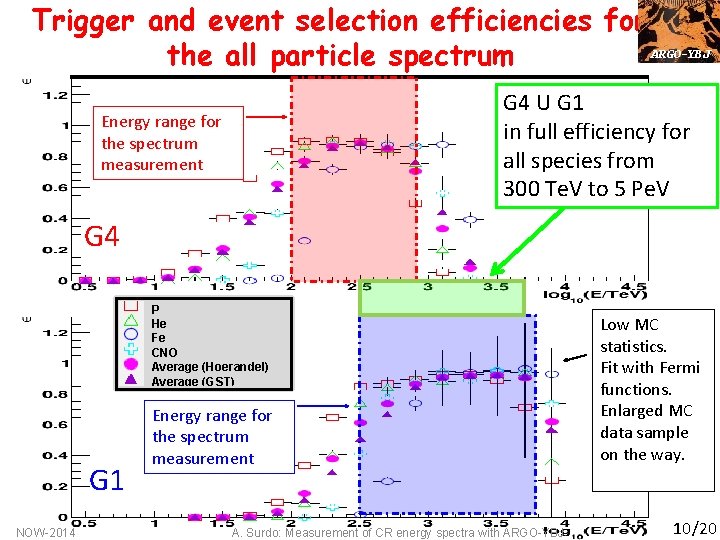
Trigger and event selection efficiencies for ARGO-YBJ the all particle spectrum G 4 U G 1 in full efficiency for all species from 300 Te. V to 5 Pe. V Energy range for the spectrum measurement G 4 P He Fe CNO Average (Hoerandel) Average (GST) G 1 NOW-2014 Energy range for the spectrum measurement A. Surdo: Measurement of CR energy spectra with ARGO-YBJ Low MC statistics. Fit with Fermi functions. Enlarged MC data sample on the way. 10/20
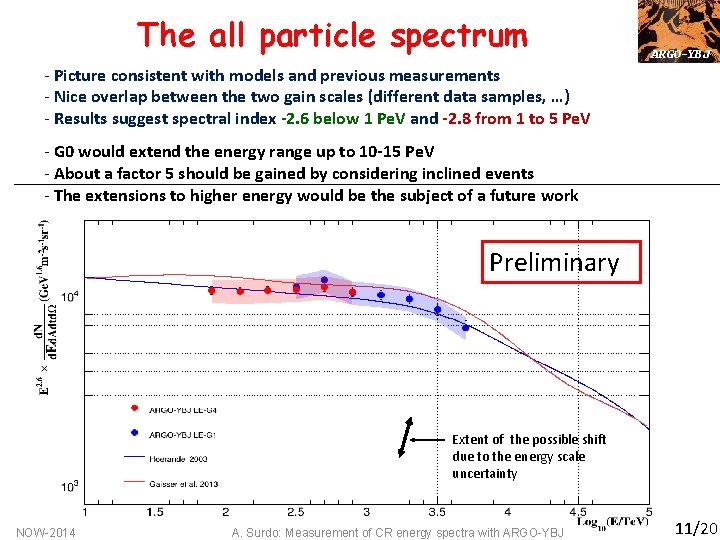
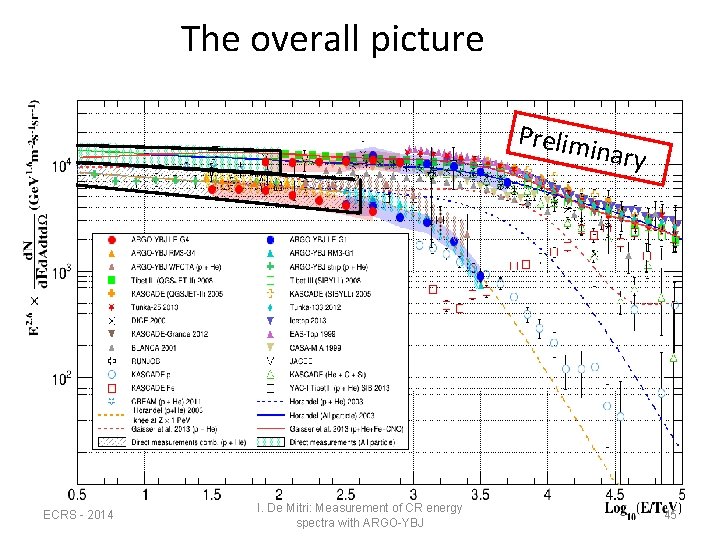
The all particle spectrum ARGO-YBJ - Picture consistent with models and previous measurements - Nice overlap between the two gain scales (different data samples, …) - Results suggest spectral index -2. 6 below 1 Pe. V and -2. 8 from 1 to 5 Pe. V - G 0 would extend the energy range up to 10 -15 Pe. V - About a factor 5 should be gained by considering inclined events - The extensions to higher energy would be the subject of a future work Preliminary Extent of the possible shift due to the energy scale uncertainty NOW-2014 A. Surdo: Measurement of CR energy spectra with ARGO-YBJ 11/20
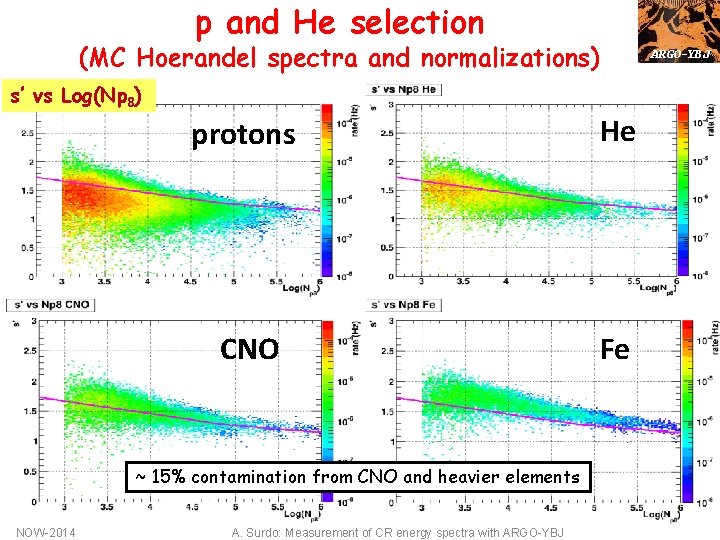
p and He selection (MC Hoerandel spectra and normalizations) s’ vs Log(Np 8) protons He CNO Fe ~ 15% contamination from CNO and heavier elements NOW-2014 A. Surdo: Measurement of CR energy spectra with ARGO-YBJ
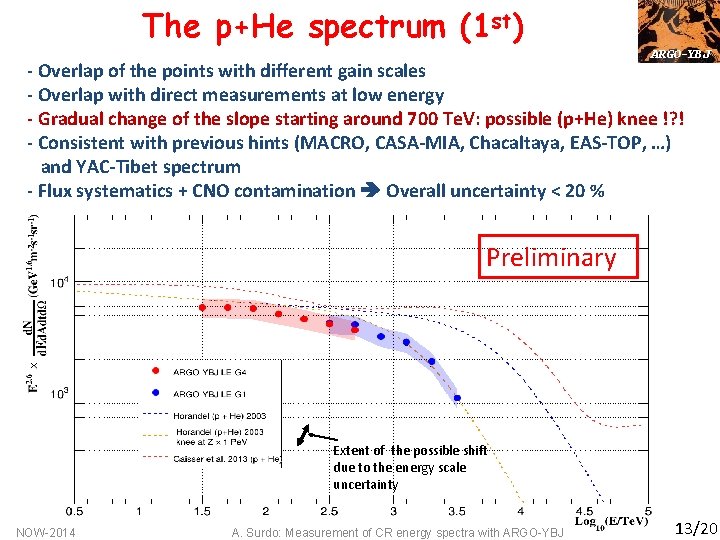
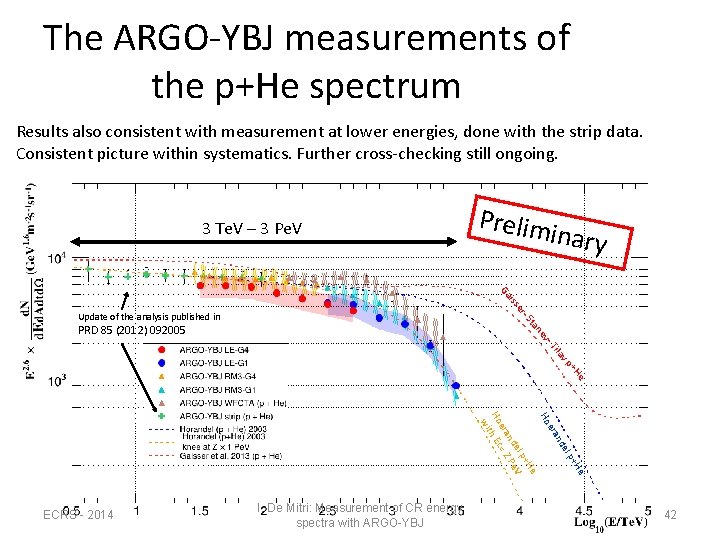
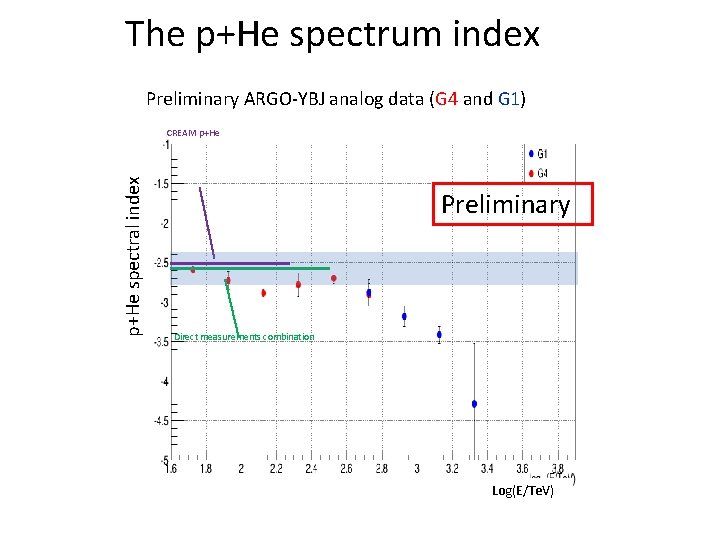
The p+He spectrum (1 st) ARGO-YBJ - Overlap of the points with different gain scales - Overlap with direct measurements at low energy - Gradual change of the slope starting around 700 Te. V: possible (p+He) knee !? ! - Consistent with previous hints (MACRO, CASA-MIA, Chacaltaya, EAS-TOP, …) and YAC-Tibet spectrum - Flux systematics + CNO contamination Overall uncertainty < 20 % Preliminary Extent of the possible shift due to the energy scale uncertainty NOW-2014 A. Surdo: Measurement of CR energy spectra with ARGO-YBJ 13/20
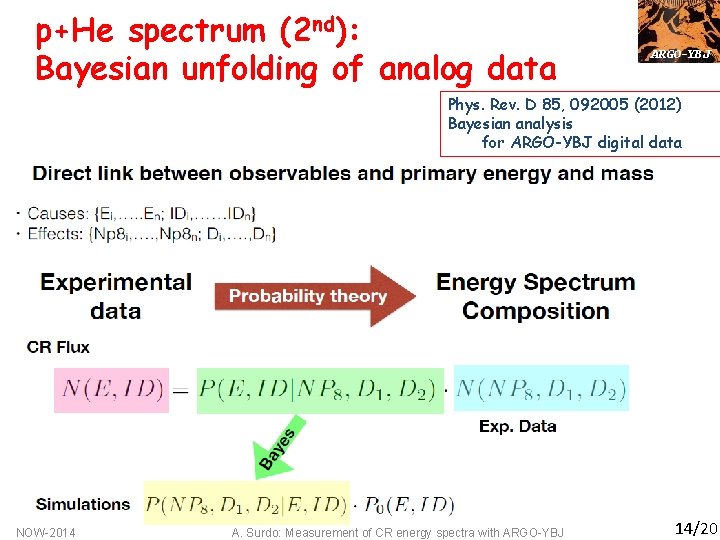
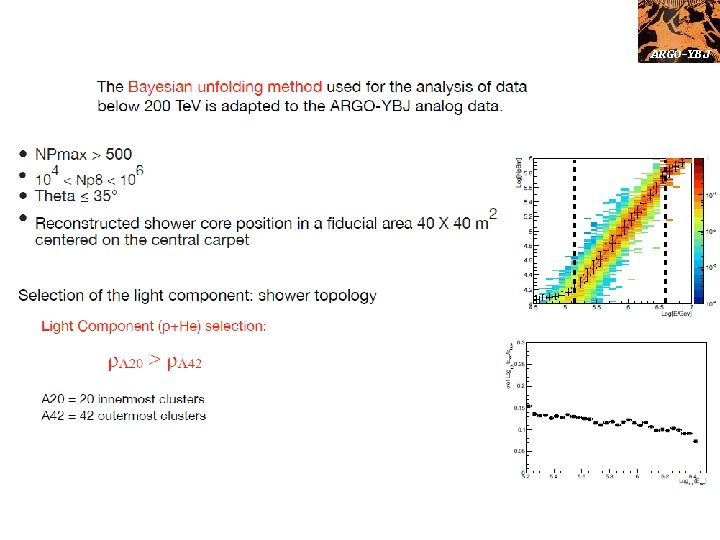
p+He spectrum (2 nd): Bayesian unfolding of analog data ARGO-YBJ Phys. Rev. D 85, 092005 (2012) Bayesian analysis for ARGO-YBJ digital data NOW-2014 A. Surdo: Measurement of CR energy spectra with ARGO-YBJ 14/20
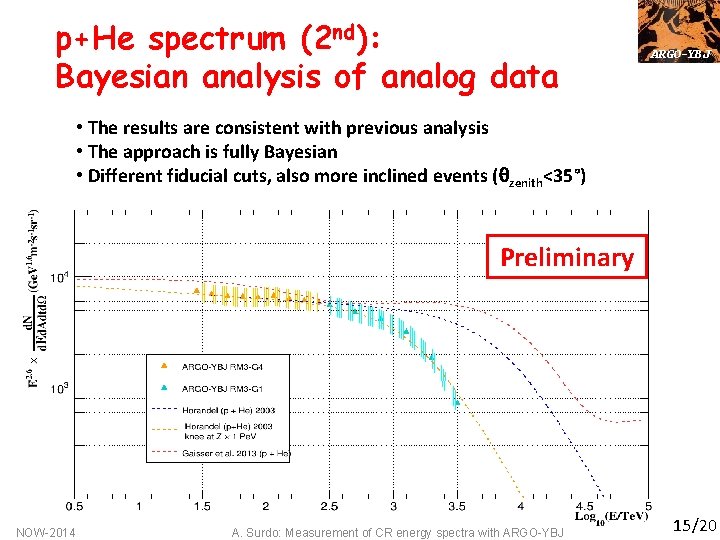
p+He spectrum (2 nd): Bayesian analysis of analog data ARGO-YBJ • The results are consistent with previous analysis • The approach is fully Bayesian • Different fiducial cuts, also more inclined events (qzenith<35°) Preliminary NOW-2014 A. Surdo: Measurement of CR energy spectra with ARGO-YBJ 15/20
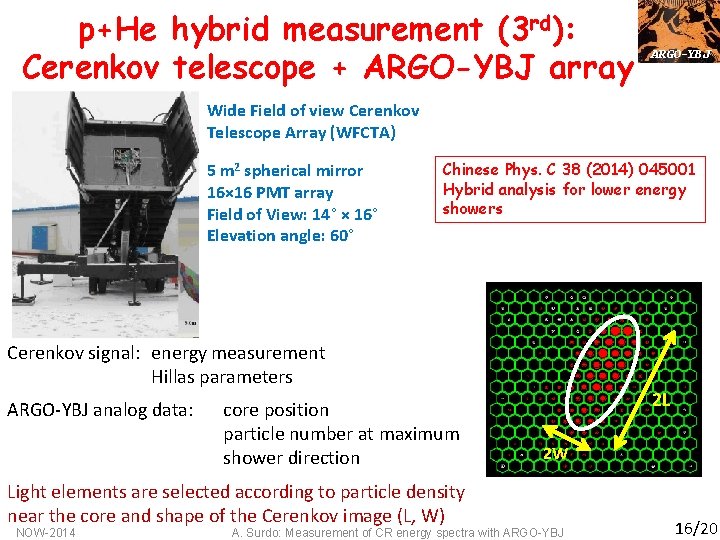
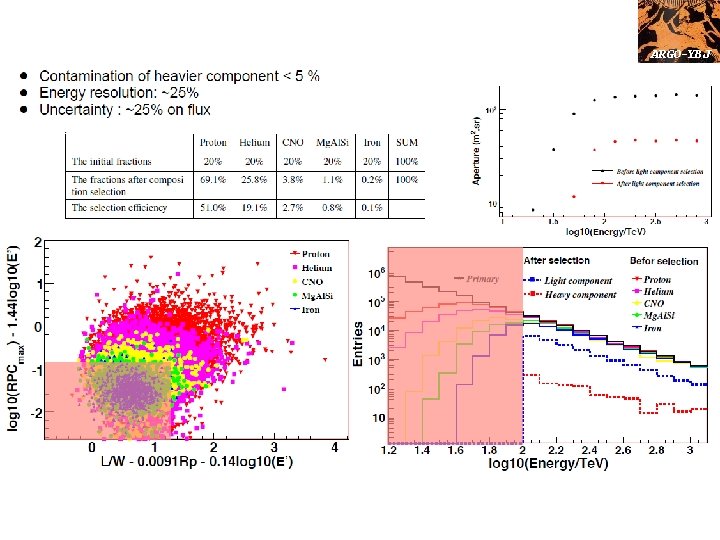
p+He hybrid measurement (3 rd): Cerenkov telescope + ARGO-YBJ array ARGO-YBJ Wide Field of view Cerenkov Telescope Array (WFCTA) 5 m 2 spherical mirror 16× 16 PMT array Field of View: 14° × 16° Elevation angle: 60° Chinese Phys. C 38 (2014) 045001 Hybrid analysis for lower energy showers Cerenkov signal: energy measurement Hillas parameters ARGO-YBJ analog data: core position particle number at maximum shower direction Light elements are selected according to particle density near the core and shape of the Cerenkov image (L, W) NOW-2014 2 L 2 W A. Surdo: Measurement of CR energy spectra with ARGO-YBJ 16/20
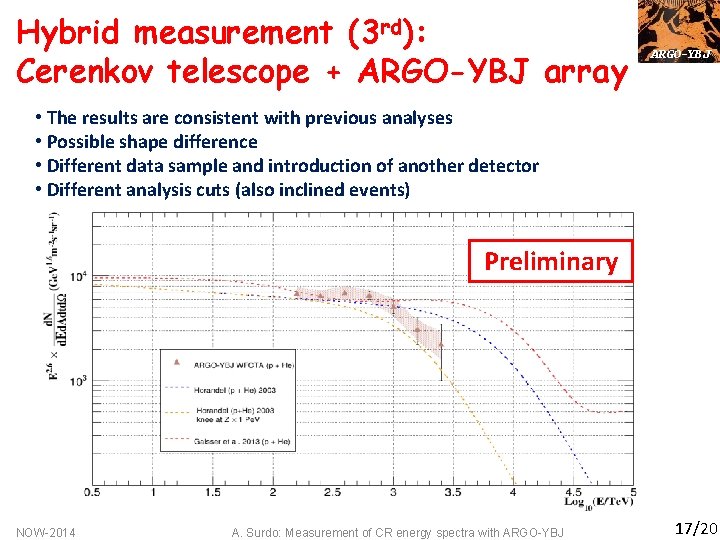
Hybrid measurement (3 rd): Cerenkov telescope + ARGO-YBJ array ARGO-YBJ • The results are consistent with previous analyses • Possible shape difference • Different data sample and introduction of another detector • Different analysis cuts (also inclined events) Preliminary NOW-2014 A. Surdo: Measurement of CR energy spectra with ARGO-YBJ 17/20
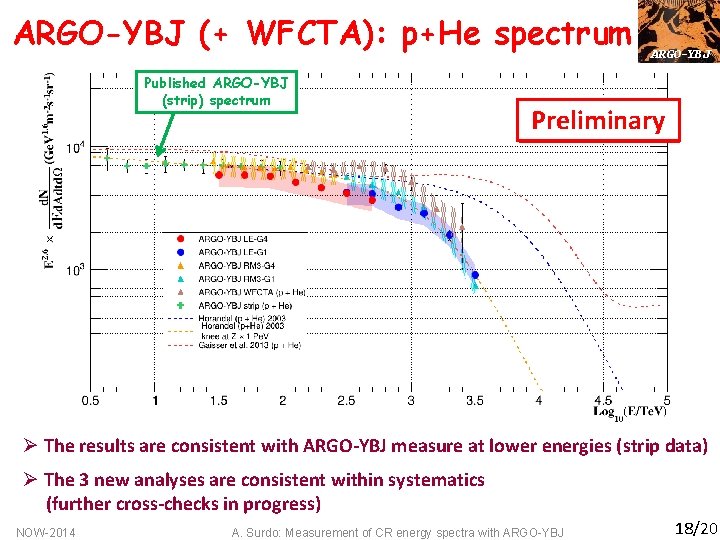
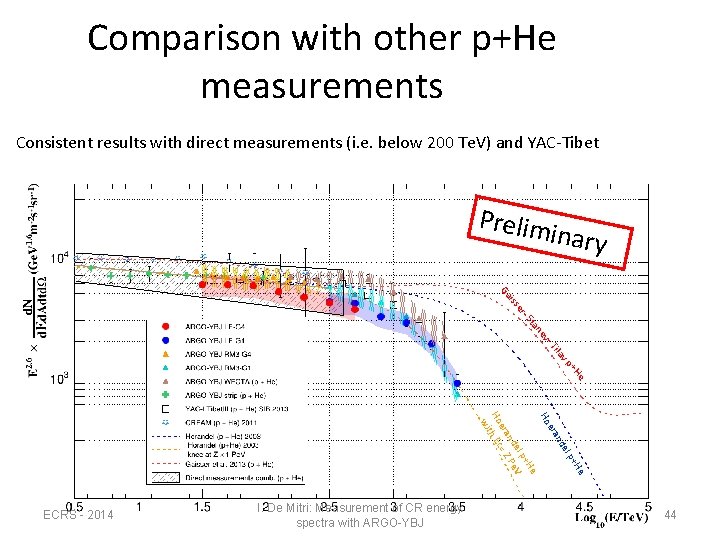
ARGO-YBJ (+ WFCTA): p+He spectrum Published ARGO-YBJ (strip) spectrum ARGO-YBJ Preliminary Ø The results are consistent with ARGO-YBJ measure at lower energies (strip data) Ø The 3 new analyses are consistent within systematics (further cross-checks in progress) NOW-2014 A. Surdo: Measurement of CR energy spectra with ARGO-YBJ 18/20
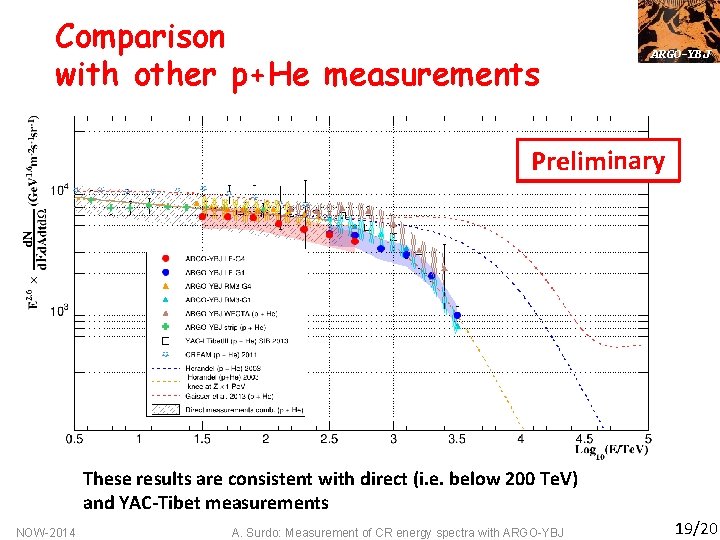
Comparison with other p+He measurements ARGO-YBJ Preliminary These results are consistent with direct (i. e. below 200 Te. V) and YAC-Tibet measurements NOW-2014 A. Surdo: Measurement of CR energy spectra with ARGO-YBJ 19/20
Summary and Outlook ARGO-YBJ q. ARGO-YBJ measured the CR spectrum in the Te. V – 5 Pe. V range. All-particle spectrum consistent with other experiments q Evidence for a bending in the p+He spectrum below 1 Pe. V (two different analyses of ARGO-YBJ data in agreement within quoted uncertainties) q Consistent results from a third independent hybrid analysis (RPC + Cerenkov signal) q Further cross checks, larger data and MC statistics for final results q Clue for an improved estimation of atmospheric n flux (spectrum of nucleons determines fluxes of atmospheric n and m) NOW-2014 A. Surdo: Measurement of CR energy spectra with ARGO-YBJ 20/20

Backup slides
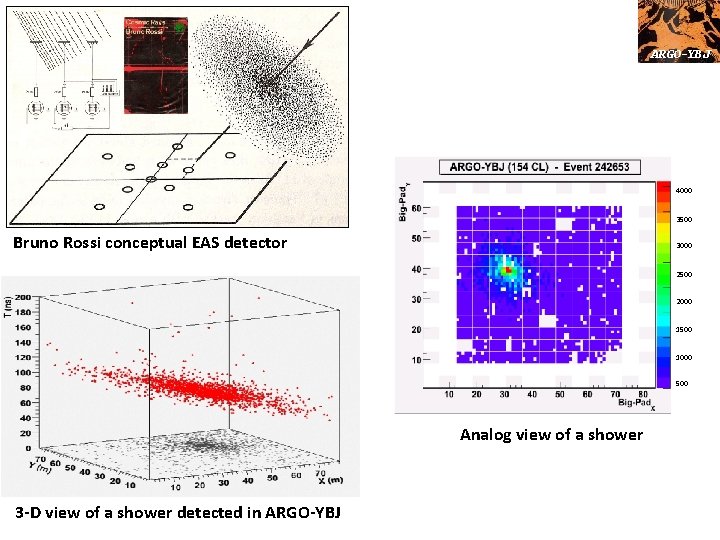
ARGO-YBJ 4000 3500 Bruno Rossi conceptual EAS detector 3000 2500 2000 1500 1000 500 Analog view of a shower 3 -D view of a shower detected in ARGO-YBJ
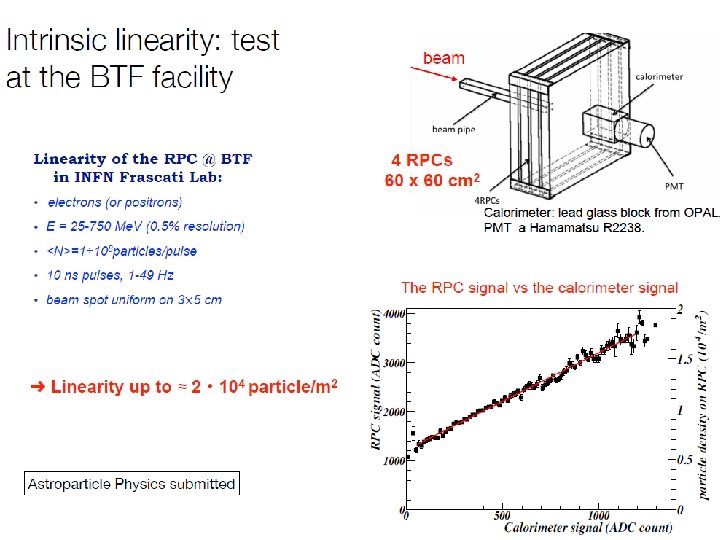
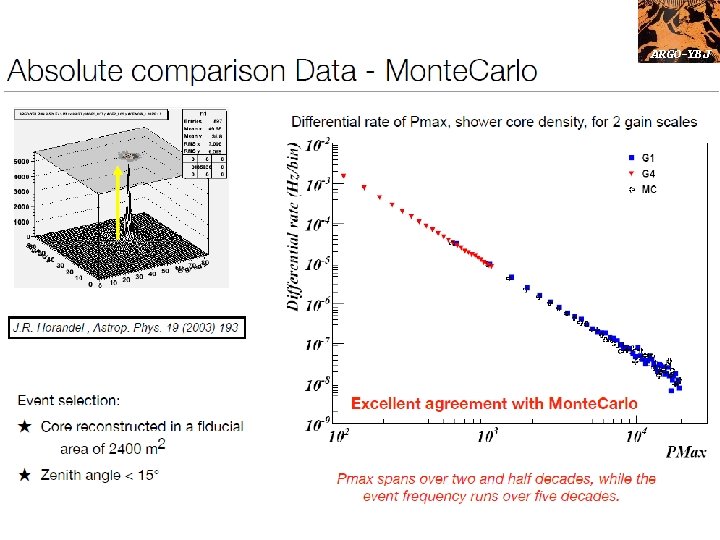
ARGO-YBJ
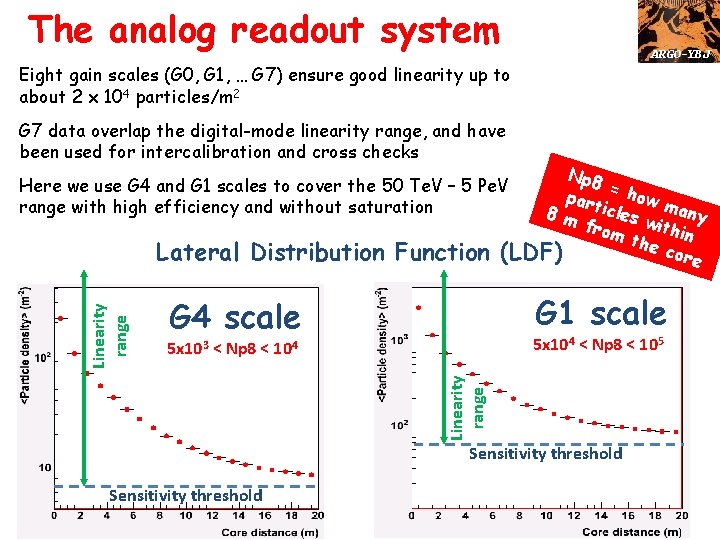
The analog readout system ARGO-YBJ Eight gain scales (G 0, G 1, … G 7) ensure good linearity up to about 2 x 10⁴ particles/m 2 G 7 data overlap the digital-mode linearity range, and have been used for intercalibration and cross checks Np 8 = part how m any 8 m icles w from ithin the core (LDF) Here we use G 4 and G 1 scales to cover the 50 Te. V – 5 Pe. V range with high efficiency and without saturation G 1 scale G 4 scale 5 x 10⁴ < Np 8 < 105 5 x 10³ < Np 8 < 104 Linearity range Lateral Distribution Function Sensitivity threshold
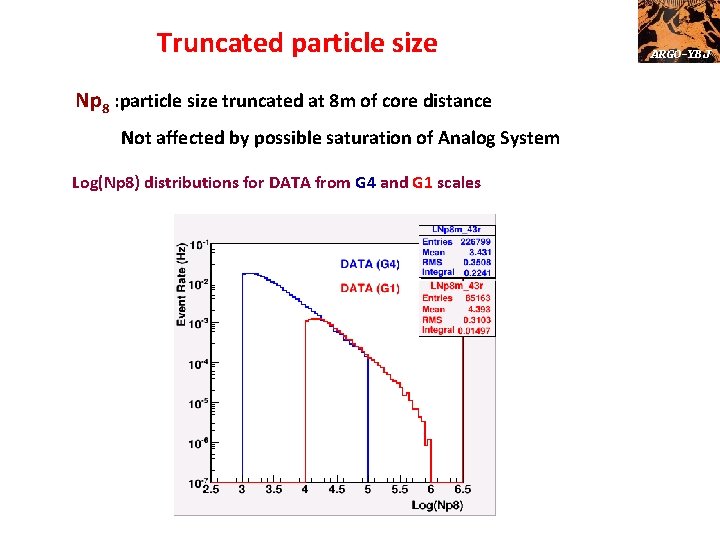
Truncated particle size Np 8 : particle size truncated at 8 m of core distance Not affected by possible saturation of Analog System Log(Np 8) distributions for DATA from G 4 and G 1 scales ARGO-YBJ
MC simulation ARGO-YBJ • Simulated air shower samples: (a) p showers (1 - 10, 000)Te. V, Theta<45° (b) He showers “ “ (c) CNO showers “ “ (d) Fe showers “ “ produced using CORSIKA code (QGSJET-II. 03 + Fluka) • Also p and He showers (1 - 3000)Te. V, Theta<45° produced using a different hadronic model: SIBYLL-2. 1 (+ Fluka) • Simulated showers (sampled on large areas) given in input to the ARGO MC (based on Geant-3) fully simulating the detector response (analog charge trigger and readout system included) • MC data reconstructed by using the same program as for real data. • Event selection: core inside a fiducial area Afid = (64 x 64) m 2 (qzen < 15° used in this analysis)
ARGO-YBJ data: LDF fits ARGO-YBJ DLog(Np 8) = (4. 7 - 5. 0) Fit with r’NKG ± 10% band Comparison of residuals from different function fits: 31
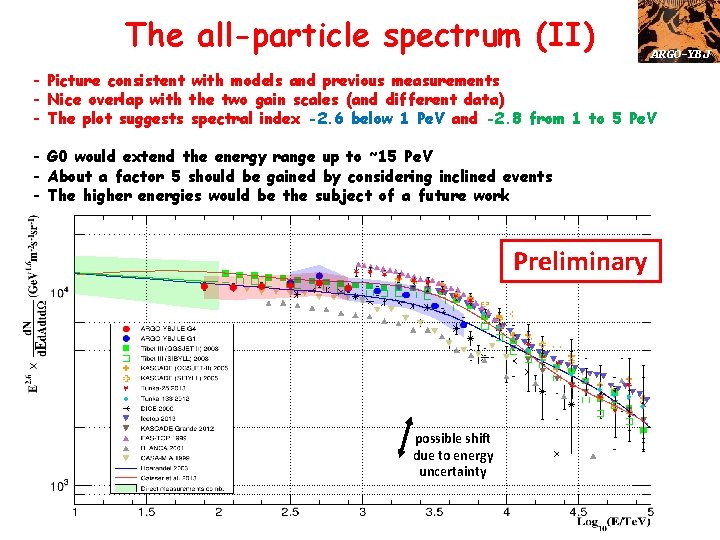
The all-particle spectrum (II) ARGO-YBJ - Picture consistent with models and previous measurements - Nice overlap with the two gain scales (and different data) - The plot suggests spectral index -2. 6 below 1 Pe. V and -2. 8 from 1 to 5 Pe. V - G 0 would extend the energy range up to ~15 Pe. V - About a factor 5 should be gained by considering inclined events - The higher energies would be the subject of a future work Preliminary possible shift due to energy uncertainty
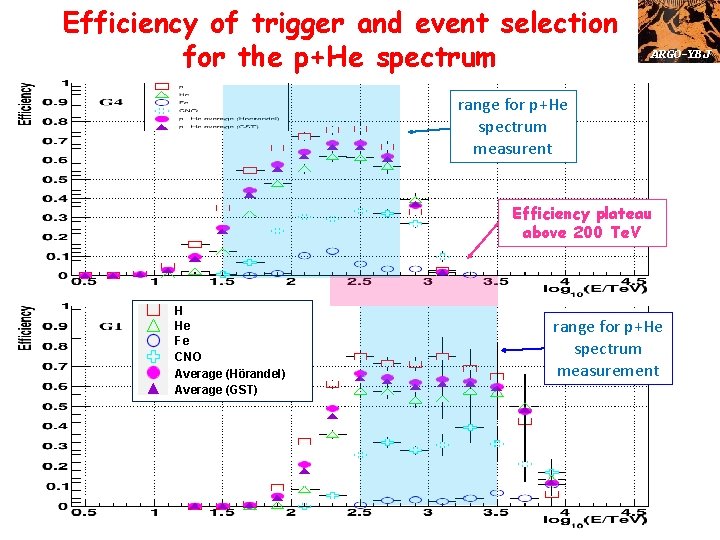
Efficiency of trigger and event selection for the p+He spectrum ARGO-YBJ range for p+He spectrum measurent Efficiency plateau above 200 Te. V H He Fe CNO Average (Hörandel) Average (GST) range for p+He spectrum measurement
Finding the best labs parameter 1 s of Log(Erec/Etrue) Log. E resolution at 270 Te. V vs labs l=120 g/cm 2 l→∞ Correction with l=120 g/cm 2 Small residual shift with Log. A as foreseen by theory No correction ( l→∞ ) ARGO-YBJ F u rt imp rove her m prog ents in ress • p • He • CNO • Fe • Total • p • He • CNO • Fe
Energy reconstruction: bias and resolution ARGO-YBJ The response function is Gaussian in Log. E. The spectra are then given in Log. E bins, much larger than the estimated bias and well above the Log. E resolution, in the considered energy range. Bin size chosen for the energy spectrum Bias < +/- 0. 05 Measurement energy range
MC Energy distributions MC sample following Horandel model spectra and composition Similar results with Gaisser-Stanev-Tilav (GST) model Measurement energy ranges MC true energy MC reconstructed energy ARGO-YBJ
Systematic uncertainty evaluations Flux ARGO-YBJ - Geometrical aperture : (5 % in/out contamination) (2. 5% angular contamination) = 5. 6 % - Efficiency: (5% from MC samples) (<10% efficiency estimation of the mixture) = 5. 0 -11. 2 % - Unfolding: 3 % - Hadronic interaction model < 5 % - TOTAL: 8. 1 % - 13. 8 % TOTAL (conservative) = 14% Energy scale - Gain of the analog system: 3. 7 % - Energy calibration: 0. 03 in Log. E = 6. 9 % - Hadronic interaction model: 5 % - TOTAL: 9. 3 % TOTAL (conservative) = 10% In the flux plots an over-conservative ± 14% shaded area has been temporarily drawn on the flux measurements Error bars show the statistical uncertainties
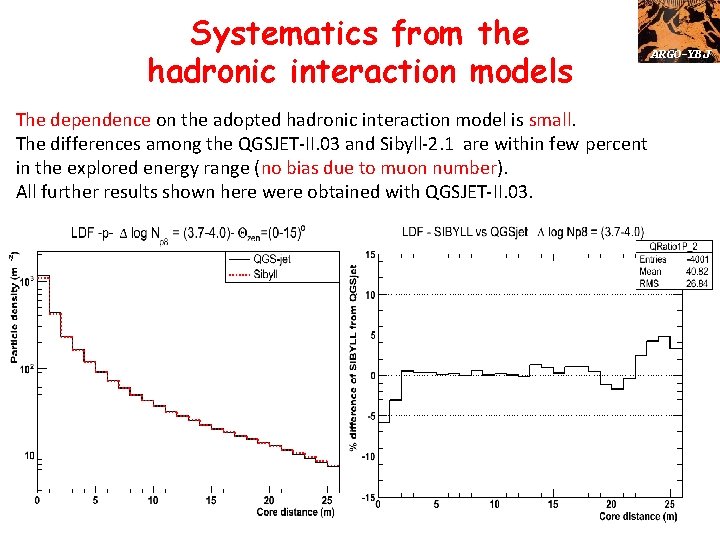
Systematics from the hadronic interaction models The dependence on the adopted hadronic interaction model is small. The differences among the QGSJET-II. 03 and Sibyll-2. 1 are within few percent in the explored energy range (no bias due to muon number). All further results shown here were obtained with QGSJET-II. 03. ARGO-YBJ
ARGO-YBJ
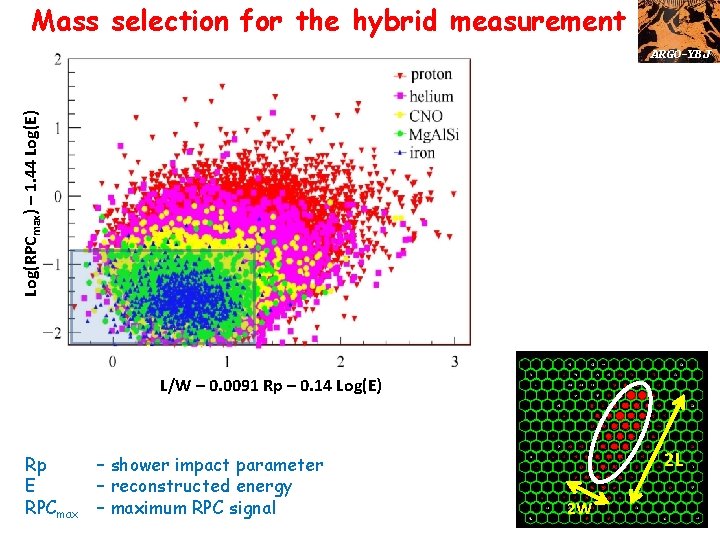
Mass selection for the hybrid measurement Log(RPCmax) – 1. 44 Log(E) ARGO-YBJ L/W – 0. 0091 Rp – 0. 14 Log(E) Rp E RPCmax – shower impact parameter – reconstructed energy – maximum RPC signal 2 L 2 W
ARGO-YBJ
The ARGO-YBJ measurements of the p+He spectrum Results also consistent with measurement at lower energies, done with the strip data. Consistent picture within systematics. Further cross-checking still ongoing. 3 Te. V – 3 Pe. V Prelim inary iss Ga er a St Update of the analysis published in v- ne PRD 85 (2012) 092005 av Til He p+ el nd era Ho He p+ V el nd Pe era = Z Ho th Ec wi ECRS - 2014 I. De Mitri: Measurement of CR energy spectra with ARGO-YBJ 42
The p+He spectrum index Preliminary ARGO-YBJ analog data (G 4 and G 1) p+He spectral index CREAM p+He Preliminary Direct measurements combination Log(E/Te. V)
Comparison with other p+He measurements Consistent results with direct measurements (i. e. below 200 Te. V) and YAC-Tibet Prelim inary iss Ga er v- ne a St av Til He p+ el nd era Ho He p+ V el nd Pe era = Z Ho th Ec wi ECRS - 2014 I. De Mitri: Measurement of CR energy spectra with ARGO-YBJ 44
The overall picture Prelim inary ECRS - 2014 I. De Mitri: Measurement of CR energy spectra with ARGO-YBJ 45
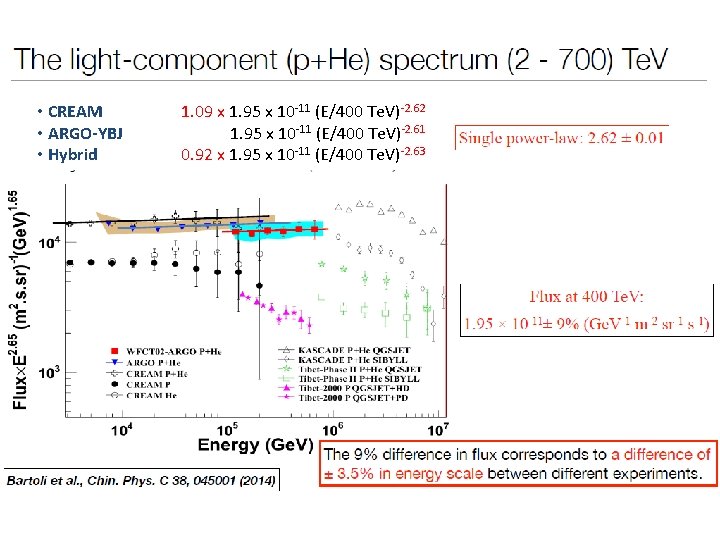
• CREAM • ARGO-YBJ • Hybrid 1. 09 x 1. 95 x 10 -11 (E/400 Te. V)-2. 62 1. 95 x 10 -11 (E/400 Te. V)-2. 61 0. 92 x 1. 95 x 10 -11 (E/400 Te. V)-2. 63
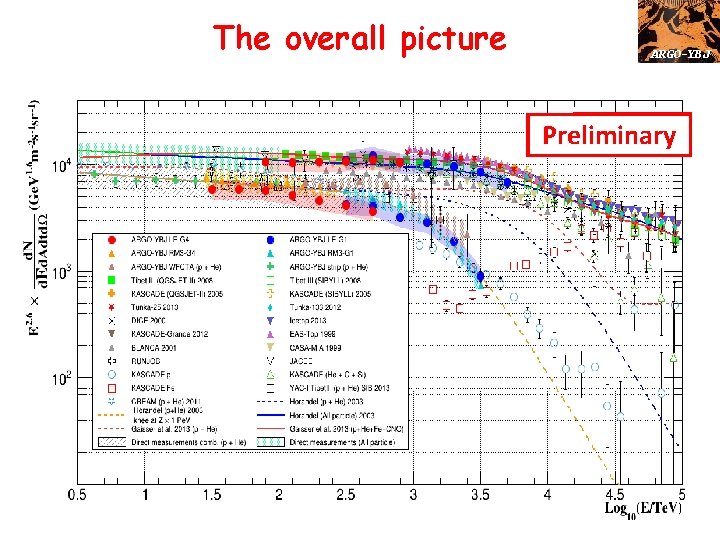
The overall picture ARGO-YBJ Preliminary
- Slides: 47