
ARGONNE QUANTUM COMPUTING TUTORIAL INTRODUCTION TO QUANTUM NETWORKING
![WHAT IS ‘z’? § Michele Mosca [Oxford, 1996]: “ 20 qubits in 20 years”](https://slidetodoc.com/presentation_image_h2/6fccd582b0e3266ebf07a642992b9e64/image-7.jpg "WHAT IS ‘z’? § Michele Mosca [Oxford, 1996]: “ 20 qubits in 20 years”")

- Slides: 33
ARGONNE QUANTUM COMPUTING TUTORIAL INTRODUCTION TO QUANTUM NETWORKING erhtjhtyhy MARTIN SUCHARA Argonne National Laboratory msuchara@anl. gov December 11, 2018 Lemont, IL
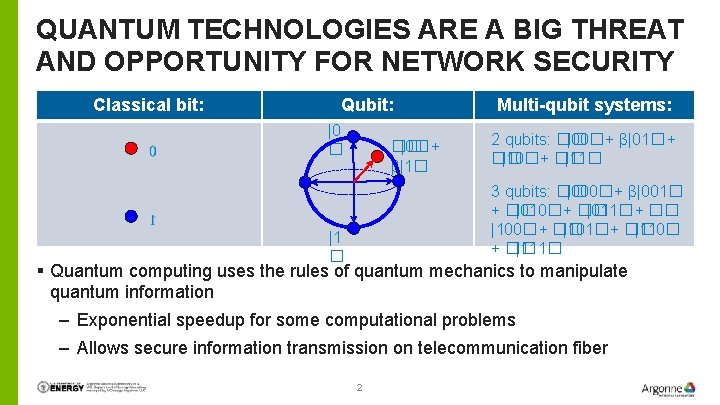
QUANTUM TECHNOLOGIES ARE A BIG THREAT AND OPPORTUNITY FOR NETWORK SECURITY Classical bit: Qubit: |0 � �� |0�+ β|1� Multi-qubit systems: 2 qubits: �� |00�+ β|01�+ �� |10�+ �� |11� 3 qubits: �� |000�+ β|001� + �� |010�+ �� |011�+ �� |100�+ �� |101�+ �� |110� + �� |111� |1 � § Quantum computing uses the rules of quantum mechanics to manipulate quantum information – Exponential speedup for some computational problems – Allows secure information transmission on telecommunication fiber 2
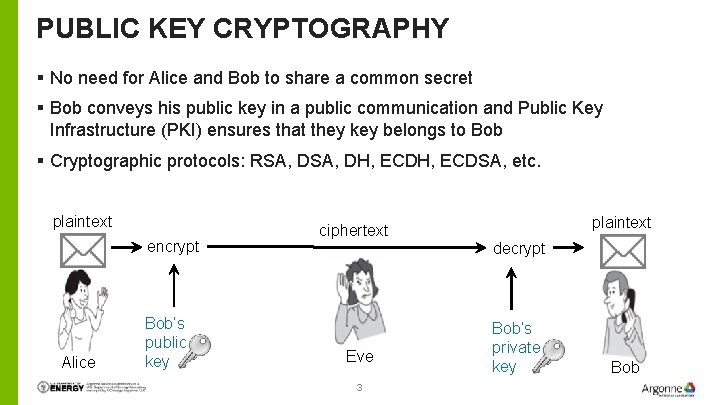
PUBLIC KEY CRYPTOGRAPHY § No need for Alice and Bob to share a common secret § Bob conveys his public key in a public communication and Public Key Infrastructure (PKI) ensures that they key belongs to Bob § Cryptographic protocols: RSA, DH, ECDSA, etc. plaintext encrypt Alice Bob’s public key plaintext ciphertext decrypt 3 Eve 3 Bob’s private key Bob
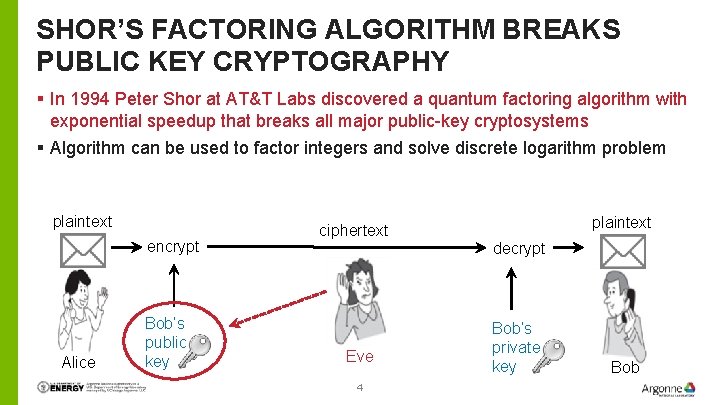
SHOR’S FACTORING ALGORITHM BREAKS PUBLIC KEY CRYPTOGRAPHY § In 1994 Peter Shor at AT&T Labs discovered a quantum factoring algorithm with exponential speedup that breaks all major public-key cryptosystems § Algorithm can be used to factor integers and solve discrete logarithm problem plaintext encrypt Alice Bob’s public key plaintext ciphertext decrypt 4 Eve 4 Bob’s private key Bob
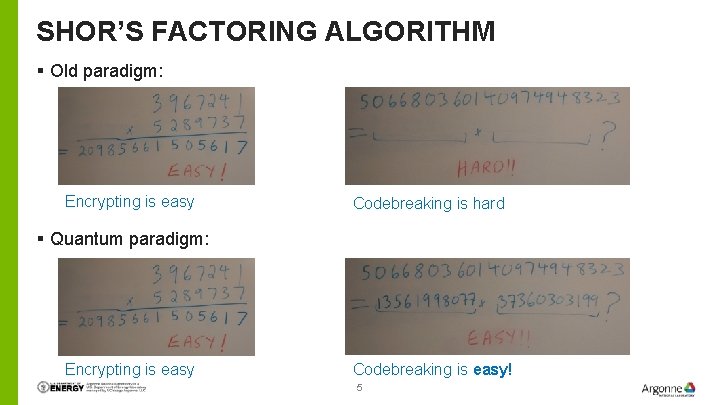
SHOR’S FACTORING ALGORITHM § Old paradigm: Encrypting is easy Codebreaking is hard § Quantum paradigm: Encrypting is easy Codebreaking is easy! 5
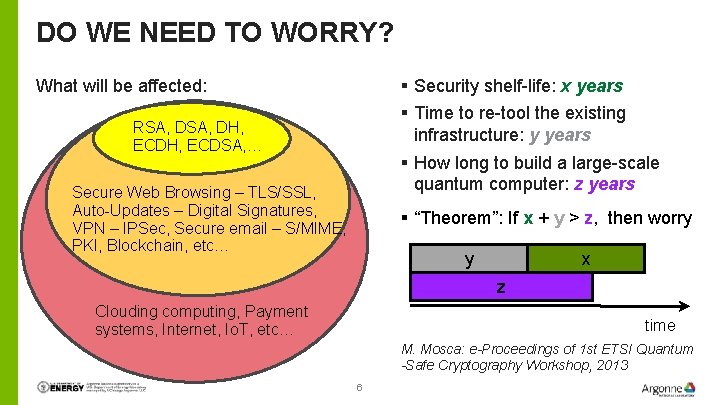
DO WE NEED TO WORRY? § Security shelf-life: x years § Time to re-tool the existing infrastructure: y years § How long to build a large-scale quantum computer: z years What will be affected: RSA, DH, ECDSA, … Secure Web Browsing – TLS/SSL, Auto-Updates – Digital Signatures, VPN – IPSec, Secure email – S/MIME, PKI, Blockchain, etc… § “Theorem”: If x + y > z, then worry y x z Clouding computing, Payment systems, Internet, Io. T, etc… time M. Mosca: e-Proceedings of 1 st ETSI Quantum -Safe Cryptography Workshop, 2013 6
WHAT IS ‘z’? § Michele Mosca [Oxford, 1996]: “ 20 qubits in 20 years” § Microsoft Research [October 2015]: ”Recent improvements in control of quantum systems make it seem feasible to finally build a quantum computer within a decade” § Michele Mosca ([NIST, April 2015], [ISACA, September 2015]): “ 1/7 chance of breaking RSA-2048 by 2026, ½ chance by 2031” § Michele Mosca [London, September 2017]: “ 1/6 chance within 10 years” § Simon Benjamin [London, September 2017]: Speculates that if someone is willing to “go Manhattan project” then “maybe 6 -12 years” 7
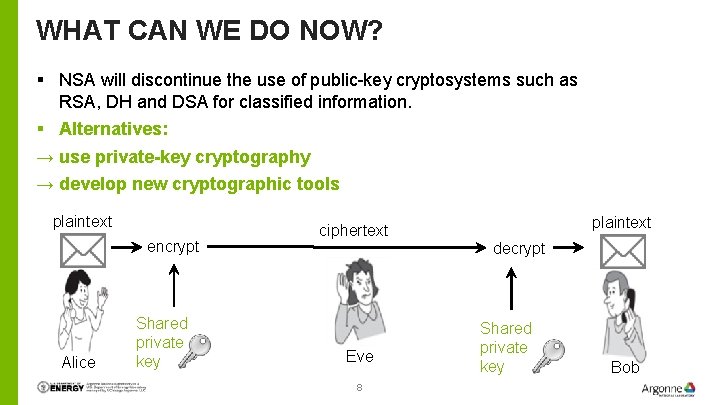
WHAT CAN WE DO NOW? § NSA will discontinue the use of public-key cryptosystems such as RSA, DH and DSA for classified information. § Alternatives: → use private-key cryptography → develop new cryptographic tools plaintext encrypt Alice Shared private key plaintext ciphertext decrypt 8 Eve 8 Shared private key Bob
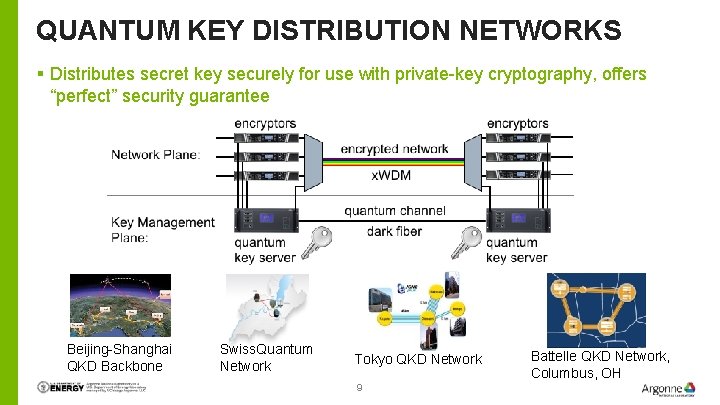
QUANTUM KEY DISTRIBUTION NETWORKS § Distributes secret key securely for use with private-key cryptography, offers “perfect” security guarantee Beijing-Shanghai QKD Backbone Swiss. Quantum Network Tokyo QKD Network 9 Battelle QKD Network, Columbus, OH
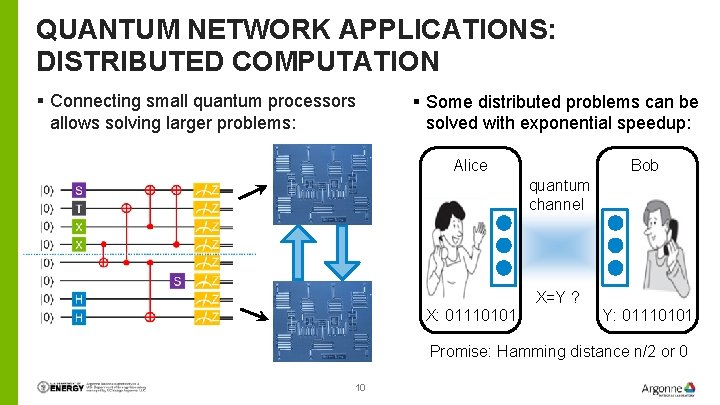
QUANTUM NETWORK APPLICATIONS: DISTRIBUTED COMPUTATION § Connecting small quantum processors allows solving larger problems: § Some distributed problems can be solved with exponential speedup: Alice Bob quantum channel X: 01110101 X=Y ? Y: 01110101 Promise: Hamming distance n/2 or 0 10
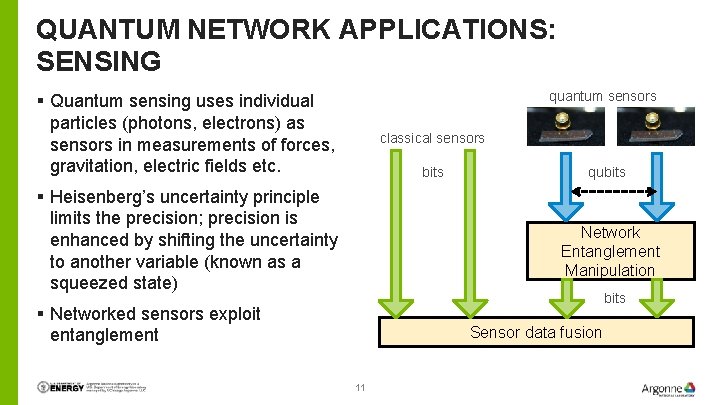
QUANTUM NETWORK APPLICATIONS: SENSING quantum sensors § Quantum sensing uses individual particles (photons, electrons) as sensors in measurements of forces, gravitation, electric fields etc. classical sensors bits § Heisenberg’s uncertainty principle limits the precision; precision is enhanced by shifting the uncertainty to another variable (known as a squeezed state) qubits Network Entanglement Manipulation bits § Networked sensors exploit entanglement Sensor data fusion 11
QUANTUM KEY DISTRIBUTION NETWORKS
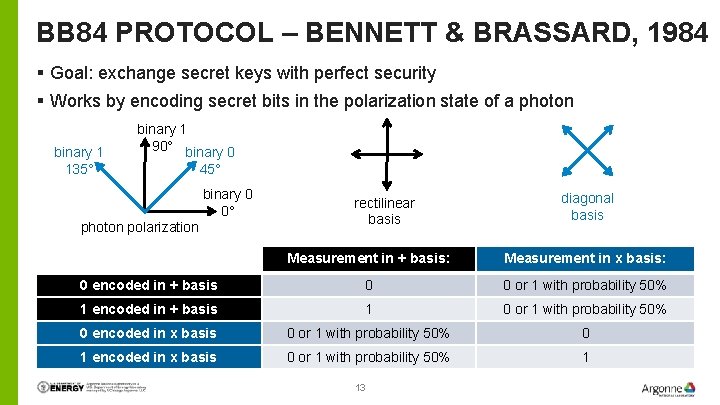
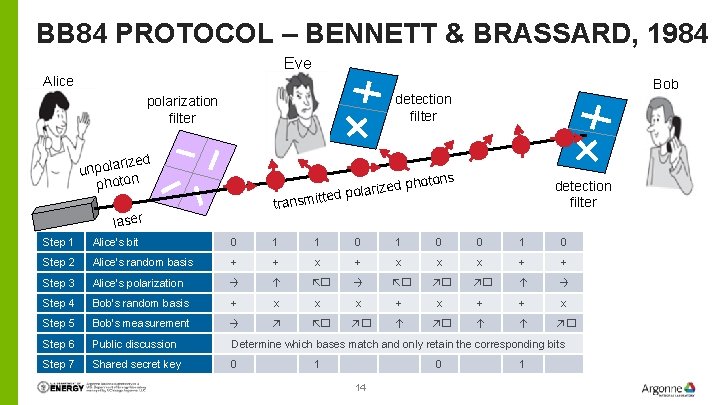
BB 84 PROTOCOL – BENNETT & BRASSARD, 1984 § Goal: exchange secret keys with perfect security § Works by encoding secret bits in the polarization state of a photon binary 1 135° binary 1 90° binary 0 45° binary 0 0° photon polarization rectilinear basis diagonal basis Measurement in + basis: Measurement in x basis: 0 encoded in + basis 0 0 or 1 with probability 50% 1 encoded in + basis 1 0 or 1 with probability 50% 0 encoded in x basis 0 or 1 with probability 50% 0 1 encoded in x basis 0 or 1 with probability 50% 1 13
BB 84 PROTOCOL – BENNETT & BRASSARD, 1984 Eve Alice Bob detection filter polarization filter rized unpola photons rized p itted pola detection filter transm laser Step 1 Alice’s bit 0 1 1 0 0 1 0 Step 2 Alice’s random basis + + x x x + + Step 3 Alice’s polarization → ↑ ↖� → ↖� ↗� ↗� ↑ → Step 4 Bob’s random basis + x x x + + x Step 5 Bob’s measurement → ↗ ↖� ↗� ↑ ↑ ↗� Step 6 Public discussion Determine which bases match and only retain the corresponding bits Step 7 Shared secret key 0 14 1
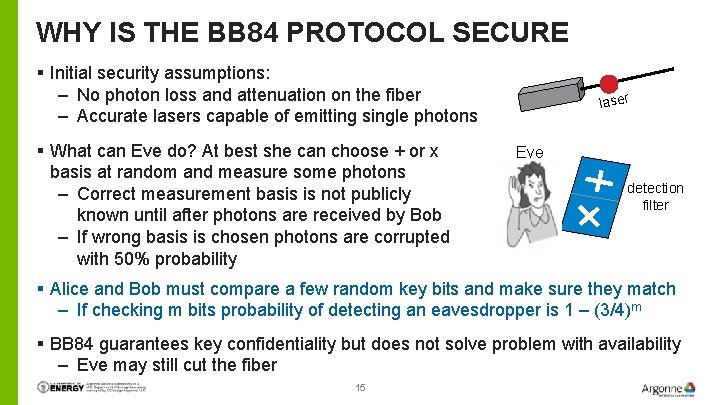
WHY IS THE BB 84 PROTOCOL SECURE § Initial security assumptions: – No photon loss and attenuation on the fiber – Accurate lasers capable of emitting single photons § What can Eve do? At best she can choose + or x basis at random and measure some photons – Correct measurement basis is not publicly known until after photons are received by Bob – If wrong basis is chosen photons are corrupted with 50% probability laser Eve detection filter § Alice and Bob must compare a few random key bits and make sure they match – If checking m bits probability of detecting an eavesdropper is 1 – (3/4)m § BB 84 guarantees key confidentiality but does not solve problem with availability – Eve may still cut the fiber 15
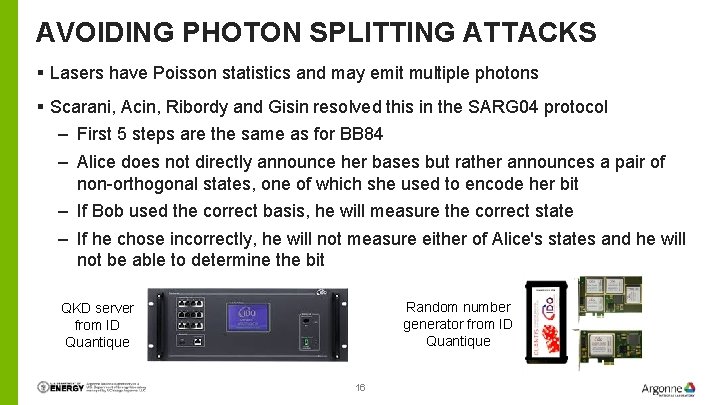
AVOIDING PHOTON SPLITTING ATTACKS § Lasers have Poisson statistics and may emit multiple photons § Scarani, Acin, Ribordy and Gisin resolved this in the SARG 04 protocol – First 5 steps are the same as for BB 84 – Alice does not directly announce her bases but rather announces a pair of non-orthogonal states, one of which she used to encode her bit – If Bob used the correct basis, he will measure the correct state – If he chose incorrectly, he will not measure either of Alice's states and he will not be able to determine the bit Random number generator from ID Quantique QKD server from ID Quantique 16
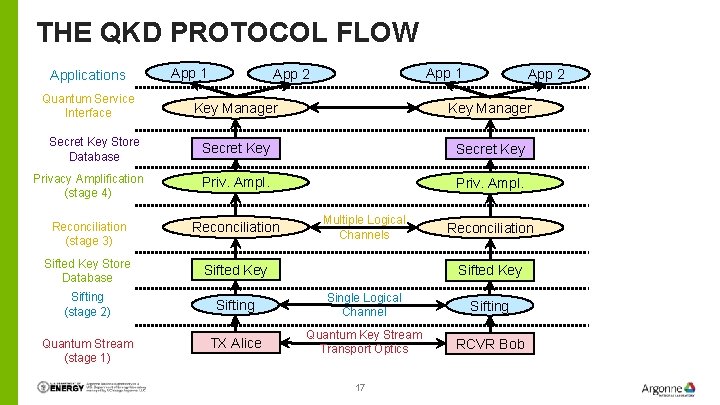
THE QKD PROTOCOL FLOW Applications Quantum Service Interface App 1 App 2 Key Manager Secret Key Privacy Amplification (stage 4) Priv. Ampl. Reconciliation (stage 3) Reconciliation Sifted Key Store Database Sifted Key Sifting (stage 2) Sifting Single Logical Channel Sifting TX Alice Quantum Key Stream Transport Optics RCVR Bob Secret Key Store Database Quantum Stream (stage 1) Multiple Logical Channels Reconciliation Sifted Key 17
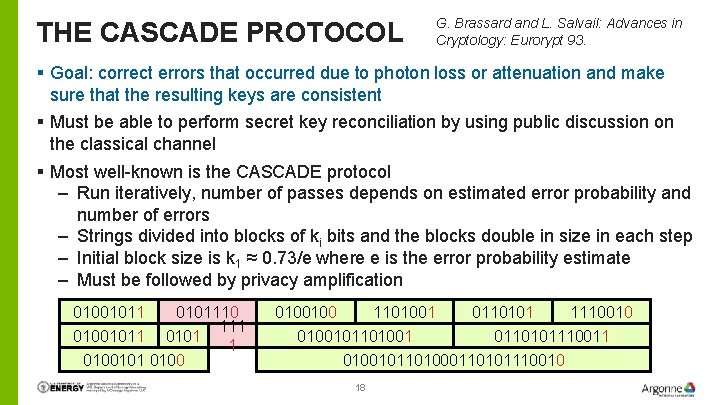
THE CASCADE PROTOCOL G. Brassard and L. Salvail: Advances in Cryptology: Eurorypt 93. § Goal: correct errors that occurred due to photon loss or attenuation and make sure that the resulting keys are consistent § Must be able to perform secret key reconciliation by using public discussion on the classical channel § Most well-known is the CASCADE protocol – Run iteratively, number of passes depends on estimated error probability and number of errors – Strings divided into blocks of ki bits and the blocks double in size in each step – Initial block size is k 1 ≈ 0. 73/e where e is the error probability estimate – Must be followed by privacy amplification 0100101110 111 01001011 0101 1 0100101 0100100 110100101101001 0110101110011 0100101101000110101110010 18 1110010
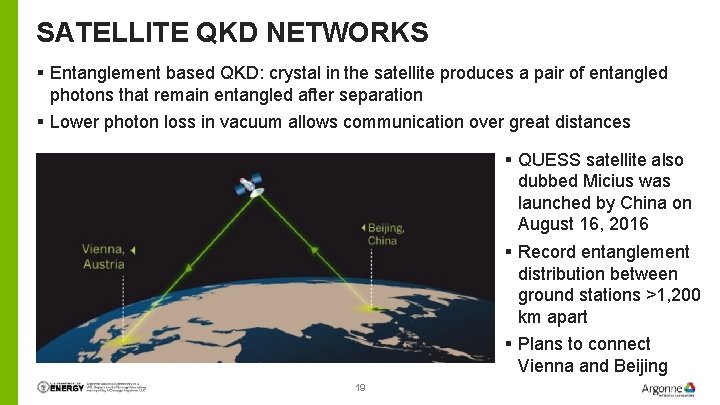
SATELLITE QKD NETWORKS § Entanglement based QKD: crystal in the satellite produces a pair of entangled photons that remain entangled after separation § Lower photon loss in vacuum allows communication over great distances § QUESS satellite also dubbed Micius was launched by China on August 16, 2016 § Record entanglement distribution between ground stations >1, 200 km apart § Plans to connect Vienna and Beijing 19
ALTERNATIVE: POST-QUANTUM CRYPTOGRAPHY § Post-quantum crypto replace traditional public-key crypto – Software solution relies on hardness of some problems – Demonstrated by Google and Microsoft to secure TLS § Each family is based on different mathematical problems that are hard to solve both with traditional computers as well as quantum computers § They differ in efficiency, e. g. , in the size of public and private keys, sizes of cipher texts and key-exchange messages, and computational cost, their maturity, and the amount of trust in their strength § In general post-quantum schemes require more resources compared to traditional cryptography 20
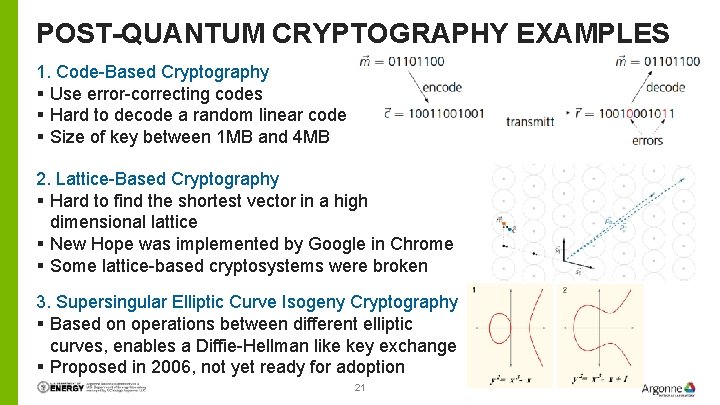
POST-QUANTUM CRYPTOGRAPHY EXAMPLES 1. Code-Based Cryptography § Use error-correcting codes § Hard to decode a random linear code § Size of key between 1 MB and 4 MB 2. Lattice-Based Cryptography § Hard to find the shortest vector in a high dimensional lattice § New Hope was implemented by Google in Chrome § Some lattice-based cryptosystems were broken 3. Supersingular Elliptic Curve Isogeny Cryptography § Based on operations between different elliptic curves, enables a Diffie-Hellman like key exchange § Proposed in 2006, not yet ready for adoption 21
QUANTUM TELEPORTATION NETWORKS
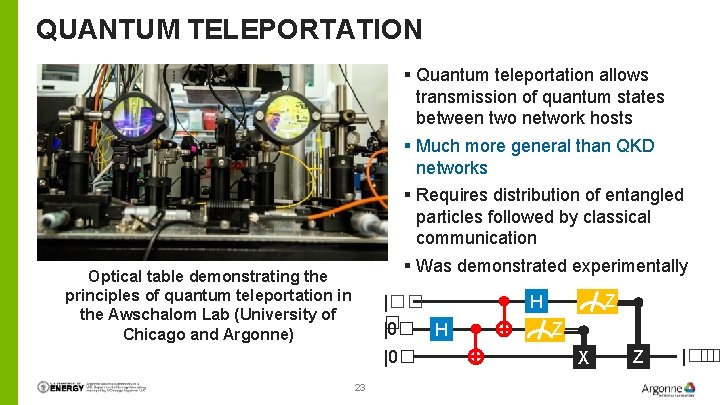
QUANTUM TELEPORTATION § Quantum teleportation allows transmission of quantum states between two network hosts § Much more general than QKD networks § Requires distribution of entangled particles followed by classical communication § Was demonstrated experimentally Optical table demonstrating the principles of quantum teleportation in the Awschalom Lab (University of Chicago and Argonne) |�� � |0� H |0� 23 Z H Z X Z |�� �
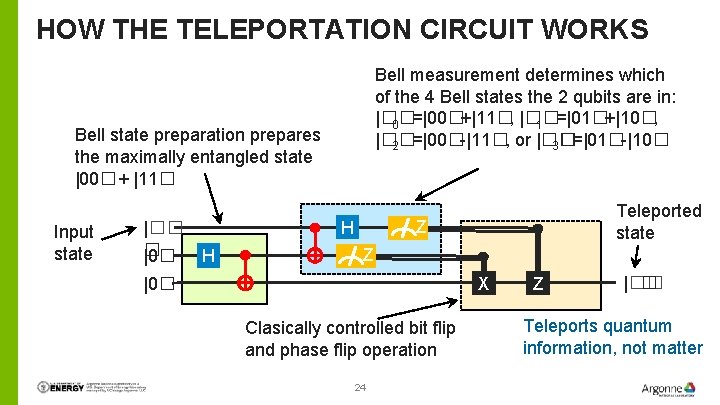
HOW THE TELEPORTATION CIRCUIT WORKS Bell measurement determines which of the 4 Bell states the 2 qubits are in: |�� 0�=|00�+|11�, |�� 1�=|01�+|10�, |�� 2�=|00�-|11�, or |�� 3�=|01�-|10� Bell state preparation prepares the maximally entangled state |00�+ |11� Input state |�� � |0� Z H H Teleported state Z |0� X Clasically controlled bit flip and phase flip operation 24 Z |�� � Teleports quantum information, not matter
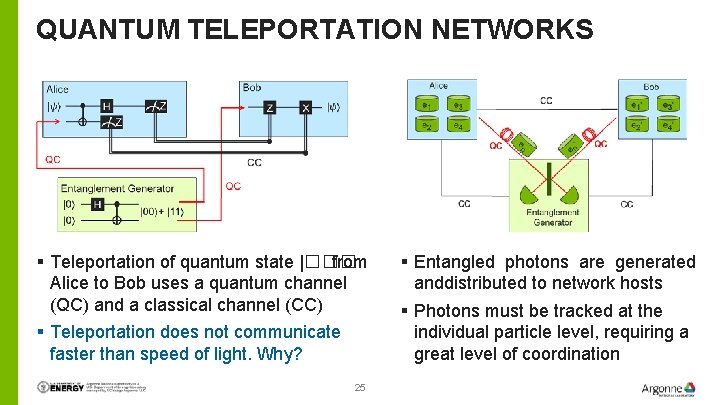
QUANTUM TELEPORTATION NETWORKS § Teleportation of quantum state |��� from Alice to Bob uses a quantum channel (QC) and a classical channel (CC) § Teleportation does not communicate faster than speed of light. Why? 25 § Entangled photons are generated anddistributed to network hosts § Photons must be tracked at the individual particle level, requiring a great level of coordination
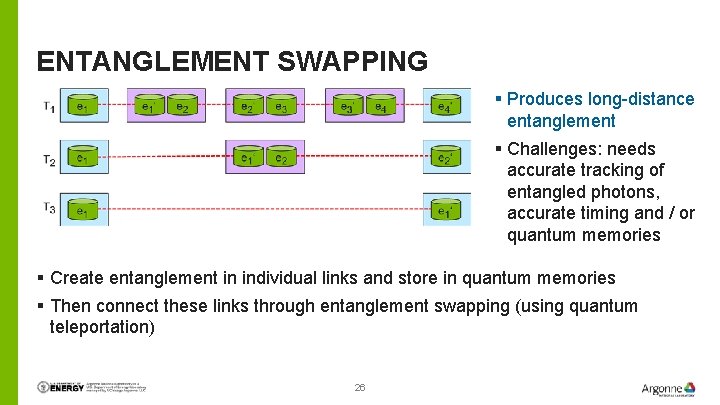
ENTANGLEMENT SWAPPING § Produces long-distance entanglement § Challenges: needs accurate tracking of entangled photons, accurate timing and / or quantum memories § Create entanglement in individual links and store in quantum memories § Then connect these links through entanglement swapping (using quantum teleportation) 26
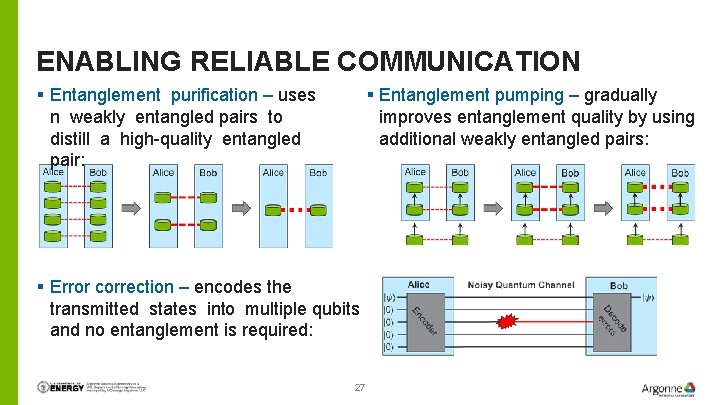
ENABLING RELIABLE COMMUNICATION § Entanglement pumping – gradually improves entanglement quality by using additional weakly entangled pairs: § Entanglement purification – uses n weakly entangled pairs to distill a high-quality entangled pair: § Error correction – encodes the transmitted states into multiple qubits and no entanglement is required: 27
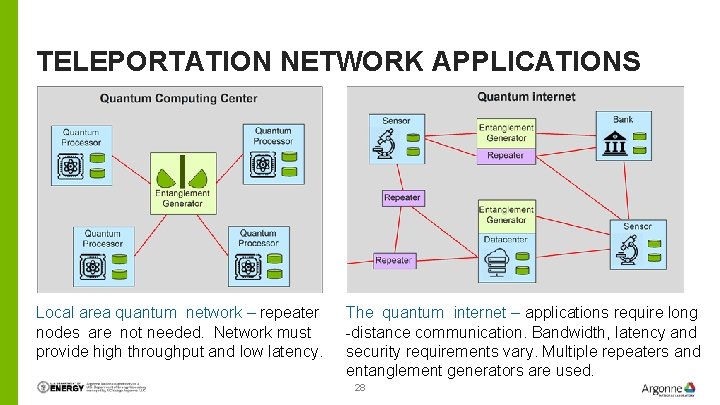
TELEPORTATION NETWORK APPLICATIONS Local area quantum network – repeater nodes are not needed. Network must provide high throughput and low latency. The quantum internet – applications require long -distance communication. Bandwidth, latency and security requirements vary. Multiple repeaters and entanglement generators are used. 28
BUILDING A QUANTUM TELEPORTATION NETWORK IN THE CHICAGO AREA
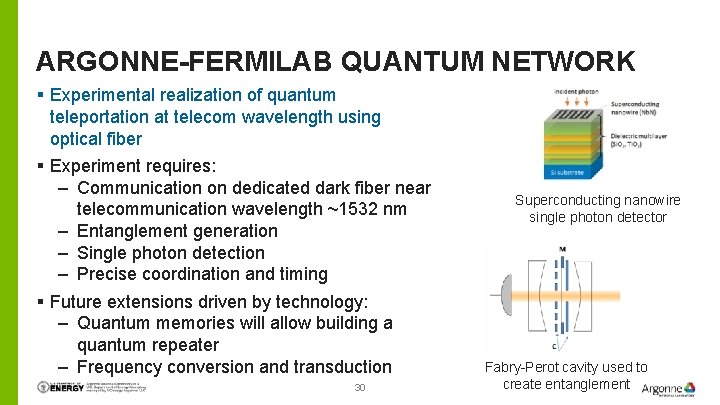
ARGONNE-FERMILAB QUANTUM NETWORK § Experimental realization of quantum teleportation at telecom wavelength using optical fiber § Experiment requires: – Communication on dedicated dark fiber near telecommunication wavelength ~1532 nm – Entanglement generation – Single photon detection – Precise coordination and timing § Future extensions driven by technology: – Quantum memories will allow building a quantum repeater – Frequency conversion and transduction 30 Superconducting nanowire single photon detector Fabry-Perot cavity used to create entanglement
THE ARGONNE-FERMILAB QUANTUM LINK 31
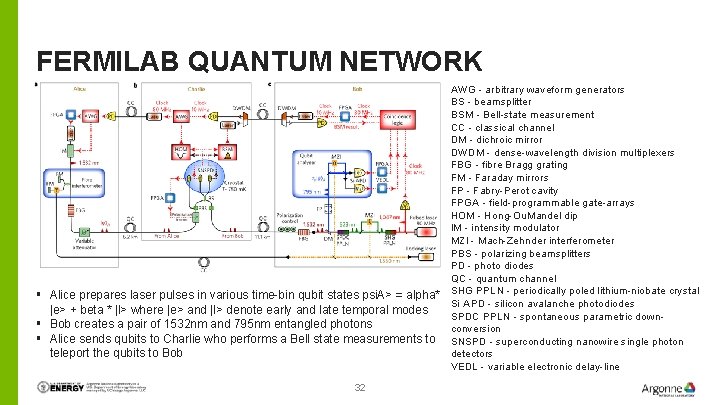
FERMILAB QUANTUM NETWORK AWG - arbitrary waveform generators BS - beamsplitter BSM - Bell-state measurement CC - classical channel DM - dichroic mirror DWDM - dense-wavelength division multiplexers FBG - fibre Bragg grating FM - Faraday mirrors FP - Fabry-Perot cavity FPGA - field-programmable gate-arrays HOM - Hong-Ou. Mandel dip IM - intensity modulator MZI - Mach-Zehnder interferometer PBS - polarizing beamsplitters PD - photo diodes QC - quantum channel § Alice prepares laser pulses in various time-bin qubit states psi. A> = alpha* SHG PPLN - periodically poled lithium-niobate crystal Si APD - silicon avalanche photodiodes |e> + beta * |l> where |e> and |l> denote early and late temporal modes SPDC PPLN - spontaneous parametric down§ Bob creates a pair of 1532 nm and 795 nm entangled photons conversion § Alice sends qubits to Charlie who performs a Bell state measurements to SNSPD - superconducting nanowire single photon teleport the qubits to Bob detectors VEDL - variable electronic delay-line 32
THANK YOU!