
Argonne Laser Test Stand Fermilab Test Beam Facility
Argonne Laser Test Stand Fermilab Test Beam Facility Karen Byrum 8 March, 2007 • Status of Argonne Laser Teststand (Joint ANL – UC program) • Some first measurements (Argonne) • Overview of Fermilab Test. Beam Facility (E. Ramberg) • FNAL Facility Capabilities at Test. Beam

Argonne Laser Test-stand • Challenges with Testing psec timing o Must Build Entire Sensor/Readout Chain to Fully Characterize Performance o Need Specialized Equipment, Ultimately a Test Beam • Two Step Plan Ø Use ANL LED Test stands and setup a new laser laboratory Ø Fully Characterize MCPs which we are specifying and Burle/Photonis is designing. Ø A way to systematically measure sensor + readout in controlled environment Ø Ultimately, take the sensor + readout to the FNAL testbeam and test in particle beam.
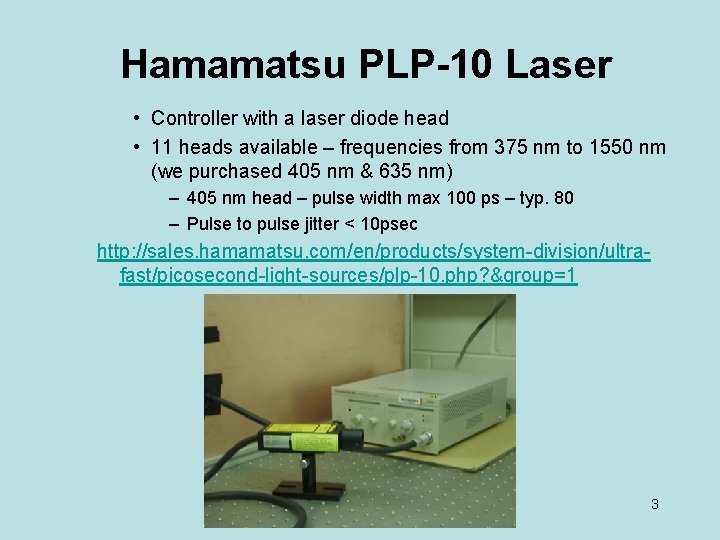
Hamamatsu PLP-10 Laser • Controller with a laser diode head • 11 heads available – frequencies from 375 nm to 1550 nm (we purchased 405 nm & 635 nm) – 405 nm head – pulse width max 100 ps – typ. 80 – Pulse to pulse jitter < 10 psec http: //sales. hamamatsu. com/en/products/system-division/ultrafast/picosecond-light-sources/plp-10. php? &group=1 3
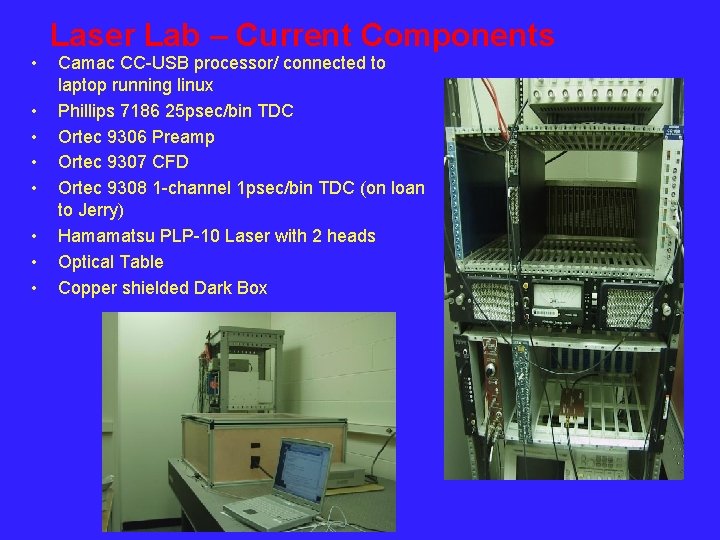
• • Laser Lab – Current Components Camac CC-USB processor/ connected to laptop running linux Phillips 7186 25 psec/bin TDC Ortec 9306 Preamp Ortec 9307 CFD Ortec 9308 1 -channel 1 psec/bin TDC (on loan to Jerry) Hamamatsu PLP-10 Laser with 2 heads Optical Table Copper shielded Dark Box
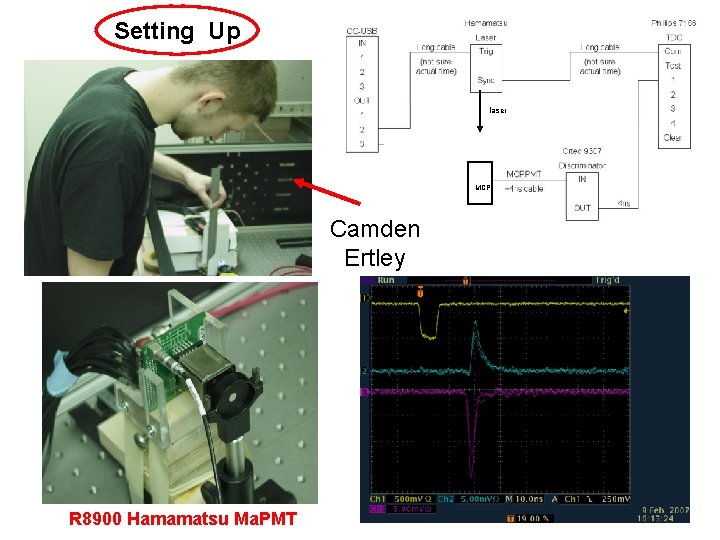
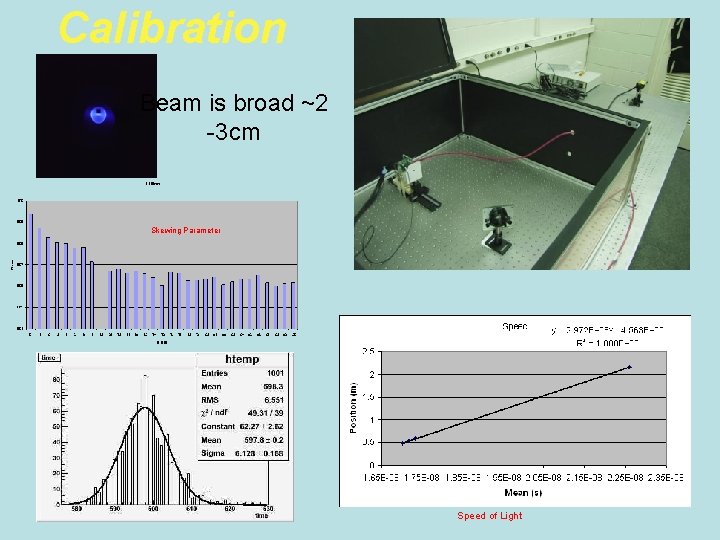
Setting Up laser MCP Camden Ertley R 8900 Hamamatsu Ma. PMT
Calibration Beam is broad ~2 -3 cm Skewing Parameter Speed of Light
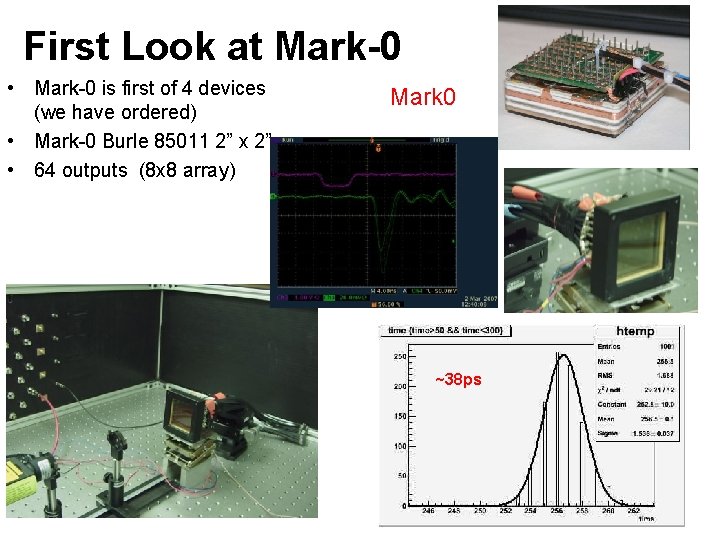
First Look at Mark-0 • Mark-0 is first of 4 devices (we have ordered) • Mark-0 Burle 85011 2” x 2” • 64 outputs (8 x 8 array) Mark 0 ~38 ps
What’s next • Fully characterize and understand laser beam to MCP performance. (ie laser power, beam size on MCP…) • Add more instrumentation (enough to readout 2 MCPs) • Instrument laser stand with 2 MCPs on xy stagers. • Add filter wheel, etc.
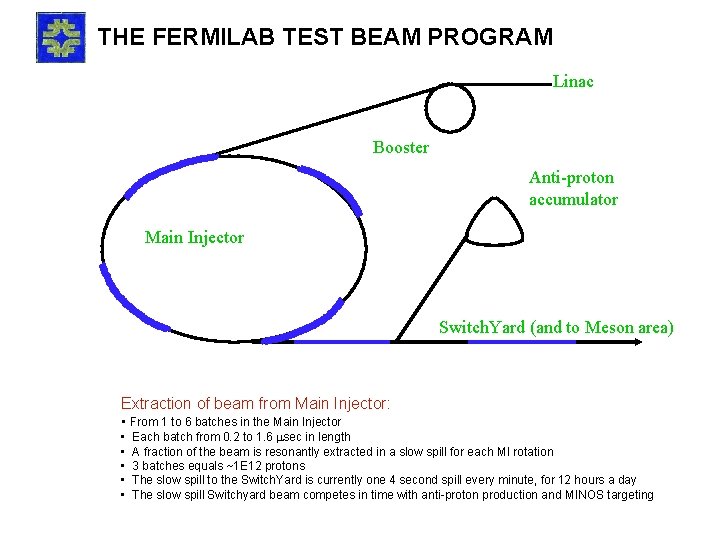
THE FERMILAB TEST BEAM PROGRAM Linac Booster Anti-proton accumulator Main Injector Switch. Yard (and to Meson area) Extraction of beam from Main Injector: • From 1 to 6 batches in the Main Injector • • • Each batch from 0. 2 to 1. 6 sec in length A fraction of the beam is resonantly extracted in a slow spill for each MI rotation 3 batches equals ~1 E 12 protons The slow spill to the Switch. Yard is currently one 4 second spill every minute, for 12 hours a day The slow spill Switchyard beam competes in time with anti-proton production and MINOS targeting

MTest Profiles 120 Ge. V proton mode Tune (Ge. V) Rate in MT 6/spill* e- fraction Measured rates in the MTBF beamline 120 66 33 16 8 4 800, 000 90, 000 40, 000 14, 000 500 0 0 0. 7% 10. 0% 30. 0% 60. 0% * (Rates are normalized to 2. 4 E 12 protons in Main Injector)
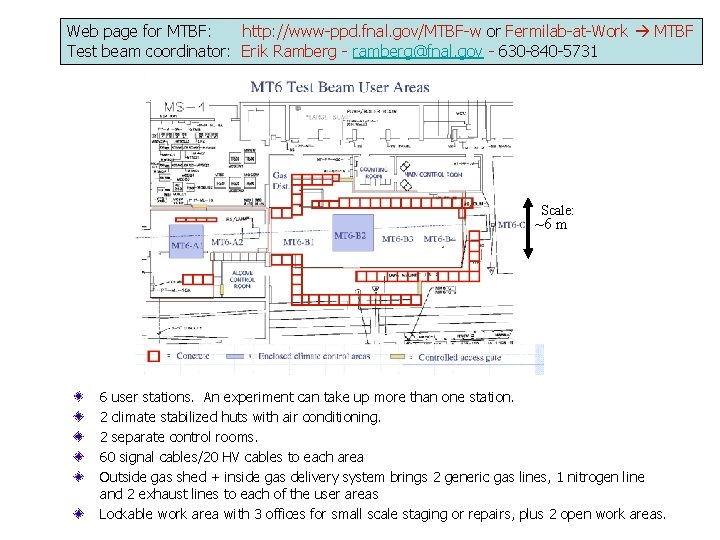
Web page for MTBF: http: //www-ppd. fnal. gov/MTBF-w or Fermilab-at-Work MTBF Test beam coordinator: Erik Ramberg - ramberg@fnal. gov - 630 -840 -5731 Scale: ~6 m 6 user stations. An experiment can take up more than one station. 2 climate stabilized huts with air conditioning. 2 separate control rooms. 60 signal cables/20 HV cables to each area Outside gas shed + inside gas delivery system brings 2 generic gas lines, 1 nitrogen line and 2 exhaust lines to each of the user areas Lockable work area with 3 offices for small scale staging or repairs, plus 2 open work areas.

Setup of Meson Test Beam Facility tracking DAQ Facility Capabilities include: Ø TOF counters ØCerenkov Detectors ØTracking system Section 2 MWPC TOF crate 3 DAQ computer (mtbf. fnal. gov) Control room MWPC crate 4 crate 5 MWPC Section 1 TOF CKOV crate 7 CAMAC crate 1 Electronics room MS 4 Power Supply Service Area
Improvements to the Test Beam • • • About 6 months ago, Fermilab initiated a very significant investment in the Meson Test Beam Facility. As a consequence of this investment, both the beamline and user facilities were improved considerably over the last few years of running. The beamline improvements include: – – – • The user facility improvements include: – – – • An intermediate moveable target which will increase low energy pion flux Low current power supplies and Hall probes to stabilize low energy tuning Minimization of material in the beamline to reduce scattering and conversion Ability to bring primary proton beam flux on an electron target Quadrupole triplets to enhance tuning. Thorough cable installation New control/conference room 4 th tracking station New TOF system and differential Cerenkov detector Motion tables and video system Laser alignment The beamline is being commissioned now and has achieved a range of 2 to 120 Ge. V beam.

• Backups
- Slides: 14