
AREAS OF TRIANGLES RIME For remote learning RIME
- Slides: 27
AREAS OF TRIANGLES: RIME For remote learning
RIME : AREAS OF TRIANGLES Key premise: In this task, students will TEACHER GUIDE: TASK OVERVIEW Investigate the area of triangles. Explain how changes to dimensions affect triangle areas. Task requirements: Students will be required to Investigate changes to triangle areas using several examples. Organise and use data to form conclusions. Key skills, strategies and understandings: Students will be able to Calculate the area of a variety of triangles. Understand the formula for area of a triangle.
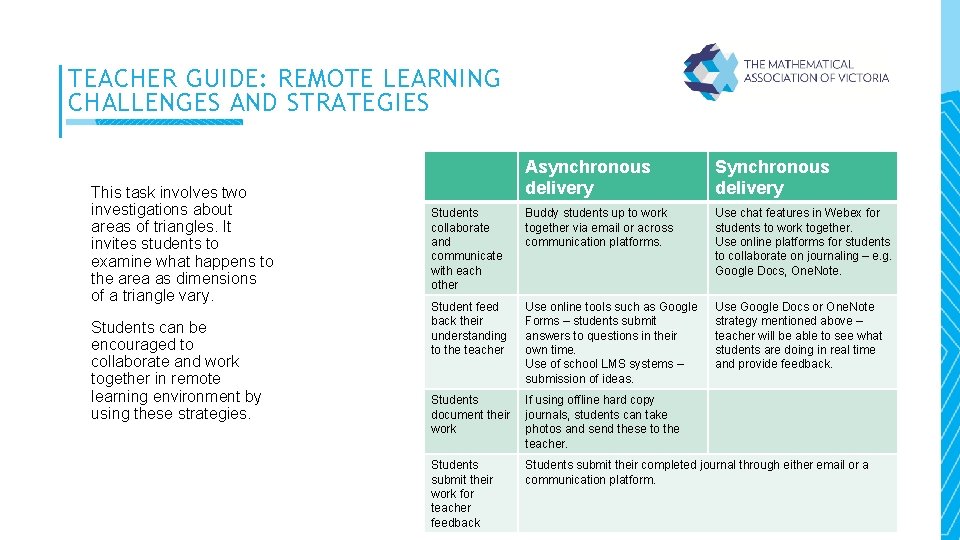
TEACHER GUIDE: REMOTE LEARNING CHALLENGES AND STRATEGIES This task involves two investigations about areas of triangles. It invites students to examine what happens to the area as dimensions of a triangle vary. Students can be encouraged to collaborate and work together in remote learning environment by using these strategies. Asynchronous delivery Students collaborate and communicate with each other Buddy students up to work together via email or across communication platforms. Use chat features in Webex for students to work together. Use online platforms for students to collaborate on journaling – e. g. Google Docs, One. Note. Student feed back their understanding to the teacher Use online tools such as Google Forms – students submit answers to questions in their own time. Use of school LMS systems – submission of ideas. Use Google Docs or One. Note strategy mentioned above – teacher will be able to see what students are doing in real time and provide feedback. Students document their work If using offline hard copy journals, students can take photos and send these to the teacher. Students submit their work for teacher feedback Students submit their completed journal through either email or a communication platform.
TEACHER GUIDE: REMOTE LEARNING CHALLENGES AND STRATEGIES For this task, students are encouraged to collaborate by: sharing results in pairs or groups of four via virtual communication e. g. Webex documenting their work using tables, diagrams and taking photos of their investigations. indicating their understanding by recording reflections. submitting their predictions, results tables, any photos and their reflections to the teacher.
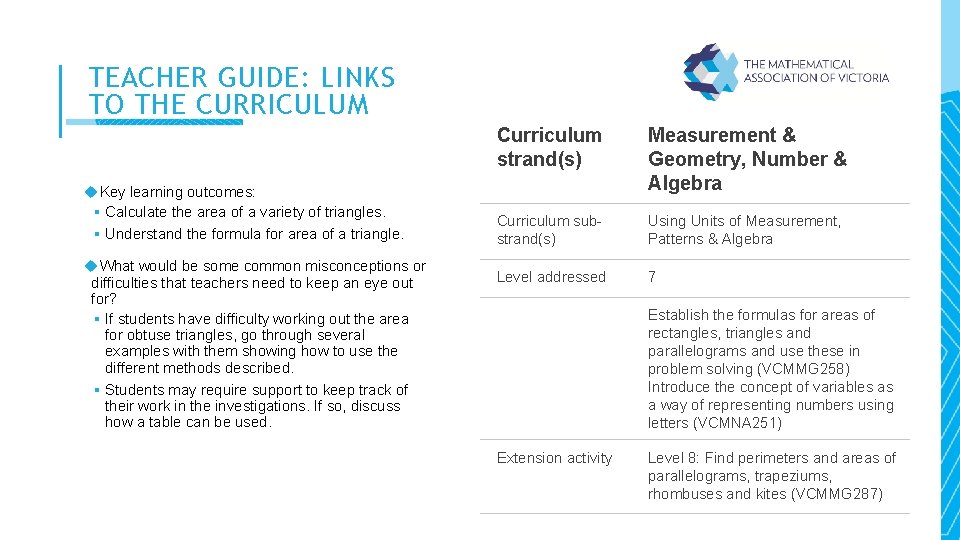
TEACHER GUIDE: LINKS TO THE CURRICULUM Key learning outcomes: § Calculate the area of a variety of triangles. § Understand the formula for area of a triangle. What would be some common misconceptions or difficulties that teachers need to keep an eye out for? § If students have difficulty working out the area for obtuse triangles, go through several examples with them showing how to use the different methods described. § Students may require support to keep track of their work in the investigations. If so, discuss how a table can be used. Curriculum strand(s) Measurement & Geometry, Number & Algebra Curriculum substrand(s) Using Units of Measurement, Patterns & Algebra Level addressed 7 Establish the formulas for areas of rectangles, triangles and parallelograms and use these in problem solving (VCMMG 258) Introduce the concept of variables as a way of representing numbers using letters (VCMNA 251) Extension activity Level 8: Find perimeters and areas of parallelograms, trapeziums, rhombuses and kites (VCMMG 287)
STUDENT SLIDE 1: AREA OF TRIANGLES The problem: There are many types of triangles. In some, the area seems easier to find than others. This lesson will reveal some surprising findings about the connections between very different triangles. Learning intentions Know how to find the area of different triangles Explain a method for calculating triangle areas. Success criteria Do 2 investigations into triangle areas Organise and explain your findings. Equipment needed Square dot paper Pen/Pencil
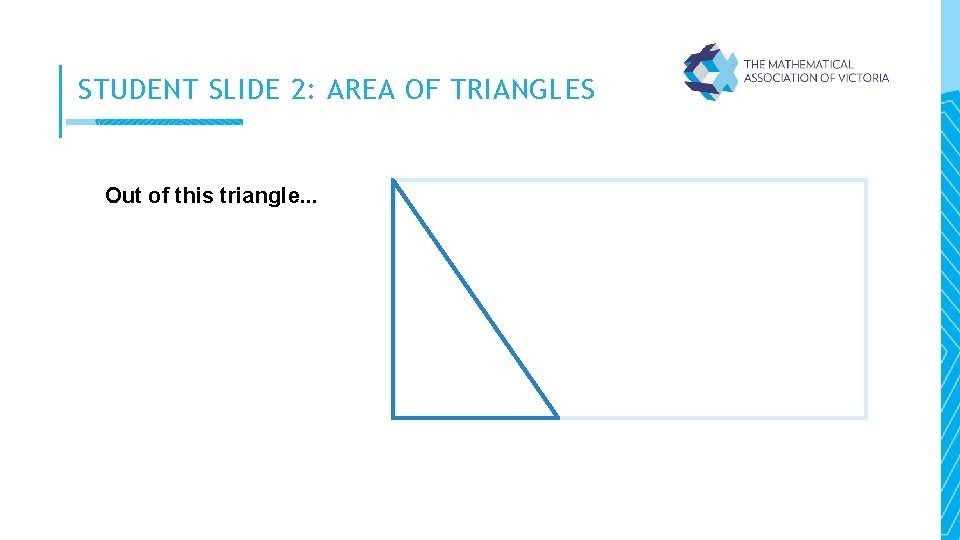
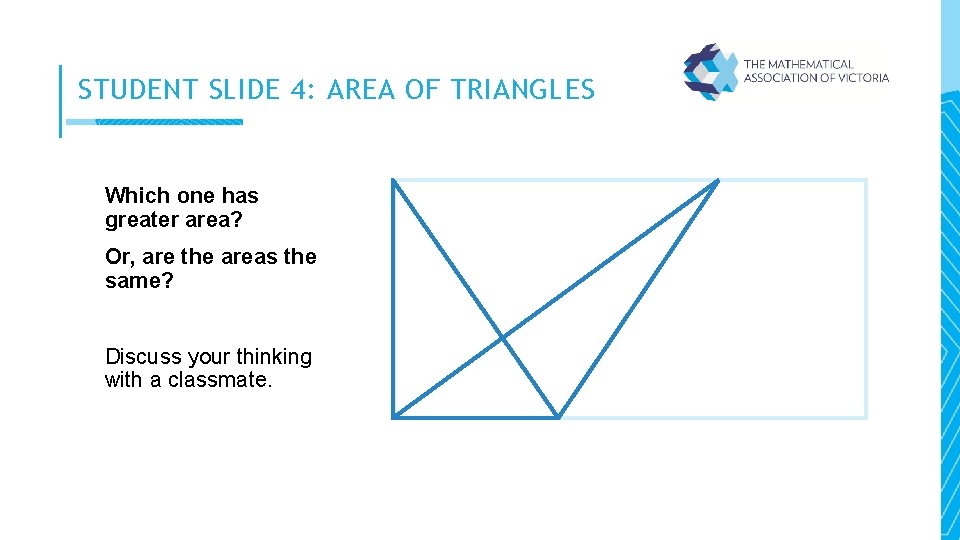
STUDENT SLIDE 2: AREA OF TRIANGLES Out of this triangle. . .
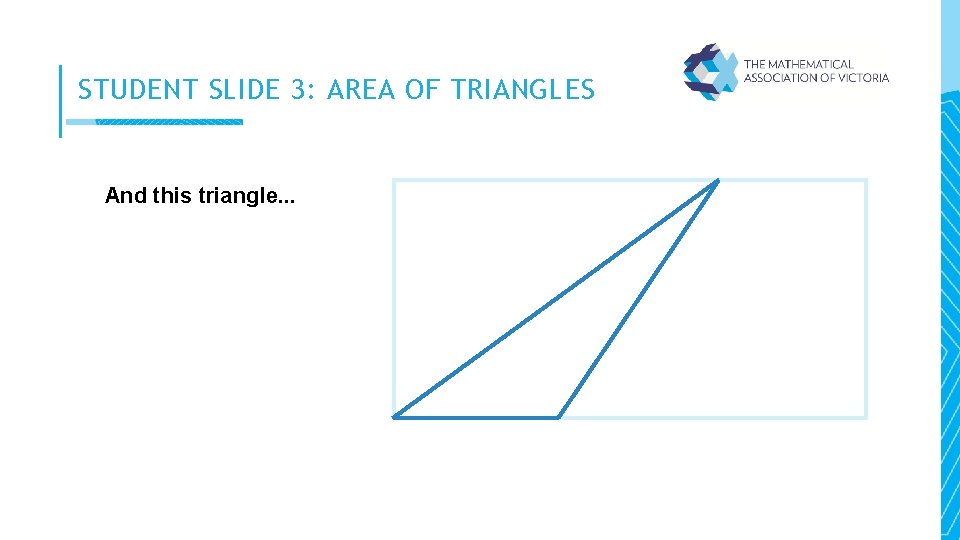
STUDENT SLIDE 3: AREA OF TRIANGLES And this triangle. . .
STUDENT SLIDE 4: AREA OF TRIANGLES Which one has greater area? Or, are the areas the same? Discuss your thinking with a classmate.
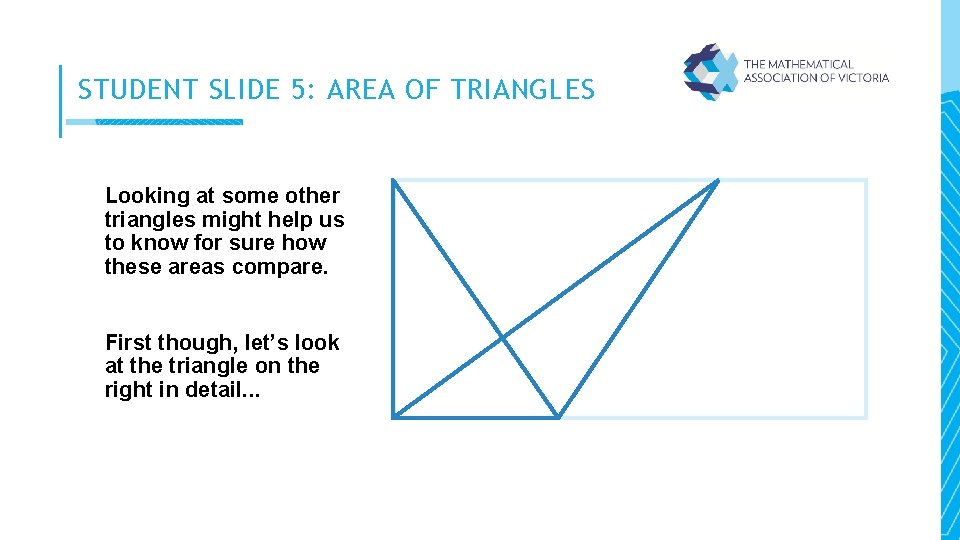
STUDENT SLIDE 5: AREA OF TRIANGLES Looking at some other triangles might help us to know for sure how these areas compare. First though, let’s look at the triangle on the right in detail. . .
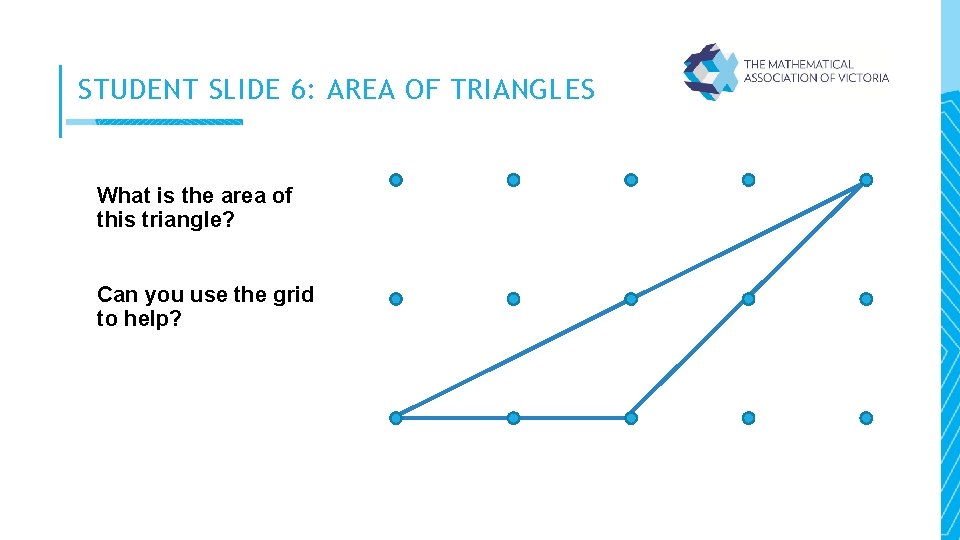
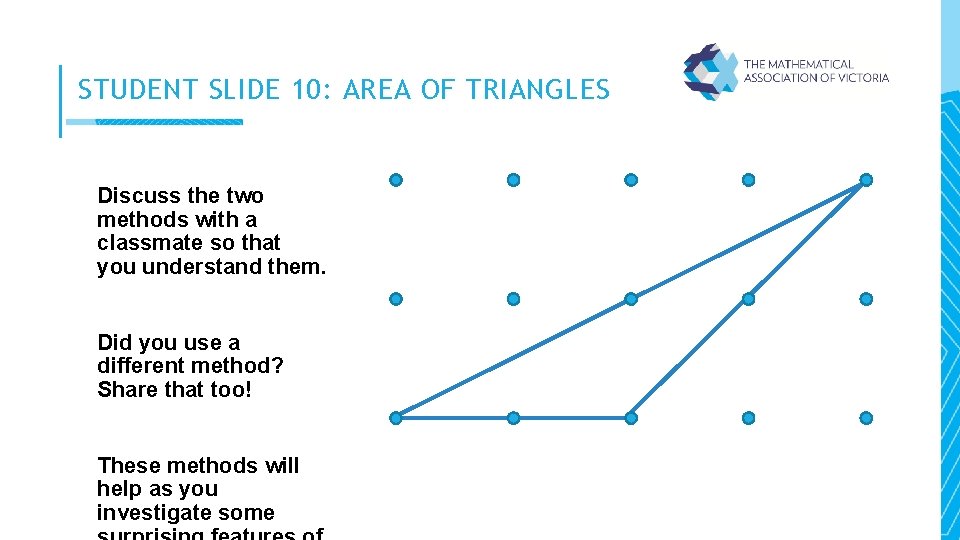
STUDENT SLIDE 6: AREA OF TRIANGLES What is the area of this triangle? Can you use the grid to help?
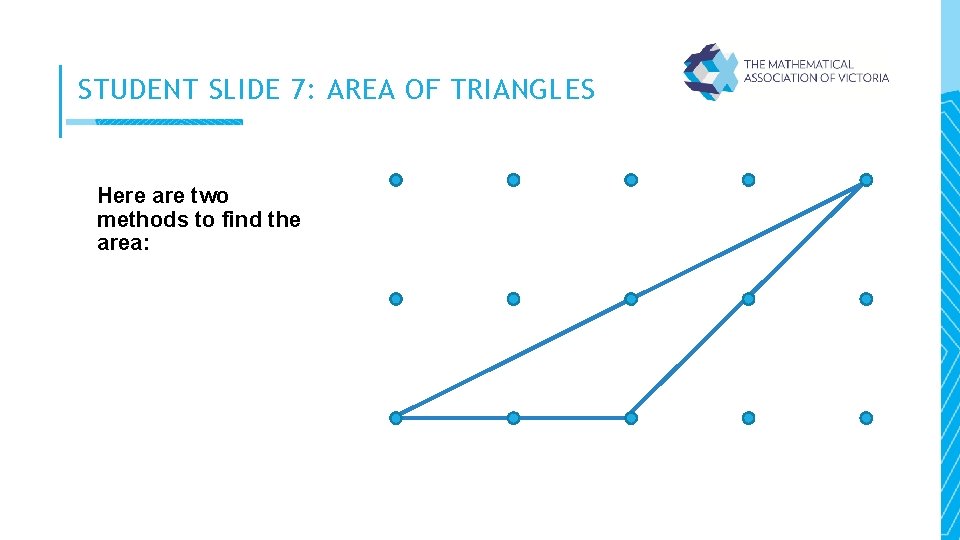
STUDENT SLIDE 7: AREA OF TRIANGLES Here are two methods to find the area:
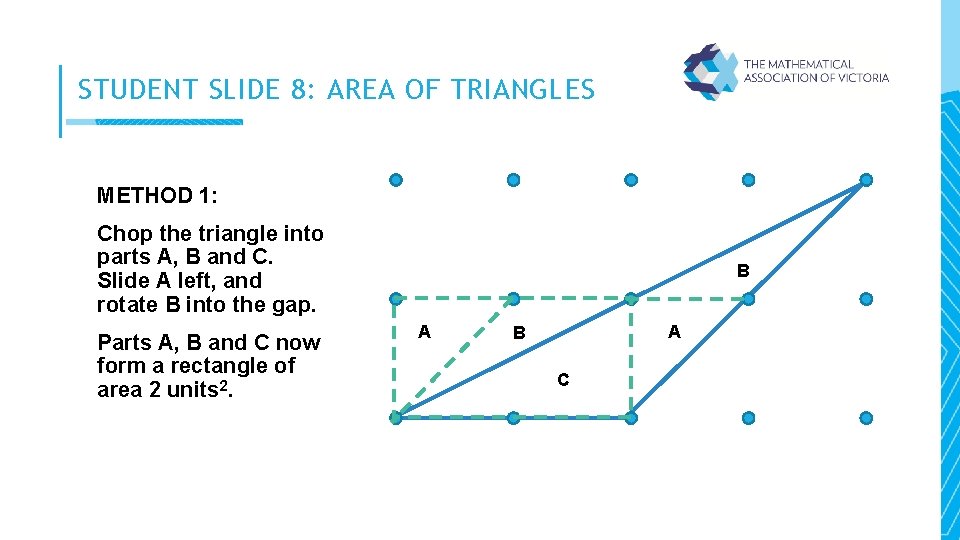
STUDENT SLIDE 8: AREA OF TRIANGLES METHOD 1: Chop the triangle into parts A, B and C. Slide A left, and rotate B into the gap. Parts A, B and C now form a rectangle of area 2 units 2. B A A B C
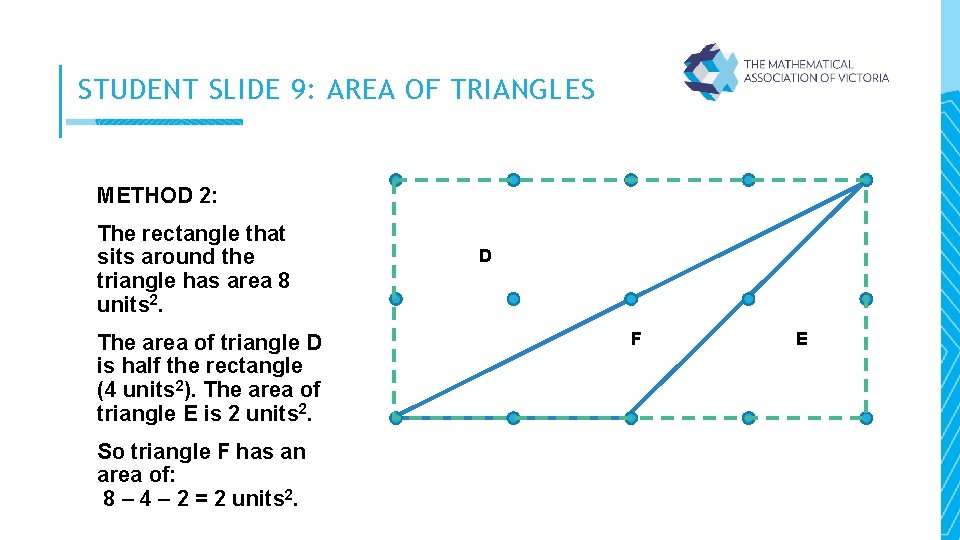
STUDENT SLIDE 9: AREA OF TRIANGLES METHOD 2: The rectangle that sits around the triangle has area 8 units 2. The area of triangle D is half the rectangle (4 units 2). The area of triangle E is 2 units 2. So triangle F has an area of: 8 – 4 – 2 = 2 units 2. D F E
STUDENT SLIDE 10: AREA OF TRIANGLES Discuss the two methods with a classmate so that you understand them. Did you use a different method? Share that too! These methods will help as you investigate some
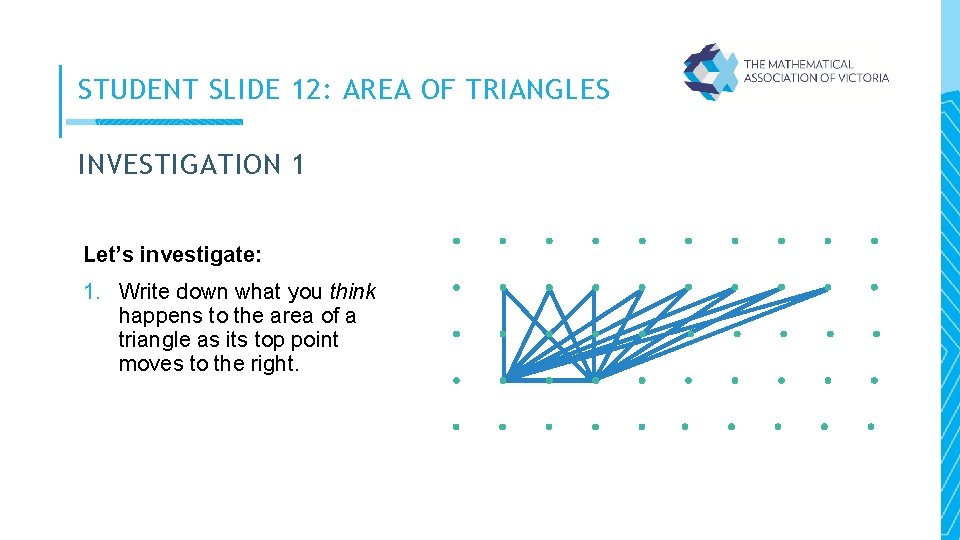
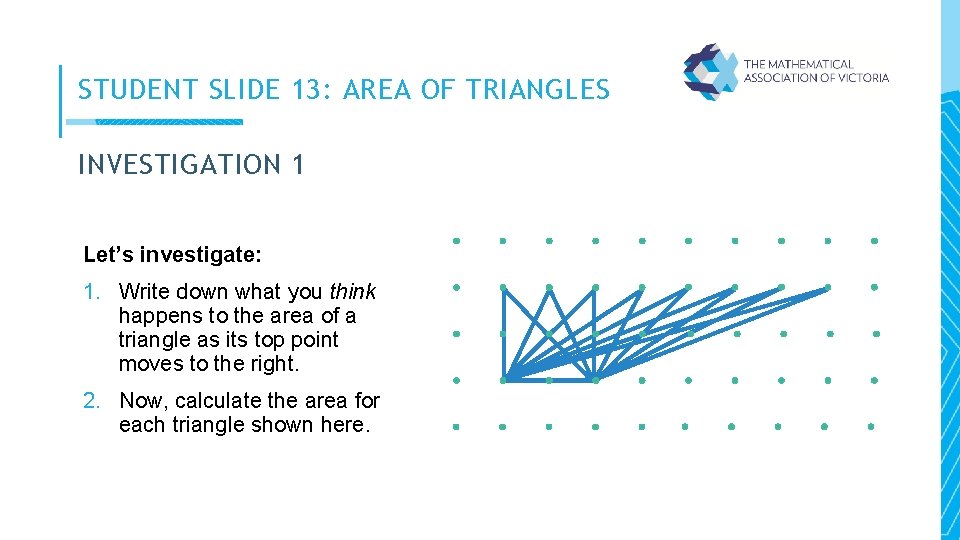
STUDENT SLIDE 11: AREA OF TRIANGLES INVESTIGATION 1 What happens to the area of a triangle as its top point moves to the right?
STUDENT SLIDE 12: AREA OF TRIANGLES INVESTIGATION 1 Let’s investigate: 1. Write down what you think happens to the area of a triangle as its top point moves to the right.
STUDENT SLIDE 13: AREA OF TRIANGLES INVESTIGATION 1 Let’s investigate: 1. Write down what you think happens to the area of a triangle as its top point moves to the right. 2. Now, calculate the area for each triangle shown here.
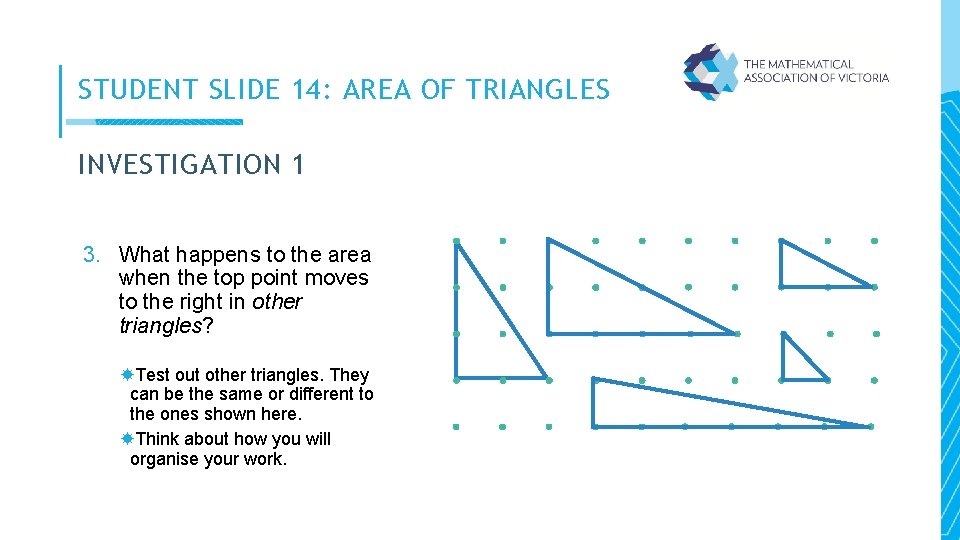
STUDENT SLIDE 14: AREA OF TRIANGLES INVESTIGATION 1 3. What happens to the area when the top point moves to the right in other triangles? Test out other triangles. They can be the same or different to the ones shown here. Think about how you will organise your work.
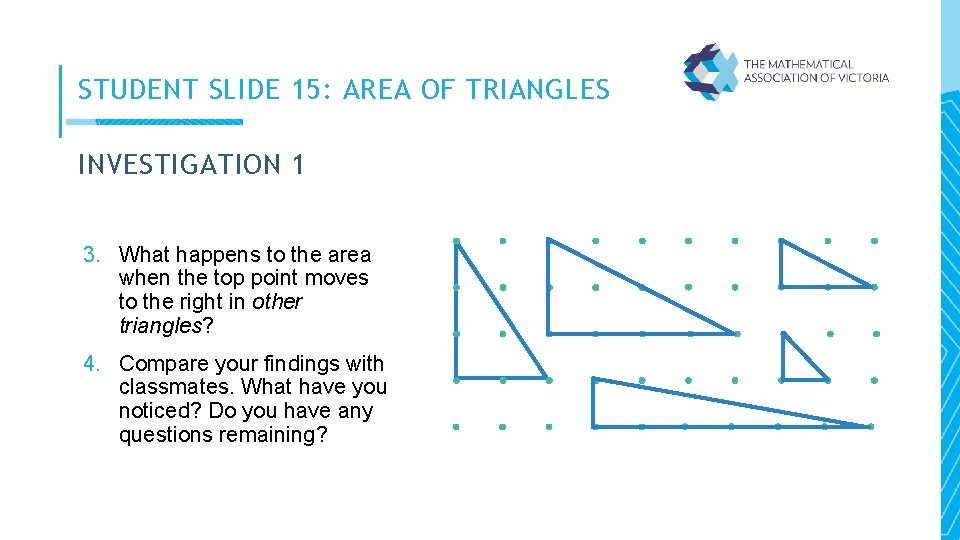
STUDENT SLIDE 15: AREA OF TRIANGLES INVESTIGATION 1 3. What happens to the area when the top point moves to the right in other triangles? 4. Compare your findings with classmates. What have you noticed? Do you have any questions remaining?
STUDENT SLIDE 16: AREA OF TRIANGLES INVESTIGATION 2 What happens to the area of a triangle as its top point moves up?
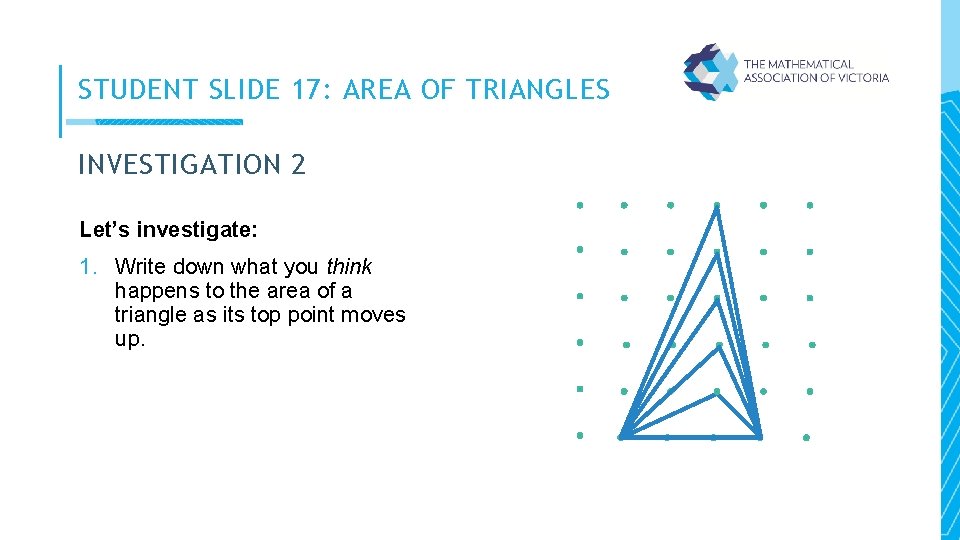
STUDENT SLIDE 17: AREA OF TRIANGLES INVESTIGATION 2 Let’s investigate: 1. Write down what you think happens to the area of a triangle as its top point moves up.
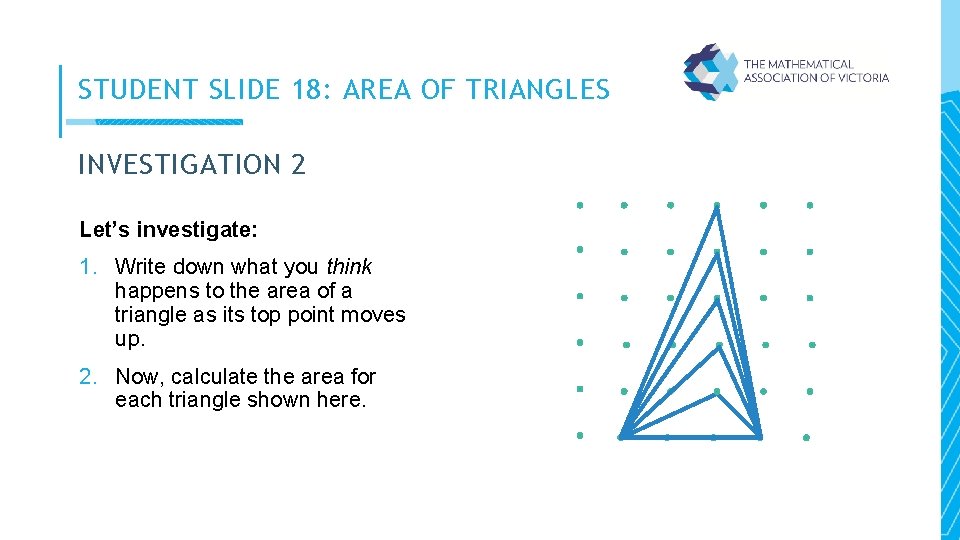
STUDENT SLIDE 18: AREA OF TRIANGLES INVESTIGATION 2 Let’s investigate: 1. Write down what you think happens to the area of a triangle as its top point moves up. 2. Now, calculate the area for each triangle shown here.
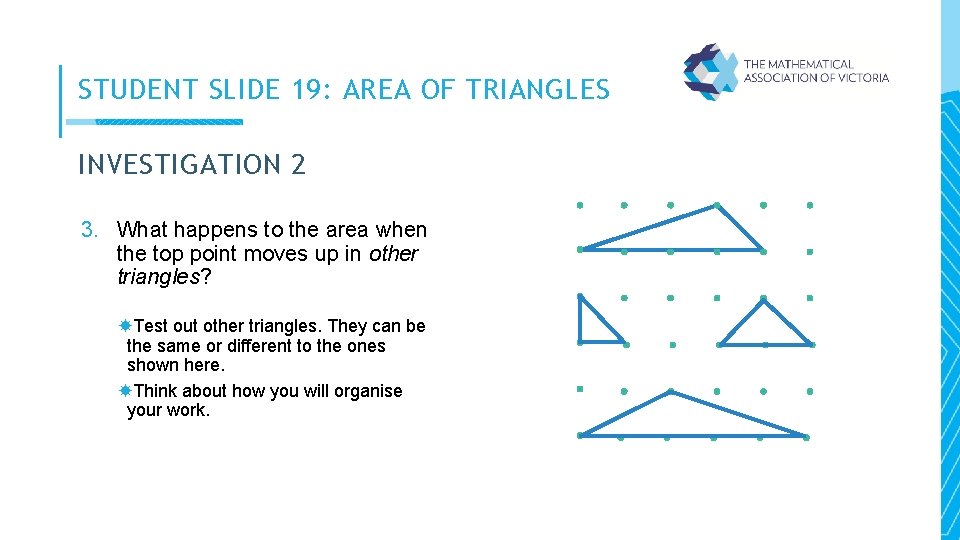
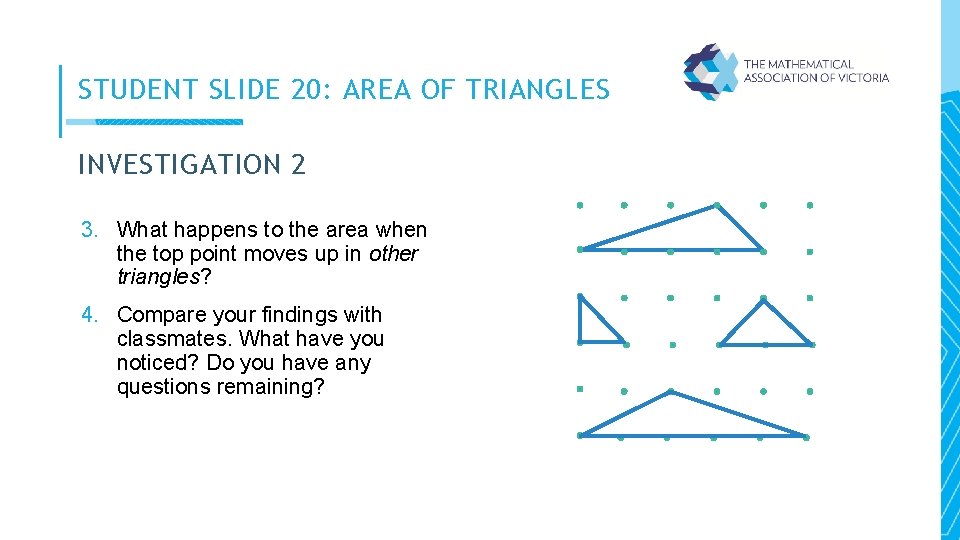
STUDENT SLIDE 19: AREA OF TRIANGLES INVESTIGATION 2 3. What happens to the area when the top point moves up in other triangles? Test out other triangles. They can be the same or different to the ones shown here. Think about how you will organise your work.
STUDENT SLIDE 20: AREA OF TRIANGLES INVESTIGATION 2 3. What happens to the area when the top point moves up in other triangles? 4. Compare your findings with classmates. What have you noticed? Do you have any questions remaining?
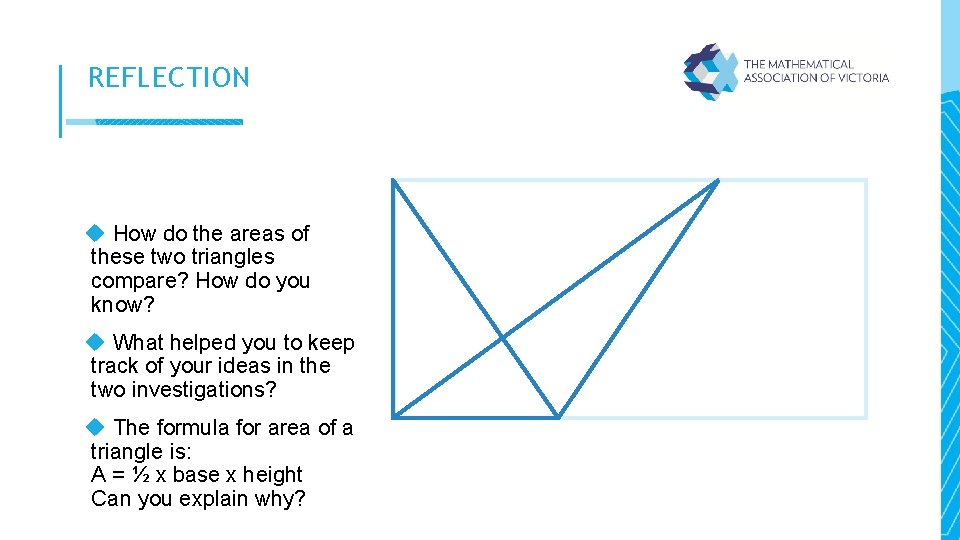
REFLECTION How do the areas of these two triangles compare? How do you know? What helped you to keep track of your ideas in the two investigations? The formula for area of a triangle is: A = ½ x base x height Can you explain why?
EXTENSION What happens to the area of a triangles as its top point moves right and up? Investigate what happens to the area when you make changes to a point on quadrilaterals.