
Areas Of Growth Human Growth and Development is










- Slides: 111
Areas Of Growth Human Growth and Development is PREDICTABLE!
EACH TEENAGER: *IS AN INDIVIDUAL *UNIQUE PERSONALITY *SPECIAL INTERESTS *LIKES AND DISLIKES.
Moving towards independence…. . n n n n Struggle with developing one’s own identity Feeling awkward or strange about one's self and one's body Focus on self, alternating between high expectations and poor self-esteem Interests and clothing style influenced by peer group Moodiness Improved ability to use speech to express one's self Realization that parents are not perfect; identification of their faults
Behaviors…. Less overt affection shown to parents, with occasional rudeness n Complaints that parents interfere with independence n Tendency to return to childish or immature behavior, particularly overwhelmed or stressed n
Future Interests and Cognitive Changes Interests focused on the present, with limited thoughts of the future n Intellectual interests expand gain in importance n Greater ability to do work (physical, mental, emotional) n
Sexuality n n Display shyness, blushing, and modesty Girls develop physically sooner than boys Increased interest in what sex is…. . Begin exploring issues and questions about their sexuality and sexual orientation
Sexuality cont. Concerns regarding physical and sexual attractiveness to others n Frequently changing relationships n Worries about being normal n
Morals, Values, and Self-Direction Greater testing of rules and limits n Capacity for abstract thinking n Development of ideals and selection of role models n More consistent evidence of conscience n Experimentation with sex and drugs (cigarettes, alcohol, and marijuana) n
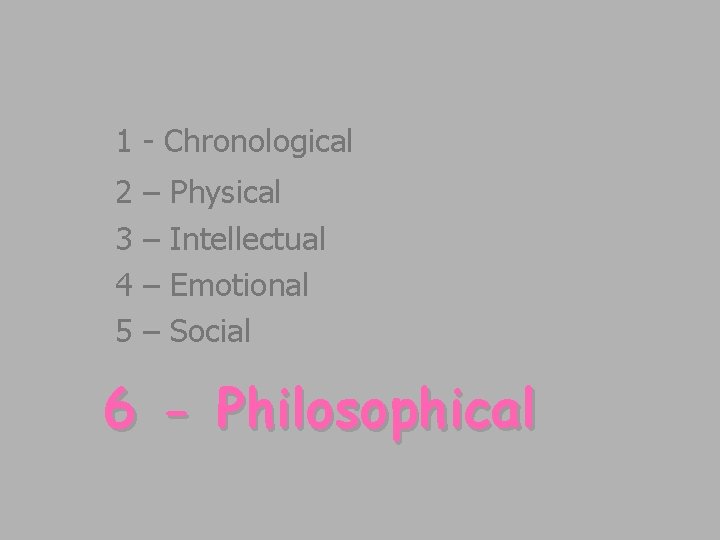
1 - Chronological 2 – Physical 3 – Intellectual 4 – Emotional 5 – Social 6 - Philosophical
1 - CHRONOLOGICAL when you reach a certain AGE…. . and by nis law something is legal to do.
It’s your birthday! n Happy Birthday! Happy Birthday
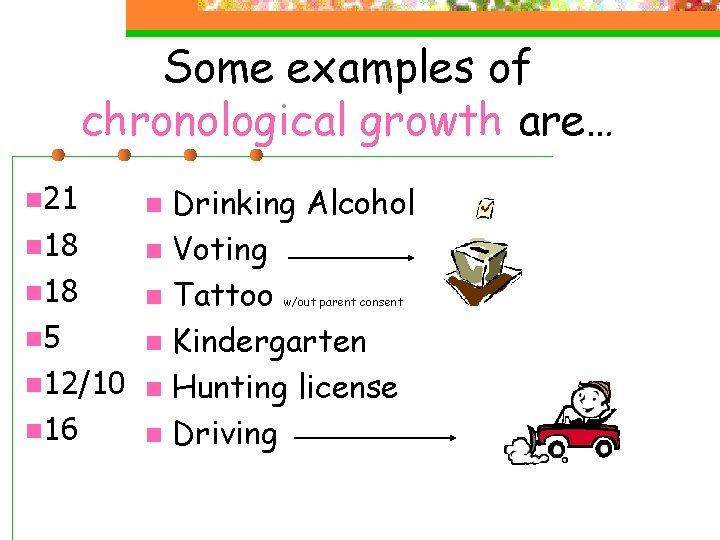
Some examples of chronological growth are… n 21 Drinking Alcohol n 18 n Voting n 18 n Tattoo n 5 n Kindergarten n 12/10 n Hunting license n 16 n Driving n w/out parent consent
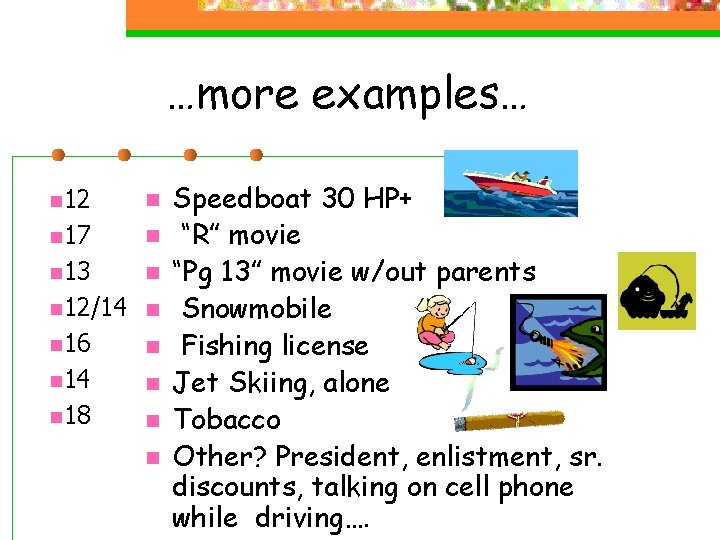
…more examples… n 12 n n 17 n n 13 n n 12/14 n n 16 n n 14 n n 18 n n Speedboat 30 HP+ “R” movie “Pg 13” movie w/out parents Snowmobile Fishing license Jet Skiing, alone Tobacco Other? President, enlistment, sr. discounts, talking on cell phone while driving….
1 - Chronological 2 – Physical 3 – Intellectual 4 – Emotional 5 – Social 6 - Philosophical
“Adolescents”…… n……. a stage of development between childhood and adulthood.
Puberty signals the beginning of Adolescence.
“Puberty”…… n…. is the part of adolescence when the reproductive system becomes mature.
Puberty…… *growth period when a teens body starts looking like and adult *develops the physical ability to
Puberty is often referred to as …. . n “the passage into adulthood“
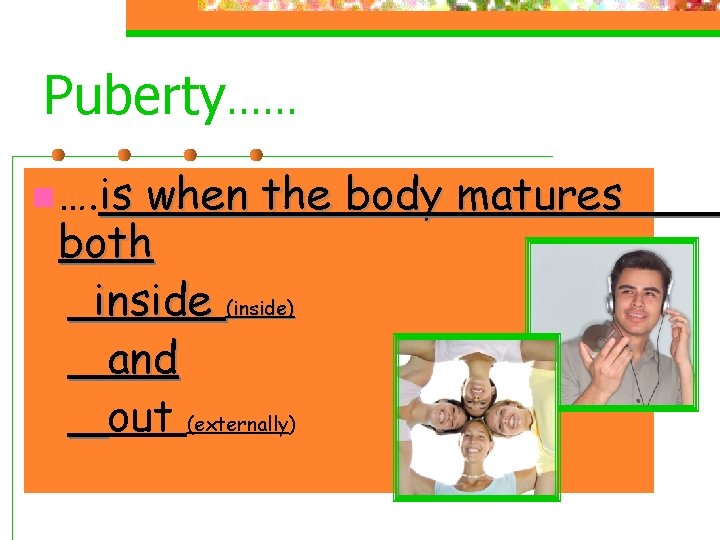
Puberty…… n …. is when the body matures both inside (inside) and out (externally)
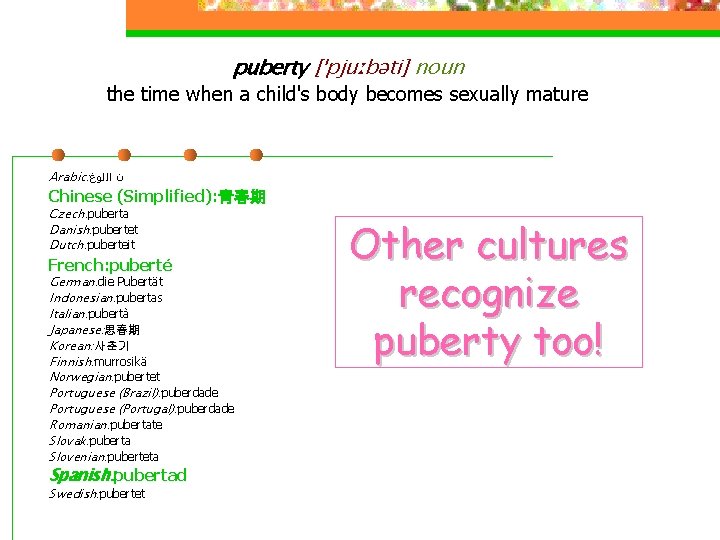
puberty [ˈpjuːbəti] noun the time when a child's body becomes sexually mature Arabic: ﺍﻟﻟﻮﻍ ﻥ Chinese (Simplified): 青春期 Czech: puberta Danish: pubertet Dutch: puberteit French: puberté German: die Pubertät Indonesian: pubertas Italian: pubertà Japanese: 思春期 Korean: 사춘기 Finnish: murrosikä Norwegian: pubertet Portuguese (Brazil): puberdade Portuguese (Portugal): puberdade Romanian: pubertate Slovak: puberta Slovenian: puberteta Spanish: pubertad Swedish: pubertet Other cultures recognize puberty too!
Puberty…. . Isn’t a single event – but rather a gradual process that lasts 3 -6 yrs…… so get used to it…your body is changing!
Puberty…. . Changes inside: brain & certain glands begin to release larger amounts of hormones into your blood stream.
Puberty…. . Hormones play an important role in your bodies development
A HORMONE is … n n . . a chemical made in one part of the body > >>> carried in the bloodstream>>>> causing a change in another part of the body. HORMONES that cause sexual maturity are called sex hormones ex: testosterone (male), progesterone (female)
The PITUITARY GLAND n …is responsible for physical growth n It releases two hormones 1. HUMAN GROWTH HORMONE > stimulates growth 2. FOLLICLE STIMULATING HORMONE> HORMONE n development of reproductive system …stimulates ovaries and testes to release hormones.
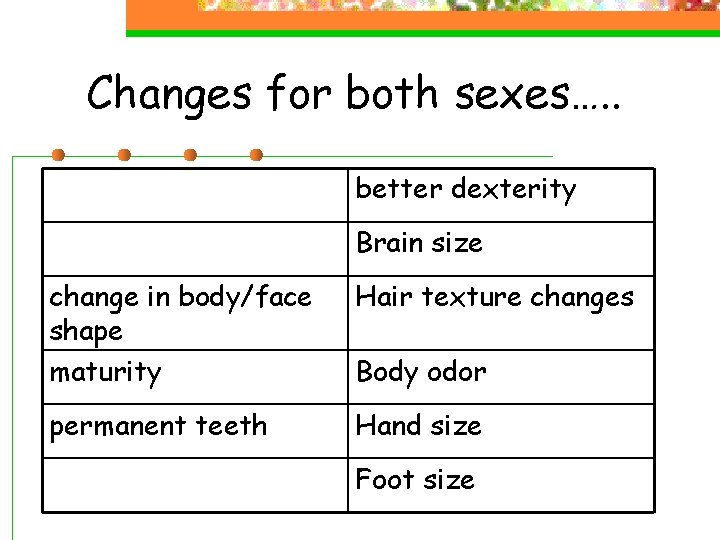
Changes for both sexes…. . better dexterity Brain size change in body/face shape maturity Hair texture changes permanent teeth Hand size Body odor Foot size
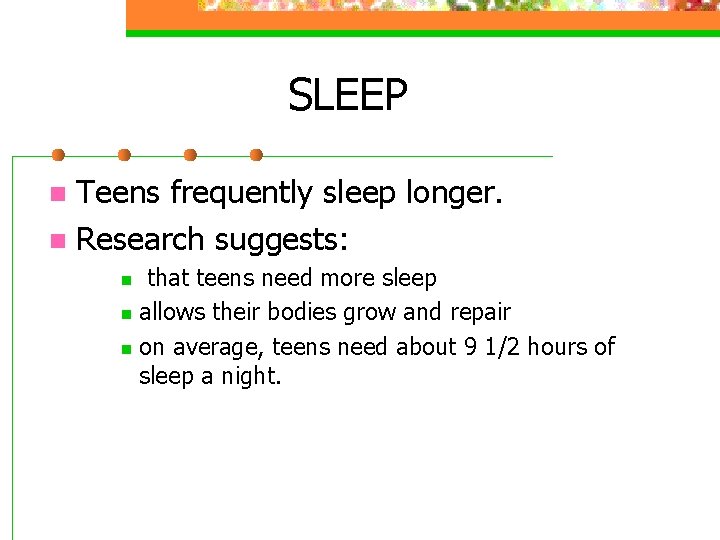
SLEEP Teens frequently sleep longer. n Research suggests: n that teens need more sleep n allows their bodies grow and repair n on average, teens need about 9 1/2 hours of sleep a night. n
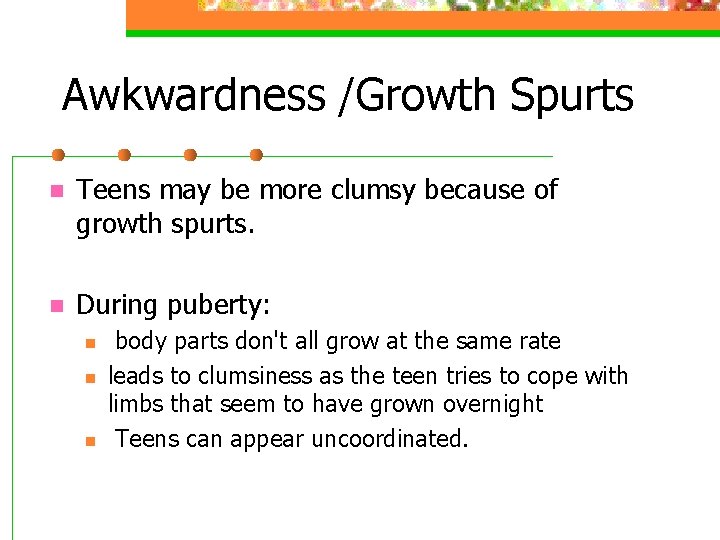
Awkwardness /Growth Spurts n Teens may be more clumsy because of growth spurts. n During puberty: n n n body parts don't all grow at the same rate leads to clumsiness as the teen tries to cope with limbs that seem to have grown overnight Teens can appear uncoordinated.
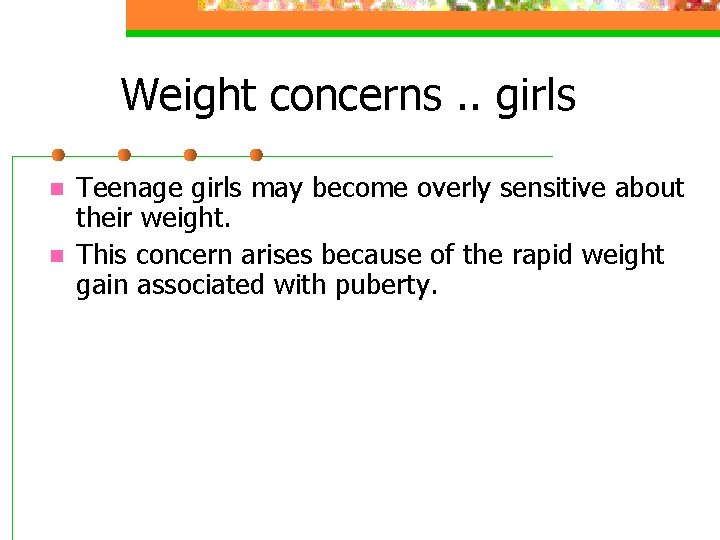
Weight concerns. . girls n n Teenage girls may become overly sensitive about their weight. This concern arises because of the rapid weight gain associated with puberty.
Weight concerns. . girls cont. n 60%of adolescent girls report that they are trying to lose weight. n A small percentage of adolescent girls (1 -3%) become so obsessed with their weight that they develop severe eating disorders such as anorexia nervosa or bulimia.
Eating Disorders…. male and female n Anorexia = self starvation n Bulimia = binge and purge n Binge Eating = bingeing on high calorie/comfort food n Anorexic/Bulimic = a combination
Developing at different rates! n Teens may be concerned because they are not physically developing at the same rate as their peers. n Teens may be more developed than their peers ("early-maturers") or less developed than their peers ("late-maturers"). n Being out of developmental "step" with peers is a concern to adolescents because most just want to fit in.
Early maturation… n Early maturation affects boys and girls differently. n BOYS……. n Research suggests that early maturing boys tend to be more popular with peers and hold more leadership positions.
early maturing… Boys continued…. n Adults often assume that early maturing boys are cognitively mature as well. n This assumption can lead to false expectations about a young person's ability to take on increased responsibility. n Risk taking
Early maturing girls n Because of their physical appearance: n n more likely to experience pressure to become involved in dating relationships with older boys before they are emotionally ready. Early maturing girls tend to suffer more from: n n n depression eating disorders anxiety.
Awkward expressing feelings n Teens may feel awkward about demonstrating affection to the opposite sex parent: n n n An teen girl who used to hug and kiss her dad may now shy away. A boy who used to kiss his mother good night may now wave to her on his way up the stairs. As they develop physically, teens are beginning to rethink their interactions with the opposite sex. n n Friendships Dating
Asking questions about sex Teens may ask more direct questions about sex: **trying to figure out their sexual values. **Teens often equate intimacy with sex. ** teens will assume that if they engage in the physical act, the emotional attachment will follow.
Puberty…. . n It is unpredictable as to EXACTLY when it will occur…. . BUT, n Puberty will eventually happen.
“Physical” changes include…. . Growth Patterns Aggressiveness Hormone Changes Primary Sex Characteristics (reproductive changes) Secondary Sex Characteristics (other changes beyond reproductive ones)
Am I normal? ? Height, foot size experiments “My shirts and pant legs are all of sudden too short”. “I now have B. O. when I never used to” “My hands can grab an adult size basketball easier now and shoe’s are changing sizes (it seems to be almost each month!)
Am I normal? ? Yes – everyone will develop into an adult! Some start sooner/later than others… slower/quicker than others…. All at their own pace. THAT IS NORMAL! Your body will develop at the time that is right for YOUR BODY!
Primary Sex Characteristics n Structures necessary for reproduction develop fully n Males> testes, penis, & related internal reproductive organs n Females> ovaries, vagina, uterus & related internal reproductive organs
Secondary Sexual Characteristics for both genders Underarm hair More body hair/texture Change in skin texture … ZITS & Oily hair ! Body Odor – need to wear deodorant
Hormonal Changes cause a “Growth Spurt” The body grows faster than it ever has (except the first year of your life). nresults low in energy levels being high and n. Appetite n. Need increases more sleep = repair and growth
Physical Growth and Development The Teenage Brain explained ( Physical Growth) https: //www. youtube. com/watch? v=hidui. Tq 1 ei 8
Growth patterns n n n Uneven – and at a different rate than peers may cause embarrassment due to lack of or over development. Awkwardness – proper coordination of all body parts haven’t developed yet. Growth of bones & muscle tissue can be painful “growing pains”
Osgood-Schlatter disease. affects the softer area of bone near the top of the shinbone, where bone growth occurs. n It's most common in boys who play games or sports that involve running or jumping. n discomfort can last a few months and may continue to recur until the child's bones stop growing. n
Aggressiveness n n n Physiological changes often cause restlessness (changes in your body) Aggressive play may be a way of reducing stress Aggressiveness may be a way to establish personal identities
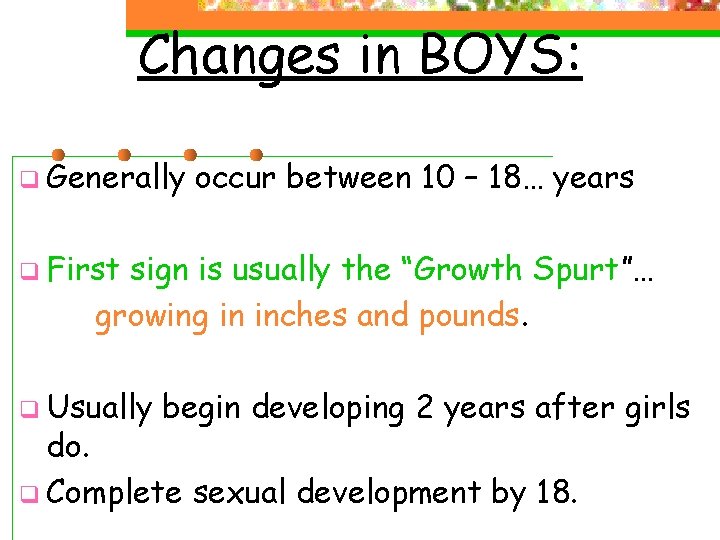
Changes in BOYS: q Generally occur between 10 – 18… years q First sign is usually the “Growth Spurt”… growing in inches and pounds. q Usually begin developing 2 years after girls do. q Complete sexual development by 18.
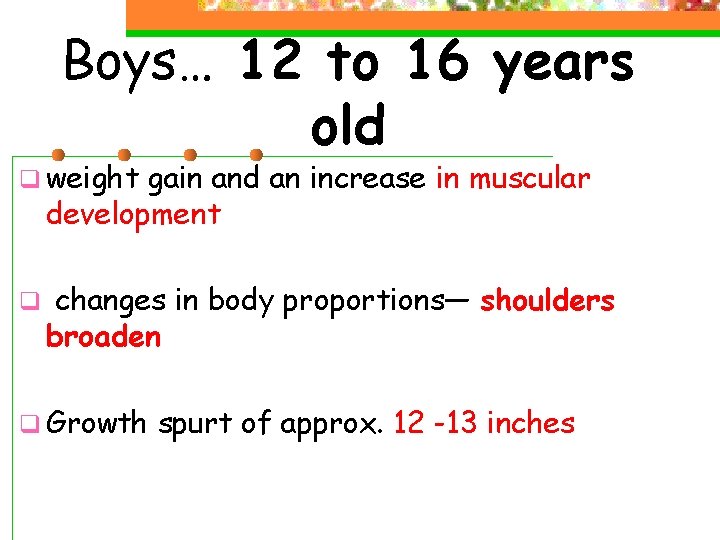
Boys… 12 to 16 years old q weight gain and an increase in muscular development q changes in body proportions— shoulders broaden q Growth spurt of approx. 12 -13 inches
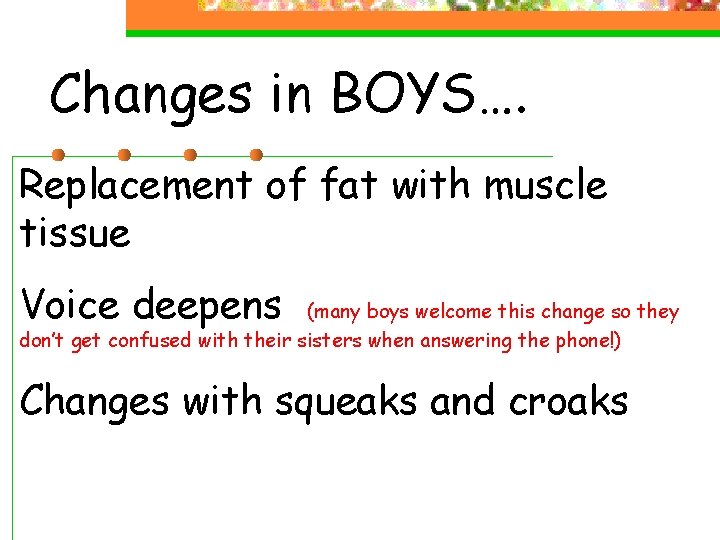
Changes in BOYS…. Replacement of fat with muscle tissue Voice deepens (many boys welcome this change so they don’t get confused with their sisters when answering the phone!) Changes with squeaks and croaks
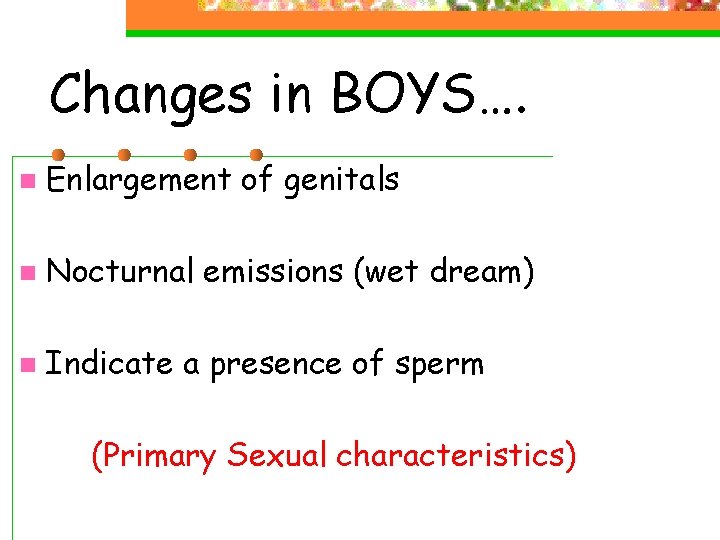
Changes in BOYS…. n Enlargement of genitals n Nocturnal emissions (wet dream) n Indicate a presence of sperm (Primary Sexual characteristics)
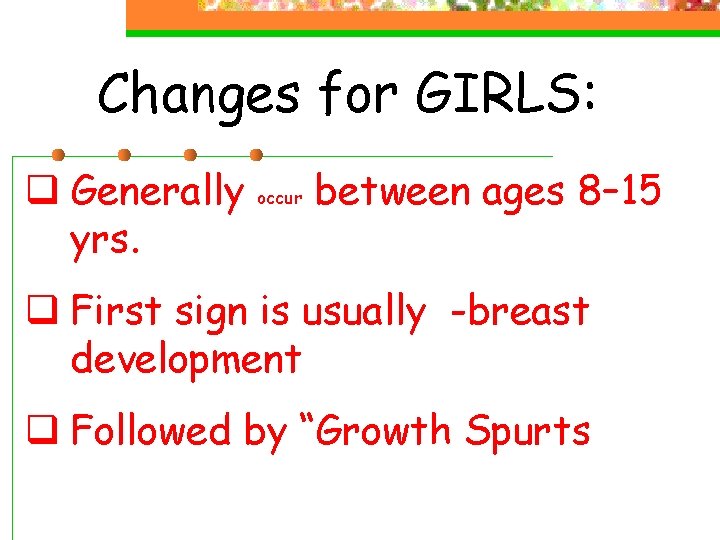
Changes for GIRLS: q Generally yrs. occur between ages 8– 15 q First sign is usually -breast development q Followed by “Growth Spurts
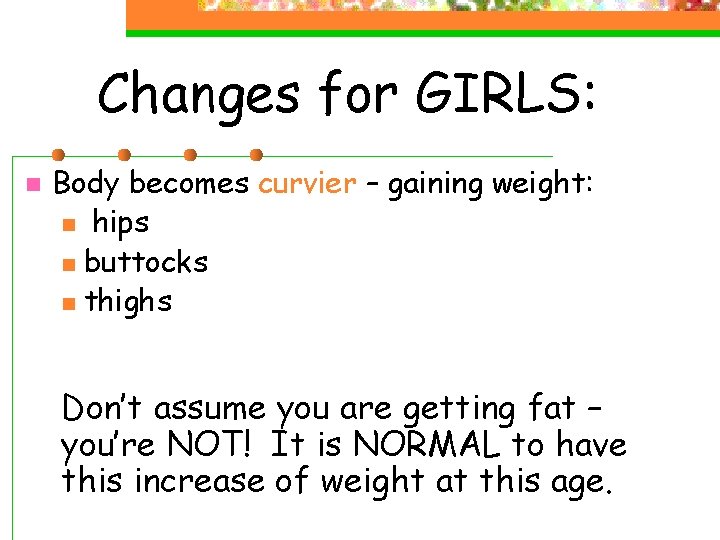
Changes for GIRLS: n Body becomes curvier – gaining weight: n hips n buttocks n thighs Don’t assume you are getting fat – you’re NOT! It is NORMAL to have this increase of weight at this age.
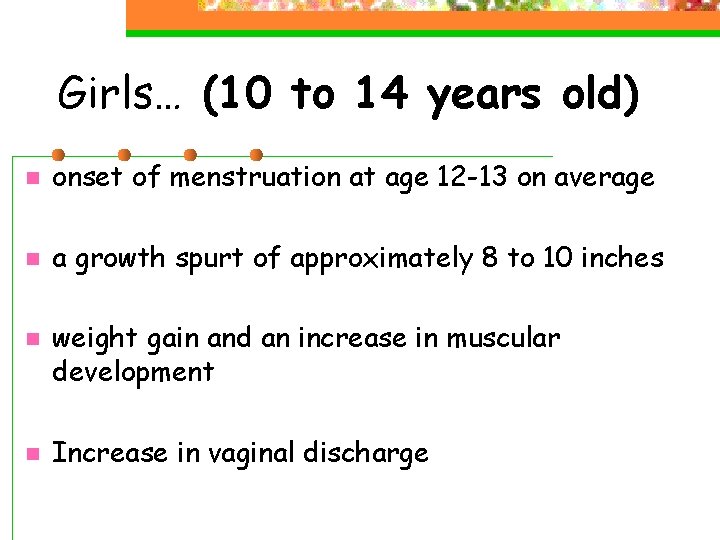
Girls… (10 to 14 years old) n onset of menstruation at age 12 -13 on average n a growth spurt of approximately 8 to 10 inches n n weight gain and an increase in muscular development Increase in vaginal discharge
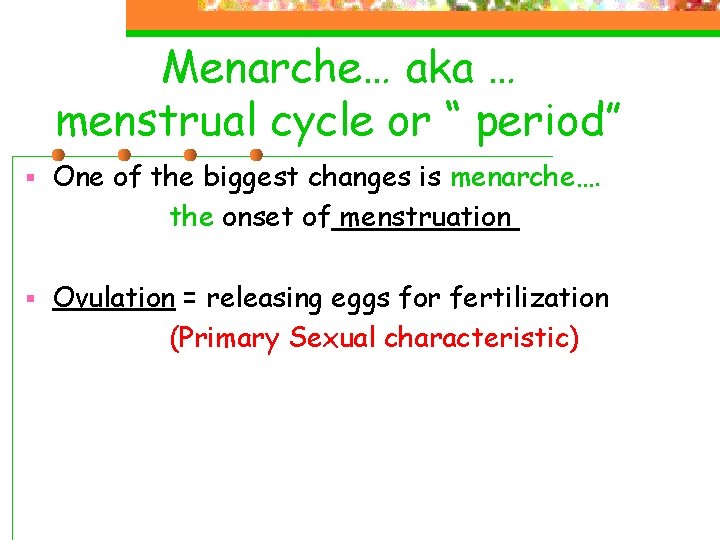
Menarche… aka … menstrual cycle or “ period” § One of the biggest changes is menarche…. the onset of menstruation § Ovulation = releasing eggs for fertilization (Primary Sexual characteristic)
Menstrual cycle n n n Releases an egg (ovum) from the ovary (girls have two of them)… OVULATION It travels down a fallopian tube (girls have two of them too)… n This is where fertilization takes place. To the uterus. n the lining of the uterus thickens and fills with extra blood and tissue to prepare for possible fertilization by sperm. (Progesterone) n IF the egg is not fertilized, the blood-filled tissue comes apart and passes out of her body through the vagina = menstruation
1 – Chronological 2 - Physical 3 – Intellectual 4 – Emotional 5 – Social 6 - Philosophical
Intellectual n n Cognitive Development During Adolescent. https: //www. youtube. com/watch? v=i. Md. Kbq fb. Eq. E
Intellectual n Thinking & Problem Solving Skills Develop n Thinking moves from concrete to abstract. Trial & Error >>>More Self Reflective>>>>View Problems with more perspective. n Increase in…. n …math n …AND the ability to THINK about the future! …. vocabulary. n …. reading. n …. & writing ability.
INTELLECTUAL n teens are beginning to think abstractly: n they can’t always predict the long-term consequences. (what are the risks? ) n Increase interest & short term enthusiasm for new ideas & projects.
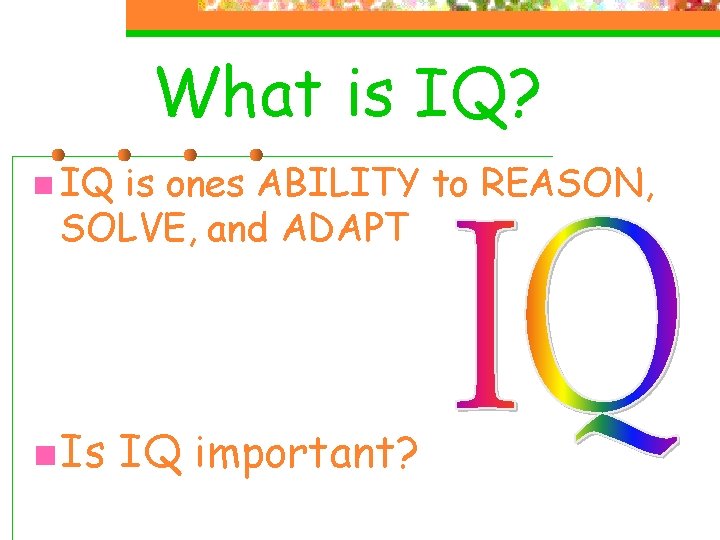
What is IQ? n IQ is ones ABILITY to REASON, SOLVE, and ADAPT n Is IQ important?
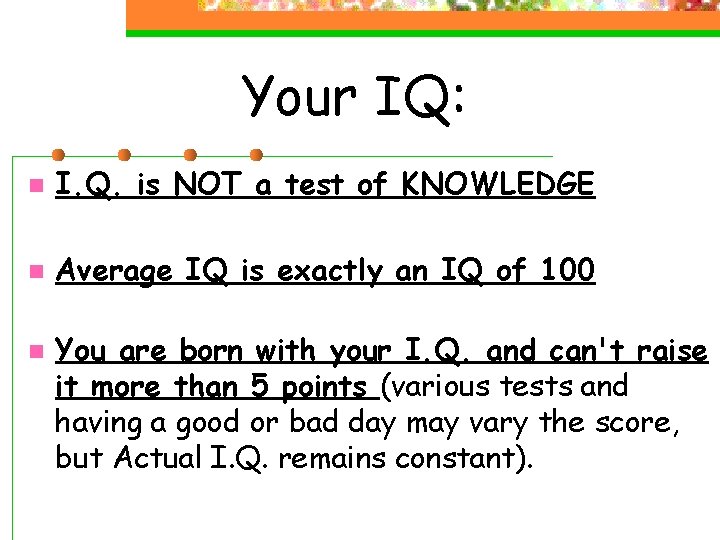
Your IQ: n I. Q. is NOT a test of KNOWLEDGE n Average IQ is exactly an IQ of 100 n You are born with your I. Q. and can't raise it more than 5 points (various tests and having a good or bad day may vary the score, but Actual I. Q. remains constant).
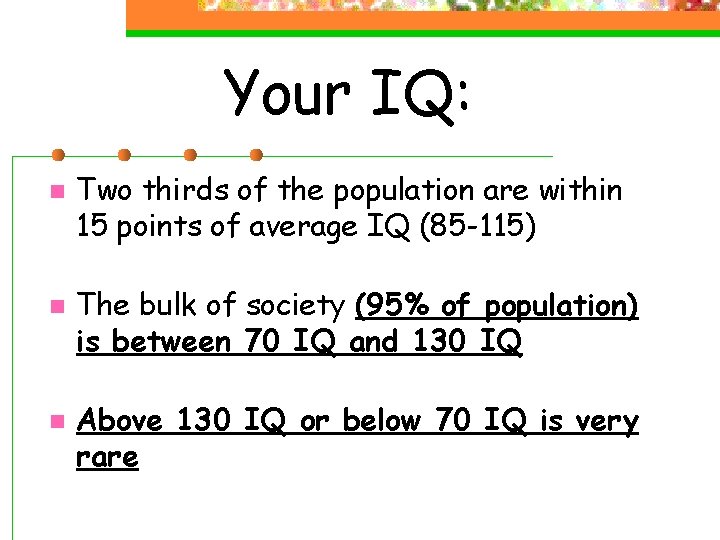
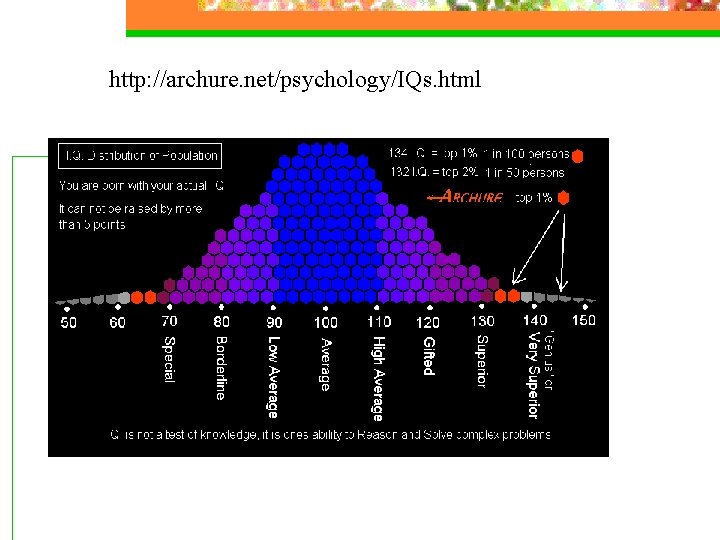
Your IQ: n n n Two thirds of the population are within 15 points of average IQ (85 -115) The bulk of society (95% of population) is between 70 IQ and 130 IQ Above 130 IQ or below 70 IQ is very rare
http: //archure. net/psychology/IQs. html
Abraham Lincoln President USA 128 Albert Einstein Physicist USA 160 Andy Warhol Pop artist USA 86 (typo? ) Arnauld Theologian France 190 Arne Beurling Mathematician Sweden 180 Arnold Schwarzenegger Actor Austria 135 Baruch Spinoza Philosopher Holland 175 Benjamin Franklin Writer, scientist & politician USA 160 Bill Gates CEO, Microsoft USA 160 Michelangelo Artist, poet & architect Italy 180 Charles Dickens Writer England 180 Leonardo da Vinci Universal Genius Italy 220 Shakira Singer Colombia 140 Sharon Stone Actress USA 154 Nicole Kidman Actor USA 132 John F. Kennedy' Ex-President USA 117 George Washington President USA 118
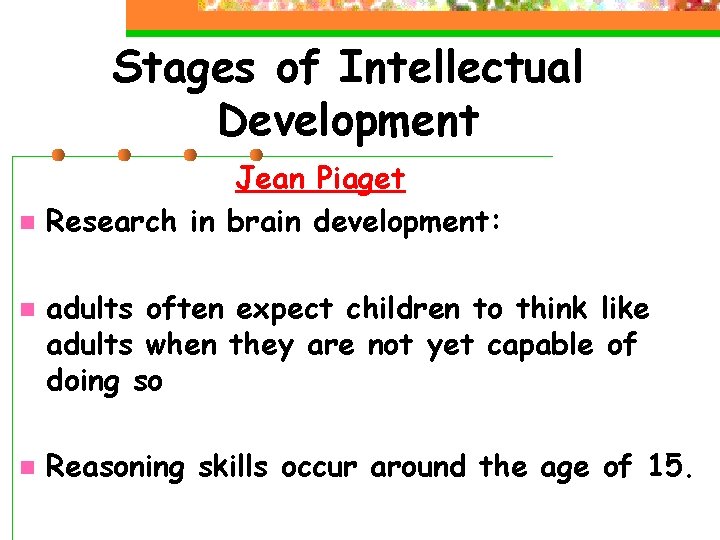
Stages of Intellectual Development n n n Jean Piaget Research in brain development: adults often expect children to think like adults when they are not yet capable of doing so Reasoning skills occur around the age of 15.
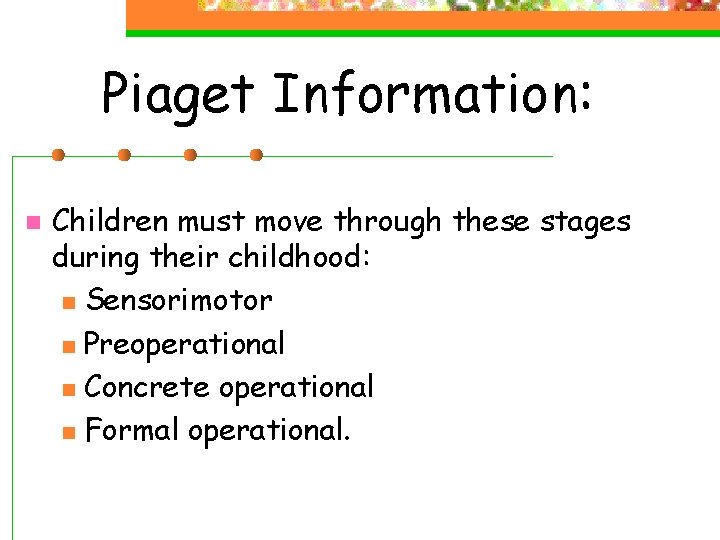
Piaget Information: n Children must move through these stages during their childhood: n Sensorimotor n Preoperational n Concrete operational n Formal operational.
n Piaget states: n n there a specific set of criteria that must be met and mastered at each stage. In order to move from the first stage to the next, the child must master that specific set of criteria.
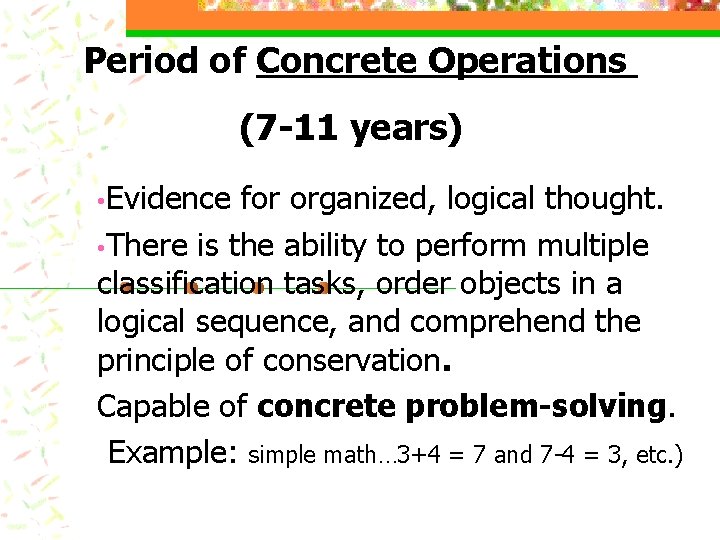
Period of Concrete Operations (7 -11 years) • Evidence for organized, logical thought. • There is the ability to perform multiple classification tasks, order objects in a logical sequence, and comprehend the principle of conservation. Capable of concrete problem-solving. Example: simple math… 3+4 = 7 and 7 -4 = 3, etc. )
Period of Formal Operations (11 -15 years) Thought becomes more abstract, incorporating the principles of formal logic. The ability to generate abstract propositions, multiple hypotheses and their possible outcomes is evident. Thinking becomes less tied to concrete reality. n Example: algebra/ geometry…Formal logical systems can be acquired. Can handle proportions, algebraic manipulation, and other purely abstract processes. If a + b = x then x = a - b. If ma/ca = IQ = 1. 00 then Ma = CA.
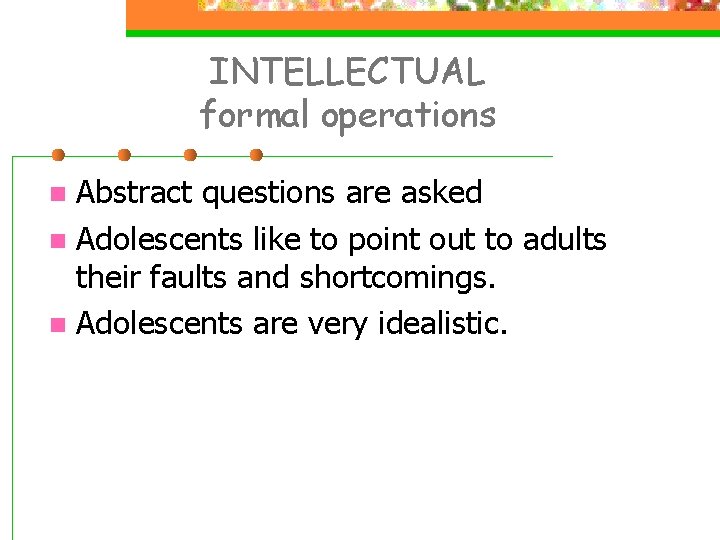
INTELLECTUAL formal operations Abstract questions are asked n Adolescents like to point out to adults their faults and shortcomings. n Adolescents are very idealistic. n
Intellectual n The Growth of Knowledge n https: //www. youtube. com/watch? v=8 nz 2 dtv--ok
Intellectual n Recent research suggests: ** teens' brains are not completely developed until late in adolescence. **connections between neurons affecting emotional, physical and mental abilities are incomplete. **could explain why some teens seem to be inconsistent in controlling their emotions, impulses, and judgments.
Intellectual Cognitive Development: n What Is It? n Most adults recognize that teens have better thinking skills than younger youth. These advances in thinking can be divided into several areas: n
Intellectual n Developing advanced reasoning skills. Advanced reasoning skills include the ability to think about multiple options and possibilities. It includes a more logical thought process and the ability to think about things hypothetically. It involves asking and answering the question, "what if. . . ? ".
Intellectual n Developing abstract thinking skills. Abstract thinking means thinking about things that cannot be seen, heard, or touched. Examples include things like faith, trust, beliefs and spirituality.
Intellectual n Developing the ability to think about thinking in a process known as "meta-cognition. " Meta -cognition allows individuals to think about how they feel and what they are thinking. It involves being able to think about how one is perceived by others. It can also be used to develop strategies, also known as mnemonic devices, for improving learning. Remembering the notes on the lines of a music staff (e, g, b, d, and f) through the phrase "every good boy does fine" is an example of such a mnemonic device.
n n How Do These Changes Affect Teens? Teens demonstrate a heightened level of selfconsciousness. Teens tend to believe that everyone is as concerned with their thoughts and behaviors as they are. This leads teens to believe that they have an "imaginary audience" of people who are always watching them.
n Teens tend to believe that no one else has ever experienced similar feelings and emotions. They may become overly dramatic in describing things that are upsetting to them. They may say things like "You'll never understand, " or "My life is ruined!"
n Teens tend to exhibit the "it can't happen to me" syndrome also known as a "personal fable. " This belief causes teens to take unnecessary risks like drinking and driving ("I won't crash this car"), having unprotected sex (I can't possibly get pregnant), or smoking (I can't possibly get cancer").
n Teens tend to become very cause-oriented. Their activism is related to the ability to think about abstract concepts. After reading about cruelty to animals a teen may become a vegetarian and a member of "People for the Ethical Treatment of Animals" (P. E. T. A. ). Another teen may become active in "Green Peace" or "Save the Whales" campaigns.
n Teens tend to exhibit a "justice" orientation. They are quick to point out inconsistencies between adults' words and their actions. They have difficulty seeing shades of gray. They see little room for error.
1 – Chronological 2 – Physical 3 – Intellectual 4 – Emotional 5 – Social 6 - Philosophical
4 - EMOTIONAL n n n 1. 2. 3. 4. Feelings Accepting feelings & learning to cope with them 4 basic emotions: Happy Sad Angry Fear
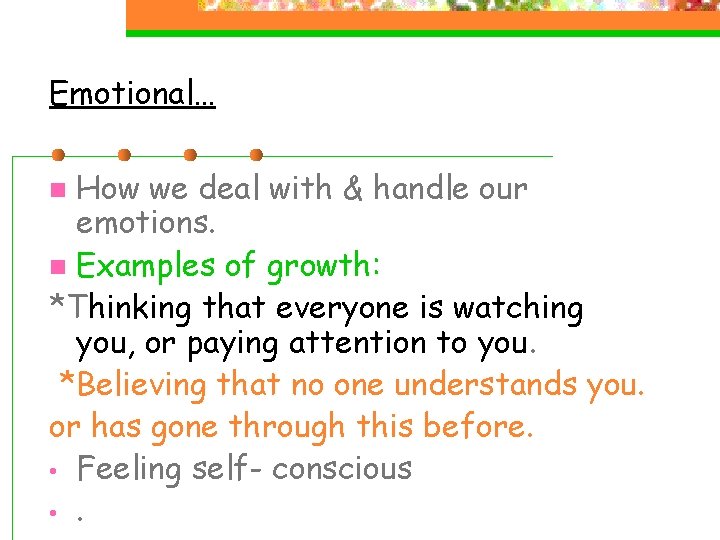
Emotional… How we deal with & handle our emotions. n Examples of growth: *Thinking that everyone is watching you, or paying attention to you. *Believing that no one understands you. or has gone through this before. • Feeling self- conscious • . n
Emotional … n Emotions may change quickly because of hormones n May be moody Mood swings – what are they? n How do they impact adolescents? n
Emotional Growth n Feeling All the Feels: n https: //www. youtube. com/watch? v=g. A Mbk. Jk 6 gn. E
1 – Chronological 2 – Physical 3 – Intellectual 4 – Emotional 5 – Social 6 - Philosophical
5 - SOCIAL n. Getting people along with n. RELATIONSHIPS
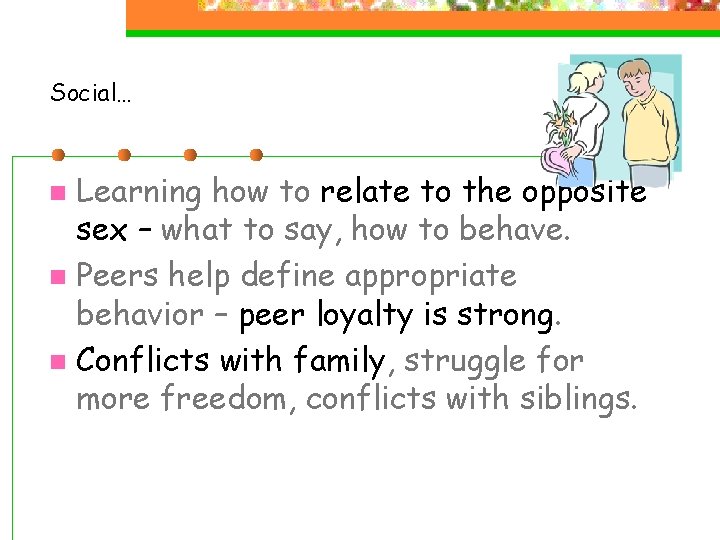
Social… Learning how to relate to the opposite sex – what to say, how to behave. n Peers help define appropriate behavior – peer loyalty is strong. n Conflicts with family, struggle for more freedom, conflicts with siblings. n
Social… Our interactions with our peers, parents, teachers, etc. n Moving from thinking that parents are most important ……. . to friends being most important. n (but they really aren’t!) n Belief that you are immortal – risk taking. http: //www. videobash. com/video_show/welcome-to-earth-264455
Social… n How does Social Media affect a teens social growth? ? ? n https: //www. youtube. com/watch? v=Hff WFd_6 b. J 0
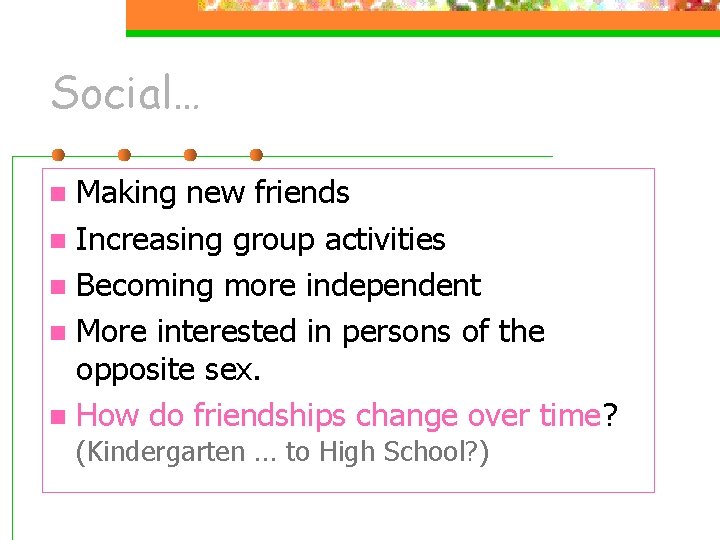
Social… Making new friends n Increasing group activities n Becoming more independent n More interested in persons of the opposite sex. n How do friendships change over time? n (Kindergarten … to High School? )
Social n Social Thinking n https: //www. youtube. com/watch? v=UG x. GDd. Qn. C 1 Y
1 - Chronological 2 – Physical 3 – Intellectual 4 – Emotional 5 – Social 6 - Philosophical
6 - PHILOSOPHICAL n A search for values &/or the meaning of life.
PHILOSOPHICAL n n n Deciding what is right and wrong and why. Asking and thinking about life questions, Meaning of life, A basic outlook on life. Someone who is becoming philosophically mature has asked themselves these kind of questions……
Questions asked by teens during philosophical growth: n Who am I? n Why was I born? n What’s life about? n What will my future be like? n What do I want to do as a career? n How do I understand my purpose in life? n What will I contribute to this world? n What are my obligations to humanity? Do 2 years olds ask themselves these questions? Why or why not
The Tasks of adolescents. . n establish a stable identity n become complete and productive adults n develop a sense of themselves n find their role in society n awareness of self and influence others’
8 Developmental Tasks for Adolescents n adolescence is marked by a multitude of changes — biological, physical, intellectual, and emotional. n There are eight main developmental tasks that adolescents must complete in order to establish an identity.
1. Achieving new and more mature girls, in one’s age group. n n n Adolescents learn through interacting with others in more adult ways. Physical maturity plays an important role in peer relations. Adolescents who mature at a slower or faster rate than others will be dropped from one peer group and generally will enter a peer group of similar maturity. For early maturing girls (girls whose bodies are fully developed at a young age), entering into a peer group of similar physical maturity can mean a greater likelihood of early sexual activity. parents need to place limits on adolescents’ outside activities.
2. Achieving a masculine or feminine social role. n n n Each adolescent develops his or her own definition of what it means to be male or female. Most adolescents conform to the sex roles of our cultural view of male (assertive) and female (passive) characteristics. Yet these roles have become more relaxed in the last 30 years. develop their masculine and feminine social roles.
3. Accepting one’s physique. n The time of the onset of puberty and the rate of body changes for adolescents vary greatly. How easily adolescents deal with these changes will partly depend on how closely their bodies match the well-defined stereotypes of the “perfect” body for young women and young men.
4. Achieving emotional independence from parents and other adults. n n Children derive strength from internalizing their parents’ values and attitudes. Adolescents, however, must redefine their sources of personal strength and move toward self-reliance. This change is smoother if adolescents and parents can agree on some level of independence that increases over time. For example, parents and adolescents should set a curfew time. That curfew should be extended as the adolescent matures.
5. Preparing for marriage and family life. Sexual maturation is the basis for this developmental task. n Achievement of this developmental task is difficult because adolescents often confuse sexual feelings with genuine intimacy. n Indeed, this developmental task is usually not achieved until late adolescence or young adulthood. n
6. Preparing for an economic career. n n n In American society, adolescents reach adult status when they are able to financially support themselves. This task has become more difficult now than in the past because the job market demands increased education and skills. Today, this developmental task is generally not achieved until late adolescence or young adulthood, after the individual completes his/her education and gains some entry-level work experience.
7. Acquiring a set of values and an ethical system as a guide to behavior; developing an ideology. n n n Adolescents gain the ability to think abstractly and to visualize possible situations. With these changes in thinking, the adolescent is able to develop his or her own set of values and beliefs. Discussing these newly forming ethical systems with parents and other adults can be a great help to adolescents in accomplishing this developmental task. In addition, parents may want to provide adolescents with hypothetical situations that challenge their emerging values, to help the adolescents evaluate the strength and appropriateness of those values.
8. Desiring and achieving socially responsible behavior. n n The family is where children learn to define themselves and their world. Adolescents must learn to define themselves and their world in the context of their new social roles. Status within the community beyond that of family is an important achievement for older adolescents and young adults. Adolescents and young adults become members of the larger community through financial and emotional independence from parents, which in turn teaches them the value of socially responsible behavior.
In summary… The many developmental tasks facing adolescents are challenging, but they are achievable. n Adolescents are getting their first taste of independence, yet they are not, and do not want to be, totally independent. n