
Areas of development that influence stages in the





- Slides: 69
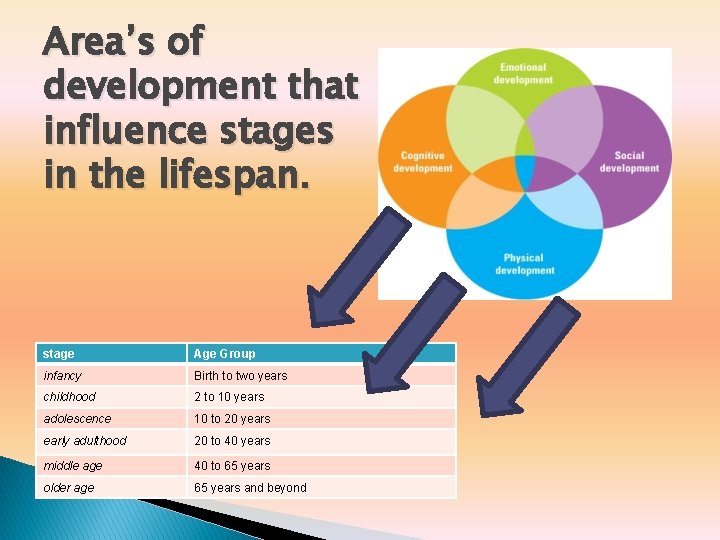
Area’s of development that influence stages in the lifespan. stage Age Group infancy Birth to two years childhood 2 to 10 years adolescence 10 to 20 years early adulthood 20 to 40 years middle age 40 to 65 years older age 65 years and beyond
EMOTIONAL DEVELOPMENT
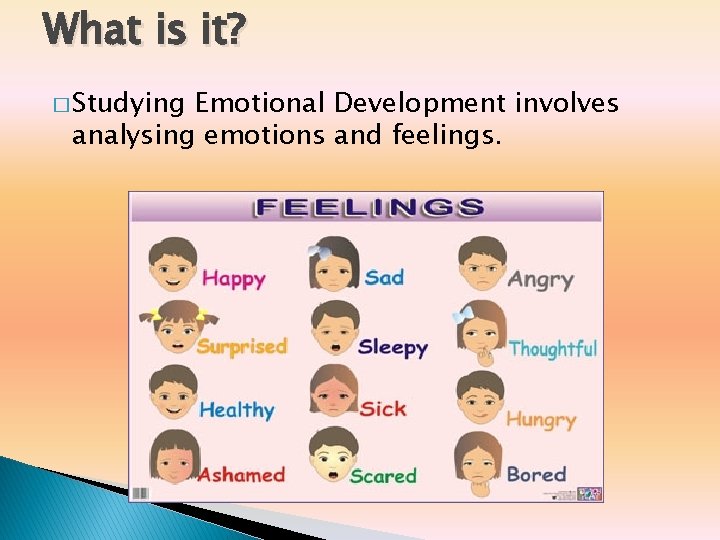
What is it? � Studying Emotional Development involves analysing emotions and feelings.
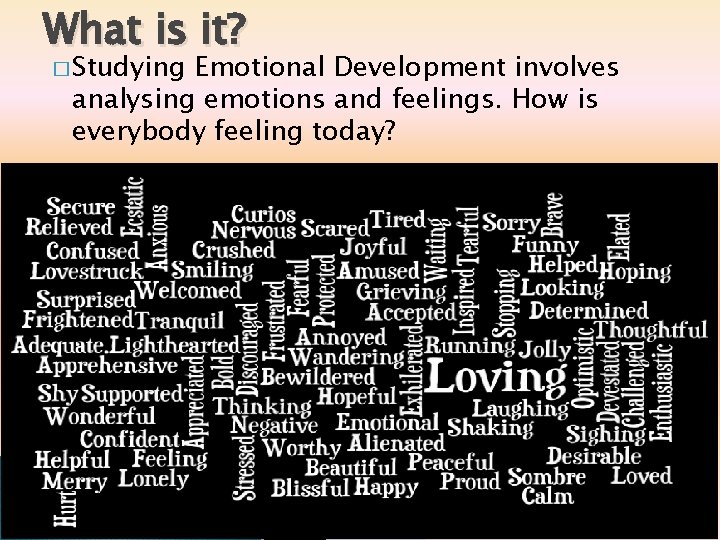
What is it? � Studying Emotional Development involves analysing emotions and feelings. How is everybody feeling today?
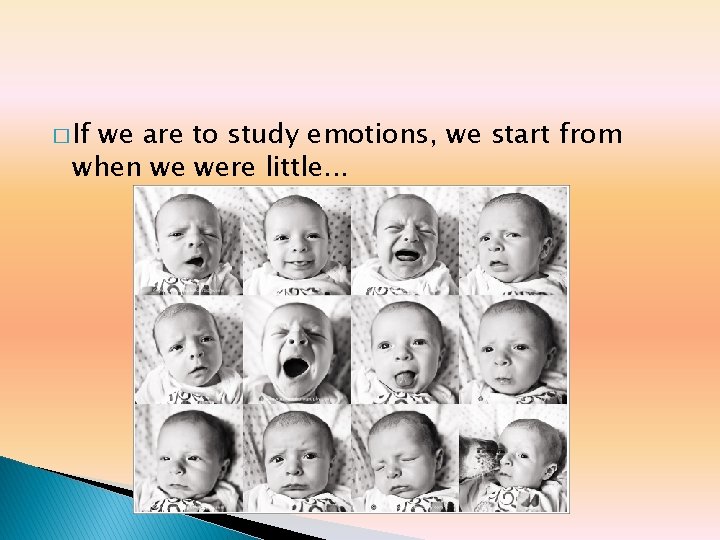
� If we are to study emotions, we start from when we were little. . .
. . And the first think we look at is ATTACHMENT
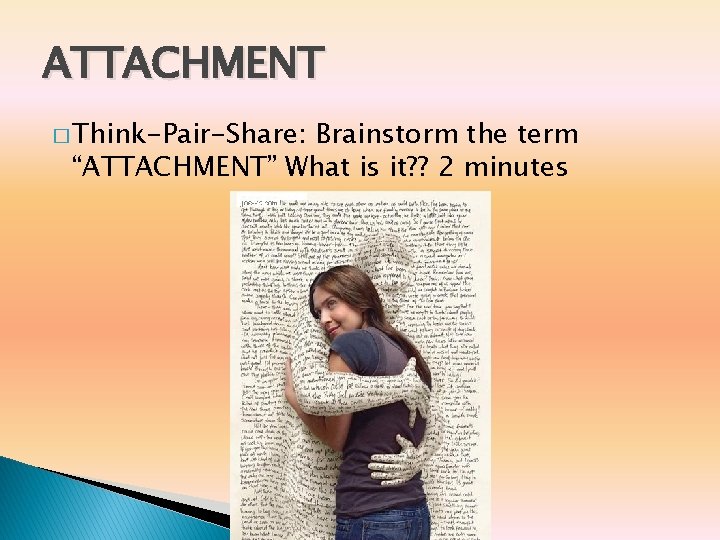
ATTACHMENT � Think-Pair-Share: Brainstorm the term “ATTACHMENT” What is it? ? 2 minutes
Attachment – definitions (p. 184) - Psychological bond First described by psychologist John Bowlby, nowadays described as ‘the tendency of infants to form an emotional bond to another person, usually their main caregiver’
Why study ATTACHMENT? ? Psychologists believe that the attachments formed during infancy – particularly in the first 12 months of life – has a considerable influence on a person’s emotional development throughout the life.
Key words: Attachment figure / Attachment target = the person to whom the infant is attached to most
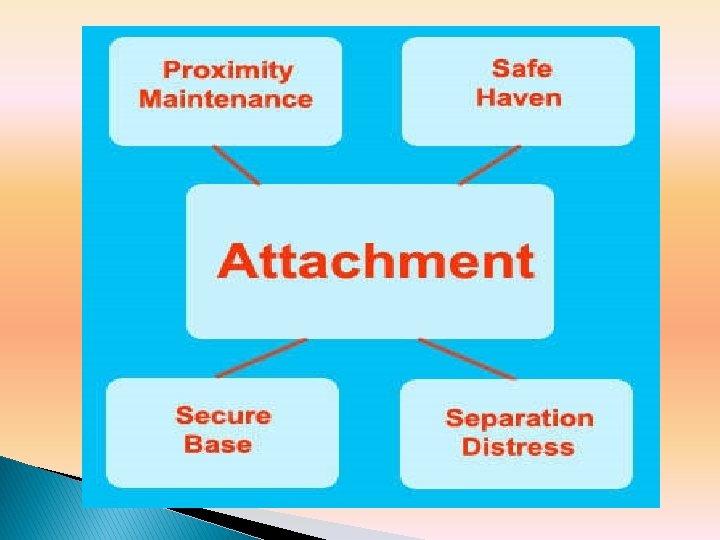
Bowlby thought that 4 things need to be present for a strong, solid and safe attachment to form:
� Proximity maintenance
� Proximity maintenance = the infant wants to be near the person to whom it is attached
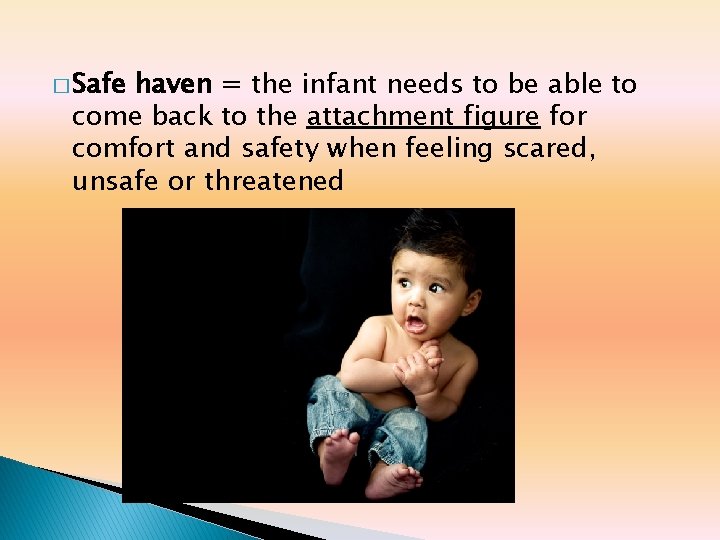
� Safe haven
� Safe haven = the infant needs to be able to come back to the attachment figure for comfort and safety when feeling scared, unsafe or threatened
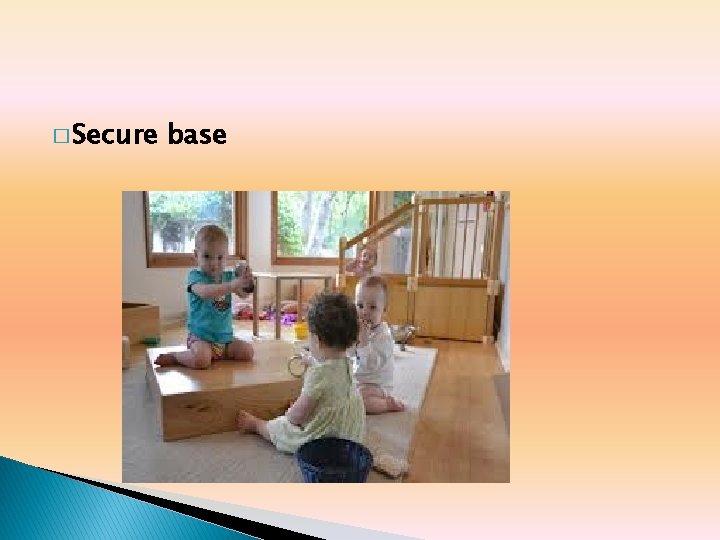
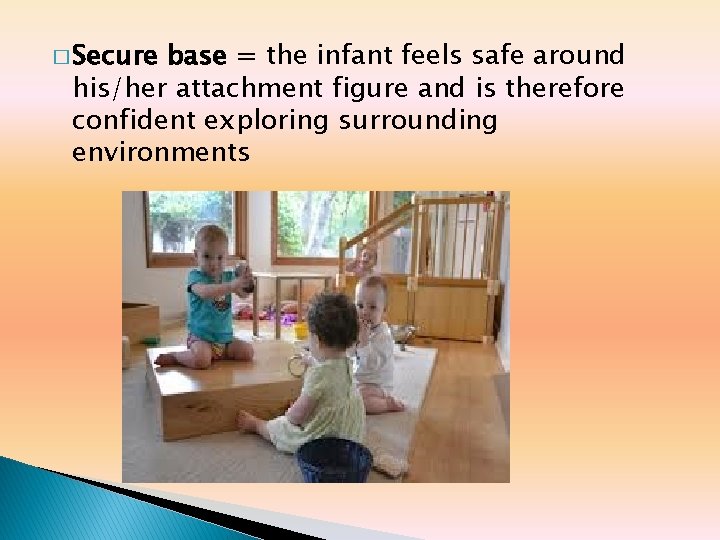
� Secure base
� Secure base = the infant feels safe around his/her attachment figure and is therefore confident exploring surrounding environments
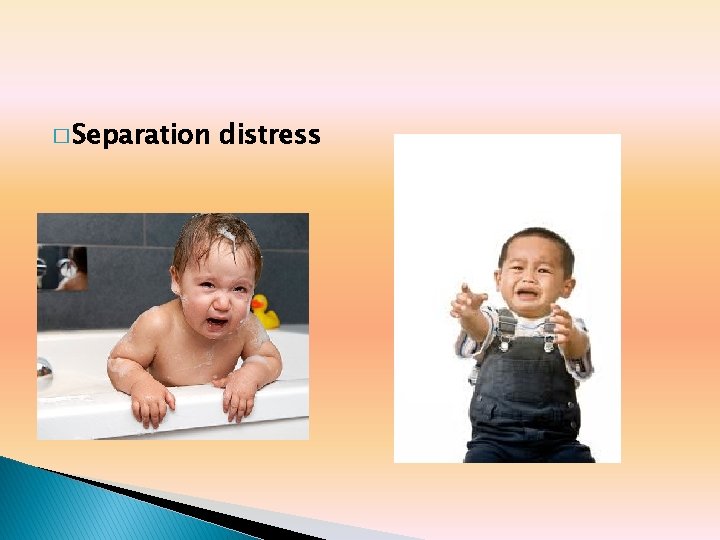
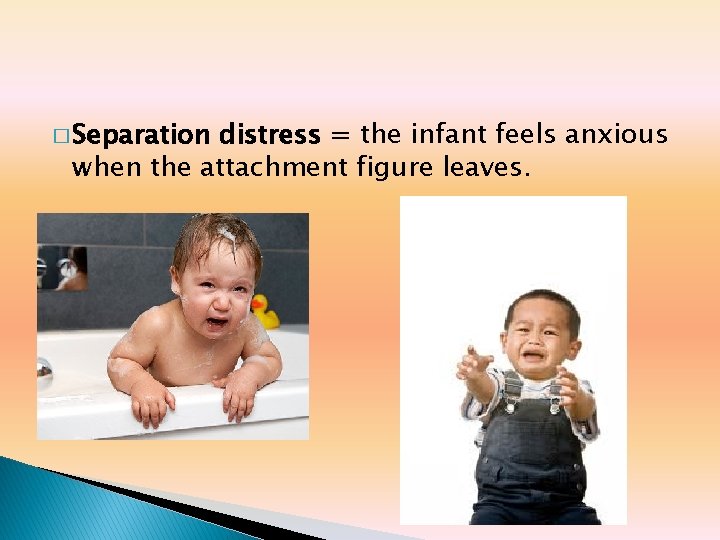
� Separation distress
� Separation distress = the infant feels anxious when the attachment figure leaves.
Bowlby thought that the attachment/bond is important for two reasons: - For healthy emotional development later in life Evolutionary function – improves chances of survival
Is it true that infants’ main/primary attachment figure is their mother? Individually think (if you can remember) when you were an infant, who were you more attached to? Mother? Father? Grandparents? Other carers? ? ? Why? If you can’t remember, think of someone else’s infants. Who are they mostly attached to and why?
Bowlby’s controversial idea was that: Mothers are the best attachment figures. Now you know that it’s not true.
Possible Indicators of Attachment � Some occur more frequently, others may not occur at all � L. A 5. 7 / p. 188 � 2 groups perform, each group performs 2 behaviours that indicate attachment
Recap Quiz from last lesson: 1. Emotional development: a) Begins at birth and ends at age 12 Is a life long process Formed during infancy has a considerable influence on a person’s emotional development throughout the life. Has its peak in middle age b) and c) b) c) d) e)
2. Attachment is. . . Formed between the infant and their caregiver a) b) c) d) Psychological bond Cognitive bond Social bond Toddler bond
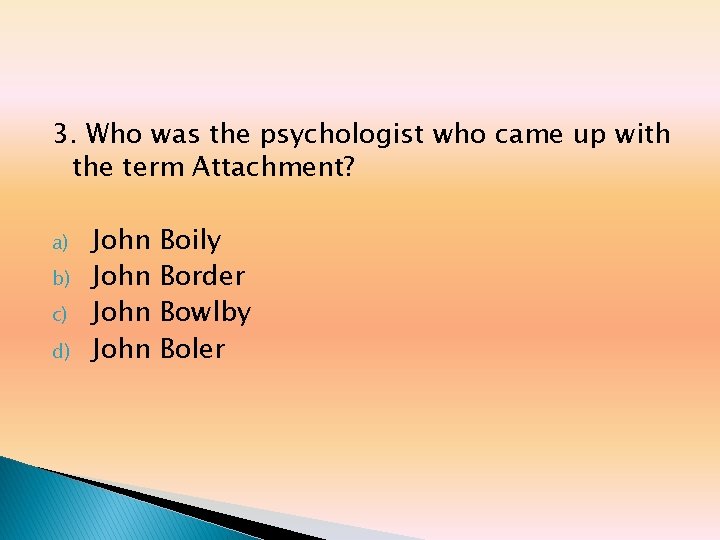
3. Who was the psychologist who came up with the term Attachment? a) b) c) d) John Boily Border Bowlby Boler
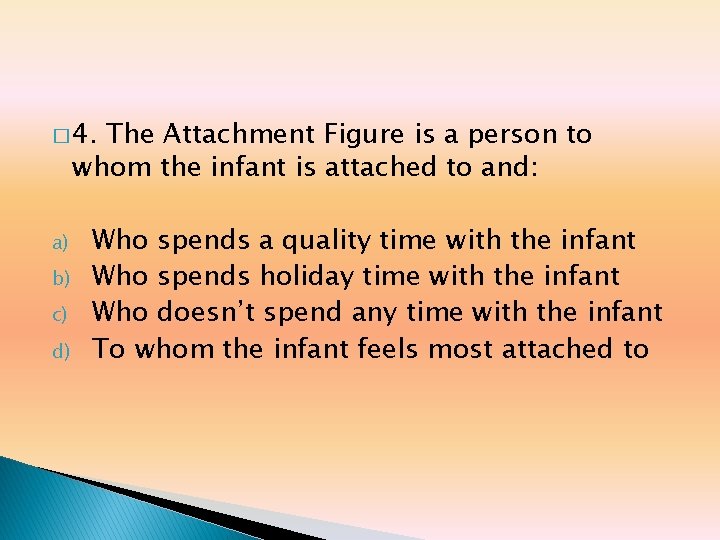
� 4. The Attachment Figure is a person to whom the infant is attached to and: a) b) c) d) Who spends a quality time with the infant Who spends holiday time with the infant Who doesn’t spend any time with the infant To whom the infant feels most attached to
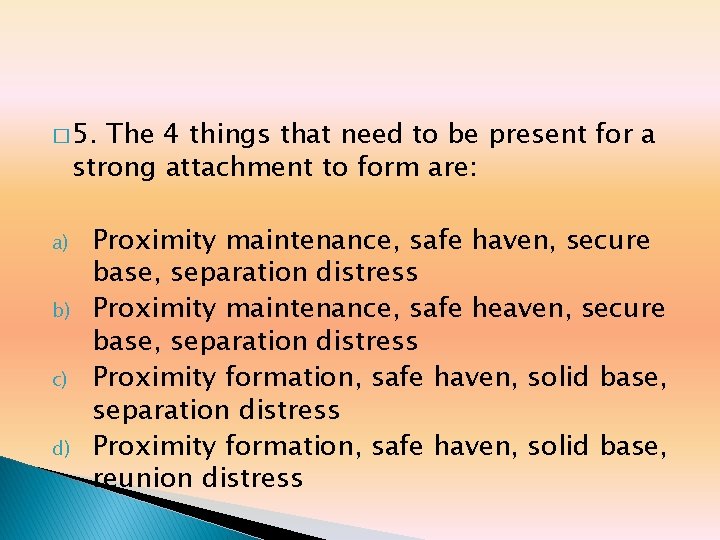
� 5. The 4 things that need to be present for a strong attachment to form are: a) b) c) d) Proximity maintenance, safe haven, secure base, separation distress Proximity maintenance, safe heaven, secure base, separation distress Proximity formation, safe haven, solid base, reunion distress
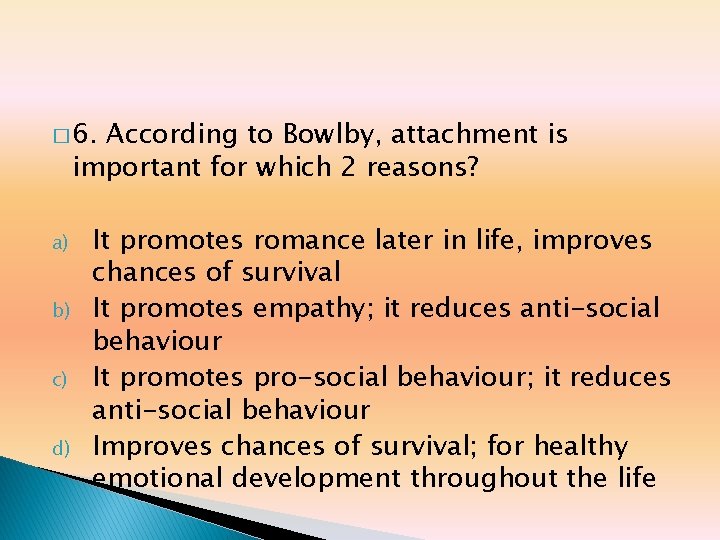
� 6. According to Bowlby, attachment is important for which 2 reasons? a) b) c) d) It promotes romance later in life, improves chances of survival It promotes empathy; it reduces anti-social behaviour It promotes pro-social behaviour; it reduces anti-social behaviour Improves chances of survival; for healthy emotional development throughout the life
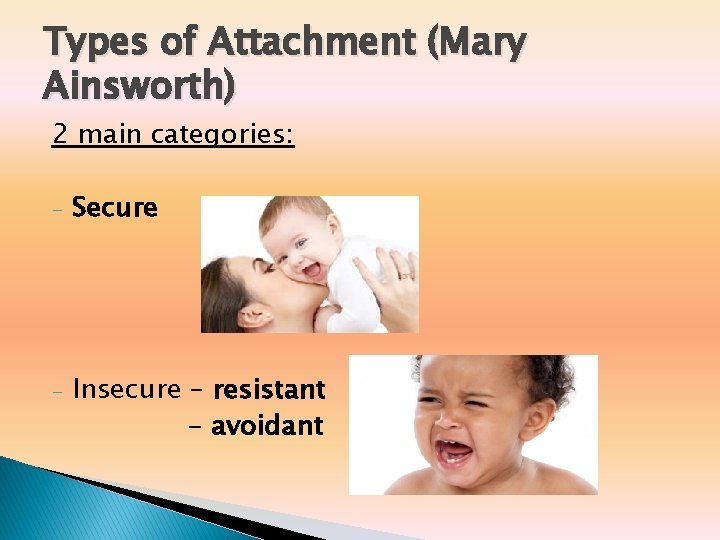
Types of Attachment (Mary Ainsworth) 2 main categories: - Secure - Insecure – resistant - avoidant
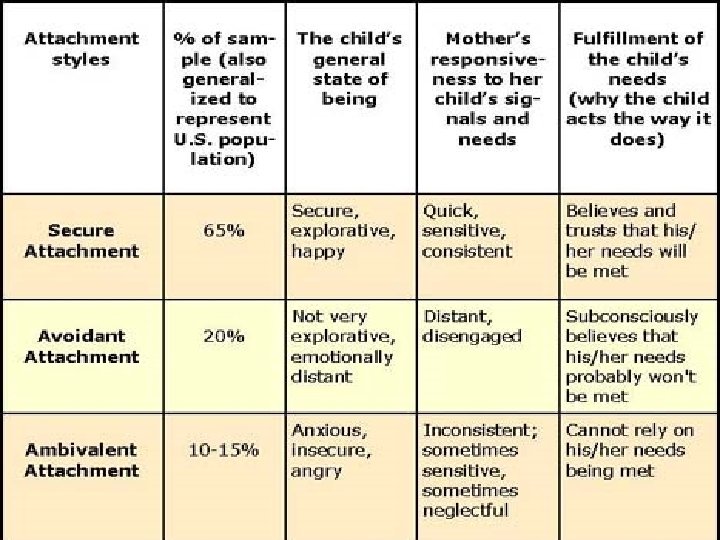
Secure attachment � Secure attachment ◦ Infants show distress when the mother leaves and are delighted to see her when she returns ◦ Their distress quickly disappears and they happily cuddle with her ◦ About 65% of one-year-olds are securely attached.
Insecure attachment � Insecure-avoidant attachment ◦ Children show very little or no reaction when the mother leaves them, or when she comes back ◦ May be the result of neglectful or abusive caregivers. ◦ About 20% of one-year-olds are in this category
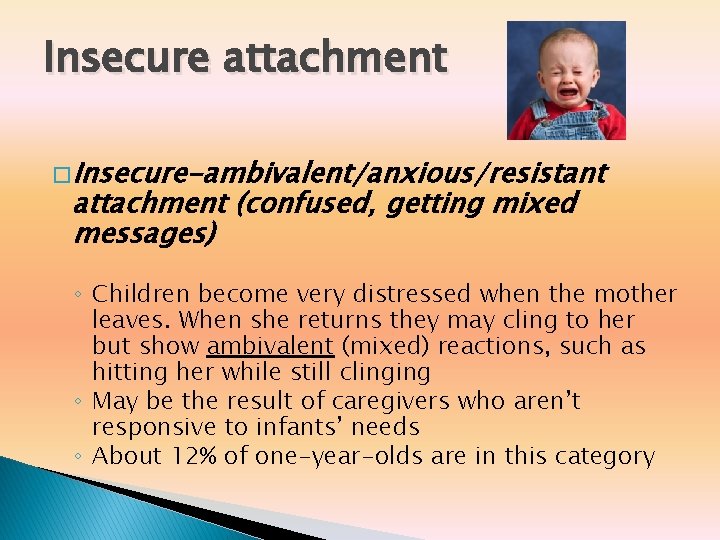
Insecure attachment � Insecure-ambivalent/anxious/resistant attachment (confused, getting mixed messages) ◦ Children become very distressed when the mother leaves. When she returns they may cling to her but show ambivalent (mixed) reactions, such as hitting her while still clinging ◦ May be the result of caregivers who aren’t responsive to infants’ needs ◦ About 12% of one-year-olds are in this category
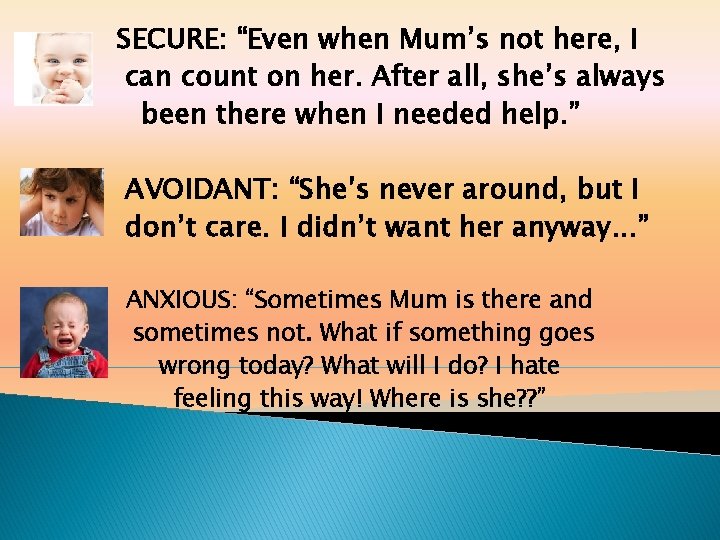
SECURE: “Even when Mum’s not here, I can count on her. After all, she’s always been there when I needed help. ” AVOIDANT: “She’s never around, but I don’t care. I didn’t want her anyway. . . ” ANXIOUS: “Sometimes Mum is there and sometimes not. What if something goes wrong today? What will I do? I hate feeling this way! Where is she? ? ”
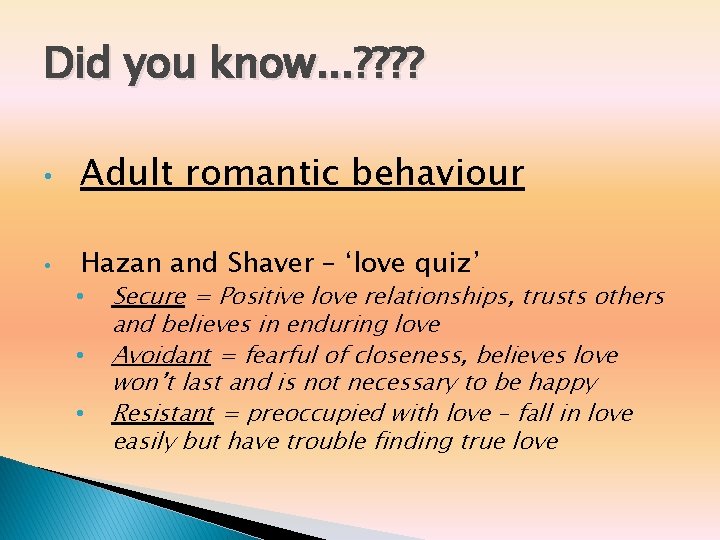
Did you know. . . ? ? • Adult romantic behaviour • Hazan and Shaver – ‘love quiz’ • • • Secure = Positive love relationships, trusts others and believes in enduring love Avoidant = fearful of closeness, believes love won’t last and is not necessary to be happy Resistant = preoccupied with love – fall in love easily but have trouble finding true love
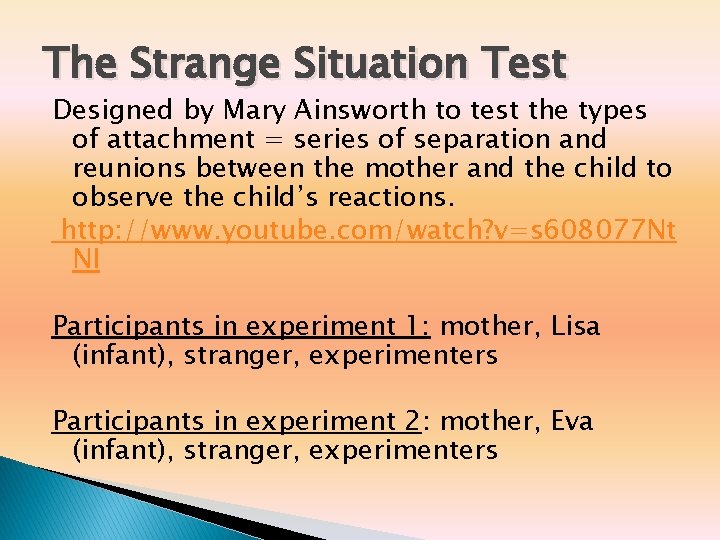
The Strange Situation Test Designed by Mary Ainsworth to test the types of attachment = series of separation and reunions between the mother and the child to observe the child’s reactions. http: //www. youtube. com/watch? v=s 608077 Nt NI Participants in experiment 1: mother, Lisa (infant), stranger, experimenters Participants in experiment 2: mother, Eva (infant), stranger, experimenters
Your tasks
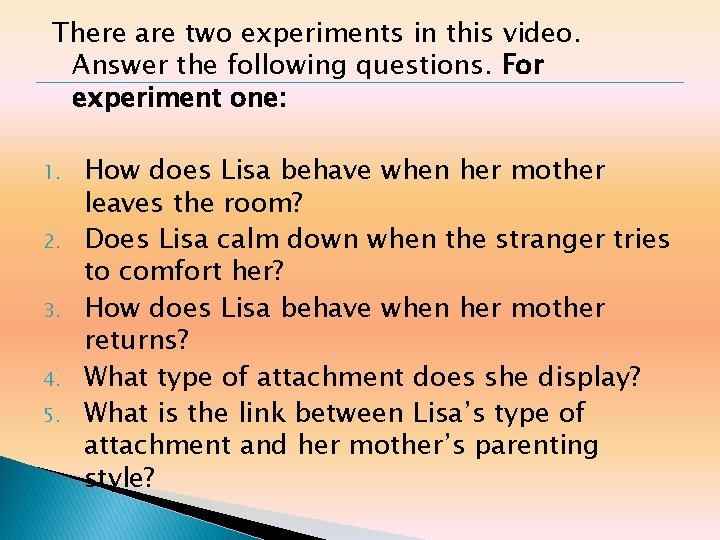
There are two experiments in this video. Answer the following questions. For experiment one: 1. 2. 3. 4. 5. How does Lisa behave when her mother leaves the room? Does Lisa calm down when the stranger tries to comfort her? How does Lisa behave when her mother returns? What type of attachment does she display? What is the link between Lisa’s type of attachment and her mother’s parenting style?
For experiment two: 1. 2. 3. 4. How does Eva behave when her mother leaves the room? How else is Eva different from Lisa? What type of attachment does Eva display? What is the link between Lisa’s type of attachment and her mother’s parenting style? (Listen to what the psychologist in black suit and glasses have to say)
Individual Task � On your laptops go to You. Tube and find a video of a child who demonstrates Ambivalent / Resistant attachment in relation to their caregiver
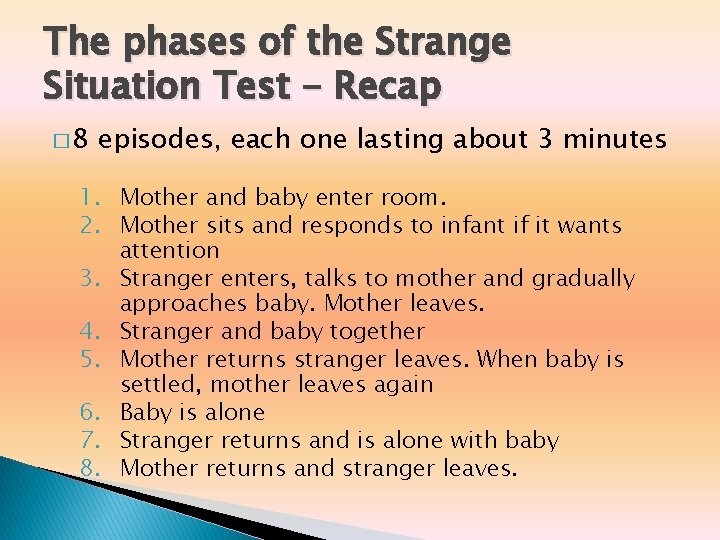
The phases of the Strange Situation Test - Recap � 8 episodes, each one lasting about 3 minutes 1. Mother and baby enter room. 2. Mother sits and responds to infant if it wants attention 3. Stranger enters, talks to mother and gradually approaches baby. Mother leaves. 4. Stranger and baby together 5. Mother returns stranger leaves. When baby is settled, mother leaves again 6. Baby is alone 7. Stranger returns and is alone with baby 8. Mother returns and stranger leaves.
The stages of the Strange Situation Test – you also find this on p. 190, Table 5. 1 What do these key words mean to you in relation to Ainsworth’s Strange Situation Test? Stranger anxiety Separation anxiety Reunion
Play – The Strange Situation Test 3 people in each scenario. 1. 2. 3. Secure attachment Insecure avoidant attachment Insecure ambivalent/resistant attachment Before you perform, tell us who is the mother, who is the child and who is the stranger.
Textbook p. 191, L. A. 5. 8 Choose to do this activity as a class discussion OR write the answers in your notebook. 2 groups – group 1 discusses the five points with the teacher - group 2 writes the answers in the notebook
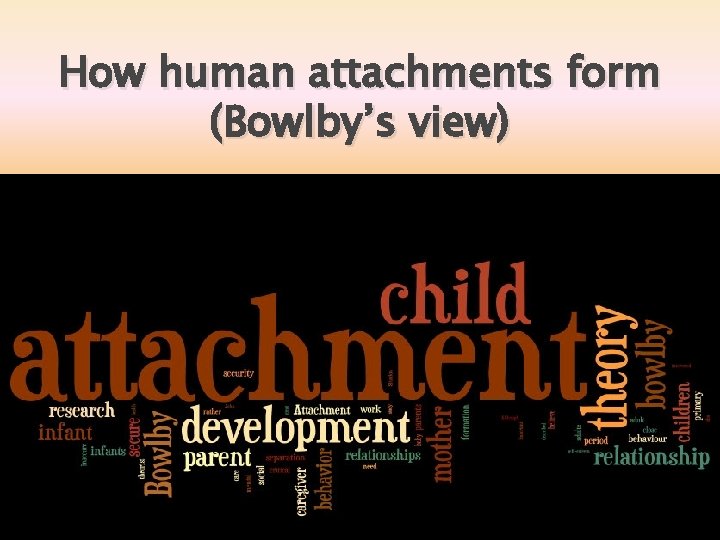
How human attachments form (Bowlby’s view)
Multiply & Merge activity – p. 191 -192 1. 2. 3. Individually read the text on pp. 191 – 192 and choose 4 ideas/facts that you find most interesting / worth knowing. Pair up with someone else and negotiate your and their ideas down to a list of 4 (8 ideas become 4) Each pair joins another pair to become a group of four and they negotiate their list (8 ideas) down to final 4 ideas/facts.
What 4 ideas/facts did you find most interesting? � Each group shares their 4 ideas to the class
The 4 facts I (Lucie) found most interesting. . . 1. 2. 3. 4. Attachment is a two-way relationship Sensitive/Critical period The impact of children who spent their childhood in orphanages with minimal physical contact with a carer -> emotionally withdrawn and overwhelmed by interactions with other children later on Most contemporary psychologists do not agree with Bowlby that there is a sensitive period for human infant-caregiver attachment
Welcome Back
HW 1: Factors influencing attachment p. 193 Task 1: List at least 2 characteristics of the caregiver that have an impact on forming an attachment Task 2: List at least 2 characteristics of the infant that have an impact on forming an attachment
HW 2: Revision Worksheet Individually complete this Worksheet that I just gave you – Activity 6. 3
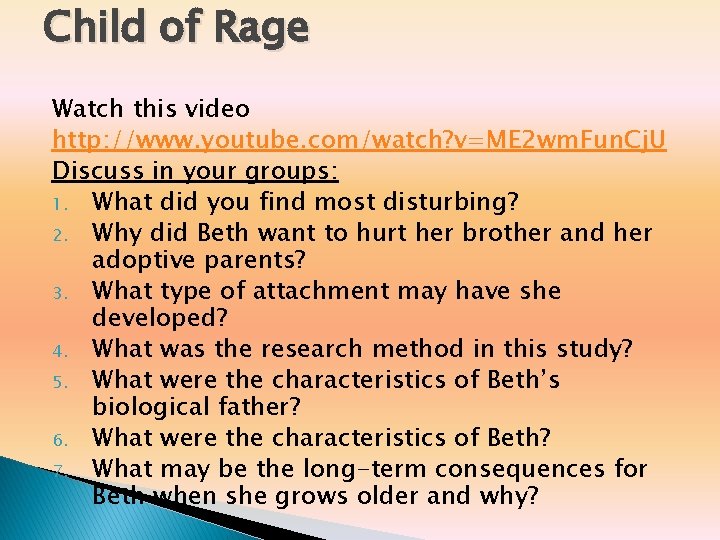
Child of Rage Watch this video http: //www. youtube. com/watch? v=ME 2 wm. Fun. Cj. U Discuss in your groups: 1. What did you find most disturbing? 2. Why did Beth want to hurt her brother and her adoptive parents? 3. What type of attachment may have she developed? 4. What was the research method in this study? 5. What were the characteristics of Beth’s biological father? 6. What were the characteristics of Beth? 7. What may be the long-term consequences for Beth when she grows older and why?
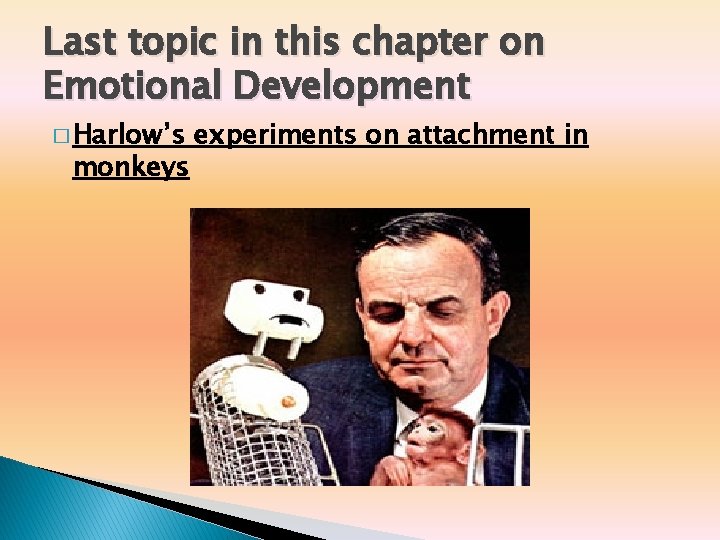
Last topic in this chapter on Emotional Development � Harlow’s monkeys experiments on attachment in
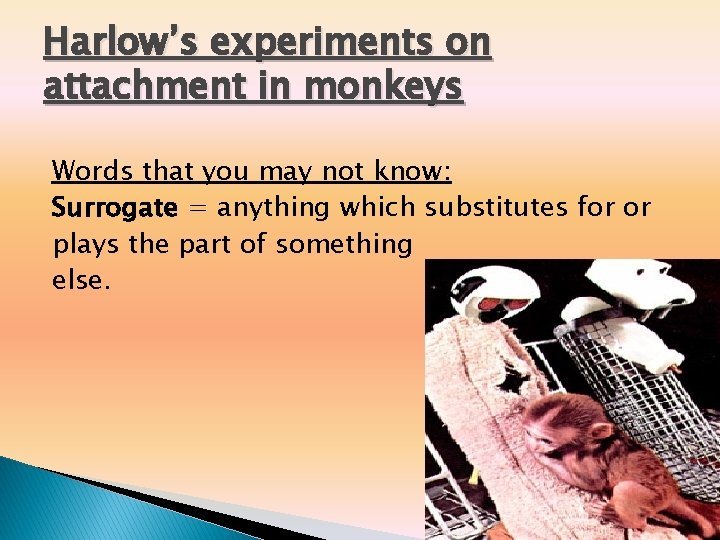
Harlow’s experiments on attachment in monkeys Words that you may not know: Surrogate = anything which substitutes for or plays the part of something else.
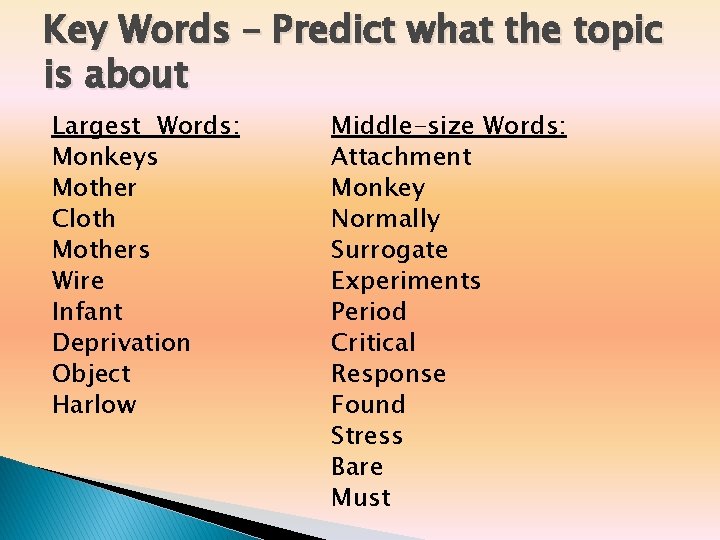
Key Words – Predict what the topic is about Largest Words: Monkeys Mother Cloth Mothers Wire Infant Deprivation Object Harlow Middle-size Words: Attachment Monkey Normally Surrogate Experiments Period Critical Response Found Stress Bare Must
Videos on this topic: http: //www. youtube. com/watch? v=_O 60 TYAIg. C 4 http: //www. youtube. com/watch? v=hs. A 5 Sec 6 d. AI Textbook – p. 195, 196 - What is this topic about? 1. Individually highlight in your text - Main ideas in the passage - Information that You find interesting 2. Compare and discuss in: Pair – Square – Write down
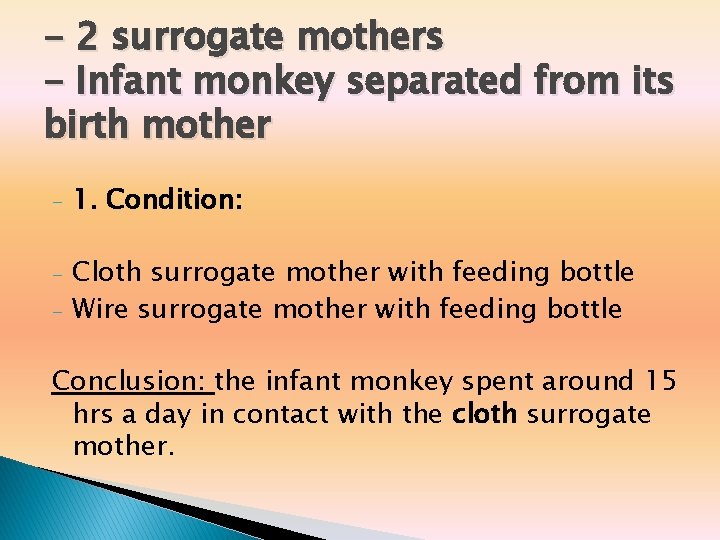
- 2 surrogate mothers - Infant monkey separated from its birth mother - 1. Condition: - Cloth surrogate mother with feeding bottle Wire surrogate mother with feeding bottle - Conclusion: the infant monkey spent around 15 hrs a day in contact with the cloth surrogate mother.
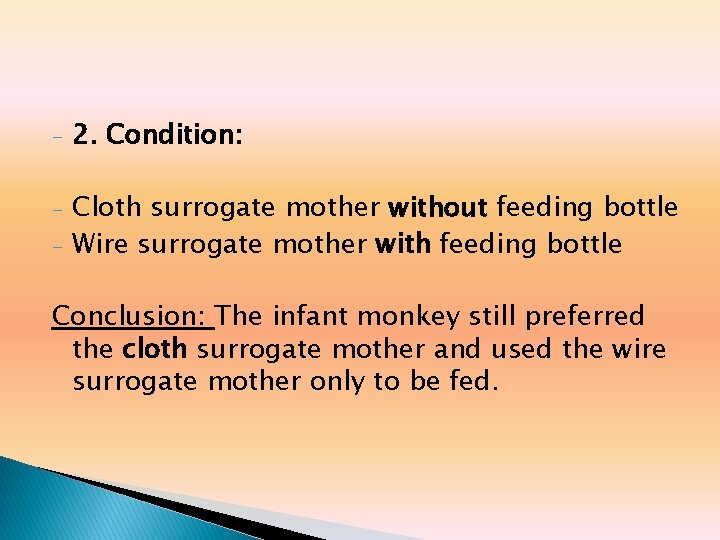
- 2. Condition: - Cloth surrogate mother without feeding bottle Wire surrogate mother with feeding bottle - Conclusion: The infant monkey still preferred the cloth surrogate mother and used the wire surrogate mother only to be fed.
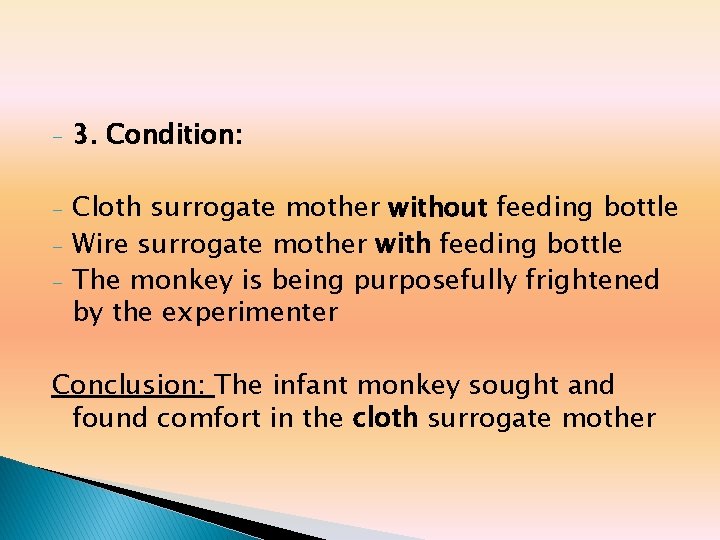
- 3. Condition: - Cloth surrogate mother without feeding bottle Wire surrogate mother with feeding bottle The monkey is being purposefully frightened by the experimenter - Conclusion: The infant monkey sought and found comfort in the cloth surrogate mother
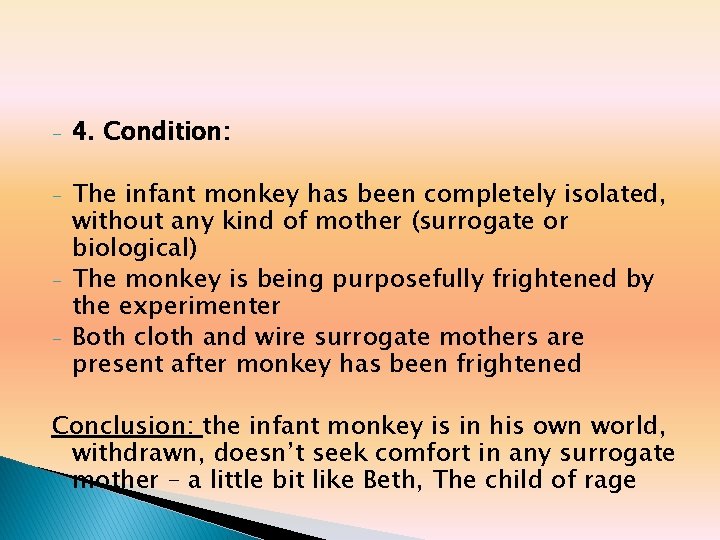
- 4. Condition: - The infant monkey has been completely isolated, without any kind of mother (surrogate or biological) The monkey is being purposefully frightened by the experimenter Both cloth and wire surrogate mothers are present after monkey has been frightened - Conclusion: the infant monkey is in his own world, withdrawn, doesn’t seek comfort in any surrogate mother – a little bit like Beth, The child of rage
Share with the class 1. What was the nature of Harlow’s experiments with monkeys in relation to attachment? 2. Can Harlow’s conclusions be generalised to human infant attachment?
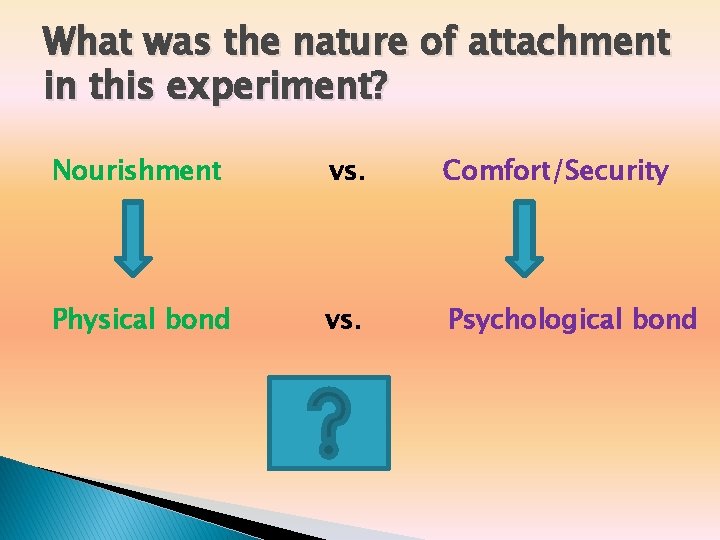
What was the nature of attachment in this experiment? Nourishment vs. Comfort/Security Physical bond vs. Psychological bond
Other animal experiments by Harlow 1. 2. 3. Individually read the text on pp. 197 -198 and choose 4 ideas/facts that you find most interesting / worth knowing. Pair up with someone else and negotiate your and their ideas down to a list of 4 (8 ideas become 4) Each pair joins another pair to become a group of four and they negotiate their list (8 ideas) down to final 4 ideas/facts.
In your groups, answer the following questions: What were the Independent and Dependent Variables in these experiments?
In your groups, answer the following questions: What were the Independent and Dependent Variables in these experiments? IV = The time that the monkeys spent isolated in cages (3 months / 6 months / 12 months) DV = The type of behaviour (slightly distressed, moderately distressed, very distressed) that the monkeys displayed after being released into the company of normally reared monkeys
Oral presentation � P. 199 – L. A 5. 13 In pairs prepare an interview between a journalist and Harry Harlow on the topic of attachment.