
Area under Curves 5 2 Consider an object
Area under Curves 5. 2
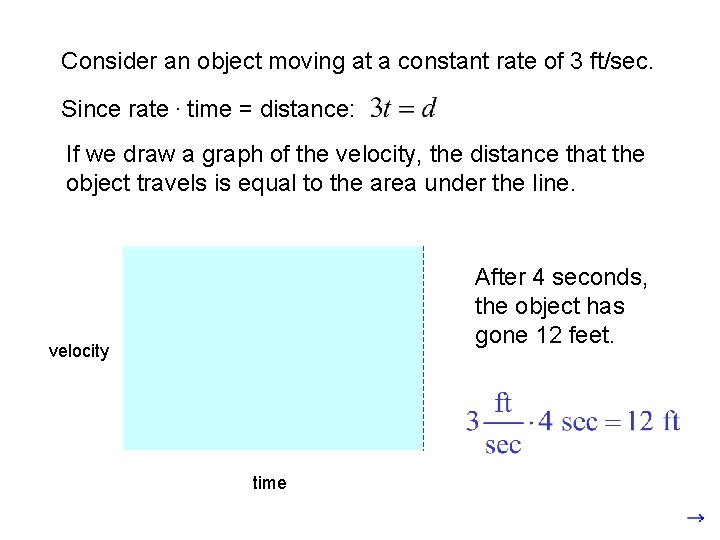
Consider an object moving at a constant rate of 3 ft/sec. Since rate. time = distance: If we draw a graph of the velocity, the distance that the object travels is equal to the area under the line. After 4 seconds, the object has gone 12 feet. velocity time
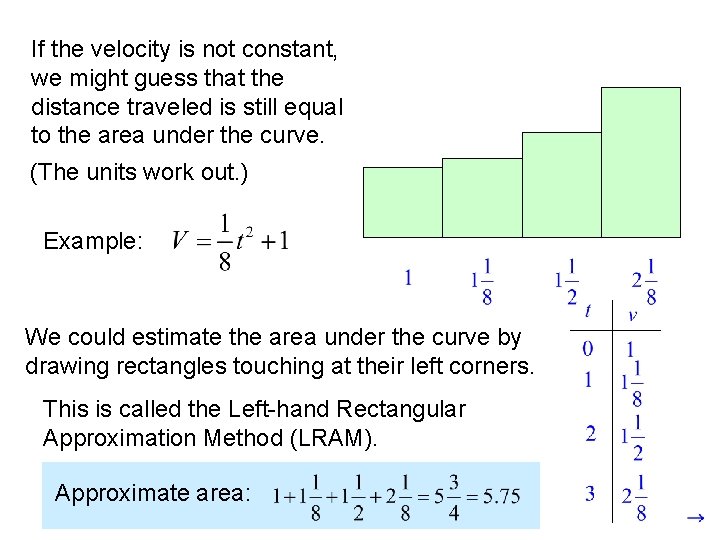
If the velocity is not constant, we might guess that the distance traveled is still equal to the area under the curve. (The units work out. ) Example: We could estimate the area under the curve by drawing rectangles touching at their left corners. This is called the Left-hand Rectangular Approximation Method (LRAM). Approximate area:
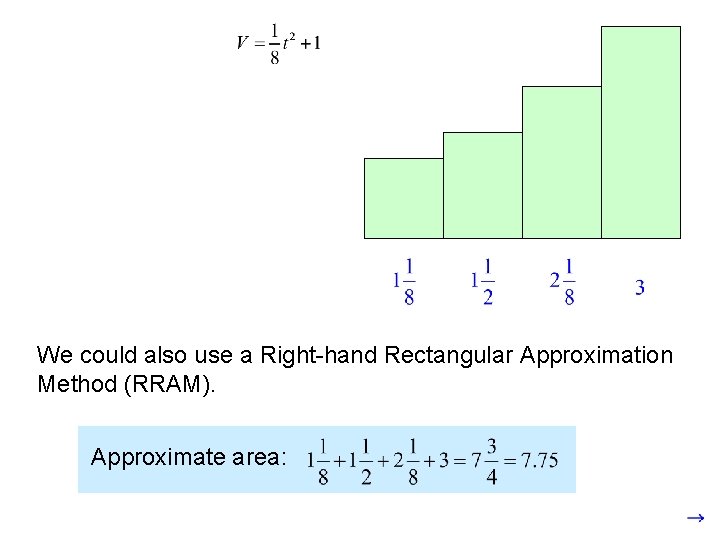
We could also use a Right-hand Rectangular Approximation Method (RRAM). Approximate area:

Another approach would be to use rectangles that touch at the midpoint. This is the Midpoint Rectangular Approximation Method (MRAM). In this example there are four subintervals. Approximate area: As the number of subintervals increases, so does the accuracy.
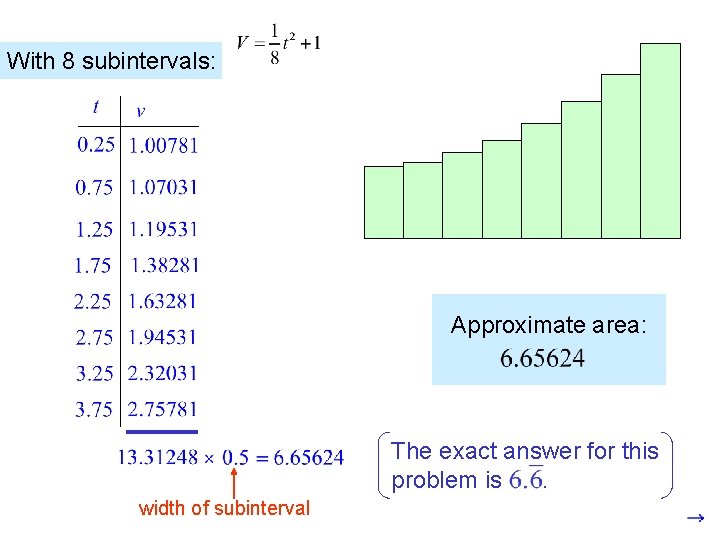
With 8 subintervals: Approximate area: The exact answer for this problem is. width of subinterval
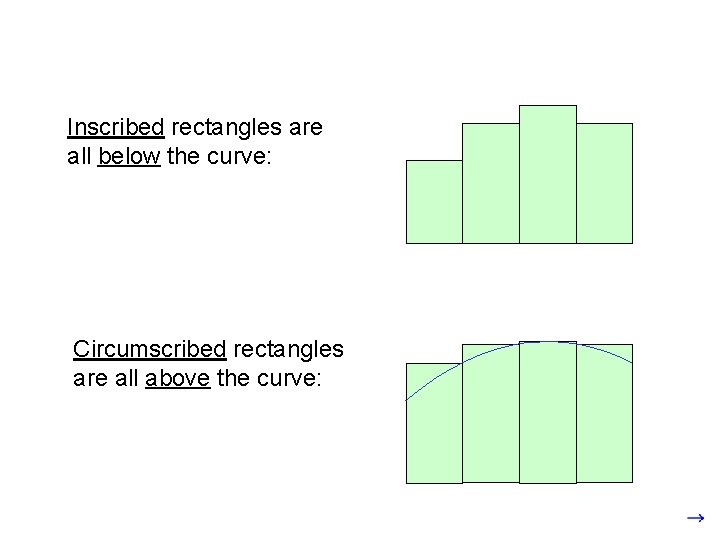
Inscribed rectangles are all below the curve: Circumscribed rectangles are all above the curve:
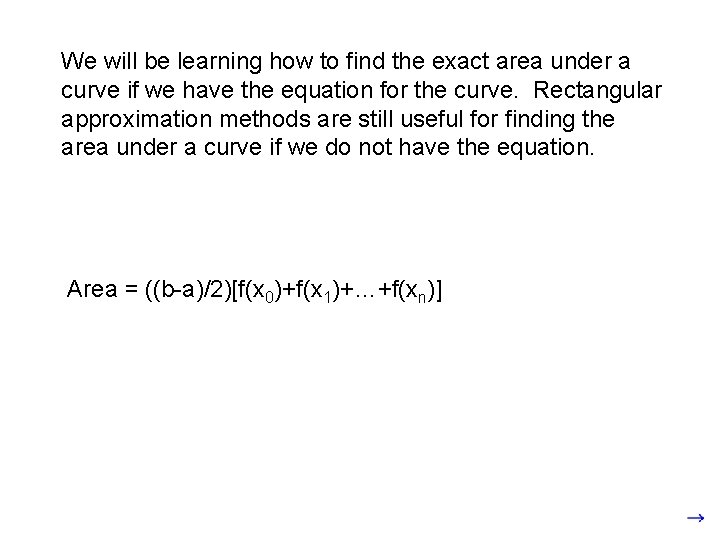
We will be learning how to find the exact area under a curve if we have the equation for the curve. Rectangular approximation methods are still useful for finding the area under a curve if we do not have the equation. Area = ((b-a)/2)[f(x 0)+f(x 1)+…+f(xn)]
Trapezoidal Rule
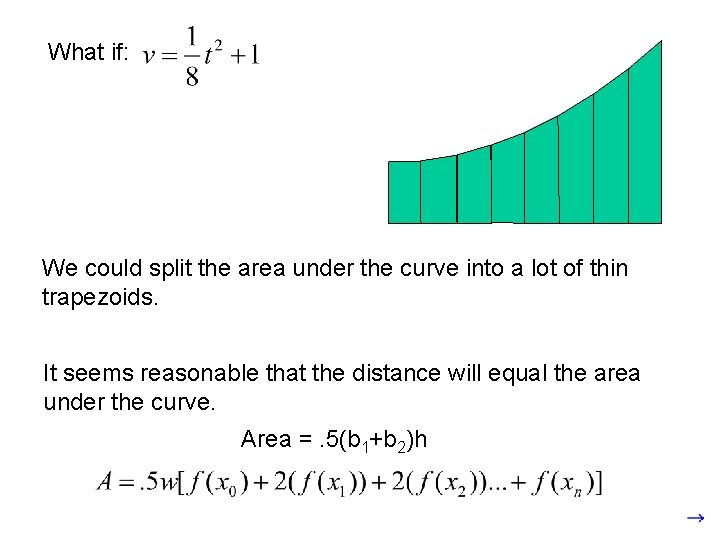
What if: We could split the area under the curve into a lot of thin trapezoids. It seems reasonable that the distance will equal the area under the curve. Area =. 5(b 1+b 2)h
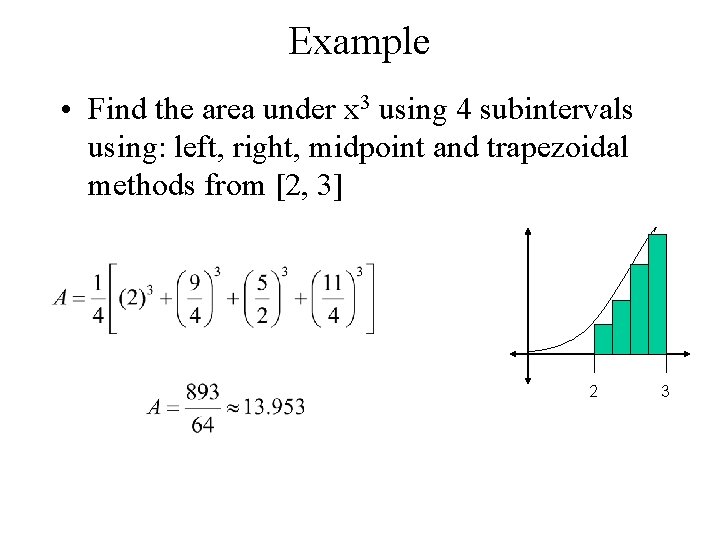
Example • Find the area under x 3 using 4 subintervals using: left, right, midpoint and trapezoidal methods from [2, 3] 2 3
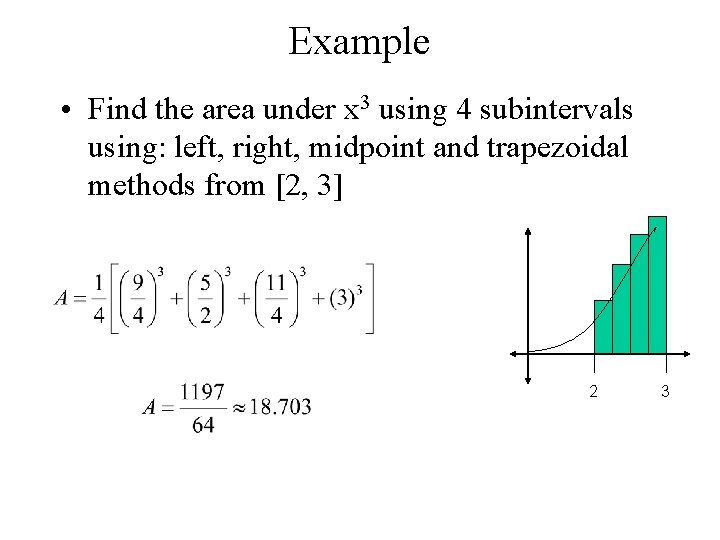
Example • Find the area under x 3 using 4 subintervals using: left, right, midpoint and trapezoidal methods from [2, 3] 2 3
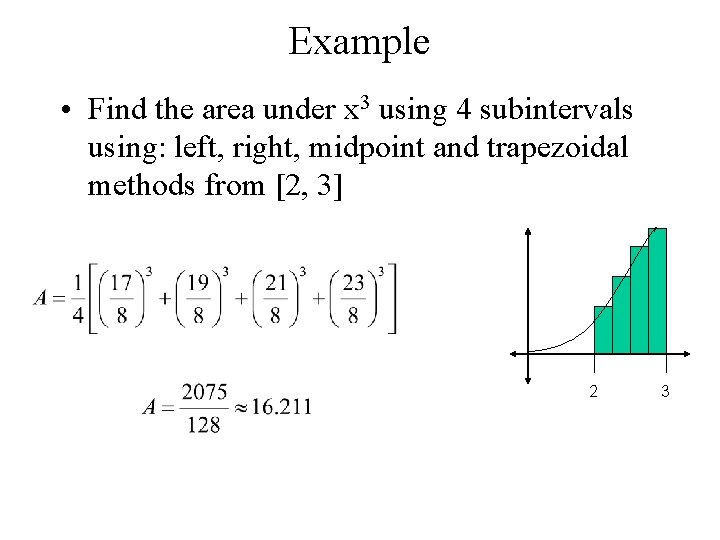
Example • Find the area under x 3 using 4 subintervals using: left, right, midpoint and trapezoidal methods from [2, 3] 2 3
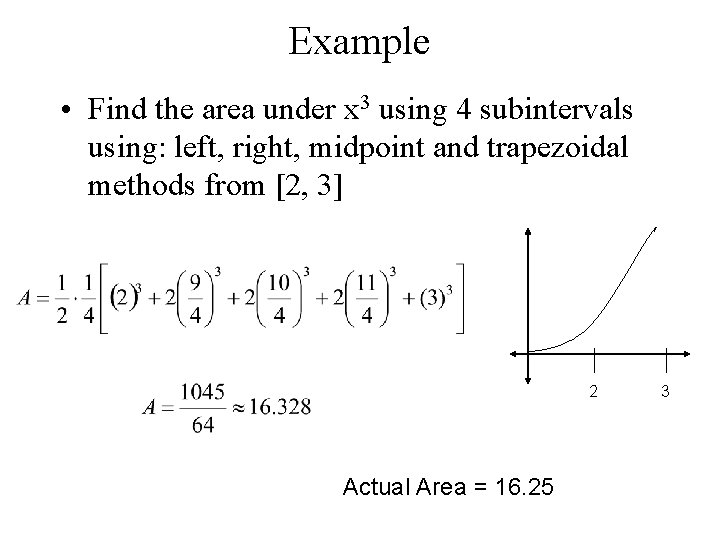
Example • Find the area under x 3 using 4 subintervals using: left, right, midpoint and trapezoidal methods from [2, 3] 2 Actual Area = 16. 25 3
- Slides: 14