
Area Perimeter Area Perimeter Objectives 7 5 04
Area & Perimeter
Area & Perimeter Objectives: 7. 5. 04 Develop fluency in the use of formulas to solve problems. Essential Question: How can I use formulas to find the perimeter and area of simple geometric figures?
Area & Perimeter Vocabulary: Polygon: a closed plane figure bounded by three or more line segments. Quadrilateral: any four sided polygon. Parallelogram: a quadrilateral whose opposite sides are parallel. Square: a four sided polygon characterized by four right angles and four sides of equal length. Rectangle: a four sided polygon characterized by four right angles and opposite sides of equal measure. Triangle: a three sided polygon. Circle: a closed plane curve consisting of all points at a given distance from a point within it called the center.
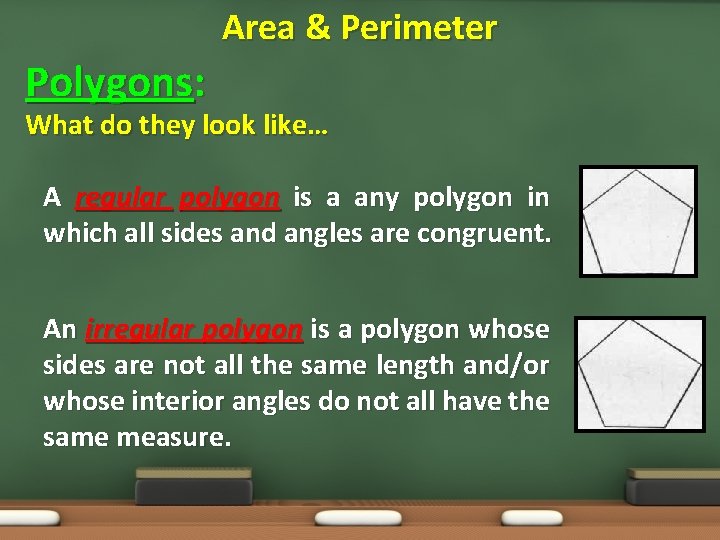
Area & Perimeter Polygons: What do they look like… A regular polygon is a any polygon in which all sides and angles are congruent. An irregular polygon is a polygon whose sides are not all the same length and/or whose interior angles do not all have the same measure.
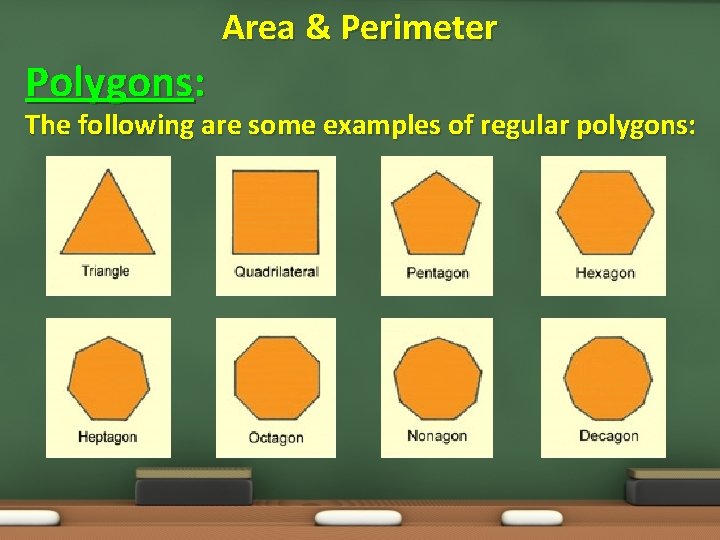
Area & Perimeter Polygons: The following are some examples of regular polygons:
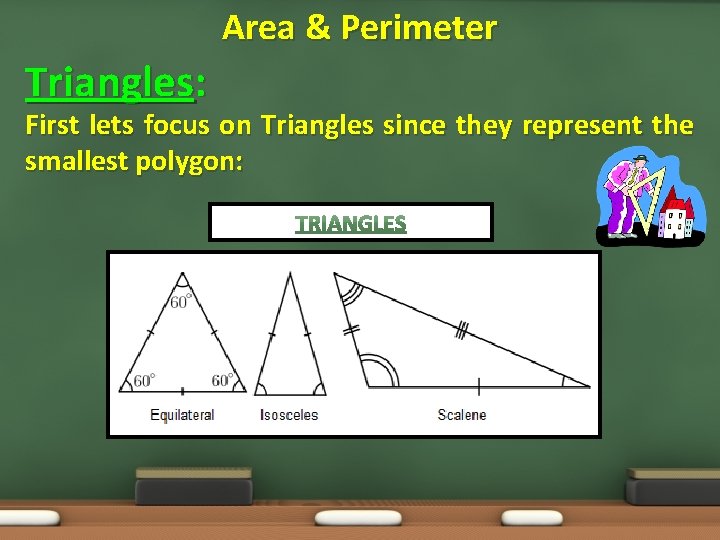
Area & Perimeter Triangles: First lets focus on Triangles since they represent the smallest polygon:
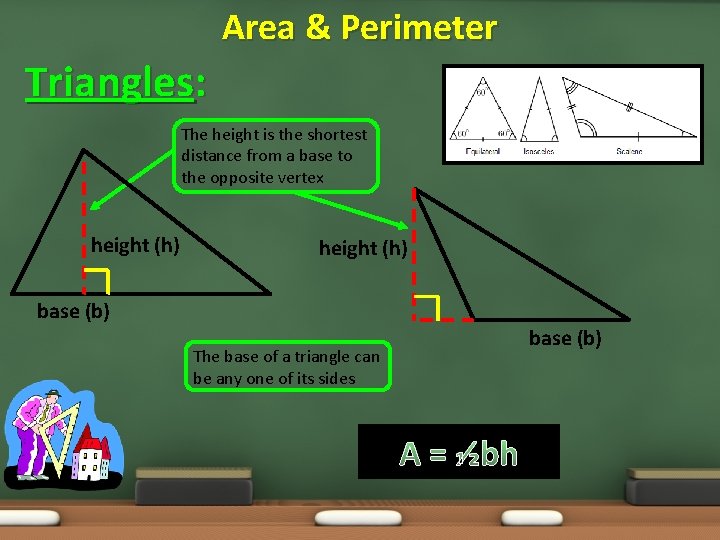
Area & Perimeter Triangles: The height is the shortest distance from a base to the opposite vertex height (h) base (b) The base of a triangle can be any one of its sides A = ½bh
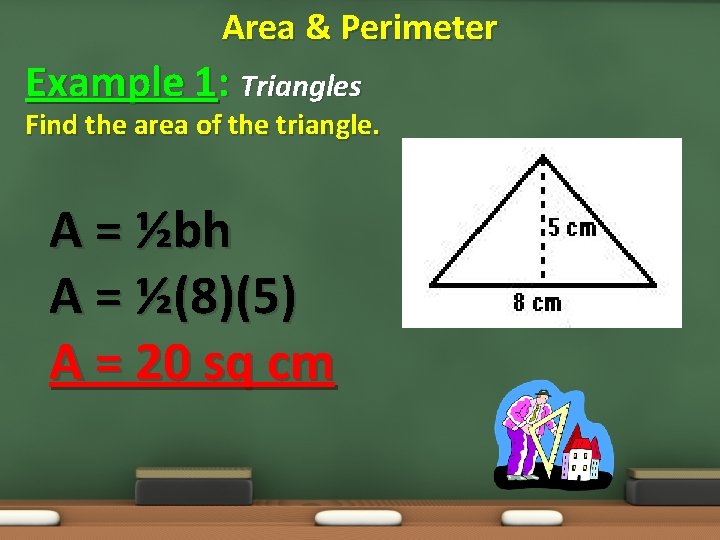
Area & Perimeter Example 1: Triangles Find the area of the triangle. A = ½bh A = ½(8)(5) A = 20 sq cm
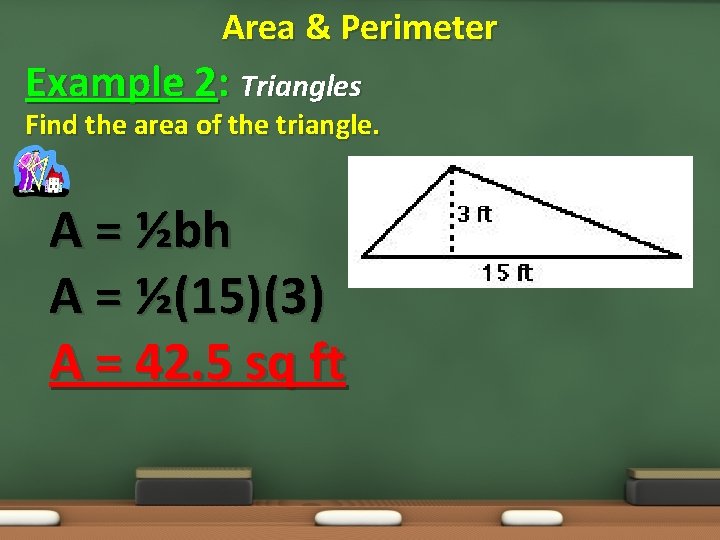
Area & Perimeter Example 2: Triangles Find the area of the triangle. A = ½bh A = ½(15)(3) A = 42. 5 sq ft
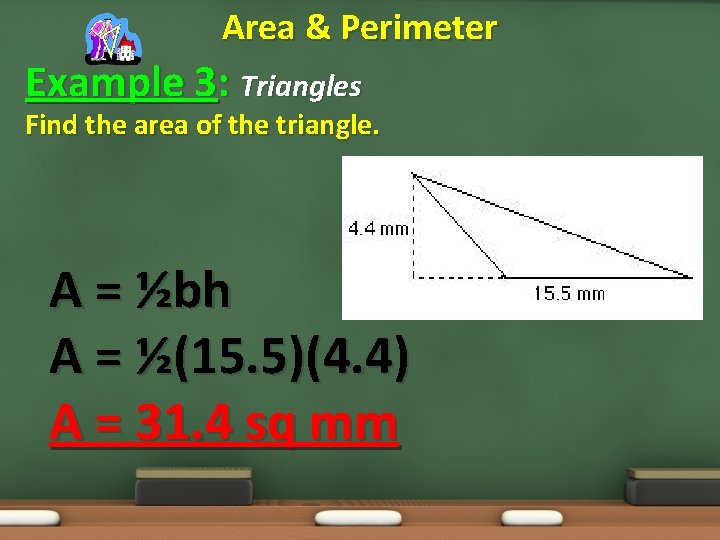
Area & Perimeter Example 3: Triangles Find the area of the triangle. A = ½bh A = ½(15. 5)(4. 4) A = 31. 4 sq mm
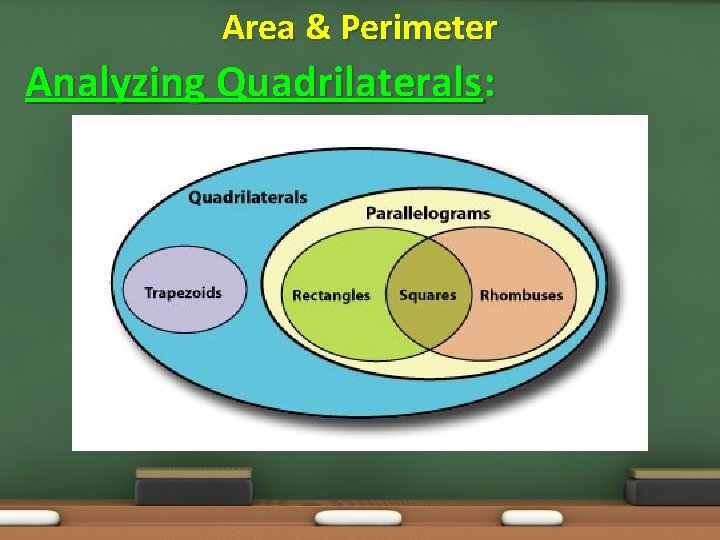
Area & Perimeter Analyzing Quadrilaterals:
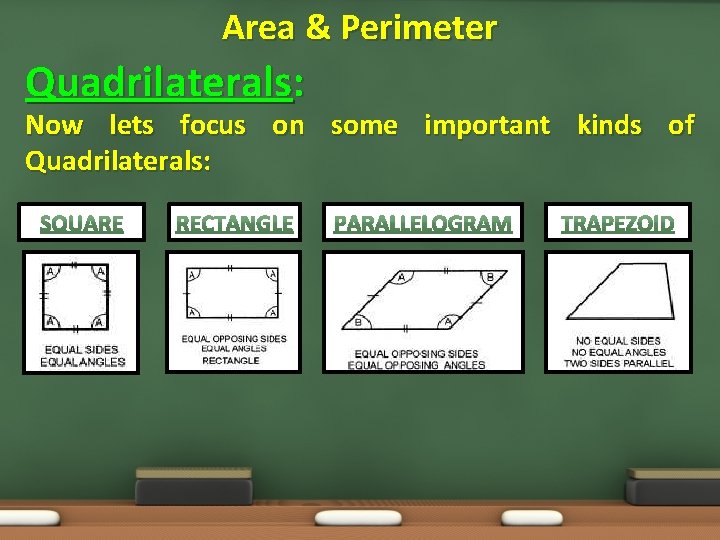
Area & Perimeter Quadrilaterals: Now lets focus on some important kinds of Quadrilaterals:
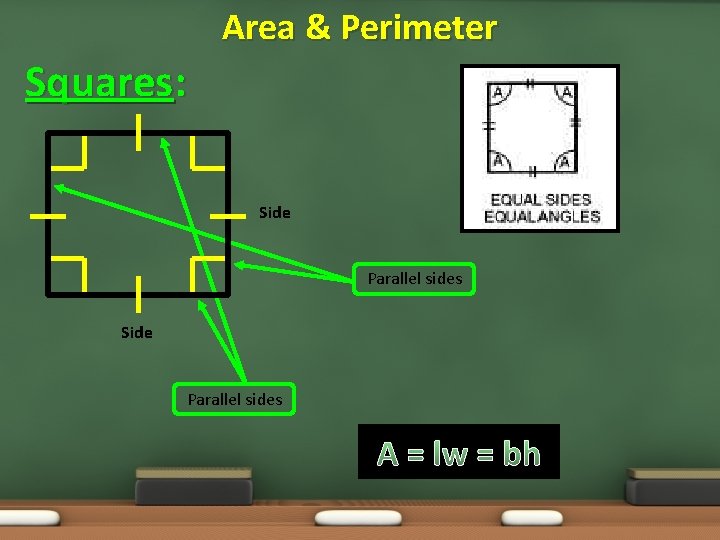
Area & Perimeter Squares: Side Parallel sides A = lw = bh
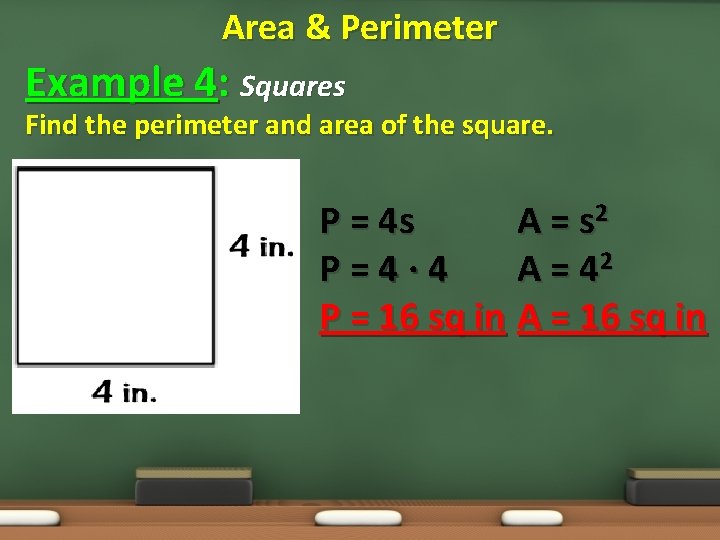
Area & Perimeter Example 4: Squares Find the perimeter and area of the square. P = 4 s A = s 2 P=4· 4 A = 42 P = 16 sq in A = 16 sq in
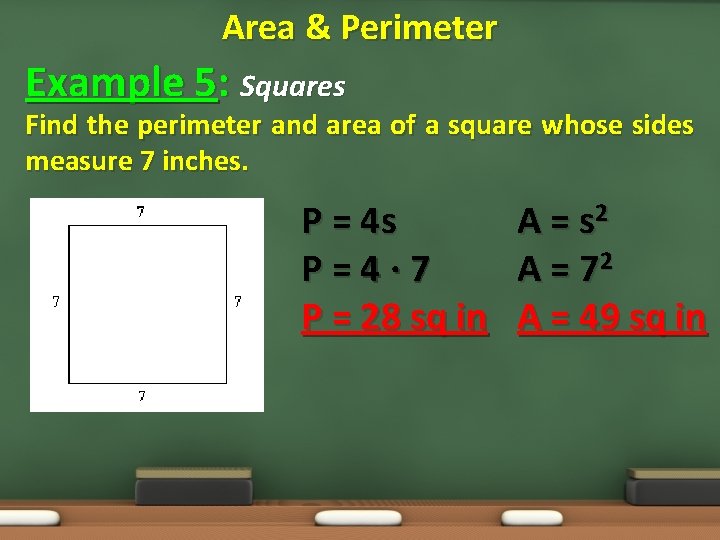
Area & Perimeter Example 5: Squares Find the perimeter and area of a square whose sides measure 7 inches. P = 4 s A = s 2 P=4· 7 A = 72 P = 28 sq in A = 49 sq in
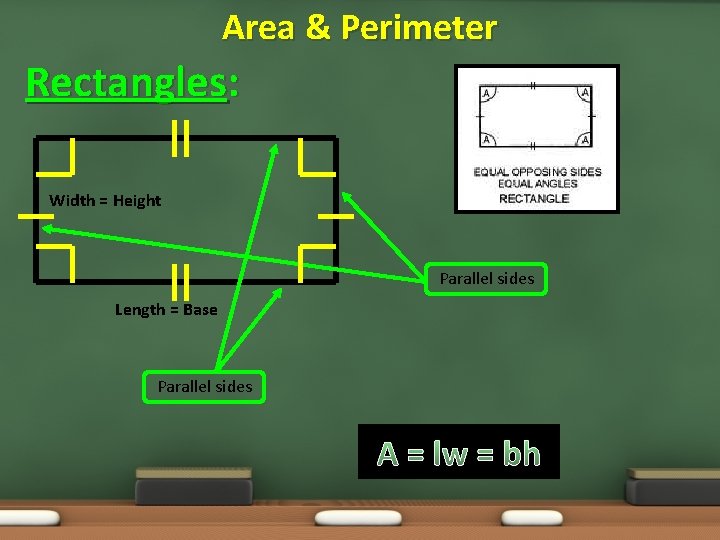
Area & Perimeter Rectangles: Width = Height Parallel sides Length = Base Parallel sides A = lw = bh
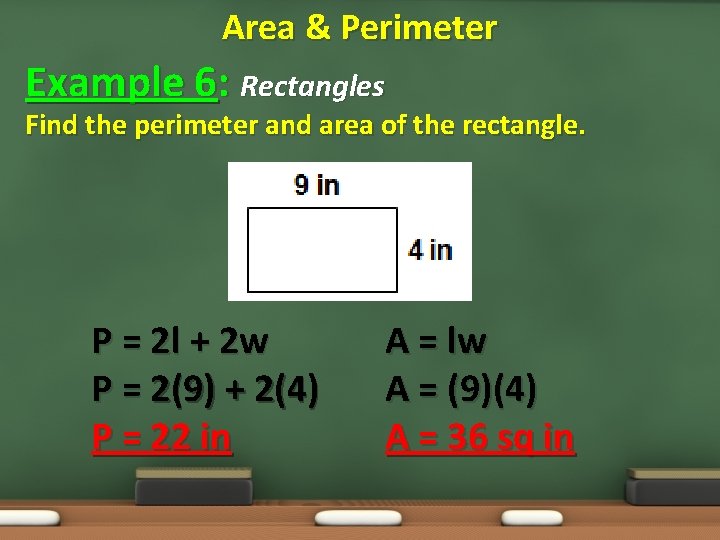
Area & Perimeter Example 6: Rectangles Find the perimeter and area of the rectangle. P = 2 l + 2 w P = 2(9) + 2(4) P = 22 in A = lw A = (9)(4) A = 36 sq in
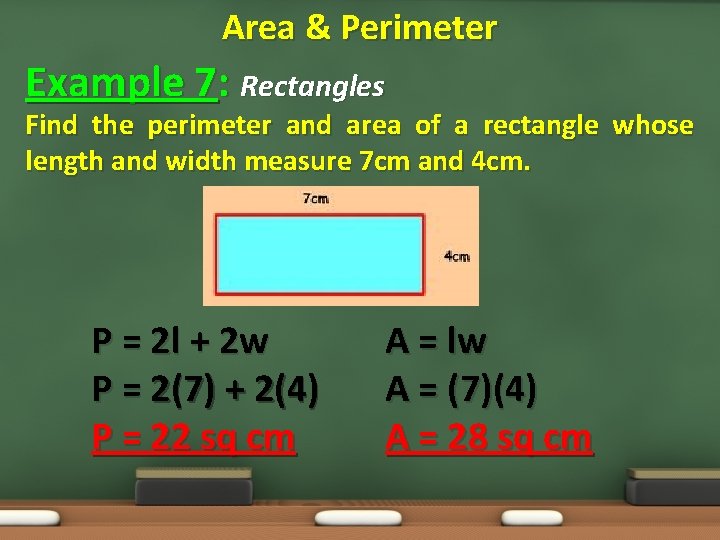
Area & Perimeter Example 7: Rectangles Find the perimeter and area of a rectangle whose length and width measure 7 cm and 4 cm. P = 2 l + 2 w P = 2(7) + 2(4) P = 22 sq cm A = lw A = (7)(4) A = 28 sq cm
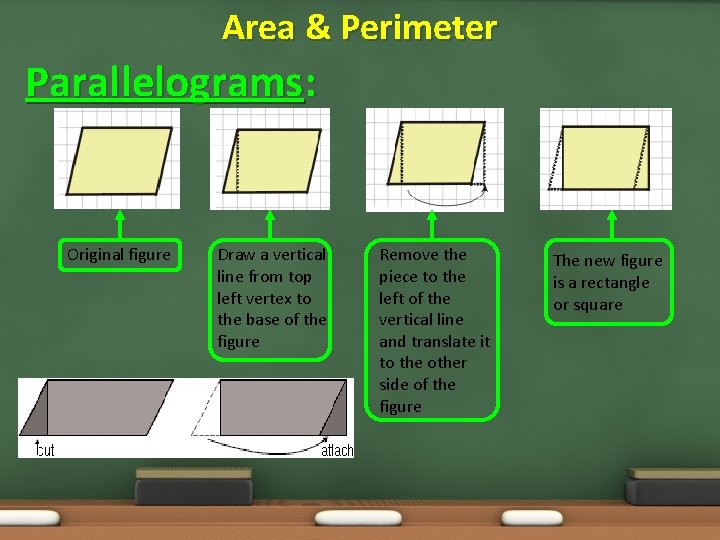
Area & Perimeter Parallelograms: Original figure Draw a vertical line from top left vertex to the base of the figure Remove the piece to the left of the vertical line and translate it to the other side of the figure The new figure is a rectangle or square
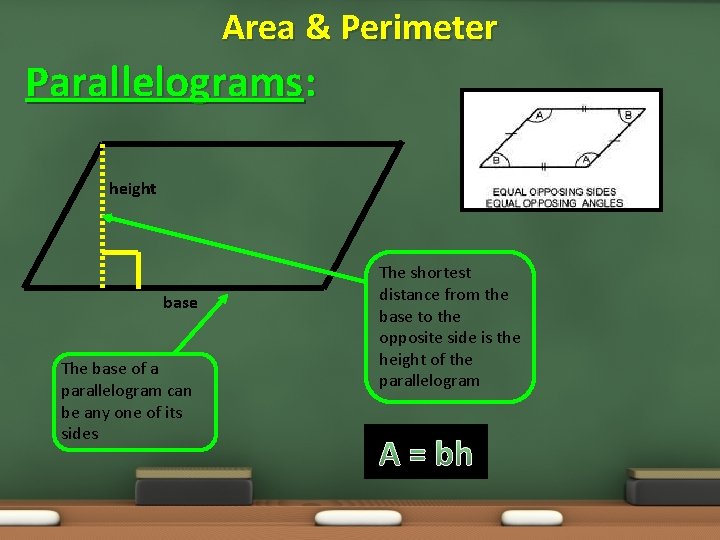
Area & Perimeter Parallelograms: height base The base of a parallelogram can be any one of its sides The shortest distance from the base to the opposite side is the height of the parallelogram A = bh
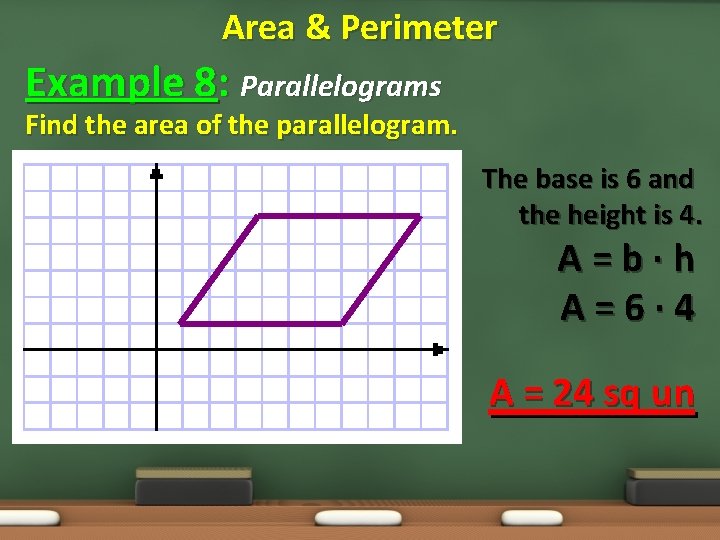
Area & Perimeter Example 8: Parallelograms Find the area of the parallelogram. The base is 6 and the height is 4. A=b·h A=6· 4 A = 24 sq un
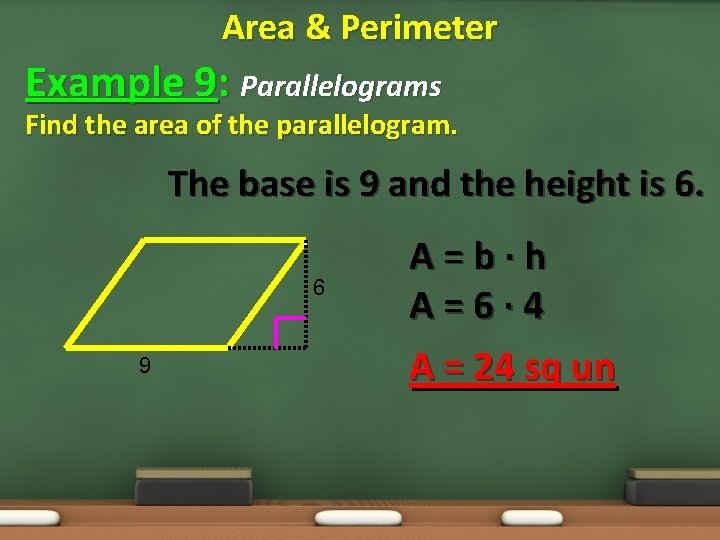
Area & Perimeter Example 9: Parallelograms Find the area of the parallelogram. The base is 9 and the height is 6. 6 9 A=b·h A=6· 4 A = 24 sq un
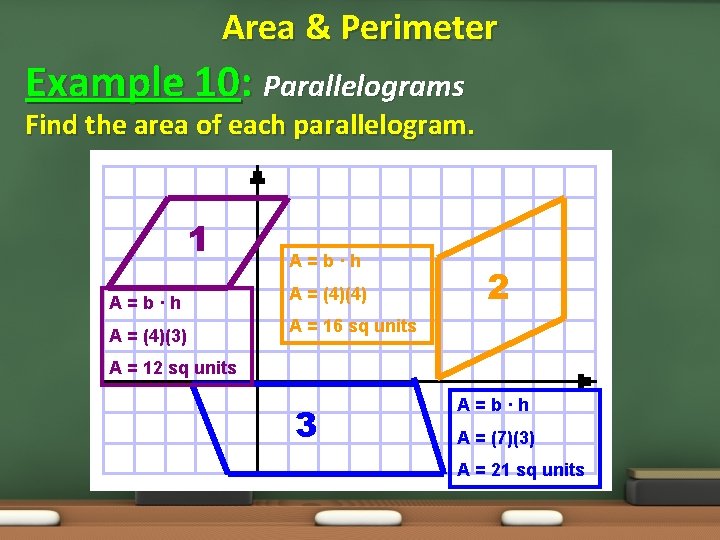
Area & Perimeter Example 10: Parallelograms Find the area of each parallelogram. 1 A=b·h A = (4)(3) A=b·h A = (4)(4) 2 A = 16 sq units A = 12 sq units 3 A=b·h A = (7)(3) A = 21 sq units
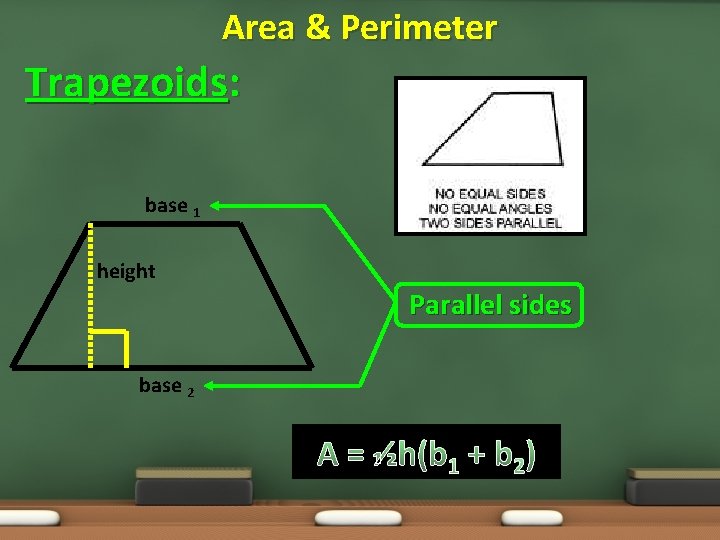
Area & Perimeter Trapezoids: base 1 height Parallel sides base 2 A = ½h(b 1 + b 2)
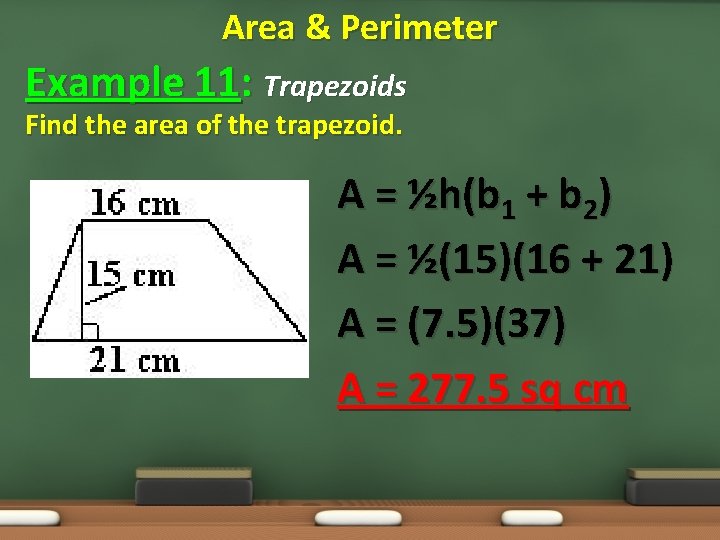
Area & Perimeter Example 11: Trapezoids Find the area of the trapezoid. A = ½h(b 1 + b 2) A = ½(15)(16 + 21) A = (7. 5)(37) A = 277. 5 sq cm
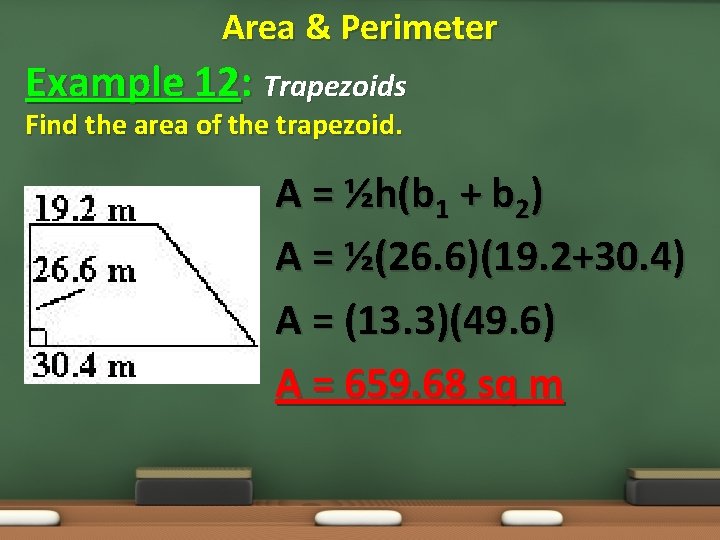
Area & Perimeter Example 12: Trapezoids Find the area of the trapezoid. A = ½h(b 1 + b 2) A = ½(26. 6)(19. 2+30. 4) A = (13. 3)(49. 6) A = 659. 68 sq m
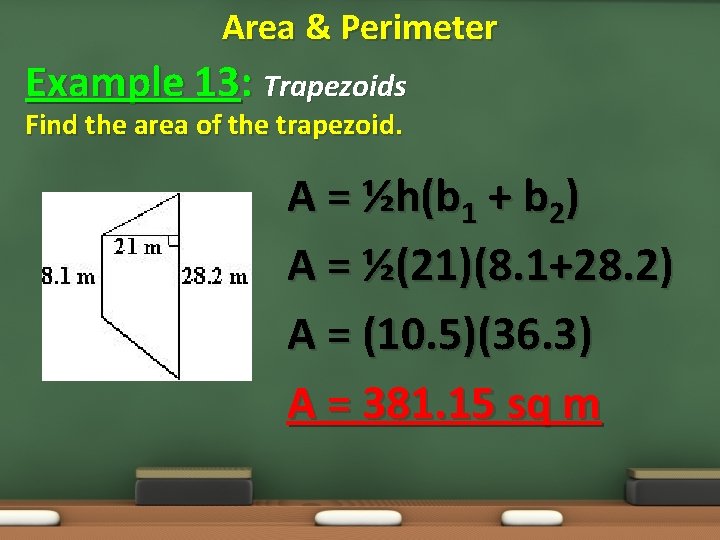
Area & Perimeter Example 13: Trapezoids Find the area of the trapezoid. A = ½h(b 1 + b 2) A = ½(21)(8. 1+28. 2) A = (10. 5)(36. 3) A = 381. 15 sq m
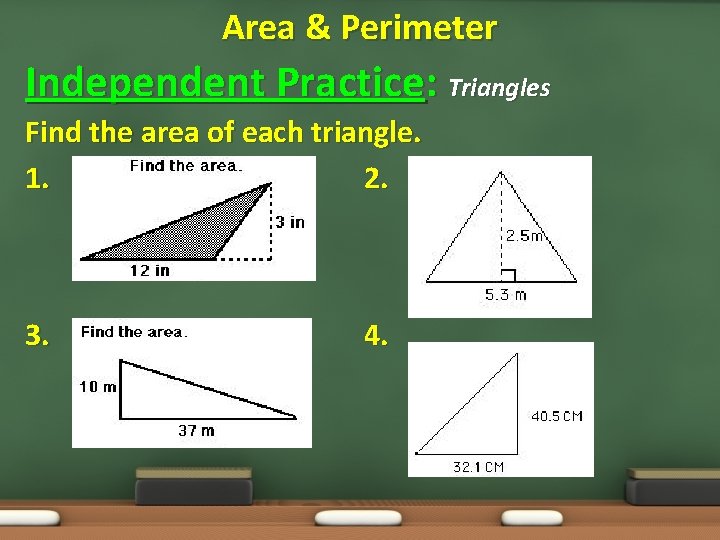
Area & Perimeter Independent Practice: Triangles Find the area of each triangle. 1. 2. 3. 4.
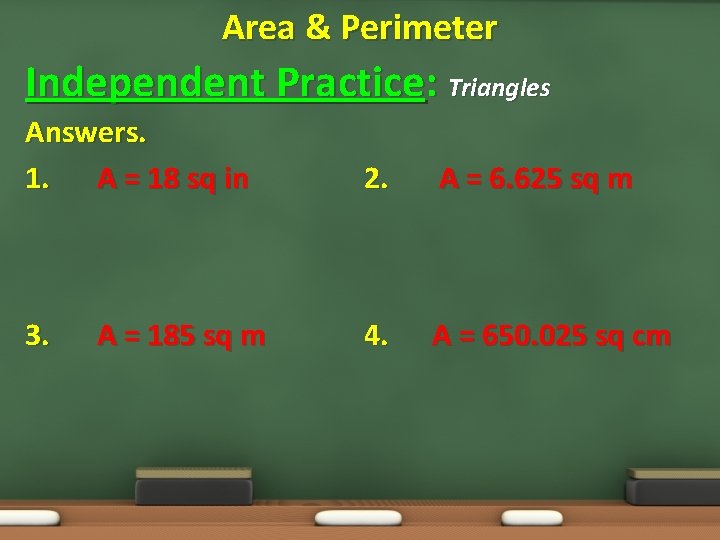
Area & Perimeter Independent Practice: Triangles Answers. 1. A = 18 sq in 2. A = 6. 625 sq m 3. 4. A = 650. 025 sq cm A = 185 sq m
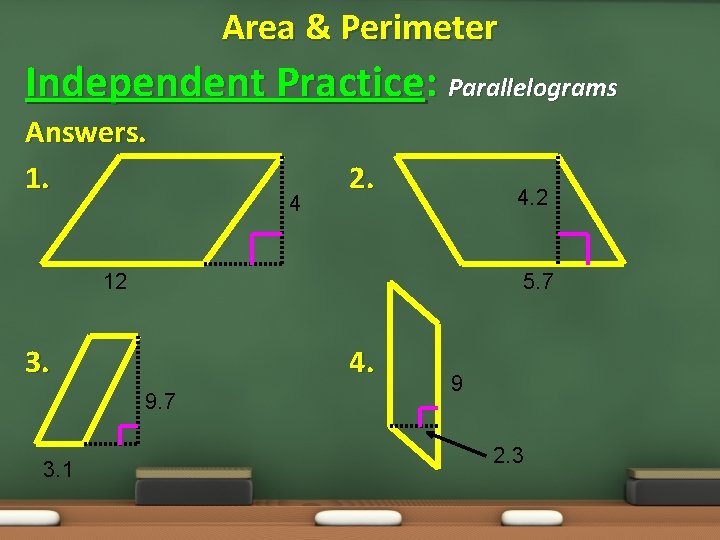
Area & Perimeter Independent Practice: Parallelograms Answers. 1. 4 2. 4. 2 12 5. 7 3. 4. 9. 7 3. 1 9 2. 3
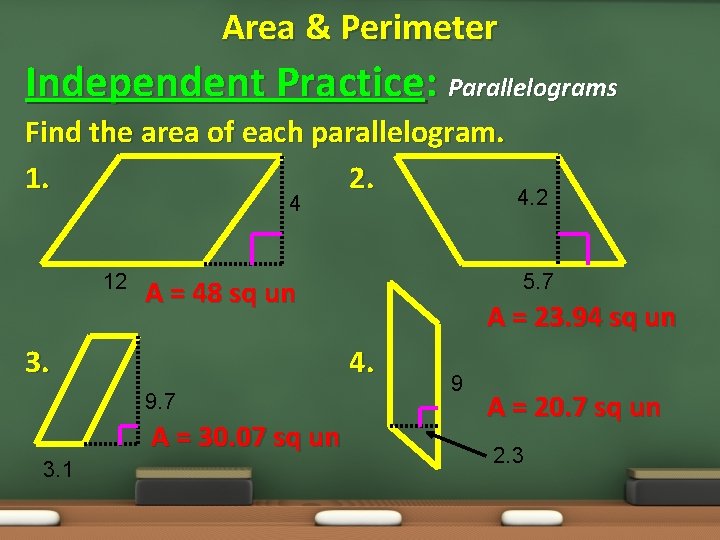
Area & Perimeter Independent Practice: Parallelograms Find the area of each parallelogram. 1. 2. 12 4 4. 2 A = 48 sq un 5. 7 3. 4. 9. 7 A = 30. 07 sq un 3. 1 A = 23. 94 sq un 9 A = 20. 7 sq un 2. 3
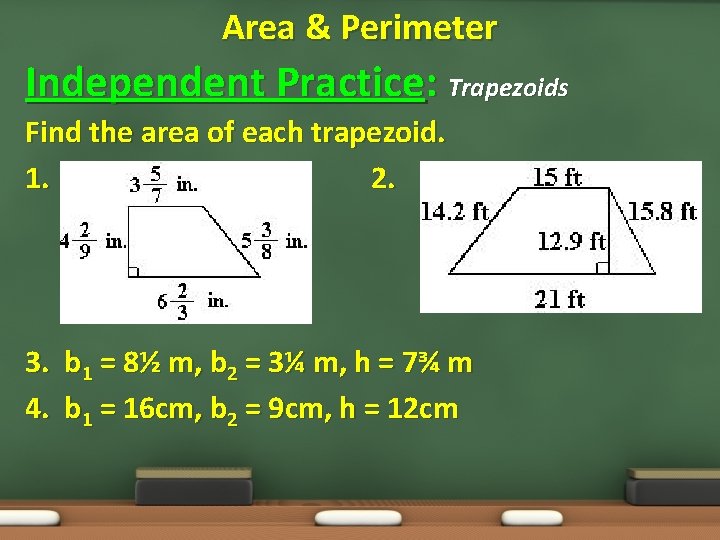
Area & Perimeter Independent Practice: Trapezoids Find the area of each trapezoid. 1. 2. 3. b 1 = 8½ m, b 2 = 3¼ m, h = 7¾ m 4. b 1 = 16 cm, b 2 = 9 cm, h = 12 cm
Area & Perimeter Independent Practice: Trapezoids Answers. 1. A = 21 173/189 sq in 3. A = 45. 53125 sq m 4. A = 150 sq cm 2. A = 232. 2 sq ft
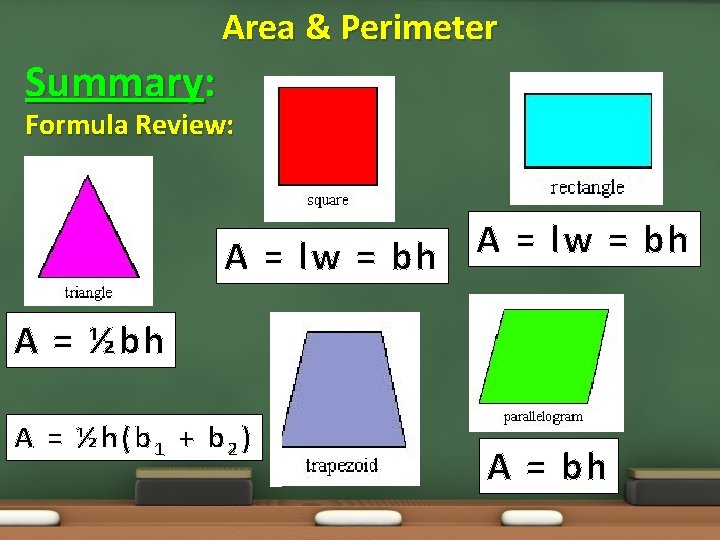
Area & Perimeter Summary: Formula Review: A = lw = bh A = ½bh A = ½h(b 1 + b 2 ) A = bh
Area & Perimeter HOMEWORK
Area & Circumference of Circles
Area & Perimeter Objectives: 7. 5. 04 Develop fluency in the use of formulas to solve problems. Essential Question: How can I use formulas to find the perimeter and area of simple geometric figures?
Area & Perimeter Circles: What do they look like… A circle is a geometric shape with all points the same distance from the center. - The circle above is called circle A since the center is at point A. (circles are always named by their centers)
Area & Perimeter HOMEWORK
- Slides: 39