
Area and Definite Integrals 4 3 OBJECTIVE Find
Area and Definite Integrals 4. 3 OBJECTIVE • Find the area under the graph of a nonnegative function over a given closed interval. • Evaluate a definite integral. • Interpret an area below the horizontal axis. • Solve applied problems involving definite integrals. Copyright © 2016, 2012 Pearson Education, Inc. 4. 3 - 1
4. 3 Area and Definite Integrals Theorem 4 Let f be a nonnegative continuous function over [0, b], and let A(x) be the area between the graph of f and the x -axis over [0, x], with 0 < x < b. Then A(x) is a differentiable function of x and Copyright © 2016, 2012 Pearson Education, Inc. 4. 3 - 2
4. 3 Area and Definite Integrals To find the area under the graph of a nonnegative, continuous function f over the interval [a, b]: 1. Find any antiderivative F of f. 2. Evaluate F(x) at x = b and x = a, and compute F(b) – F(a). The result is the area under the graph over the interval [a, b]. Copyright © 2016, 2012 Pearson Education, Inc. 4. 3 - 3
4. 3 Area and Definite Integrals Example 1: Find the area under the graph of y = x 2 +1 over the interval [– 1, 2]. 1. Find any antiderivative F(x) of f (x). We choose the simplest one. Copyright © 2016, 2012 Pearson Education, Inc. 4. 3 - 4
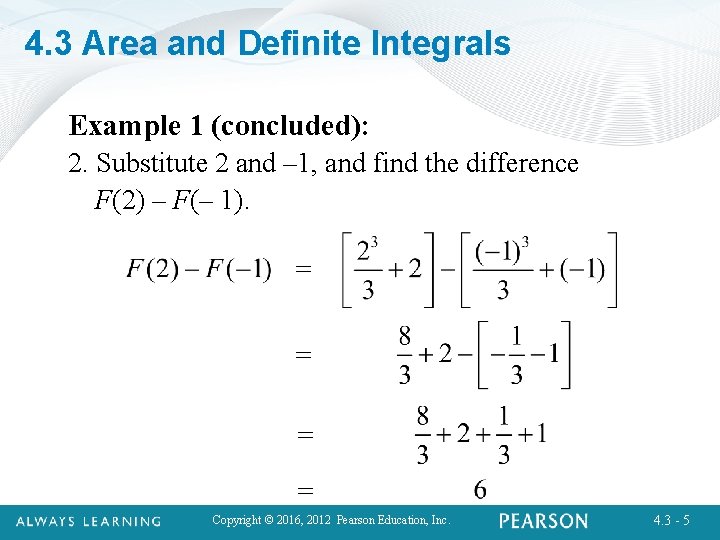
4. 3 Area and Definite Integrals Example 1 (concluded): 2. Substitute 2 and – 1, and find the difference F(2) – F(– 1). Copyright © 2016, 2012 Pearson Education, Inc. 4. 3 - 5
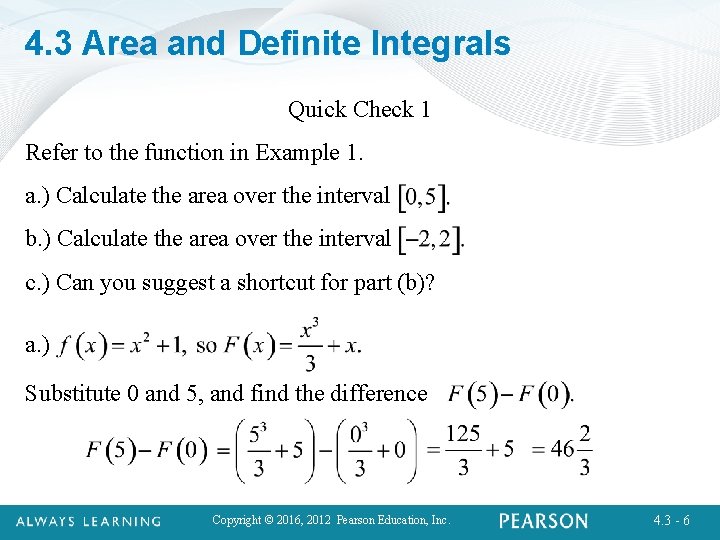
4. 3 Area and Definite Integrals Quick Check 1 Refer to the function in Example 1. a. ) Calculate the area over the interval b. ) Calculate the area over the interval c. ) Can you suggest a shortcut for part (b)? a. ) Substitute 0 and 5, and find the difference Copyright © 2016, 2012 Pearson Education, Inc. 4. 3 - 6
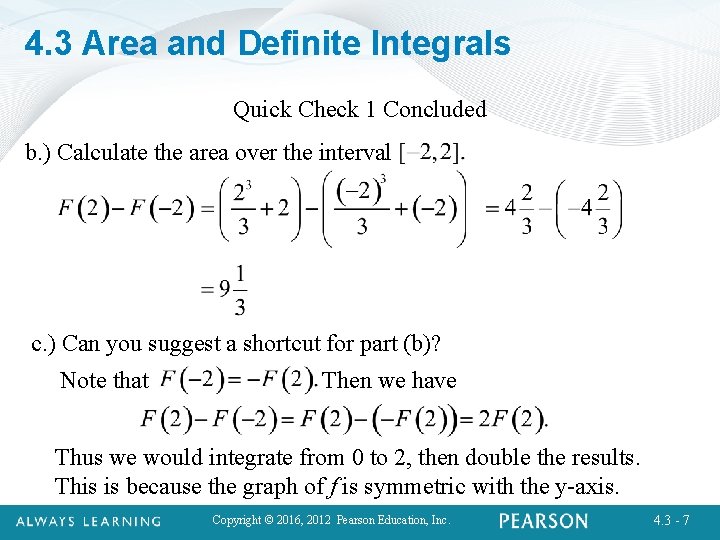
4. 3 Area and Definite Integrals Quick Check 1 Concluded b. ) Calculate the area over the interval c. ) Can you suggest a shortcut for part (b)? Note that Then we have Thus we would integrate from 0 to 2, then double the results. This is because the graph of f is symmetric with the y-axis. Copyright © 2016, 2012 Pearson Education, Inc. 4. 3 - 7
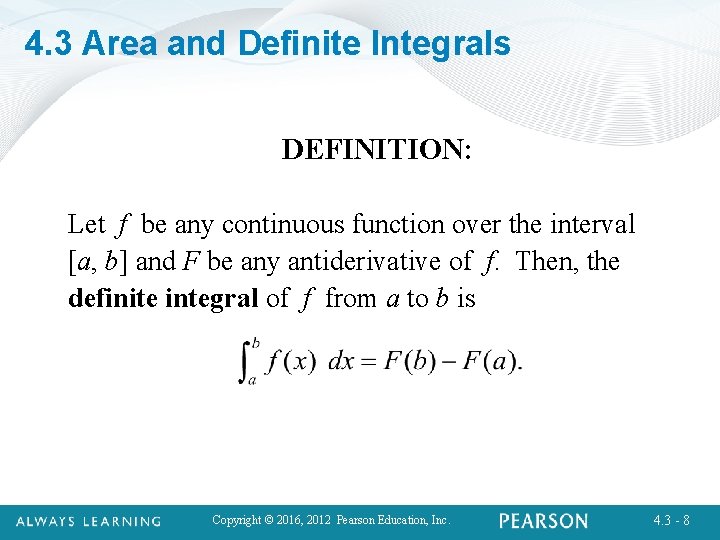
4. 3 Area and Definite Integrals DEFINITION: Let f be any continuous function over the interval [a, b] and F be any antiderivative of f. Then, the definite integral of f from a to b is Copyright © 2016, 2012 Pearson Education, Inc. 4. 3 - 8
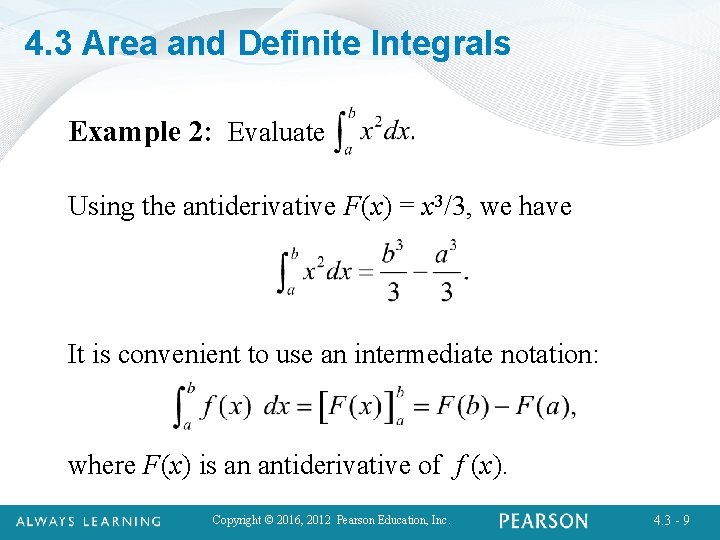
4. 3 Area and Definite Integrals Example 2: Evaluate Using the antiderivative F(x) = x 3/3, we have It is convenient to use an intermediate notation: where F(x) is an antiderivative of f (x). Copyright © 2016, 2012 Pearson Education, Inc. 4. 3 - 9
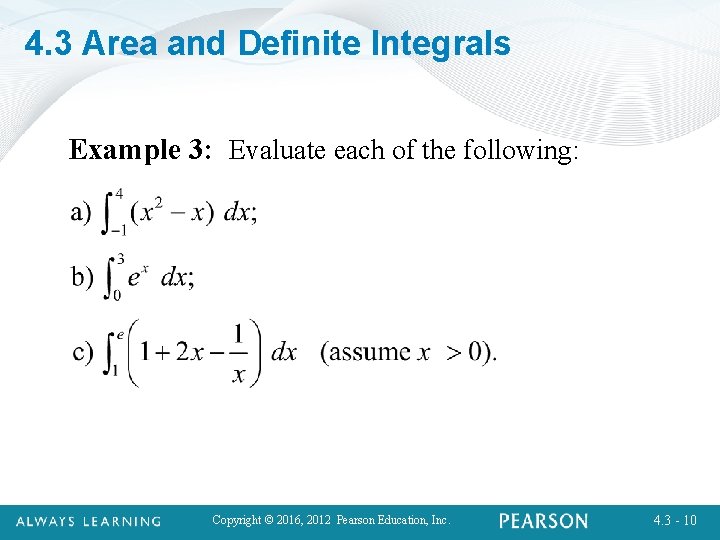
4. 3 Area and Definite Integrals Example 3: Evaluate each of the following: Copyright © 2016, 2012 Pearson Education, Inc. 4. 3 - 10
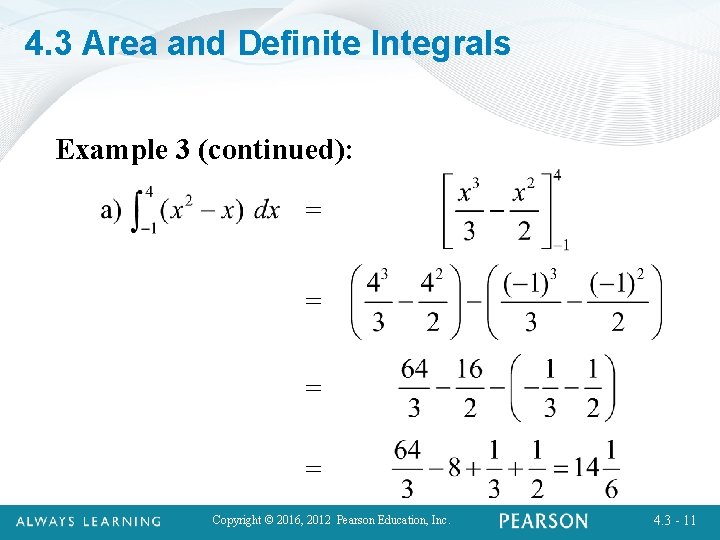
4. 3 Area and Definite Integrals Example 3 (continued): Copyright © 2016, 2012 Pearson Education, Inc. 4. 3 - 11
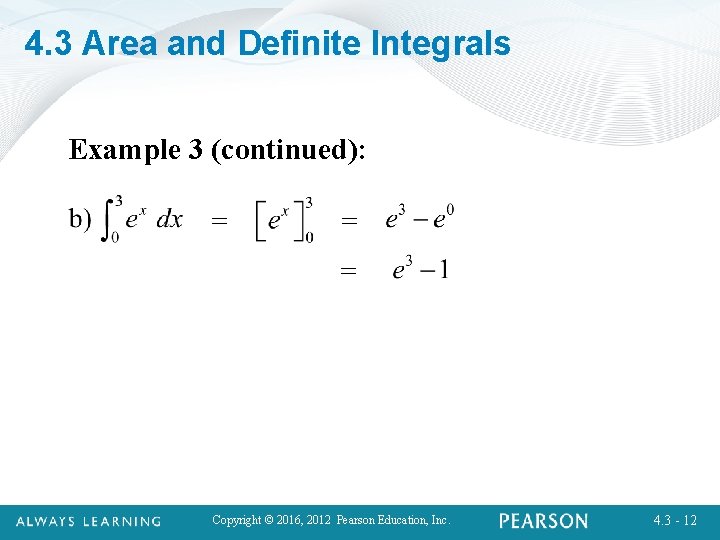
4. 3 Area and Definite Integrals Example 3 (continued): Copyright © 2016, 2012 Pearson Education, Inc. 4. 3 - 12
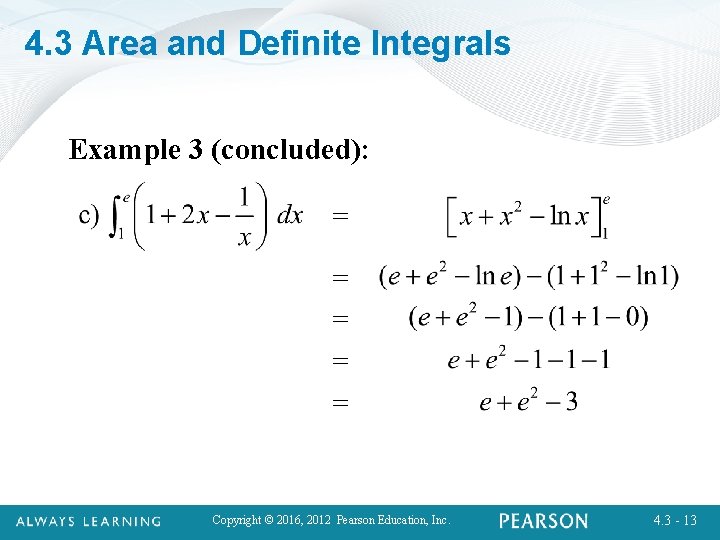
4. 3 Area and Definite Integrals Example 3 (concluded): Copyright © 2016, 2012 Pearson Education, Inc. 4. 3 - 13
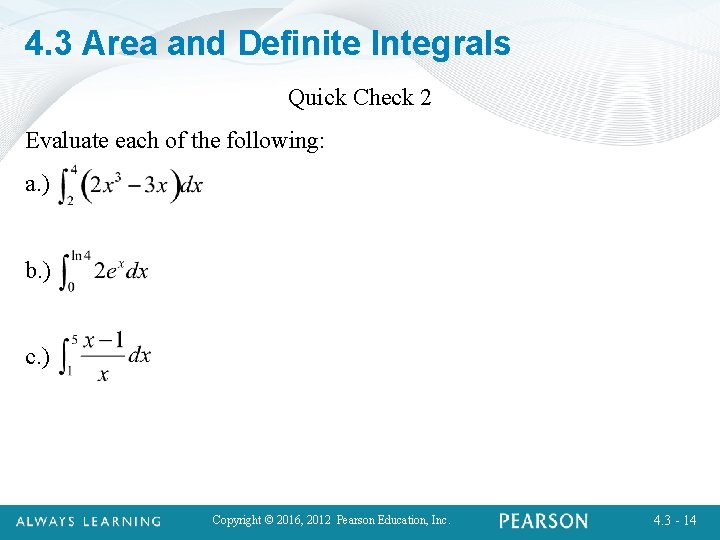
4. 3 Area and Definite Integrals Quick Check 2 Evaluate each of the following: a. ) b. ) c. ) Copyright © 2016, 2012 Pearson Education, Inc. 4. 3 - 14
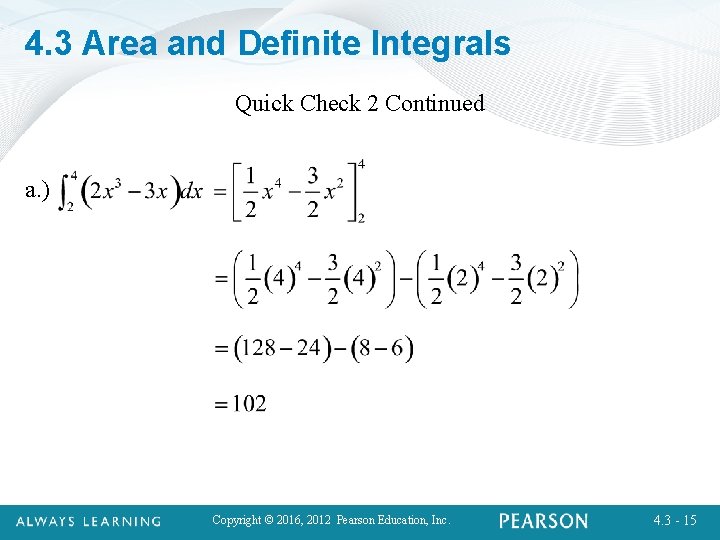
4. 3 Area and Definite Integrals Quick Check 2 Continued a. ) Copyright © 2016, 2012 Pearson Education, Inc. 4. 3 - 15
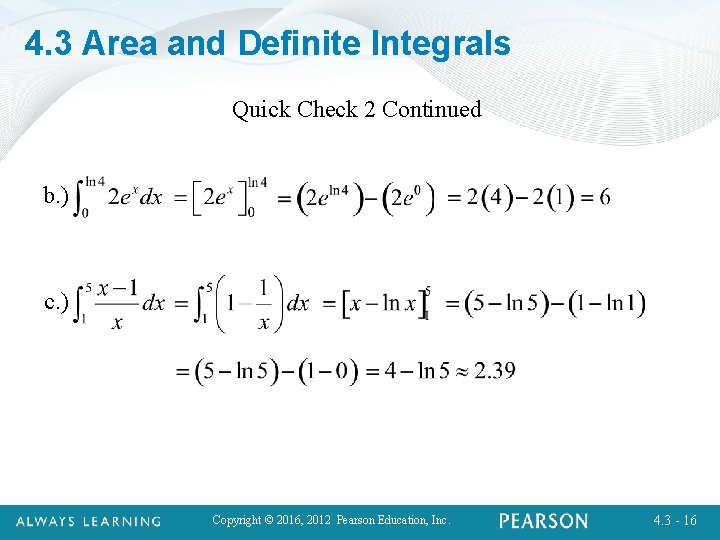
4. 3 Area and Definite Integrals Quick Check 2 Continued b. ) c. ) Copyright © 2016, 2012 Pearson Education, Inc. 4. 3 - 16
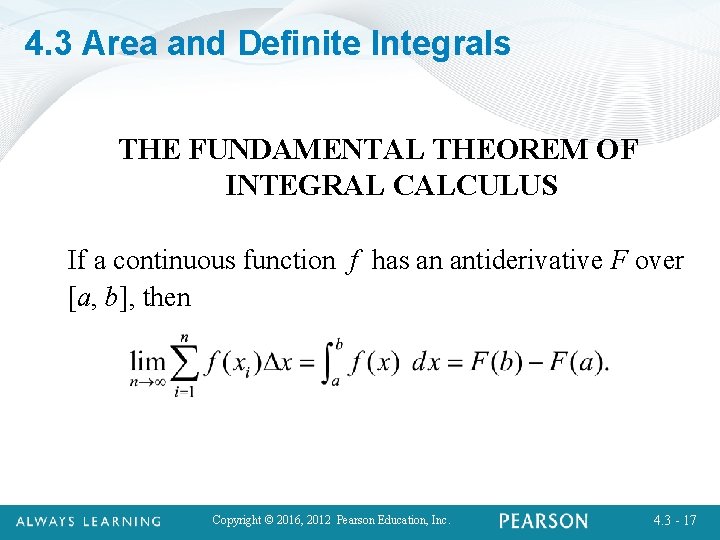
4. 3 Area and Definite Integrals THE FUNDAMENTAL THEOREM OF INTEGRAL CALCULUS If a continuous function f has an antiderivative F over [a, b], then Copyright © 2016, 2012 Pearson Education, Inc. 4. 3 - 17
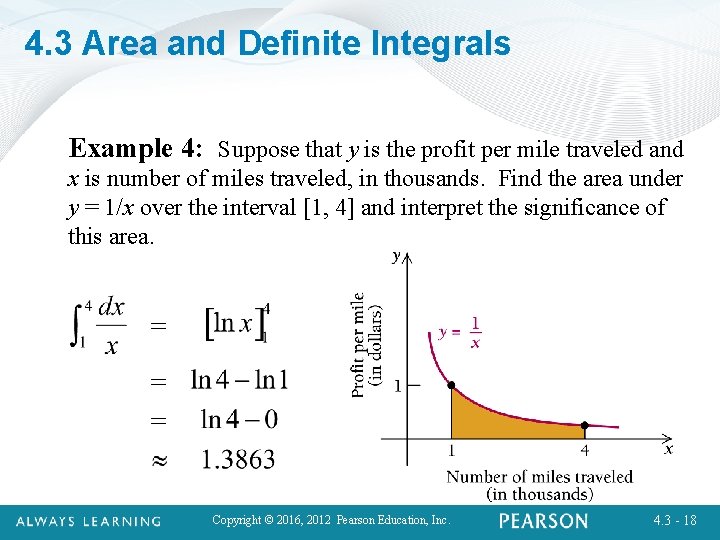
4. 3 Area and Definite Integrals Example 4: Suppose that y is the profit per mile traveled and x is number of miles traveled, in thousands. Find the area under y = 1/x over the interval [1, 4] and interpret the significance of this area. Copyright © 2016, 2012 Pearson Education, Inc. 4. 3 - 18
4. 3 Area and Definite Integrals Example 4 (concluded): The area represents a total profit of $1386. 30 when the miles traveled increase from 1000 to 4000 miles. Copyright © 2016, 2012 Pearson Education, Inc. 4. 3 - 19
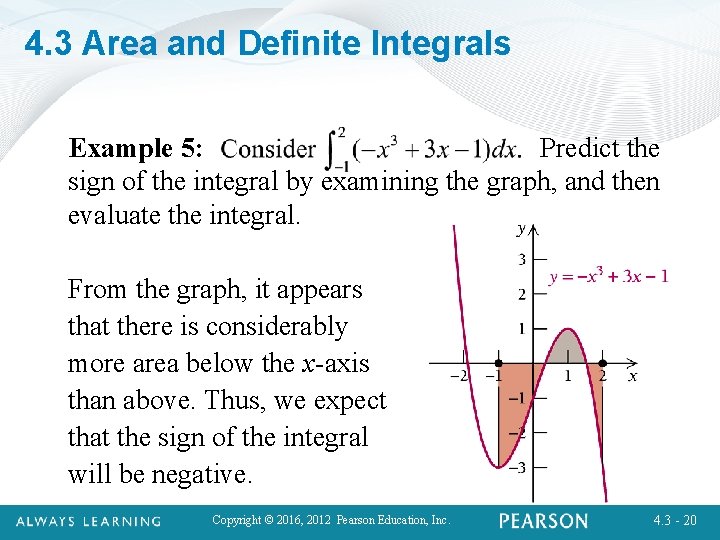
4. 3 Area and Definite Integrals Example 5: Predict the sign of the integral by examining the graph, and then evaluate the integral. From the graph, it appears that there is considerably more area below the x-axis than above. Thus, we expect that the sign of the integral will be negative. Copyright © 2016, 2012 Pearson Education, Inc. 4. 3 - 20
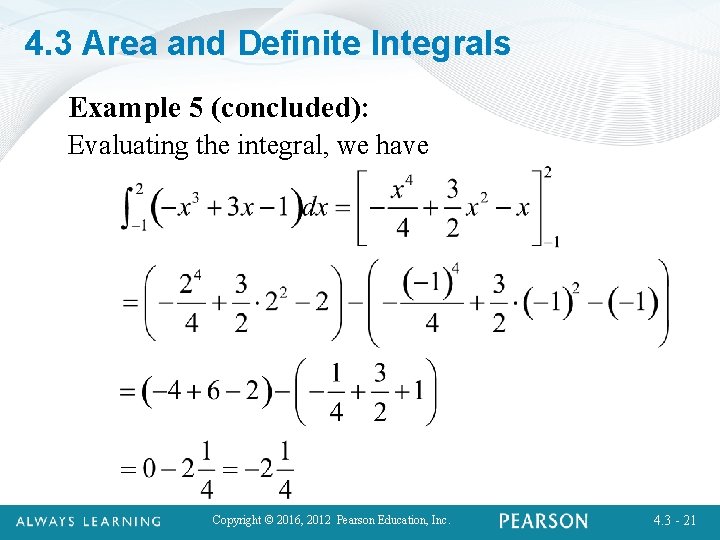
4. 3 Area and Definite Integrals Example 5 (concluded): Evaluating the integral, we have Copyright © 2016, 2012 Pearson Education, Inc. 4. 3 - 21
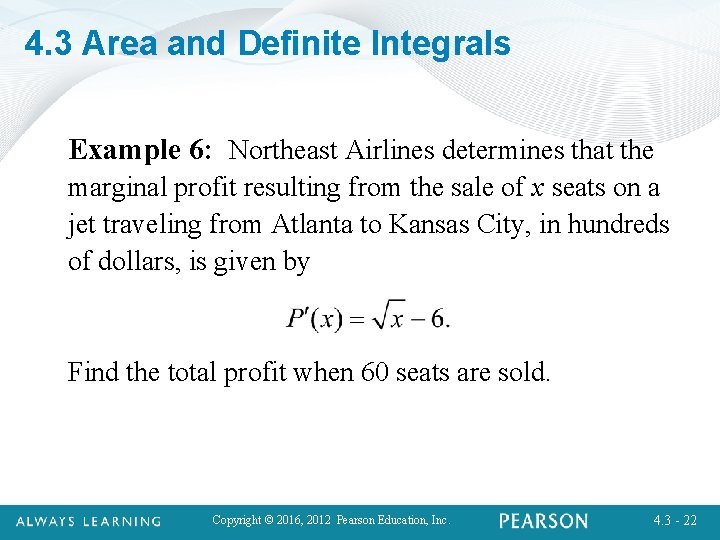
4. 3 Area and Definite Integrals Example 6: Northeast Airlines determines that the marginal profit resulting from the sale of x seats on a jet traveling from Atlanta to Kansas City, in hundreds of dollars, is given by Find the total profit when 60 seats are sold. Copyright © 2016, 2012 Pearson Education, Inc. 4. 3 - 22
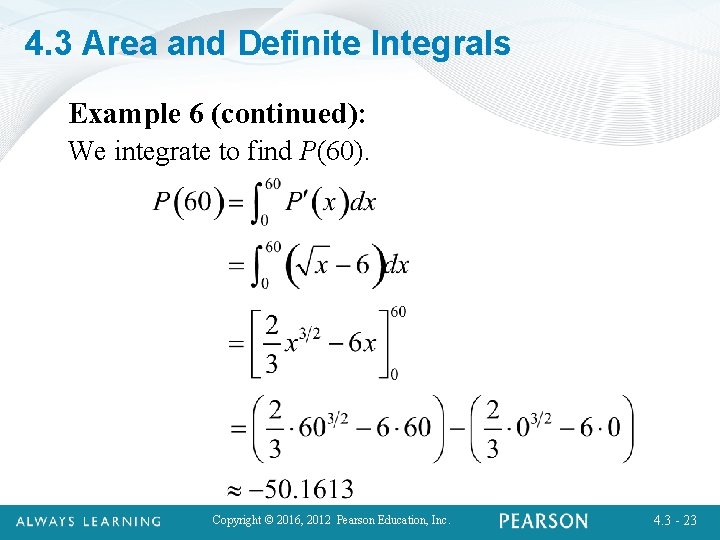
4. 3 Area and Definite Integrals Example 6 (continued): We integrate to find P(60). Copyright © 2016, 2012 Pearson Education, Inc. 4. 3 - 23
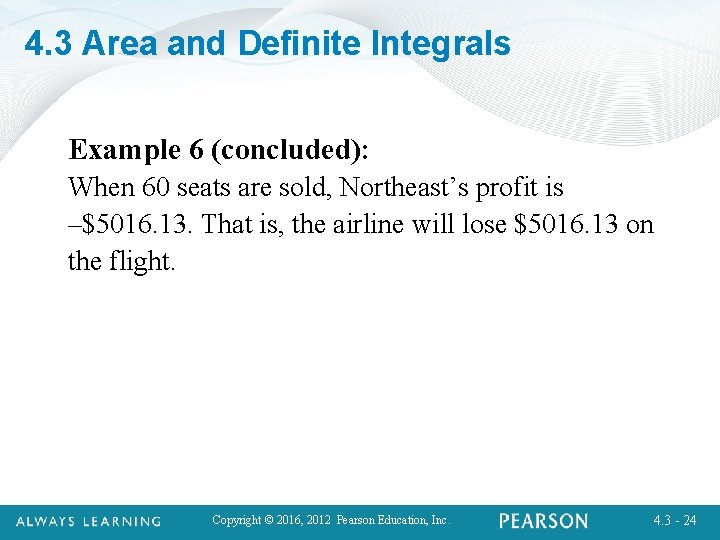
4. 3 Area and Definite Integrals Example 6 (concluded): When 60 seats are sold, Northeast’s profit is –$5016. 13. That is, the airline will lose $5016. 13 on the flight. Copyright © 2016, 2012 Pearson Education, Inc. 4. 3 - 24
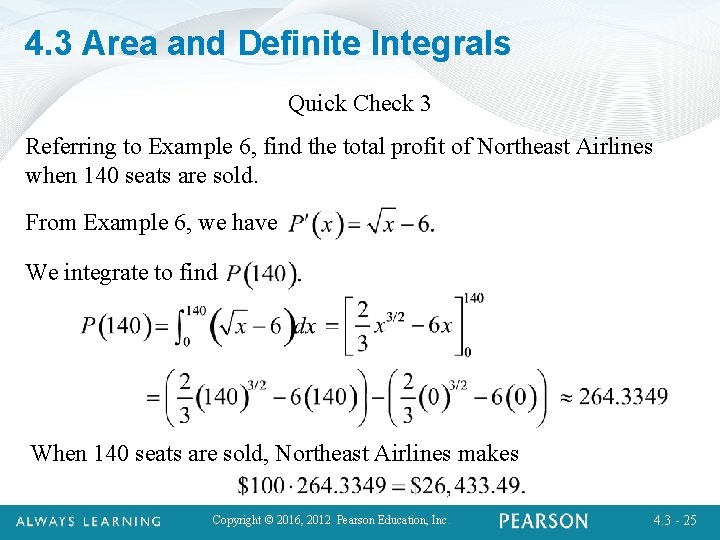
4. 3 Area and Definite Integrals Quick Check 3 Referring to Example 6, find the total profit of Northeast Airlines when 140 seats are sold. From Example 6, we have We integrate to find When 140 seats are sold, Northeast Airlines makes Copyright © 2016, 2012 Pearson Education, Inc. 4. 3 - 25
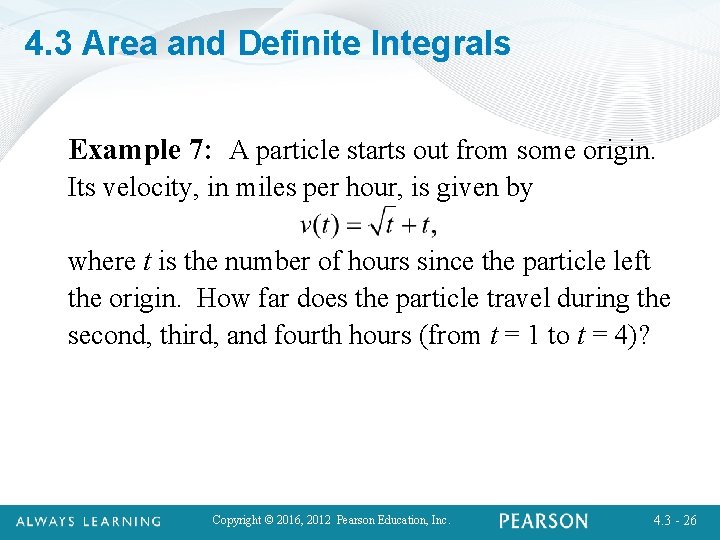
4. 3 Area and Definite Integrals Example 7: A particle starts out from some origin. Its velocity, in miles per hour, is given by where t is the number of hours since the particle left the origin. How far does the particle travel during the second, third, and fourth hours (from t = 1 to t = 4)? Copyright © 2016, 2012 Pearson Education, Inc. 4. 3 - 26
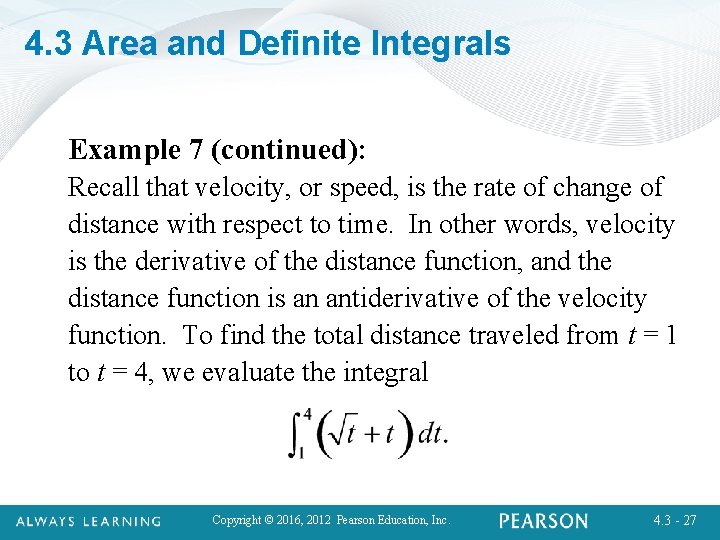
4. 3 Area and Definite Integrals Example 7 (continued): Recall that velocity, or speed, is the rate of change of distance with respect to time. In other words, velocity is the derivative of the distance function, and the distance function is an antiderivative of the velocity function. To find the total distance traveled from t = 1 to t = 4, we evaluate the integral Copyright © 2016, 2012 Pearson Education, Inc. 4. 3 - 27
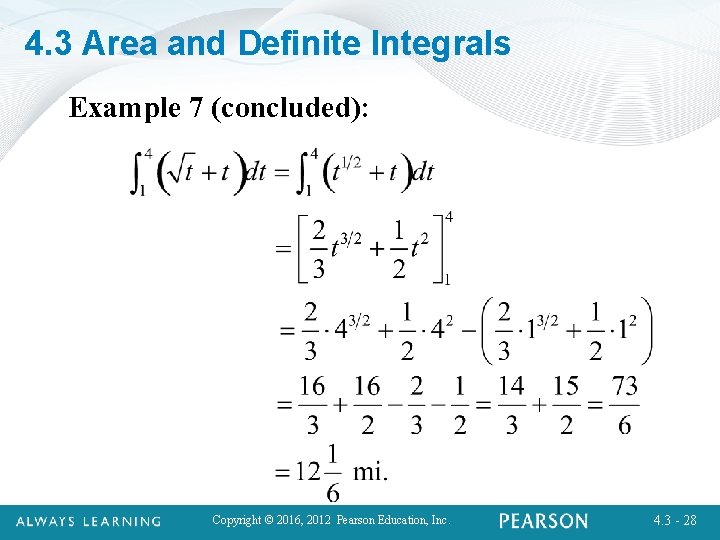
4. 3 Area and Definite Integrals Example 7 (concluded): Copyright © 2016, 2012 Pearson Education, Inc. 4. 3 - 28
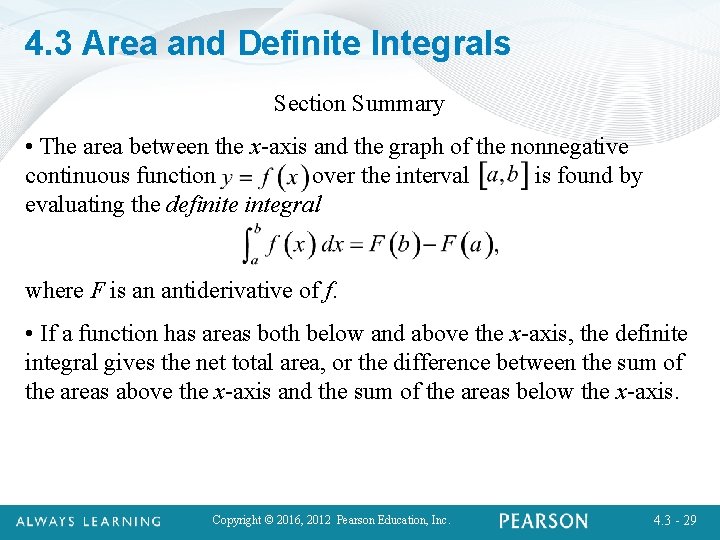
4. 3 Area and Definite Integrals Section Summary • The area between the x-axis and the graph of the nonnegative continuous function over the interval is found by evaluating the definite integral where F is an antiderivative of f. • If a function has areas both below and above the x-axis, the definite integral gives the net total area, or the difference between the sum of the areas above the x-axis and the sum of the areas below the x-axis. Copyright © 2016, 2012 Pearson Education, Inc. 4. 3 - 29
4. 3 Area and Definite Integrals Section Summary Concluded If there is more area above the x-axis than below, then the definite integral will be positive. If there is more area below the x-axis than above, then the definite integral will be negative. If the areas above and below the x-axis are the same, then the definite integral will be 0. Copyright © 2016, 2012 Pearson Education, Inc. 4. 3 - 30
- Slides: 30