
AREA 1 GUIDING PRINCIPLES SECTION 3 Consequences Utilitarian
- Slides: 15
AREA 1 GUIDING PRINCIPLES • • SECTION 3 Consequences (Utilitarian Ethics) Duty and Reason (Kantian Ethics)
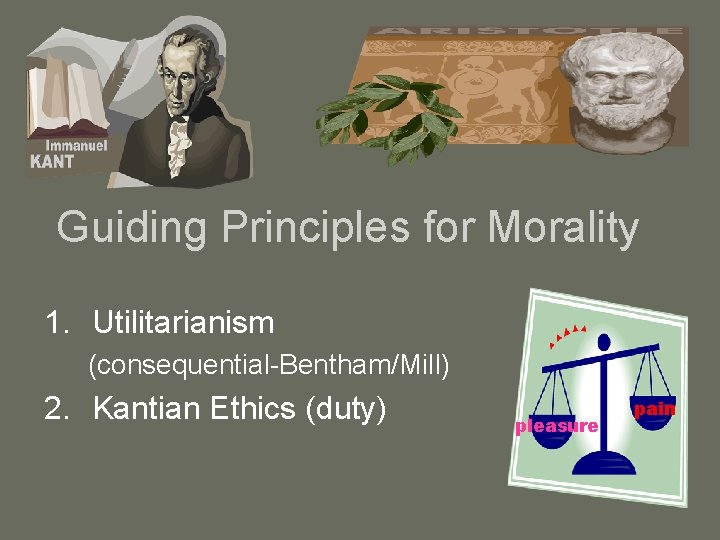
Guiding Principles for Morality 1. Utilitarianism (consequential-Bentham/Mill) 2. Kantian Ethics (duty) pleasure pain
Moral decisions guided by… • Consequential, i. e. Utilitarianism – a good moral decision is that which the consequences of the action produces the greatest good for the greatest number of people OR • Duty – morals based on what you should do not what you might ought to do.
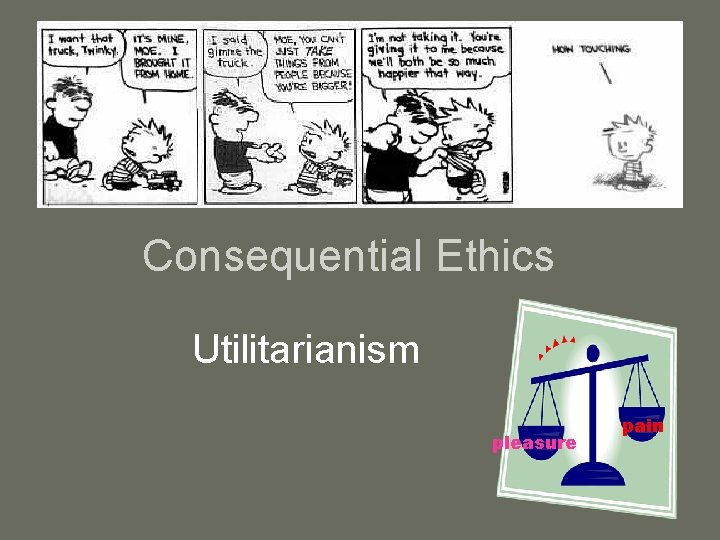
Consequential Ethics Utilitarianism pleasure pain
Consequential Ethics • E. g. Utilitarianism: actions are good or bad depending on the outcome. • The moral consequences of the action is the promotion of human happiness/wellbeing and the minimising of unhappiness/pain. • The aim is to achieve consequences that will bring about the greatest happiness for the greatest number of people. • Distinction between act-utilitarianism and rule utilitarianism. • Reference to Mill or Bentham’s position.
Utilitarianism • Utility means an action is determined by its ‘utility’, or ‘usefulness’ • Utilitarian ethics focus on consequences of actions rather than actions themselves • Actions not good/bad in themselves- it is the consequence of the action which is considered
• A moral theory which says that what is morally right is whatever produces the greatest overall amount of pleasure or happiness to the greatest number of people. • The moral consequence of good actions promote the greatest happiness/well-being and the minimising of unhappiness/pain for the greatest number of people • Based on the assumption/idea that happiness/pleasure is the desired end of all human activity • Formulated by Jeremy Bentham and developed by John Stuart Mill
Act Utilitarianism • Maintains that the good action is the one that leads to the greatest good in a particular situation • Is flexible, being able to take into account individual situations at a given moment. • Problems- has the potential to justify virtually any act • Might be impractical to suggest that we should measure each moral choice every time we act.
Rule Utilitarianism • Looks at potential rules of action. • To determine whether a rule should be followed, he/she looks at what would happen if it were constantly followed. • If adherence to the rule produces more happiness than otherwise, it is a rule that morally should be followed at all times. • The distinction between act and rule utilitarianism is therefore based on a difference about the proper object of consequentialist calculation: specific to a case or generalized to rules. • Problem- may permit unethical practices because minority interests are not protected, eg slavery.
Kantian Ethics The Categorical Imperative
Immanuel Kant (1724 -1804) KEY ISSUE • An action is good or bad, right or wrong, by something within the action itself (does not consider the consequences. • Use of reason to discover a rational basis for one’s sense of duty • How to devise a principle (maxim) by which one could distinguish between right and wrong
What is morality? A. it is meant to guide our actions; maxim= principle of action B. It is universal, the same for everyone C. is a matter of following absolute rules D. rules that admit no exceptions and appeal not to religious considerations but to reason E. it is categorical, not optional
Reason and Duty • Kant is best known for this • Do right without any reference to rules or emotions- detached action • Uses human reason • Do good without any thought about the consequences- that is duty. • Categorical Imperative= can my act be universalized? Don’t treat people as a means to an end act as if you are a law-maker in a free society • Anything we ought to do we must be able to do otherwise there is no point in having the duty.
The Categorical Imperative – If morality is based on universal reason, then it can’t mention what varies (relative) – Any moral law must hold for all rational beings; if it depends on something contingent and variable, it is not a law SO – “Act only on that maxim through which you can at the same time will that it should become a universal law”
• Good -straightforward and based on reason, no emotions, we have responsibility, intrinsic worth of all people, unselfish, forbids immoral acts • Bad- not immediate, too general, motives are impossible to remove, lack of emotion de-humanises decisions, duties change as society changes, duty does not self-create must be a duty-giver.