
Are you ready Scientific Method Biodiversity Chemistry Ecology
Are you ready?
Scientific Method Biodiversity Chemistry Ecology & Population of Life Cell Structure Hodge Podge 10 10 10 20 20 20 30 30 30 40 40 40 50 50 50
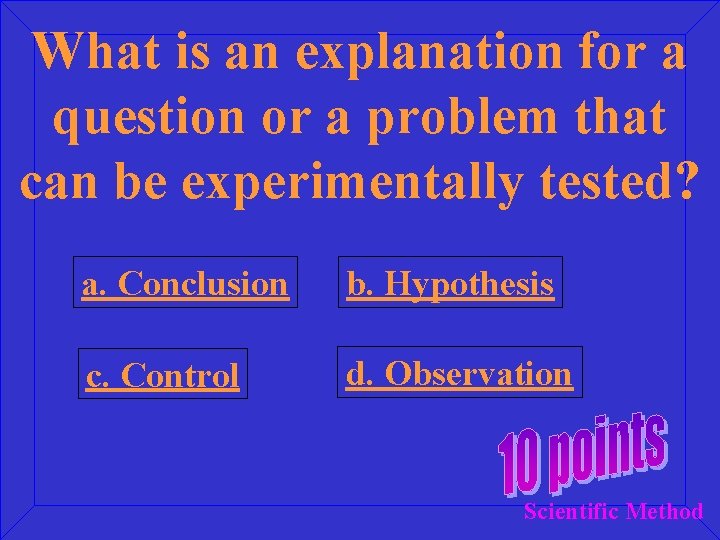
What is an explanation for a question or a problem that can be experimentally tested? a. Conclusion b. Hypothesis c. Control d. Observation Scientific Method
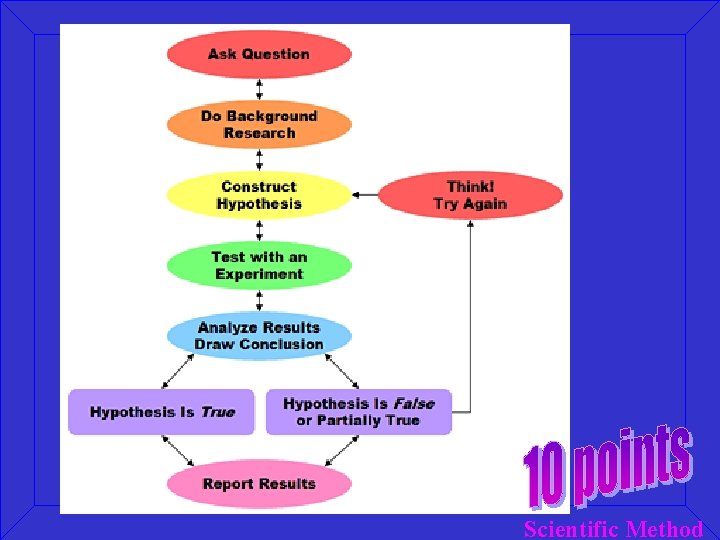
Scientific Method
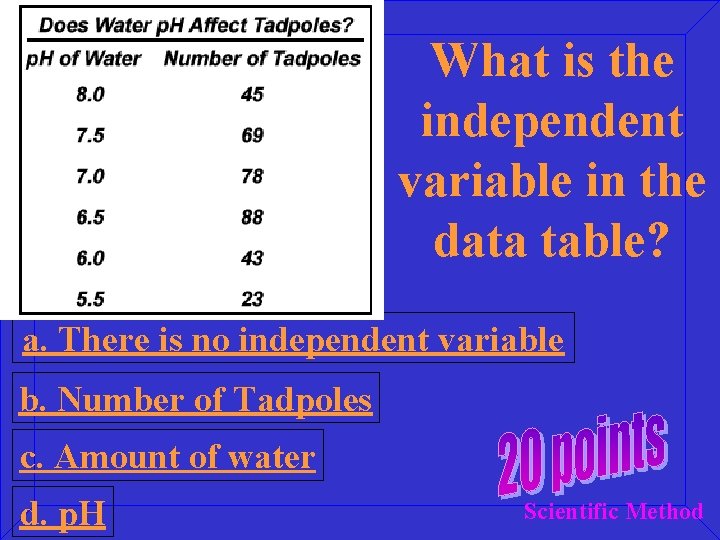
What is the independent variable in the data table? a. There is no independent variable b. Number of Tadpoles c. Amount of water d. p. H Scientific Method
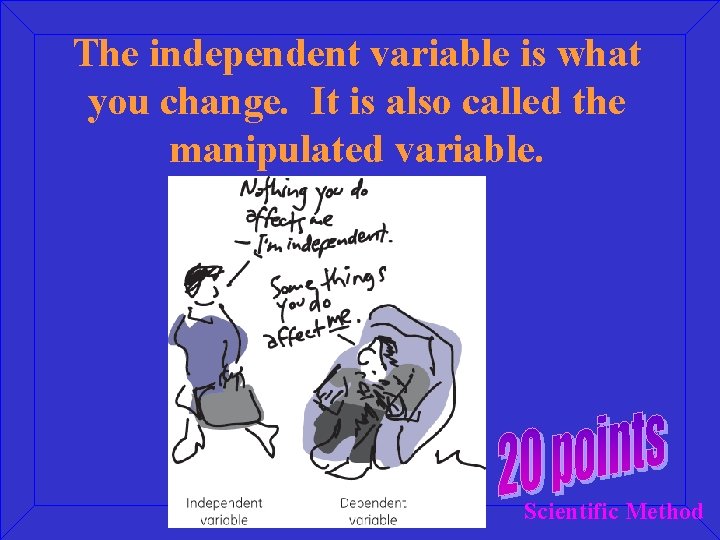
The independent variable is what you change. It is also called the manipulated variable. Scientific Method
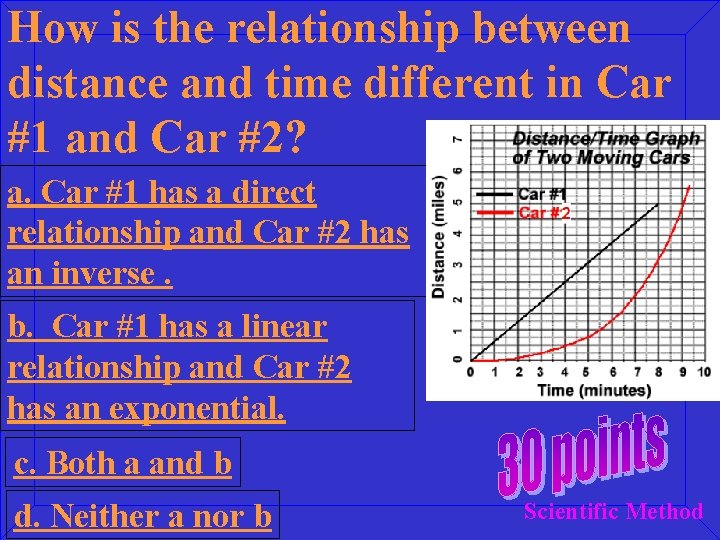
How is the relationship between distance and time different in Car #1 and Car #2? a. Car #1 has a direct relationship and Car #2 has an inverse. b. Car #1 has a linear relationship and Car #2 has an exponential. c. Both a and b d. Neither a nor b Scientific Method
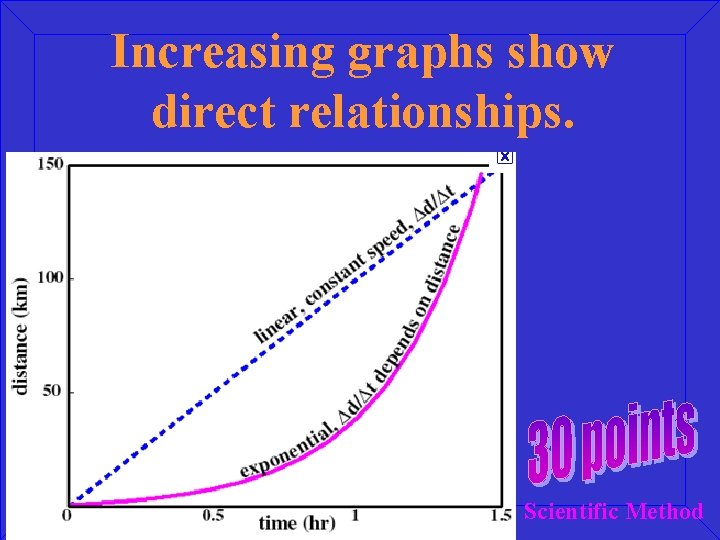
Increasing graphs show direct relationships. Scientific Method
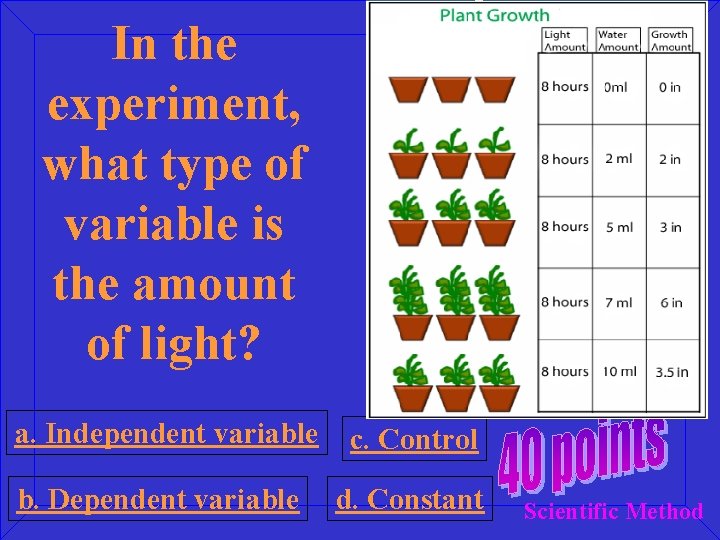
In the experiment, what type of variable is the amount of light? a. Independent variable c. Control b. Dependent variable d. Constant Scientific Method
Constant and Control are not the same. Constants are things kept the same for each condition. Controls are comparisons. Scientific Method
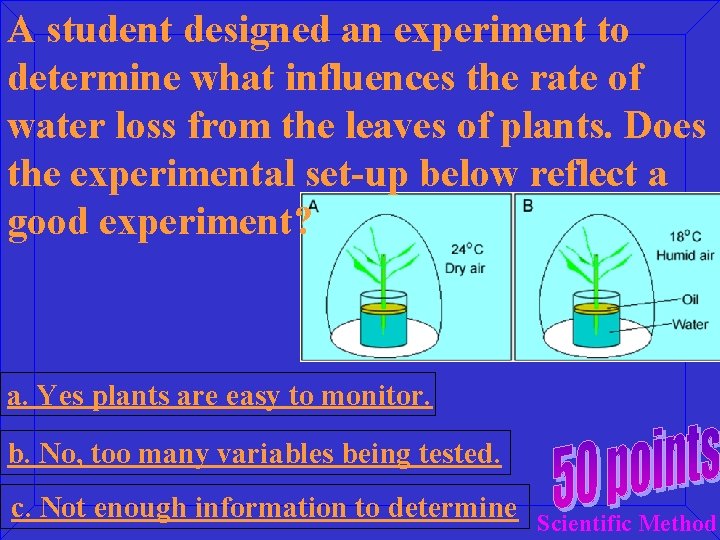
A student designed an experiment to determine what influences the rate of water loss from the leaves of plants. Does the experimental set-up below reflect a good experiment? a. Yes plants are easy to monitor. b. No, too many variables being tested. c. Not enough information to determine Scientific Method
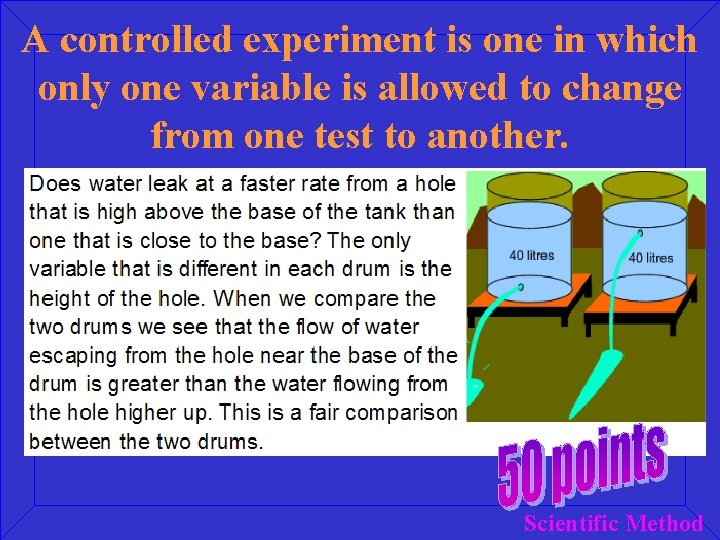
A controlled experiment is one in which only one variable is allowed to change from one test to another. Scientific Method
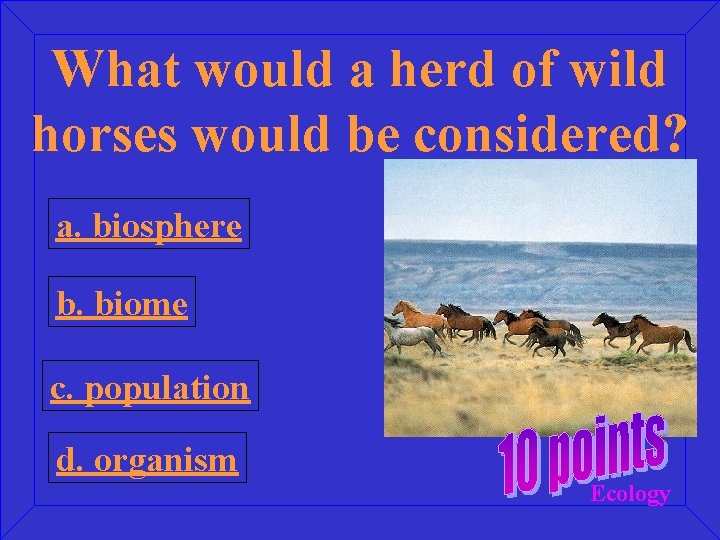
What would a herd of wild horses would be considered? a. biosphere b. biome c. population d. organism Ecology
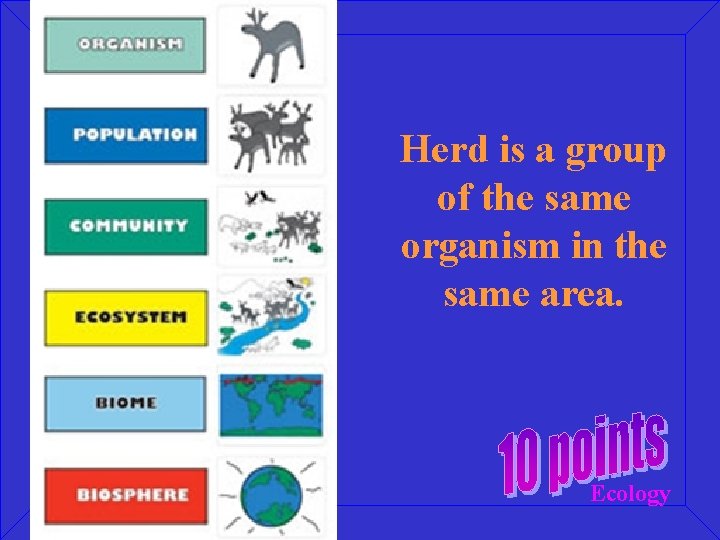
Herd is a group of the same organism in the same area. Ecology
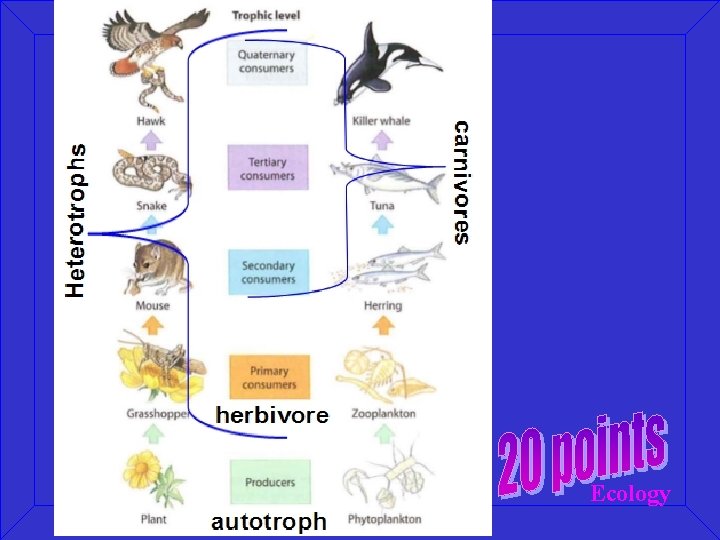
What are animals that consume only plants? a. producers c. carnivores b. herbivores d. omnivores Ecology
Ecology
Which trophic level contains the most biomass? a. Tertiary consumer b. Secondary consumer c. Primary consumer d. producer Ecology
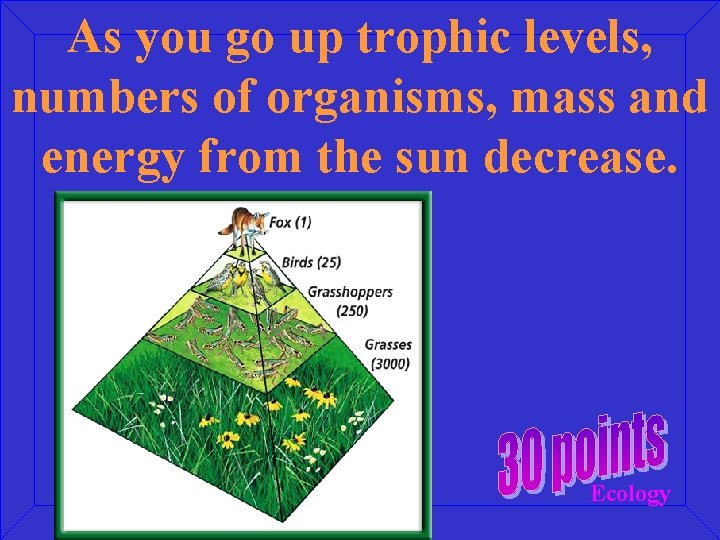
As you go up trophic levels, numbers of organisms, mass and energy from the sun decrease. Ecology
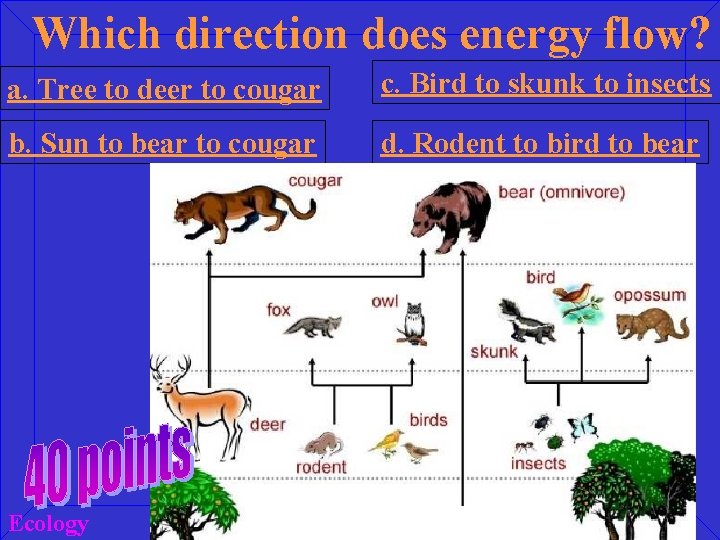
Which direction does energy flow? a. Tree to deer to cougar c. Bird to skunk to insects b. Sun to bear to cougar d. Rodent to bird to bear Ecology
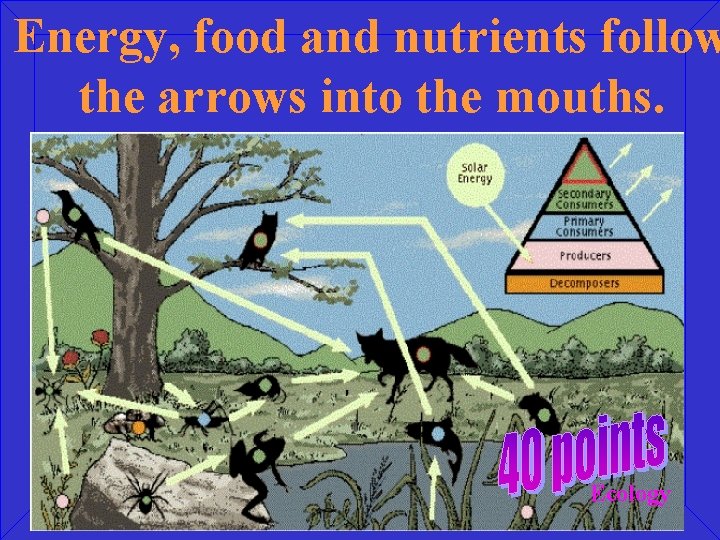
Energy, food and nutrients follow the arrows into the mouths. Ecology
What is the role of a detritivore in an ecosystem? a. They are food for consumers. b. They return nutrients back to the soil. c. Through photosynthesis they can make their own food. d. They eat plants. Ecology
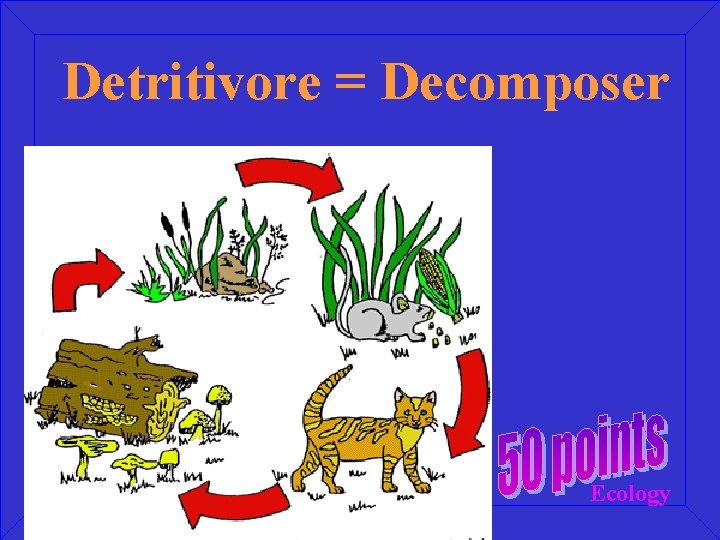
Detritivore = Decomposer Ecology
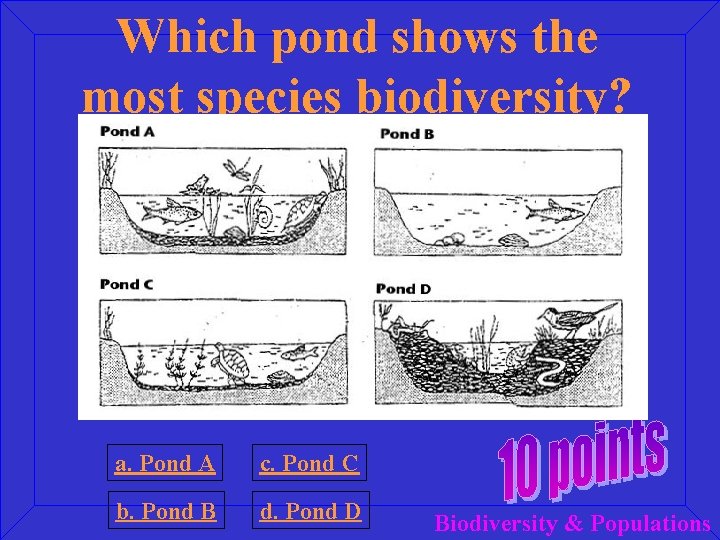
Which pond shows the most species biodiversity? a. Pond A c. Pond C b. Pond B d. Pond D Biodiversity & Populations
Species Biodiversity is the degree of variation of life forms within a given ecosystem, biome, or entire planet. Biodiversity is a measure of the health of ecosystems. Biodiversity & Populations
The dramatic rise in the rate of extinction of species is thought to be due to _. a. the reduction of the ozone layer b. the difference between the needs of the human population and available resources c. intentional introduction of foreign species into new environments d. acid rain Biodiversity & Populations
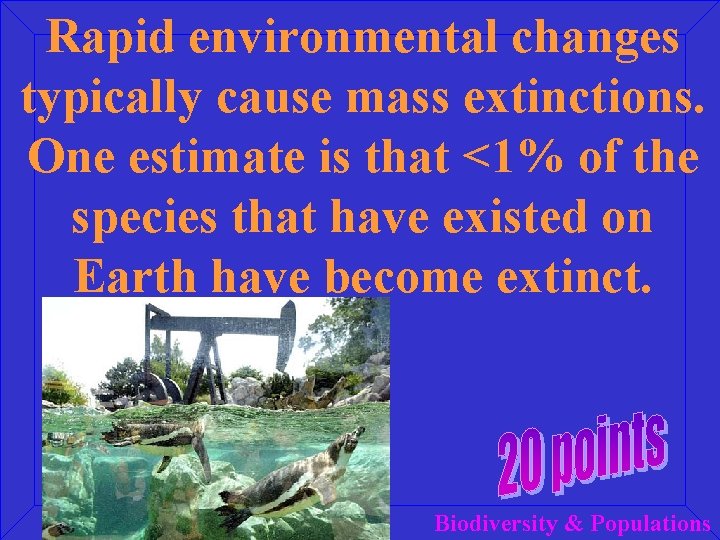
Rapid environmental changes typically cause mass extinctions. One estimate is that <1% of the species that have existed on Earth have become extinct. Biodiversity & Populations
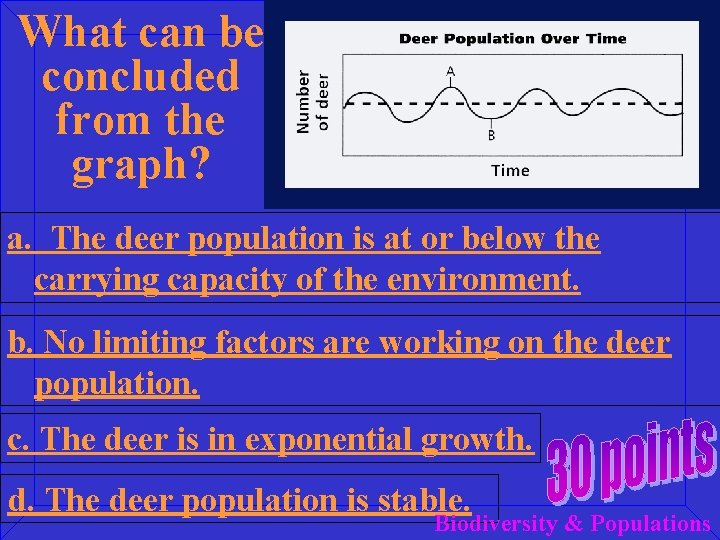
What can be concluded from the graph? a. The deer population is at or below the carrying capacity of the environment. b. No limiting factors are working on the deer population. c. The deer is in exponential growth. d. The deer population is stable. Biodiversity & Populations
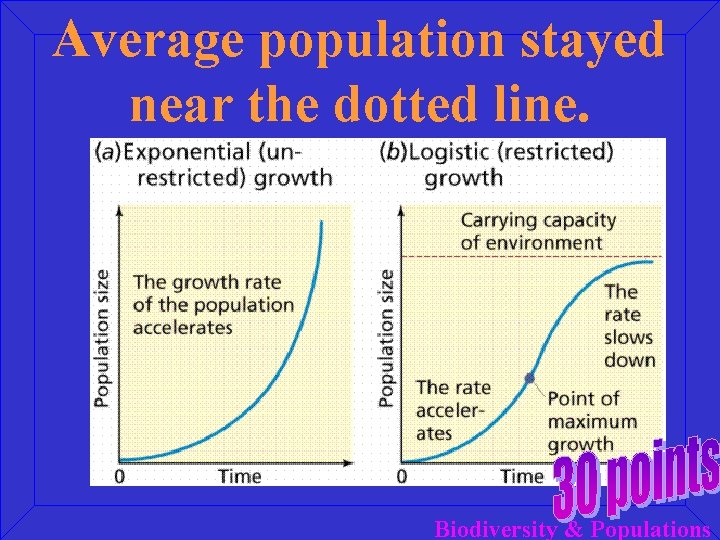
Average population stayed near the dotted line. Biodiversity & Populations
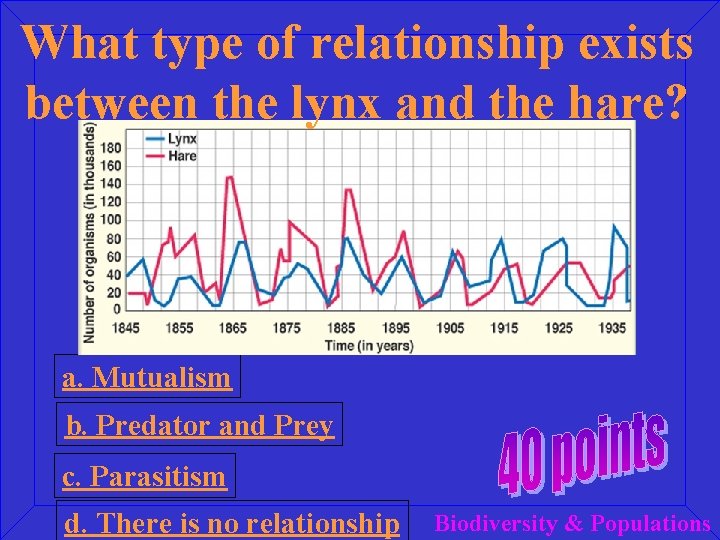
What type of relationship exists between the lynx and the hare? a. Mutualism b. Predator and Prey c. Parasitism d. There is no relationship Biodiversity & Populations
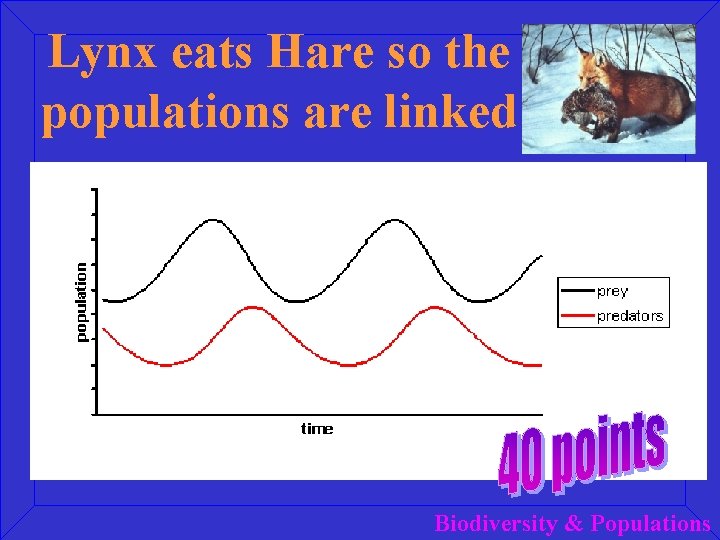
Lynx eats Hare so the populations are linked Biodiversity & Populations
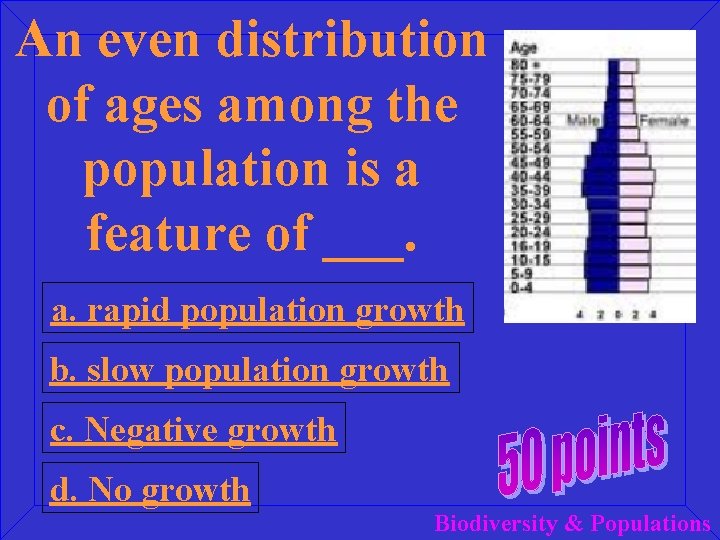
An even distribution of ages among the population is a feature of ___. a. rapid population growth b. slow population growth c. Negative growth d. No growth Biodiversity & Populations
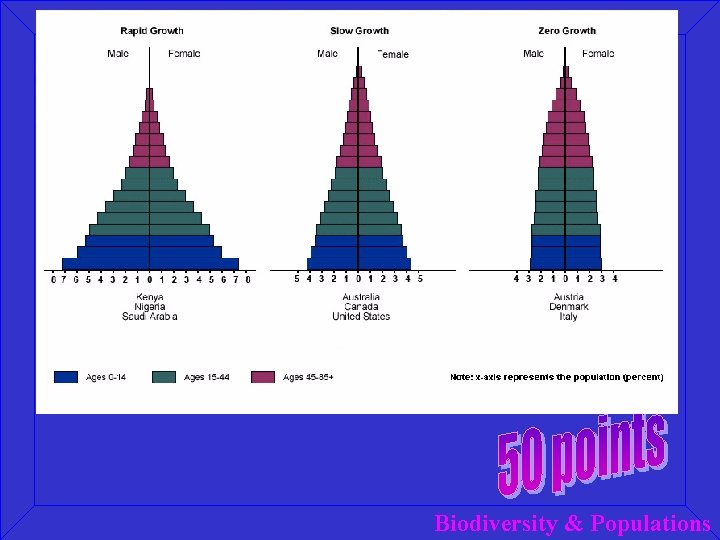
Biodiversity & Populations
What marcomolecule contains an organism’s genetic material? a. Proteins c. DNA b. Lipids d. carbohydrate Chemistry of Life
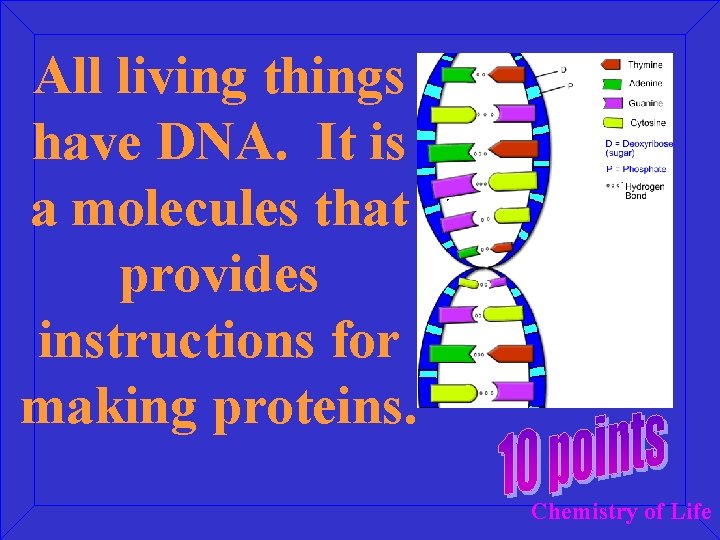
All living things have DNA. It is a molecules that provides instructions for making proteins. Chemistry of Life
What are the basic building blocks of proteins? a. Nucleic acids b. Peptide bonds c. Amino acids d. Fatty acids Chemistry of Life
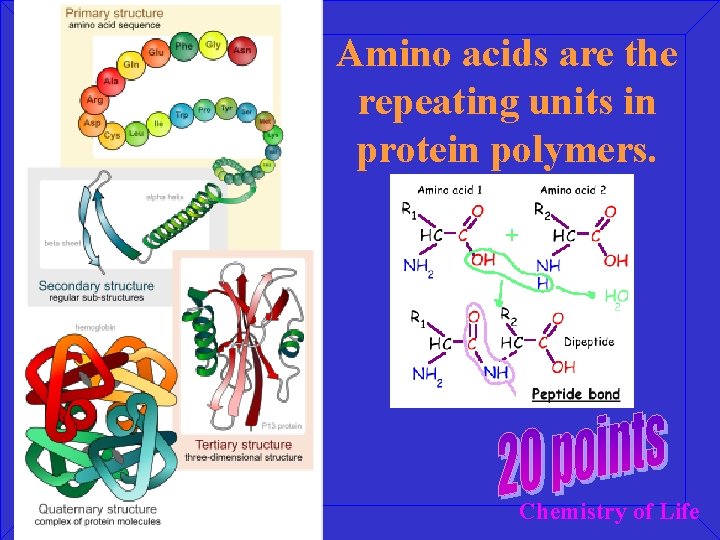
Amino acids are the repeating units in protein polymers. Chemistry of Life
Which compound is considered an organic molecule? a. Salt b. Protons c. Water d. Nucleic acid Chemistry of Life
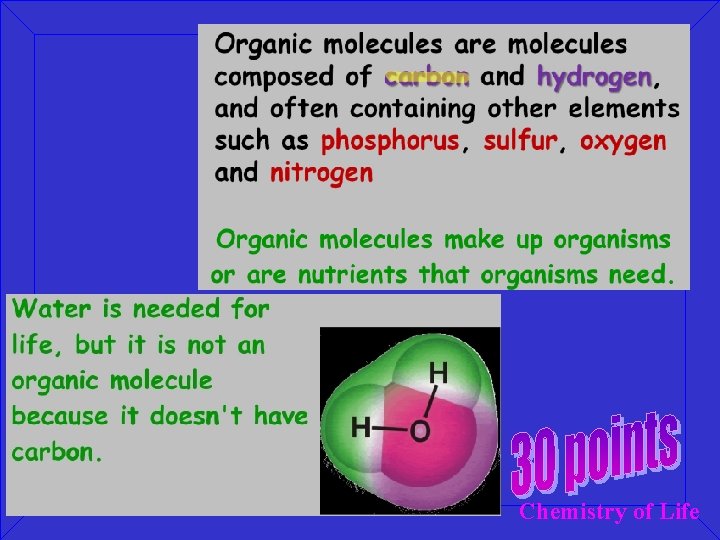
Chemistry of Life
The various enzymes in our bodies are _____. a. lipids b. carbohydrades c. Nucleic acids d. proteins Chemistry of Life
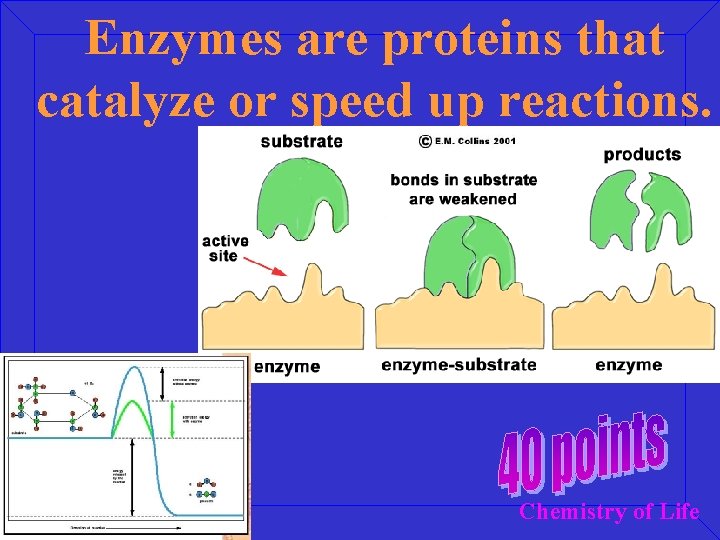
Enzymes are proteins that catalyze or speed up reactions. Chemistry of Life
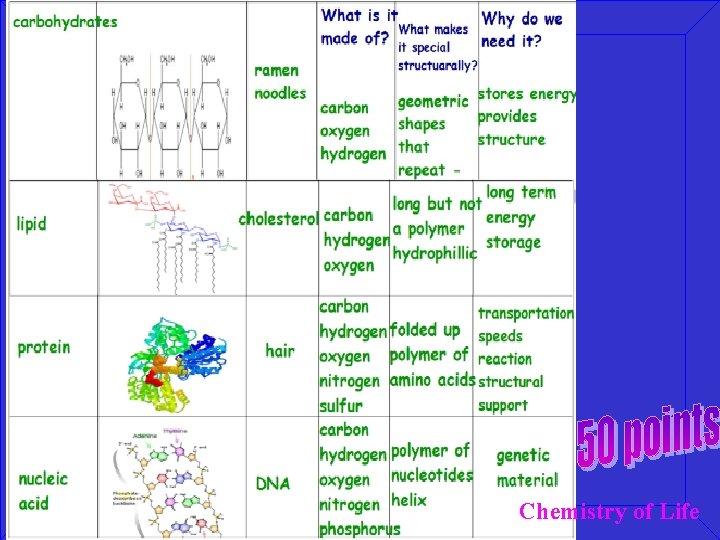
Which biomolecule stores energy? a. lipids b. proteins c. carbohydrates d. Both a and c Chemistry of Life
Chemistry of Life
Which of the following do not have cell walls? a. animals c. all eukaryotes b. plants d. all prokaryotes Cell Structure
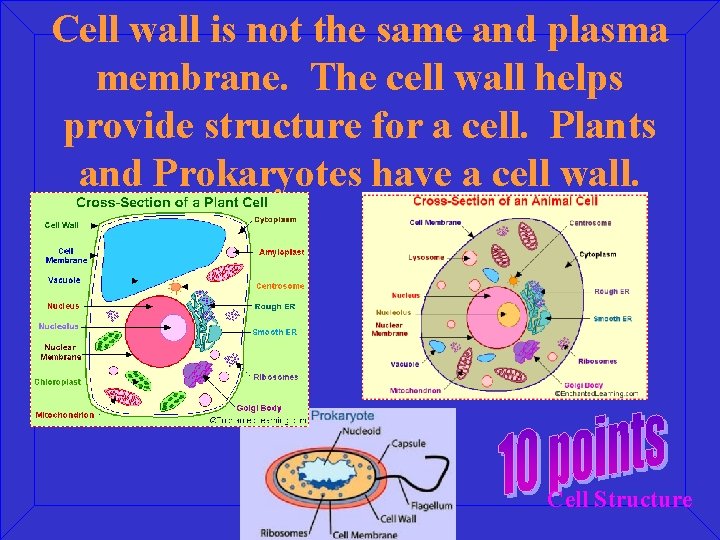
Cell wall is not the same and plasma membrane. The cell wall helps provide structure for a cell. Plants and Prokaryotes have a cell wall. Cell Structure
If a cell contains a nucleus, it must be a(n) a. Plant b. animal c. prokaryote d. eukaryote Cell Structure
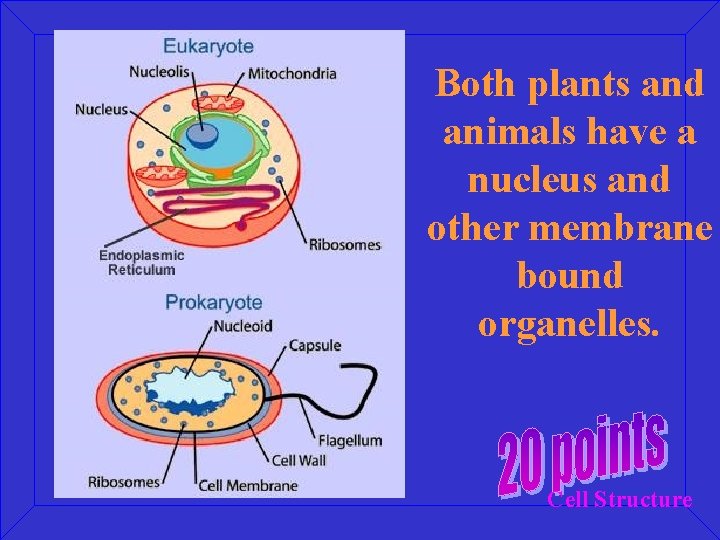
Both plants and animals have a nucleus and other membrane bound organelles. Cell Structure
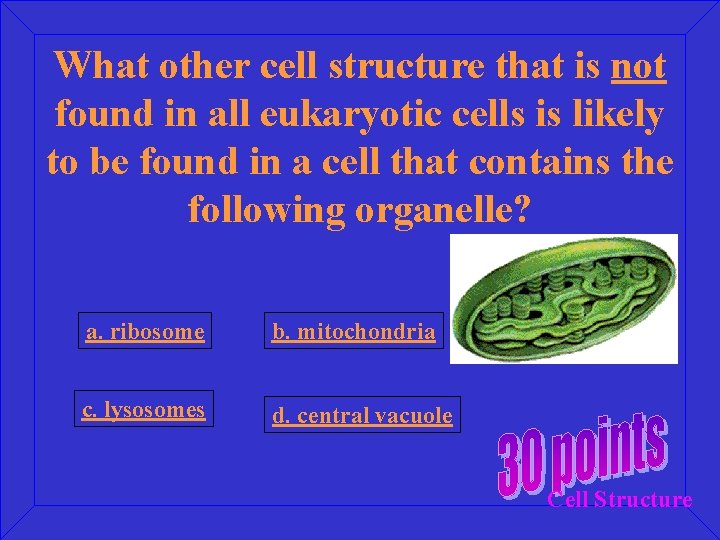
What other cell structure that is not found in all eukaryotic cells is likely to be found in a cell that contains the following organelle? a. ribosome b. mitochondria c. lysosomes d. central vacuole Cell Structure
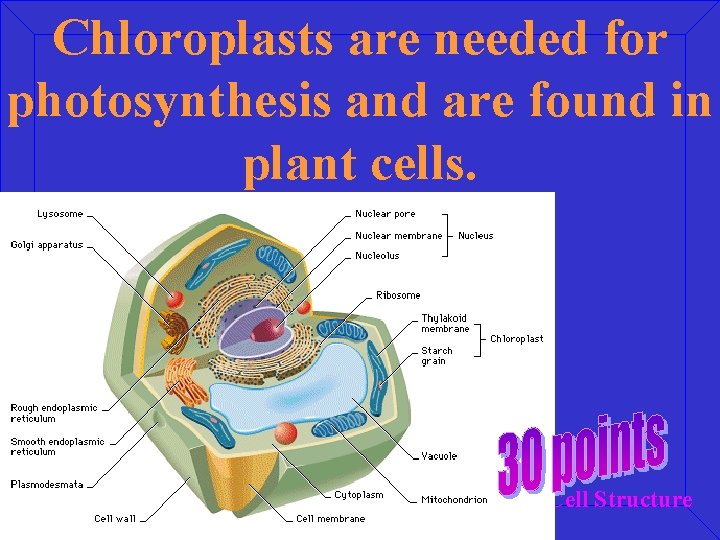
Chloroplasts are needed for photosynthesis and are found in plant cells. Cell Structure
What is the purpose of ribosomes? a. To make DNA c. To transport materials throughout the cell b. To package materials d. To make proteins Cell Structure
ØRibosomes make proteins by arranging amino acids according to instructions from RNA. Ø Ribosomes are found in all cells. ØIn eukaryotes they float free in the cytoplasm and attach to the outside of the endoplasmic reticulum. Cell Structure
A plasma membrane is made up of a(n) _____. a. Lipid bilayer b. Enzyme bilayer c. Carbohydrate bilayer d. Protein layer Cell Structure
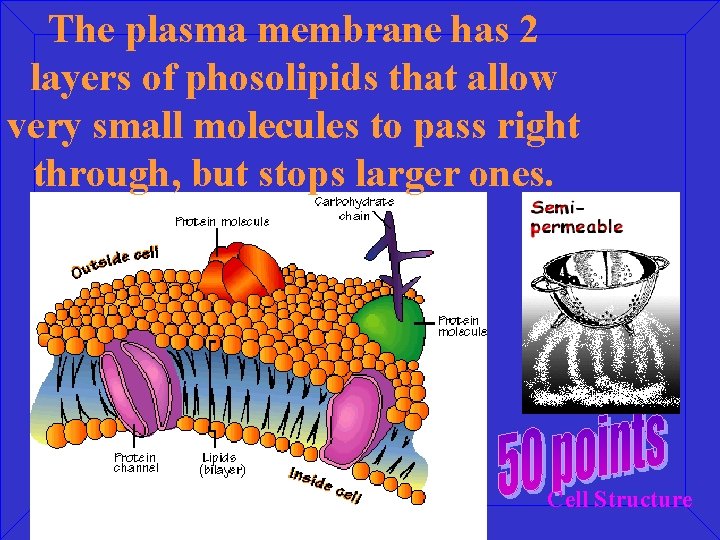
The plasma membrane has 2 layers of phosolipids that allow very small molecules to pass right through, but stops larger ones. Cell Structure
The nonliving factors of an ecosystem are called a. Population b. homeostasis c. Abiotic factors d. Biotic factors Hodge Podge
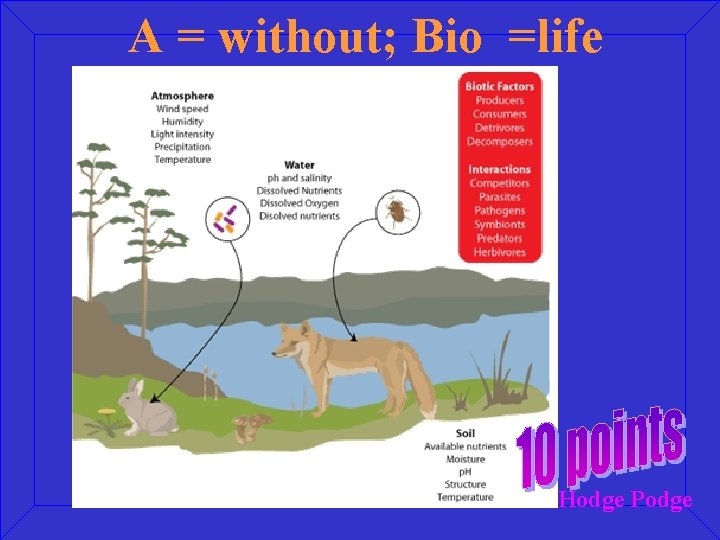
A = without; Bio =life Hodge Podge
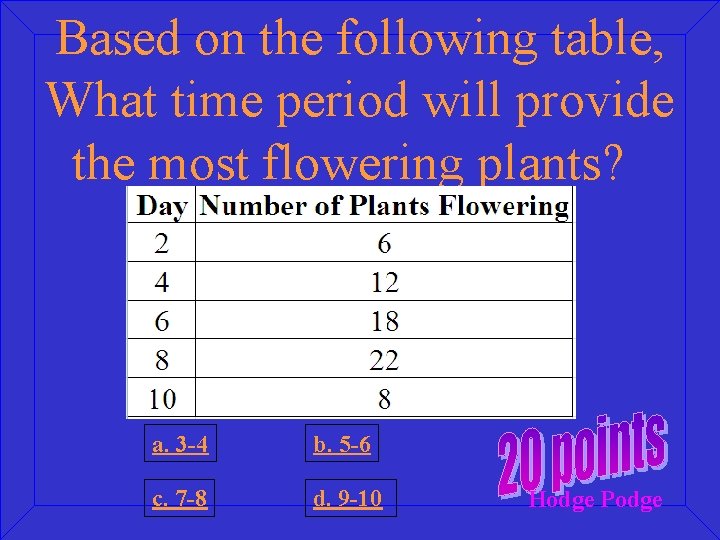
Based on the following table, What time period will provide the most flowering plants? a. 3 -4 b. 5 -6 c. 7 -8 d. 9 -10 Hodge Podge
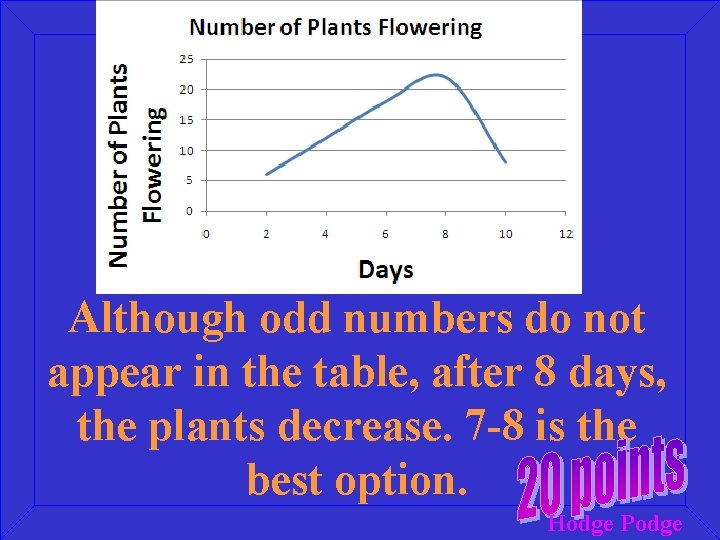
Although odd numbers do not appear in the table, after 8 days, the plants decrease. 7 -8 is the best option. Hodge Podge
What organisms lack membrane-bound organelles? a. prokaryote c. plant b. eukaryote d. animal Hodge Podge
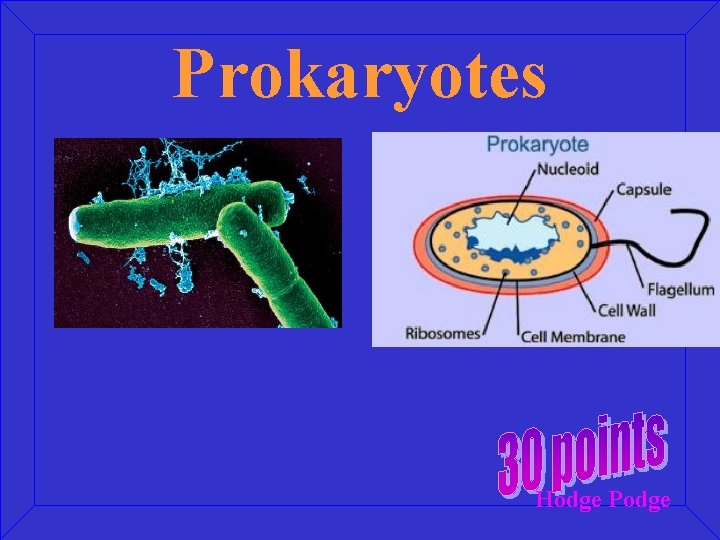
Prokaryotes Hodge Podge
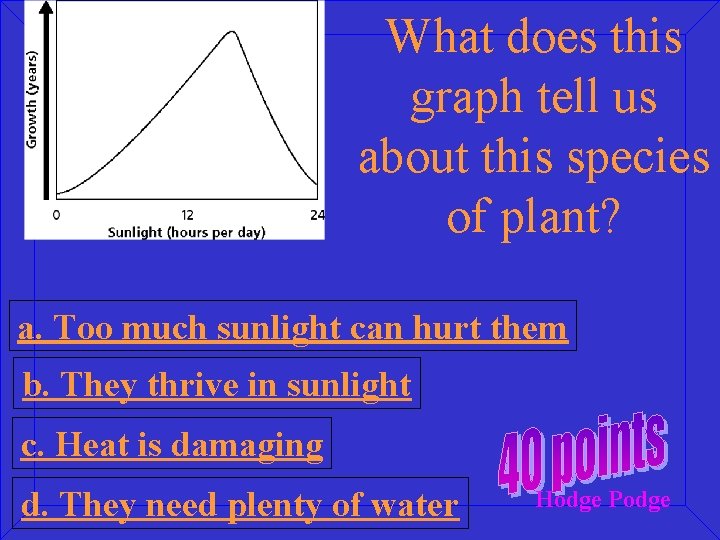
What does this graph tell us about this species of plant? a. Too much sunlight can hurt them b. They thrive in sunlight c. Heat is damaging d. They need plenty of water Hodge Podge
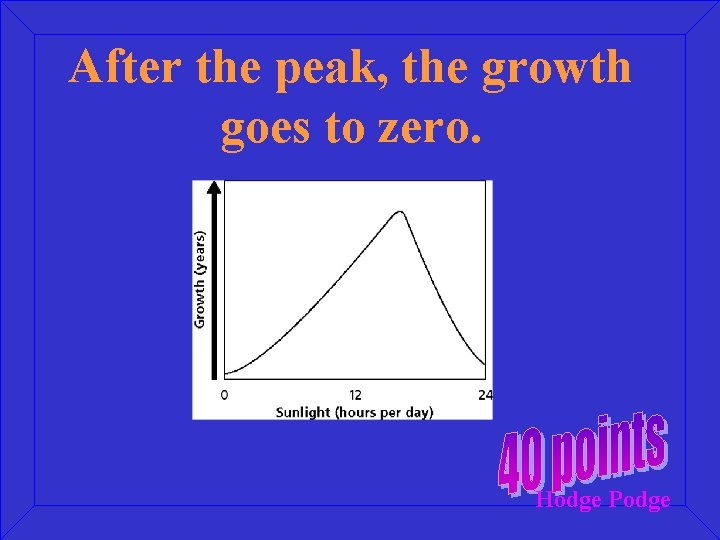
After the peak, the growth goes to zero. Hodge Podge
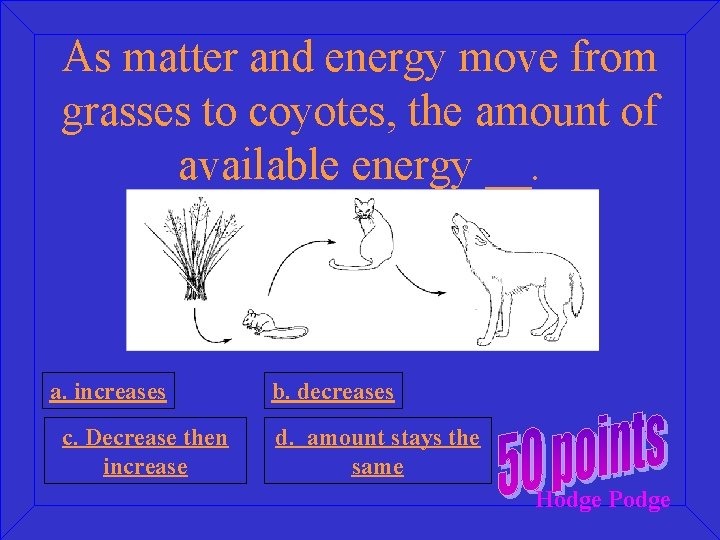
As matter and energy move from grasses to coyotes, the amount of available energy __. a. increases c. Decrease then increase b. decreases d. amount stays the same Hodge Podge
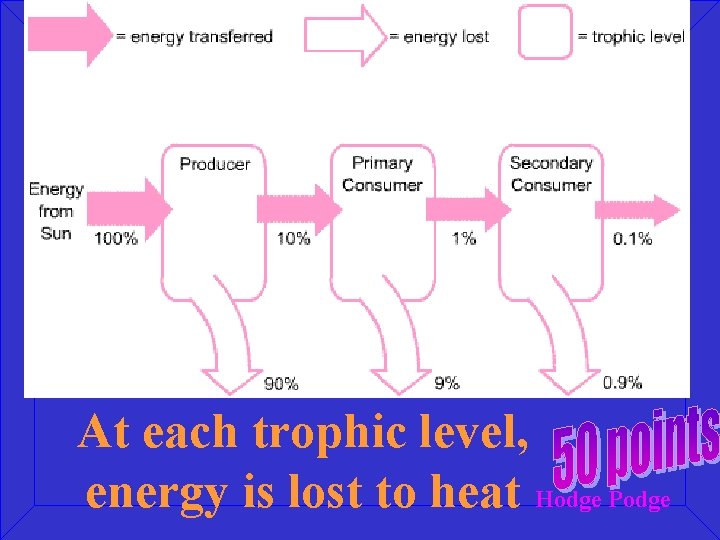
At each trophic level, energy is lost to heat Hodge Podge

How much will you wager?
- Slides: 63