
Are You Ready for Alternative Response Ohios Alternative

- Slides: 90
Are You Ready for Alternative Response? Ohio’s Alternative Response Symposium May 13, 2010 Caren Kaplan American Humane Association Steve Hanson Supreme Court of Ohio Kristin Gilbert, Jennifer Justice, Leslie Mc. Gee, Cheryl Wolfe and Roger Ward Ohio Department of Job and Family Services
Purposes of Alternative Response and Child Protection n n CPS was established to respond to all reports of suspected child maltreatment -numbers overwhelm available resources Currently either screen out or do not open for services more than half of the reports - yet many children are vulnerable
Purposes of Alternative Response and Child Protection n n Investigatory practice is often adversarial and alienates parents AR = way to serve more screened-in reports at earlier stage by engaging families in a non -adversarial process of linking them to needed services
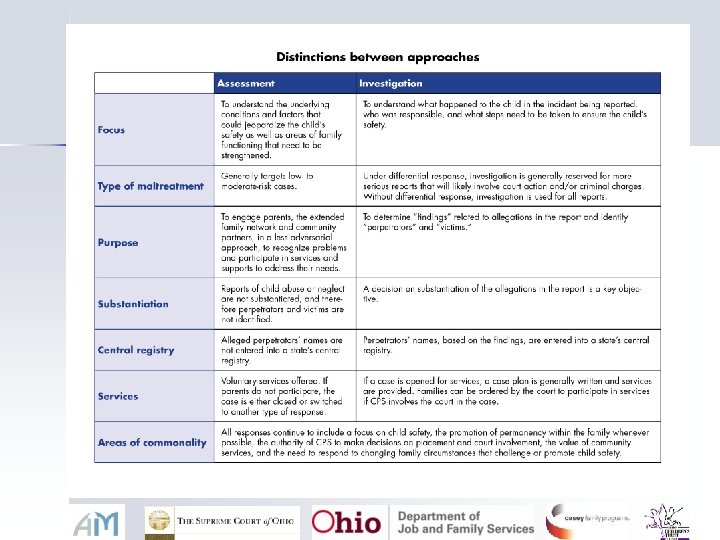
What is Alternative Response? n n n Alternative to child protection investigative response and one of several responses within a differential response system Sets aside fault finding and substantiation decision Usually applied to reports that do not allege serious and imminent harm
What is Alternative Response? n n n Focuses less on investigative fact finding and more on assessing and ensuring child safety Seeks safety through family engagement and collaborative partnerships Allows and encourages agencies to provide services without formal determination of abuse or neglect
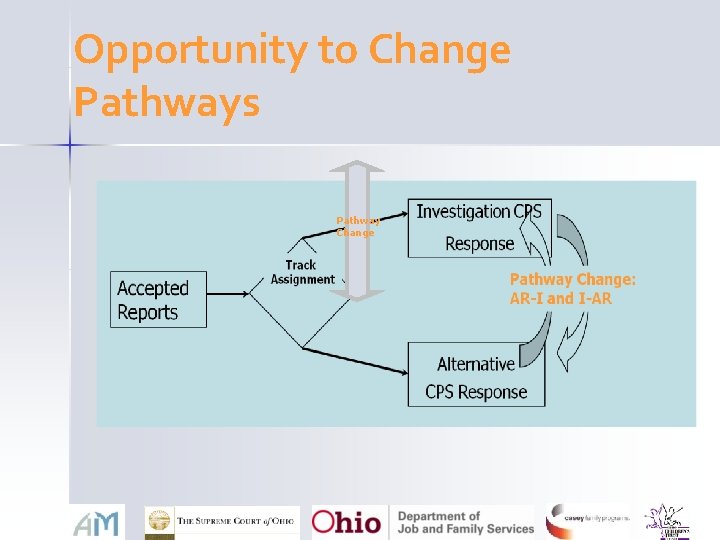
Core AR Elements 1. 2. 3. 4. Use of two or more discrete response tracks for cases that are screened in and accepted Establishment of discrete response tracks is codified in statute, policy, or protocols Track assignment depends on an array of factors (e. g. , presence of imminent danger, level of risk, the number of previous reports, the source of the report, and/or presenting case characteristics such as type of alleged maltreatment and age of the alleged victim) Original track assignment can change based on new information that alters risk level or safety concerns
Core AR Elements 5. 6. 7. Services are voluntary on a non-investigative track – families can choose to receive investigation response – families can accept or refuse offered services if there are no safety concerns No substantiation of alleged maltreatment for families served in a non-investigative track; services are offered without a formal determination of child maltreatment Alternative use of central registry depending on track, meaning name of alleged perpetrator is not entered into central registry for those individuals who are served through a non-investigative track
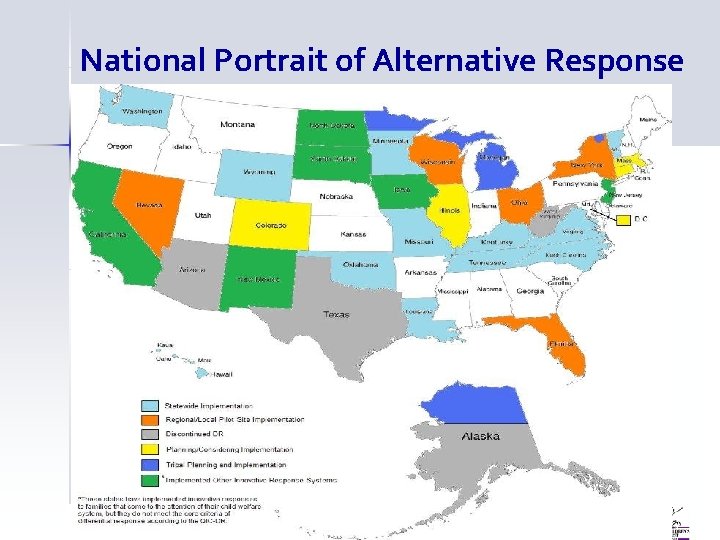
National Portrait of Alternative Response
Why Implement Alternative Response? n n n Many parents, reporters, and social workers become frustrated with limited responses available to children and families CPS “investigation” is perceived as overly accusatory and adversarial as initial response for many reports Focus on substantiation and identifying perpetrator does not contribute to family’s readiness to engage in services
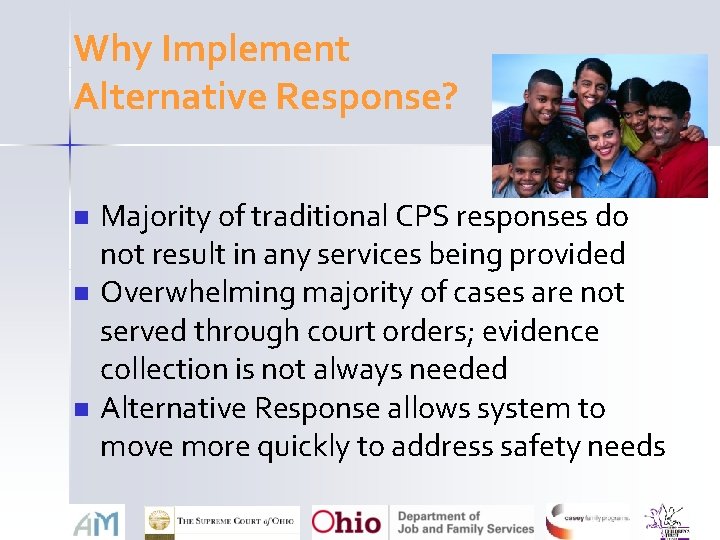
Why Implement Alternative Response? n n n Majority of traditional CPS responses do not result in any services being provided Overwhelming majority of cases are not served through court orders; evidence collection is not always needed Alternative Response allows system to move more quickly to address safety needs
Why Implement Alternative Response? n n n Alternative response can support families by applying available resources to services rather than investigations Alternative response is often accompanied by greater efforts to identify, build, and coordinate formal and non-formal services and supports Children are safer sooner
Purpose of Alternative Response and Child Protection n Serve screened in reports earlier n Engage families in assessment n Link families to needed services 12
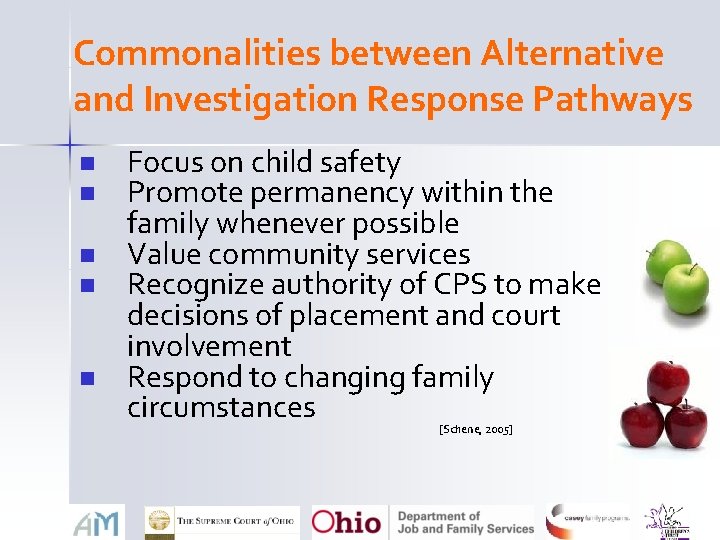
Commonalities between Alternative and Investigation Response Pathways n n n Focus on child safety Promote permanency within the family whenever possible Value community services Recognize authority of CPS to make decisions of placement and court involvement Respond to changing family circumstances [Schene, 2005]
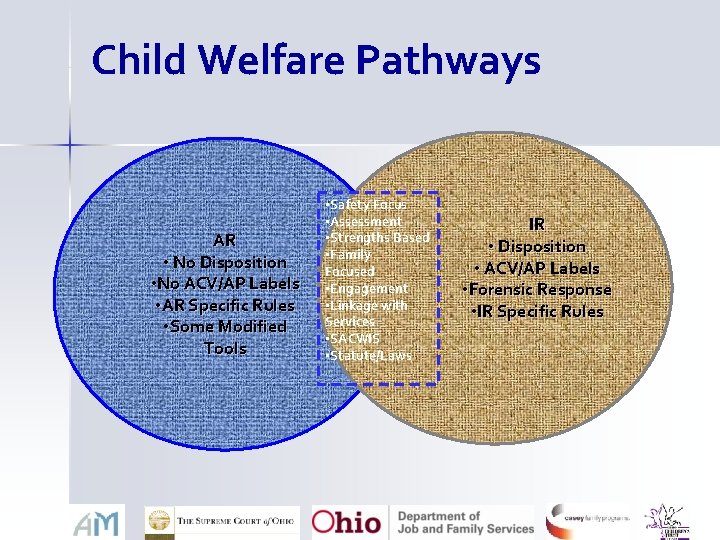
Child Welfare Pathways AR • No Disposition • No ACV/AP Labels • AR Specific Rules • Some Modified Tools • Safety Focus • Assessment IR • Strengths Based • Disposition • Family • ACV/AP Labels Focused n Disposition • Engagement d • Forensic Response • Linkage with n ACV/AP Labels • IR Specific Rules Services n Forensic Approach • SACWIS • Statute/Laws n TR Specific Rules TR
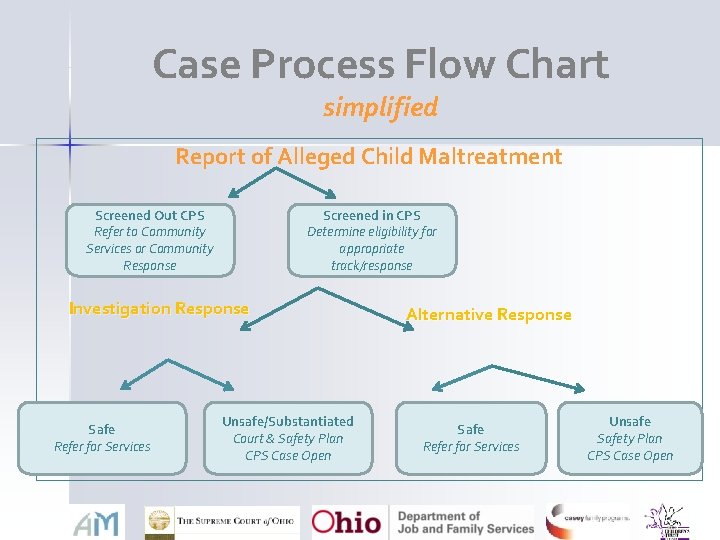
Case Process Flow Chart simplified Report of Alleged Child Maltreatment Screened Out CPS Refer to Community Services or Community Response Screened in CPS Determine eligibility for appropriate track/response Investigation Response Safe Refer for Services Unsafe/Substantiated Court & Safety Plan CPS Case Open Alternative Response Safe Refer for Services Unsafe Safety Plan CPS Case Open
Opportunity to Change Pathways Pathway Change
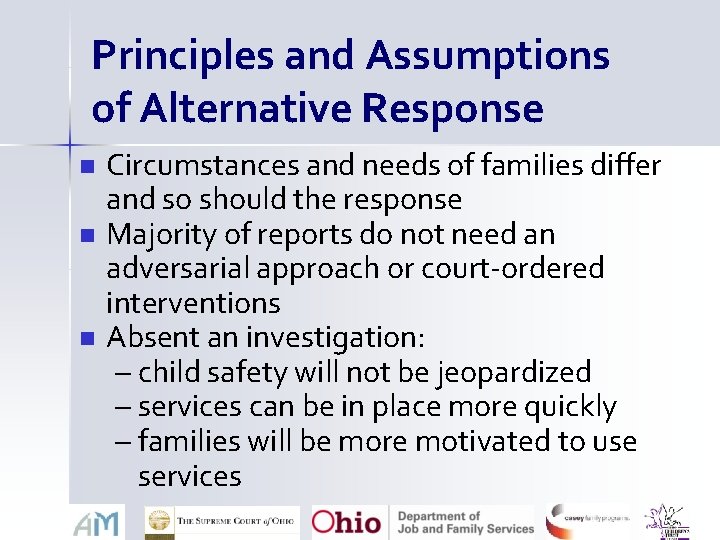
Principles and Assumptions of Alternative Response n n n Circumstances and needs of families differ and so should the response Majority of reports do not need an adversarial approach or court-ordered interventions Absent an investigation: – child safety will not be jeopardized – services can be in place more quickly – families will be more motivated to use services
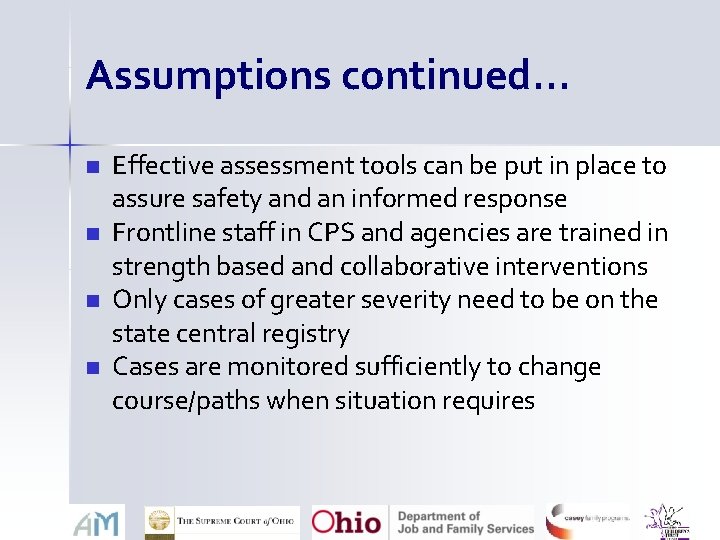
Assumptions continued. . . n n Effective assessment tools can be put in place to assure safety and an informed response Frontline staff in CPS and agencies are trained in strength based and collaborative interventions Only cases of greater severity need to be on the state central registry Cases are monitored sufficiently to change course/paths when situation requires
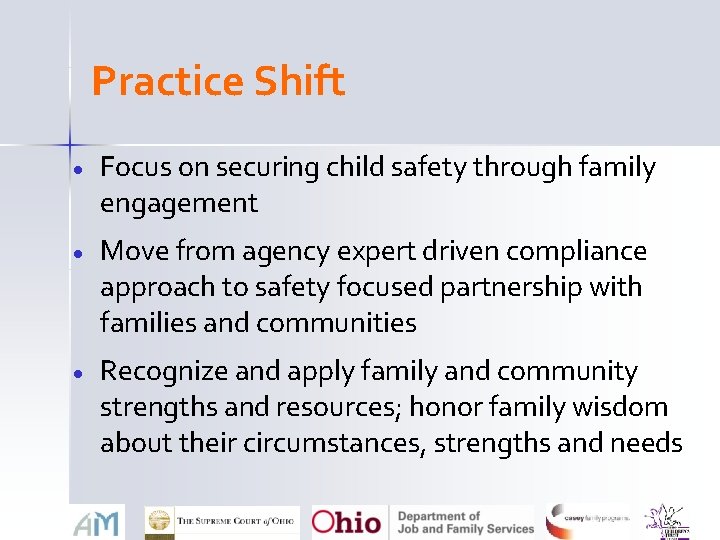
Practice Shift Focus on securing child safety through family engagement Move from agency expert driven compliance approach to safety focused partnership with families and communities Recognize and apply family and community strengths and resources; honor family wisdom about their circumstances, strengths and needs
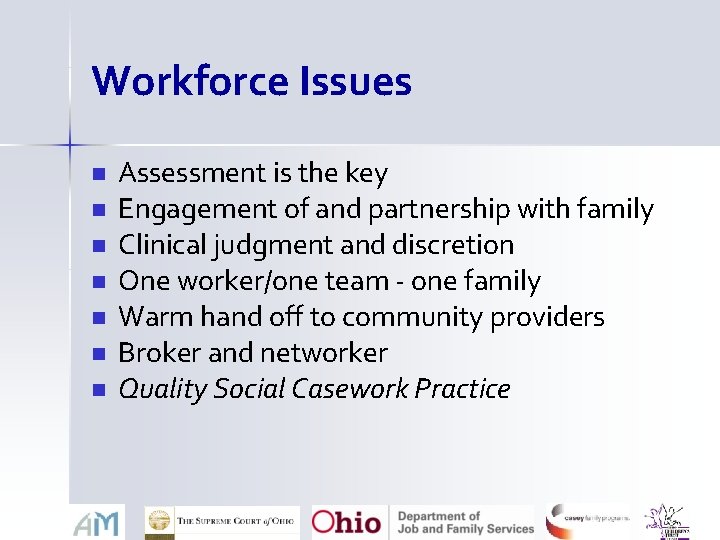
Workforce Issues n n n n Assessment is the key Engagement of and partnership with family Clinical judgment and discretion One worker/one team - one family Warm hand off to community providers Broker and networker Quality Social Casework Practice
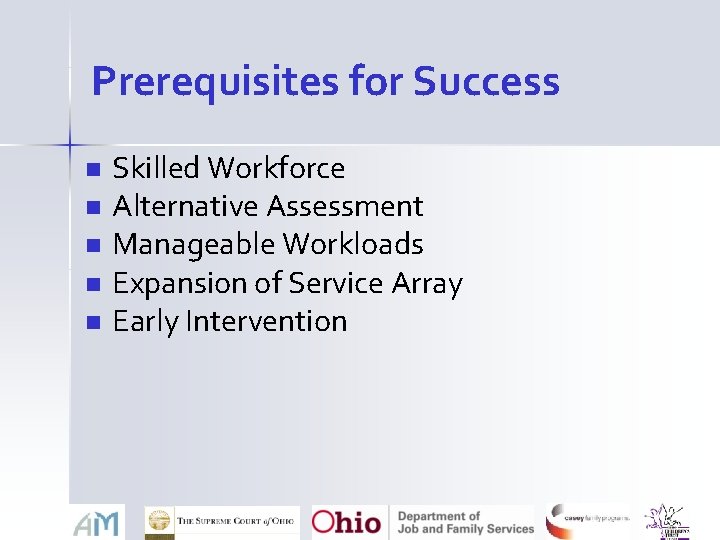
Prerequisites for Success n n n Skilled Workforce Alternative Assessment Manageable Workloads Expansion of Service Array Early Intervention
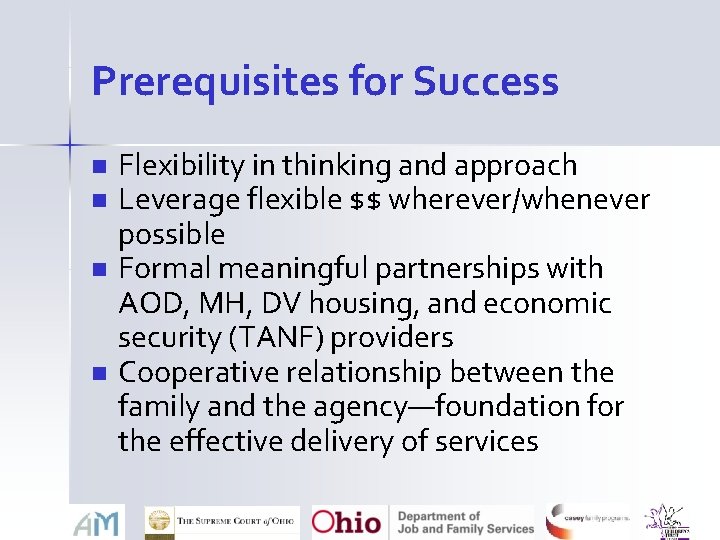
Prerequisites for Success n n Flexibility in thinking and approach Leverage flexible $$ wherever/whenever possible Formal meaningful partnerships with AOD, MH, DV housing, and economic security (TANF) providers Cooperative relationship between the family and the agency—foundation for the effective delivery of services
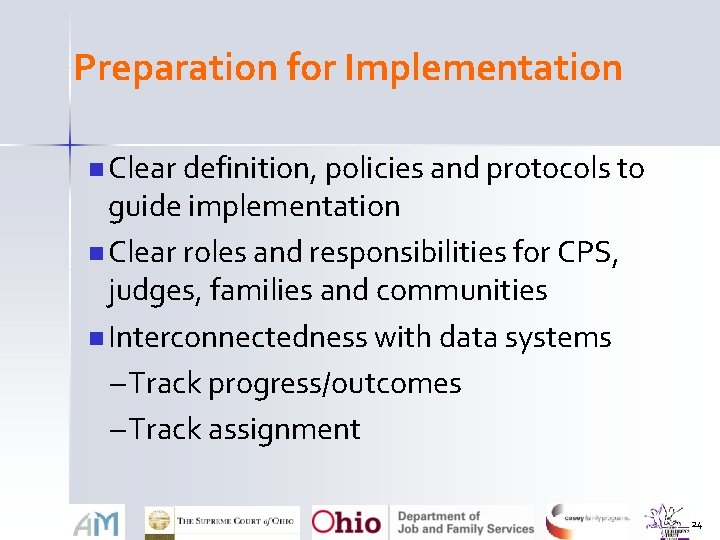
Preparation for Implementation n Clear definition, policies and protocols to guide implementation n Clear roles and responsibilities for CPS, judges, families and communities n Interconnectedness with data systems – Track progress/outcomes – Track assignment 24
Preparation for Implementation n Educating mandated reporters n Partnering with community agencies n Training staff and community partners n Working with courts and law enforcement 25
Prospective Benefits n n n More children are better protected over time by engaging more parents in the process of making sustainable changes Rate of subsequent, repeat reports to CPS has been demonstrated to decrease Both families and agency child protection workers are more satisfied with the outcomes Involvement of larger systems of support Approach is cost neutral or saves money over time
Lessons Learned n n n There is intrinsic value of family voice – as partners, guiding service planning and decision making Community partnerships are most effective ways to protect children There is a need to involve families and community stakeholders early in process
Lessons Learned n n n Communication among/across stakeholders & jurisdictions is essential – establish vehicles for regular contact Assessment is ongoing and cumulative as trust builds - need to respond Evaluation matters – bring evaluators in early and make the investment to do it well
Resources n American Humane – http: //www. americanhumane. org/protecting -children/programs/differential-response/ n Quality Improvement Center on Alternative Response – http: //www. differentialresponseqic. org/ n Caren Kaplan – carenk@americanhumane. org
With Gratitude
OHIO ALTERNATIVE RESPONSE PILOT PROJECT Establishing Alternative Response as an option for Ohio’s Families
How Did We End Up Here? The Sequence of Events n Two reports were critical of inconsistencies in Ohio’s application of statutory definitions for child abuse, neglect and dependency – ABA Report – CFSR n Subcommittee on Responding to Child, Abuse, Neglect & Dependency (2004) n Final Report (January 2006) Advisory Committee on Children Families & the Court
2006 Recommendations n Change to Child In Need of Protective Services (CHIPS) legislative structure n Look into alternative/differential response as an option for handling some accepted reports of child maltreatment
2007 - Established Framework n n Received statutory authority to initiate a pilot study Launched a nation-wide search for an experienced consultants Selected American Humane, Institute for Applied Research & Minnesota Partners - AIM Conducted Regional Forums on Alternative Response to assist communities in self-identifying an interest in serving as a pilot site
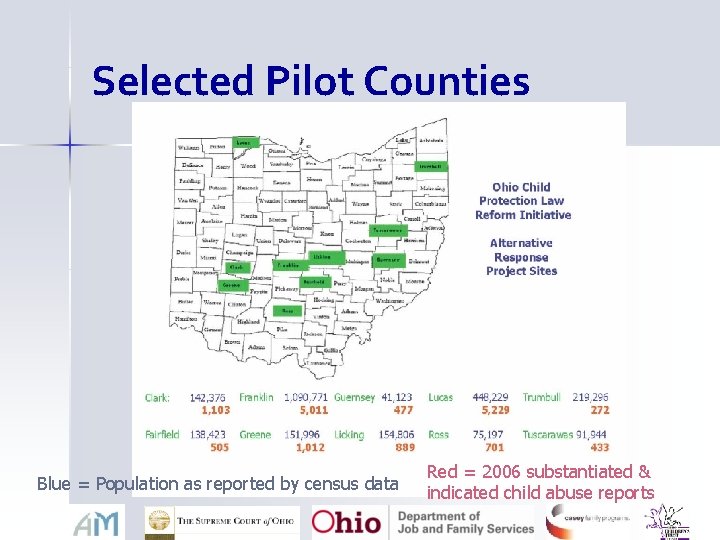
Selected Pilot Counties Blue = Population as reported by census data Red = 2006 substantiated & indicated child abuse reports
Expanded Partnerships
Ohio’s Alternative Response Plan n n Created a Design Team Two representatives per site were appointed to a workgroup of the Supreme Court of Ohio’s Subcommittee on Responding to Child Abuse, Neglect and Dependency
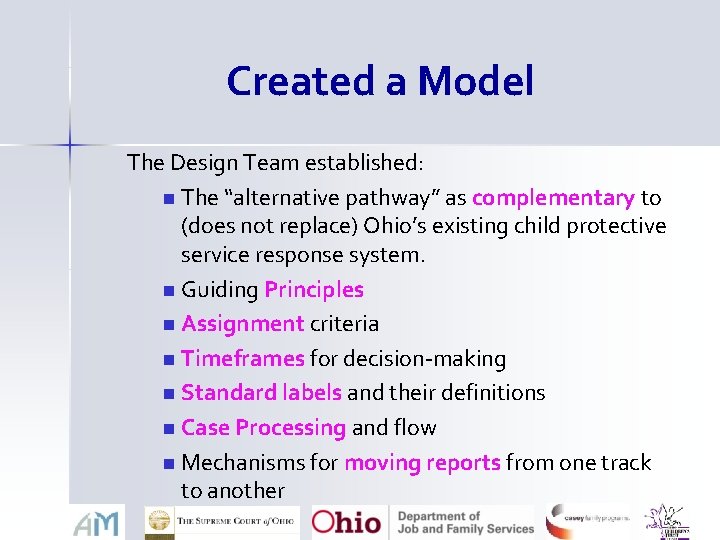
Created a Model The Design Team established: n The “alternative pathway” as complementary to (does not replace) Ohio’s existing child protective service response system. n Guiding Principles n Assignment criteria n Timeframes for decision-making n Standard labels and their definitions n Case Processing and flow n Mechanisms for moving reports from one track to another
Prepared for Implementation n Establishing training for staff and community n Evaluating local services n Developing a statewide message and educational materials
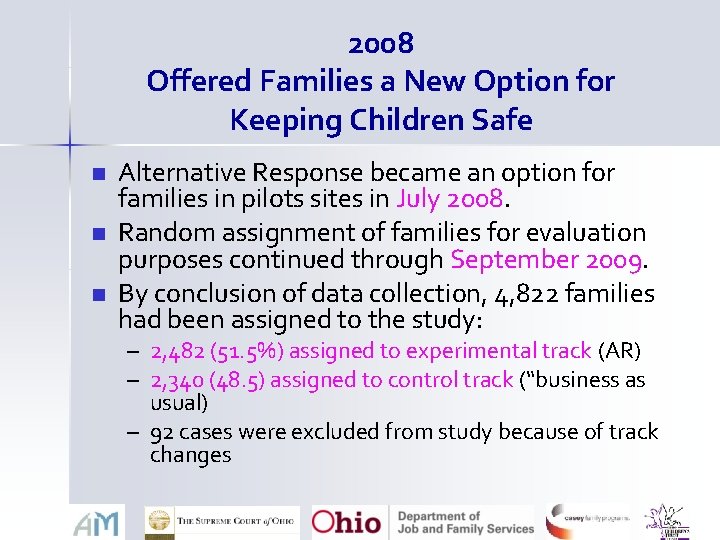
2008 Offered Families a New Option for Keeping Children Safe n n n Alternative Response became an option for families in pilots sites in July 2008. Random assignment of families for evaluation purposes continued through September 2009. By conclusion of data collection, 4, 822 families had been assigned to the study: – 2, 482 (51. 5%) assigned to experimental track (AR) – 2, 340 (48. 5) assigned to control track (“business as usual) – 92 cases were excluded from study because of track changes
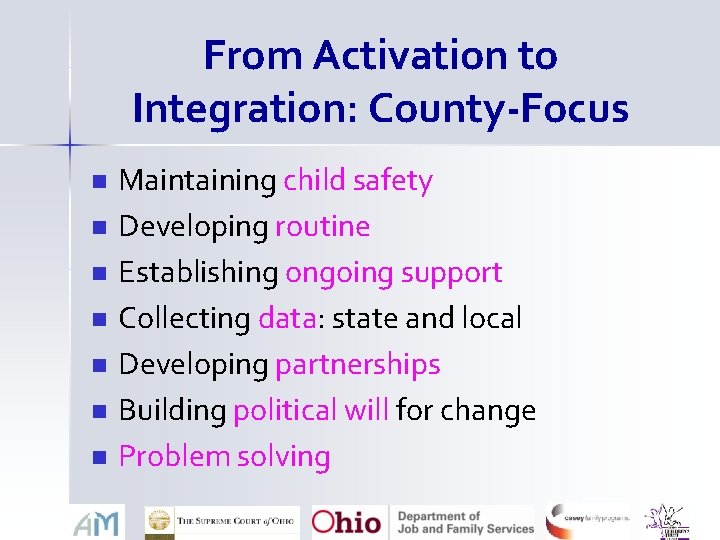
From Activation to Integration: County-Focus n n n n Maintaining child safety Developing routine Establishing ongoing support Collecting data: state and local Developing partnerships Building political will for change Problem solving
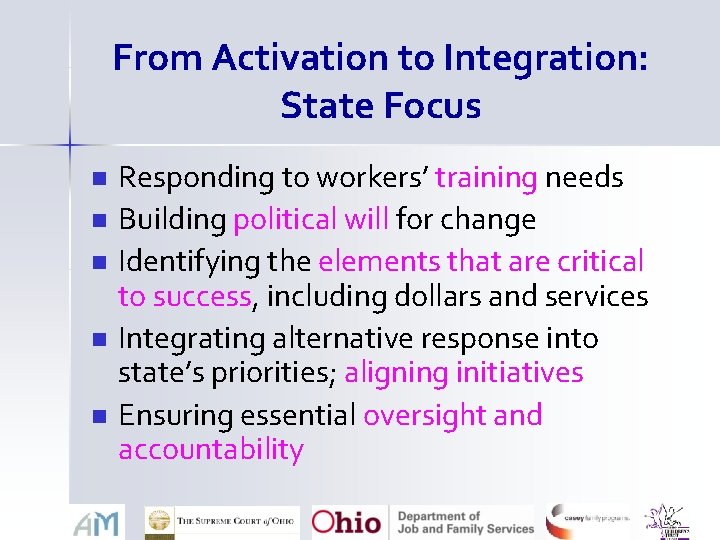
From Activation to Integration: State Focus n n n Responding to workers’ training needs Building political will for change Identifying the elements that are critical to success, including dollars and services Integrating alternative response into state’s priorities; aligning initiatives Ensuring essential oversight and accountability
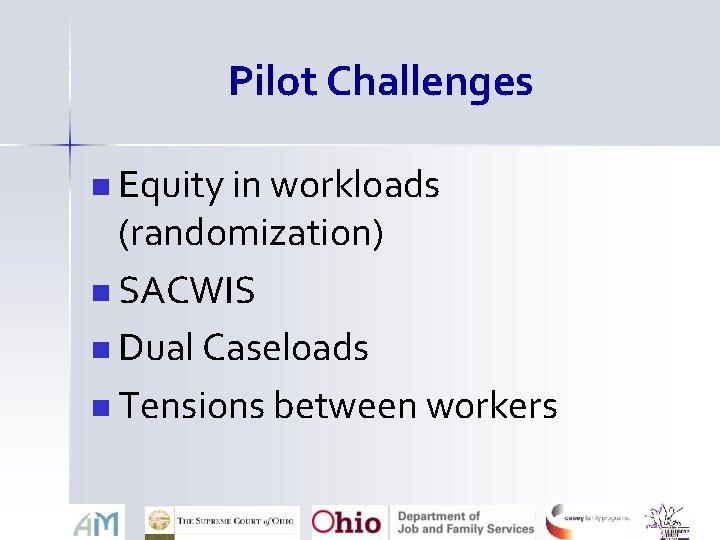
Pilot Challenges n Equity in workloads (randomization) n SACWIS n Dual Caseloads n Tensions between workers
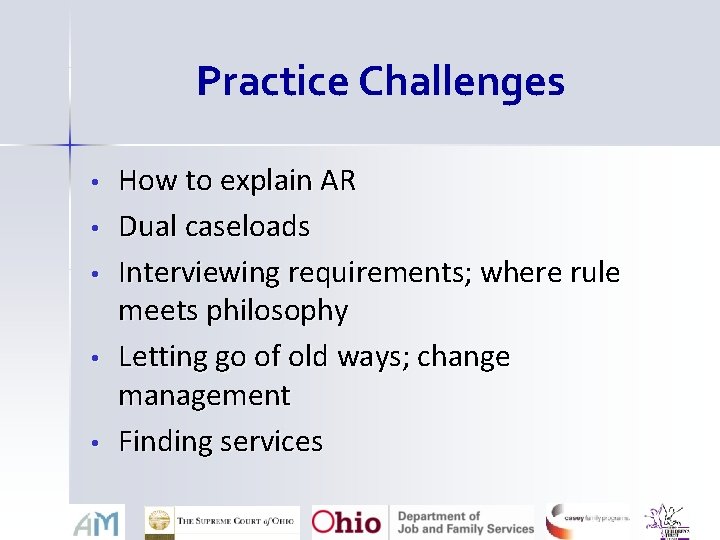
Practice Challenges • • • How to explain AR Dual caseloads Interviewing requirements; where rule meets philosophy Letting go of old ways; change management Finding services
From the front line: what’s good? • • Family Response Time Spent in Field Increased/More Creative Services for Families’ Supports Outcomes show promise Services reflect family needs Caseworker satisfaction
From the front line: lessons…. • • Importance of skilled decision-making at the front door (screening). Extended timeframes for assessment allow greater opportunity for engagement Caseload size has impact on workers’ ability to engage Flexible Funding: effective response to families must have the flexibility that allows both immediacy and allows services to be determined by need rather than availability.
From the front line: critical connections…. • • • Housing Gaps in substance abuse and mental health services Transportation
Infinity and Beyond! n Pilot Study Time Frame: – July 1, 2008 - December 30, 2009 (18 months) n Final Report – April 2010 n Dual Focus: – Targeted Pilot Expansion n RFA – March 2010 AR Symposium - May 13 & 14, 2010 Ten Expansion Pilots – June 2010 – Statewide Implementation
REQUEST FOR APPLICATIONS
Application Review Process n n n EVALUATION by American Humane Consultants using Criteria in Application SELECTION: Recommendations made to ODJFS & SCO; decisions made by Subcommittee NOTIFICATION on June 18 th: Selected sites contacted via telephone (preferred) or E-mail
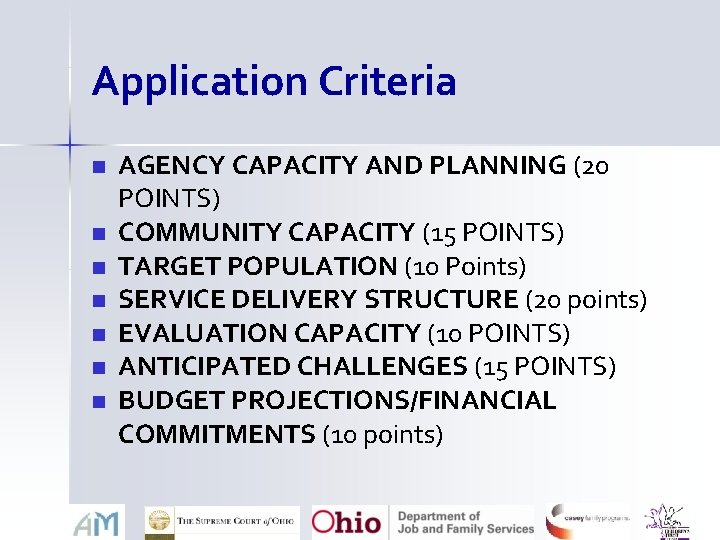
Application Criteria n n n n AGENCY CAPACITY AND PLANNING (20 POINTS) COMMUNITY CAPACITY (15 POINTS) TARGET POPULATION (10 Points) SERVICE DELIVERY STRUCTURE (20 points) EVALUATION CAPACITY (10 POINTS) ANTICIPATED CHALLENGES (15 POINTS) BUDGET PROJECTIONS/FINANCIAL COMMITMENTS (10 points)
Expectations of AR Counties n n Participate in Ohio AR Leadership Council Assess reports of alleged CA/N using AR approach as permitted by Ohio statute Provide services for families as directed by assessment process and family service plan Collect, analyze and report on specific data elements to assure ongoing AR efficacy
Timeline n n May 13, 2010: Counties submitting proposals are required to attend Are You Ready for Alternative Response? from 2: 00 pm – 5: 30 pm May 28, 2010: Deadline for submitting electronic applications to ohioar 2010@gmail. com with the subject line “Ohio AR Application. ” June 18, 2010: Selection/Announcement of ten pilot sites. September, 2010: Families are assigned to Counties’ Alternative Response Pathways
What Lies Ahead?
Future Plans n n n Continue to support original 10 pilots Partner closely with the QIC-DR 6 county pilot and support their implementation Review AR Project Final Report recommendations and outline next steps Continue the critical support provided by the AIM team Expand to 10 new counties by September 2010
Future Plans n n n Build training infrastructure Bring on additional counties during the first quarter of 2011 Review current policies and forms Draft Ch. 119 rules Continue to enhance SACWIS to support the Alternative Response approach
It’s Important to Know….
Training n The 10 accepted sites will minimally have the following: – Two-day initial training that includes AR 101, procedural changes, pathway assignment and engagement techniques – A community forum to help partners understand the changes that will be occurring within the agency’s approach with families
Training n n Each agency will have at least two on-site coaching experiences provided by AIM staff The new sites will be a part of Ohio’s Leadership Council, the partnership group of Ohio’s alternative response sites. As such, they will have the opportunity to participate in all activities available to the Council. In the past, this has included: – On-site coaching – Specialized training opportunities – Peer review opportunities – Quarterly Leadership Council activities
Training n n It is recommended that all agency staff participate in the initial AR training Training for all assists in avoiding organizational myths and internal friction Generally, ongoing AR training has been directed to AR staff Capacity and relevance determine the appropriateness of non-AR attending AR training experiences
Funding n n n Provided by Casey Family Programs $20, 000 per year for two years Operates on a calendar year All monies must be liquidated by the end of each year Quarterly reports are required
Funding n Approved uses of funding: – – – Services Travel Staff Training Consultants Cost associated with public events
Additional FAQ’s n n Advantageous for counties to apply as group? Will there be experimental and control groups? Funding available per service plan? Alternative Response expansion plans?
One Goal Two Approaches AR Policy and Practice
Similarities n n n Child safety is the priority Comprehensive safety and risk assessments Holistic family assessment involving all children and adults in the home Service plans developed with the family and based on family needs, safety and risk issues Ongoing reviews of safety, risk and services Case closure based on increased safety, risk reduction or agreement to terminate services
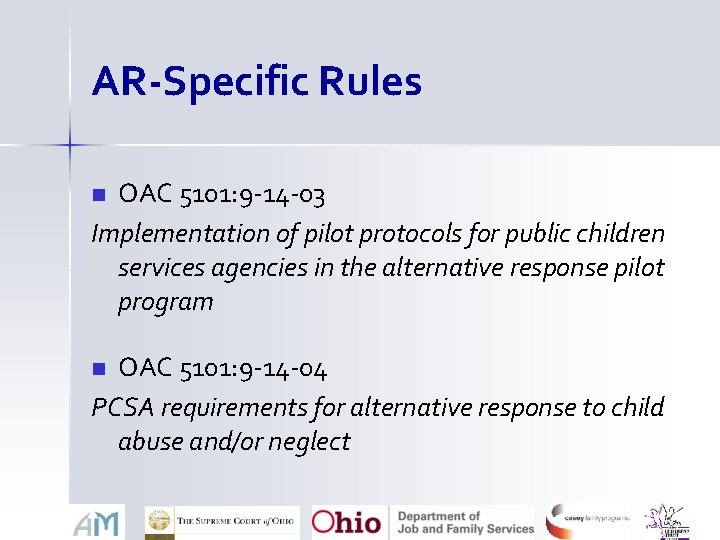
AR-Specific Rules OAC 5101: 9 -14 -03 Implementation of pilot protocols for public children services agencies in the alternative response pilot program n OAC 5101: 9 -14 -04 PCSA requirements for alternative response to child abuse and/or neglect n
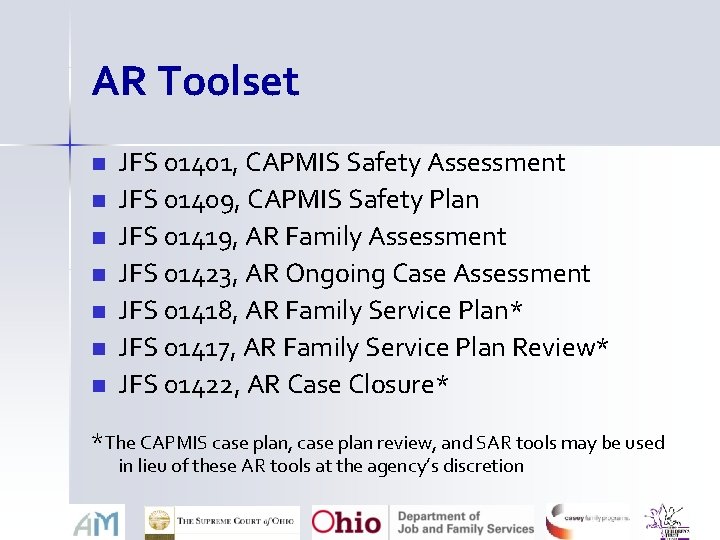
AR Toolset n n n n JFS 01401, CAPMIS Safety Assessment JFS 01409, CAPMIS Safety Plan JFS 01419, AR Family Assessment JFS 01423, AR Ongoing Case Assessment JFS 01418, AR Family Service Plan* JFS 01417, AR Family Service Plan Review* JFS 01422, AR Case Closure* *The CAPMIS case plan, case plan review, and SAR tools may be used in lieu of these AR tools at the agency’s discretion
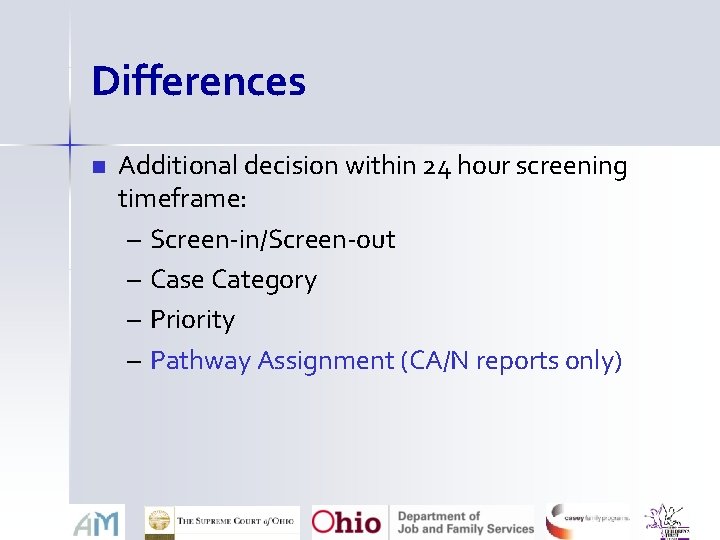
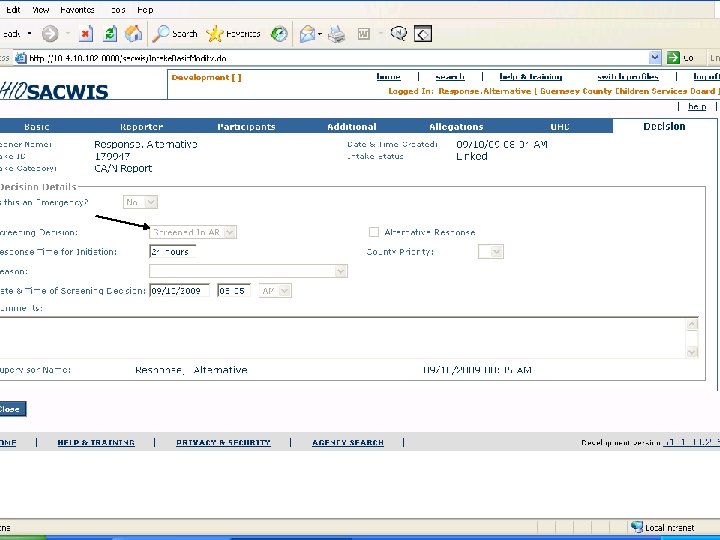
Differences n Additional decision within 24 hour screening timeframe: – Screen-in/Screen-out – Case Category – Priority – Pathway Assignment (CA/N reports only)
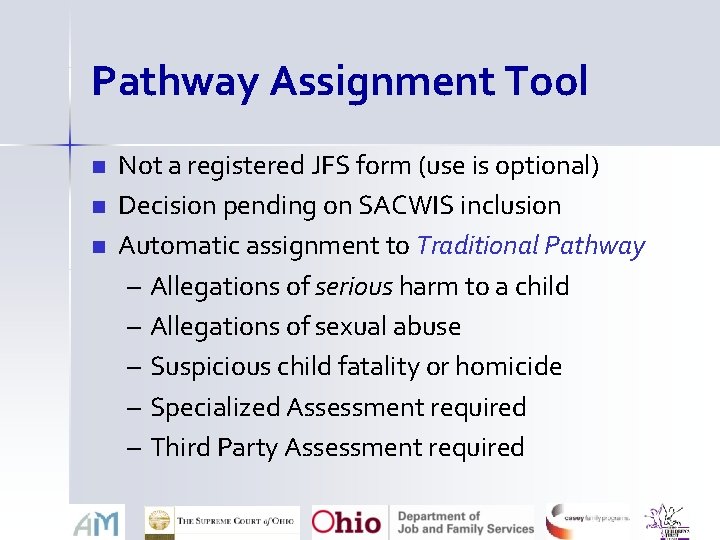
Pathway Assignment Tool n n n Not a registered JFS form (use is optional) Decision pending on SACWIS inclusion Automatic assignment to Traditional Pathway – Allegations of serious harm to a child – Allegations of sexual abuse – Suspicious child fatality or homicide – Specialized Assessment required – Third Party Assessment required
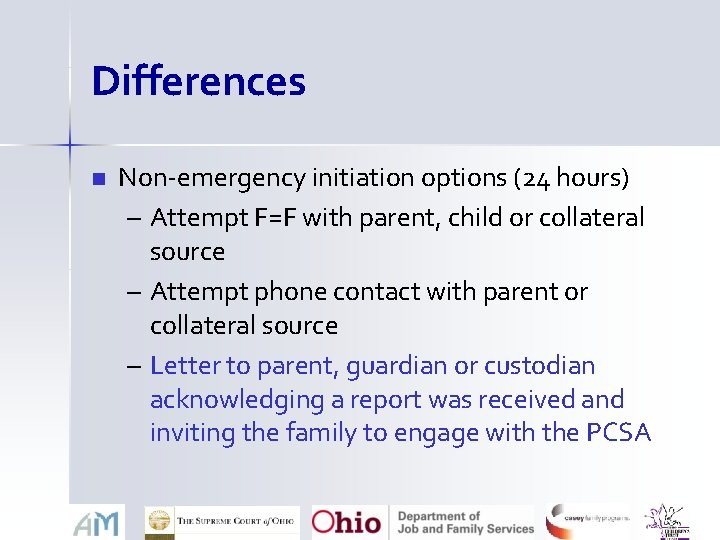
Differences n Non-emergency initiation options (24 hours) – Attempt F=F with parent, child or collateral source – Attempt phone contact with parent or collateral source – Letter to parent, guardian or custodian acknowledging a report was received and inviting the family to engage with the PCSA
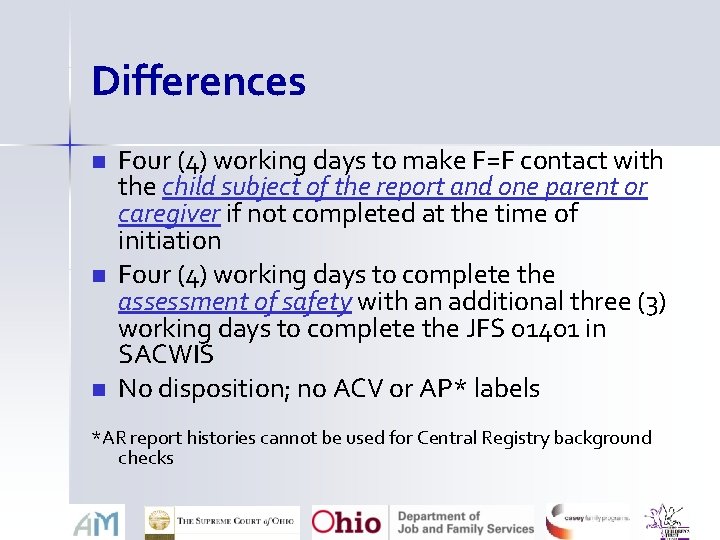
Differences n n n Four (4) working days to make F=F contact with the child subject of the report and one parent or caregiver if not completed at the time of initiation Four (4) working days to complete the assessment of safety with an additional three (3) working days to complete the JFS 01401 in SACWIS No disposition; no ACV or AP* labels *AR report histories cannot be used for Central Registry background checks
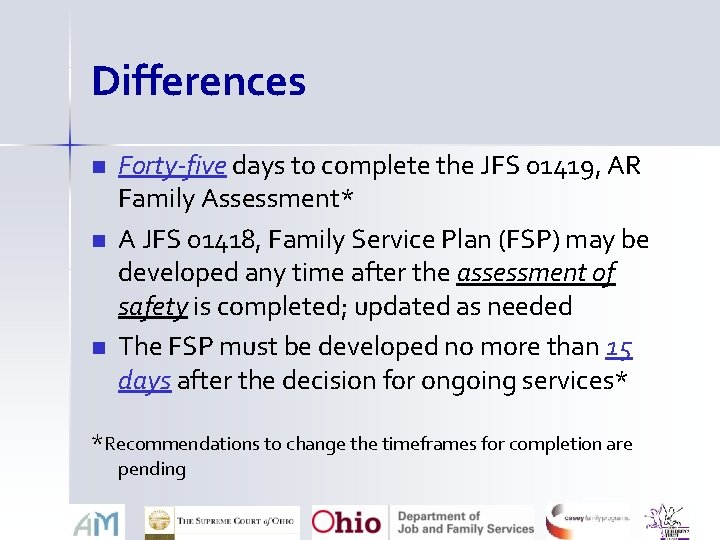
Differences n n n Forty-five days to complete the JFS 01419, AR Family Assessment* A JFS 01418, Family Service Plan (FSP) may be developed any time after the assessment of safety is completed; updated as needed The FSP must be developed no more than 15 days after the decision for ongoing services* *Recommendations to change the timeframes for completion are pending
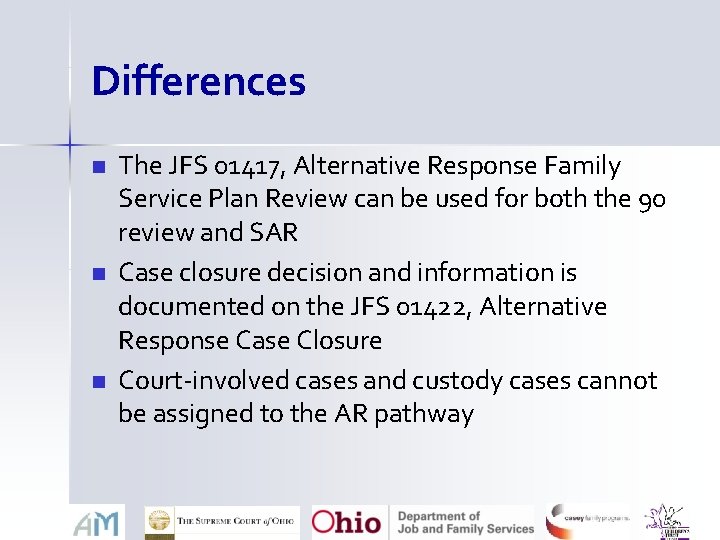
Differences n n n The JFS 01417, Alternative Response Family Service Plan Review can be used for both the 90 review and SAR Case closure decision and information is documented on the JFS 01422, Alternative Response Case Closure Court-involved cases and custody cases cannot be assigned to the AR pathway
Q&A n Alternative Response Mailbox: AR@jfs. ohio. gov n Child Protective Services: 614 -466 -1213 – Dorothy Striker (Program Lead) – Catherine Lawhorn – David Thomas – Denielle Ell-Rittinger
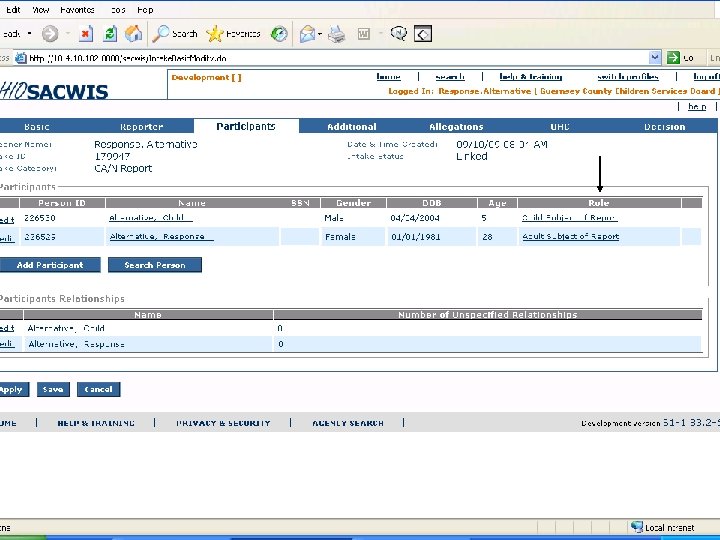
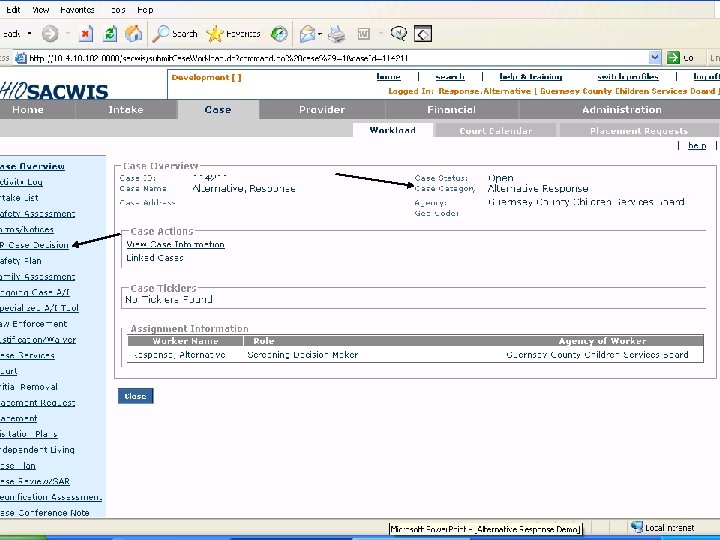
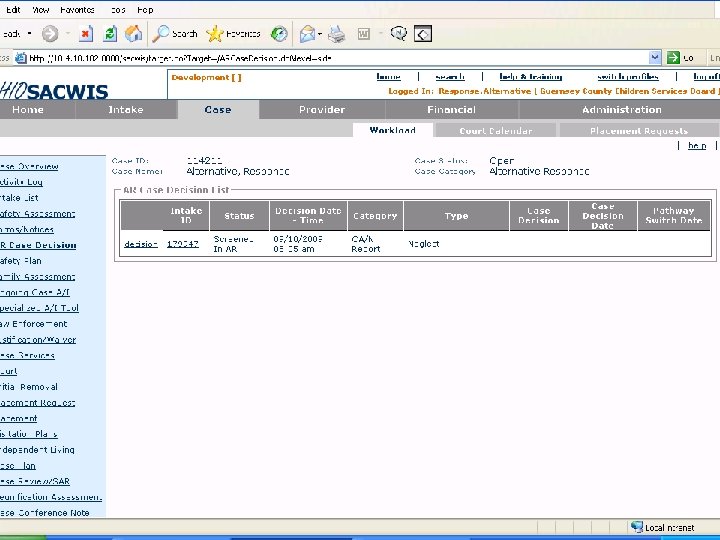
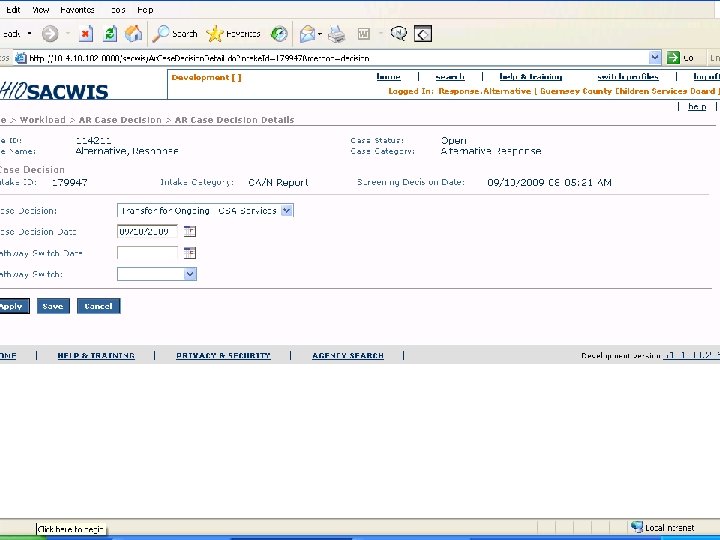
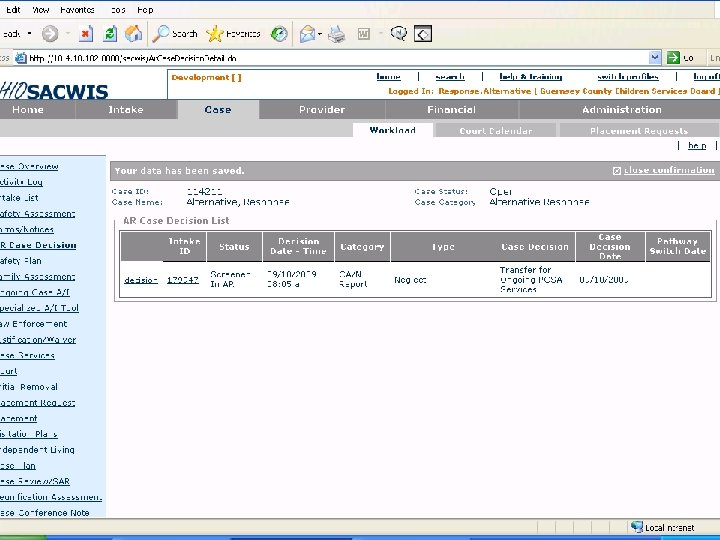
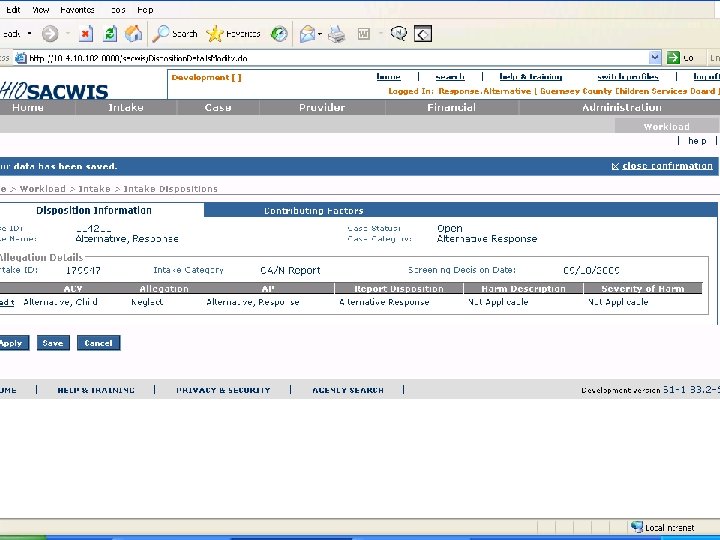
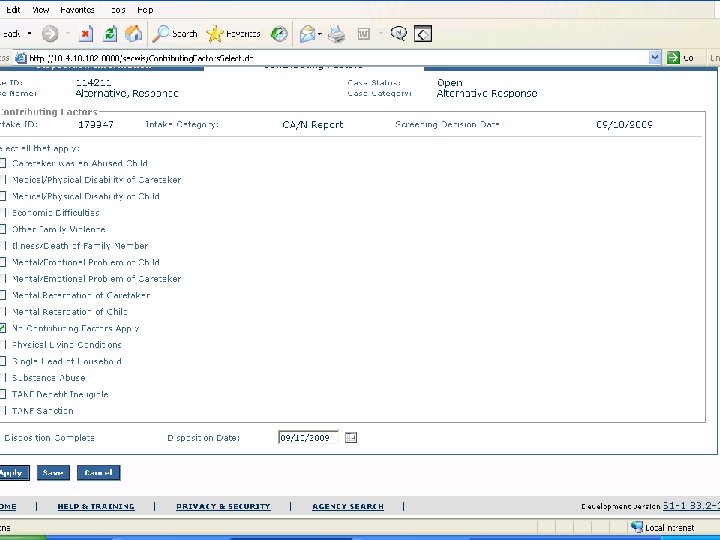
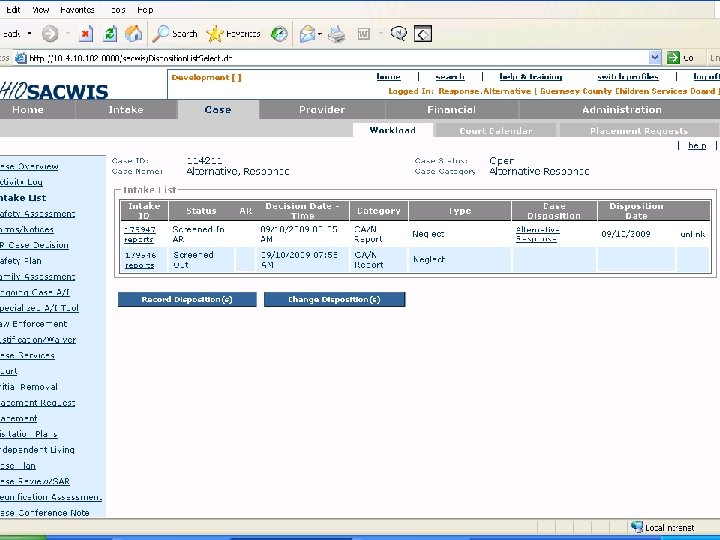
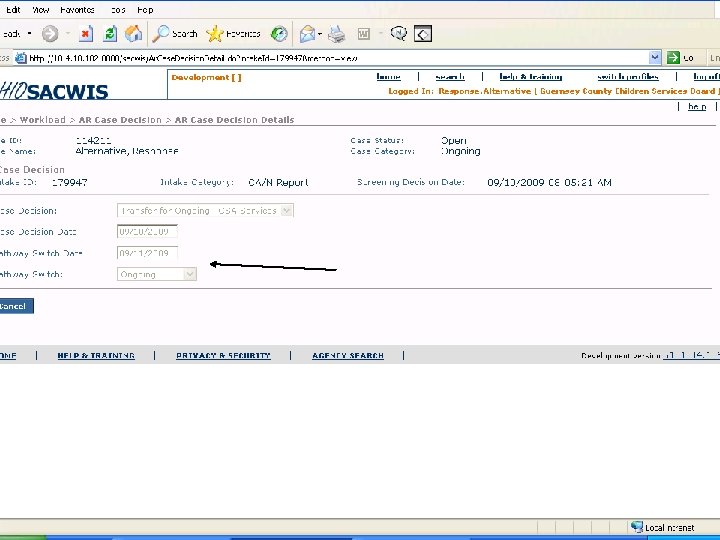
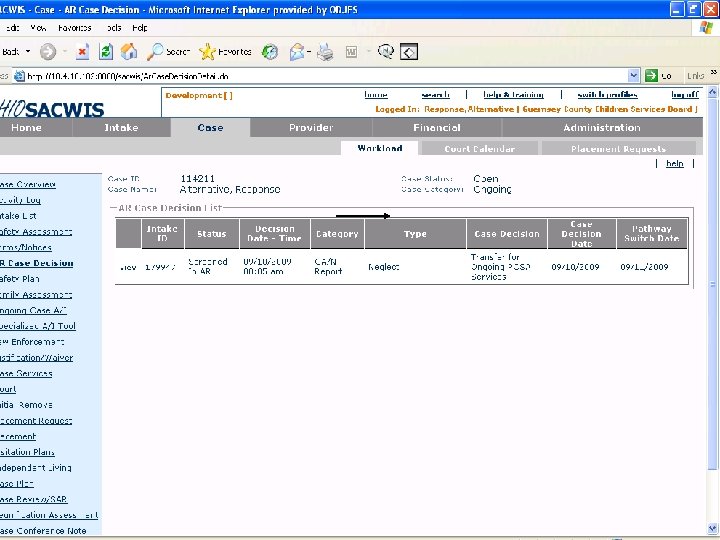
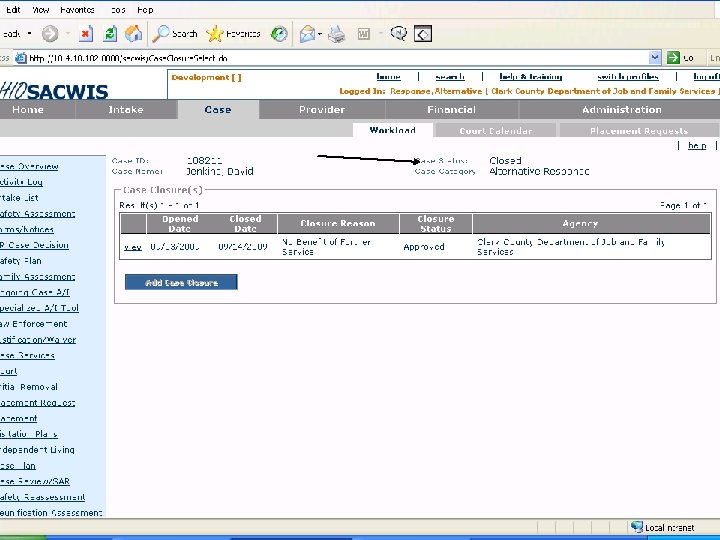
Alternative Response and SACWIS
Data n n Majority if not all of the data collection will be gathered from SACWIS It is vital that counties use SACWIS If other data is needed, ODJFS will ensure that it serves a clearly defined purpose and is related to statewide implementation One example is services
Counting What Matters n n n We will extract SACWIS data to inform pilots. For families to improve, they must have services. Concern: Service data is currently insufficient for determining… – The number of people needing specific services. – Duration between the referral and delivery. n It is critical for county leaders to know for future planning how many families need specific services, the demand for those services, and costs.
Counting What Matters n If we are unable to modify SACWIS that will allow us to report to counties, we will require counties to report this information to us on a per case level. n We prefer to obtain this information from SACWIS rather than counties. Thus, we care working closely with the SACWIS team to make a change in the Service screens.