
Are you HIRT Hemophilia Injury Recognition Tool Perceptions
- Slides: 10
Are you HIRT? (Hemophilia Injury Recognition Tool): Perceptions from young men with mild hemophilia in Canada on the use of the mobile app for injury selfmanagement Jo. Ann Nilson, Kathy Mulder, Dr. Kristy Wittmeier, Dr. Candice Schachter, Dr. Richard Lomotey, Dr. Cathy Arnold, Dr. Sarah Oosman July 26, 2016 CHS-Baxalta Inherited Bleeding Disorder Fellowship for Nurses and Allied Health Care Professionals BHAP Caregiver Award 2011 and 2014
Mild Hemophilia What has been noted by health care workers: • Neglected diagnosis • Diagnosis made later in life • Young men don’t always attend clinic • Many do not recognize signs of injuries needing medical attention (Schulman, 2012; Lipton, 2011; Peerlinck and Jacquemin, 2010; Lindvall, 2012; Chambost, 2002; Kumar et al. , 2013) Perceptions from young men with mild hemophilia: • Resistant to acknowledging their condition • Rely on their experiential learning • Will call their family or siblings for advice, not the HTC • Don’t like “lectures” • Often participate in aggressive non-hemophilia approved activities Nilson J, Schachter C, Mulder K, Hahn M, Hilliard P, Steele M, Jarock C. (2012). A qualitative study identifying the knowledge, attitudes and behaviours of young men with mild haemophilia. Haemophilia (2012), 18, e 120 -e 125.
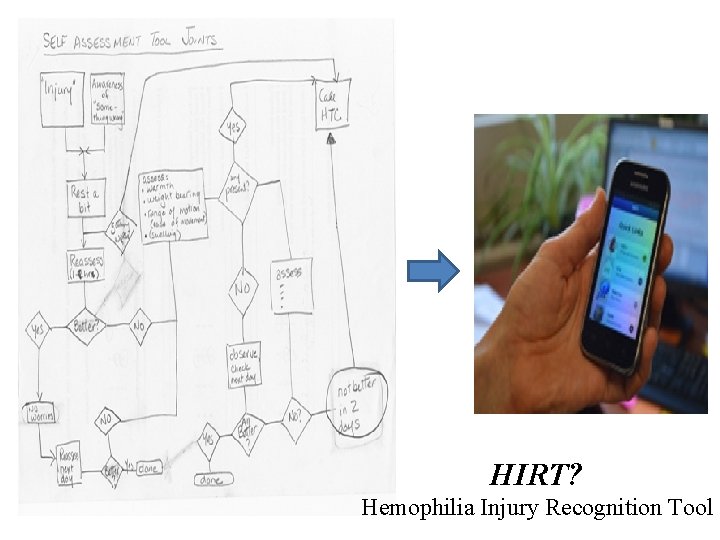
HIRT? Hemophilia Injury Recognition Tool
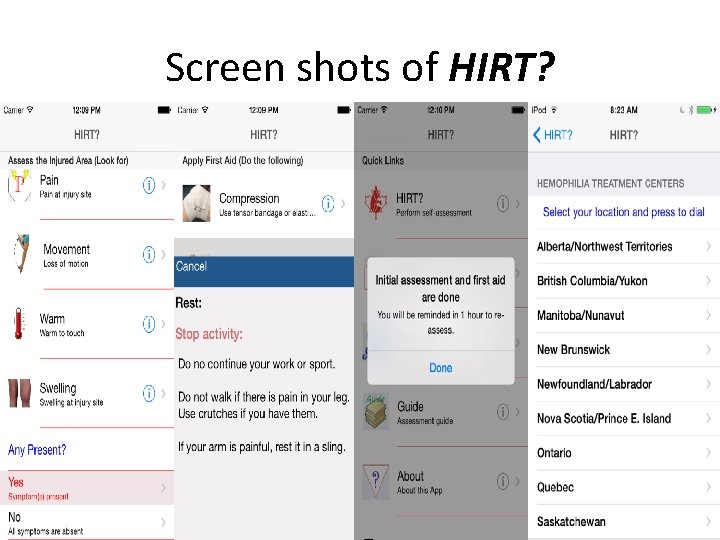
Screen shots of HIRT?
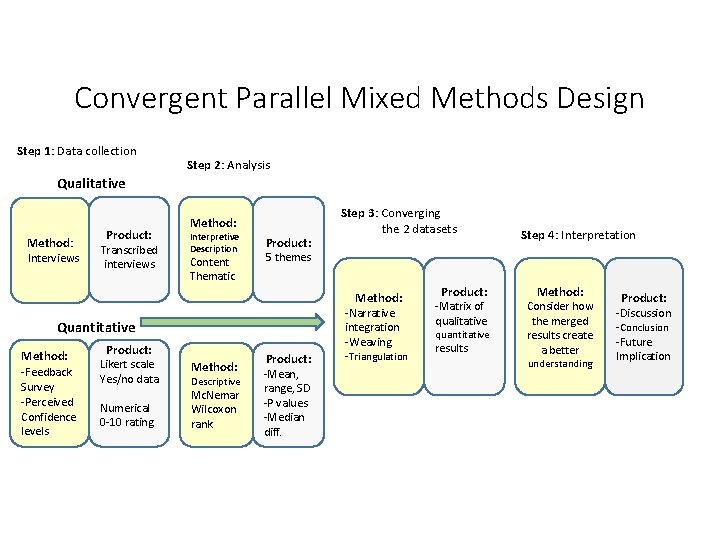
Convergent Parallel Mixed Methods Design Step 1: Data collection Step 2: Analysis Qualitative Method: Interviews Product: Transcribed interviews Method: Interpretive Description Content Thematic Product: Step 3: Converging the 2 datasets 5 themes Method: Quantitative Method: -Feedback Survey -Perceived Confidence levels Product: Likert scale Yes/no data Method: Numerical 0 -10 rating Mc. Nemar Wilcoxon rank Descriptive Step 4: Interpretation Product: -Mean, range, SD -P values -Median diff. -Narrative integration -Weaving -Triangulation Product: -Matrix of qualitative quantitative results Method: Consider how the merged results create a better understanding Product: -Discussion -Conclusion -Future Implication
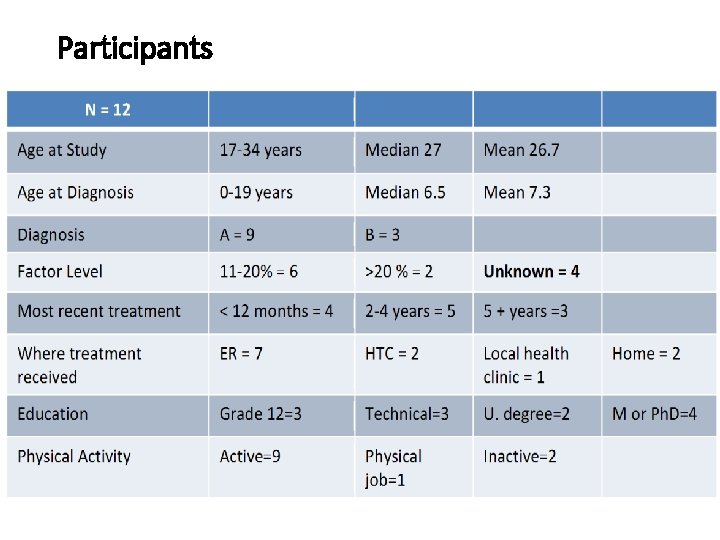
Participants
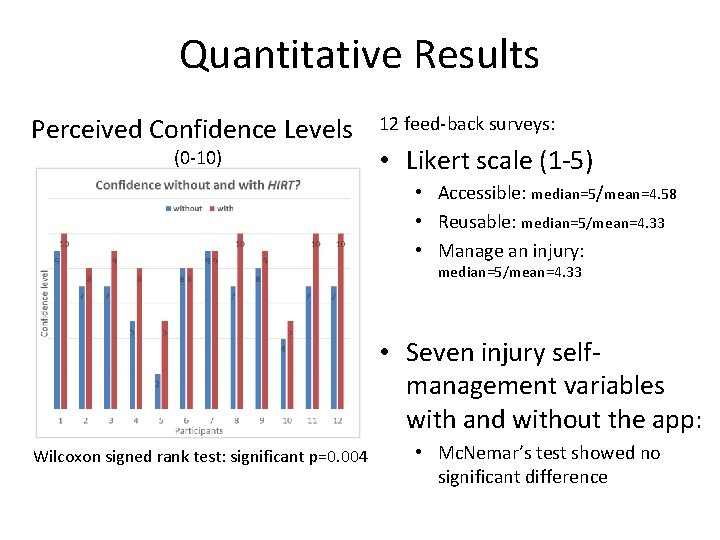
Quantitative Results Perceived Confidence Levels (0 -10) 12 feed-back surveys: • Likert scale (1 -5) • Accessible: median=5/mean=4. 58 • Reusable: median=5/mean=4. 33 • Manage an injury: median=5/mean=4. 33 • Seven injury selfmanagement variables with and without the app: Wilcoxon signed rank test: significant p=0. 004 • Mc. Nemar’s test showed no significant difference
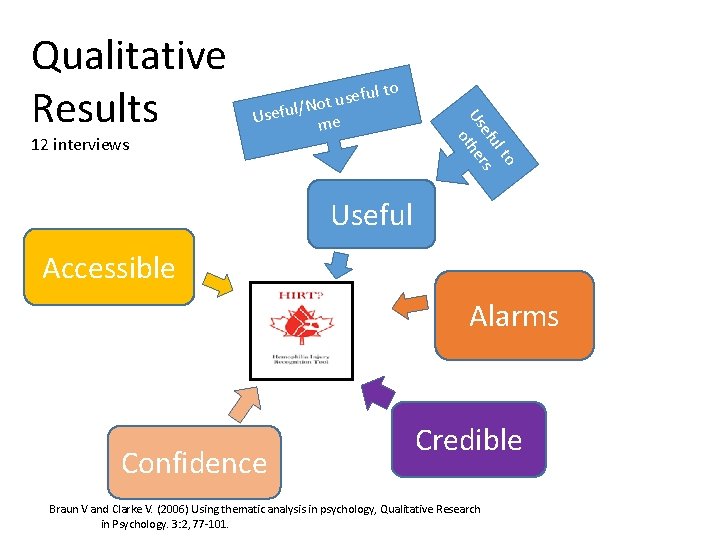
12 interviews l to efu s u t o /N Useful me Accessible Confidence H I R T ? l to efu rs Us the o Qualitative Results Useful Alarms Credible Braun V and Clarke V. (2006) Using thematic analysis in psychology, Qualitative Research in Psychology. 3: 2, 77 -101.
Clinical Implications • Provided a resource to fill a gap in knowledge for YMWMH • It has been developed with the young men resulting in a useful tool • Evaluation demonstrated that HIRT? – Significantly improved perceived confidence levels in YMWMH for injury self-management – Those newly diagnosed acknowledged the benefit of the assessment and first aid – The alarms added value in assisting with prompting re-assessment for those who may forget about the injury – Those experienced with bleeds appreciated the contacts and assessment guide
Conclusion HIRT? has demonstrated the potential to have a clinically important influence on perceived injury selfmanagement. It may assist to: • Decrease the delay in identifying bleeds • Facilitate earlier communication with the health care team Canadian Hemophilia Society Strategic Plan 2016 -2020 • Educational efforts will need to be creative, focused and carefully targeted. • Embrace new technologies and make information available to people in a multitude of ways http: //www. hemophilia. ca/files/CHS%20 Strategic%20 Plan%202016 -2020%20 FINAL. pdf (page 5 -6)