
Are you feeling worried about going to school
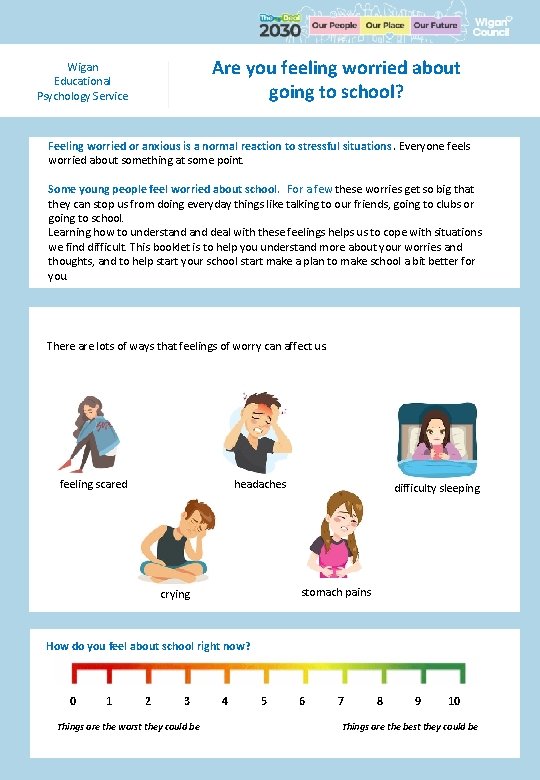
Are you feeling worried about going to school? Wigan Educational Psychology Service Feeling worried or anxious is a normal reaction to stressful situations. Everyone feels worried about something at some point. Some young people feel worried about school. For a few these worries get so big that they can stop us from doing everyday things like talking to our friends, going to clubs or going to school. Learning how to understand deal with these feelings helps us to cope with situations we find difficult. This booklet is to help you understand more about your worries and thoughts, and to help start your school start make a plan to make school a bit better for you. There are lots of ways that feelings of worry can affect us. feeling scared headaches crying difficulty sleeping stomach pains How do you feel about school right now? 0 1 2 3 4 5 6 7 8 9 10 Things are the worst they could be Things are the best they could be
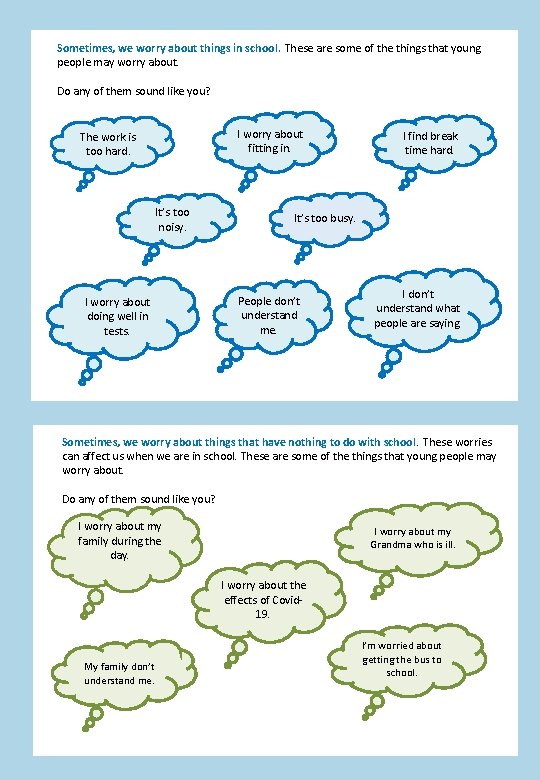
Sometimes, we worry about things in school. These are some of the things that young people may worry about. Do any of them sound like you? I worry about fitting in. The work is too hard. It’s too noisy. I worry about doing well in tests. I find break time hard. It’s too busy. People don’t understand me. I don’t understand what people are saying. Sometimes, we worry about things that have nothing to do with school. These worries can affect us when we are in school. These are some of the things that young people may worry about. Do any of them sound like you? I worry about my family during the day. I worry about my Grandma who is ill. I worry about the effects of Covid 19. My family don’t understand me. I’m worried about getting the bus to school.
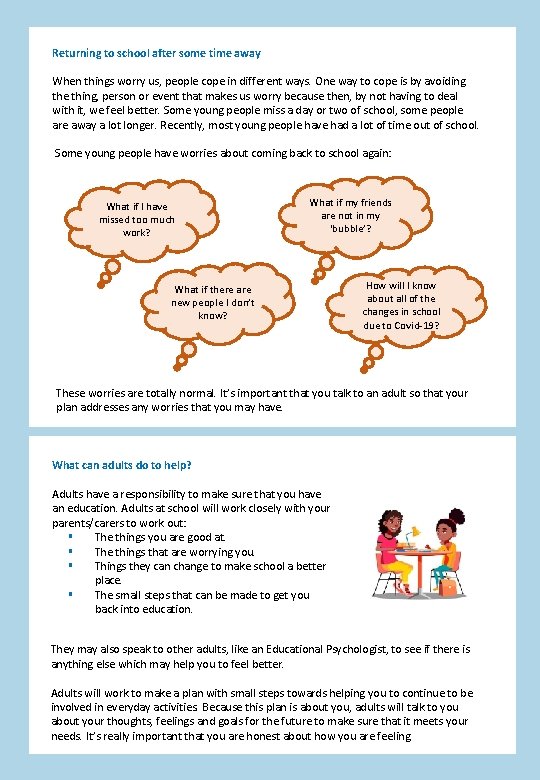
Returning to school after some time away When things worry us, people cope in different ways. One way to cope is by avoiding the thing, person or event that makes us worry because then, by not having to deal with it, we feel better. Some young people miss a day or two of school, some people are away a lot longer. Recently, most young people have had a lot of time out of school. Some young people have worries about coming back to school again: What if I have missed too much work? What if my friends are not in my ‘bubble’? What if there are new people I don’t know? How will I know about all of the changes in school due to Covid-19? These worries are totally normal. It’s important that you talk to an adult so that your plan addresses any worries that you may have. What can adults do to help? Adults have a responsibility to make sure that you have an education. Adults at school will work closely with your parents/carers to work out: § The things you are good at. § The things that are worrying you. § Things they can change to make school a better place. § The small steps that can be made to get you back into education. They may also speak to other adults, like an Educational Psychologist, to see if there is anything else which may help you to feel better. Adults will work to make a plan with small steps towards helping you to continue to be involved in everyday activities. Because this plan is about you, adults will talk to you about your thoughts, feelings and goals for the future to make sure that it meets your needs. It’s really important that you are honest about how you are feeling.
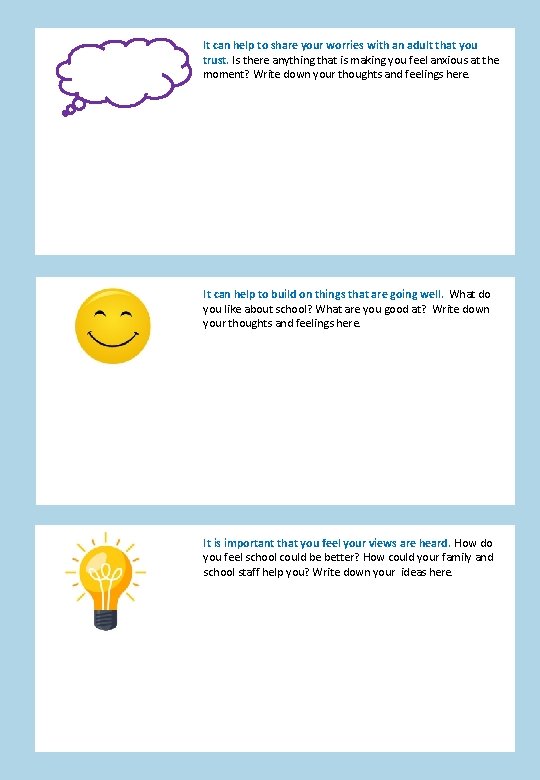
It can help to share your worries with an adult that you trust. Is there anything that is making you feel anxious at the moment? Write down your thoughts and feelings here. It can help to build on things that are going well. What do you like about school? What are you good at? Write down your thoughts and feelings here. It is important that you feel your views are heard. How do you feel school could be better? How could your family and school staff help you? Write down your ideas here.
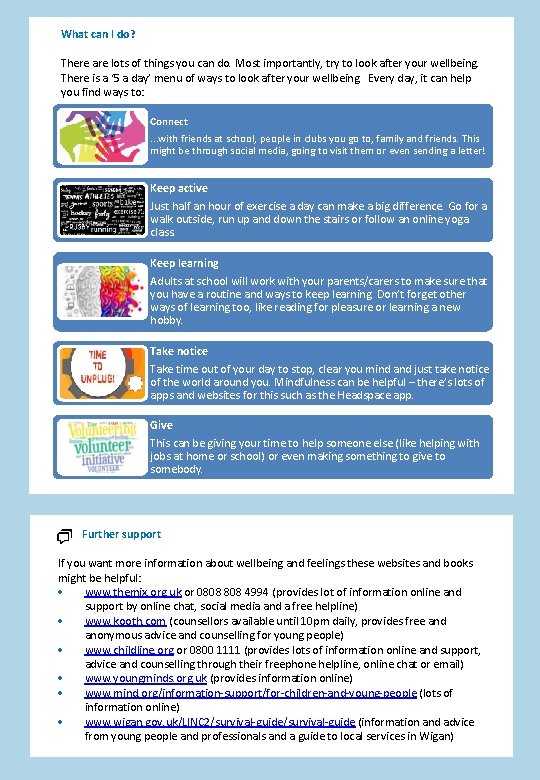
What can I do? There are lots of things you can do. Most importantly, try to look after your wellbeing. There is a ‘ 5 a day’ menu of ways to look after your wellbeing. Every day, it can help you find ways to: Connect. . . with friends at school, people in clubs you go to, family and friends. This might be through social media, going to visit them or even sending a letter! Connect Keep active Just half an hour of exercise a day can make a big difference. Go for a walk outside, run up and down the stairs or follow an online yoga class. . . . with friends at school, people in clubs you go to, family and Keep learning friends. This might be through social media, going to visit them Adults at school will work with your parents/carers to make sure that or even sending a letter! you have a routine and ways to keep learning. Don’t forget other ways of learning too, like reading for pleasure or learning a new hobby. Take notice Take time out of your day to stop, clear you mind and just take notice of the world around you. Mindfulness can be helpful – there’s lots of apps and websites for this such as the Headspace app. Give This can be giving your time to help someone else (like helping with jobs at home or school) or even making something to give to somebody. Further support If you want more information about wellbeing and feelings these websites and books might be helpful: www. themix. org. uk or 0808 4994 (provides lot of information online and support by online chat, social media and a free helpline) www. kooth. com (counsellors available until 10 pm daily, provides free and anonymous advice and counselling for young people) www. childline. org or 0800 1111 (provides lots of information online and support, advice and counselling through their freephone helpline, online chat or email) www. youngminds. org. uk (provides information online) www. mind. org/information-support/for-children-and-young-people (lots of information online) www. wigan. gov. uk/LINC 2/survival-guide (information and advice from young people and professionals and a guide to local services in Wigan)
- Slides: 5