
Are we ready for an Outcomesbased Regulatory Framework
Are we ready for an Outcomes-based Regulatory Framework? Sharing at the 28 th EPSO Conference 25 Sep 2019 1
Agenda 1. 2. 3. 4. Background Impetus for shift to outcomes-based regulation One size does not fit all? How do we get there? 2
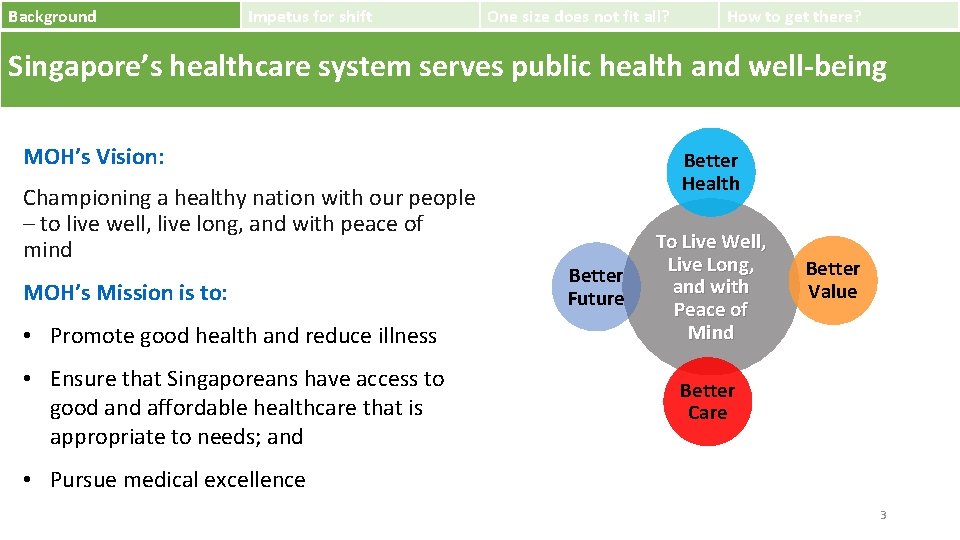
Background Impetus for shift One size does not fit all? How to get there? Singapore’s healthcare system serves public health and well-being MOH’s Vision: Championing a healthy nation with our people – to live well, live long, and with peace of mind MOH’s Mission is to: • Promote good health and reduce illness • Ensure that Singaporeans have access to good and affordable healthcare that is appropriate to needs; and Better Health Better Future To Live Well, Live Long, and with Peace of Mind Better Value Better Care • Pursue medical excellence 3
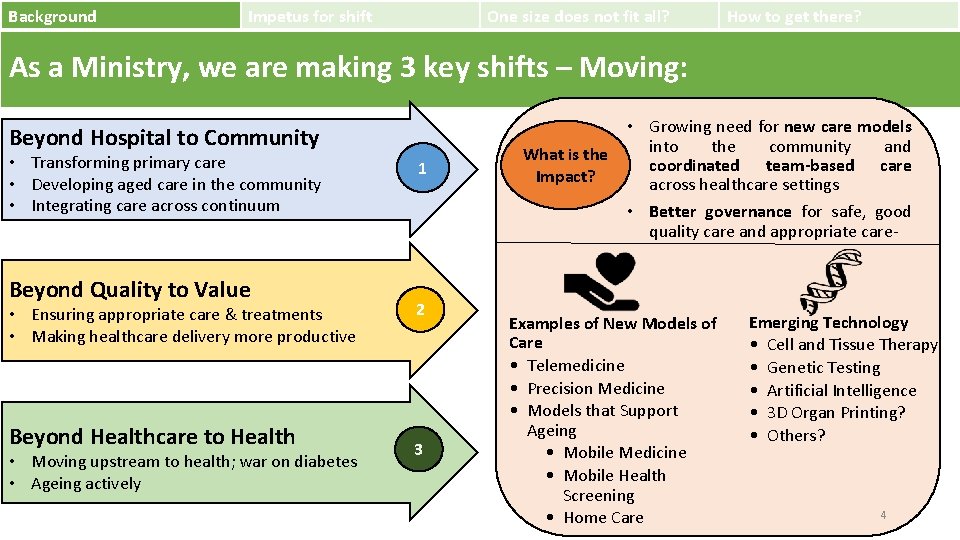
Background Impetus for shift One size does not fit all? How to get there? As a Ministry, we are making 3 key shifts – Moving: Beyond Hospital to Community • Transforming primary care • Developing aged care in the community • Integrating care across continuum Beyond Quality to Value • Ensuring appropriate care & treatments • Making healthcare delivery more productive Beyond Healthcare to Health • Moving upstream to health; war on diabetes • Ageing actively 1 2 3 • Growing need for new care models into the community and What is the coordinated team-based care Impact? across healthcare settings • Better governance for safe, good quality care and appropriate care- Examples of New Models of Care • Telemedicine • Precision Medicine • Models that Support Ageing • Mobile Medicine • Mobile Health Screening • Home Care Emerging Technology • Cell and Tissue Therapy • Genetic Testing • Artificial Intelligence • 3 D Organ Printing? • Others? 4
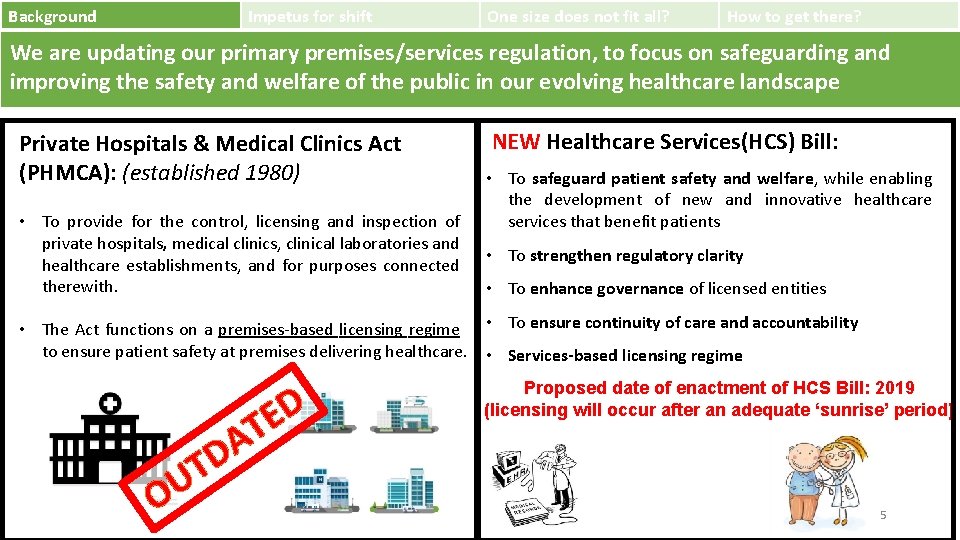
Background Impetus for shift One size does not fit all? How to get there? We are updating our primary premises/services regulation, to focus on safeguarding and improving the safety and welfare of the public in our evolving healthcare landscape Private Hospitals & Medical Clinics Act (PHMCA): (established 1980) • To provide for the control, licensing and inspection of private hospitals, medical clinics, clinical laboratories and healthcare establishments, and for purposes connected therewith. NEW Healthcare Services(HCS) Bill: • To safeguard patient safety and welfare, while enabling the development of new and innovative healthcare services that benefit patients • To strengthen regulatory clarity • To enhance governance of licensed entities • The Act functions on a premises-based licensing regime • To ensure continuity of care and accountability to ensure patient safety at premises delivering healthcare. • Services-based licensing regime O T U A D D E T Proposed date of enactment of HCS Bill: 2019 (licensing will occur after an adequate ‘sunrise’ period) 5
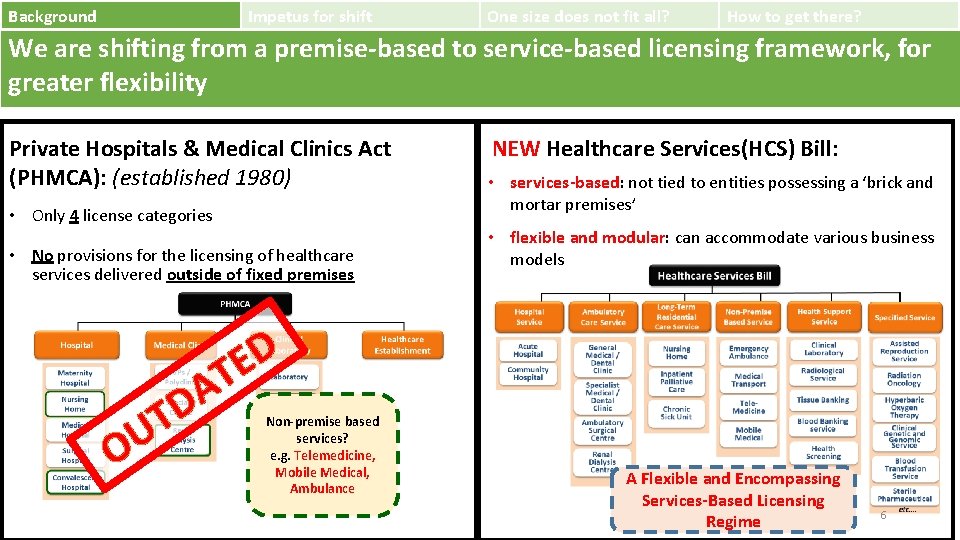
Background Impetus for shift One size does not fit all? How to get there? We are shifting from a premise-based to service-based licensing framework, for greater flexibility Private Hospitals & Medical Clinics Act (PHMCA): (established 1980) • Only 4 license categories • No provisions for the licensing of healthcare services delivered outside of fixed premises NEW Healthcare Services(HCS) Bill: • services-based: not tied to entities possessing a ‘brick and mortar premises’ • flexible and modular: can accommodate various business models T U O D E T A D Non-premise based services? e. g. Telemedicine, Mobile Medical, Ambulance A Flexible and Encompassing Services-Based Licensing Regime 6
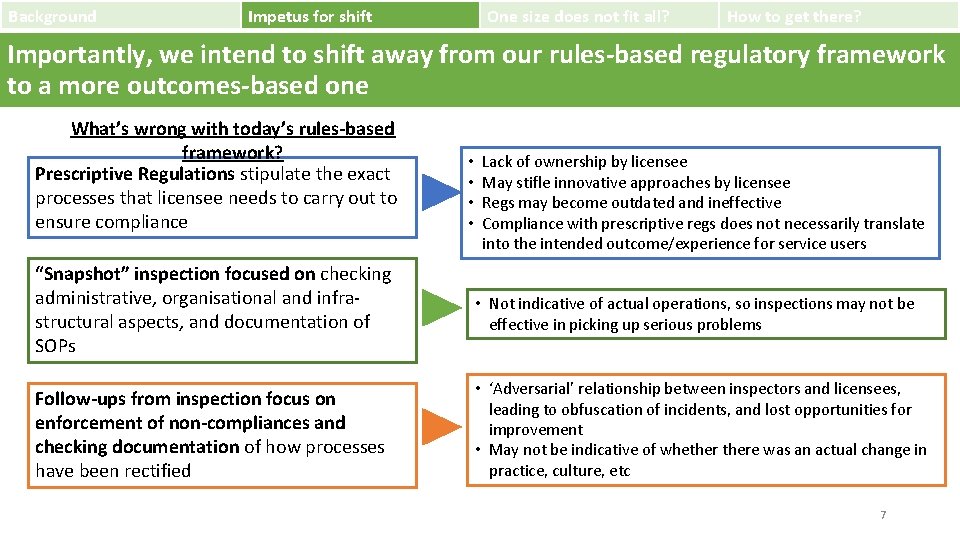
Background Impetus for shift One size does not fit all? How to get there? Importantly, we intend to shift away from our rules-based regulatory framework to a more outcomes-based one What’s wrong with today’s rules-based framework? Prescriptive Regulations stipulate the exact processes that licensee needs to carry out to ensure compliance • • Lack of ownership by licensee May stifle innovative approaches by licensee Regs may become outdated and ineffective Compliance with prescriptive regs does not necessarily translate into the intended outcome/experience for service users “Snapshot” inspection focused on checking administrative, organisational and infrastructural aspects, and documentation of SOPs • Not indicative of actual operations, so inspections may not be effective in picking up serious problems Follow-ups from inspection focus on enforcement of non-compliances and checking documentation of how processes have been rectified • ‘Adversarial’ relationship between inspectors and licensees, leading to obfuscation of incidents, and lost opportunities for improvement • May not be indicative of whethere was an actual change in practice, culture, etc 7
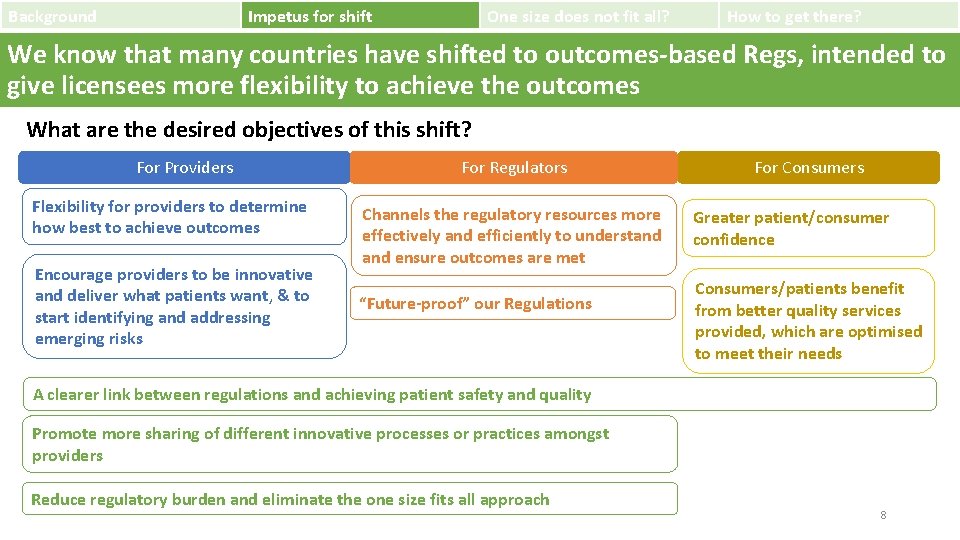
Background Impetus for shift One size does not fit all? How to get there? We know that many countries have shifted to outcomes-based Regs, intended to give licensees more flexibility to achieve the outcomes What are the desired objectives of this shift? For Providers Flexibility for providers to determine how best to achieve outcomes Encourage providers to be innovative and deliver what patients want, & to start identifying and addressing emerging risks For Regulators Channels the regulatory resources more effectively and efficiently to understand ensure outcomes are met “Future-proof” our Regulations For Consumers Greater patient/consumer confidence Consumers/patients benefit from better quality services provided, which are optimised to meet their needs A clearer link between regulations and achieving patient safety and quality Promote more sharing of different innovative processes or practices amongst providers Reduce regulatory burden and eliminate the one size fits all approach 8
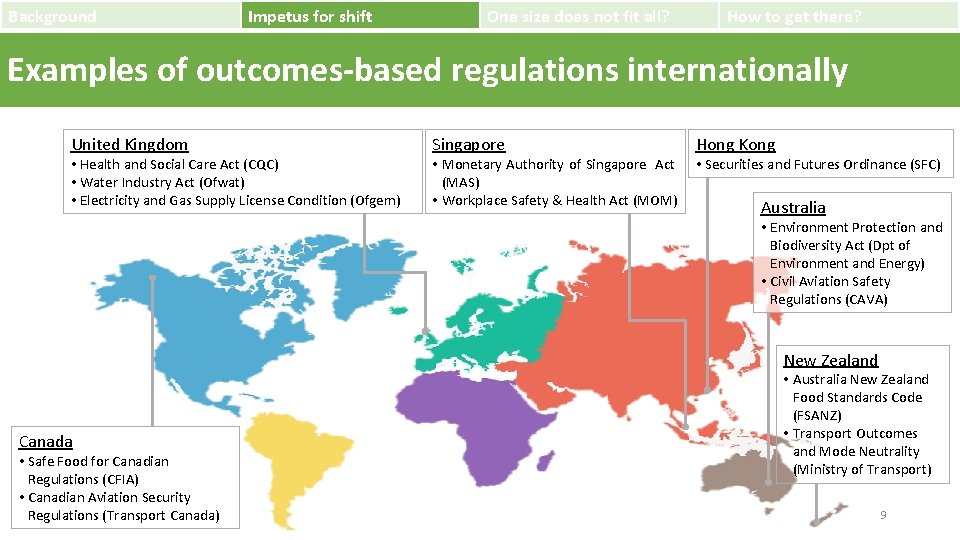
Background Impetus for shift One size does not fit all? How to get there? Examples of outcomes-based regulations internationally United Kingdom • Health and Social Care Act (CQC) • Water Industry Act (Ofwat) • Electricity and Gas Supply License Condition (Ofgem) Singapore • Monetary Authority of Singapore Act (MAS) • Workplace Safety & Health Act (MOM) Hong Kong • Securities and Futures Ordinance (SFC) Australia • Environment Protection and Biodiversity Act (Dpt of Environment and Energy) • Civil Aviation Safety Regulations (CAVA) New Zealand Canada • Safe Food for Canadian Regulations (CFIA) • Canadian Aviation Security Regulations (Transport Canada) • Australia New Zealand Food Standards Code (FSANZ) • Transport Outcomes and Mode Neutrality (Ministry of Transport) 9
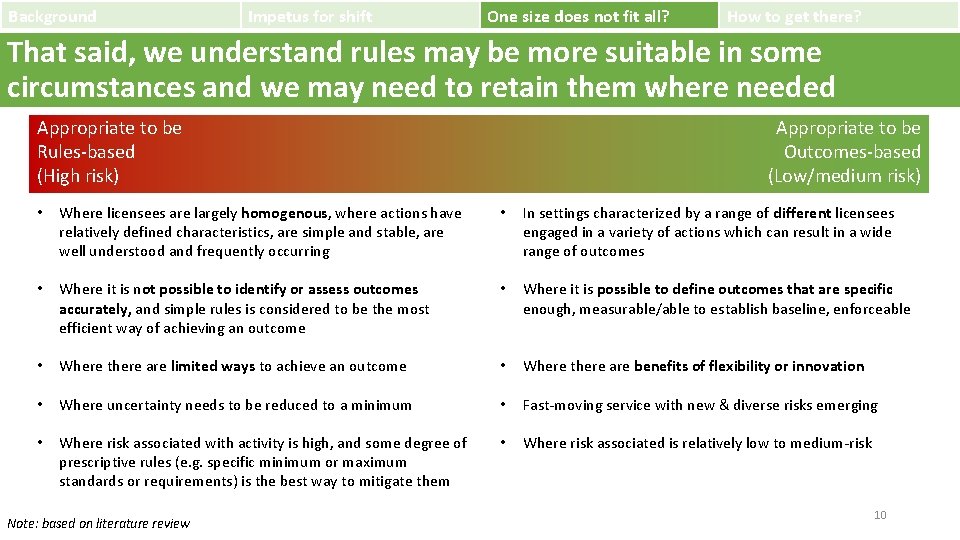
Background Impetus for shift One size does not fit all? How to get there? That said, we understand rules may be more suitable in some circumstances and we may need to retain them where needed Appropriate to be Outcomes-based (Low/medium risk) Appropriate to be Rules-based (High risk) • Where licensees are largely homogenous, where actions have relatively defined characteristics, are simple and stable, are well understood and frequently occurring • In settings characterized by a range of different licensees engaged in a variety of actions which can result in a wide range of outcomes • Where it is not possible to identify or assess outcomes accurately, and simple rules is considered to be the most efficient way of achieving an outcome • Where it is possible to define outcomes that are specific enough, measurable/able to establish baseline, enforceable • Where there are limited ways to achieve an outcome • Where there are benefits of flexibility or innovation • Where uncertainty needs to be reduced to a minimum • Fast-moving service with new & diverse risks emerging • Where risk associated with activity is high, and some degree of prescriptive rules (e. g. specific minimum or maximum standards or requirements) is the best way to mitigate them • Where risk associated is relatively low to medium-risk Note: based on literature review 10
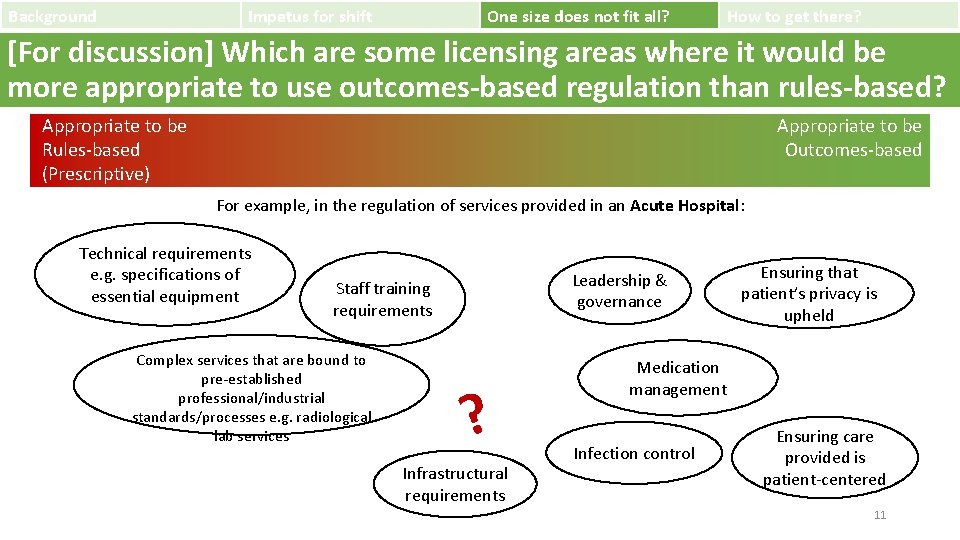
Background Impetus for shift One size does not fit all? How to get there? [For discussion] Which are some licensing areas where it would be more appropriate to use outcomes-based regulation than rules-based? Appropriate to be Outcomes-based Appropriate to be Rules-based (Prescriptive) For example, in the regulation of services provided in an Acute Hospital: Technical requirements e. g. specifications of essential equipment Leadership & governance Staff training requirements Complex services that are bound to pre-established professional/industrial standards/processes e. g. radiological lab services ? Infrastructural requirements Ensuring that patient’s privacy is upheld Medication management Infection control Ensuring care provided is patient-centered 11
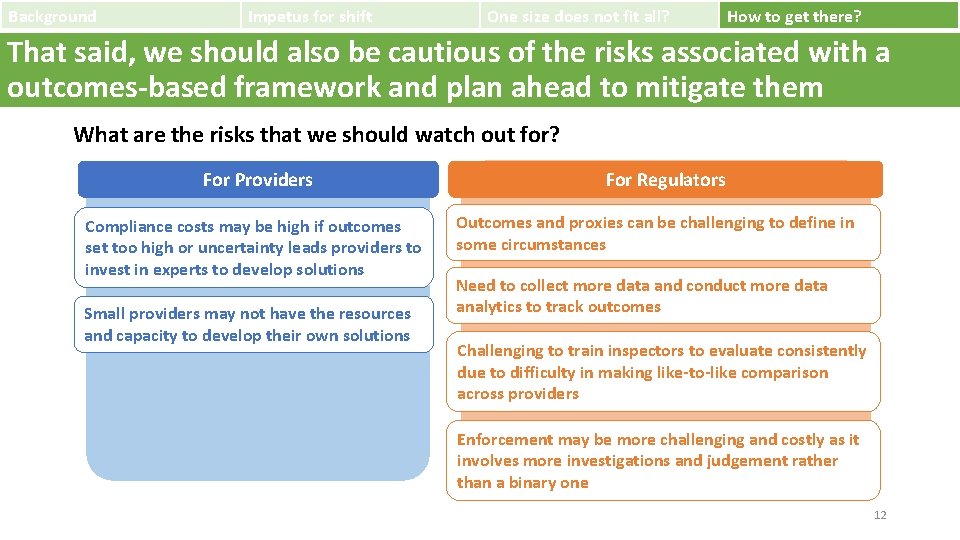
Background Impetus for shift One size does not fit all? How to get there? That said, we should also be cautious of the risks associated with a outcomes-based framework and plan ahead to mitigate them What are the risks that we should watch out for? For Providers Compliance costs may be high if outcomes set too high or uncertainty leads providers to invest in experts to develop solutions Small providers may not have the resources and capacity to develop their own solutions For Regulators Outcomes and proxies can be challenging to define in some circumstances Need to collect more data and conduct more data analytics to track outcomes Challenging to train inspectors to evaluate consistently due to difficulty in making like-to-like comparison across providers Enforcement may be more challenging and costly as it involves more investigations and judgement rather than a binary one 12
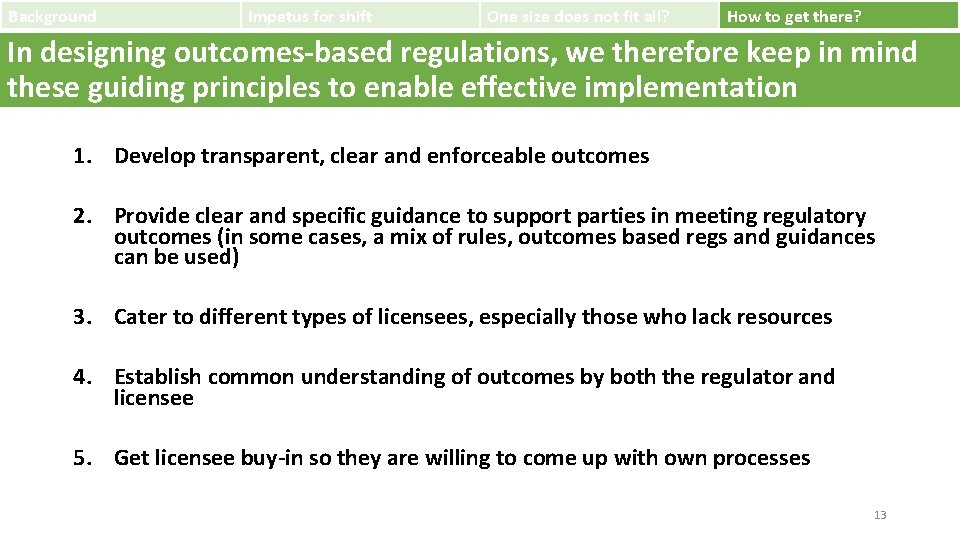
Background Impetus for shift One size does not fit all? How to get there? In designing outcomes-based regulations, we therefore keep in mind these guiding principles to enable effective implementation 1. Develop transparent, clear and enforceable outcomes 2. Provide clear and specific guidance to support parties in meeting regulatory outcomes (in some cases, a mix of rules, outcomes based regs and guidances can be used) 3. Cater to different types of licensees, especially those who lack resources 4. Establish common understanding of outcomes by both the regulator and licensee 5. Get licensee buy-in so they are willing to come up with own processes 13
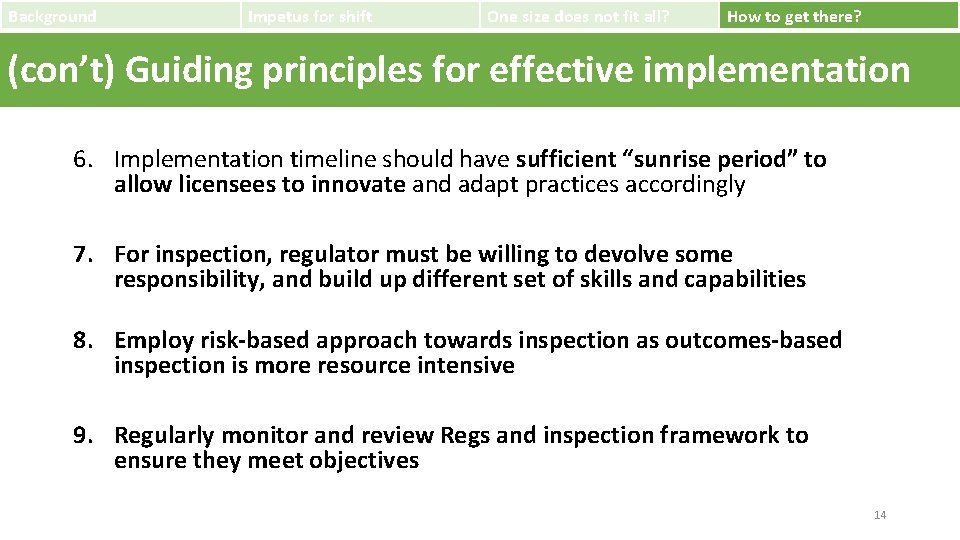
Background Impetus for shift One size does not fit all? How to get there? (con’t) Guiding principles for effective implementation 6. Implementation timeline should have sufficient “sunrise period” to allow licensees to innovate and adapt practices accordingly 7. For inspection, regulator must be willing to devolve some responsibility, and build up different set of skills and capabilities 8. Employ risk-based approach towards inspection as outcomes-based inspection is more resource intensive 9. Regularly monitor and review Regs and inspection framework to ensure they meet objectives 14
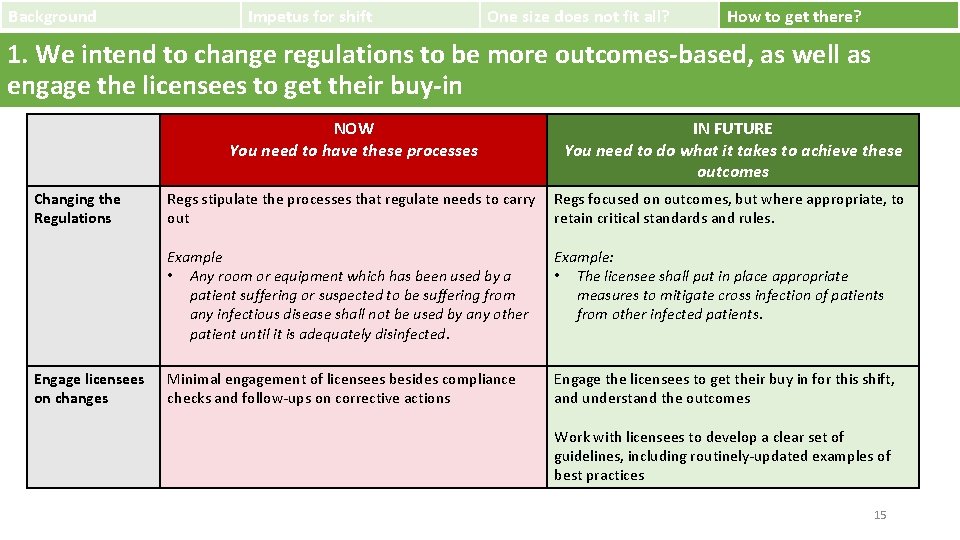
Background Impetus for shift One size does not fit all? How to get there? 1. We intend to change regulations to be more outcomes-based, as well as engage the licensees to get their buy-in Changing the Regulations Engage licensees on changes NOW You need to have these processes IN FUTURE You need to do what it takes to achieve these outcomes Regs stipulate the processes that regulate needs to carry out Regs focused on outcomes, but where appropriate, to retain critical standards and rules. Example • Any room or equipment which has been used by a patient suffering or suspected to be suffering from any infectious disease shall not be used by any other patient until it is adequately disinfected. Example: • The licensee shall put in place appropriate measures to mitigate cross infection of patients from other infected patients. Minimal engagement of licensees besides compliance checks and follow-ups on corrective actions Engage the licensees to get their buy in for this shift, and understand the outcomes Work with licensees to develop a clear set of guidelines, including routinely-updated examples of best practices 15
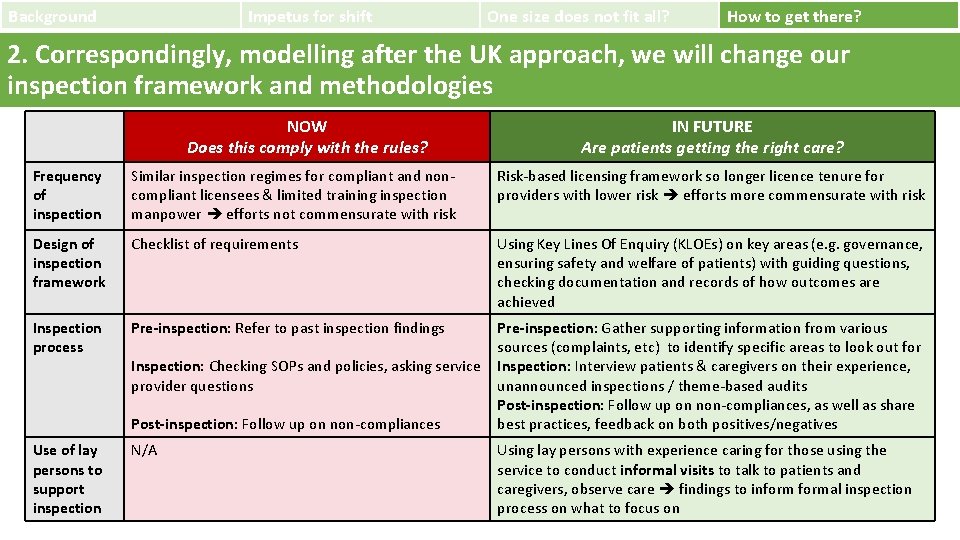
Background Impetus for shift One size does not fit all? How to get there? 2. Correspondingly, modelling after the UK approach, we will change our inspection framework and methodologies NOW Does this comply with the rules? IN FUTURE Are patients getting the right care? Frequency of inspection Similar inspection regimes for compliant and noncompliant licensees & limited training inspection manpower efforts not commensurate with risk Risk-based licensing framework so longer licence tenure for providers with lower risk efforts more commensurate with risk Design of inspection framework Checklist of requirements Using Key Lines Of Enquiry (KLOEs) on key areas (e. g. governance, ensuring safety and welfare of patients) with guiding questions, checking documentation and records of how outcomes are achieved Inspection process Pre-inspection: Refer to past inspection findings Pre-inspection: Gather supporting information from various sources (complaints, etc) to identify specific areas to look out for Inspection: Interview patients & caregivers on their experience, unannounced inspections / theme-based audits Post-inspection: Follow up on non-compliances, as well as share best practices, feedback on both positives/negatives Inspection: Checking SOPs and policies, asking service provider questions Post-inspection: Follow up on non-compliances Use of lay persons to support inspection N/A Using lay persons with experience caring for those using the service to conduct informal visits to talk to patients and caregivers, observe care findings to informal inspection process on what to focus on 16
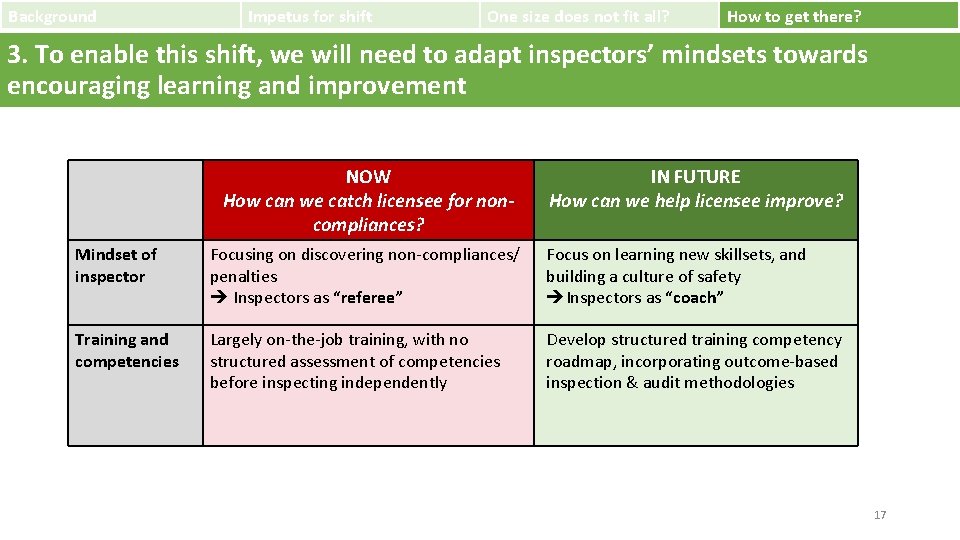
Background Impetus for shift One size does not fit all? How to get there? 3. To enable this shift, we will need to adapt inspectors’ mindsets towards encouraging learning and improvement NOW How can we catch licensee for noncompliances? IN FUTURE How can we help licensee improve? Mindset of inspector Focusing on discovering non-compliances/ penalties Inspectors as “referee” Focus on learning new skillsets, and building a culture of safety Inspectors as “coach” Training and competencies Largely on-the-job training, with no structured assessment of competencies before inspecting independently Develop structured training competency roadmap, incorporating outcome-based inspection & audit methodologies 17
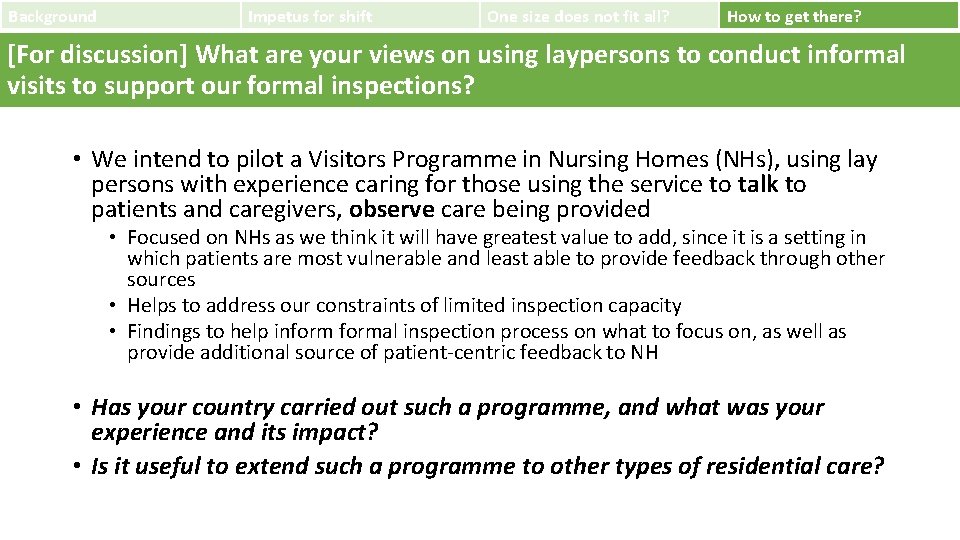
Background Impetus for shift One size does not fit all? How to get there? [For discussion] What are your views on using laypersons to conduct informal visits to support our formal inspections? • We intend to pilot a Visitors Programme in Nursing Homes (NHs), using lay persons with experience caring for those using the service to talk to patients and caregivers, observe care being provided • Focused on NHs as we think it will have greatest value to add, since it is a setting in which patients are most vulnerable and least able to provide feedback through other sources • Helps to address our constraints of limited inspection capacity • Findings to help informal inspection process on what to focus on, as well as provide additional source of patient-centric feedback to NH • Has your country carried out such a programme, and what was your experience and its impact? • Is it useful to extend such a programme to other types of residential care?
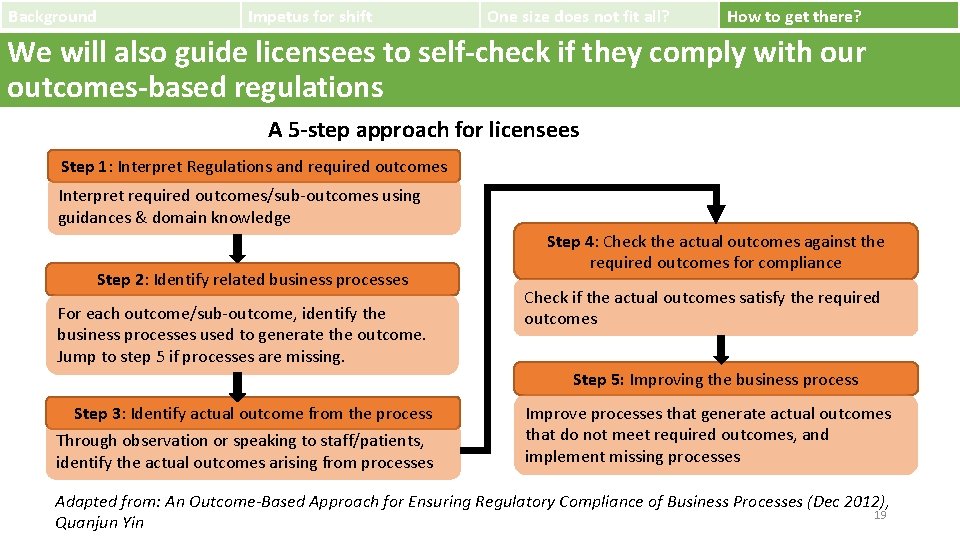
Background Impetus for shift One size does not fit all? How to get there? We will also guide licensees to self-check if they comply with our outcomes-based regulations A 5 -step approach for licensees Step 1: Interpret Regulations and required outcomes Interpret required outcomes/sub-outcomes using guidances & domain knowledge Step 2: Identify related business processes For each outcome/sub-outcome, identify the business processes used to generate the outcome. Jump to step 5 if processes are missing. Step 4: Check the actual outcomes against the required outcomes for compliance Check if the actual outcomes satisfy the required outcomes Step 5: Improving the business process Step 3: Identify actual outcome from the process Through observation or speaking to staff/patients, identify the actual outcomes arising from processes Improve processes that generate actual outcomes that do not meet required outcomes, and implement missing processes Adapted from: An Outcome-Based Approach for Ensuring Regulatory Compliance of Business Processes (Dec 2012), 19 Quanjun Yin
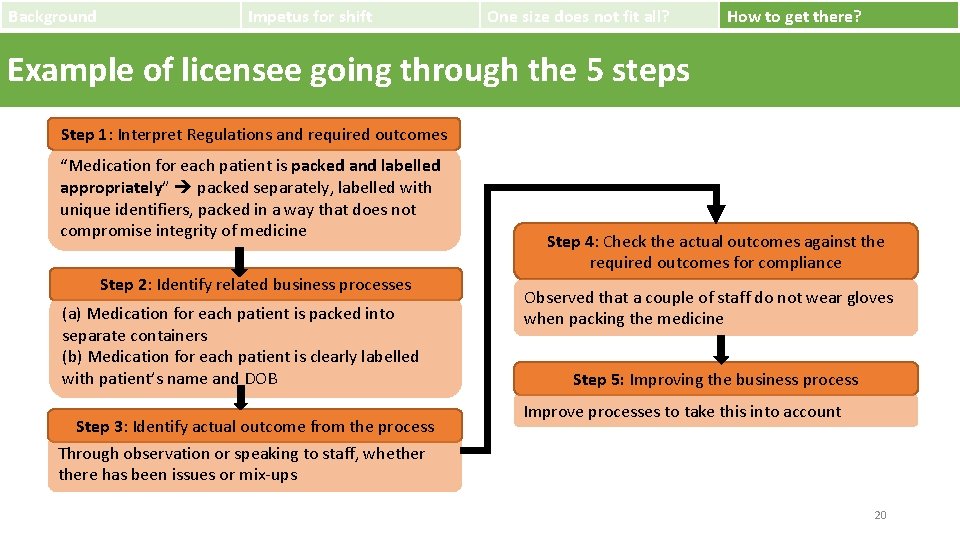
Background Impetus for shift One size does not fit all? How to get there? Example of licensee going through the 5 steps Step 1: Interpret Regulations and required outcomes “Medication for each patient is packed and labelled appropriately” packed separately, labelled with unique identifiers, packed in a way that does not compromise integrity of medicine Step 2: Identify related business processes (a) Medication for each patient is packed into separate containers (b) Medication for each patient is clearly labelled with patient’s name and DOB Step 3: Identify actual outcome from the process Step 4: Check the actual outcomes against the required outcomes for compliance Observed that a couple of staff do not wear gloves when packing the medicine Step 5: Improving the business process Improve processes to take this into account Through observation or speaking to staff, whethere has been issues or mix-ups 20
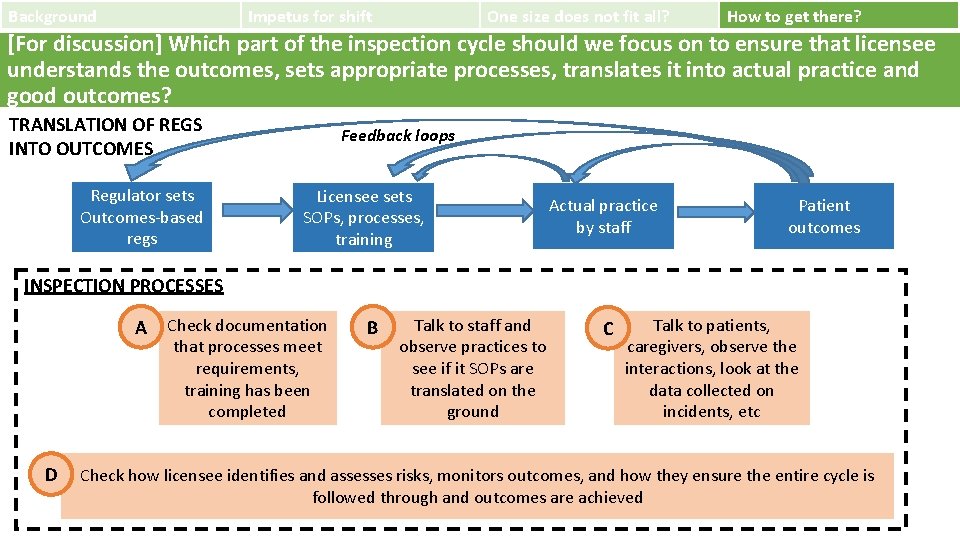
Background Impetus for shift One size does not fit all? How to get there? [For discussion] Which part of the inspection cycle should we focus on to ensure that licensee understands the outcomes, sets appropriate processes, translates it into actual practice and good outcomes? TRANSLATION OF REGS INTO OUTCOMES Regulator sets Outcomes-based regs Feedback loops Licensee sets SOPs, processes, training Actual practice by staff Patient outcomes INSPECTION PROCESSES A D Check documentation that processes meet requirements, training has been completed B Talk to staff and observe practices to see if it SOPs are translated on the ground C Talk to patients, caregivers, observe the interactions, look at the data collected on incidents, etc Check how licensee identifies and assesses risks, monitors outcomes, and how they ensure the entire cycle is followed through and outcomes are achieved 21
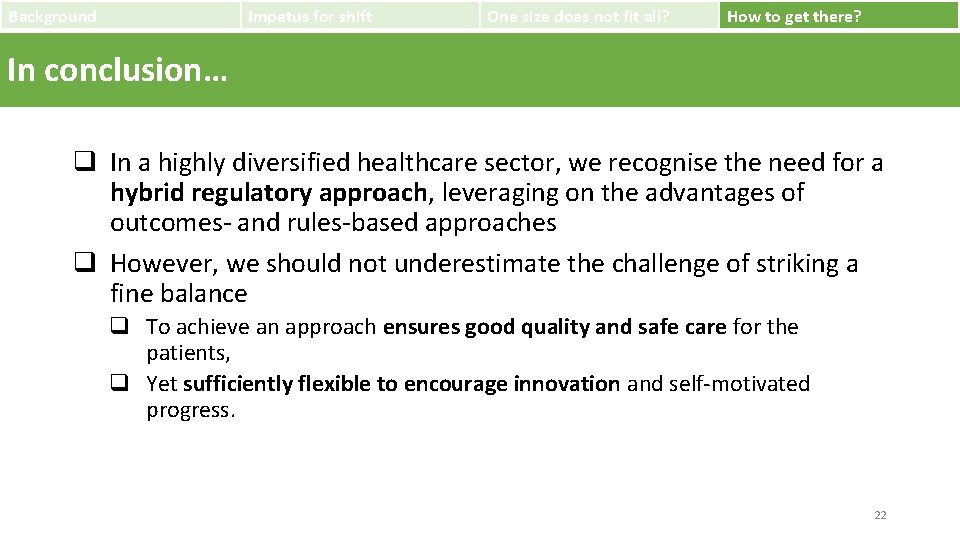
Background Impetus for shift One size does not fit all? How to get there? In conclusion… q In a highly diversified healthcare sector, we recognise the need for a hybrid regulatory approach, leveraging on the advantages of outcomes- and rules-based approaches q However, we should not underestimate the challenge of striking a fine balance q To achieve an approach ensures good quality and safe care for the patients, q Yet sufficiently flexible to encourage innovation and self-motivated progress. 22
Thank you! 23
- Slides: 23