
Are There Different Types of Calories By Alexander
Are There Different Types of Calories? By Alexander Pitetti and Tyler Zinko
The different types of calories. • Carbohydrates- Most common type of calorie, and contain 3. 75 kilocalories per gram. Can be divided into simple and complex carbohydrates. • Proteins- They help to develop body muscle, and contain 4 kilocalories per gram. • Fat- Most unwanted type, but it still plays an important role in the body. Without it, the body can’t absorb vitamins A, D, E, and K. • Fact-All of them burn when used in the body and turn into heat energy, which we call calories.
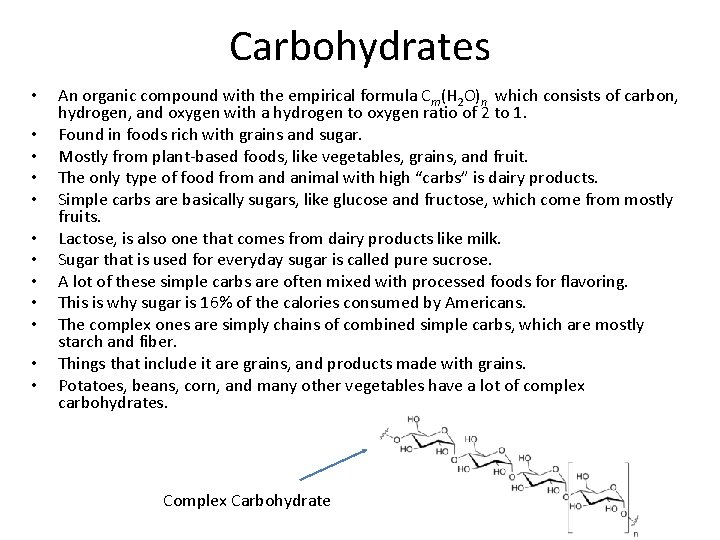
Carbohydrates • • • An organic compound with the empirical formula Cm(H 2 O)n which consists of carbon, hydrogen, and oxygen with a hydrogen to oxygen ratio of 2 to 1. Found in foods rich with grains and sugar. Mostly from plant-based foods, like vegetables, grains, and fruit. The only type of food from and animal with high “carbs” is dairy products. Simple carbs are basically sugars, like glucose and fructose, which come from mostly fruits. Lactose, is also one that comes from dairy products like milk. Sugar that is used for everyday sugar is called pure sucrose. A lot of these simple carbs are often mixed with processed foods for flavoring. This is why sugar is 16% of the calories consumed by Americans. The complex ones are simply chains of combined simple carbs, which are mostly starch and fiber. Things that include it are grains, and products made with grains. Potatoes, beans, corn, and many other vegetables have a lot of complex carbohydrates. Complex Carbohydrate
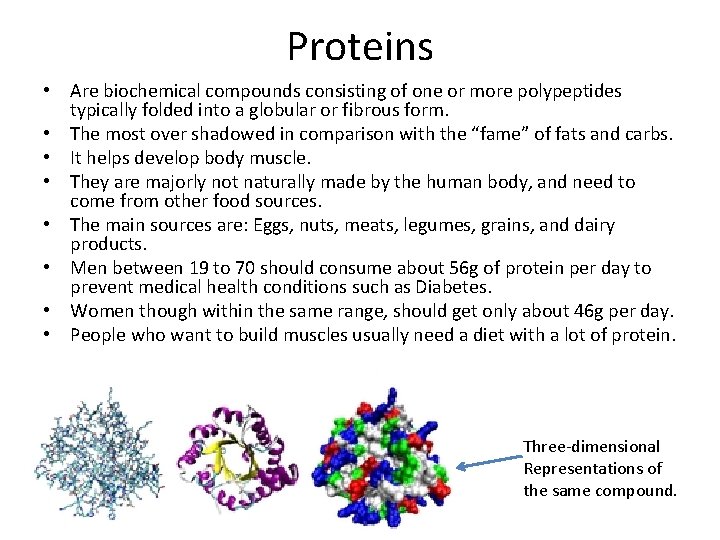
Proteins • Are biochemical compounds consisting of one or more polypeptides typically folded into a globular or fibrous form. • The most over shadowed in comparison with the “fame” of fats and carbs. • It helps develop body muscle. • They are majorly not naturally made by the human body, and need to come from other food sources. • The main sources are: Eggs, nuts, meats, legumes, grains, and dairy products. • Men between 19 to 70 should consume about 56 g of protein per day to prevent medical health conditions such as Diabetes. • Women though within the same range, should get only about 46 g per day. • People who want to build muscles usually need a diet with a lot of protein. Three-dimensional Representations of the same compound.
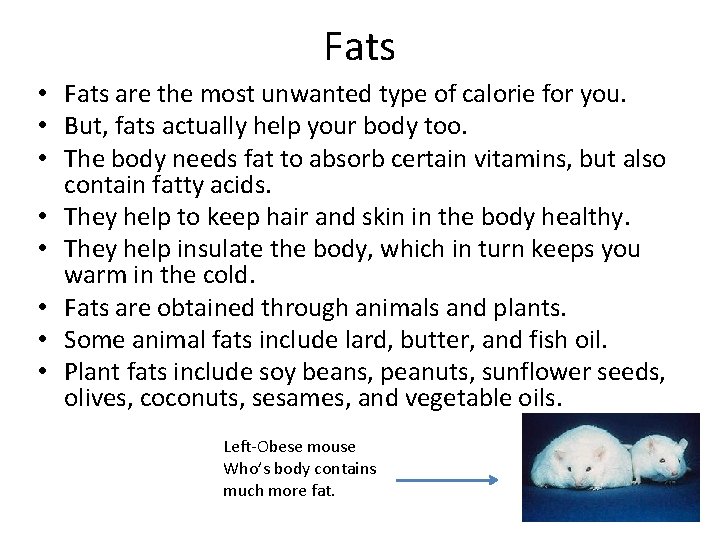
Fats • Fats are the most unwanted type of calorie for you. • But, fats actually help your body too. • The body needs fat to absorb certain vitamins, but also contain fatty acids. • They help to keep hair and skin in the body healthy. • They help insulate the body, which in turn keeps you warm in the cold. • Fats are obtained through animals and plants. • Some animal fats include lard, butter, and fish oil. • Plant fats include soy beans, peanuts, sunflower seeds, olives, coconuts, sesames, and vegetable oils. Left-Obese mouse Who’s body contains much more fat.
Important Vocabulary • Empirical- Provable or verifiable by experience. • Glucose- A sugar that has several forms that look different. (Used for energy by plants and animals) • Fructose- A yellow-white solution of sugar that is sweeter than sucrose and found in honey, and many fruits. • Lactose- a disaccharide present in milk • Sucrose- a crystalline disaccharide • Polypeptides- Singular chains of amino acids bonded together. • Globular- globe shaped; spherical • Fibrous- containing, or consisting of • Legumes- any plant of the legume family for feed or food. • Disaccharide- any of a group of carbohydrates that yield monosaccharides • Legume family- the large plant family called Leguminosae including plants, trees, shrubs, and vines having compound leaves. • Monosaccharide- carbohydrate that doesn’t hydrolyze. • Hydrolyze- to subject or be subjected to hydrolysis. • Hydrolysis- when a compound splits by reacting to water.
Sources • • • American Psychological Association (APA): hydrolysis. (n. d. ). Collins English Dictionary - Complete & Unabridged 10 th Edition. Retrieved December 15, 2011, from Dictionary. com website: http: //dictionary. reference. com/browse/hydrolysis. Chicago Manual Style (CMS): hydrolysis. Dictionary. com. Collins English Dictionary - Complete & Unabridged 10 th Edition. Harper. Collins Publishers. http: //dictionary. reference. com/browse/hydrolysis (accessed: December 15, 2011). Maton, Anthea; Jean Hopkins, Charles William Mc. Laughlin, Susan Johnson, Maryanna Quon Warner, David La. Hart, Jill D. Wright (1993). Human Biology and Health. Englewood Cliffs, New Jersey, USA: Prentice Hall. ISBN 0 -13 -981176 -1. OCLC 32308337. ^ Mozaffarian D, Katan MB, Ascherio A, Stampfer MJ, Willett WC (13 April 2006). "Trans Fatty Acids and Cardiovascular Disease". New England Journal of Medicine 354 (15): 1601– 1613. doi: 10. 1056/NEJMra 054035. PMID 16611951. ^ Stern, David P. (May 19, 2008). Newtonian mechanics – (15) Energy. From Stargazers to Starships. Retrieved April 11, 2011 from NASA's International Solar-Terrestrial Physics Goddard Space Flight Center website. Donatelle, Rebecca J. (2005). Health, the Basics (6 th ed. ). San Francisco: Pearson Education, Inc. ISBN 0131206877. OCLC 51801859. Unknown, Maliam. About the Different Types of Calories. 2005 Unknown. 12/15/11 <http: //www. articledashboard. com/Article/Ab out-The-Different-Types-Of-Calories/880182>.
- Slides: 7