
Are problems good or bad Welcome problems approach
Are problems good or bad ? Welcome problems approach ! Nava Klein Quality and Ops Excellence HP-Indigo
A 3 • “A 3” is just a paper size on which the problem solving process is captured • Began in the 60 s as a Quality Circle collaborative problem-solving format • Why did Toyota start with structured problem solving A 3 ? – At Toyota, evolved to become the standard for problem-solving, proposals, status reviews – What is important is the (PDCA) process and thinking behind it (not the format)
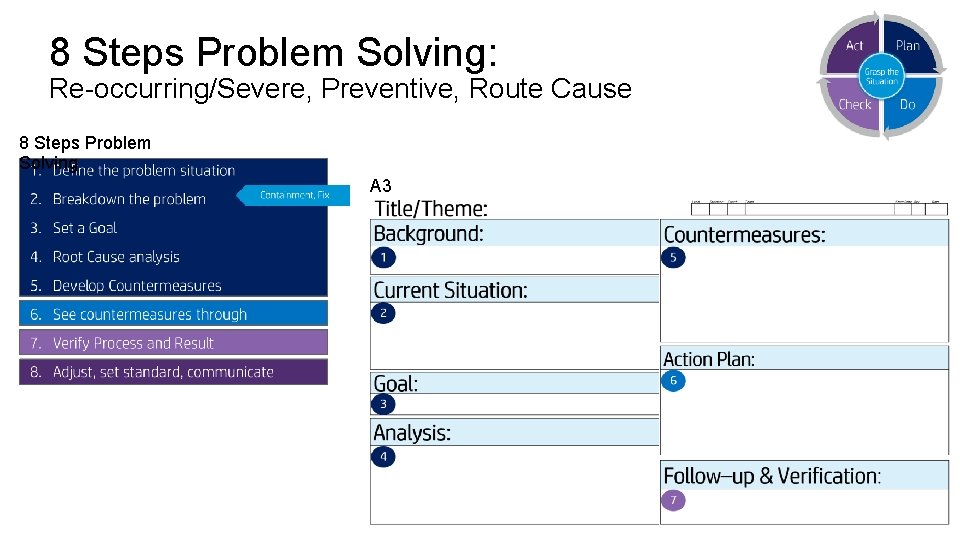
8 Steps Problem Solving: Re-occurring/Severe, Preventive, Route Cause 8 Steps Problem Solving A 3

8 Steps Problem Solving 1. Define the problem situation 2. Breakdown the problem Containment, Fix 3. Set a Goal 4. Root Cause analysis 5. Develop Countermeasures 6. See countermeasures through 7. Verify Process and Result 8. Adjust, set standard, communicate
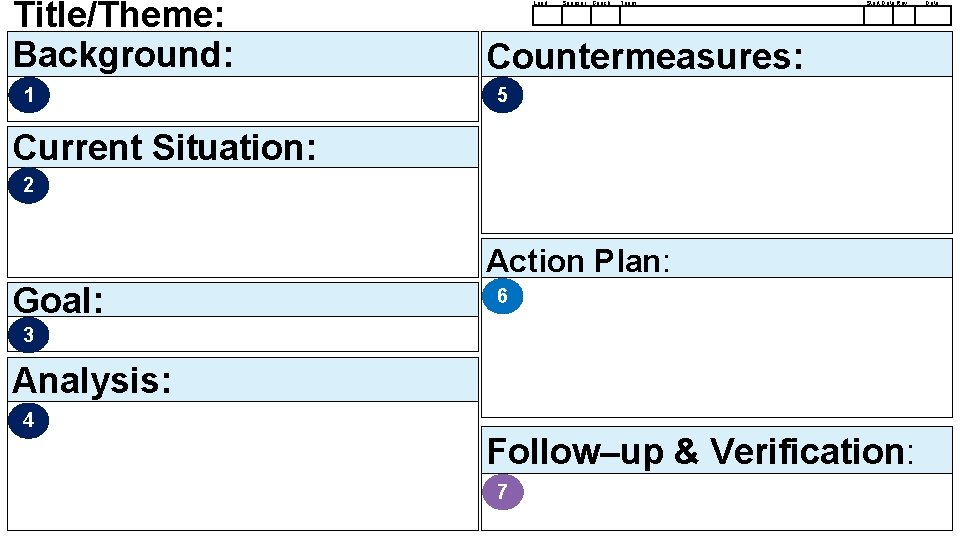
Title/Theme: Background: 1 Lead Sponsor Coach Team Start Date Rev Countermeasures: 5 Current Situation: 2 Action Plan: Goal: 6 3 Analysis: 4 Follow–up & Verification: 7 Date
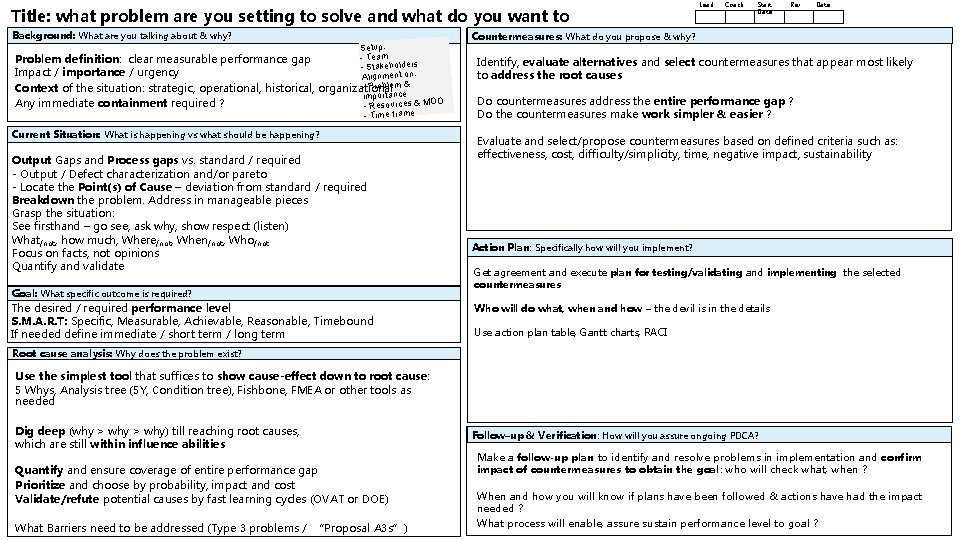
Title: what problem are you setting to solve and what do you want to Background: ? What are you talking about & why? Countermeasures: What do you propose & why? achieve Lead Coach Start Date Rev Date Setup: - Team Problem definition: clear measurable performance gap - Stakeholders Impact / importance / urgency Alignment on: - Problem & Context of the situation: strategic, operational, historical, organizational importance OO Any immediate containment required ? - Resources & M - Time frame Current Situation: What is happening vs what should be happening? Output Gaps and Process gaps vs. standard / required - Output / Defect characterization and/or pareto - Locate the Point(s) of Cause – deviation from standard / required Breakdown the problem. Address in manageable pieces Grasp the situation: See firsthand – go see, ask why, show respect (listen) What/not, how much, Where/not, When/not, Who/not Focus on facts, not opinions Quantify and validate Goal: What specific outcome is required? The desired / required performance level S. M. A. R. T: Specific, Measurable, Achievable, Reasonable, Timebound If needed define immediate / short term / long term Identify, evaluate alternatives and select countermeasures that appear most likely to address the root causes Do countermeasures address the entire performance gap ? Do the countermeasures make work simpler & easier ? Evaluate and select/propose countermeasures based on defined criteria such as: effectiveness, cost, difficulty/simplicity, time, negative impact, sustainability Action Plan: Specifically how will you implement? Get agreement and execute plan for testing/validating and implementing the selected countermeasures Who will do what, when and how – the devil is in the details Use action plan table, Gantt charts, RACI Root cause analysis: Why does the problem exist? Use the simplest tool that suffices to show cause-effect down to root cause: 5 Whys, Analysis tree (5 Y, Condition tree), Fishbone, FMEA or other tools as needed Dig deep (why > why) till reaching root causes, which are still within influence abilities Quantify and ensure coverage of entire performance gap Prioritize and choose by probability, impact and cost Validate/refute potential causes by fast learning cycles (OVAT or DOE) What Barriers need to be addressed (Type 3 problems / “Proposal A 3 s”) Follow–up & Verification: How will you assure ongoing PDCA? Make a follow-up plan to identify and resolve problems in implementation and confirm impact of countermeasures to obtain the goal: who will check what, when ? When and how you will know if plans have been followed & actions have had the impact needed ? What process will enable, assure sustain performance level to goal ?
- Slides: 6