
Arduino Programming Part 5 Userdefined functions ME 120

- Slides: 15
Arduino Programming – Part 5: User-defined functions ME 120 Mechanical and Materials Engineering Portland State University http: //web. cecs. pdx. edu/~me 120 ME 120: User-defined functions: average analog input reading Fall 2013
Overview • Continue case study of analog input with a photoresistor • Use loop to compute the average of multiple readings • Create a user-defined function Perform a generic task ❖ Reuse in other programs ❖ Encapsulate code to separate the details ❖ • See on-line reference: http: //arduino. cc/en/Reference/Home. Page ❖ http: //www. arduino. cc/en/Reference/Function. Declaration ❖ ME 120: User-defined functions: average analog input reading 2
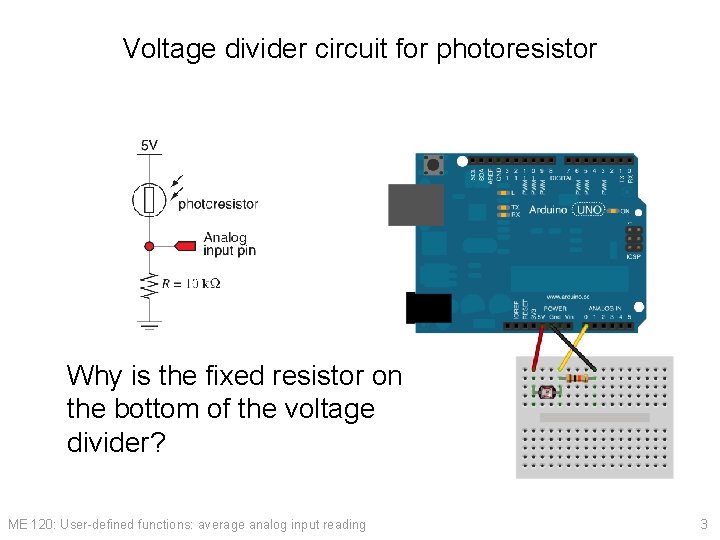
Voltage divider circuit for photoresistor Why is the fixed resistor on the bottom of the voltage divider? ME 120: User-defined functions: average analog input reading 3
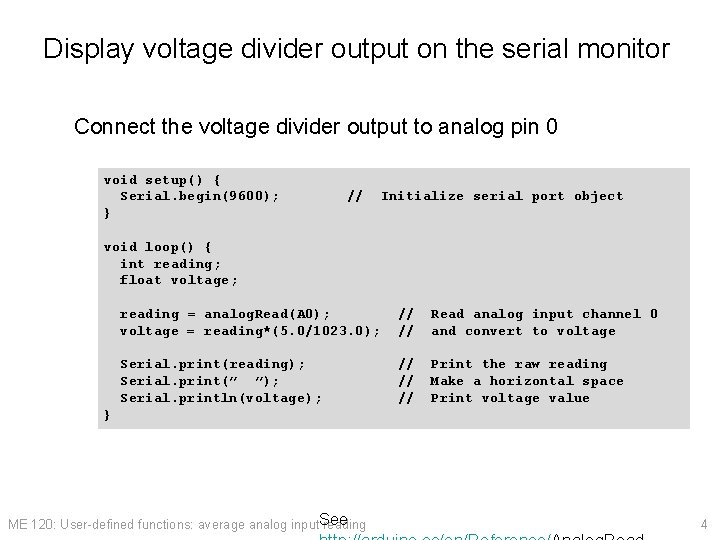
Display voltage divider output on the serial monitor Connect the voltage divider output to analog pin 0 void setup() { Serial. begin(9600); } // Initialize serial port object void loop() { int reading; float voltage; reading = analog. Read(A 0); voltage = reading*(5. 0/1023. 0); // // Read analog input channel 0 and convert to voltage Serial. print(reading); Serial. print(” ”); Serial. println(voltage); // // // Print the raw reading Make a horizontal space Print voltage value } ME 120: User-defined functions: average analog input. See reading 4
Average multiple readings ME 120: User-defined functions: average analog input reading 5
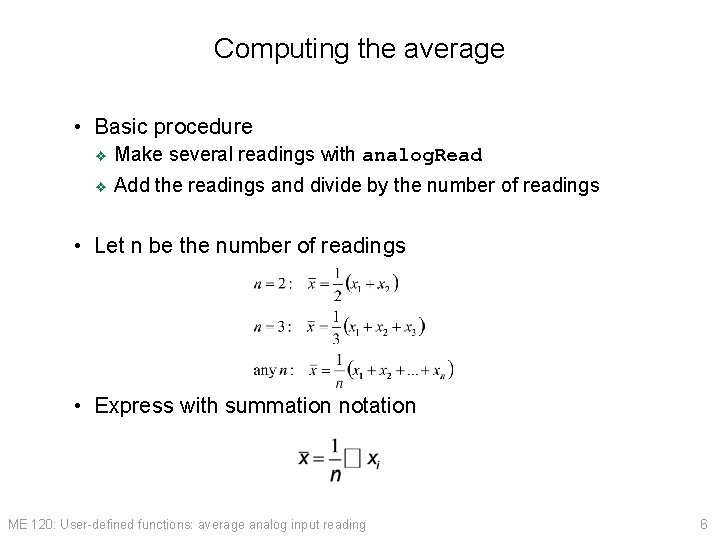
Computing the average • Basic procedure ❖ Make several readings with analog. Read ❖ Add the readings and divide by the number of readings • Let n be the number of readings • Express with summation notation ME 120: User-defined functions: average analog input reading 6
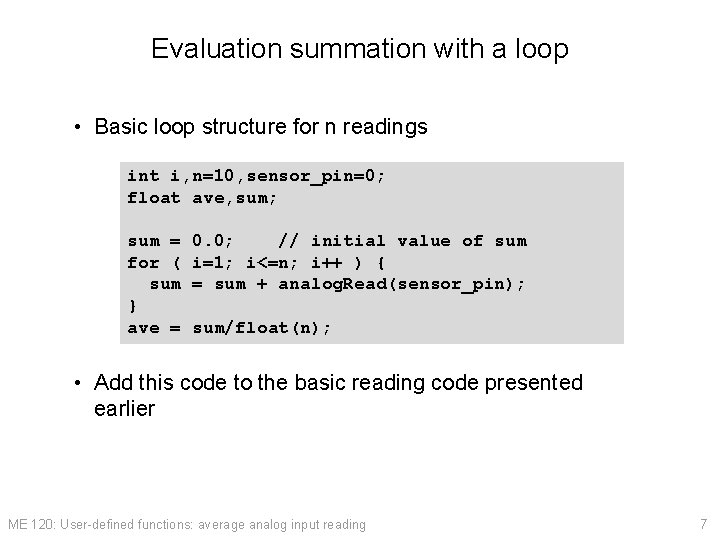
Evaluation summation with a loop • Basic loop structure for n readings int i, n=10, sensor_pin=0; float ave, sum; sum = for ( sum } ave = 0. 0; // initial value of sum i=1; i<=n; i++ ) { = sum + analog. Read(sensor_pin); sum/float(n); • Add this code to the basic reading code presented earlier ME 120: User-defined functions: average analog input reading 7
Writing a function to compute the average of n readings ME 120: User-defined functions: average analog input reading 8
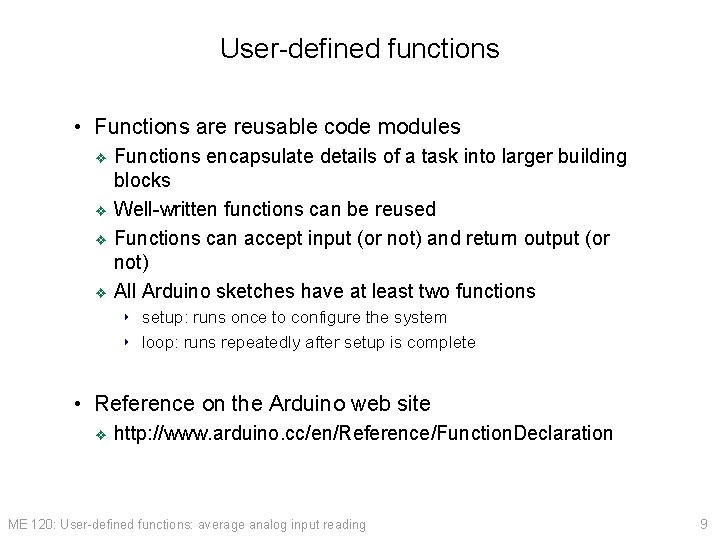
User-defined functions • Functions are reusable code modules Functions encapsulate details of a task into larger building blocks ❖ Well-written functions can be reused ❖ Functions can accept input (or not) and return output (or not) ❖ All Arduino sketches have at least two functions ❖ ‣ setup: runs once to configure the system ‣ loop: runs repeatedly after setup is complete • Reference on the Arduino web site ❖ http: //www. arduino. cc/en/Reference/Function. Declaration ME 120: User-defined functions: average analog input reading 9
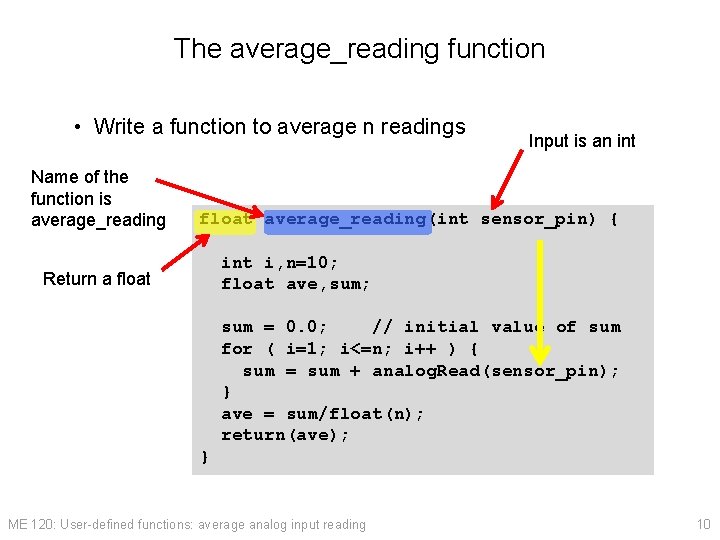
The average_reading function • Write a function to average n readings Name of the function is average_reading Input is an int float average_reading(int sensor_pin) { int i, n=10; float ave, sum; Return a float sum = 0. 0; // initial value of sum for ( i=1; i<=n; i++ ) { sum = sum + analog. Read(sensor_pin); } ave = sum/float(n); return(ave); } ME 120: User-defined functions: average analog input reading 10
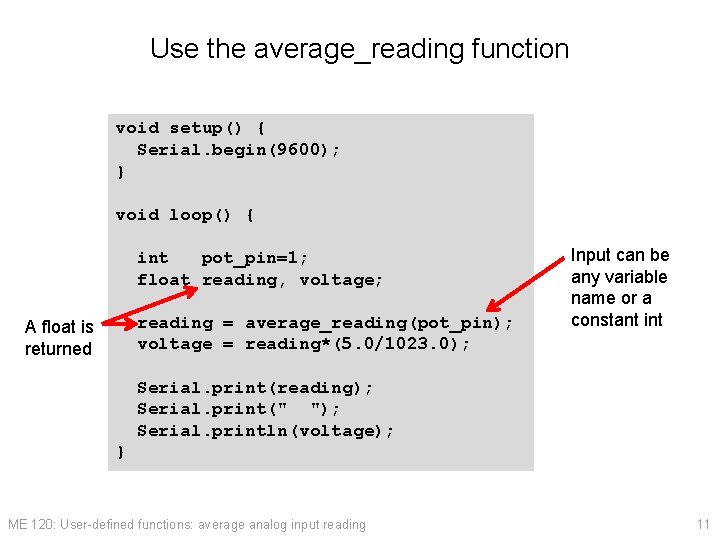
Use the average_reading function void setup() { Serial. begin(9600); } void loop() { int pot_pin=1; float reading, voltage; reading = average_reading(pot_pin); voltage = reading*(5. 0/1023. 0); A float is returned Input can be any variable name or a constant int Serial. print(reading); Serial. print(" "); Serial. println(voltage); } ME 120: User-defined functions: average analog input reading 11
Update the function to allow the number of readings to be a variable ME 120: User-defined functions: average analog input reading 12
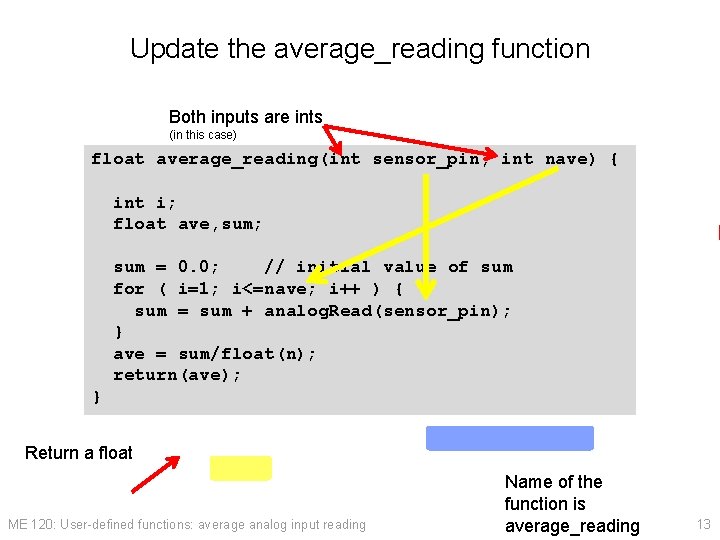
Update the average_reading function Both inputs are ints (in this case) float average_reading(int sensor_pin, int nave) { int i; float ave, sum; sum = 0. 0; // initial value of sum for ( i=1; i<=nave; i++ ) { sum = sum + analog. Read(sensor_pin); } ave = sum/float(n); return(ave); } Return a float ME 120: User-defined functions: average analog input reading Name of the function is average_reading 13
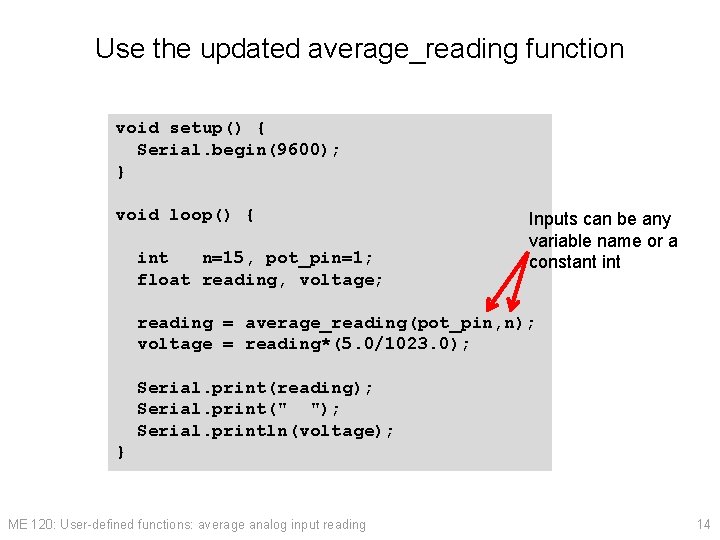
Use the updated average_reading function void setup() { Serial. begin(9600); } void loop() { int n=15, pot_pin=1; float reading, voltage; Inputs can be any variable name or a constant int reading = average_reading(pot_pin, n); voltage = reading*(5. 0/1023. 0); Serial. print(reading); Serial. print(" "); Serial. println(voltage); } ME 120: User-defined functions: average analog input reading 14
Summary of user-defined functions • You chose the name ❖ Make sure the name is not already used • You chose the type of return value • You choose the number and type of inputs ❖ Input types are declared in the function definition ‣ float average_reading( int sensor_pin, int nave ) { … } Input variables are used in the body of the function ❖ When function is called in another section of code, any variable that matches the type of the declared input can be used ❖ ‣ reading = average_reading( pot_pin, 15 ); • Variables in the function are local ❖ Calling function is not affected by local variables and logic in the function ME 120: User-defined functions: average analog input reading 15