
Architectures for HighPerformance Embedded Computing Robert Cooper Mark
Architectures for High-Performance Embedded Computing Robert Cooper Mark Littlefield 9/17/09 Mercury Computer Systems Curtiss-Wright Controls
What is Open. VPX? § Promotes standard components, interoperability, accelerated development and deployment § Defines a set of system specifications § VITA 46 / VPX – a board form-factor standard intended as a VME/CPCI follow-on § Dense, compact, rugged form factor § Abundant backplane I/O § Highly scalable, highly flexible § Introduces 2 -level maintenance through VITA 48/VPX-REDI § Broad industry participation § Vendors, integrators, customers § Wide applicability in military, aerospace and commercial § Multi-INT, radar data exploitation, information dissemination § Avionics § Homeland security § Telecom and transport 2
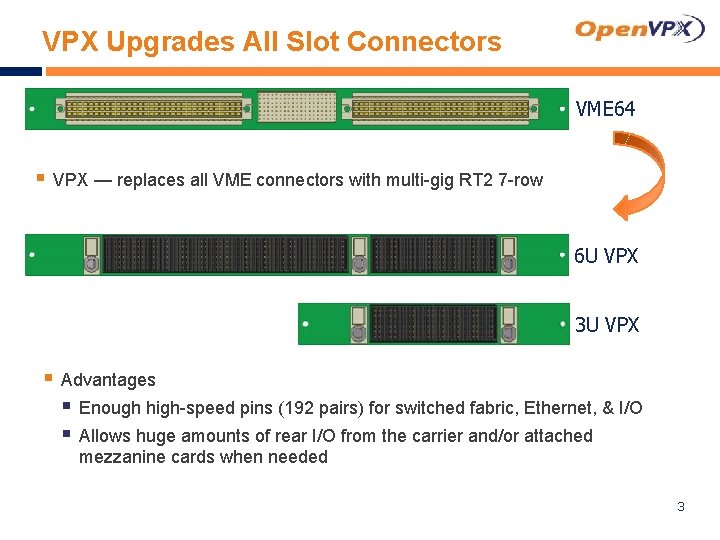
VPX Upgrades All Slot Connectors VME 64 § VPX — replaces all VME connectors with multi-gig RT 2 7 -row 6 U VPX 3 U VPX § Advantages § Enough high-speed pins (192 pairs) for switched fabric, Ethernet, & I/O § Allows huge amounts of rear I/O from the carrier and/or attached mezzanine cards when needed 3
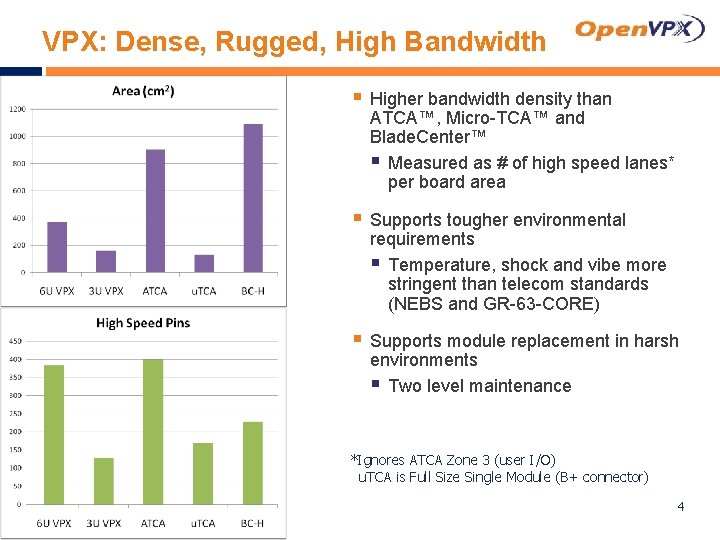
VPX: Dense, Rugged, High Bandwidth § Higher bandwidth density than ATCA™, Micro-TCA™ and Blade. Center™ § Measured as # of high speed lanes* per board area § Supports tougher environmental requirements § Temperature, shock and vibe more stringent than telecom standards (NEBS and GR-63 -CORE) § Supports module replacement in harsh environments § Two level maintenance *Ignores ATCA Zone 3 (user I/O) u. TCA is Full Size Single Module (B+ connector) 4
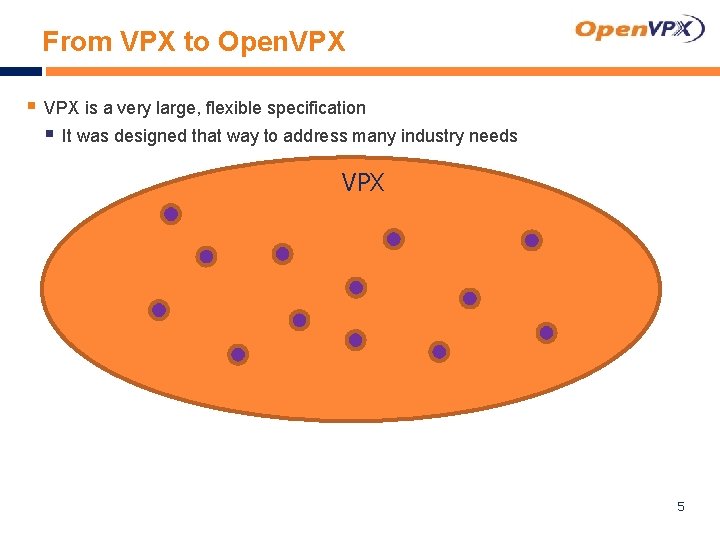
From VPX to Open. VPX § VPX is a very large, flexible specification § It was designed that way to address many industry needs VPX 5
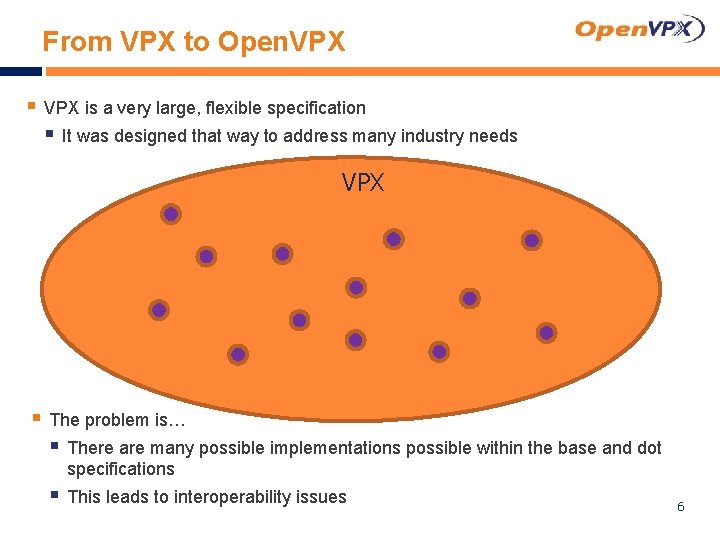
From VPX to Open. VPX § VPX is a very large, flexible specification § It was designed that way to address many industry needs VPX § The problem is… § There are many possible implementations possible within the base and dot specifications § This leads to interoperability issues 6
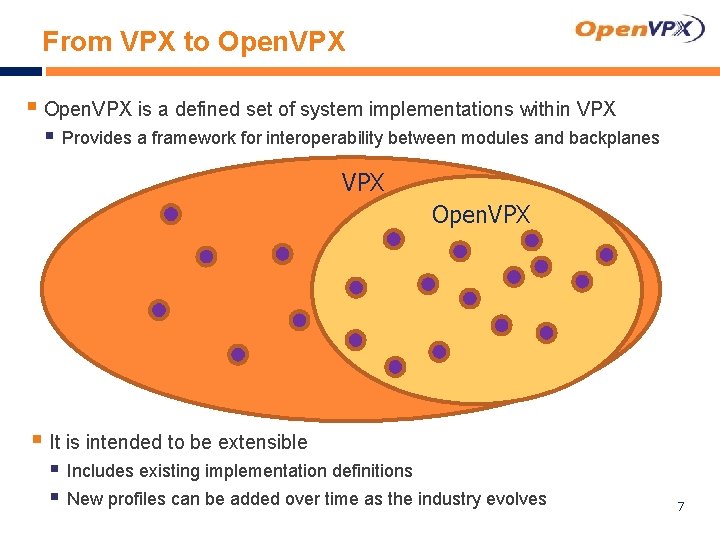
From VPX to Open. VPX § Open. VPX is a defined set of system implementations within VPX § Provides a framework for interoperability between modules and backplanes VPX Open. VPX § It is intended to be extensible § Includes existing implementation definitions § New profiles can be added over time as the industry evolves 7
Open. VPX Scope and Priorities § Specifies a set of system architectures § Not just a collection of pinout and protocol specifications § Guides system developers to choose one of a set of standard backplane and slot profiles § Uses existing standards and drafts with minimal possible changes: § VPX (VITA-46) § REDI (VITA-48) § PMC / XMC (VITA-42) § Rapidly delivers results into VITA Standards Organization § Urgency driven by critical programs needing system level VPX today § On target to contribute 1. 0 Specification to VITA 65 by October 2009 § VITA 65 to follow VSO process with goal to ratify as VITA / ANSI standard § Expect additional system profiles may be added over time as needed 8
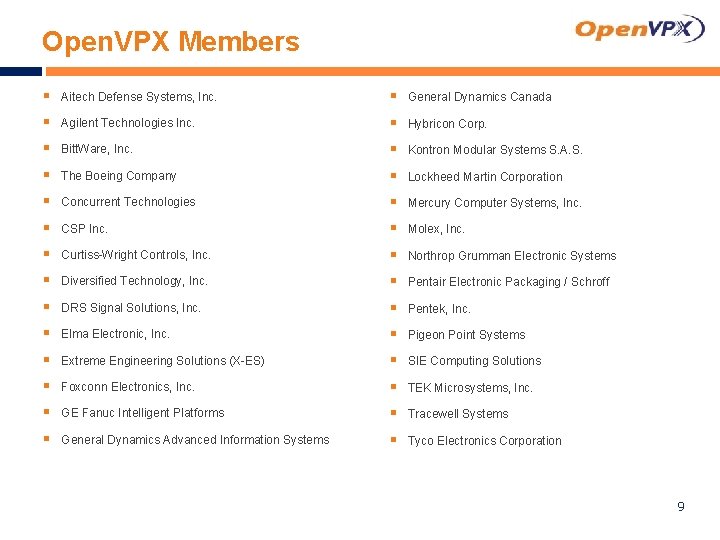
Open. VPX Members § Aitech Defense Systems, Inc. § General Dynamics Canada § Agilent Technologies Inc. § Hybricon Corp. § Bitt. Ware, Inc. § Kontron Modular Systems S. A. S. § The Boeing Company § Lockheed Martin Corporation § Concurrent Technologies § Mercury Computer Systems, Inc. § CSP Inc. § Molex, Inc. § Curtiss-Wright Controls, Inc. § Northrop Grumman Electronic Systems § Diversified Technology, Inc. § Pentair Electronic Packaging / Schroff § DRS Signal Solutions, Inc. § Pentek, Inc. § Elma Electronic, Inc. § Pigeon Point Systems § Extreme Engineering Solutions (X-ES) § SIE Computing Solutions § Foxconn Electronics, Inc. § TEK Microsystems, Inc. § GE Fanuc Intelligent Platforms § Tracewell Systems § General Dynamics Advanced Information Systems § Tyco Electronics Corporation 9
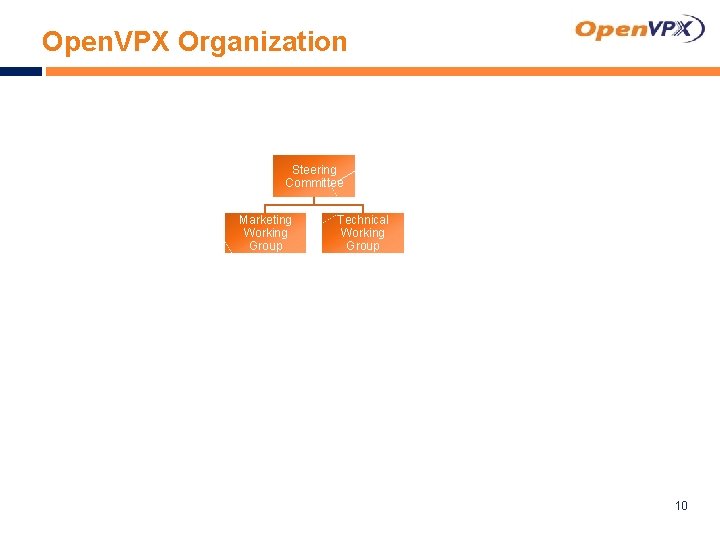
Open. VPX Organization Steering Committee Taxonomy and Terminology Utility Plane Marketing Working Group Technical Working Group Power Distribution Management (46. 11) Backplane Development Chassis Compliance 3 U 6 U 10
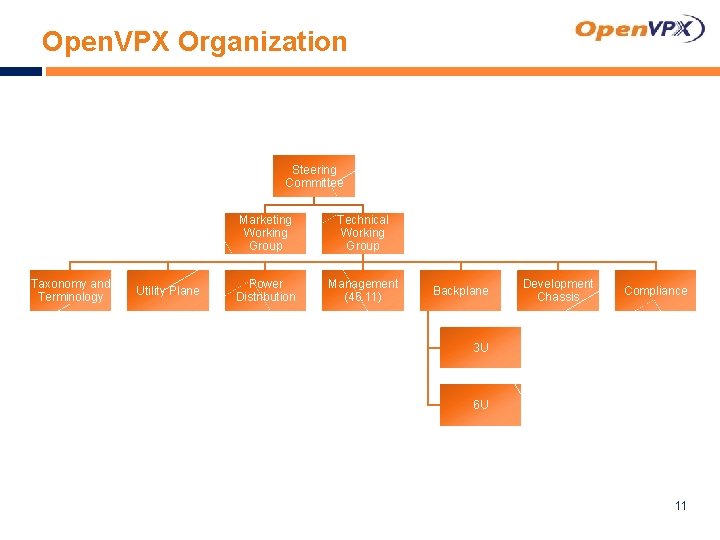
Open. VPX Organization Steering Committee Taxonomy and Terminology Utility Plane Marketing Working Group Technical Working Group Power Distribution Management (46. 11) Backplane Development Chassis Compliance 3 U 6 U 11
Open. VPX Specification § Planes § Pipes § Profiles 12
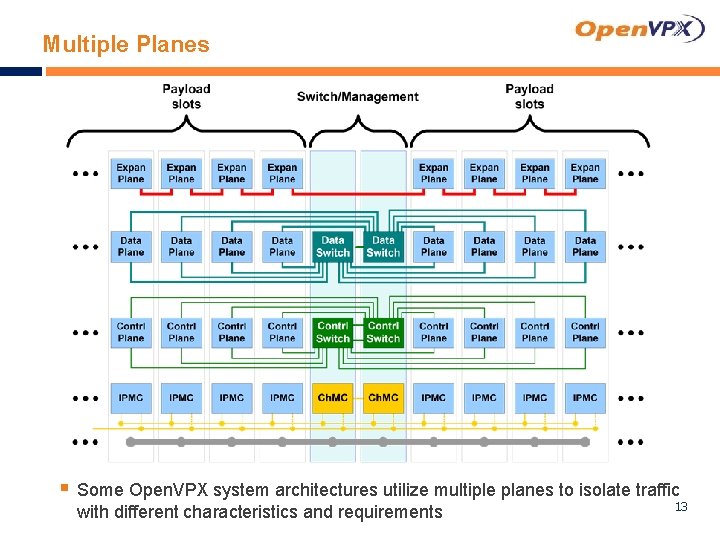
Multiple Planes § Some Open. VPX system architectures utilize multiple planes to isolate traffic with different characteristics and requirements 13
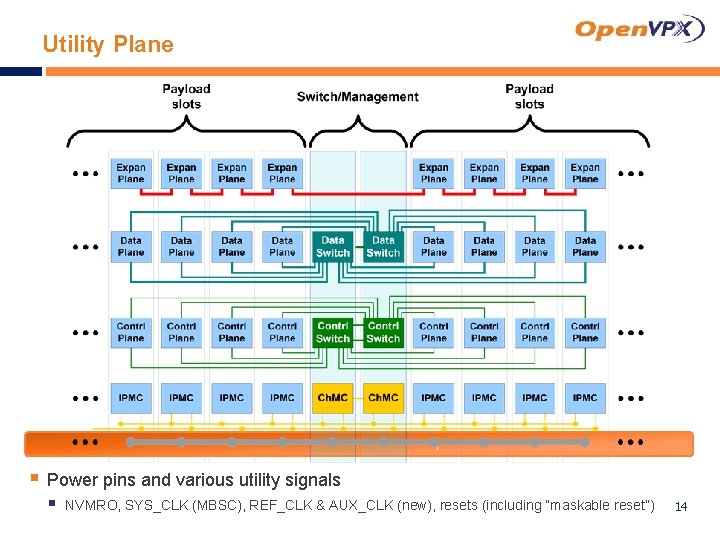
Utility Plane § Power pins and various utility signals § NVMRO, SYS_CLK (MBSC), REF_CLK & AUX_CLK (new), resets (including “maskable reset”) 14
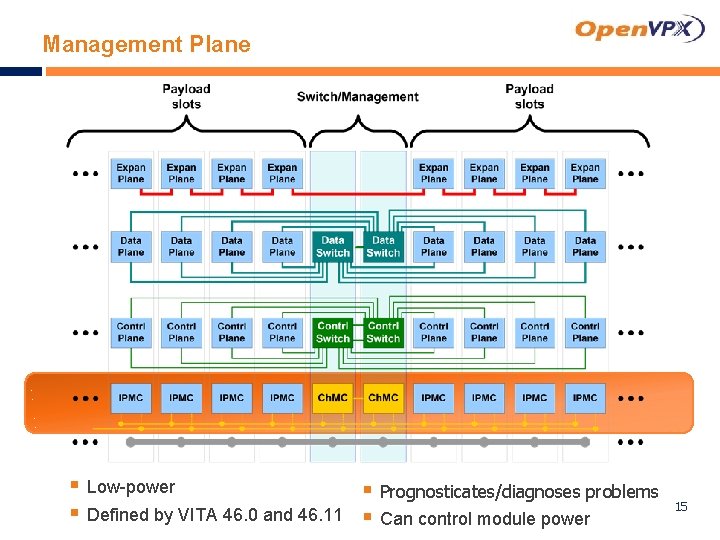
Management Plane § Low-power § Prognosticates/diagnoses problems § Defined by VITA 46. 0 and 46. 11 § Can control module power 15
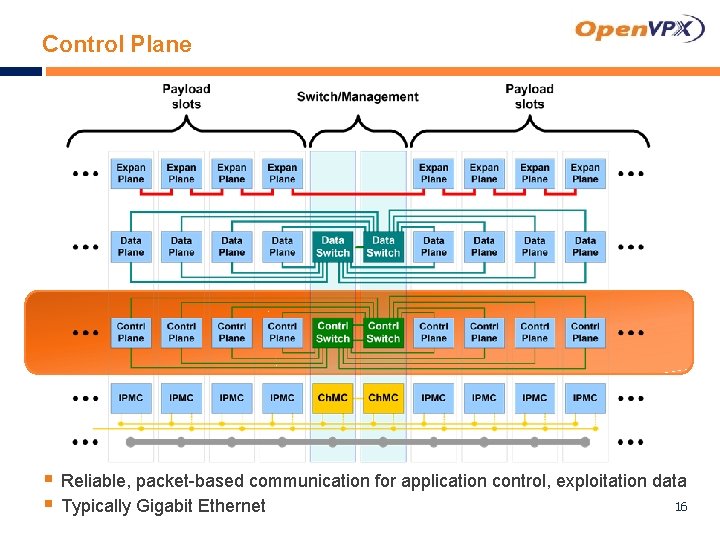
Control Plane § Reliable, packet-based communication for application control, exploitation data 16 § Typically Gigabit Ethernet
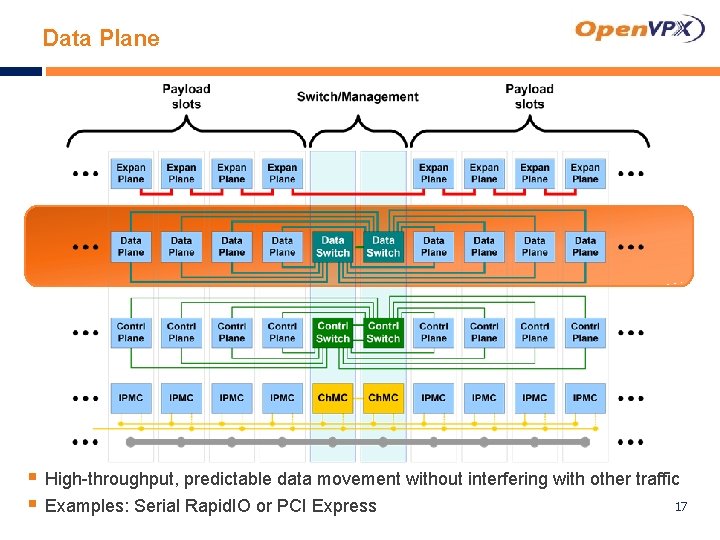
Data Plane § High-throughput, predictable data movement without interfering with other traffic 17 § Examples: Serial Rapid. IO or PCI Express
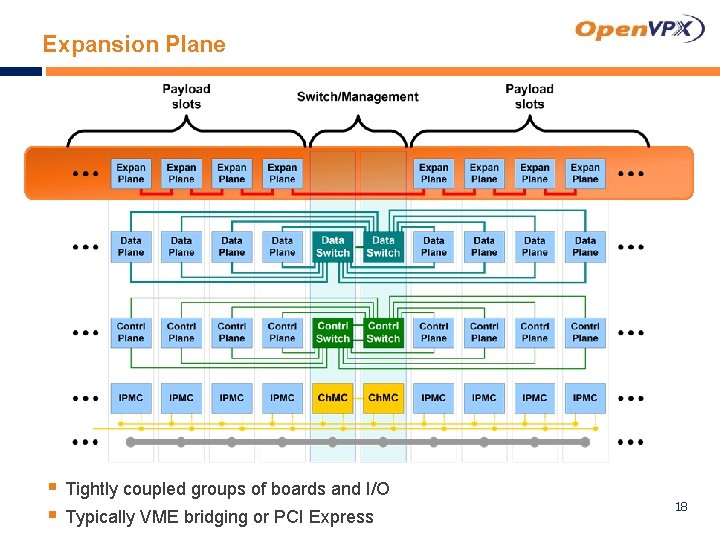
Expansion Plane § Tightly coupled groups of boards and I/O § Typically VME bridging or PCI Express 18
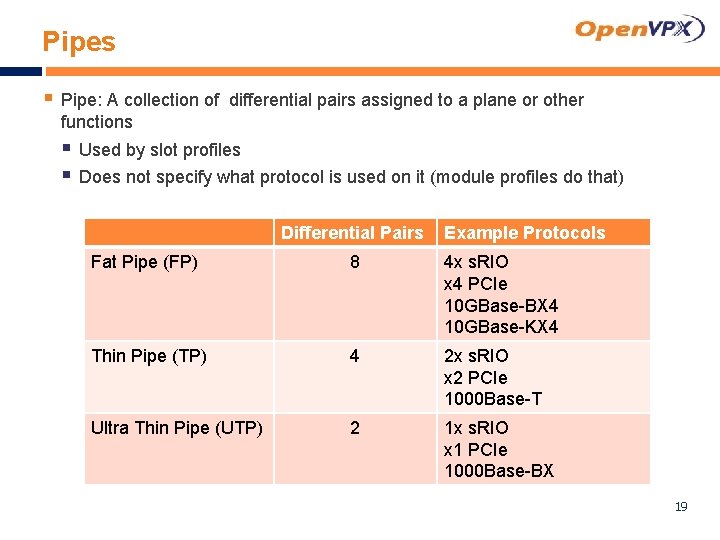
Pipes § Pipe: A collection of differential pairs assigned to a plane or other functions § Used by slot profiles § Does not specify what protocol is used on it (module profiles do that) Differential Pairs Example Protocols Fat Pipe (FP) 8 4 x s. RIO x 4 PCIe 10 GBase-BX 4 10 GBase-KX 4 Thin Pipe (TP) 4 2 x s. RIO x 2 PCIe 1000 Base-T Ultra Thin Pipe (UTP) 2 1 x s. RIO x 1 PCIe 1000 Base-BX 19
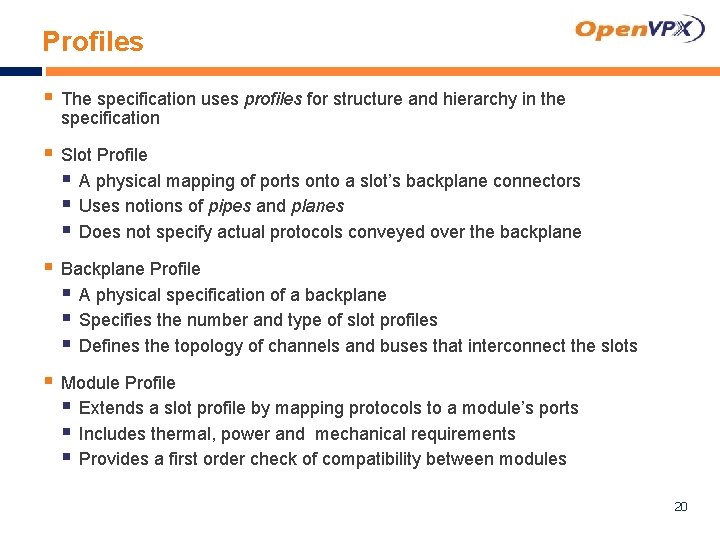
Profiles § The specification uses profiles for structure and hierarchy in the specification § Slot Profile § A physical mapping of ports onto a slot’s backplane connectors § Uses notions of pipes and planes § Does not specify actual protocols conveyed over the backplane § Backplane Profile § A physical specification of a backplane § Specifies the number and type of slot profiles § Defines the topology of channels and buses that interconnect the slots § Module Profile § Extends a slot profile by mapping protocols to a module’s ports § Includes thermal, power and mechanical requirements § Provides a first order check of compatibility between modules 20
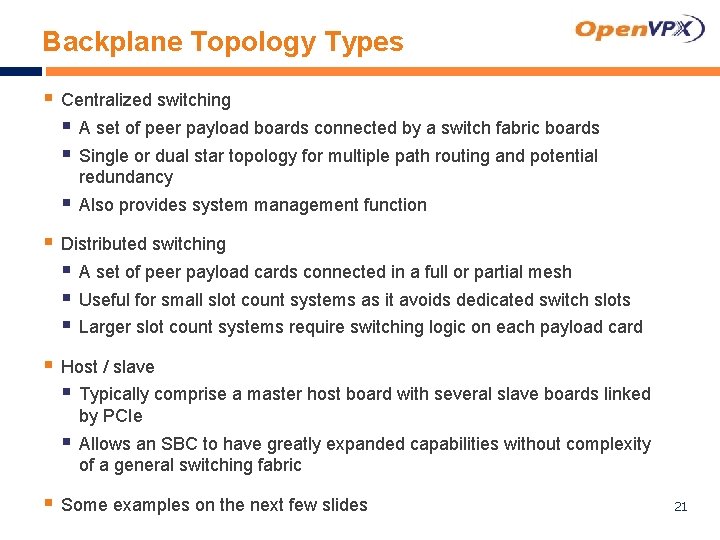
Backplane Topology Types § Centralized switching § A set of peer payload boards connected by a switch fabric boards § Single or dual star topology for multiple path routing and potential redundancy § Also provides system management function § Distributed switching § A set of peer payload cards connected in a full or partial mesh § Useful for small slot count systems as it avoids dedicated switch slots § Larger slot count systems require switching logic on each payload card § Host / slave § Typically comprise a master host board with several slave boards linked by PCIe § Allows an SBC to have greatly expanded capabilities without complexity of a general switching fabric § Some examples on the next few slides 21
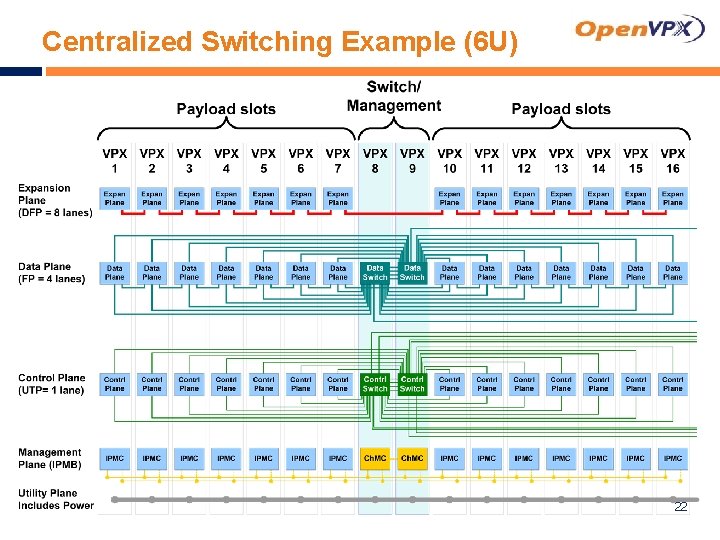
Centralized Switching Example (6 U) 22
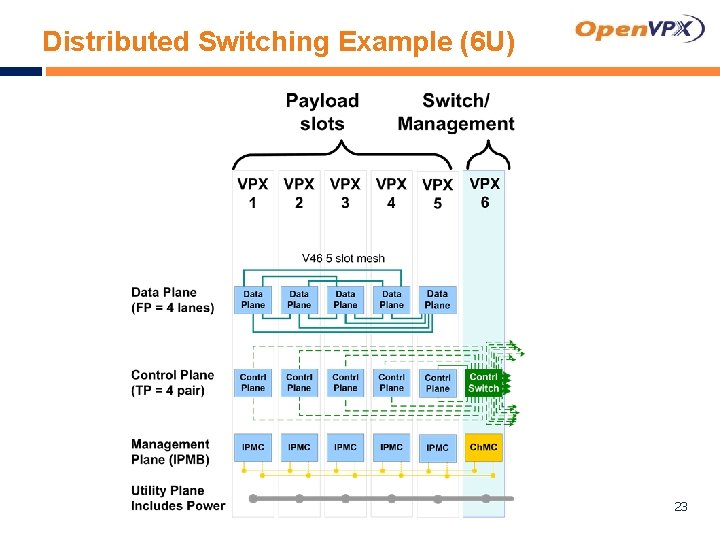
Distributed Switching Example (6 U) 23
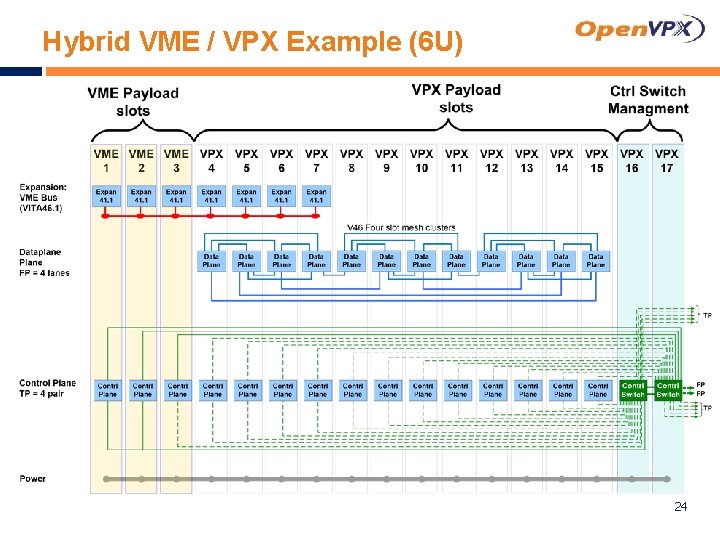
Hybrid VME / VPX Example (6 U) 24
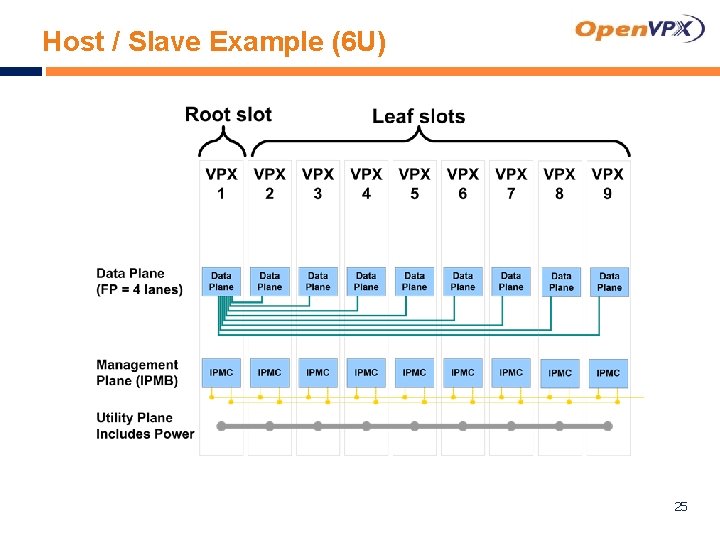
Host / Slave Example (6 U) 25
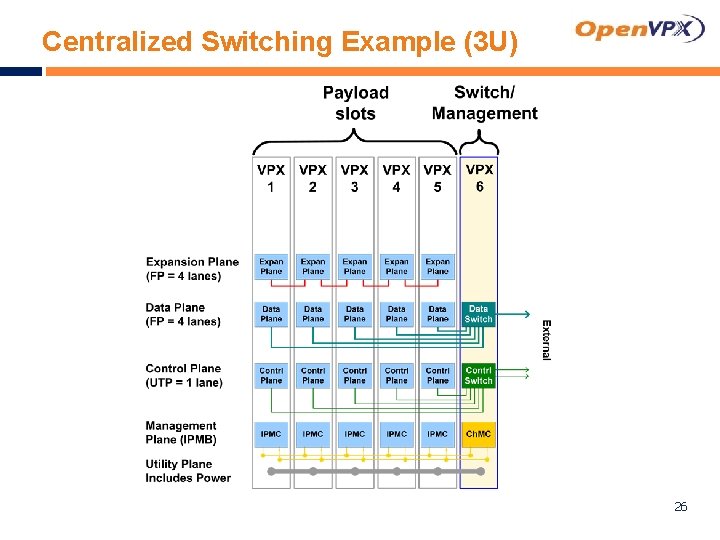
Centralized Switching Example (3 U) 26
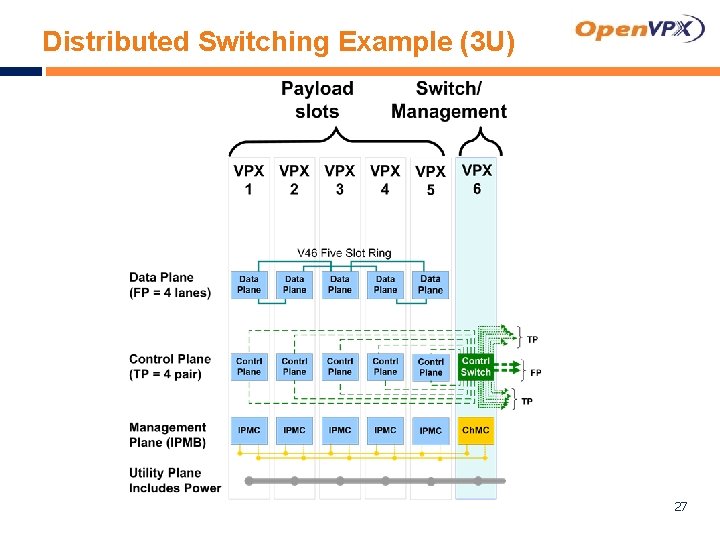
Distributed Switching Example (3 U) 27
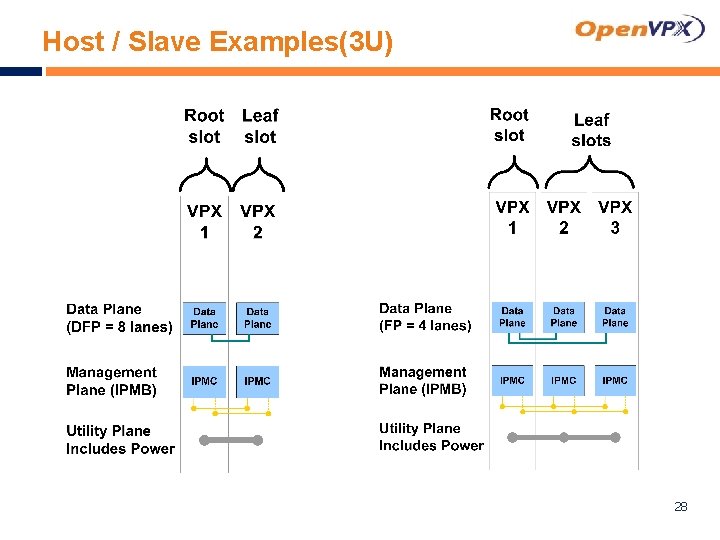
Host / Slave Examples(3 U) 28
Open. VPX Is Not Specifying Everything § User defined pins reserved in every slot profile § Provides for flexibility in handling I/O and custom board-to-board links § Historically, 6 U VME provided lots of user I/O pins on P 0 and P 2 § Limits full interoperability and interchangeability of Open. VPX compliant modules § Full plug-and-play is considered less critical than customer and vendor differentiation to meet critical application functional and SWa. P requirements § Module profiles do not fully specify interoperability above layers 1 and 2 § E. g. fabric discovery, enumeration and routing choices not fully specified § These may be specified via later standards work § Only development chassis are standardized § I/O provided via rear transition modules (RTMs) § Deployment scenarios typically use a custom backplane to deal with I/O in conduction cooled and other rugged packages 29
Typical Open. VPX Development Flow § Determine application requirements § Size, weight and power § Processing, fabric and I/O requirements 30
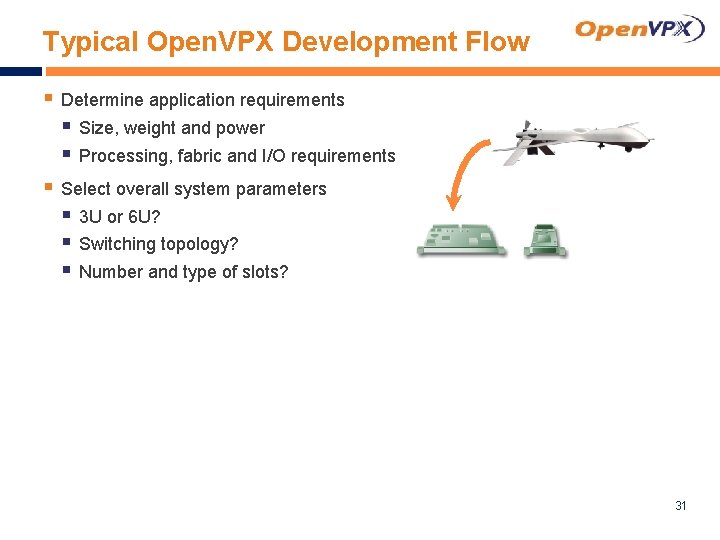
Typical Open. VPX Development Flow § Determine application requirements § Size, weight and power § Processing, fabric and I/O requirements § Select overall system parameters § 3 U or 6 U? § Switching topology? § Number and type of slots? 31
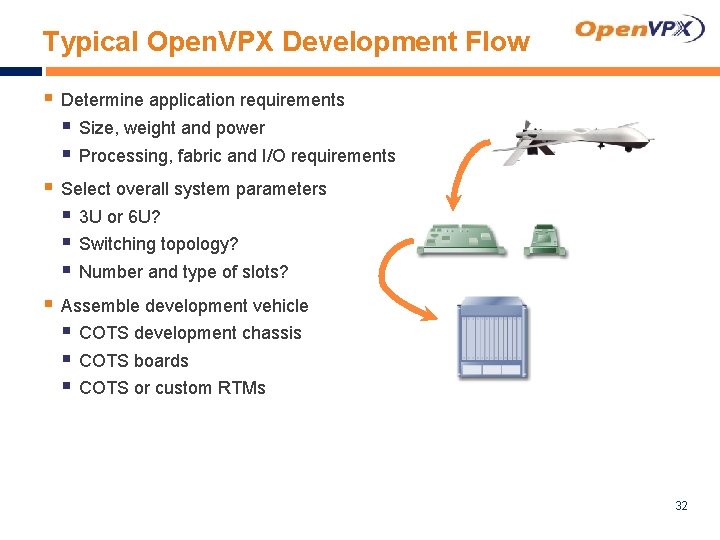
Typical Open. VPX Development Flow § Determine application requirements § Size, weight and power § Processing, fabric and I/O requirements § Select overall system parameters § 3 U or 6 U? § Switching topology? § Number and type of slots? § Assemble development vehicle § COTS development chassis § COTS boards § COTS or custom RTMs 32
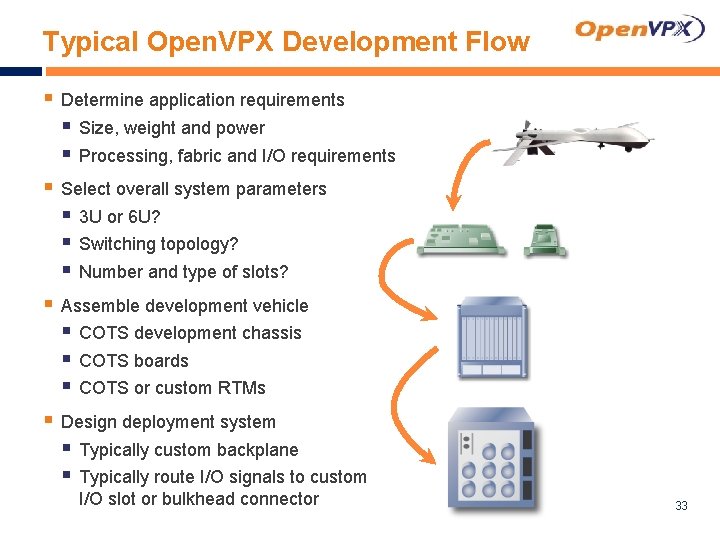
Typical Open. VPX Development Flow § Determine application requirements § Size, weight and power § Processing, fabric and I/O requirements § Select overall system parameters § 3 U or 6 U? § Switching topology? § Number and type of slots? § Assemble development vehicle § COTS development chassis § COTS boards § COTS or custom RTMs § Design deployment system § Typically custom backplane § Typically route I/O signals to custom I/O slot or bulkhead connector 33
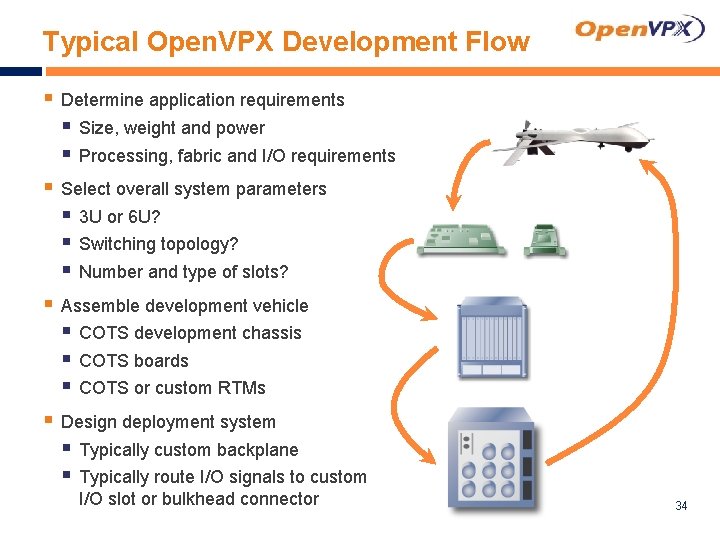
Typical Open. VPX Development Flow § Determine application requirements § Size, weight and power § Processing, fabric and I/O requirements § Select overall system parameters § 3 U or 6 U? § Switching topology? § Number and type of slots? § Assemble development vehicle § COTS development chassis § COTS boards § COTS or custom RTMs § Design deployment system § Typically custom backplane § Typically route I/O signals to custom I/O slot or bulkhead connector 34
Open. VPX Benefits § Promotes interoperability and vendor choice § Provides specific design profiles that vendors can design to and integrators can specify as requirements § Reduces integration issues resulting in faster development & deployment time § Higher board volumes Economies of scale § Industry leading bandwidth and density § Higher velocity of technology upgrades § Will support higher backplane signaling speeds as technology matures 35
Questions?
- Slides: 36