
Architecture Patterns for Building CloudNative Applications HELLO is
Architecture Patterns for Building Cloud-Native Applications HELLO is me a n y m r e d l i Bill W CT. NET User Group 09 -October-2012 (6: 15 ish-8: 00 ish) Boston Azure User Group http: //www. bostonazure. org @bostonazure Bill Wilder http: //blog. codingoutloud. com @codingoutloud
O L L HE s i e m a n y Mymname is Bill Wilder l l i B r e d l i W codingoutloud@gmail. com blog. codingoutloud. com @codingoutloud

www. cloudarchitecturepatterns. com Who is Bill Wilder? www. bostonazure. org www. devpartners. com
I will ass-u-me… 1. You know what “the cloud” is 2. You have an inkling about Amazon Web Services and Windows Azure cloud platforms 3. You understand that such cloud platforms include compute services [like hosted virtual machines (VMs), in both Iaa. S and Paa. S modes], SQL and No. SQL database services, file storage services, messaging, DNS, management, etc. 4. You are interested in understanding cloudnative applications
Roadmap for rest of talk… … 1. Give context and definition for cloud-native 2. Cover three specific patterns for building cloud-native applications 3. Mention several other patterns ? • Q&A during talk is okay (time permitting) • Q&A at end with any remaining time • Also feel free to join me for lunch to talk cloud
Cloud Platform Characteristics • Scaling – or “resource allocation” – is horizontal – and ∞ (“illusion of infinite resources”) • Resources are easily added or released – self-service portal or API; cloud scaling is automatable • Pay only for currently allocated resources – costs are operational, granular, controllable, and transparent • Optimized for cost-efficiency – cloud services are MT, hardware is commodity – MTTR over MTTF • Rich, robust functionality is simply accessible – like an iceberg

Cloud-Native Application Characteristics • Application architecture is aligned with the cloud platform architecture – uses the platform in the most natural way – lets the platform do the heavy lifting • Are loosely coupled – for scalability, reliability, and flexibility • Scale horizontally, automatically, bidirectionally – maintaining UX and cost-optimizing – scale operationally along with capacity • Handle busy signals and node failures – without unnecessary UX degradation • Use geo-distribution services – minimize network latency
Know the rules “If I had asked people what they wanted, they would have said faster horses. ” - Henry Ford
Know the rules “If I had asked IT departments what they wanted, they would have said Iaa. S. ” - Henry Cloud
Use the right tool for the job… Better on water than on land…. sorta “unreliable”when used on land.
Modern Application Challenges 1. Scaling compute 2. Scaling data 3. Scaling geographically 4. Handling failure … and all while maintaining User Experience (UX) • Example patterns we will review: a. b. c. d. Horizontal Scaling Queue-Centric Workflow Database Sharding Other patterns briefly as time permits
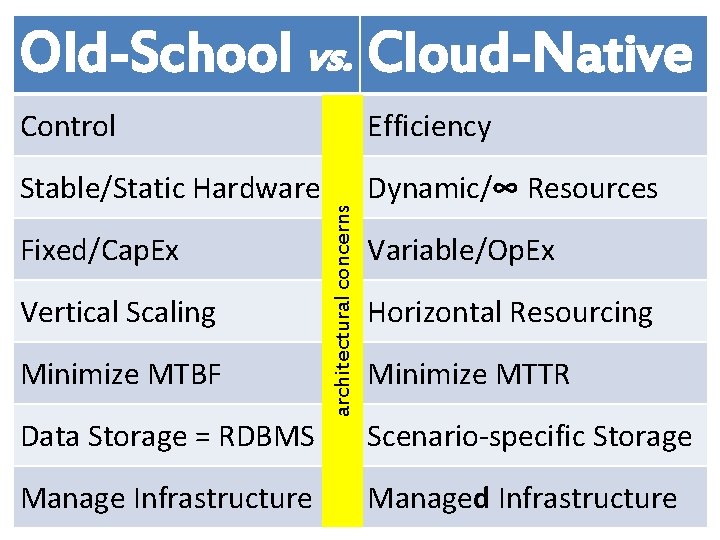
Old-School vs. Cloud-Native Control Efficiency Fixed/Cap. Ex Vertical Scaling Minimize MTBF Data Storage = RDBMS Manage Infrastructure architectural concerns Pre-Cloud Stable/Static Hardwarevs. Cloud-Native Dynamic/∞ Resources Variable/Op. Ex Horizontal Resourcing Minimize MTTR Scenario-specific Storage Managed Infrastructure
pattern 1 of 3 Horizontal Scaling Compute Pattern
? What’s the difference between performance and scale?
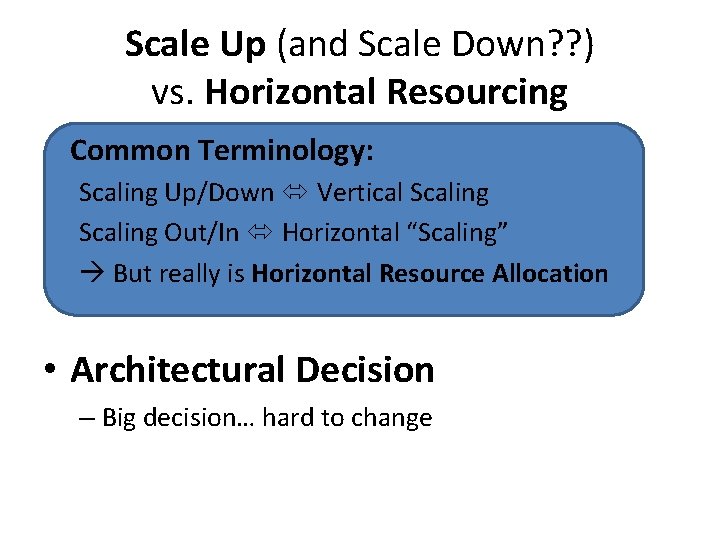
Scale Up (and Scale Down? ? ) vs. Horizontal Resourcing Common Terminology: Scaling Up/Down Vertical Scaling Out/In Horizontal “Scaling” But really is Horizontal Resource Allocation • Architectural Decision – Big decision… hard to change
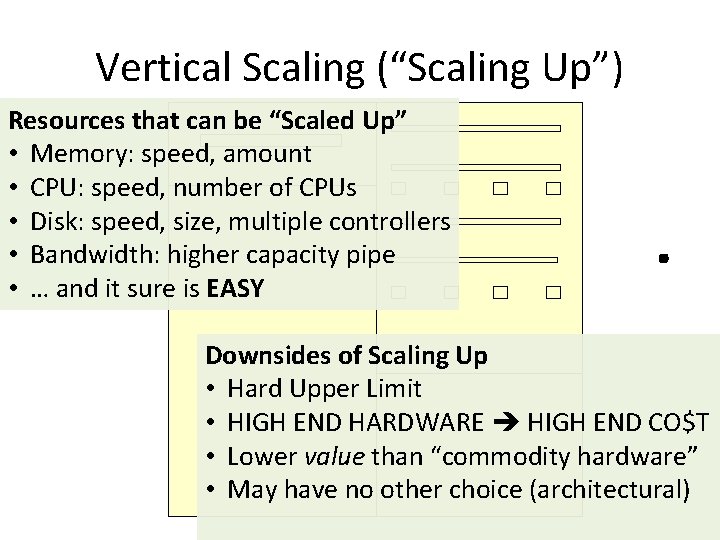
Vertical Scaling (“Scaling Up”) Resources that can be “Scaled Up” • Memory: speed, amount • CPU: speed, number of CPUs • Disk: speed, size, multiple controllers • Bandwidth: higher capacity pipe • … and it sure is EASY . Downsides of Scaling Up • Hard Upper Limit • HIGH END HARDWARE HIGH END CO$T • Lower value than “commodity hardware” • May have no other choice (architectural)
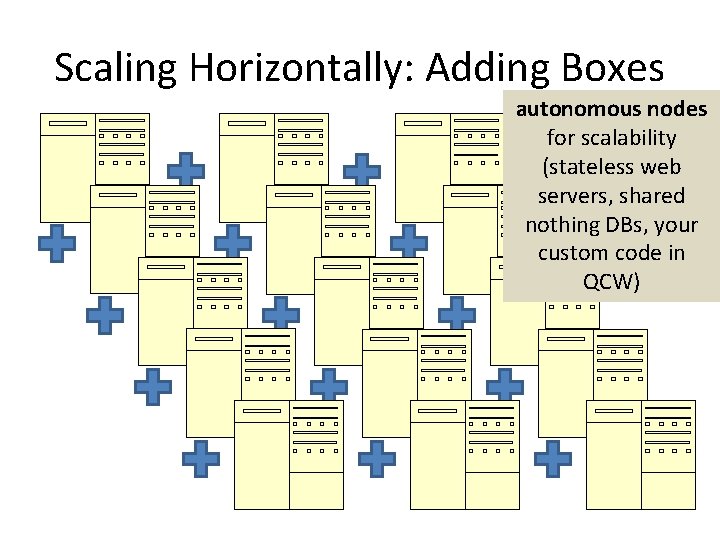
Scaling Horizontally: Adding Boxes autonomous nodes for scalability (stateless web servers, shared nothing DBs, your custom code in QCW)
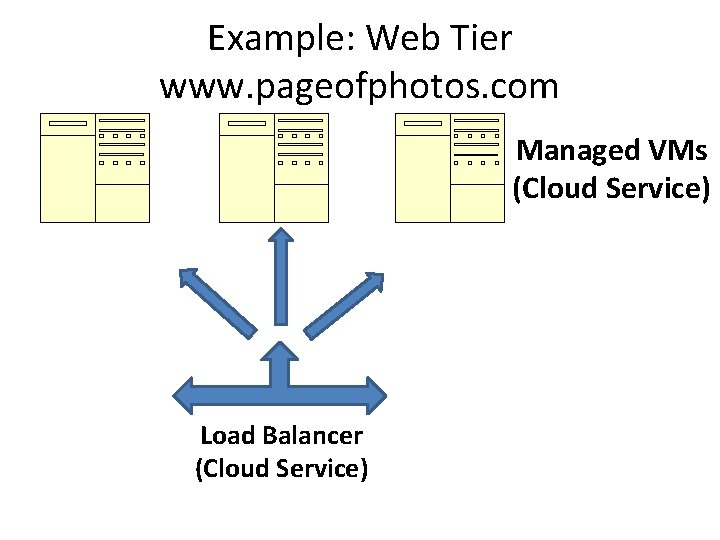
Example: Web Tier www. pageofphotos. com Managed VMs (Cloud Service) Load Balancer (Cloud Service)
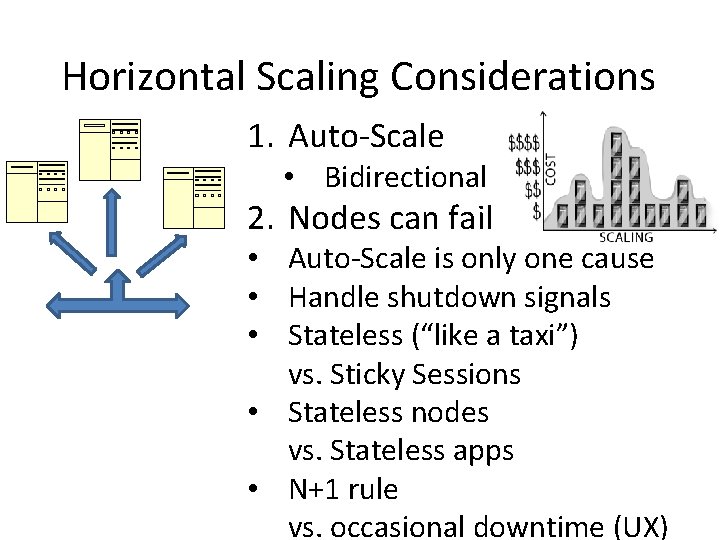
Horizontal Scaling Considerations 1. Auto-Scale • Bidirectional 2. Nodes can fail • Auto-Scale is only one cause • Handle shutdown signals • Stateless (“like a taxi”) vs. Sticky Sessions • Stateless nodes vs. Stateless apps • N+1 rule vs. occasional downtime (UX)
? How many users does your cloud-native application need before it needs to be able to horizontally scale?
pattern 2 of 3 Queue-Centric Workflow Pattern (QCW for short)
Extend www. pageofphotos. com example into next Tier • QCW enables applications where the UI and back-end services are Loosely Coupled • (Compare to CQRS at the end)
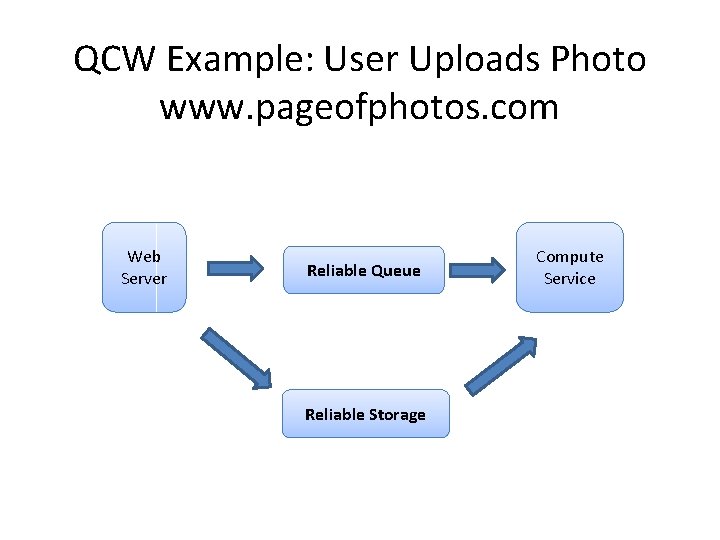
QCW Example: User Uploads Photo www. pageofphotos. com Web Server Reliable Queue Reliable Storage Compute Service
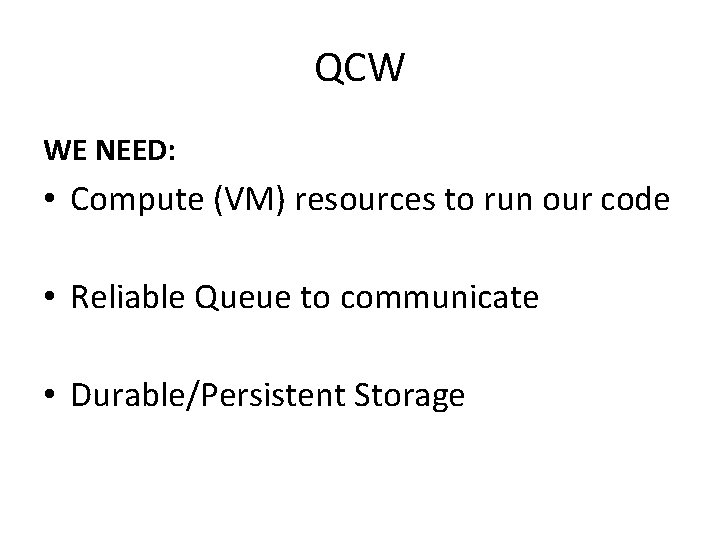
QCW WE NEED: • Compute (VM) resources to run our code • Reliable Queue to communicate • Durable/Persistent Storage
Where does Windows Azure fit?
![QCW [on Windows Azure] WE NEED: • Compute (VM) resources to run our code](http://slidetodoc.com/presentation_image_h/0ffd1b06cf024401ad97b6cb73bb73fa/image-27.jpg "QCW [on Windows Azure] WE NEED: • Compute (VM) resources to run our code")
QCW [on Windows Azure] WE NEED: • Compute (VM) resources to run our code üWeb Roles (IIS) and Worker Roles (w/o IIS) • Reliable Queue to communicate üAzure Storage Queues • Durable/Persistent Storage üAzure Storage Blobs & Tables; WASD
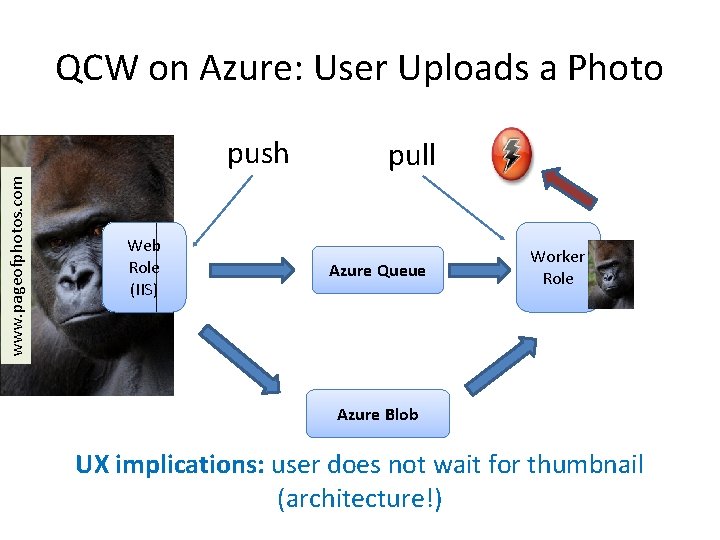
QCW on Azure: User Uploads a Photo www. pageofphotos. com push Web Role (IIS) pull Azure Queue Worker Role Azure Blob UX implications: user does not wait for thumbnail (architecture!)
QCW enables Responsive UX • Response to interactive users is as fast as a work request can be persisted • Time consuming work done asynchronously • Comparable total resource consumption, arguably better subjective UX • UX challenge – how to express Async to users? – Communicate Progress – Display Final results – Long Polling/Web Sockets (e. g. , Signal. R or Node. io)
QCW enables Scalable App • Decoupled front/back provides insulation – Blocking is Bane of Scalability – Order processing partner doing maintenance – Twitter down – Email server unreachable – Internet connectivity interruption • Loosely coupled, concern-independent scaling – (see next slide) – Get Scale Units right
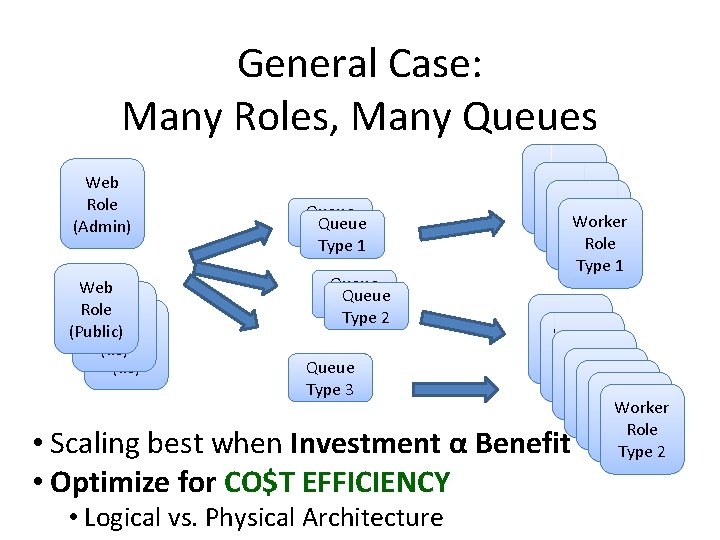
General Case: Many Roles, Many Queues Web Role (Admin) Web Role (Public) Role (IIS) Queue Type 1 Queue Type 2 Queue Type 3 Worker Role Type 1 Worker Role Worker Role Worker Type. Role 2 Type 2 • Scaling best when Investment α Benefit • Optimize for CO$T EFFICIENCY • Logical vs. Physical Architecture
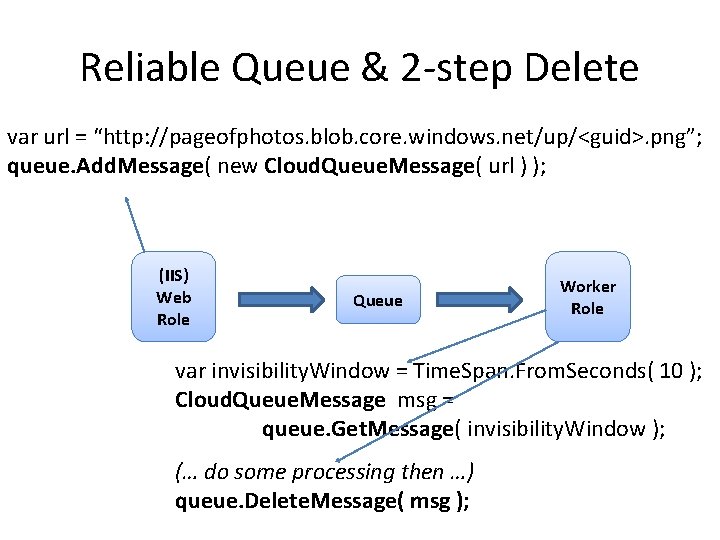
Reliable Queue & 2 -step Delete var url = “http: //pageofphotos. blob. core. windows. net/up/<guid>. png”; queue. Add. Message( new Cloud. Queue. Message( url ) ); (IIS) Web Role Queue Worker Role var invisibility. Window = Time. Span. From. Seconds( 10 ); Cloud. Queue. Message msg = queue. Get. Message( invisibility. Window ); (… do some processing then …) queue. Delete. Message( msg );
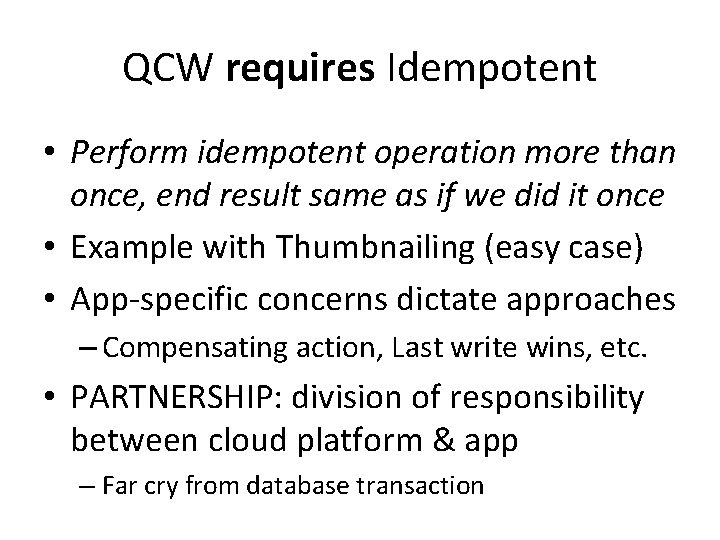
QCW requires Idempotent • Perform idempotent operation more than once, end result same as if we did it once • Example with Thumbnailing (easy case) • App-specific concerns dictate approaches – Compensating action, Last write wins, etc. • PARTNERSHIP: division of responsibility between cloud platform & app – Far cry from database transaction
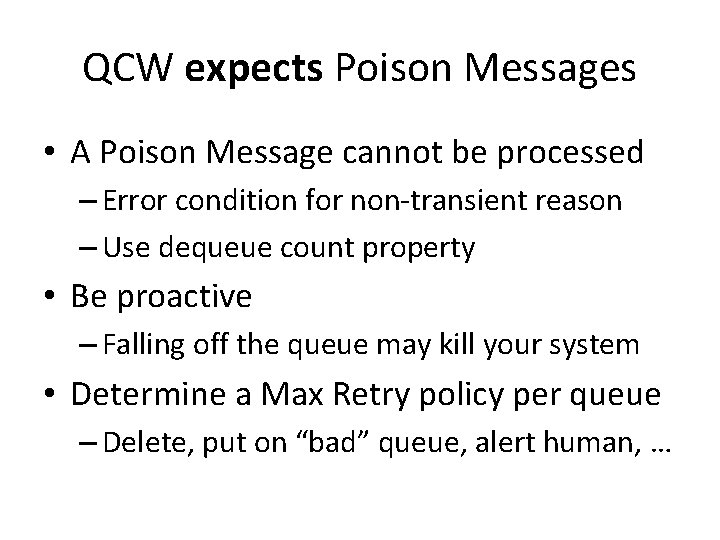
QCW expects Poison Messages • A Poison Message cannot be processed – Error condition for non-transient reason – Use dequeue count property • Be proactive – Falling off the queue may kill your system • Determine a Max Retry policy per queue – Delete, put on “bad” queue, alert human, …
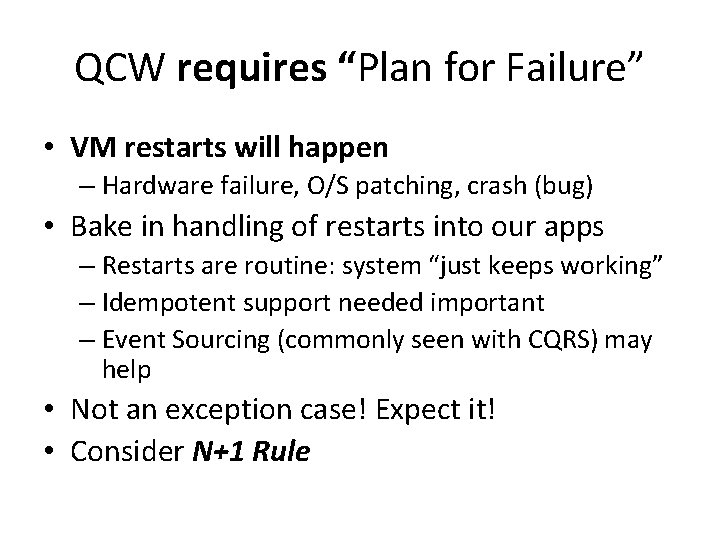
QCW requires “Plan for Failure” • VM restarts will happen – Hardware failure, O/S patching, crash (bug) • Bake in handling of restarts into our apps – Restarts are routine: system “just keeps working” – Idempotent support needed important – Event Sourcing (commonly seen with CQRS) may help • Not an exception case! Expect it! • Consider N+1 Rule
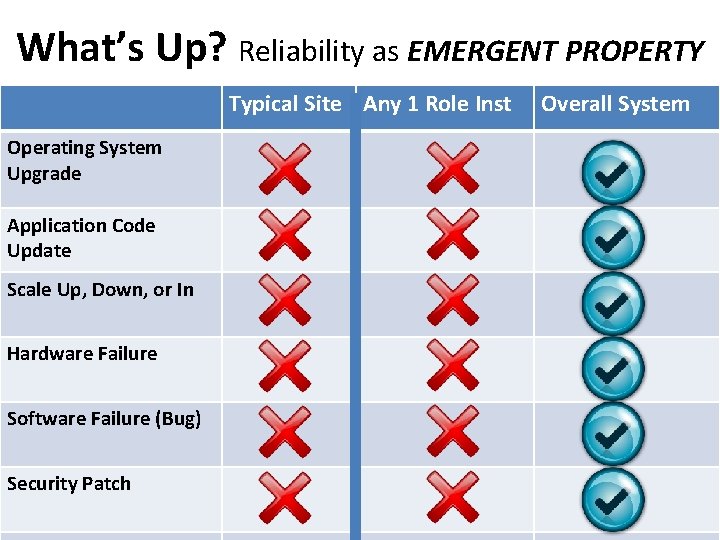
What’s Up? Reliability as EMERGENT PROPERTY Typical Site Any 1 Role Inst Operating System Upgrade Application Code Update Scale Up, Down, or In Hardware Failure Software Failure (Bug) Security Patch Overall System
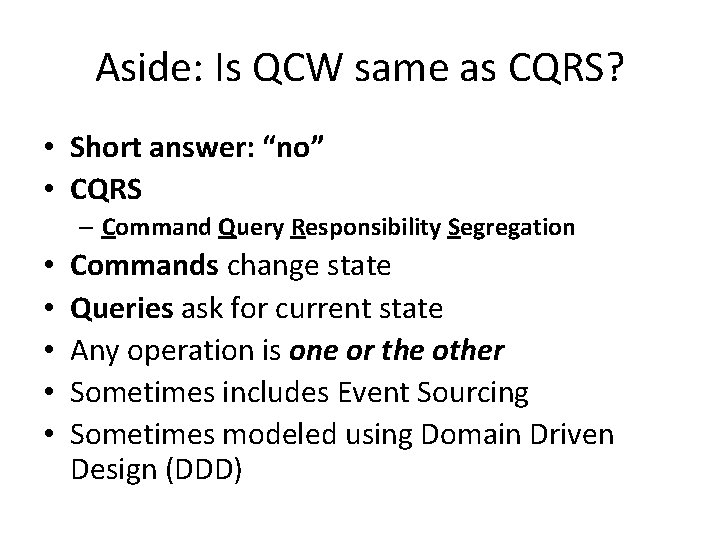
Aside: Is QCW same as CQRS? • Short answer: “no” • CQRS – Command Query Responsibility Segregation • • • Commands change state Queries ask for current state Any operation is one or the other Sometimes includes Event Sourcing Sometimes modeled using Domain Driven Design (DDD)
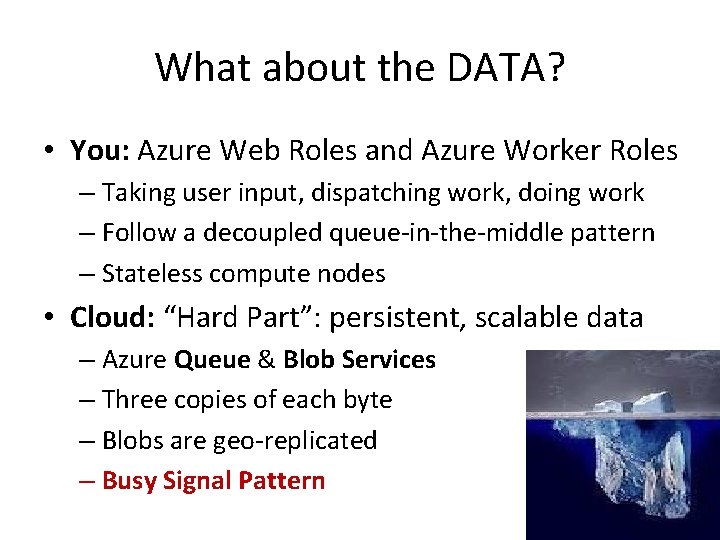
What about the DATA? • You: Azure Web Roles and Azure Worker Roles – Taking user input, dispatching work, doing work – Follow a decoupled queue-in-the-middle pattern – Stateless compute nodes • Cloud: “Hard Part”: persistent, scalable data – Azure Queue & Blob Services – Three copies of each byte – Blobs are geo-replicated – Busy Signal Pattern
pattern 3 of 3 Database Sharding Pattern
Foursquare is a Social Network
Foursquare #Fail • October 4, 2010 – trouble begins… • After 17 hours of downtime over two days… “Oct. 5 10: 28 p. m. : Running on pizza and Red Bull. Another long night. ” WHAT WENT WRONG?
What is Sharding? • Problem: one database can’t handle all the data – Too big, not performant, needs geo distribution, … • Solution: split data across multiple databases – One Logical Database, multiple Physical Databases • Each Physical Database Node is a Shard • Most scalable is Shared Nothing design – May require some denormalization (duplication)
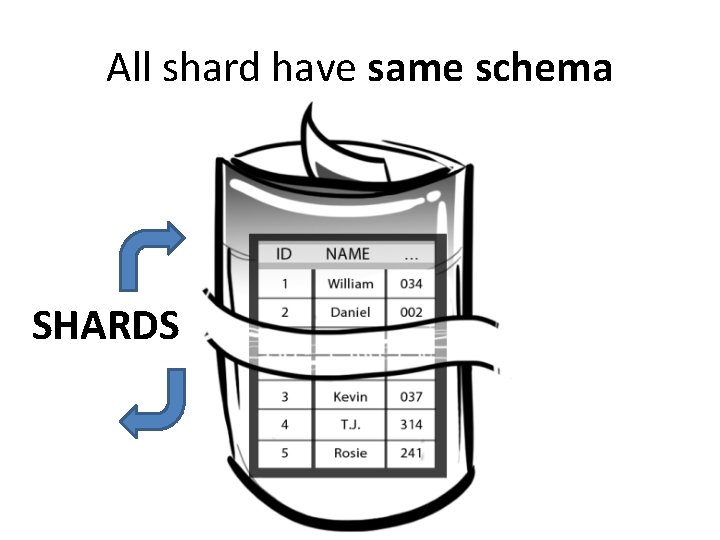
All shard have same schema SHARDS
Sharding is Difficult • What defines a shard? (Where to put stuff? ) – Example – use country of origin: customer_us, customer_fr, customer_cn, customer_ie, … – Use same approach to find records (can use lookup) • What happens if a shard gets too big? – Rebalancing shards can get complex (esp roll-your-own) – Foursquare case study is interesting • Query / join / transact across shards • Cache coherence, connection pool management – Roll-your-own challenge
Where does Windows Azure fit?
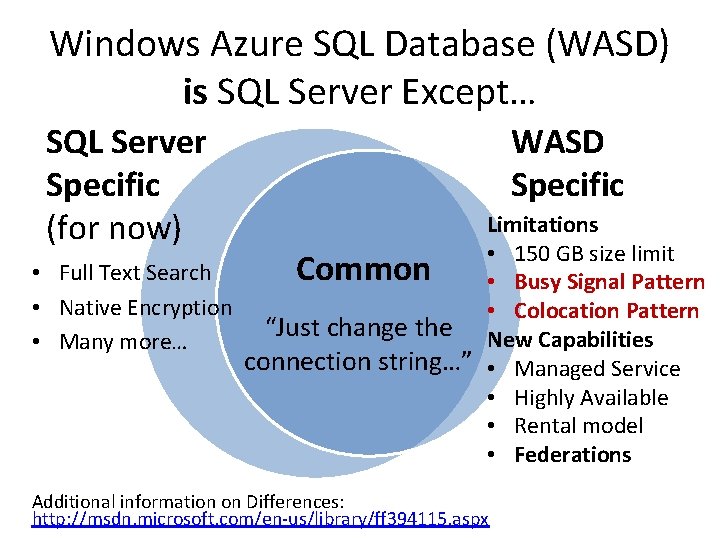
Windows Azure SQL Database (WASD) is SQL Server Except… SQL Server Specific (for now) WASD Specific Limitations • 150 GB size limit • Full Text Search Common • Busy Signal Pattern • Native Encryption • Colocation Pattern “Just change the New Capabilities • Many more… connection string…” • Managed Service • Highly Available • Rental model • Federations Additional information on Differences: http: //msdn. microsoft. com/en-us/library/ff 394115. aspx
Windows Azure SQL Databse Federations for Sharding • Single “master” database – “Query Fanout” makes partitions transparent – Instead of customer_us, customer_fr, etc… we are back to customer database • • Handles redistributing shards Handles cache coherence Simplifies connection pooling No MERGE, only SPLIT currently • http: //blogs. msdn. com/b/cbiyikoglu/archive/2011/01/18/sql-azurefederations-robust-connectivity-model-for-federated-data. aspx
Foursquare #Fail Foursquare was implementing database sharding in the application layer. WASD Federations makes this unnecessary. WHAT WENT WRONG?
? My database instance is limited to 150 GB. ∞∞∞ Does that mean the cloud doesn’t really offer the illusion of infinite resources?
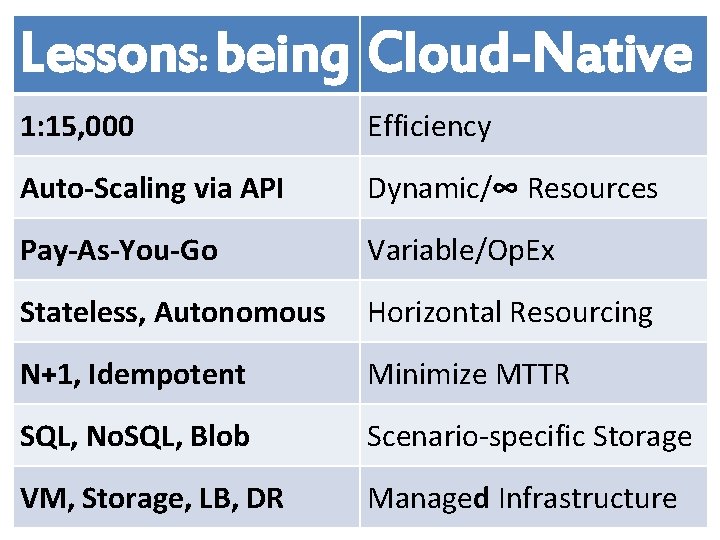
Lessons: being Cloud-Native 1: 15, 000 Pre-Cloud Auto-Scaling via API Efficiency vs. Cloud-Native Dynamic/∞ Resources Pay-As-You-Go Variable/Op. Ex Stateless, Autonomous Horizontal Resourcing N+1, Idempotent Minimize MTTR SQL, No. SQL, Blob Scenario-specific Storage VM, Storage, LB, DR Managed Infrastructure
Know the rules “Know the rules well, so you can break them effectively. ” - Dalai Lama XIV
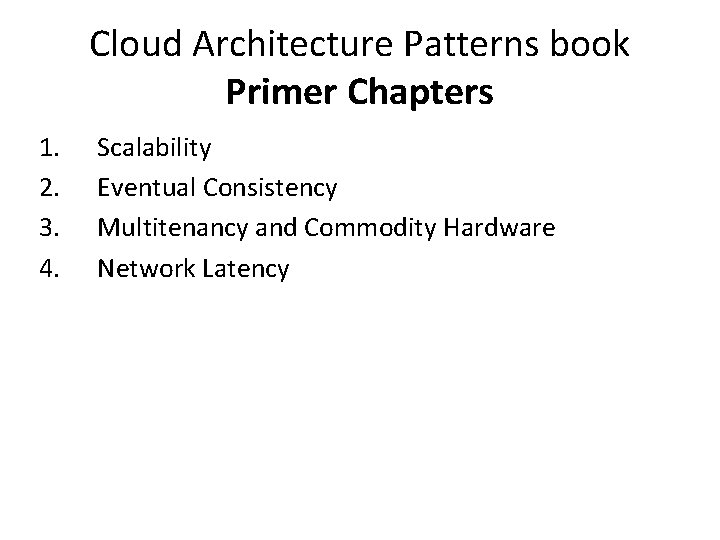
Cloud Architecture Patterns book Primer Chapters 1. 2. 3. 4. Scalability Eventual Consistency Multitenancy and Commodity Hardware Network Latency
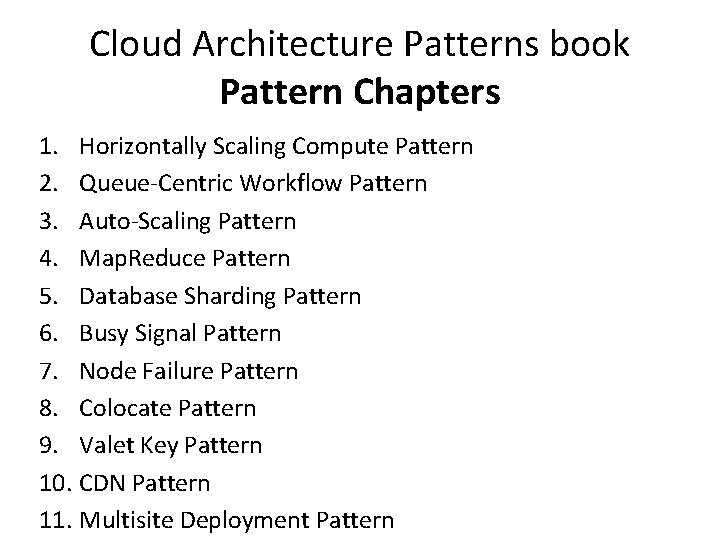
Cloud Architecture Patterns book Pattern Chapters 1. Horizontally Scaling Compute Pattern 2. Queue-Centric Workflow Pattern 3. Auto-Scaling Pattern 4. Map. Reduce Pattern 5. Database Sharding Pattern 6. Busy Signal Pattern 7. Node Failure Pattern 8. Colocate Pattern 9. Valet Key Pattern 10. CDN Pattern 11. Multisite Deployment Pattern
? Questions? Comments? More information?
Boston. Azure. org • Boston Azure cloud user group • Focused on Microsoft’s Paa. S cloud platform • Monthly, 6: 00 -8: 30 PM in Boston area – Food; wifi; free; great topics; growing community • Follow on Twitter: @bostonazure • More info or to join our Meetup. com group: http: //www. bostonazure. org
Contact Me Looking for … • consulting help with Windows Azure Platform? • someone to bounce Azure or cloud questions off? • a speaker for your user group or company technology event? Just Ask! Bill Wilder @codingoutloud http: //blog. codingoutloud. community inquiries: codingoutloud@gmail. com business inquiries: www. devpartners. com


DONE

- Slides: 59