
Architecture of Software Systems Lecture 4 Design Patterns
![New Observable for String items Observable<String> source = Observable. from(new String[]{"1", "2", "3", "4",](https://slidetodoc.com/presentation_image/3f571d655f2bfe732ef1038c12baf6f0/image-41.jpg "New Observable for String items Observable<String> source = Observable. from(new String[]{\"1\", \"2\", \"3\", \"4\",")
- Slides: 55
Architecture of Software Systems – Lecture 4 Design Patterns for Distributed Systems Martin Rehák
Overview • Selected Design & Architectural patterns for Distributed/Multiplatform computing • Content based on: – Douglas C. Schmidt, Pattern Oriented Software Engineering – Gang of Four: Gamma, Helm, Johnson, Vlissides; Design Patterns: Elements of Reusable Object. Oriented Software – (Guerraoui/Rodrigues: Introduction to Reliable Distributed Programming) –…
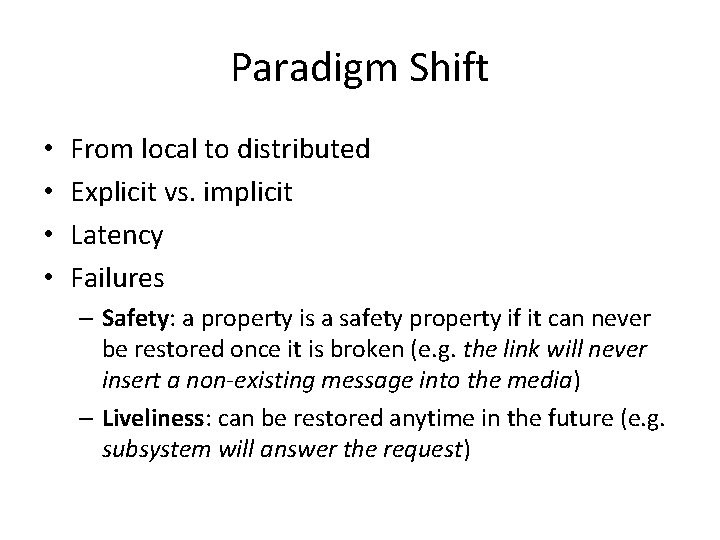
Paradigm Shift • • From local to distributed Explicit vs. implicit Latency Failures – Safety: a property is a safety property if it can never be restored once it is broken (e. g. the link will never insert a non-existing message into the media) – Liveliness: can be restored anytime in the future (e. g. subsystem will answer the request)
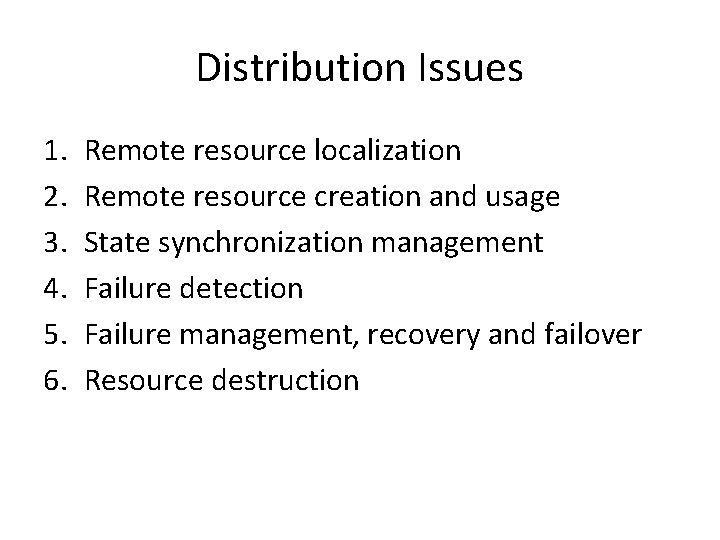
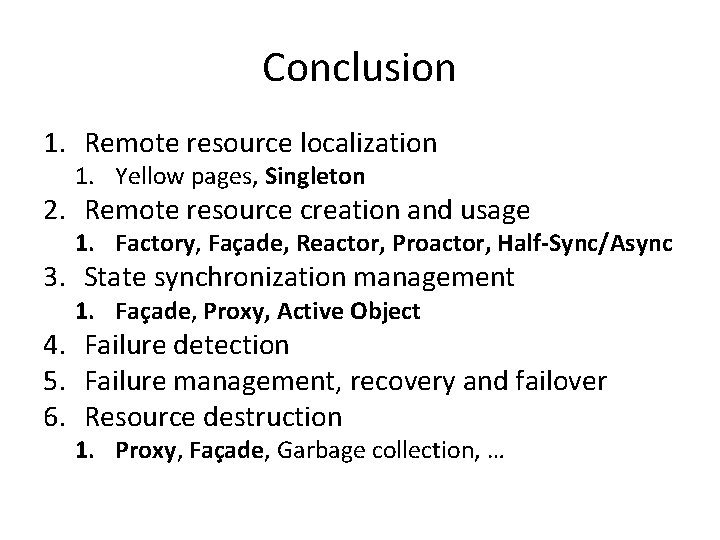
Distribution Issues 1. 2. 3. 4. 5. 6. Remote resource localization Remote resource creation and usage State synchronization management Failure detection Failure management, recovery and failover Resource destruction
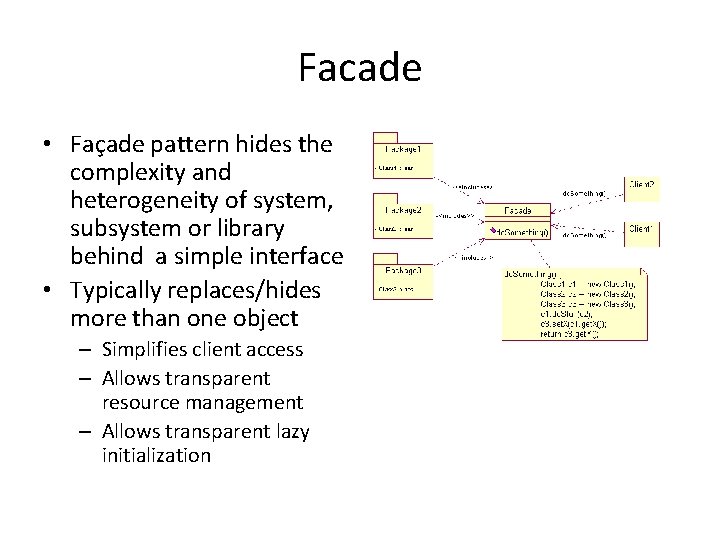
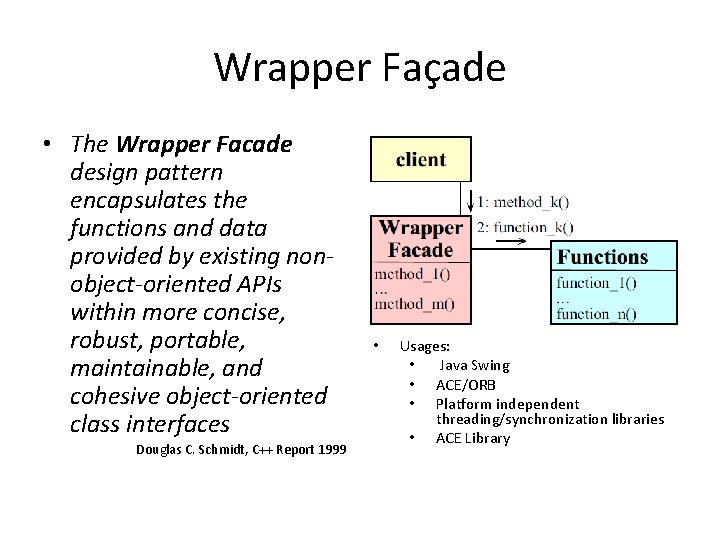
Facade • Façade pattern hides the complexity and heterogeneity of system, subsystem or library behind a simple interface • Typically replaces/hides more than one object – Simplifies client access – Allows transparent resource management – Allows transparent lazy initialization
Facade vs. Interface • Interface (in Java sense) is far more restricted than Façade • Only defines a contract between the library/implementing class and its user – programmer • Façade pattern allows active handling of more complex issues than actual business logic – Most of the code in distributed applications is NOT directly related to business logic
(Wrapper) Façade Example: JDBC • Java Database Connectivity provides a unified API for most database work in Java • Unified methods and constants • Uses the Adapter pattern to incorporate thirdparty DBMS drivers • Successfully hides most of the connection complexity/decisions from the Application Developer
Adapter/Wrapper • The Adapter pattern provides mapping between two (isofunctional) interfaces • Ensures syntactic and semantic compatibility of calls
Wrapper Façade • The Wrapper Facade design pattern encapsulates the functions and data provided by existing nonobject-oriented APIs within more concise, robust, portable, maintainable, and cohesive object-oriented class interfaces Douglas C. Schmidt, C++ Report 1999 • Usages: • Java Swing • ACE/ORB • Platform independent threading/synchronization libraries • ACE Library
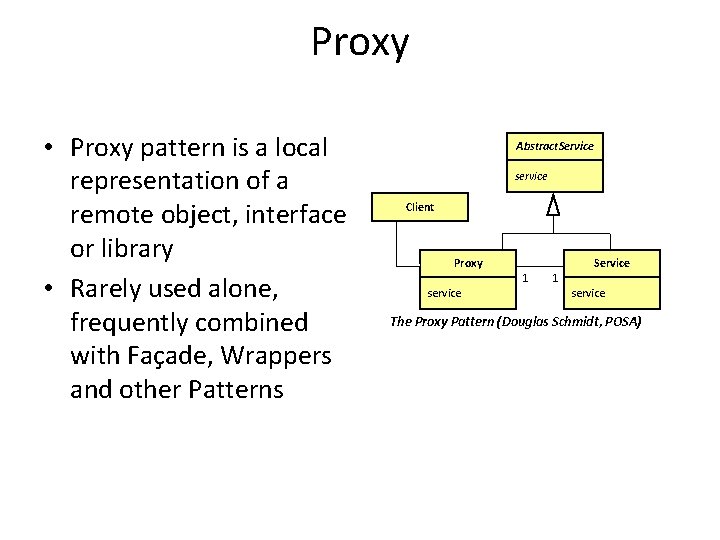
Proxy • Proxy pattern is a local representation of a remote object, interface or library • Rarely used alone, frequently combined with Façade, Wrappers and other Patterns Abstract. Service service Client Proxy service 1 1 Service service The Proxy Pattern (Douglas Schmidt, POSA)
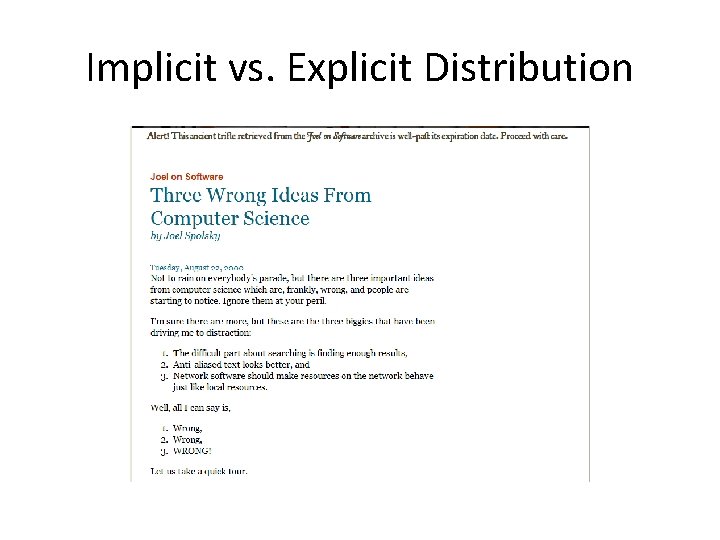
Implicit vs. Explicit Distribution
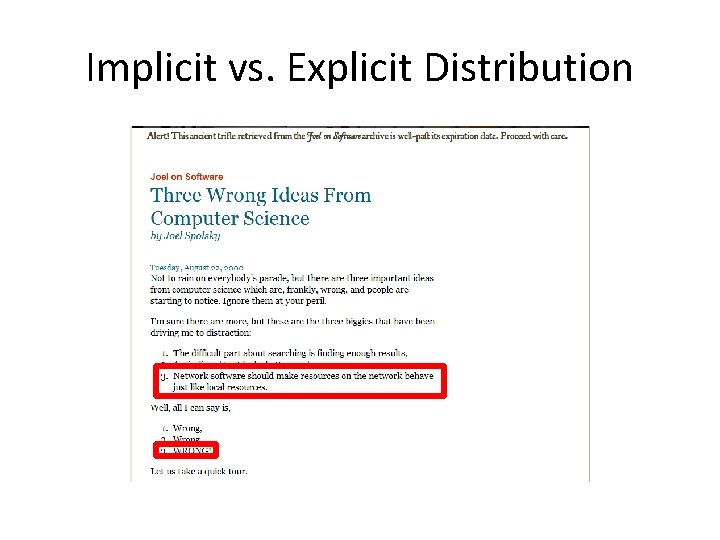
Implicit vs. Explicit Distribution
Failure Propagation (1) • An example of (easy) failure in a distributed system – why distribution matters • Two components: • (A) Thermometer, with HTTP REST API, returns temperature as string • (B) Client, using thermometer to measure swimming pool temperature What could go wrong?
Failure Propagation (2) • Thermometer breaks down and system generates random noise. • In case of thermometer failure, some pools got to boil…
Failure Propagation (3) • Thermometer breaks down and system generates random noise. • In case of thermometer failure, some pools got to boil… • Solution: Use -1 in the reply as a failure indicator, as text handling is unsupported in pool controllers
Failure Propagation (4) • BUT: Thermometers are also used in Europe (on ski slopes), with Celsius scale instead of Fahrenheit • -1 is completely plausible value and leads to shutdown of snow canons for ski resort customers
Stateful vs. Stateless design • State consistency and resource management are the points where most abstractions break in real life: – CORBA – COM/DCOM/OLE • Alternative approaches make the distribution EXPLICIT and incorporate it into the design from the beginning – Messaging – HTTP-based architectures/APIs
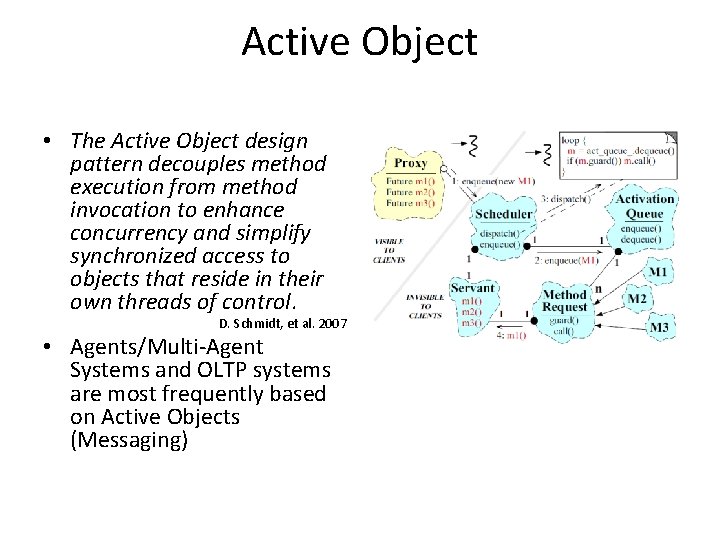
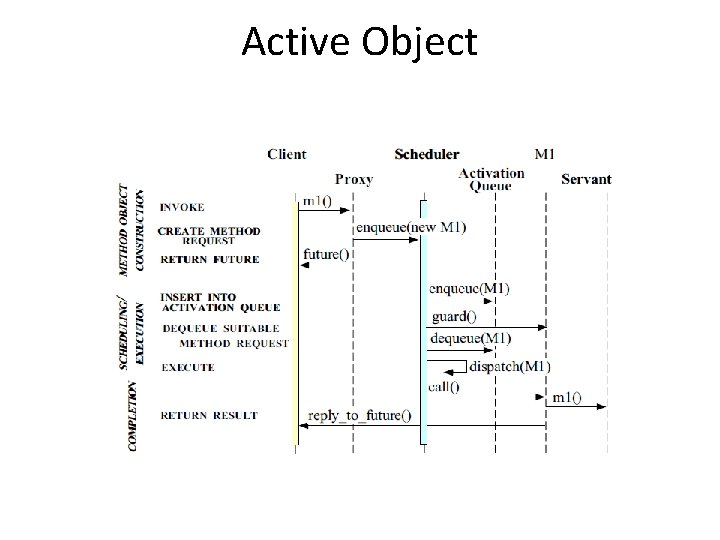
Active Object • The Active Object design pattern decouples method execution from method invocation to enhance concurrency and simplify synchronized access to objects that reside in their own threads of control. D. Schmidt, et al. 2007 • Agents/Multi-Agent Systems and OLTP systems are most frequently based on Active Objects (Messaging)
Active Object
What is the downside of AO? • Asynchronous operation handling is pushed to client • Scalability and efficiency. • Active Object is based on the assumption that the task performed by the object has a uniform resource consumption. • This assumption is almost never true, especially in case of web servers or other IO-heavy systems. • Hence the motivation for Reactor and Proactor. • Reactor and Proactor provide transparent sync-async transition and efficient resource allocation.
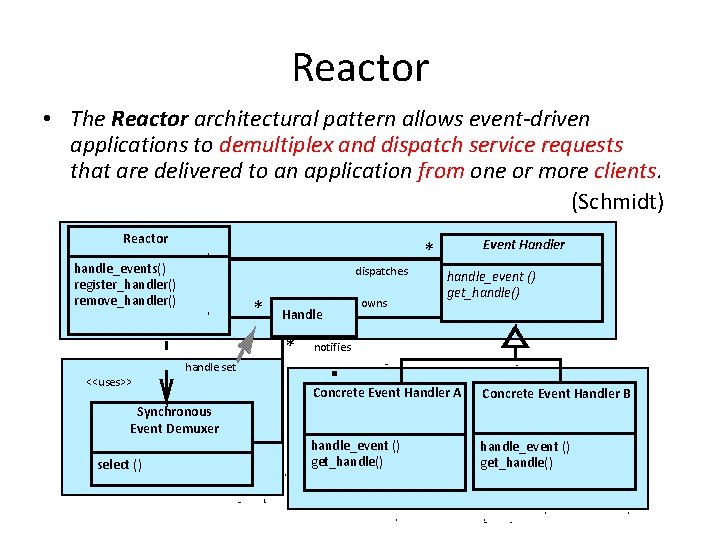
Reactor • The Reactor architectural pattern allows event-driven applications to demultiplex and dispatch service requests that are delivered to an application from one or more clients. (Schmidt) Reactor handle_events() register_handler() remove_handler() dispatches * Handle * <<uses>> Event Handler * owns handle_event () get_handle() notifies handle set Concrete Event Handler A Concrete Event Handler B handle_event () get_handle() Synchronous Event Demuxer select ()
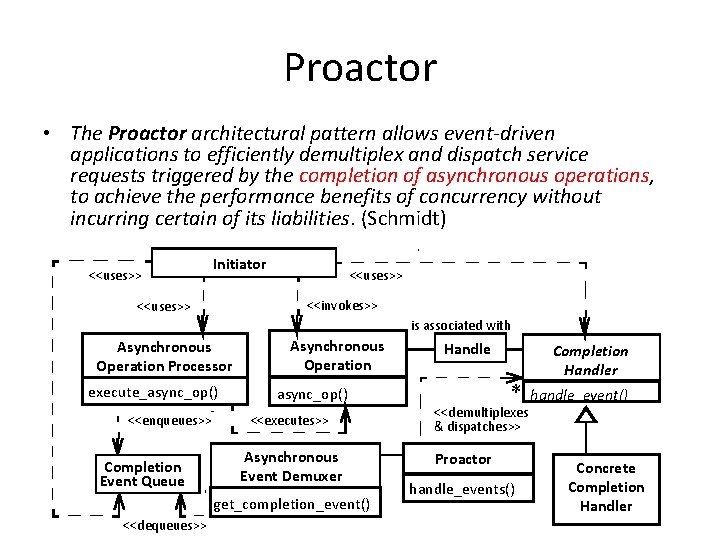
Proactor • The Proactor architectural pattern allows event-driven applications to efficiently demultiplex and dispatch service requests triggered by the completion of asynchronous operations, to achieve the performance benefits of concurrency without incurring certain of its liabilities. (Schmidt) <<uses>> Initiator <<uses>> <<invokes>> <<uses>> is associated with Asynchronous Operation Processor execute_async_op() <<enqueues>> Completion Event Queue Asynchronous Operation * async_op() <<executes>> Asynchronous Event Demuxer get_completion_event() <<dequeues>> Handle <<demultiplexes & dispatches>> Proactor handle_events() Completion Handler handle_event() Concrete Completion Handler
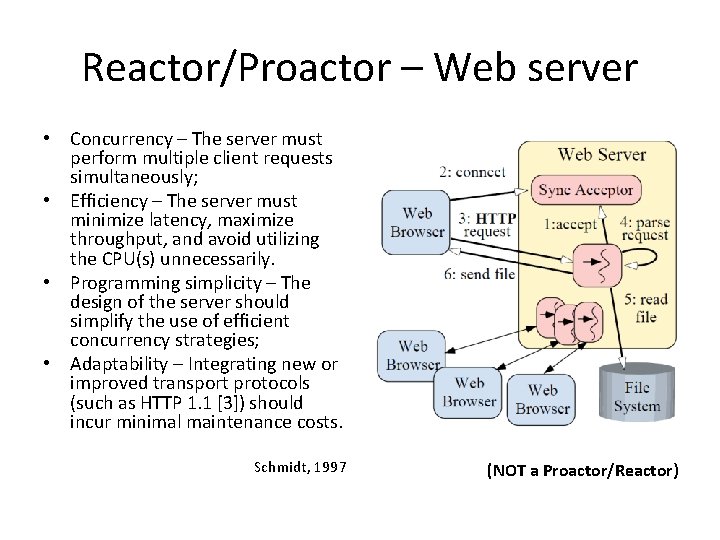
Reactor/Proactor – Web server • Concurrency – The server must perform multiple client requests simultaneously; • Efficiency – The server must minimize latency, maximize throughput, and avoid utilizing the CPU(s) unnecessarily. • Programming simplicity – The design of the server should simplify the use of efficient concurrency strategies; • Adaptability – Integrating new or improved transport protocols (such as HTTP 1. 1 [3]) should incur minimal maintenance costs. Schmidt, 1997 (NOT a Proactor/Reactor)
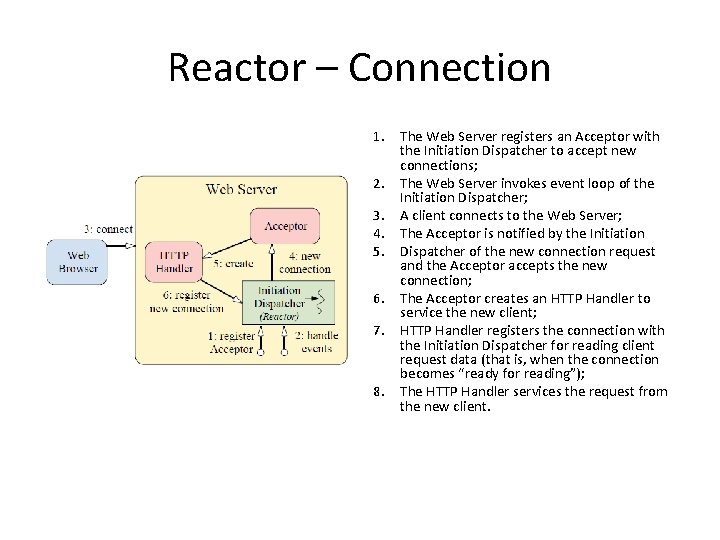
Reactor – Connection 1. The Web Server registers an Acceptor with the Initiation Dispatcher to accept new connections; 2. The Web Server invokes event loop of the Initiation Dispatcher; 3. A client connects to the Web Server; 4. The Acceptor is notified by the Initiation 5. Dispatcher of the new connection request and the Acceptor accepts the new connection; 6. The Acceptor creates an HTTP Handler to service the new client; 7. HTTP Handler registers the connection with the Initiation Dispatcher for reading client request data (that is, when the connection becomes “ready for reading”); 8. The HTTP Handler services the request from the new client.
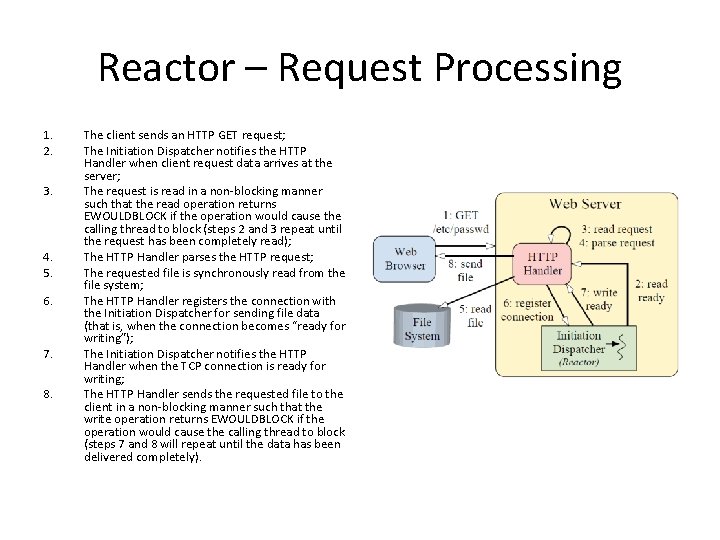
Reactor – Request Processing 1. 2. 3. 4. 5. 6. 7. 8. The client sends an HTTP GET request; The Initiation Dispatcher notifies the HTTP Handler when client request data arrives at the server; The request is read in a non-blocking manner such that the read operation returns EWOULDBLOCK if the operation would cause the calling thread to block (steps 2 and 3 repeat until the request has been completely read); The HTTP Handler parses the HTTP request; The requested file is synchronously read from the file system; The HTTP Handler registers the connection with the Initiation Dispatcher for sending file data (that is, when the connection becomes “ready for writing”); The Initiation Dispatcher notifies the HTTP Handler when the TCP connection is ready for writing; The HTTP Handler sends the requested file to the client in a non-blocking manner such that the write operation returns EWOULDBLOCK if the operation would cause the calling thread to block (steps 7 and 8 will repeat until the data has been delivered completely).
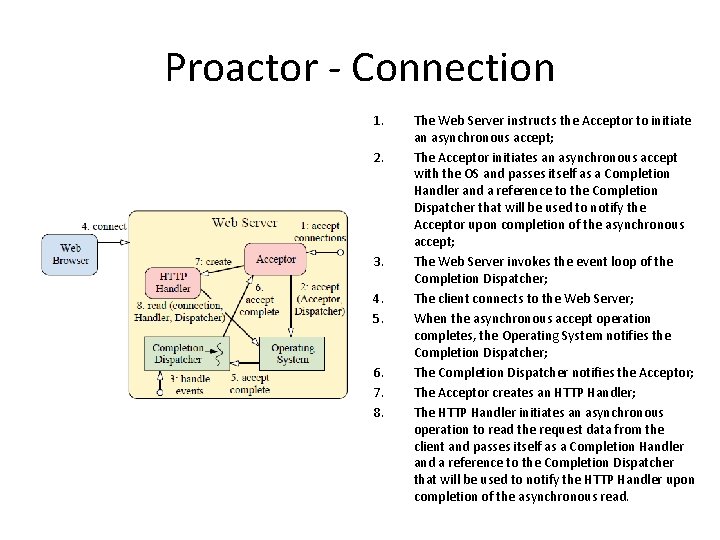
Proactor - Connection 1. 2. 3. 4. 5. 6. 7. 8. The Web Server instructs the Acceptor to initiate an asynchronous accept; The Acceptor initiates an asynchronous accept with the OS and passes itself as a Completion Handler and a reference to the Completion Dispatcher that will be used to notify the Acceptor upon completion of the asynchronous accept; The Web Server invokes the event loop of the Completion Dispatcher; The client connects to the Web Server; When the asynchronous accept operation completes, the Operating System notifies the Completion Dispatcher; The Completion Dispatcher notifies the Acceptor; The Acceptor creates an HTTP Handler; The HTTP Handler initiates an asynchronous operation to read the request data from the client and passes itself as a Completion Handler and a reference to the Completion Dispatcher that will be used to notify the HTTP Handler upon completion of the asynchronous read.
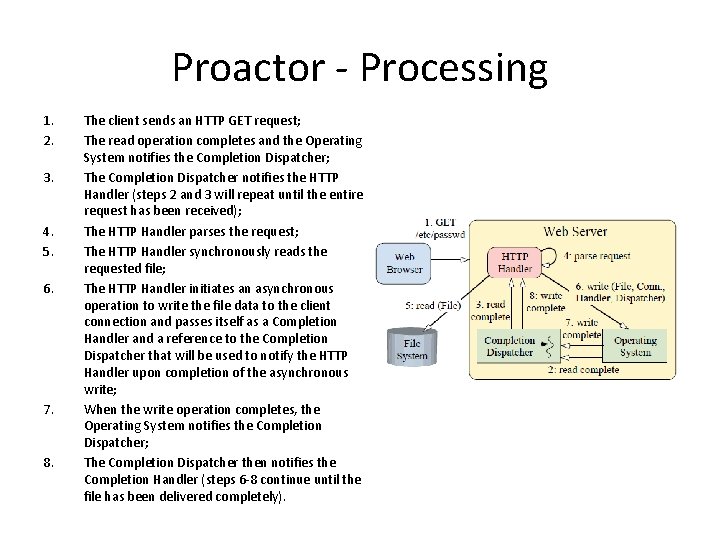
Proactor - Processing 1. 2. 3. 4. 5. 6. 7. 8. The client sends an HTTP GET request; The read operation completes and the Operating System notifies the Completion Dispatcher; The Completion Dispatcher notifies the HTTP Handler (steps 2 and 3 will repeat until the entire request has been received); The HTTP Handler parses the request; The HTTP Handler synchronously reads the requested file; The HTTP Handler initiates an asynchronous operation to write the file data to the client connection and passes itself as a Completion Handler and a reference to the Completion Dispatcher that will be used to notify the HTTP Handler upon completion of the asynchronous write; When the write operation completes, the Operating System notifies the Completion Dispatcher; The Completion Dispatcher then notifies the Completion Handler (steps 6 -8 continue until the file has been delivered completely).
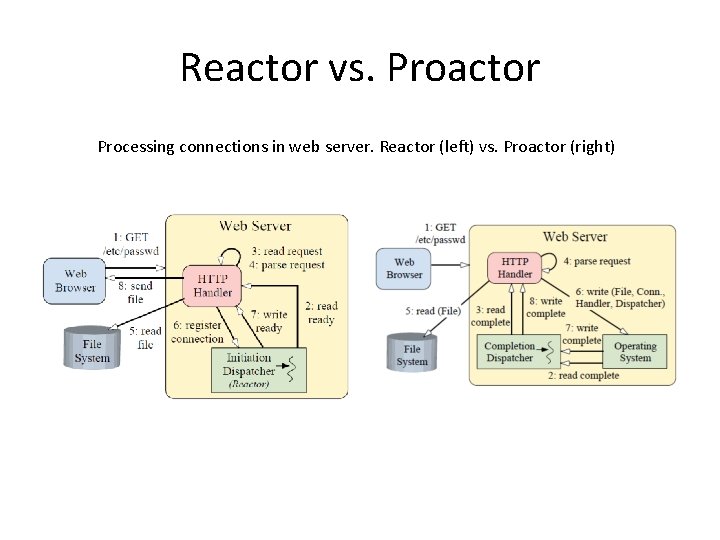
Reactor vs. Proactor Processing connections in web server. Reactor (left) vs. Proactor (right)
From design to code and towards reactive programming PRACTICAL EXAMPLES
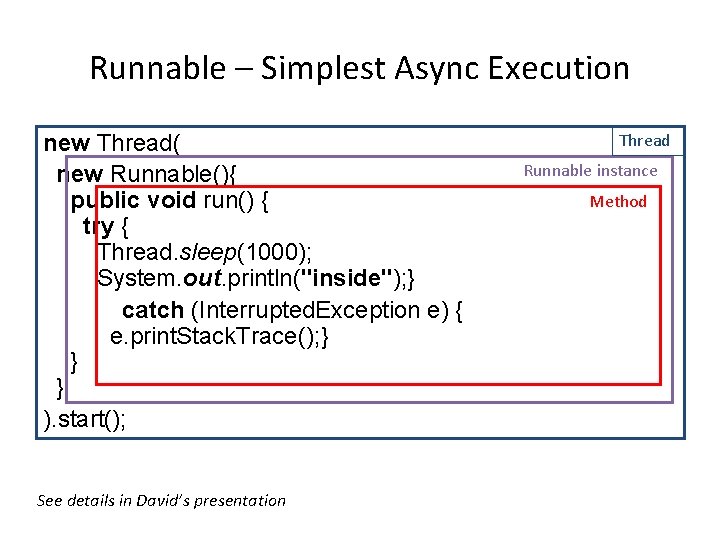
Runnable – Simplest Async Execution new Thread( new Runnable(){ public void run() { try { Thread. sleep(1000); System. out. println("inside"); } catch (Interrupted. Exception e) { e. print. Stack. Trace(); } } } ). start(); See details in David’s presentation Thread Runnable instance Method
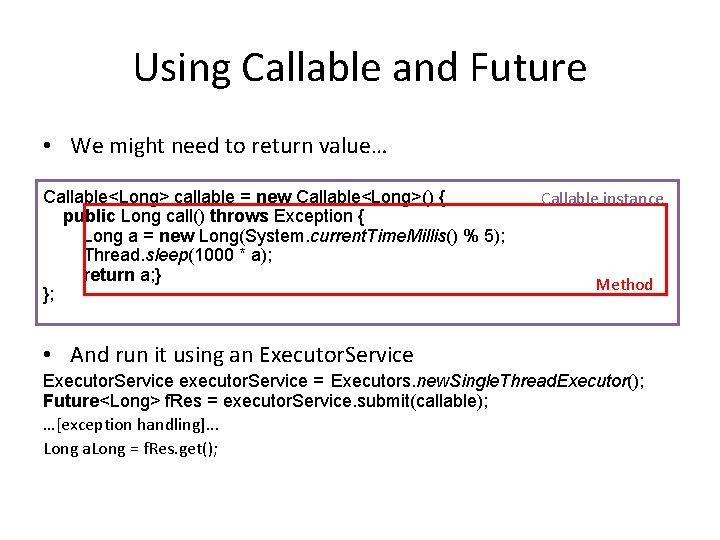
Using Callable and Future • We might need to return value… Callable<Long> callable = new Callable<Long>() { public Long call() throws Exception { Long a = new Long(System. current. Time. Millis() % 5); Thread. sleep(1000 * a); return a; } }; Callable instance Method • And run it using an Executor. Service executor. Service = Executors. new. Single. Thread. Executor(); Future<Long> f. Res = executor. Service. submit(callable); …[exception handling]. . . Long a. Long = f. Res. get();
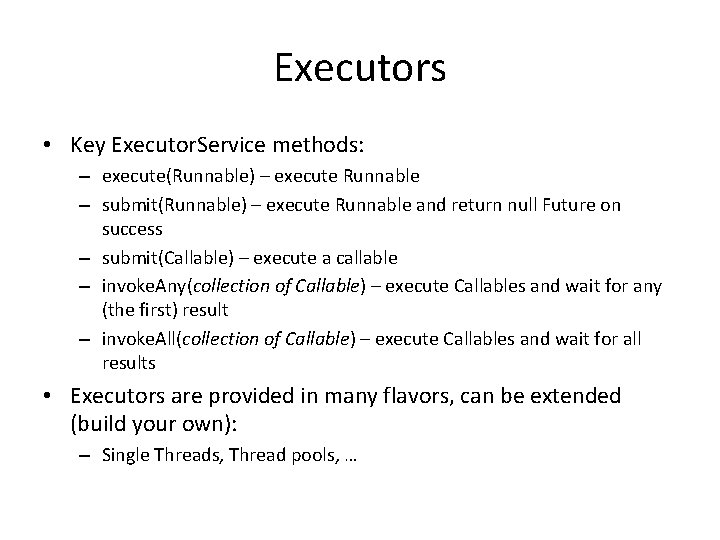
Executors • Key Executor. Service methods: – execute(Runnable) – execute Runnable – submit(Runnable) – execute Runnable and return null Future on success – submit(Callable) – execute a callable – invoke. Any(collection of Callable) – execute Callables and wait for any (the first) result – invoke. All(collection of Callable) – execute Callables and wait for all results • Executors are provided in many flavors, can be extended (build your own): – Single Threads, Thread pools, …
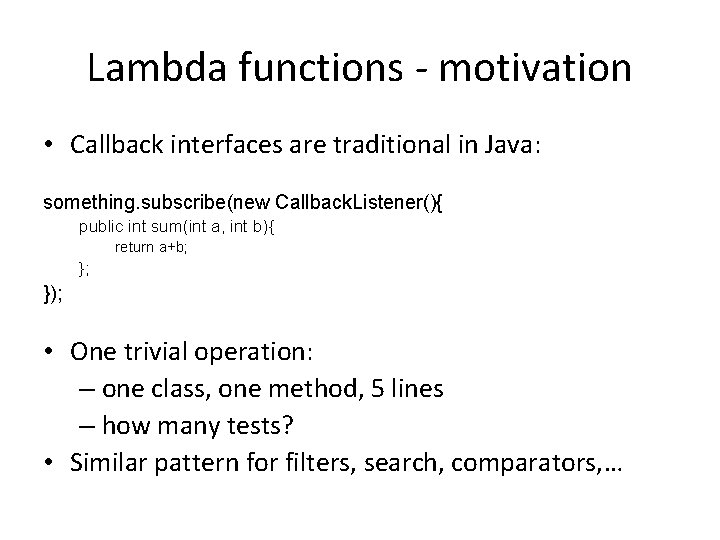
Lambda functions - motivation • Callback interfaces are traditional in Java: something. subscribe(new Callback. Listener(){ public int sum(int a, int b){ return a+b; }); • One trivial operation: – one class, one method, 5 lines – how many tests? • Similar pattern for filters, search, comparators, …
Lambda functions (for those who don’t know it yet) • Procedural (Imperative ) vs. Functional programming • In Java, everything is an object – Object-oriented approach is compatible with both Imperative and Functional styles – Until recently, Imperative approaches were dominant – Not (so much) today…due to changing nature of IT • Java was, until very recently, a procedural, objectoriented language • Competition from Scala, . NET and other factors pushed it to adopt more functional paradigm
Lambda functions under the hood • Couple of issues: – To which class (class structure) does the function belong to – Important for access control and other issues • There are two ways how to approach the problem: • Create anonymous inner class under the hood at compile time – But (even anonymous/inner) classes are not free – they consume memory • invokedynamic – build the representation at runtime (on first invocation) and call it one or more times – Static method + factory instance – Inner class (still theoretically possible…) – … anything that any compiler might deem efficient in the future
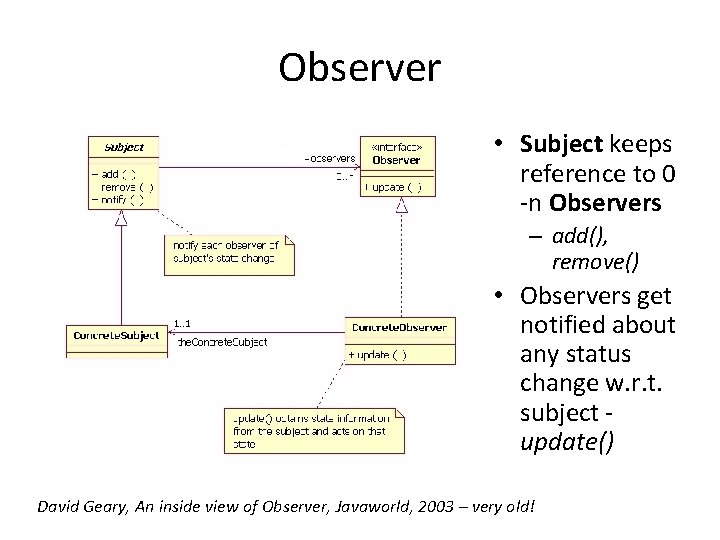
Reactive programming and Observables • Observer: (very traditional) pattern where an object (subject) holds a list of listeners that get notified by the object about (any) state changes • Reactive. X: Functional-like reactive programming approach that allows efficient decoupling between – Event happening – Transformations on the event data – Reaction to an event • Similar to Java 8 Streams, but on a different level • Exists across many programming languages
Observer • Subject keeps reference to 0 -n Observers – add(), remove() • Observers get notified about any status change w. r. t. subject update() David Geary, An inside view of Observer, Javaworld, 2003 – very old!
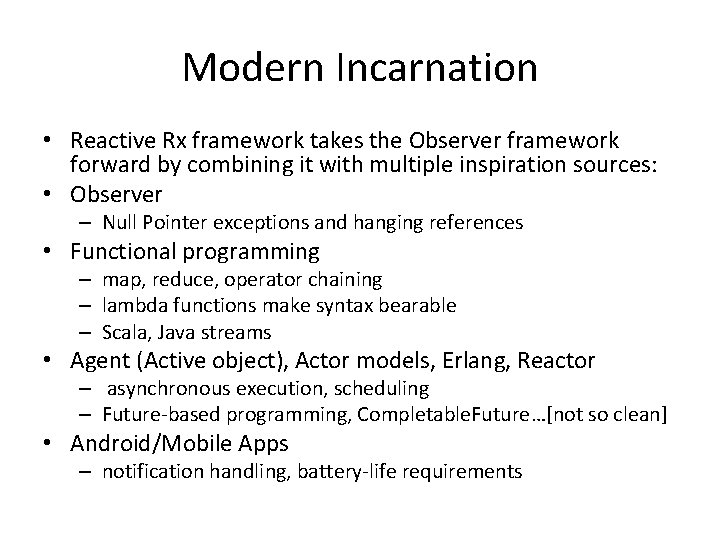
Modern Incarnation • Reactive Rx framework takes the Observer framework forward by combining it with multiple inspiration sources: • Observer – Null Pointer exceptions and hanging references • Functional programming – map, reduce, operator chaining – lambda functions make syntax bearable – Scala, Java streams • Agent (Active object), Actor models, Erlang, Reactor – asynchronous execution, scheduling – Future-based programming, Completable. Future…[not so clean] • Android/Mobile Apps – notification handling, battery-life requirements
Reactive. X • “Reactive. X is a library for composing asynchronous and event-based programs by using observable sequences. ” • “It extends the observer pattern to support sequences of data and/or events and adds operators that allow you to compose sequences together declaratively while abstracting away concerns about things like low-level threading, synchronization, thread-safety, concurrent data structures, and non-blocking I/O. " reactivex. io/intro. html, March 2016
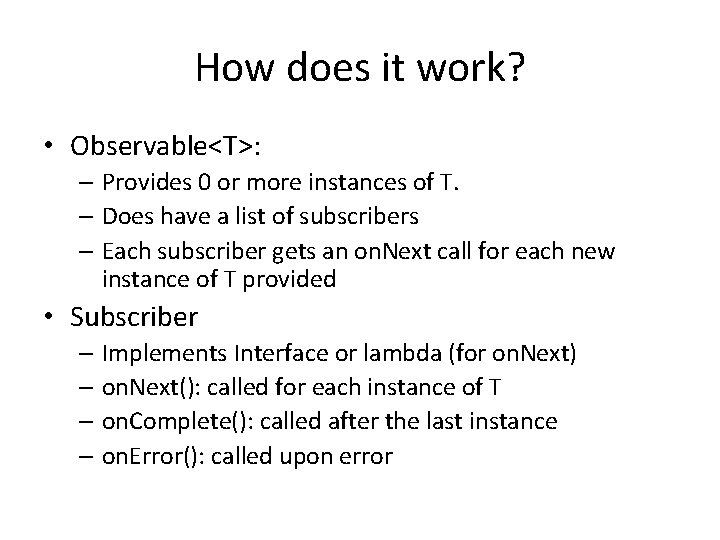
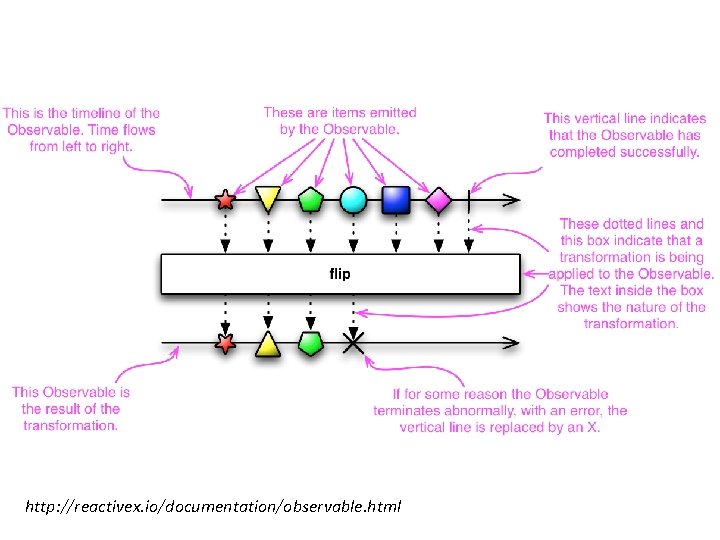
How does it work? • Observable<T>: – Provides 0 or more instances of T. – Does have a list of subscribers – Each subscriber gets an on. Next call for each new instance of T provided • Subscriber – Implements Interface or lambda (for on. Next) – on. Next(): called for each instance of T – on. Complete(): called after the last instance – on. Error(): called upon error
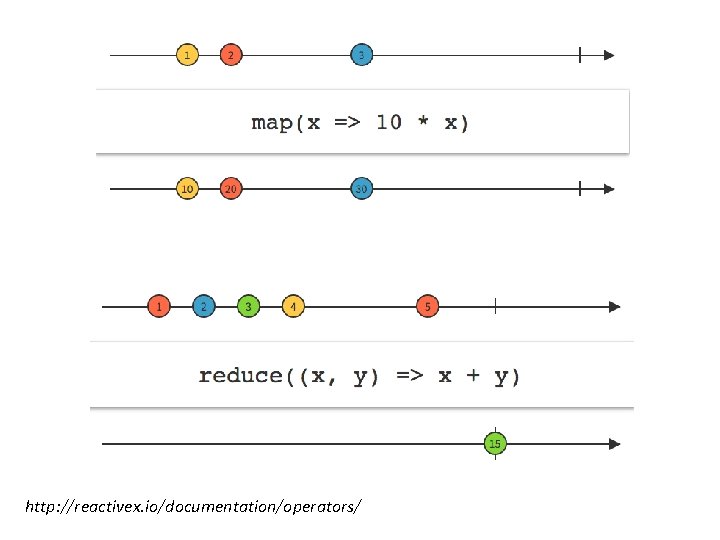
New Observable for String items Observable<String> source = Observable. from(new String[]{"1", "2", "3", "4", "5"}); Creates an Observable from a collection Observable<Integer> io = source. map( s -> Integer. parse. Int(s)). reduce((i, i 2) -> i+i 2); lambda converts String to Integer map applies lambda to all items from source Creates a consumer for the Observable io. subscribe( integer -> {System. out. println("integer = " + integer); } ) Reduces items to a single value
http: //reactivex. io/documentation/observable. html
http: //reactivex. io/documentation/operators/
So, what is the big change? • Operators: (Most often) transform an Observable into another observable of the same of different type • Chaining: Observables can be chained using operators that either transform the items or manage the handling of the observables – Buffer, merge, on
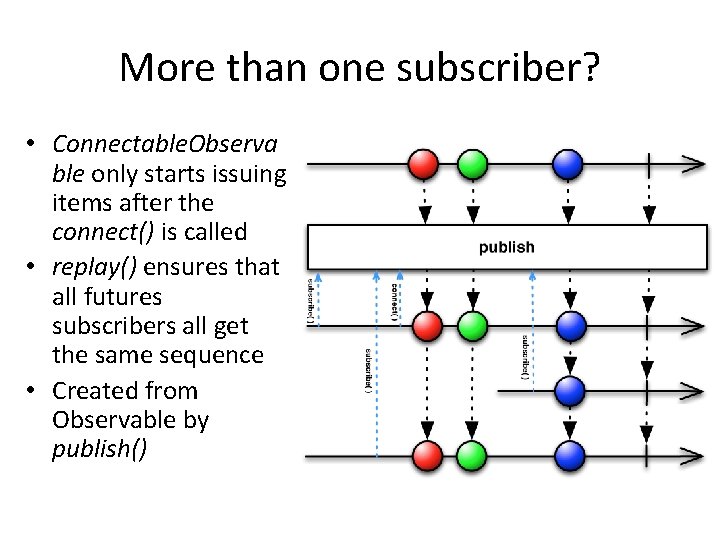
More than one subscriber? • Connectable. Observa ble only starts issuing items after the connect() is called • replay() ensures that all futures subscribers all get the same sequence • Created from Observable by publish()
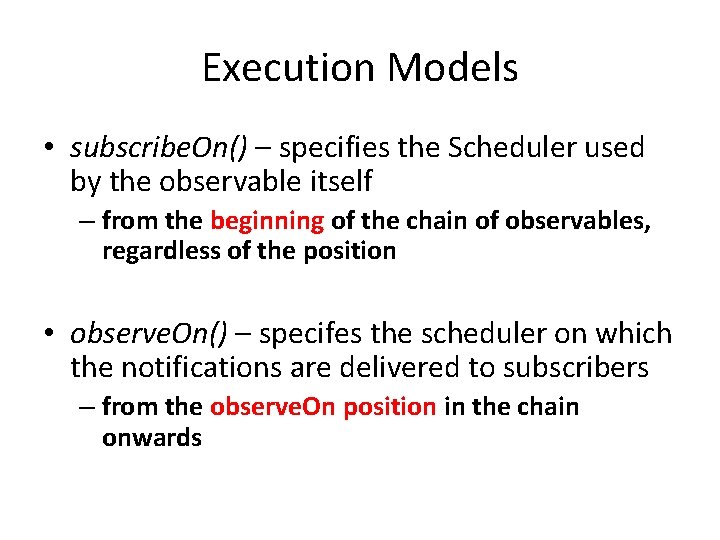
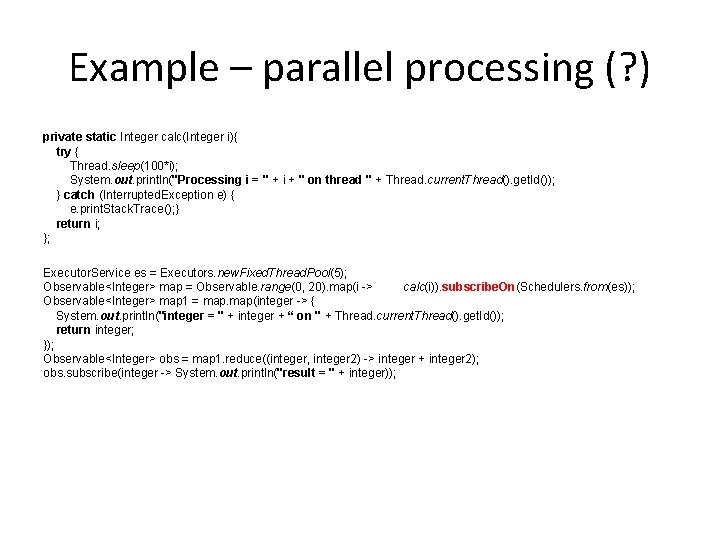
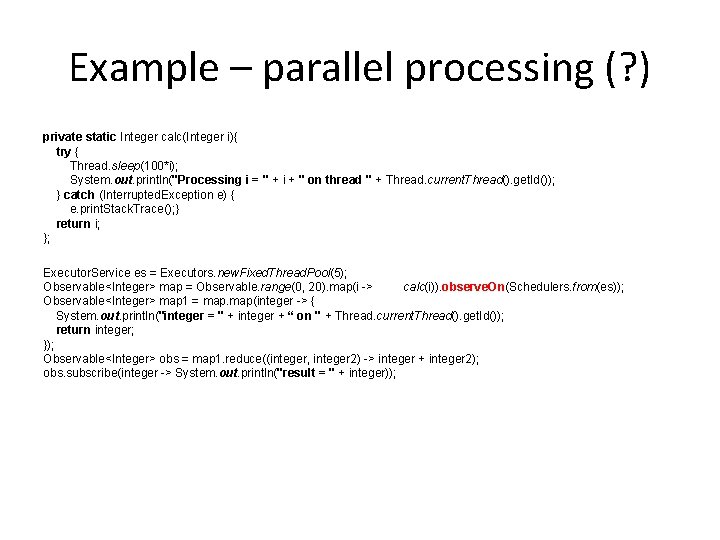
Execution Models • subscribe. On() – specifies the Scheduler used by the observable itself – from the beginning of the chain of observables, regardless of the position • observe. On() – specifes the scheduler on which the notifications are delivered to subscribers – from the observe. On position in the chain onwards
Example – parallel processing (? ) private static Integer calc(Integer i){ try { Thread. sleep(100*i); System. out. println("Processing i = " + i + " on thread " + Thread. current. Thread(). get. Id()); } catch (Interrupted. Exception e) { e. print. Stack. Trace(); } return i; }; Executor. Service es = Executors. new. Fixed. Thread. Pool(5); Observable<Integer> map = Observable. range(0, 20). map(i -> calc(i)). subscribe. On(Schedulers. from(es)); Observable<Integer> map 1 = map(integer -> { System. out. println("integer = " + integer + “ on " + Thread. current. Thread(). get. Id()); return integer; }); Observable<Integer> obs = map 1. reduce((integer, integer 2) -> integer + integer 2); obs. subscribe(integer -> System. out. println("result = " + integer));
Example – parallel processing (? ) private static Integer calc(Integer i){ try { Thread. sleep(100*i); System. out. println("Processing i = " + i + " on thread " + Thread. current. Thread(). get. Id()); } catch (Interrupted. Exception e) { e. print. Stack. Trace(); } return i; }; Executor. Service es = Executors. new. Fixed. Thread. Pool(5); Observable<Integer> map = Observable. range(0, 20). map(i -> calc(i)). observe. On(Schedulers. from(es)); Observable<Integer> map 1 = map(integer -> { System. out. println("integer = " + integer + “ on " + Thread. current. Thread(). get. Id()); return integer; }); Observable<Integer> obs = map 1. reduce((integer, integer 2) -> integer + integer 2); obs. subscribe(integer -> System. out. println("result = " + integer));
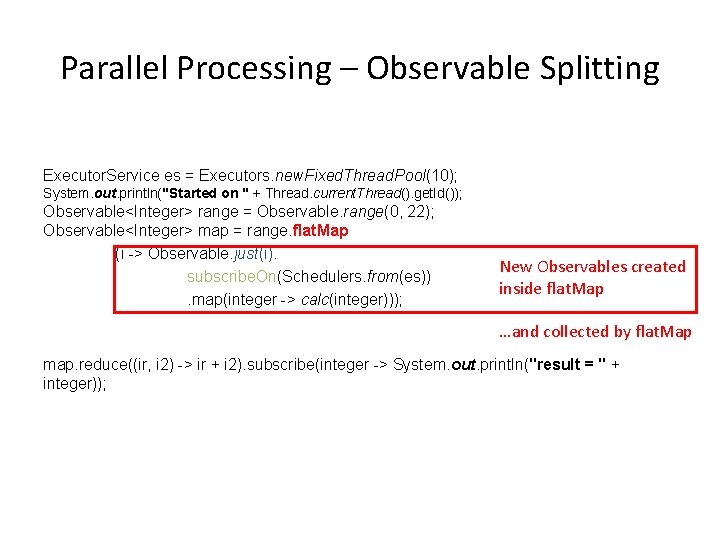
Parallel Processing – Observable Splitting Executor. Service es = Executors. new. Fixed. Thread. Pool(10); System. out. println("Started on " + Thread. current. Thread(). get. Id()); Observable<Integer> range = Observable. range(0, 22); Observable<Integer> map = range. flat. Map (i -> Observable. just(i). subscribe. On(Schedulers. from(es)). map(integer -> calc(integer))); New Observables created inside flat. Map …and collected by flat. Map map. reduce((ir, i 2) -> ir + i 2). subscribe(integer -> System. out. println("result = " + integer));
Light introduction to DISTRIBUTION AND RELIABILITY
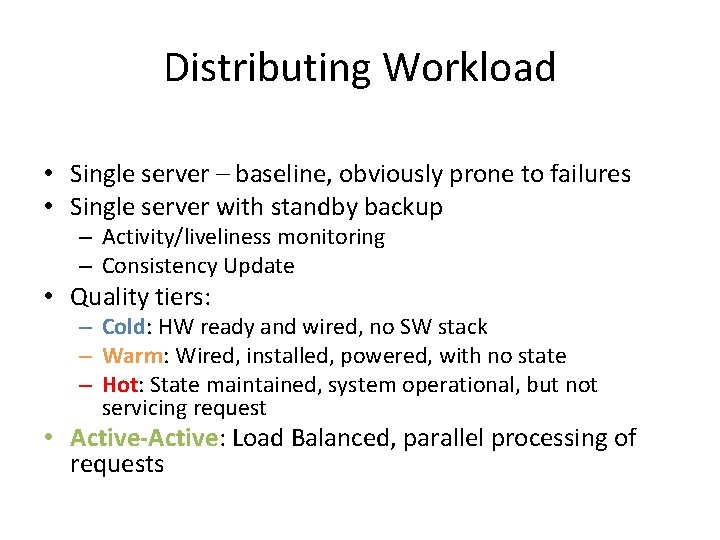
Distributing Workload • Single server – baseline, obviously prone to failures • Single server with standby backup – Activity/liveliness monitoring – Consistency Update • Quality tiers: – Cold: HW ready and wired, no SW stack – Warm: Wired, installed, powered, with no state – Hot: State maintained, system operational, but not servicing request • Active-Active: Load Balanced, parallel processing of requests
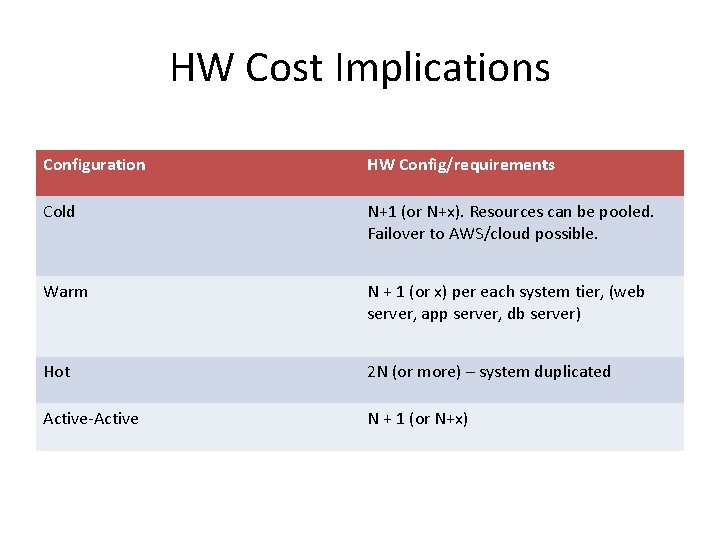
HW Cost Implications Configuration HW Config/requirements Cold N+1 (or N+x). Resources can be pooled. Failover to AWS/cloud possible. Warm N + 1 (or x) per each system tier, (web server, app server, db server) Hot 2 N (or more) – system duplicated Active-Active N + 1 (or N+x)
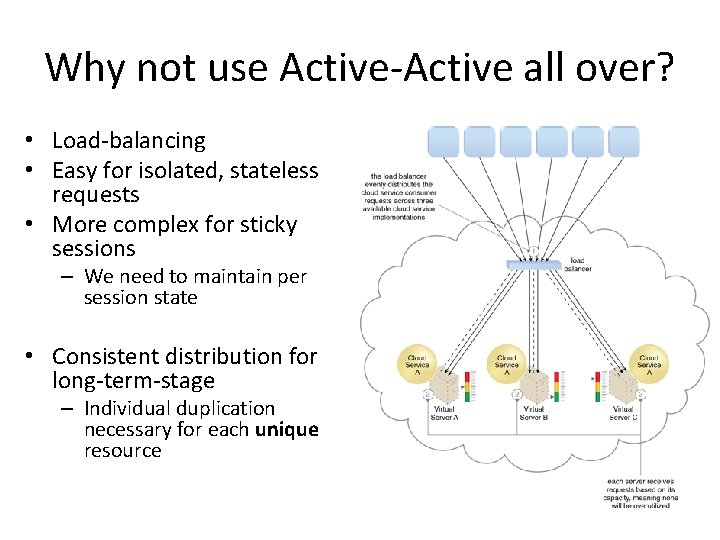
Why not use Active-Active all over? • Load-balancing • Easy for isolated, stateless requests • More complex for sticky sessions – We need to maintain per session state • Consistent distribution for long-term-stage – Individual duplication necessary for each unique resource
Corollaly • Uniqueness is expensive • Pooling is efficient and scalable • State persistence/management incurs nontrivial costs and constraints
Conclusion 1. Remote resource localization 1. Yellow pages, Singleton 2. Remote resource creation and usage 1. Factory, Façade, Reactor, Proactor, Half-Sync/Async 3. State synchronization management 1. Façade, Proxy, Active Object 4. Failure detection 5. Failure management, recovery and failover 6. Resource destruction 1. Proxy, Façade, Garbage collection, …