
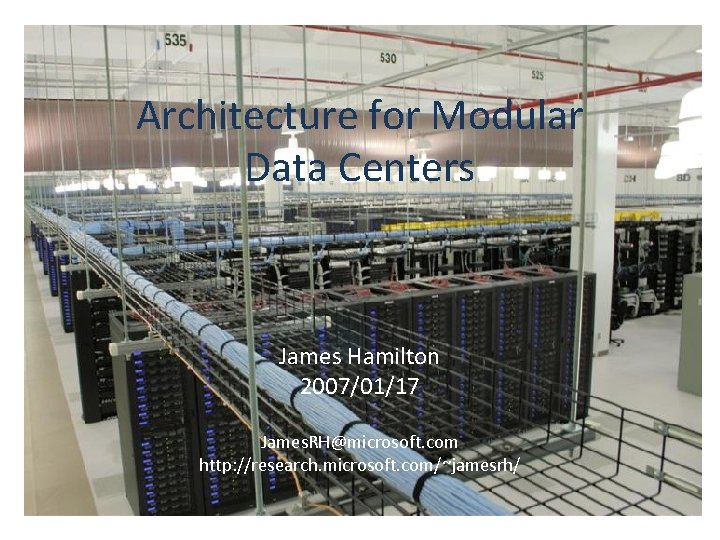
Architecture for Modular Data Centers James Hamilton 20070117
- Slides: 10
Architecture for Modular Data Centers James Hamilton 2007/01/17 James. RH@microsoft. com http: //research. microsoft. com/~jamesrh/
Background and Biases • 15 years in database engine development – Lead architect on IBM DB 2 – Architect on SQL Server • Have lead most core engine teams: Optimizer, compiler, XML, client APIs, full text search, execution engine, protocols, etc. • Lead the Exchange Hosted Services Team – Email anti-spam, anti-virus, and archiving for 2. 2 m seats with $27 m revenue – ~700 servers in 10 world-wide data centers • Currently Architect on the Windows Live Core team • Automation & redundancy is only way to: – Reduce costs – Improve rate of innovation – Reduce operational failures and downtime 1/17/2007 2
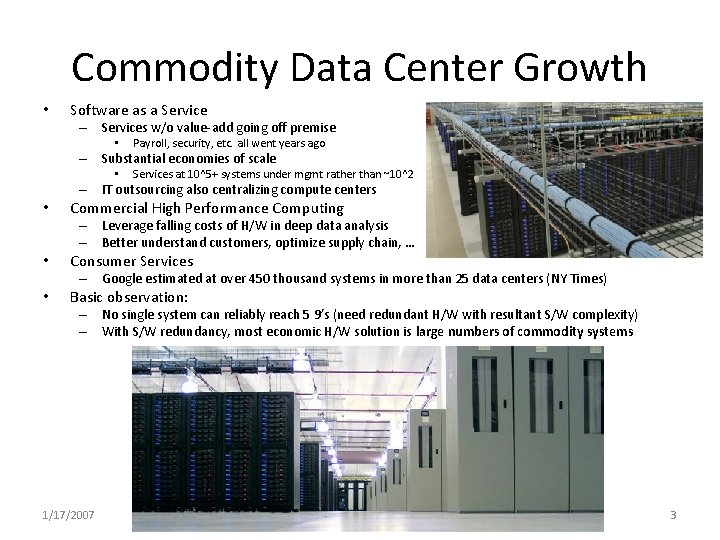
Commodity Data Center Growth • Software as a Service – Services w/o value-add going off premise • Payroll, security, etc. all went years ago – Substantial economies of scale • • Services at 10^5+ systems under mgmt rather than ~10^2 – IT outsourcing also centralizing compute centers Commercial High Performance Computing – Leverage falling costs of H/W in deep data analysis – Better understand customers, optimize supply chain, … Consumer Services – Google estimated at over 450 thousand systems in more than 25 data centers (NY Times) Basic observation: – No single system can reliably reach 5 9’s (need redundant H/W with resultant S/W complexity) – With S/W redundancy, most economic H/W solution is large numbers of commodity systems 1/17/2007 3
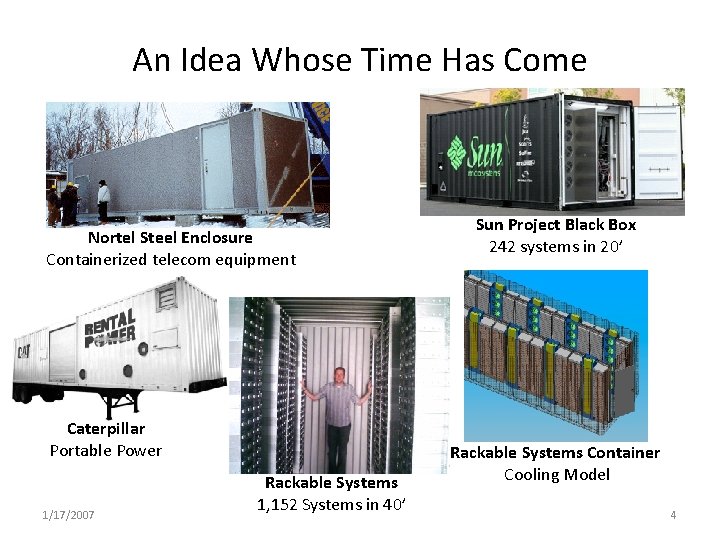
An Idea Whose Time Has Come Nortel Steel Enclosure Containerized telecom equipment Caterpillar Portable Power 1/17/2007 Rackable Systems 1, 152 Systems in 40’ Sun Project Black Box 242 systems in 20’ Rackable Systems Container Cooling Model 4
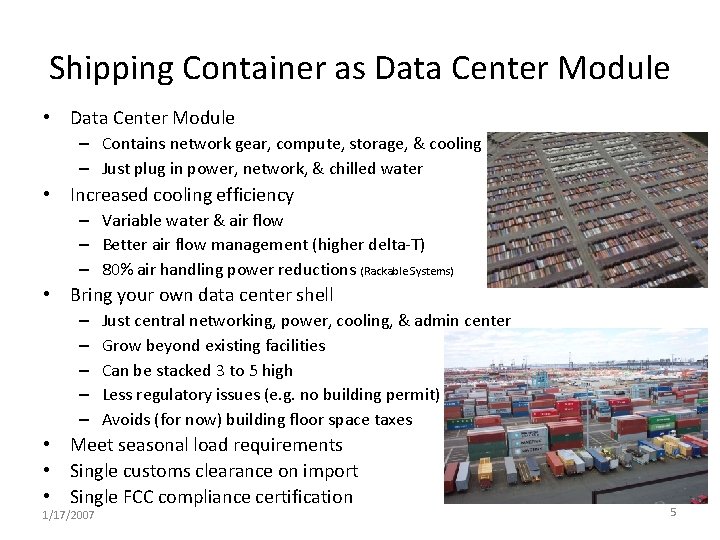
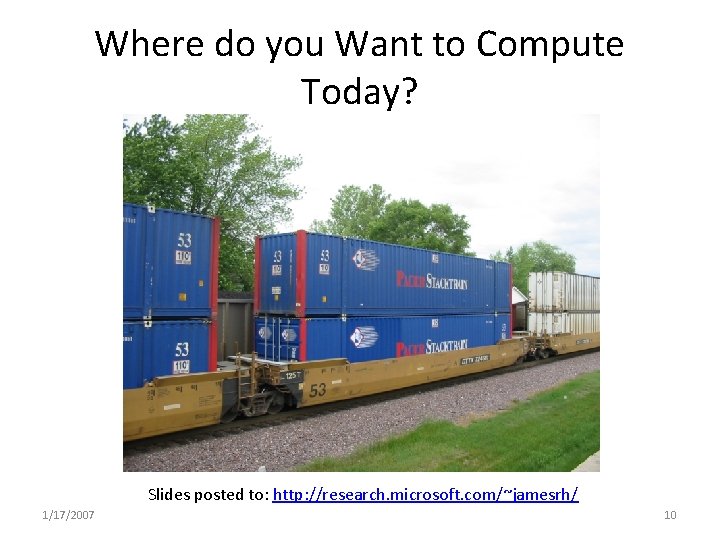
Shipping Container as Data Center Module • Data Center Module – Contains network gear, compute, storage, & cooling – Just plug in power, network, & chilled water • Increased cooling efficiency – Variable water & air flow – Better air flow management (higher delta-T) – 80% air handling power reductions (Rackable Systems) • Bring your own data center shell – – – Just central networking, power, cooling, & admin center Grow beyond existing facilities Can be stacked 3 to 5 high Less regulatory issues (e. g. no building permit) Avoids (for now) building floor space taxes • Meet seasonal load requirements • Single customs clearance on import • Single FCC compliance certification 1/17/2007 5
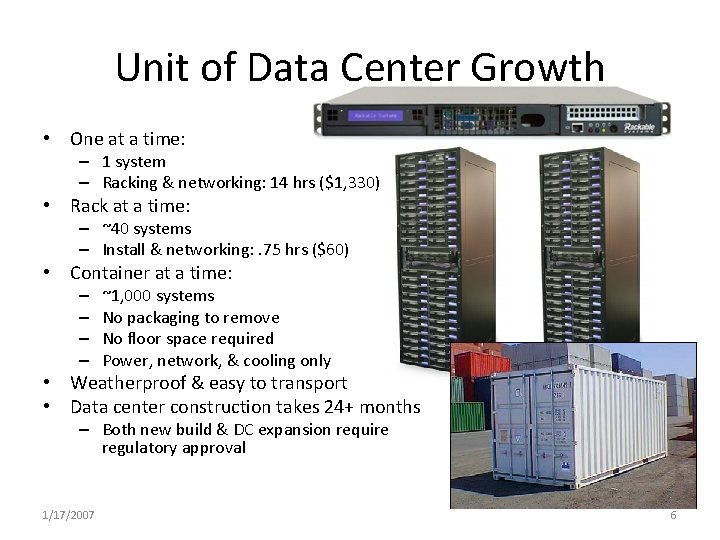
Unit of Data Center Growth • One at a time: – 1 system – Racking & networking: 14 hrs ($1, 330) • Rack at a time: – ~40 systems – Install & networking: . 75 hrs ($60) • Container at a time: – – ~1, 000 systems No packaging to remove No floor space required Power, network, & cooling only • Weatherproof & easy to transport • Data center construction takes 24+ months – Both new build & DC expansion require regulatory approval 1/17/2007 6
Manufacturing & H/W Admin. Savings • Factory racking, stacking & packing much more efficient – Robotics and/or inexpensive labor • Avoid layers of packaging – Systems->packing box->pallet->container – Materials cost and wastage and labor at customer site • Data Center power & cooling expensive consulting contracts – Data centers are still custom crafted rather than prefab units – Move skill set to module manufacturer who designs power & cooling once – Installation design to meet module power, network, & cooling specs • More space efficient – Power densities in excess of 1250 W/sq ft – Rooftop or parking lot installation acceptable • Service-Free – H/W admin contracts can exceed 25% of systems cost – Sufficient redundancy that it just degrades over time • At end of service, return for remanufacture & recycling – 20% to 50% of systems outages caused by Admin error (A. Brown & D. Patterson) 1/17/2007 7
DC Location Flexibility & Portability • Dynamic data center – Inexpensive intermodal transit anywhere in world – Move data center to cheap power & networking – Install capacity where needed – Conventional Data centers cost upwards of $150 M & take 24+ months to design & build – Political/Social issues • USA PATRIOT act concerns and other national interests can require local data centers • Build out a massively distributed data center fabric – Install satellite data centers near consumers 1/17/2007 8
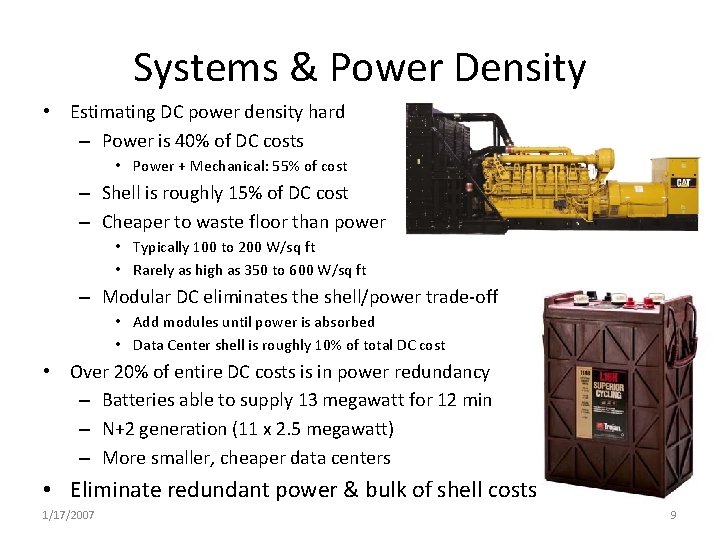
Systems & Power Density • Estimating DC power density hard – Power is 40% of DC costs • Power + Mechanical: 55% of cost – Shell is roughly 15% of DC cost – Cheaper to waste floor than power • Typically 100 to 200 W/sq ft • Rarely as high as 350 to 600 W/sq ft – Modular DC eliminates the shell/power trade-off • Add modules until power is absorbed • Data Center shell is roughly 10% of total DC cost • Over 20% of entire DC costs is in power redundancy – Batteries able to supply 13 megawatt for 12 min – N+2 generation (11 x 2. 5 megawatt) – More smaller, cheaper data centers • Eliminate redundant power & bulk of shell costs 1/17/2007 9
Where do you Want to Compute Today? Slides posted to: http: //research. microsoft. com/~jamesrh/ 1/17/2007 10