
Architecture Evaluation Topics Evaluation Factors Architecture Tradeoff Analysis
- Slides: 25
Architecture Evaluation
Topics Evaluation Factors Architecture Tradeoff Analysis Method (ATAM)
Why Evaluate Software Architectures? Software architecture is the earliest life-cycle artifact that embodies significant design decisions: choices and tradeoffs. ◦ Choices are easy to make, but hard to change once implemented Software architecture is a combination of design and analysis (H. Cervantes, R. Kazman, Designing Software Architectures: A Practical Approach, Addison-Wesley, 2016, p. 175. ) Design is the process of making decisions and analysis is the process of understanding implications of those decisions. Architecture design involves tradeoffs in system qualities ◦ System qualities are largely dependent on architectural decisions ◦ Promoting one quality often comes at the expense of another quality There are two commonly known approaches (we’ll look at both) • ATAM (Arch. Tradeoff Analysis Method) • SAAM (Scenario based Architecture Analysis Method)
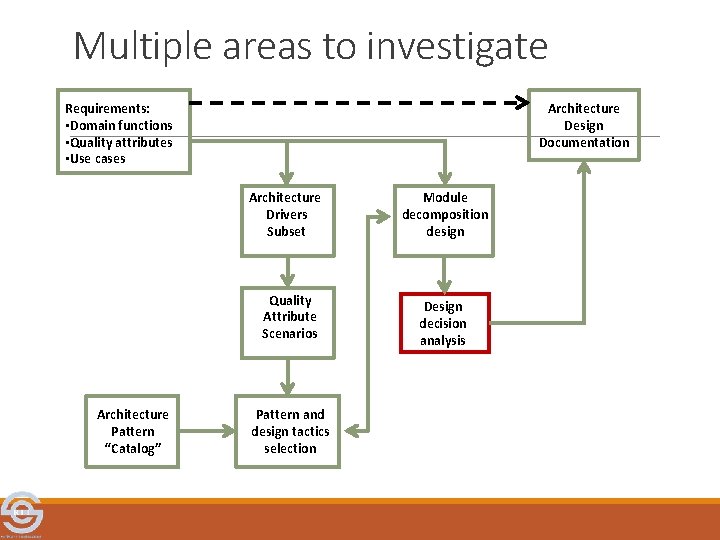
Multiple areas to investigate Requirements: • Domain functions • Quality attributes • Use cases Architecture Design Documentation Architecture Drivers Subset Quality Attribute Scenarios Architecture Pattern “Catalog” Pattern and design tactics selection Module decomposition design Design decision analysis
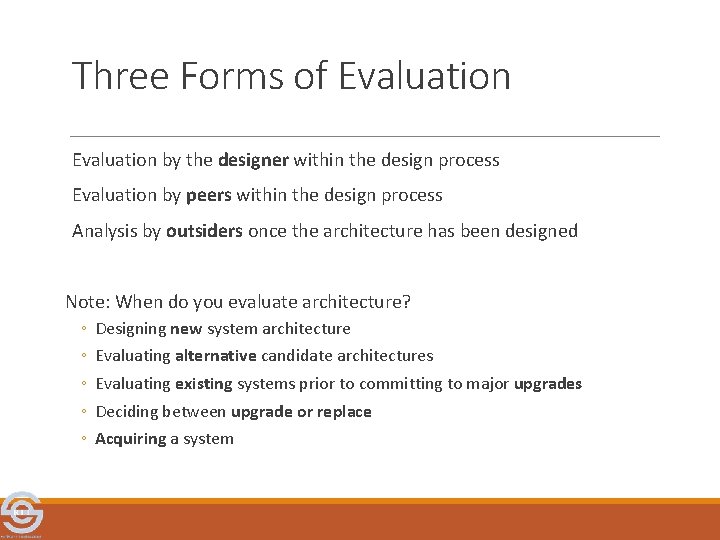
Three Forms of Evaluation by the designer within the design process Evaluation by peers within the design process Analysis by outsiders once the architecture has been designed Note: When do you evaluate architecture? ◦ ◦ ◦ Designing new system architecture Evaluating alternative candidate architectures Evaluating existing systems prior to committing to major upgrades Deciding between upgrade or replace Acquiring a system
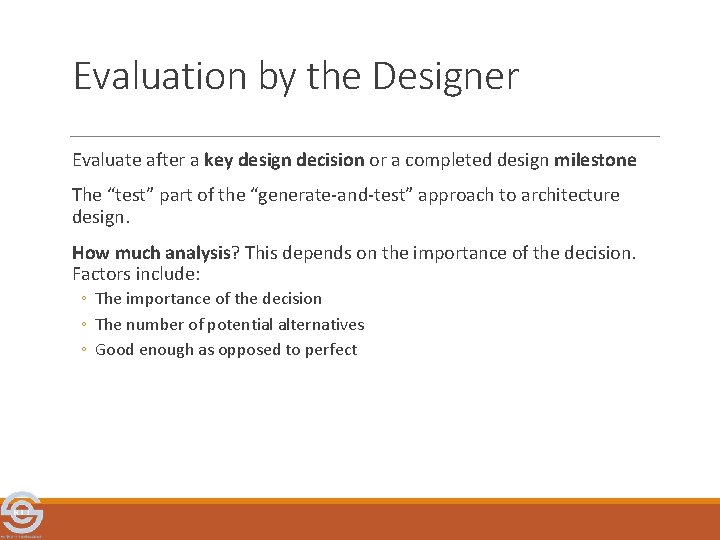
Evaluation by the Designer Evaluate after a key design decision or a completed design milestone The “test” part of the “generate-and-test” approach to architecture design. How much analysis? This depends on the importance of the decision. Factors include: ◦ The importance of the decision ◦ The number of potential alternatives ◦ Good enough as opposed to perfect
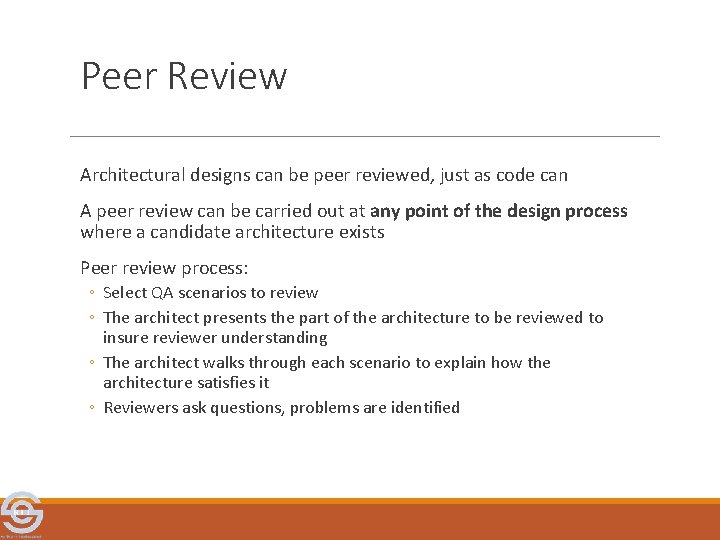
Peer Review Architectural designs can be peer reviewed, just as code can A peer review can be carried out at any point of the design process where a candidate architecture exists Peer review process: ◦ Select QA scenarios to review ◦ The architect presents the part of the architecture to be reviewed to insure reviewer understanding ◦ The architect walks through each scenario to explain how the architecture satisfies it ◦ Reviewers ask questions, problems are identified
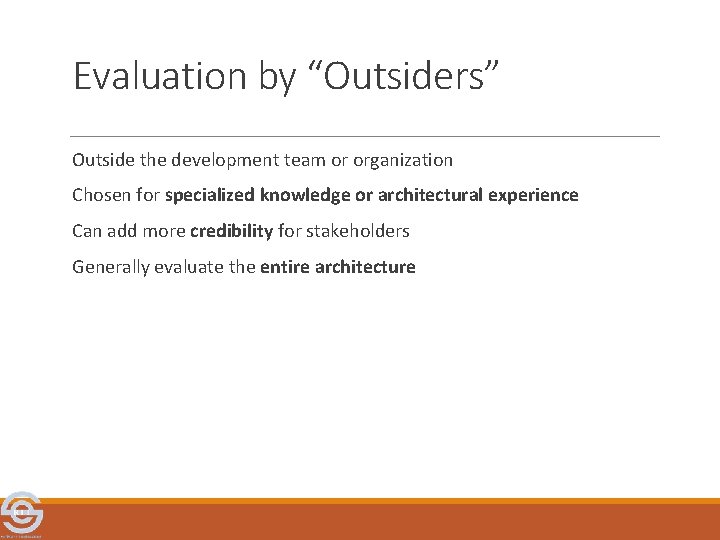
Evaluation by “Outsiders” Outside the development team or organization Chosen for specialized knowledge or architectural experience Can add more credibility for stakeholders Generally evaluate the entire architecture
Contextual Factors for Evaluation What artifacts are available? Who performs the evaluation? Which stakeholders are needed and will participate? What stakeholders see the results? What are the business goals? The evaluation should answer whether the system will satisfy the business goals.
The Architecture Tradeoff Analysis Method A method to evaluate software architecture to discover: Risks - alternatives that might create future problems in some quality attribute Non-risks - decisions that promote qualities that help realize business/mission goals Sensitivity points - alternatives for which a slight change makes a significant difference in some quality attribute Tradeoffs - decisions affecting more than one quality attribute Not precise analysis – find potential conflicts between architectural decisions and predicted quality to identify possible design mitigation
ATAM Outputs Presentation of the architecture Articulation of business goals Prioritized QA requirements expressed as scenarios Specific risks and non-risks, plus overarching risk themes that may have far reaching impacts on business goals Architecture decisions mapped to QA requirements Identified sensitivity points and tradeoffs
ATAM Process A short, facilitated interaction between multiple stakeholders to identify risks, sensitivities, and tradeoffs Evaluation team – 3 -5 “outsiders” ◦ Experienced architects ◦ Roles : team leader, moderator to facilitate, scribe(s), questioners Representative stakeholders and decision makers Preconditions: ◦ Software architecture exists and is documented ◦ Prepare architecture and business presentations ◦ Material is reviewed ahead of time
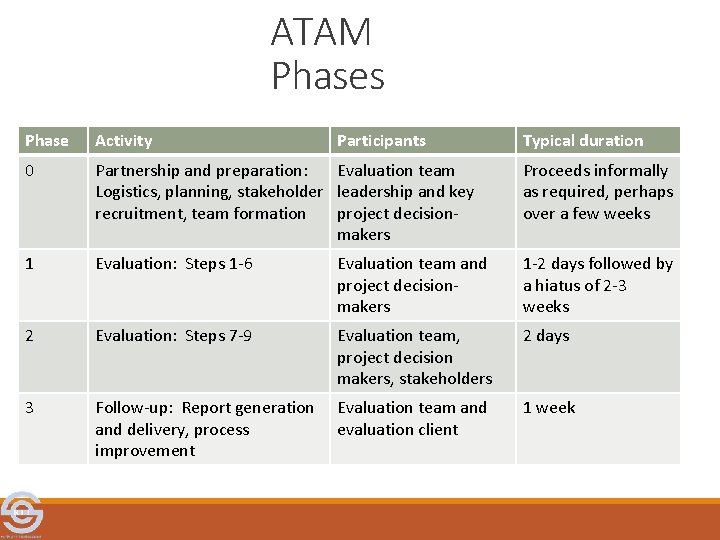
ATAM Phases Phase Activity Participants Typical duration 0 Partnership and preparation: Evaluation team Logistics, planning, stakeholder leadership and key recruitment, team formation project decisionmakers Proceeds informally as required, perhaps over a few weeks 1 Evaluation: Steps 1 -6 Evaluation team and project decisionmakers 1 -2 days followed by a hiatus of 2 -3 weeks 2 Evaluation: Steps 7 -9 Evaluation team, project decision makers, stakeholders 2 days 3 Follow-up: Report generation Evaluation team and delivery, process evaluation client improvement 1 week
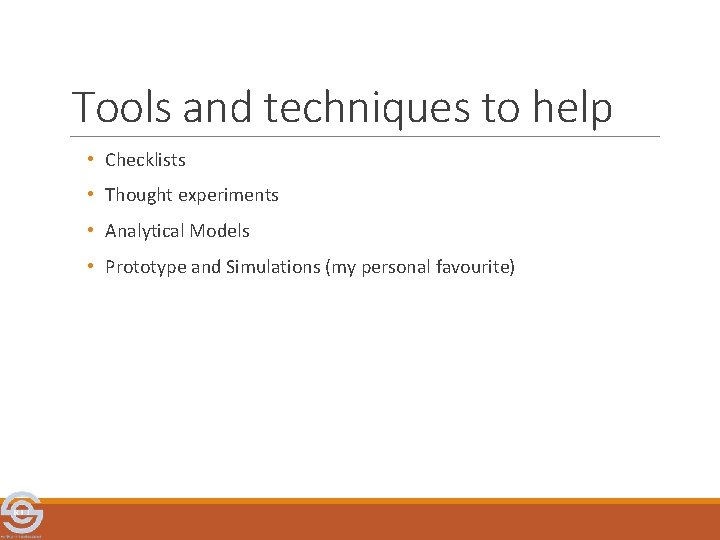
Tools and techniques to help • Checklists • Thought experiments • Analytical Models • Prototype and Simulations (my personal favourite)
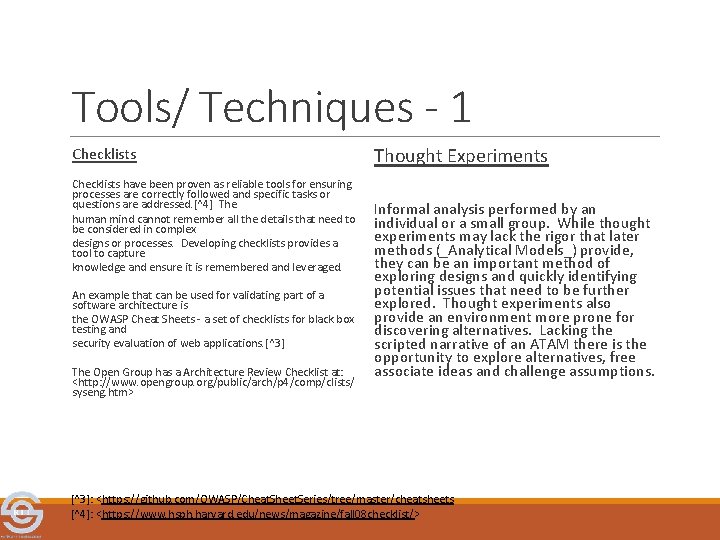
Tools/ Techniques - 1 Checklists have been proven as reliable tools for ensuring processes are correctly followed and specific tasks or questions are addressed. [^4] The human mind cannot remember all the details that need to be considered in complex designs or processes. Developing checklists provides a tool to capture knowledge and ensure it is remembered and leveraged. An example that can be used for validating part of a software architecture is the OWASP Cheat Sheets - a set of checklists for black box testing and security evaluation of web applications. [^3] The Open Group has a Architecture Review Checklist at: <http: //www. opengroup. org/public/arch/p 4/comp/clists/ syseng. htm> Thought Experiments Informal analysis performed by an individual or a small group. While thought experiments may lack the rigor that later methods (_Analytical Models_) provide, they can be an important method of exploring designs and quickly identifying potential issues that need to be further explored. Thought experiments also provide an environment more prone for discovering alternatives. Lacking the scripted narrative of an ATAM there is the opportunity to explore alternatives, free associate ideas and challenge assumptions. [^3]: <https: //github. com/OWASP/Cheat. Sheet. Series/tree/master/cheatsheets [^4]: <https: //www. hsph. harvard. edu/news/magazine/fall 08 checklist/>
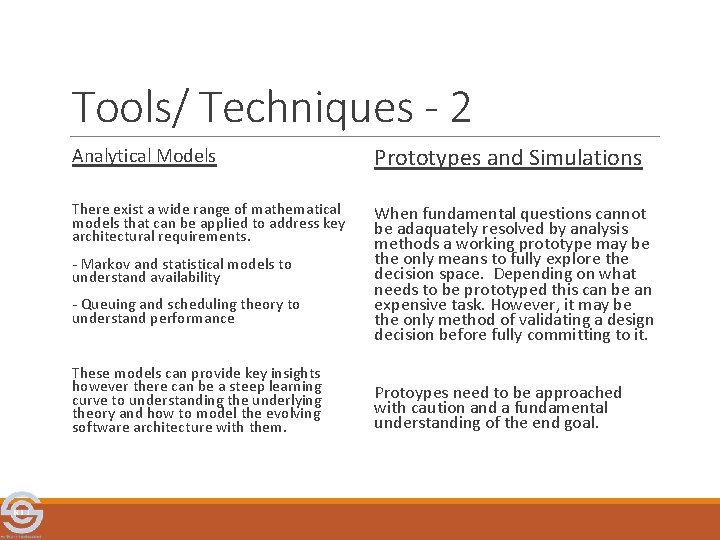
Tools/ Techniques - 2 Analytical Models Prototypes and Simulations There exist a wide range of mathematical models that can be applied to address key architectural requirements. When fundamental questions cannot be adaquately resolved by analysis methods a working prototype may be the only means to fully explore the decision space. Depending on what needs to be prototyped this can be an expensive task. However, it may be the only method of validating a design decision before fully committing to it. - Markov and statistical models to understand availability - Queuing and scheduling theory to understand performance These models can provide key insights however there can be a steep learning curve to understanding the underlying theory and how to model the evolving software architecture with them. Protoypes need to be approached with caution and a fundamental understanding of the end goal.
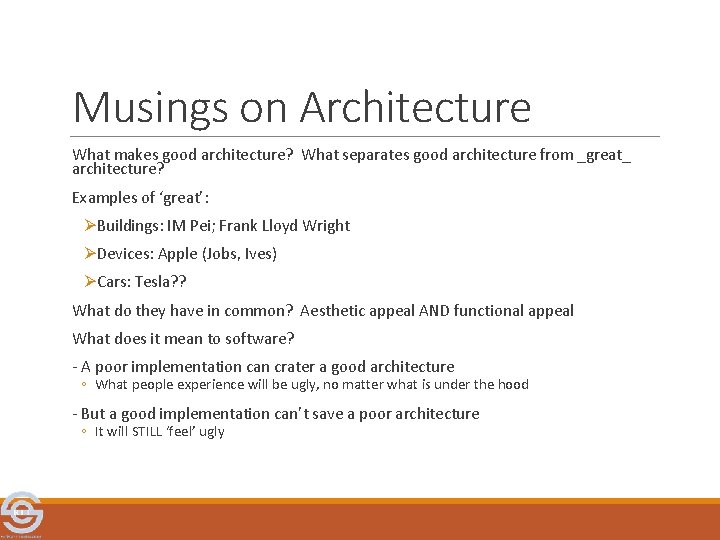
Musings on Architecture What makes good architecture? What separates good architecture from _great_ architecture? Examples of ‘great’: ØBuildings: IM Pei; Frank Lloyd Wright ØDevices: Apple (Jobs, Ives) ØCars: Tesla? ? What do they have in common? Aesthetic appeal AND functional appeal What does it mean to software? - A poor implementation can crater a good architecture ◦ What people experience will be ugly, no matter what is under the hood - But a good implementation can’t save a poor architecture ◦ It will STILL ‘feel’ ugly
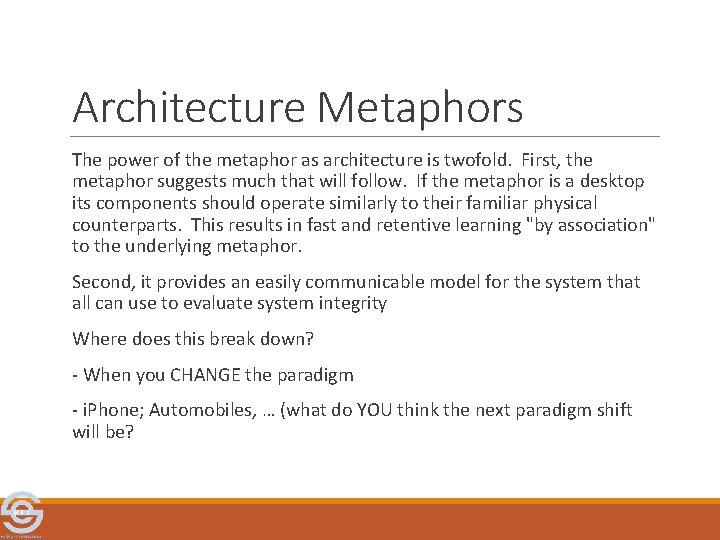
Architecture Metaphors The power of the metaphor as architecture is twofold. First, the metaphor suggests much that will follow. If the metaphor is a desktop its components should operate similarly to their familiar physical counterparts. This results in fast and retentive learning "by association" to the underlying metaphor. Second, it provides an easily communicable model for the system that all can use to evaluate system integrity Where does this break down? - When you CHANGE the paradigm - i. Phone; Automobiles, … (what do YOU think the next paradigm shift will be?
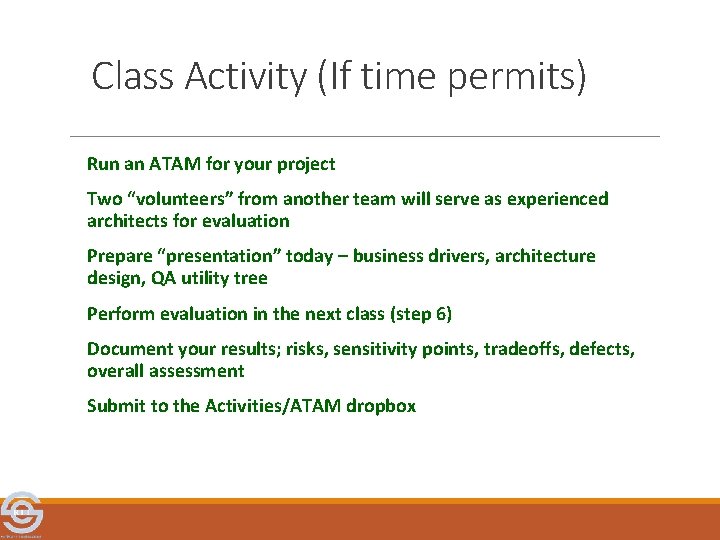
Class Activity (If time permits) Run an ATAM for your project Two “volunteers” from another team will serve as experienced architects for evaluation Prepare “presentation” today – business drivers, architecture design, QA utility tree Perform evaluation in the next class (step 6) Document your results; risks, sensitivity points, tradeoffs, defects, overall assessment Submit to the Activities/ATAM dropbox
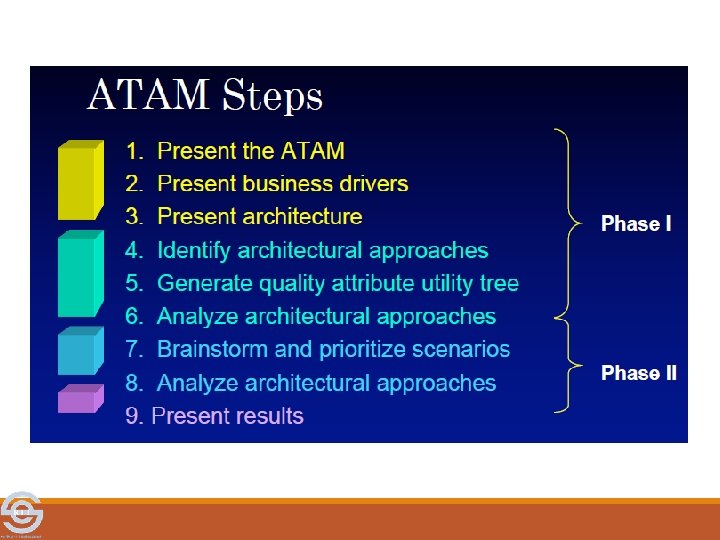
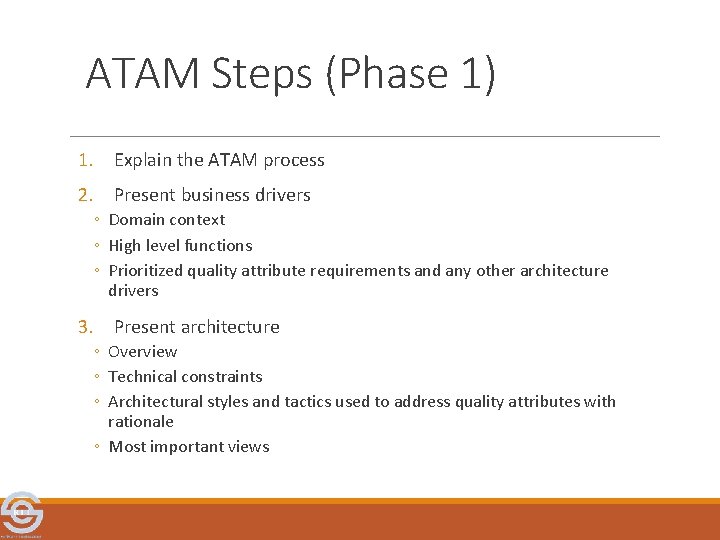
ATAM Steps (Phase 1) 1. Explain the ATAM process 2. Present business drivers ◦ Domain context ◦ High level functions ◦ Prioritized quality attribute requirements and any other architecture drivers 3. Present architecture ◦ Overview ◦ Technical constraints ◦ Architectural styles and tactics used to address quality attributes with rationale ◦ Most important views
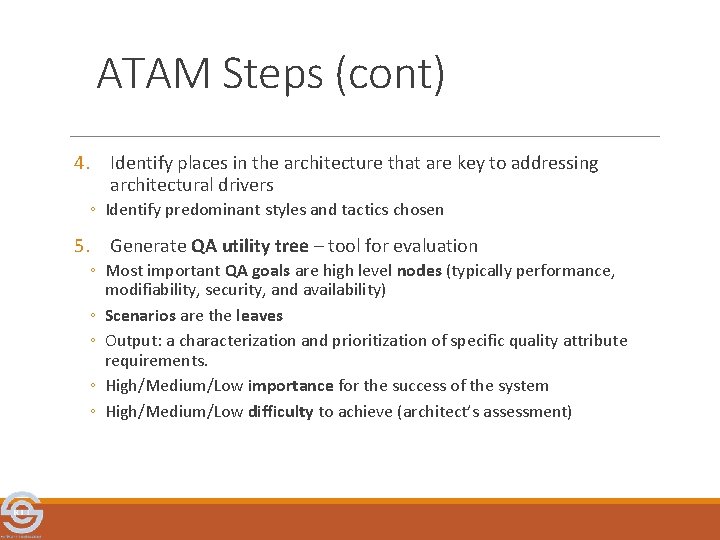
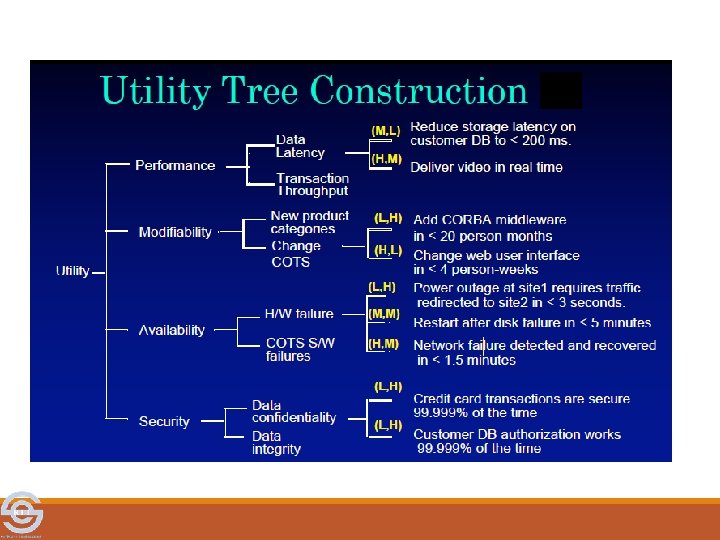
ATAM Steps (cont) 4. Identify places in the architecture that are key to addressing architectural drivers ◦ Identify predominant styles and tactics chosen 5. Generate QA utility tree – tool for evaluation ◦ Most important QA goals are high level nodes (typically performance, modifiability, security, and availability) ◦ Scenarios are the leaves ◦ Output: a characterization and prioritization of specific quality attribute requirements. ◦ High/Medium/Low importance for the success of the system ◦ High/Medium/Low difficulty to achieve (architect’s assessment)
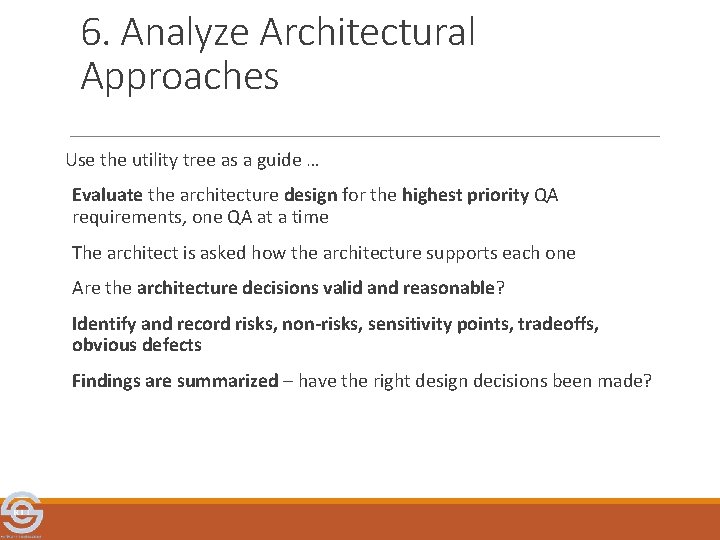
6. Analyze Architectural Approaches Use the utility tree as a guide … Evaluate the architecture design for the highest priority QA requirements, one QA at a time The architect is asked how the architecture supports each one Are the architecture decisions valid and reasonable? Identify and record risks, non-risks, sensitivity points, tradeoffs, obvious defects Findings are summarized – have the right design decisions been made?
7, 8, 9: Brainstorm, Re-analyze, Present All stakeholders participate Phase 1 results are summarized Stakeholders brainstorm scenarios important to them Generated scenarios are consolidated, compared to the utility tree, and prioritized. The architecture analysis process is repeated Summarize and present results ( and presumably adjust the architecture as a consequence)