
Architecture CSE 403 Fallingwater by Frank Lloyd Wright
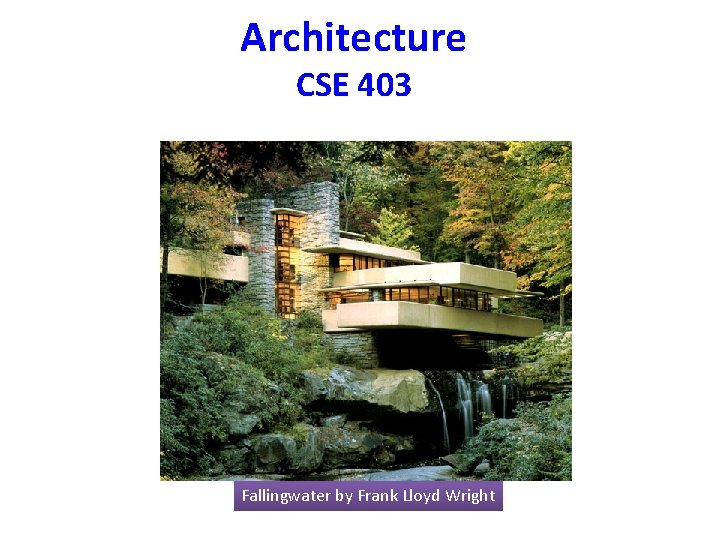
Architecture CSE 403 Fallingwater by Frank Lloyd Wright
Why architecture? “Good software architecture makes the rest of the project easy. ” Steve Mc. Connell, Survival Guide “There are two ways of constructing a software design: one way is to make it so simple that there are obviously no deficiencies; the other is to make it so complicated that there are no obvious deficiencies. ” C. A. R. Hoare (1985)
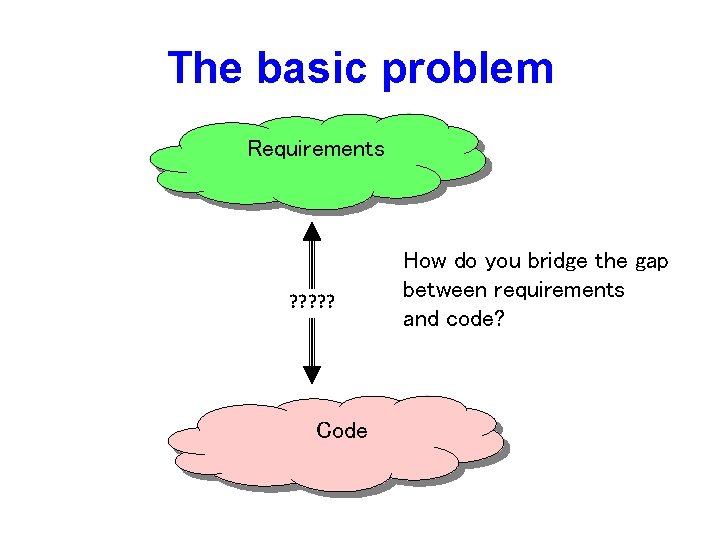
The basic problem Requirements ? ? ? Code How do you bridge the gap between requirements and code?
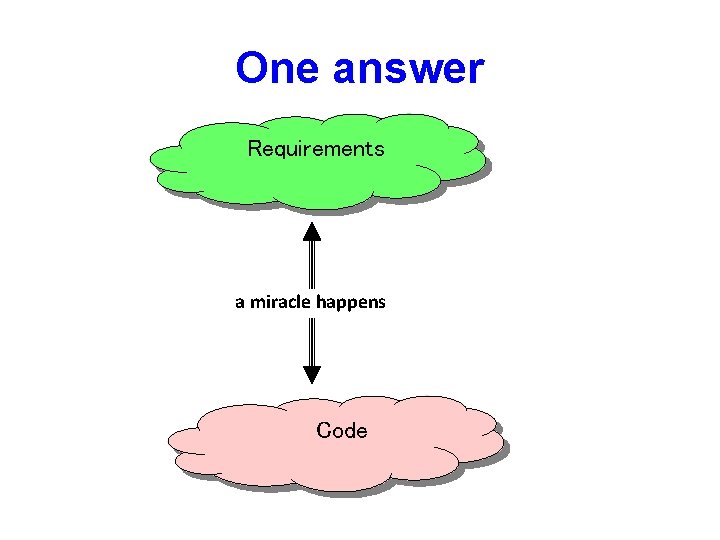
One answer Requirements a miracle happens Code
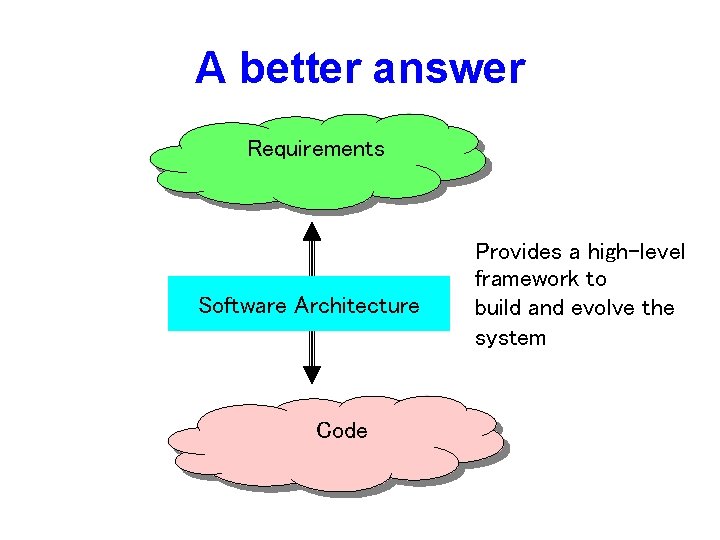
A better answer Requirements Software Architecture Code Provides a high-level framework to build and evolve the system
What does an architecture look like?
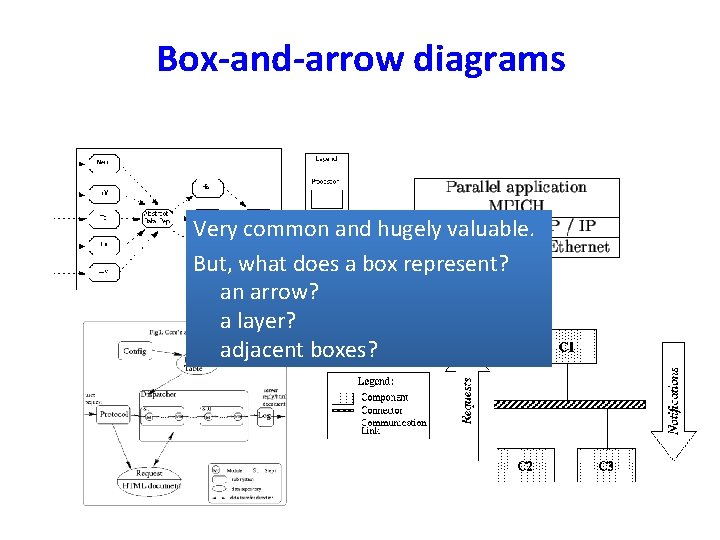
Box-and-arrow diagrams Very common and hugely valuable. But, what does a box represent? an arrow? a layer? adjacent boxes?
An architecture: components and connectors • Components define the basic computations comprising the system and their behaviors – abstract data types, filters, etc. • Connectors define the interconnections between components – procedure call, event announcement, asynchronous message sends, etc. • The line between them may be fuzzy at times – Ex: A connector might (de)serialize data, but can it perform other, richer computations?
UML diagrams • UML = universal modeling language • A standardized way to describe (draw) architecture – Also implementation details such as subclassing, uses (dependences), and much more • Widely used in industry • Topic of next lecture
A good architecture • Satisfies functional and performance requirements • Manages complexity • Accommodates future change • Is concerned with – reliability, safety, understandability, compatibility, robustness, … 10
Divide and conquer • Benefits of decomposition: – Decrease size of tasks – Support independent testing and analysis – Separate work assignments – Ease understanding • Use of abstraction leads to modularity – Implementation techniques: information hiding, interfaces • To achieve modularity, you need: – Strong cohesion within a component – Loose coupling between components – And these properties should be true at each level
An architecture helps with System understanding: interactions between modules Reuse: high-level view shows opportunity for reuse Construction: breaks development down into work items; provides a path from requirements to code Evolution: high-level view shows evolution path Management: helps understand work items and track progress Communication: provides vocabulary; a picture says 1000 words
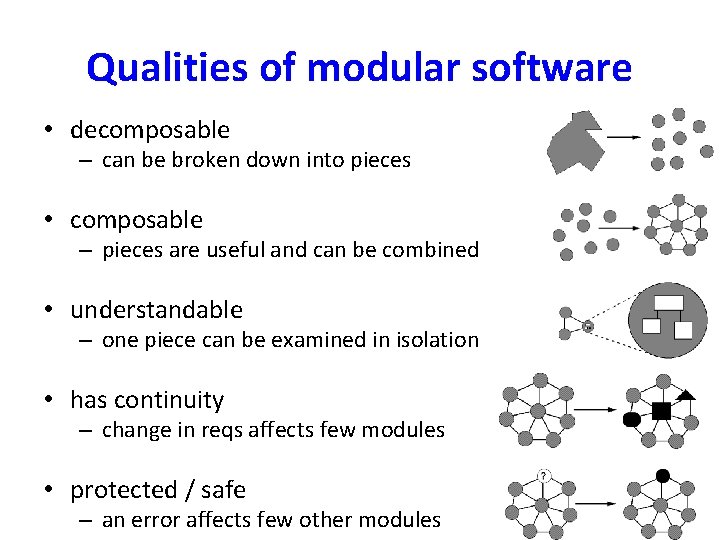
Qualities of modular software • decomposable – can be broken down into pieces • composable – pieces are useful and can be combined • understandable – one piece can be examined in isolation • has continuity – change in reqs affects few modules • protected / safe – an error affects few other modules
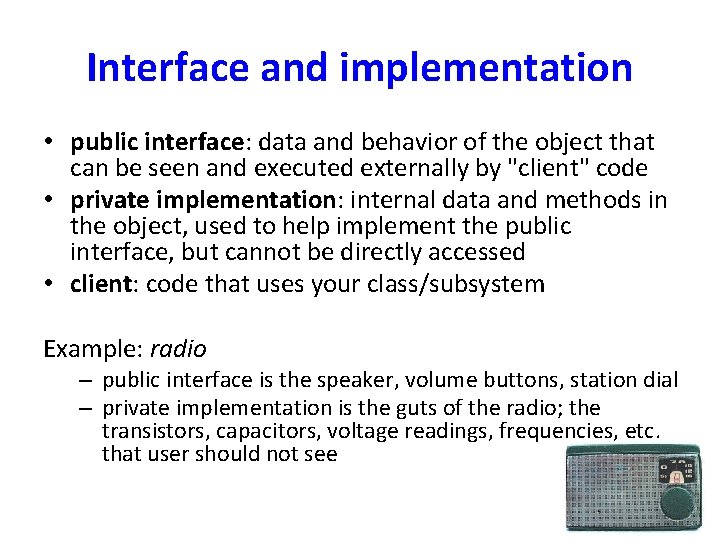
Interface and implementation • public interface: data and behavior of the object that can be seen and executed externally by "client" code • private implementation: internal data and methods in the object, used to help implement the public interface, but cannot be directly accessed • client: code that uses your class/subsystem Example: radio – public interface is the speaker, volume buttons, station dial – private implementation is the guts of the radio; the transistors, capacitors, voltage readings, frequencies, etc. that user should not see 14
Properties of architecture • • • Coupling Cohesion Style conformity Matching Errosion
Loose coupling • Coupling: the kind and quantity of interconnections among modules • Modules that are loosely coupled (or uncoupled) are better than those that are tightly coupled • The more tightly coupled two modules are, the harder it is to work with them separately
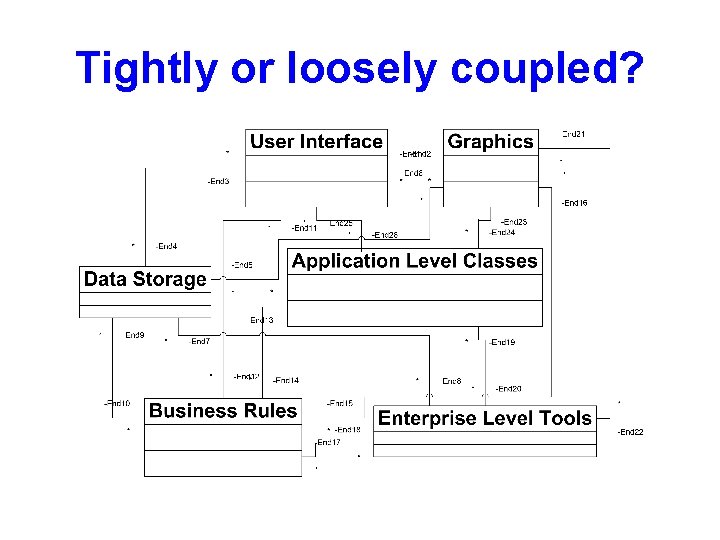
Tightly or loosely coupled?
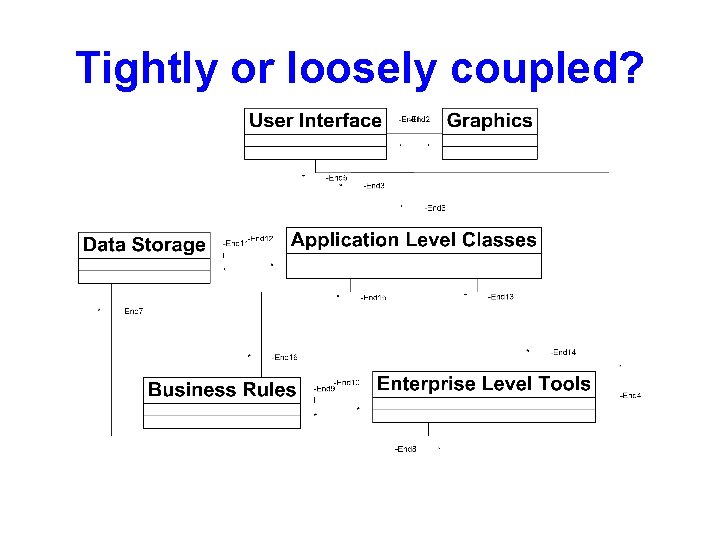
Tightly or loosely coupled?
Strong cohesion • Cohesion: how closely the operations in a module are related • Tight relationships improve clarity and understanding • Classes with good abstraction usually have strong cohension • No schizophrenic classes!
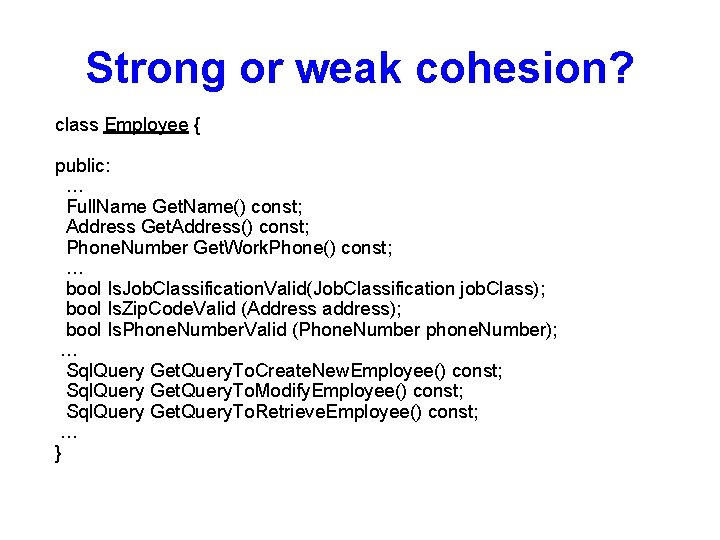
Strong or weak cohesion? class Employee { public: … Full. Name Get. Name() const; Address Get. Address() const; Phone. Number Get. Work. Phone() const; … bool Is. Job. Classification. Valid(Job. Classification job. Class); bool Is. Zip. Code. Valid (Address address); bool Is. Phone. Number. Valid (Phone. Number phone. Number); … Sql. Query Get. Query. To. Create. New. Employee() const; Sql. Query Get. Query. To. Modify. Employee() const; Sql. Query Get. Query. To. Retrieve. Employee() const; … }
Architectural style • Defines the vocabulary of components and connectors for a family (style) • Constraints on the elements and their combination – Topological constraints (no cycles, register/announce relationships, etc. ) – Execution constraints (timing, etc. ) • By choosing a style, one gets all the known properties of that style (for any architecture in that style) – Ex: performance, lack of deadlock, ease of making particular classes of changes, etc.
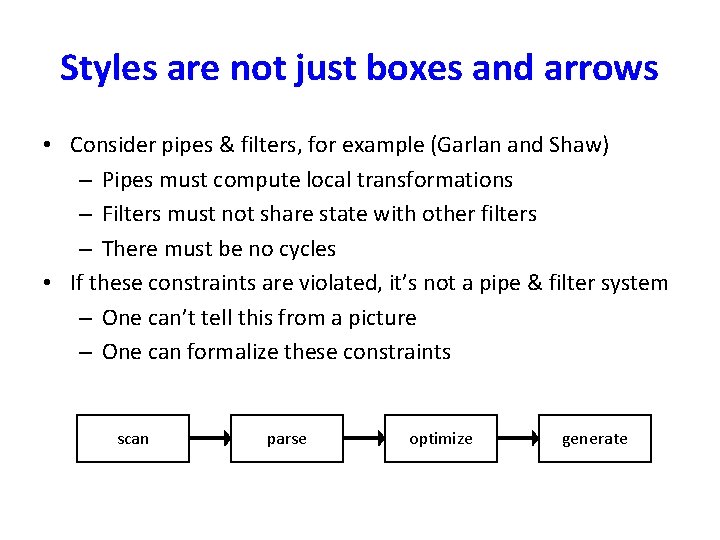
Styles are not just boxes and arrows • Consider pipes & filters, for example (Garlan and Shaw) – Pipes must compute local transformations – Filters must not share state with other filters – There must be no cycles • If these constraints are violated, it’s not a pipe & filter system – One can’t tell this from a picture – One can formalize these constraints scan parse optimize generate
The design and the reality • The code is often less clean the design • The design is still useful – communication among team members – selected deviations can be explained more concisely and with clearer reasoning
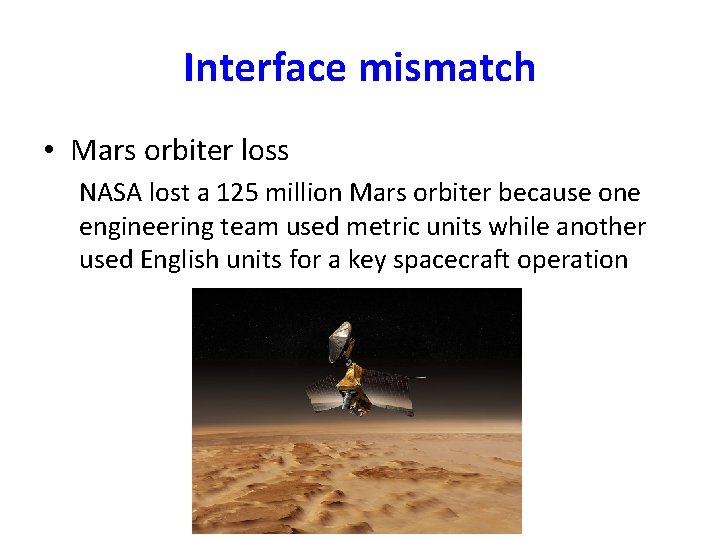
Interface mismatch • Mars orbiter loss NASA lost a 125 million Mars orbiter because one engineering team used metric units while another used English units for a key spacecraft operation
Architectural mismatch • • Garlan, Allen, Ockerbloom tried to build a toolset to support software architecture definition from existing components – OODB (OBST) – graphical user interface toolkit (Interviews) – RPC mechanism (MIG/Mach RPC) – Event-based tool integration mechanism (Softbench) It went to hell in a handbasket, not because the pieces didn’t work, but because they didn’t fit together – – • • Excessive code size Poor performance Needed to modify out-of-the-box components (e. g. , memory allocation) Error-prone construction process Architectural Mismatch: Why Reuse Is So Hard. IEEE Software 12, 6 (Nov. 1995) Architecture should warn about such problems (& identify problems)
Views A • • view illuminates a set of top-level design decisions how the system is composed of interacting parts where are the main pathways of interaction key properties of the parts information to allow high-level analysis and appraisal
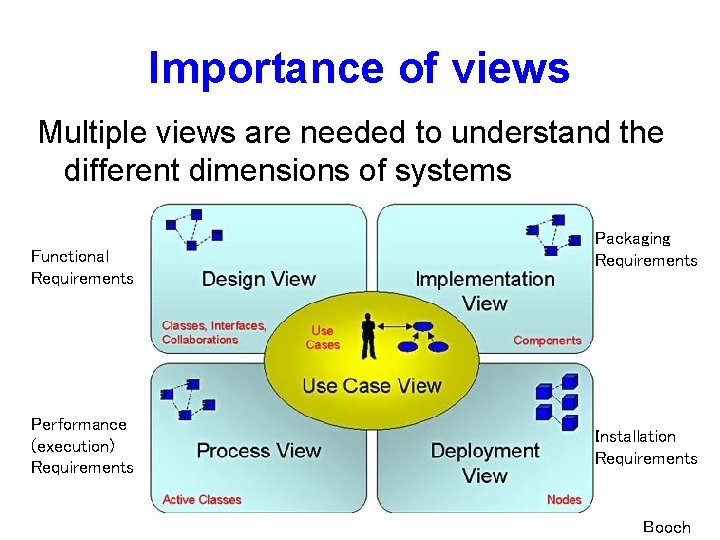
Importance of views Multiple views are needed to understand the different dimensions of systems Functional Requirements Performance (execution) Requirements Packaging Requirements Installation Requirements Booch
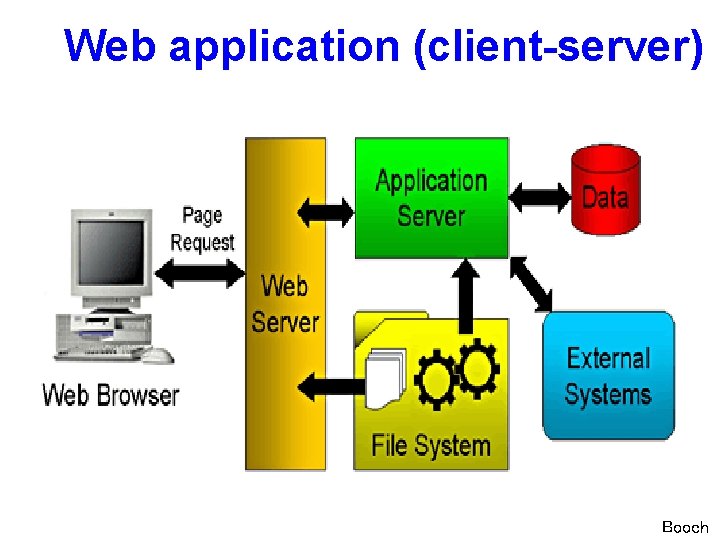
Web application (client-server) Booch
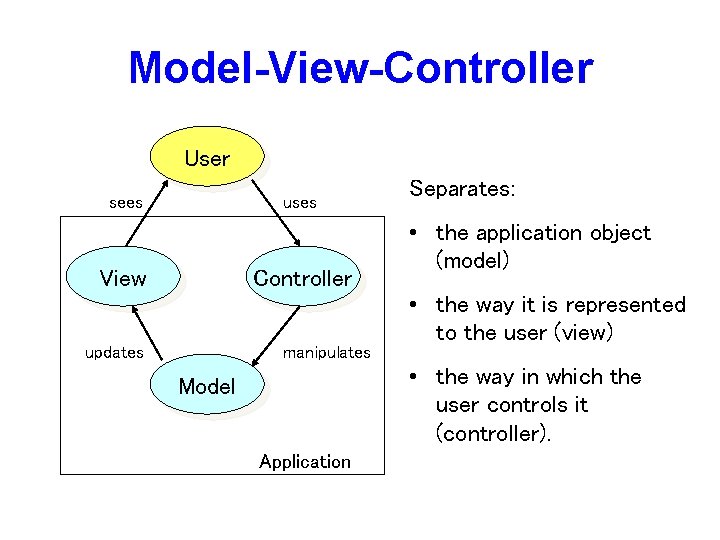
Model-View-Controller User sees uses View Controller updates manipulates Separates: • the application object (model) • the way it is represented to the user (view) • the way in which the user controls it (controller). Model Application
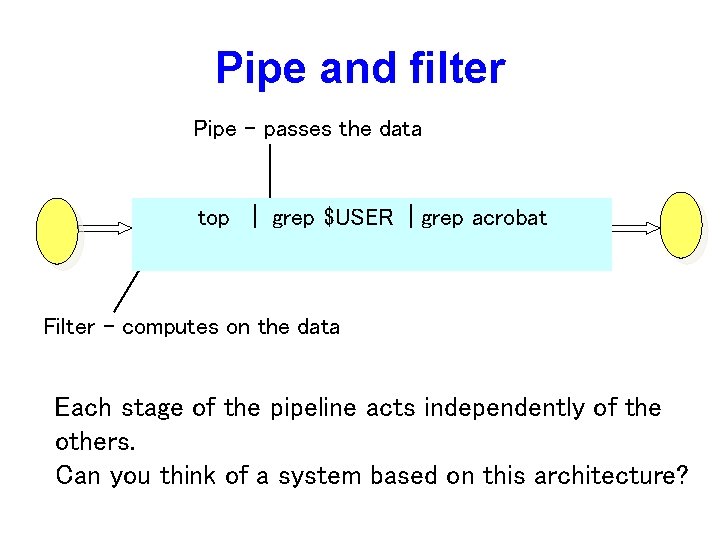
Pipe and filter Pipe – passes the data top | grep $USER | grep acrobat , , , Filter - computes on the data Each stage of the pipeline acts independently of the others. Can you think of a system based on this architecture?
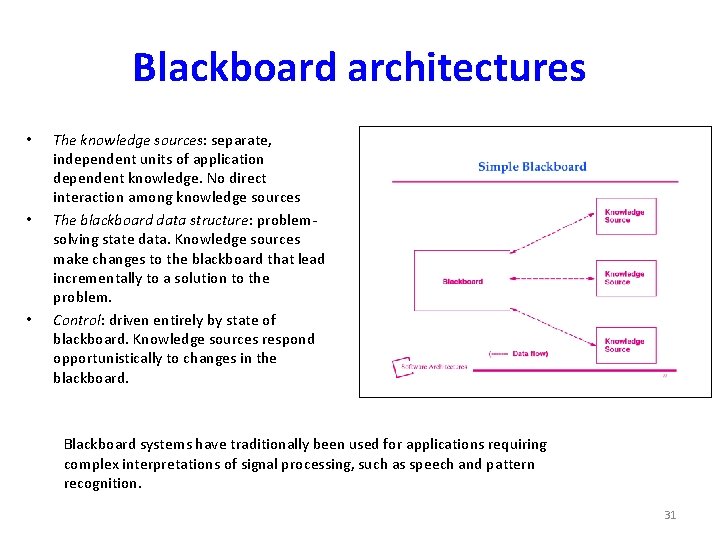
Blackboard architectures • • • The knowledge sources: separate, independent units of application dependent knowledge. No direct interaction among knowledge sources The blackboard data structure: problemsolving state data. Knowledge sources make changes to the blackboard that lead incrementally to a solution to the problem. Control: driven entirely by state of blackboard. Knowledge sources respond opportunistically to changes in the blackboard. Blackboard systems have traditionally been used for applications requiring complex interpretations of signal processing, such as speech and pattern recognition. 31
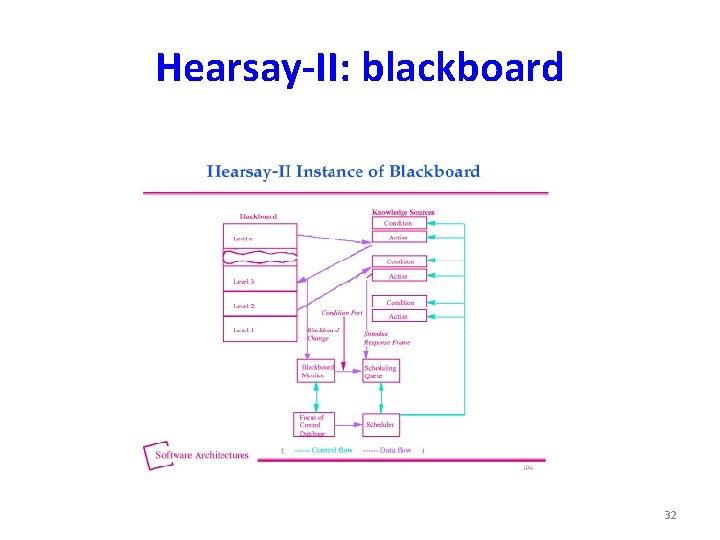
Hearsay-II: blackboard 32
- Slides: 32