
Architecture Basic Structures What basic structures do architects
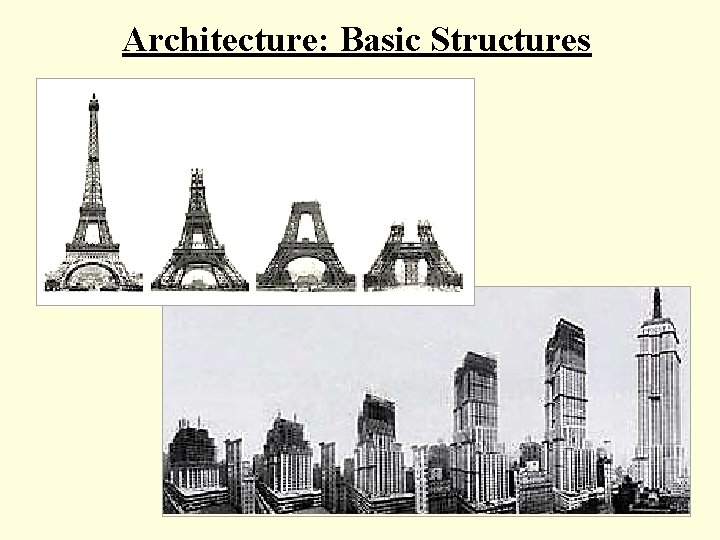
Architecture: Basic Structures
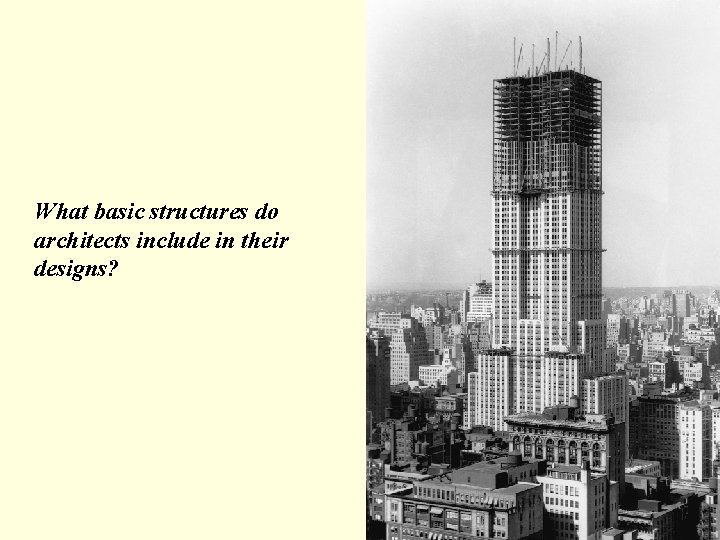
What basic structures do architects include in their designs?
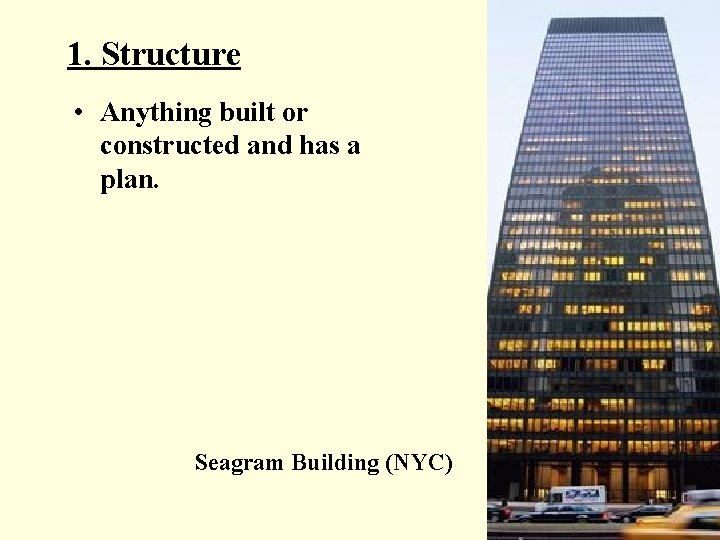
1. Structure • Anything built or constructed and has a plan. Seagram Building (NYC)
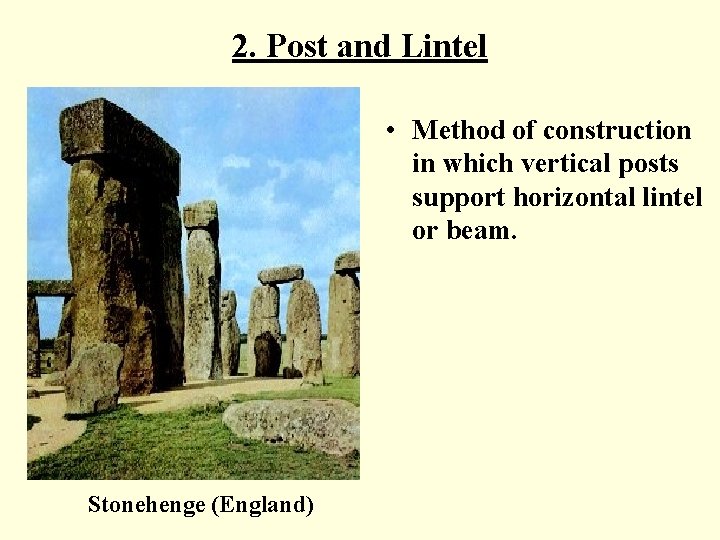
2. Post and Lintel • Method of construction in which vertical posts support horizontal lintel or beam. Stonehenge (England)
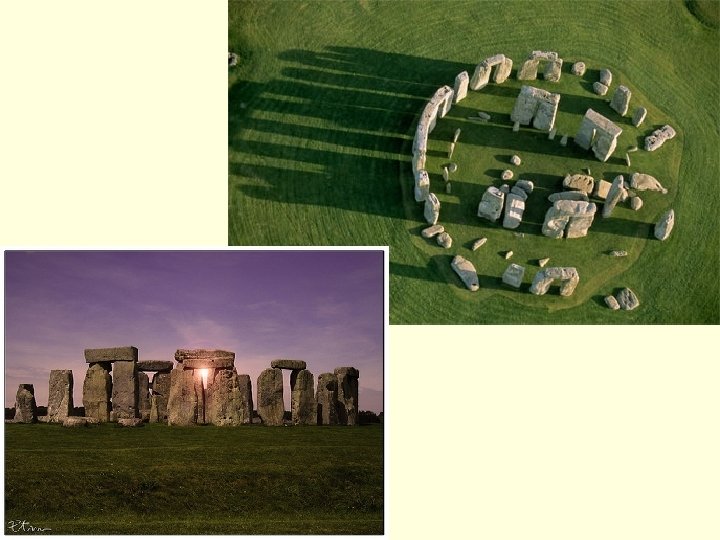
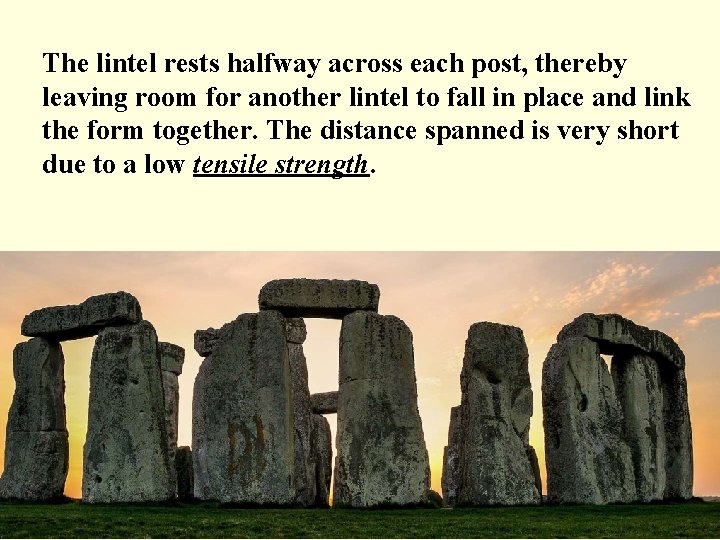
The lintel rests halfway across each post, thereby leaving room for another lintel to fall in place and link the form together. The distance spanned is very short due to a low tensile strength.
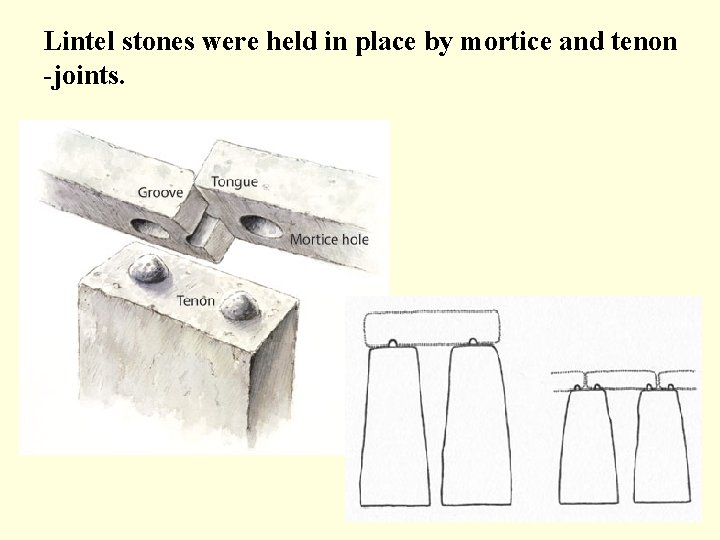
Lintel stones were held in place by mortice and tenon -joints.
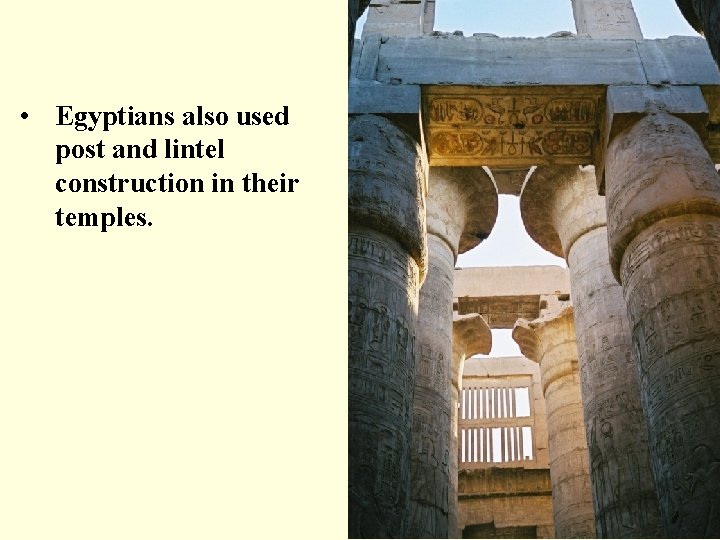
• Egyptians also used post and lintel construction in their temples.
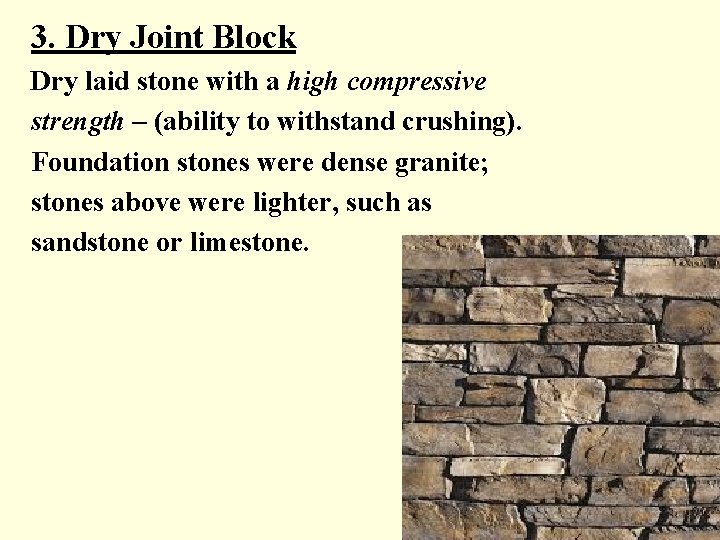
3. Dry Joint Block Dry laid stone with a high compressive strength – (ability to withstand crushing). Foundation stones were dense granite; stones above were lighter, such as sandstone or limestone.
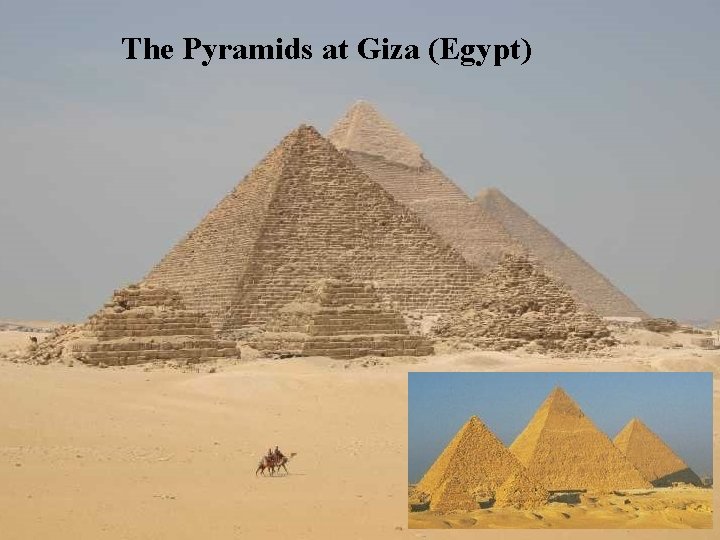
The Pyramids at Giza (Egypt)
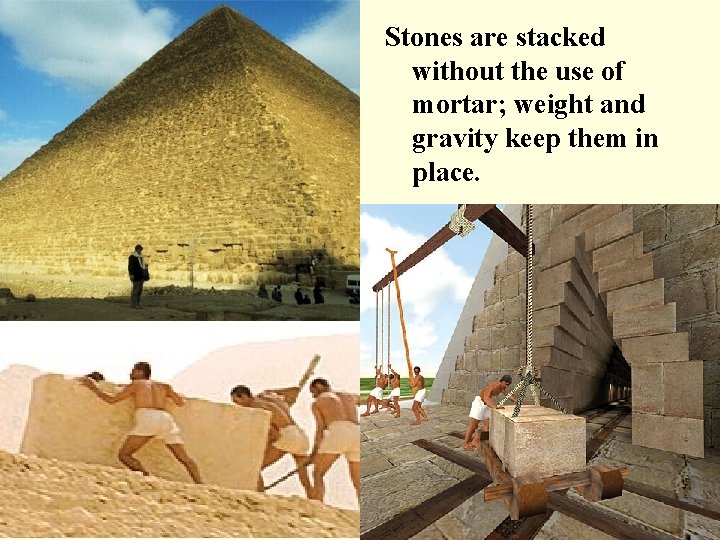
Stones are stacked without the use of mortar; weight and gravity keep them in place.
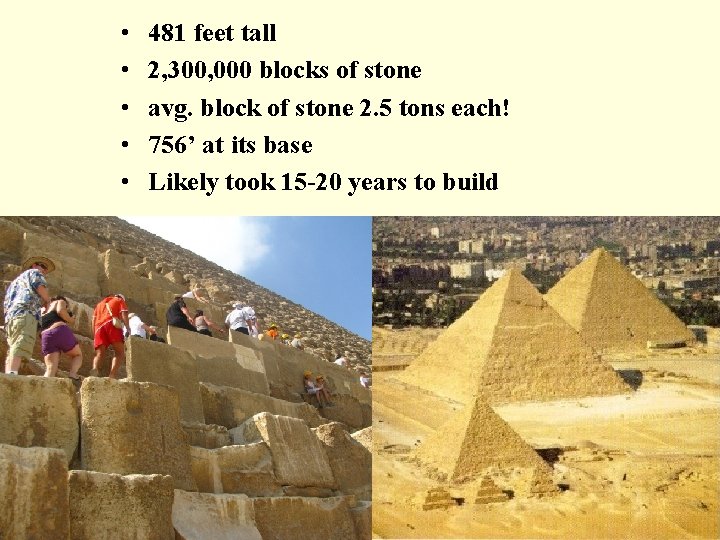
• • • 481 feet tall 2, 300, 000 blocks of stone avg. block of stone 2. 5 tons each! 756’ at its base Likely took 15 -20 years to build
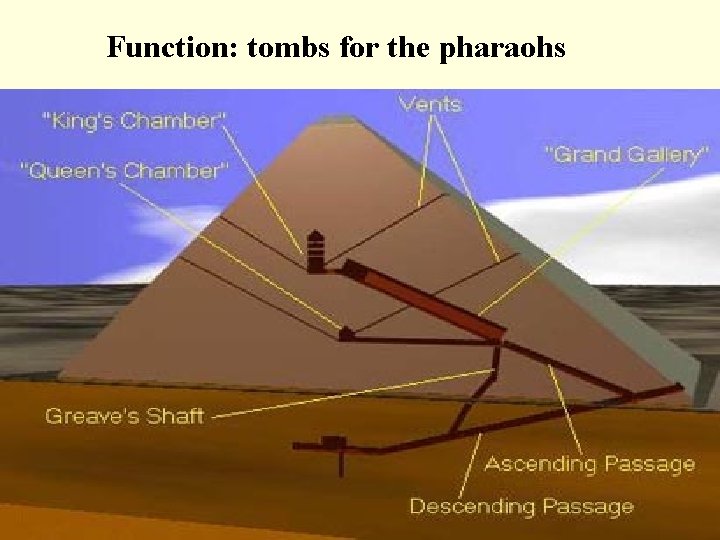
Function: tombs for the pharaohs
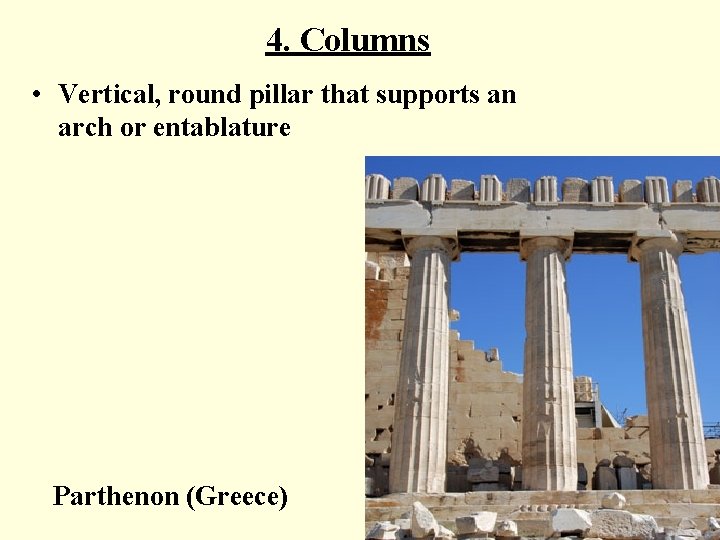
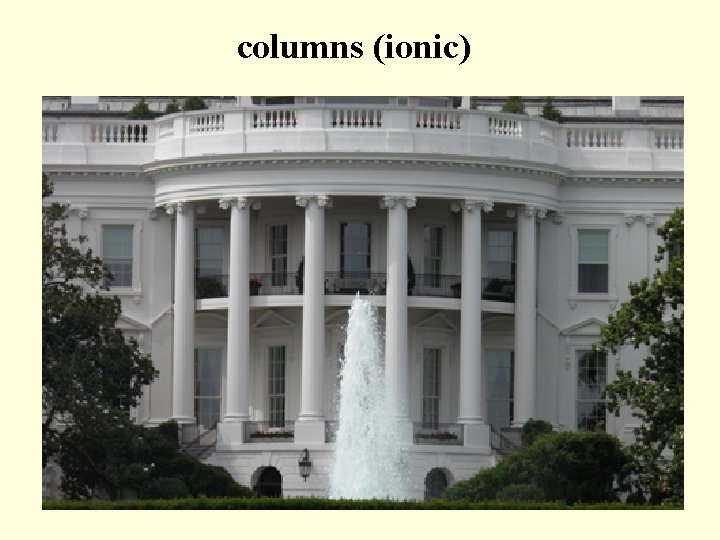
4. Columns • Vertical, round pillar that supports an arch or entablature Parthenon (Greece)
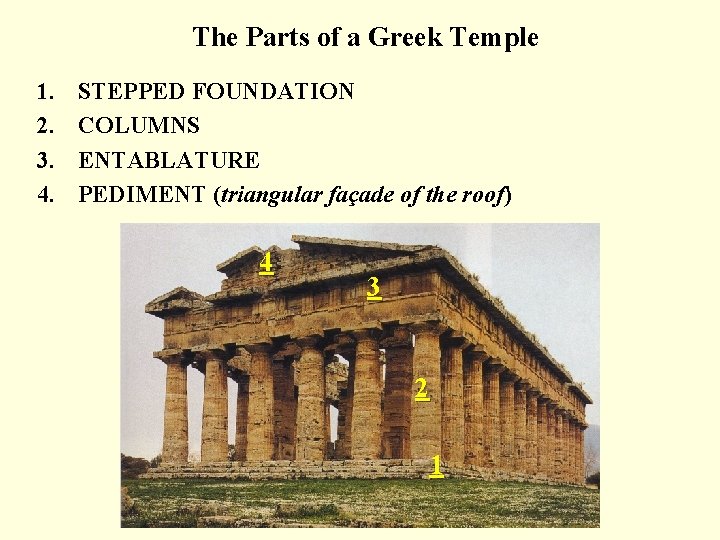
The Parts of a Greek Temple 1. 2. 3. 4. STEPPED FOUNDATION COLUMNS ENTABLATURE PEDIMENT (triangular façade of the roof) 4 3 2 1
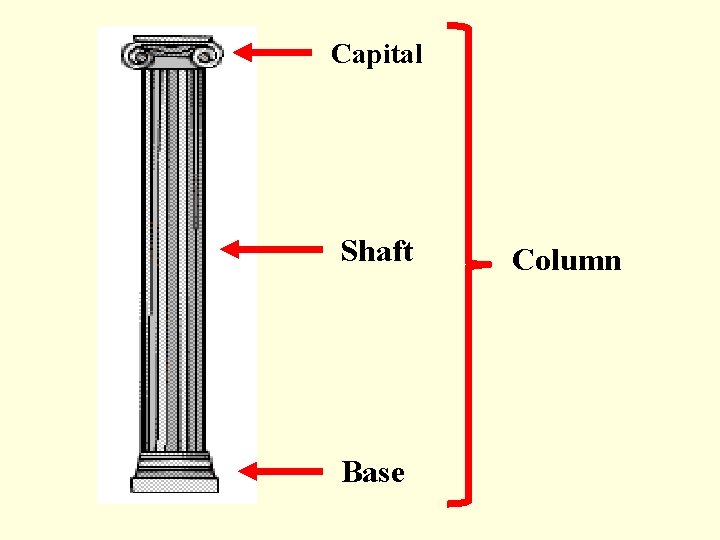
Capital Shaft Base Column
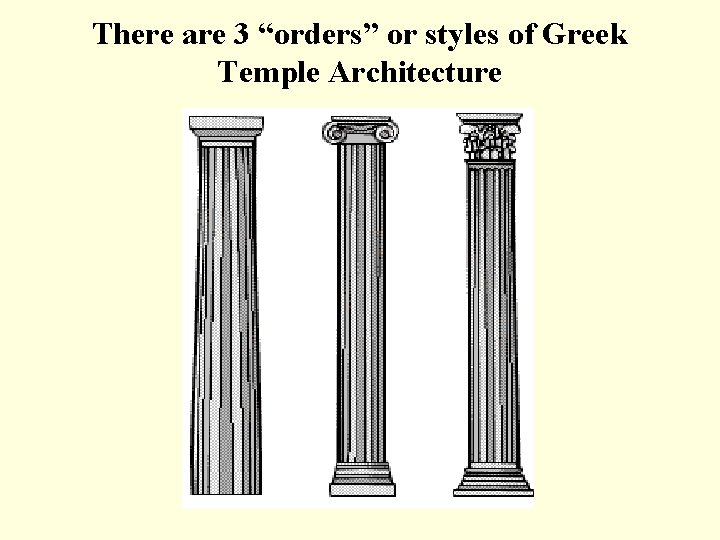
There are 3 “orders” or styles of Greek Temple Architecture
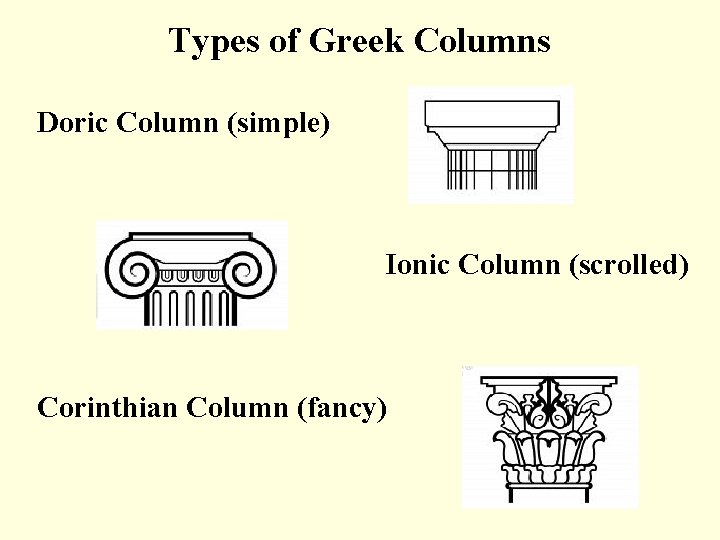
Types of Greek Columns Doric Column (simple) Ionic Column (scrolled) Corinthian Column (fancy)
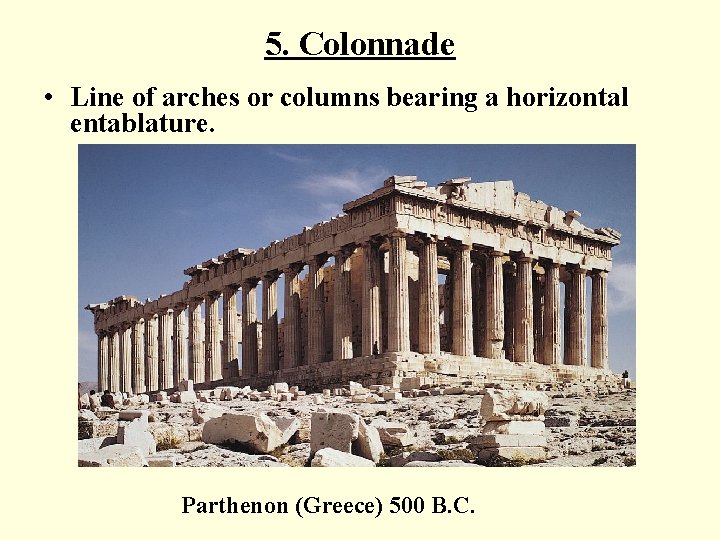
5. Colonnade • Line of arches or columns bearing a horizontal entablature. Parthenon (Greece) 500 B. C.
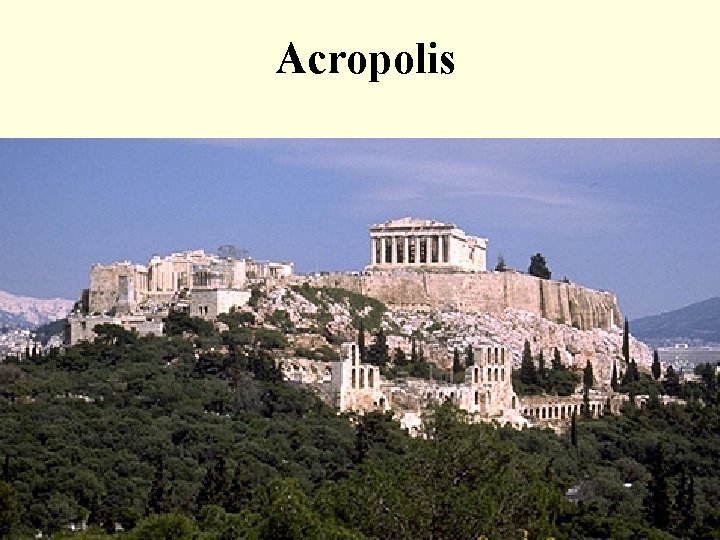
Acropolis
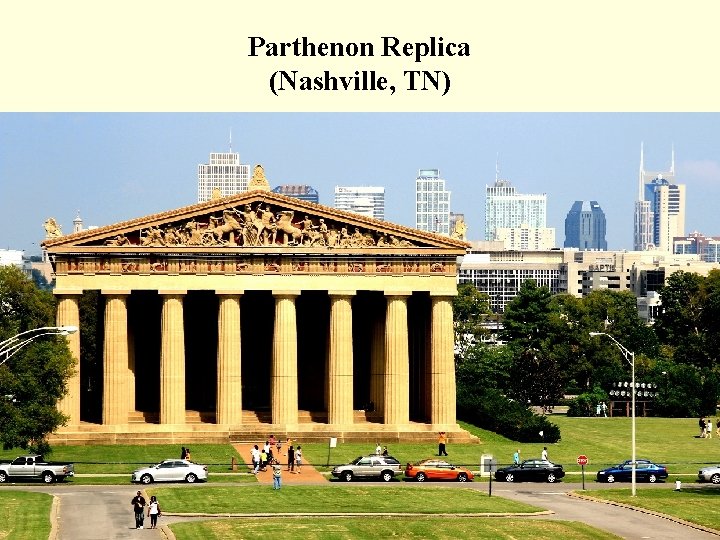
Parthenon Replica (Nashville, TN)
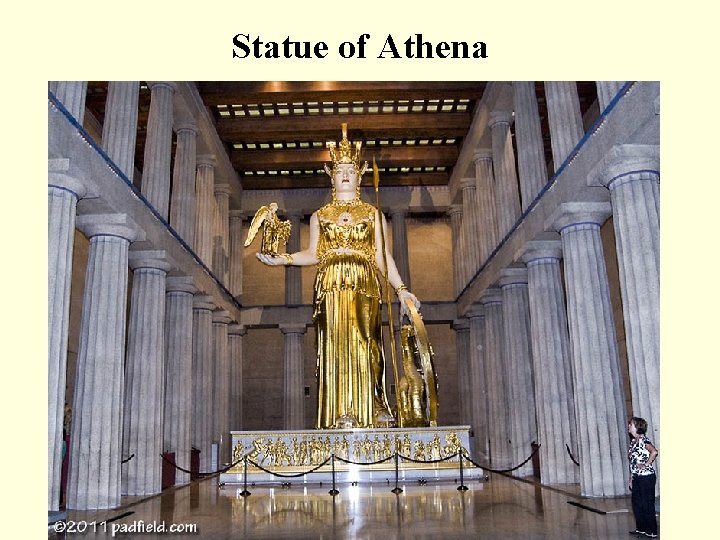
Statue of Athena
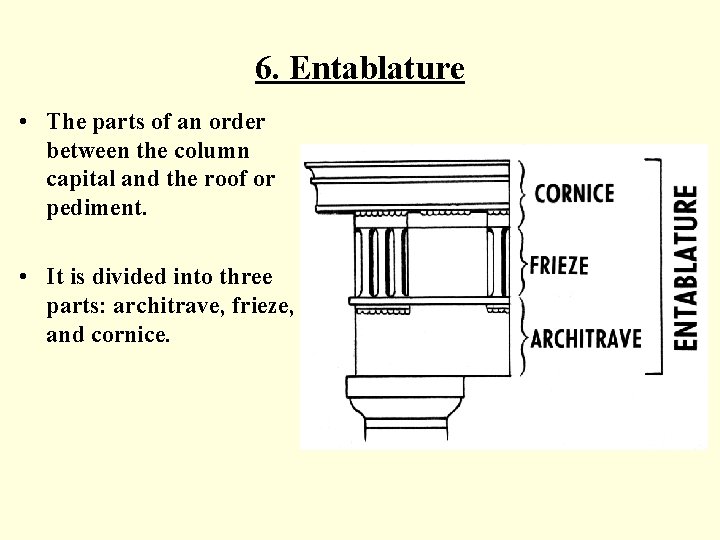
6. Entablature • The parts of an order between the column capital and the roof or pediment. • It is divided into three parts: architrave, frieze, and cornice.
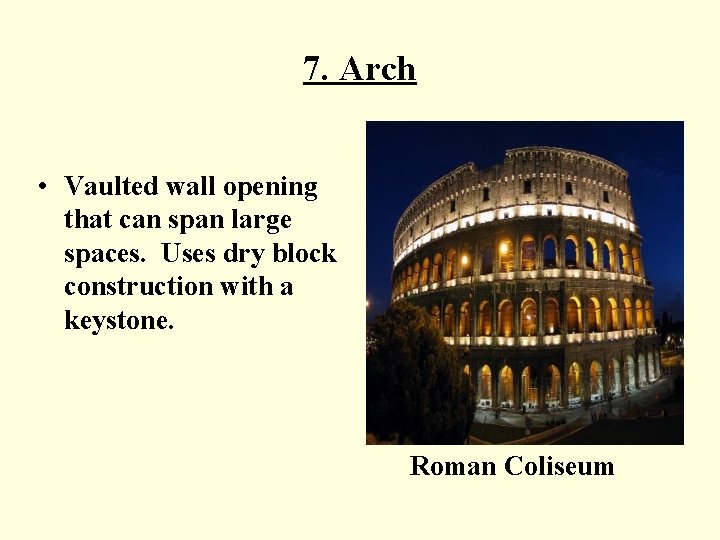
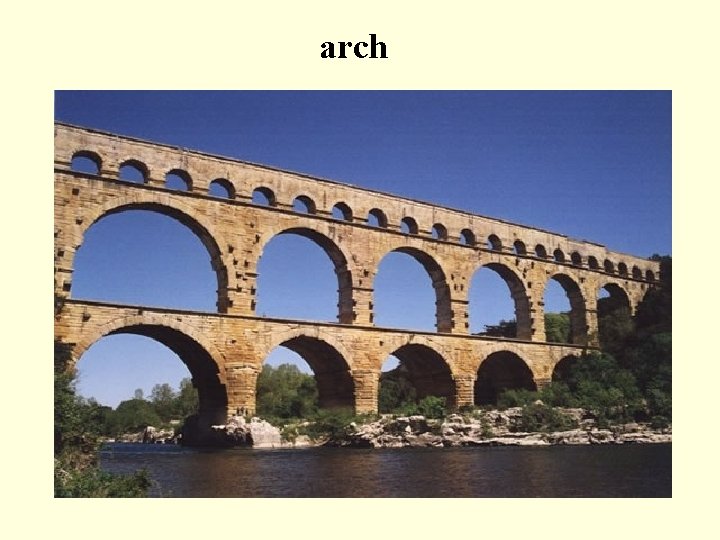
7. Arch • Vaulted wall opening that can span large spaces. Uses dry block construction with a keystone. Roman Coliseum
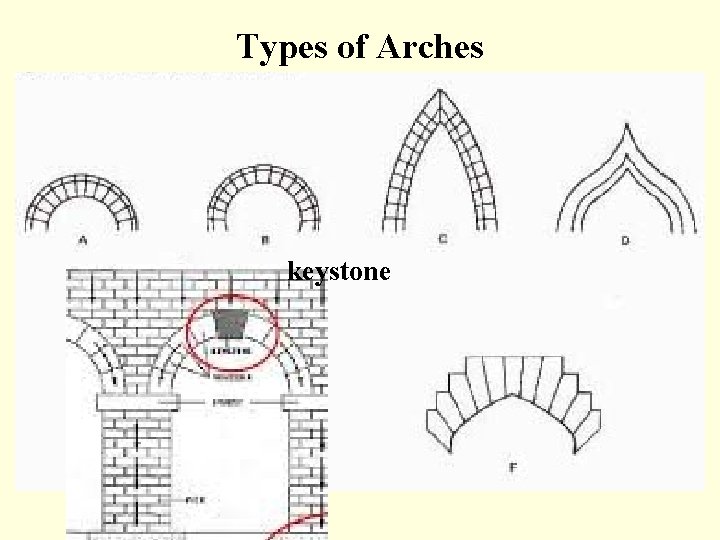
Types of Arches keystone
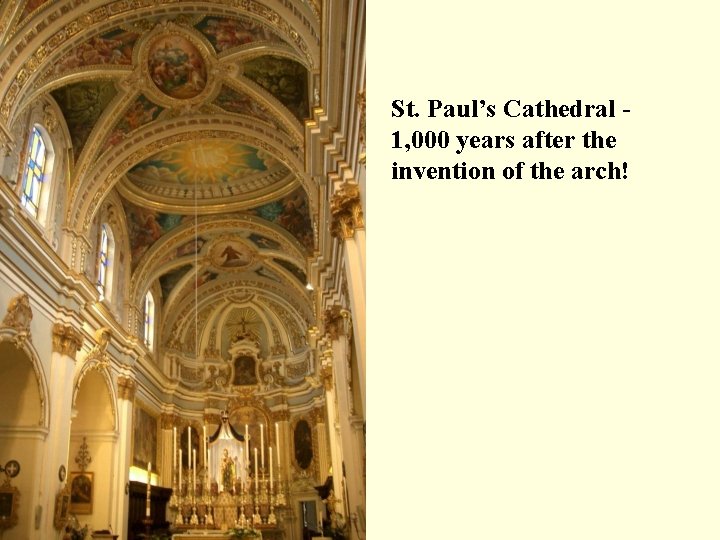
St. Paul’s Cathedral 1, 000 years after the invention of the arch!
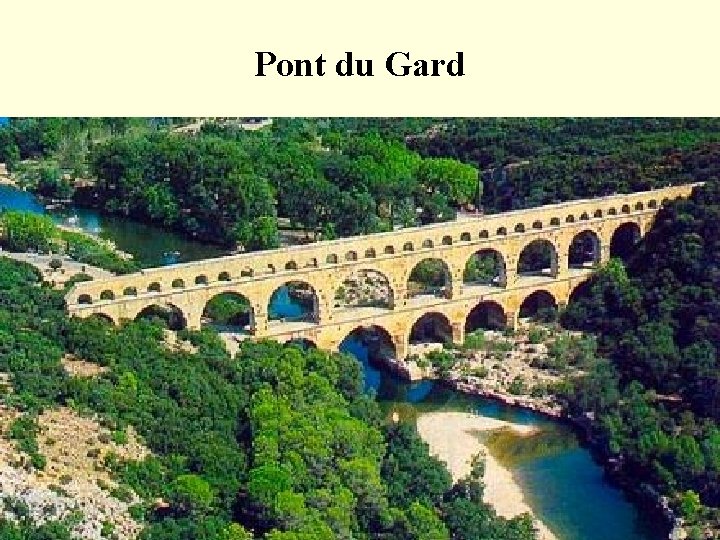
Pont du Gard
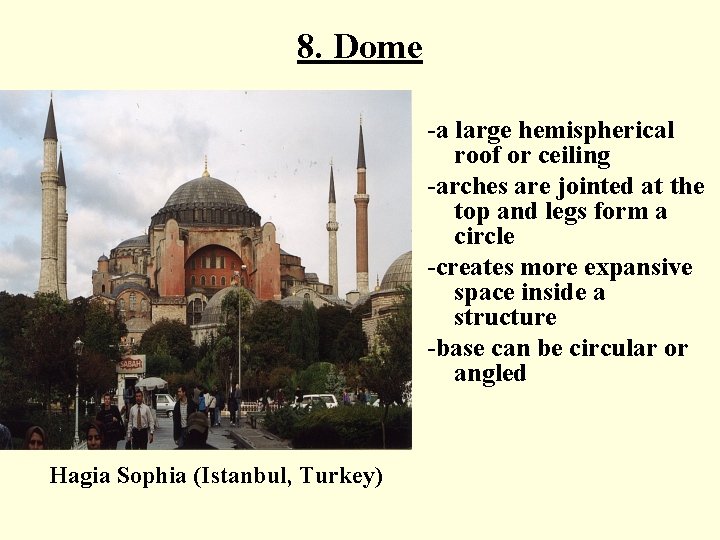
8. Dome -a large hemispherical roof or ceiling -arches are jointed at the top and legs form a circle -creates more expansive space inside a structure -base can be circular or angled Hagia Sophia (Istanbul, Turkey)
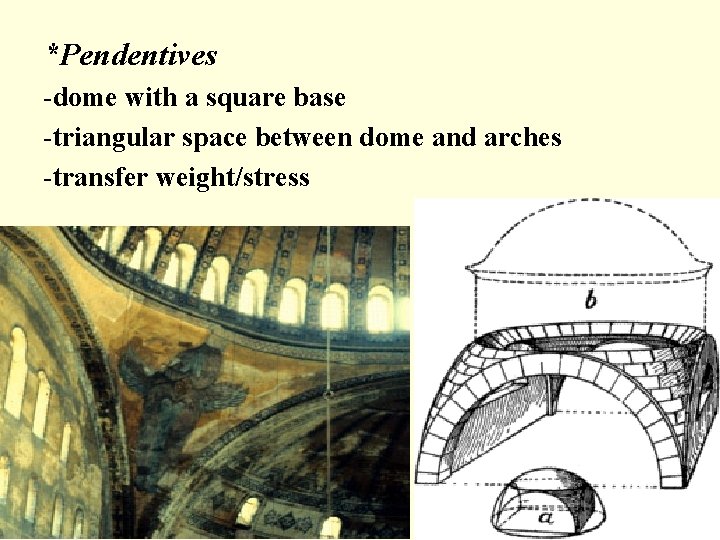
*Pendentives -dome with a square base -triangular space between dome and arches -transfer weight/stress
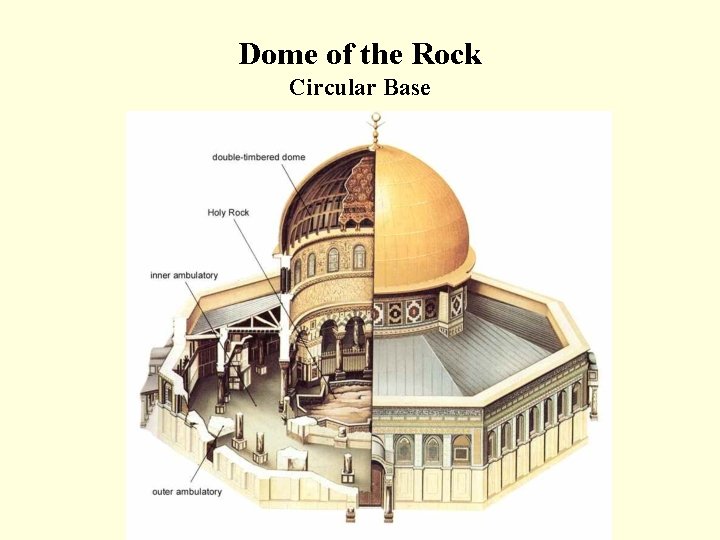
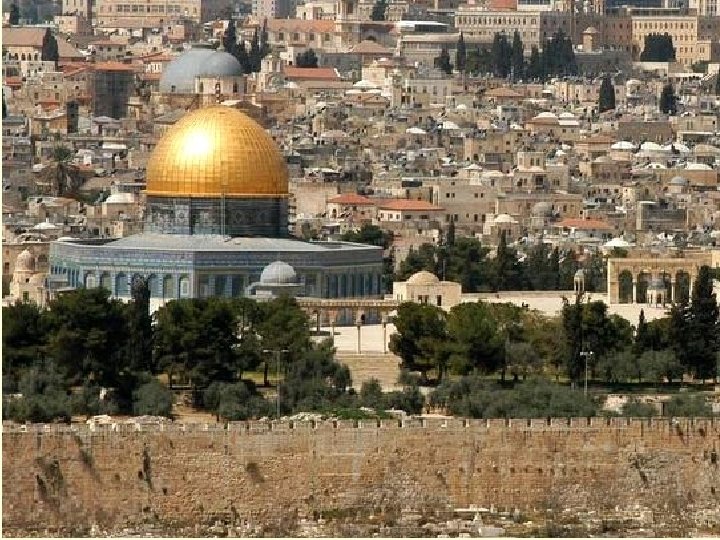
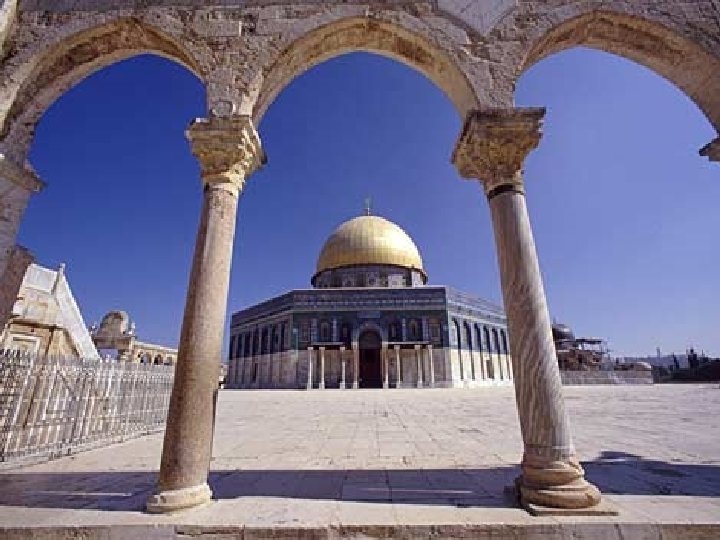
Dome of the Rock Circular Base
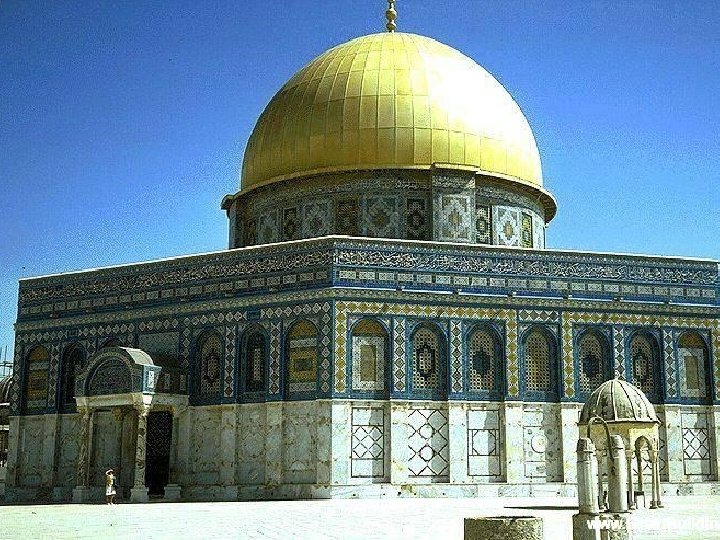
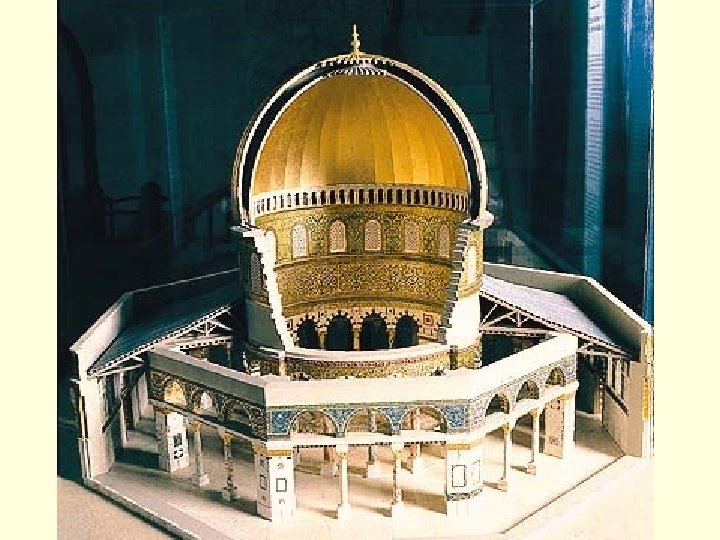
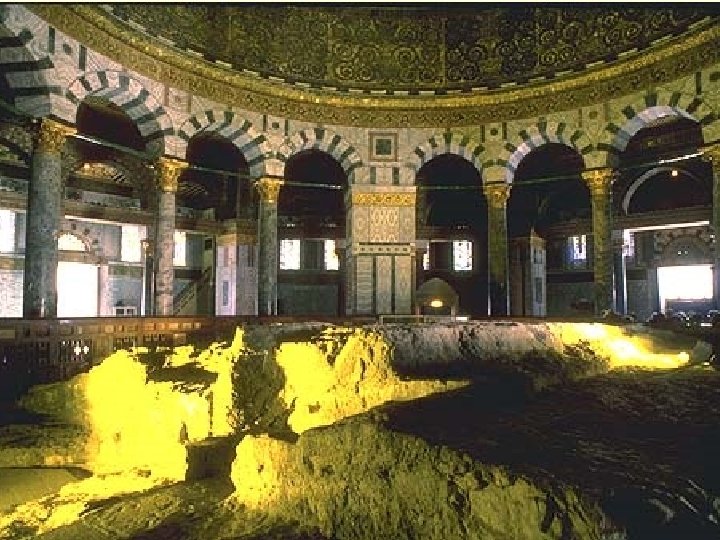
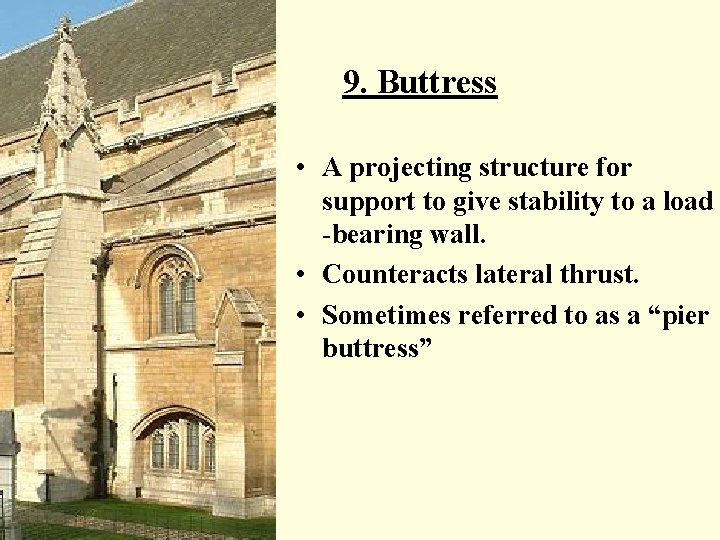
9. Buttress • A projecting structure for support to give stability to a load -bearing wall. • Counteracts lateral thrust. • Sometimes referred to as a “pier buttress”
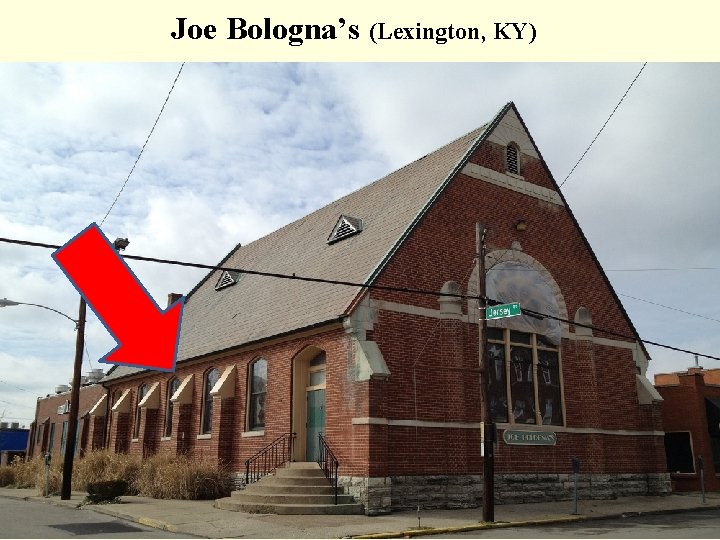
Joe Bologna’s (Lexington, KY)
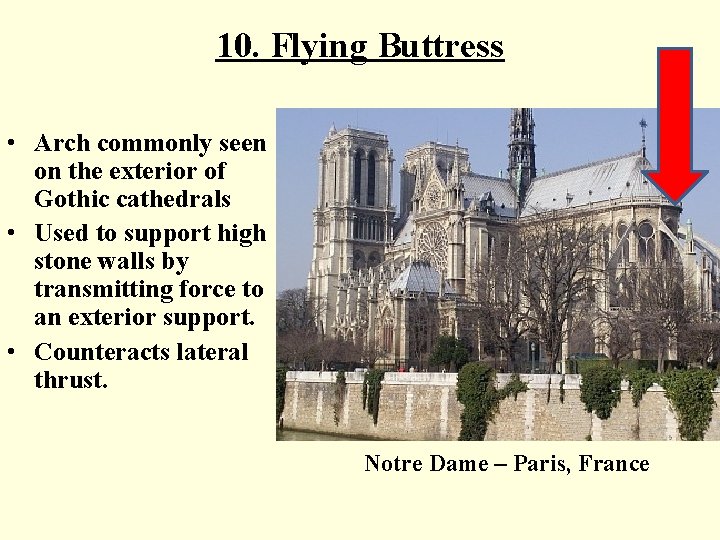
10. Flying Buttress • Arch commonly seen on the exterior of Gothic cathedrals • Used to support high stone walls by transmitting force to an exterior support. • Counteracts lateral thrust. Notre Dame – Paris, France
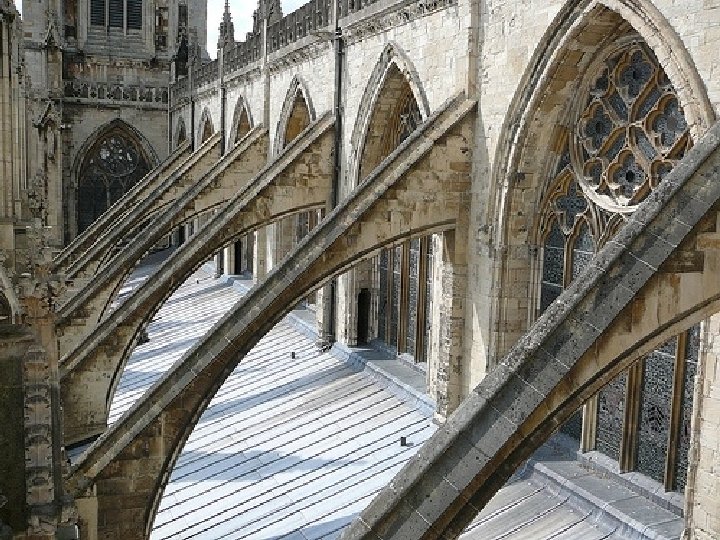
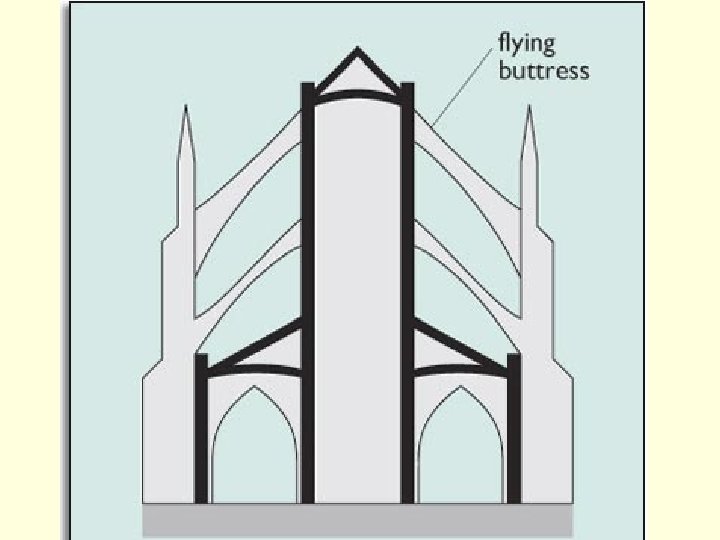
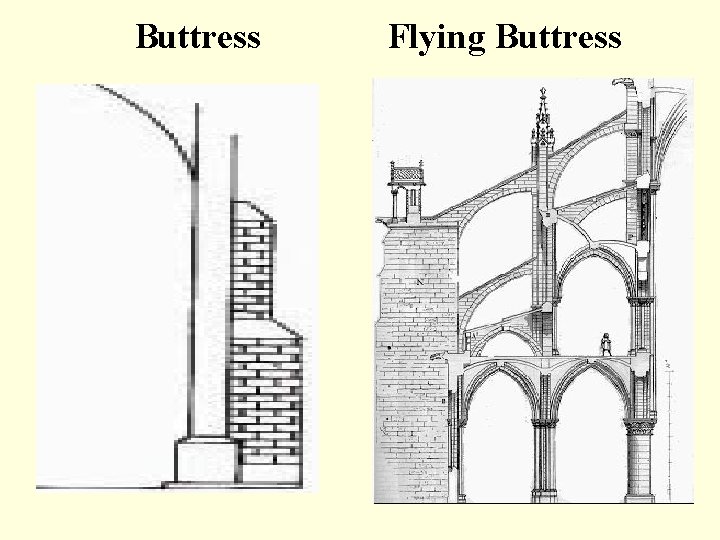
Buttress Flying Buttress
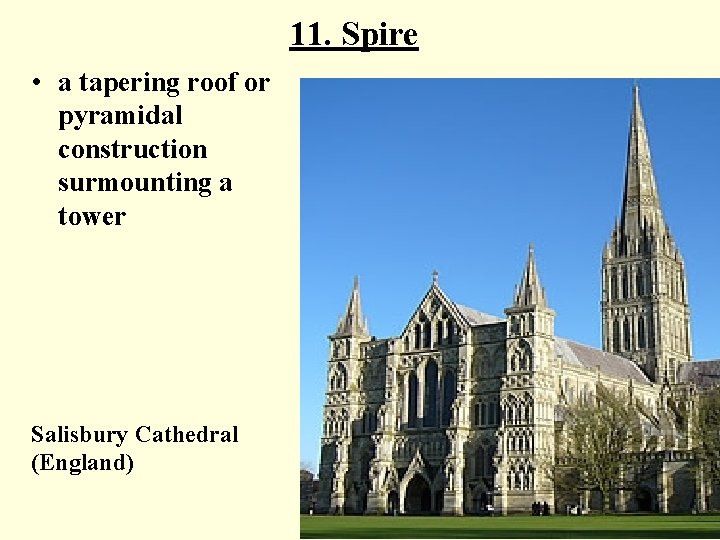
11. Spire • a tapering roof or pyramidal construction surmounting a tower Salisbury Cathedral (England)
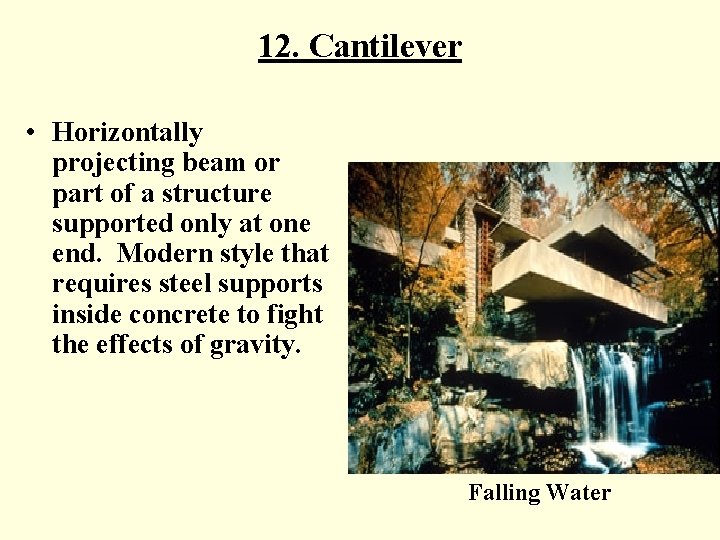
12. Cantilever • Horizontally projecting beam or part of a structure supported only at one end. Modern style that requires steel supports inside concrete to fight the effects of gravity. Falling Water
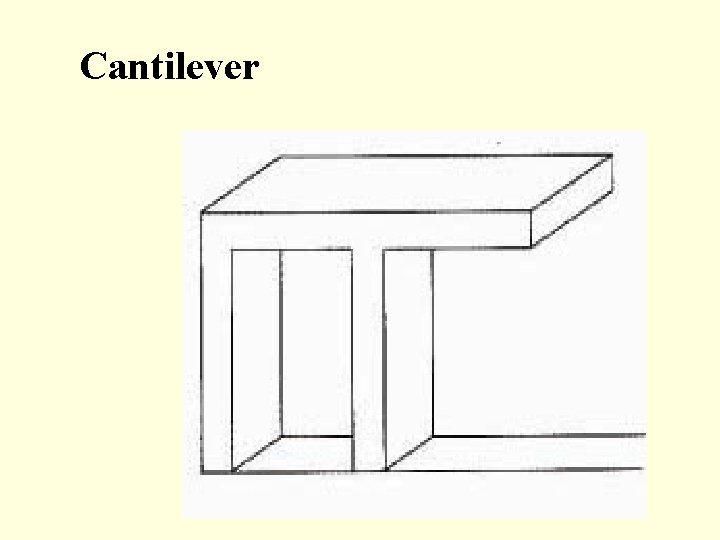
Cantilever

BUZZER-BEATER Review First person to stand up must identify the structure in the image!
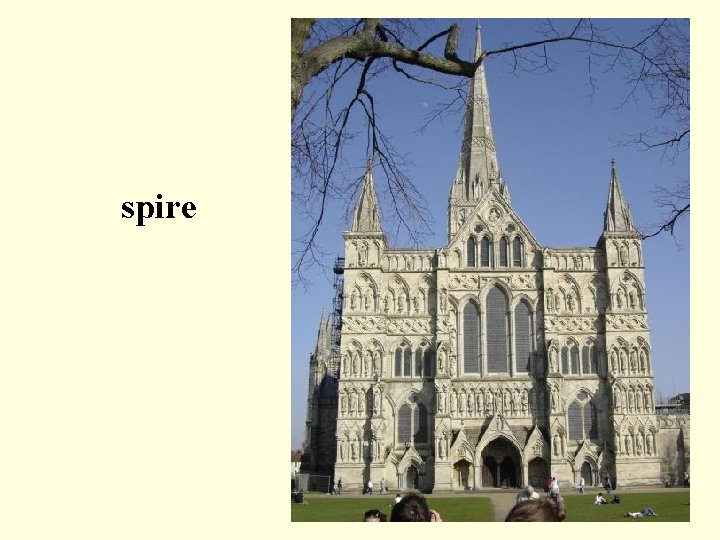
spire
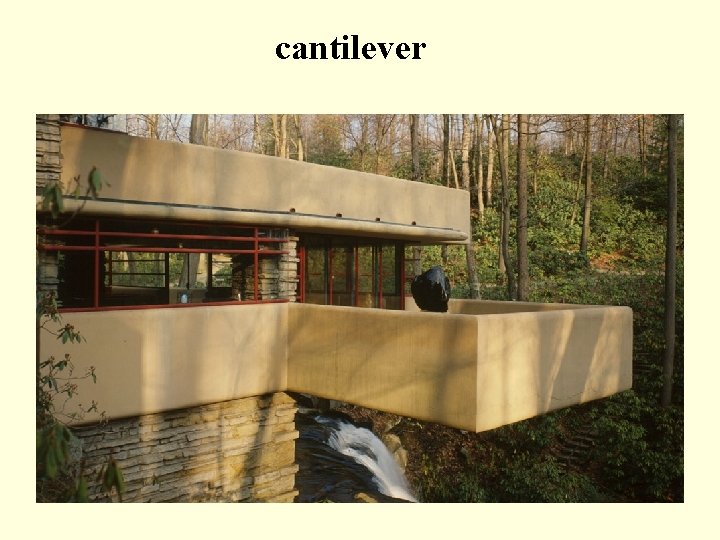
cantilever
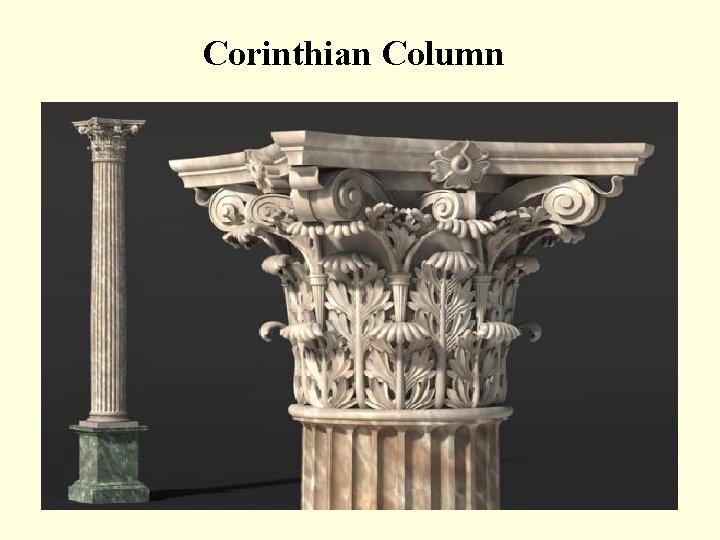
Corinthian Column
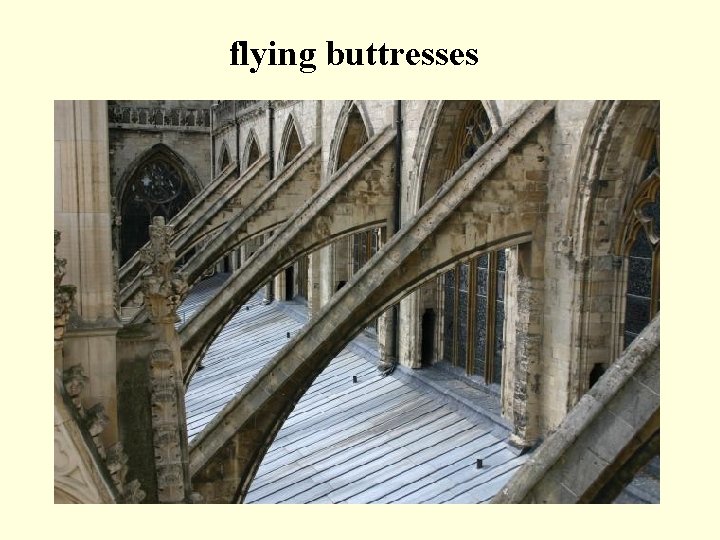
flying buttresses
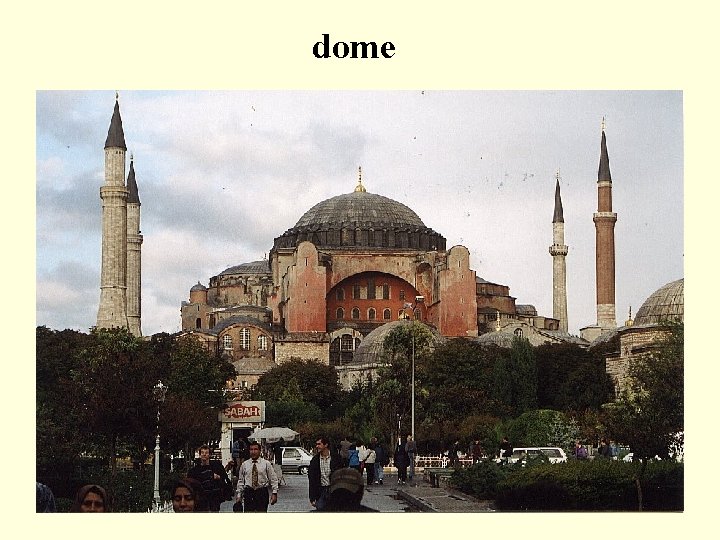
dome
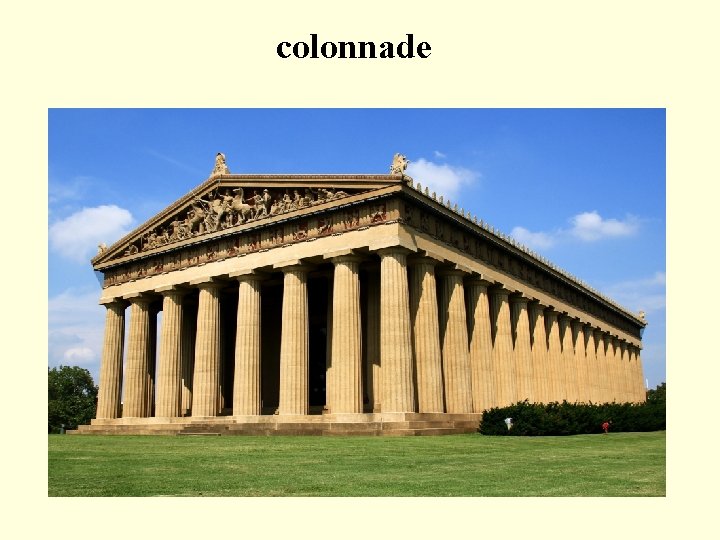
colonnade
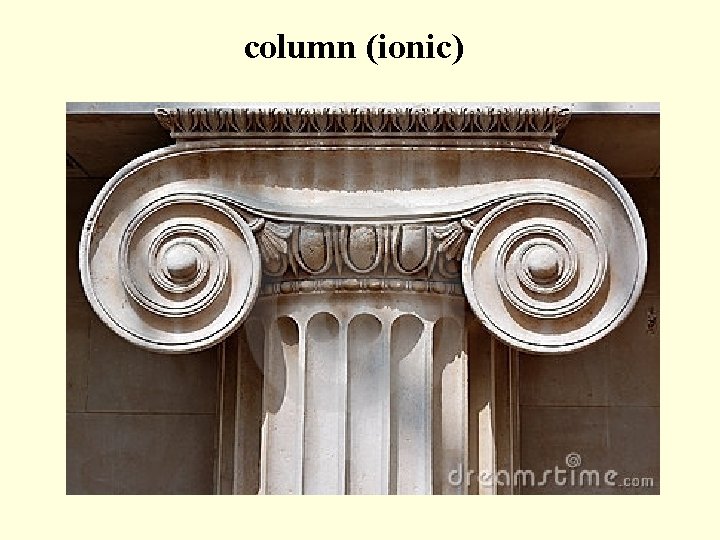
column (ionic)
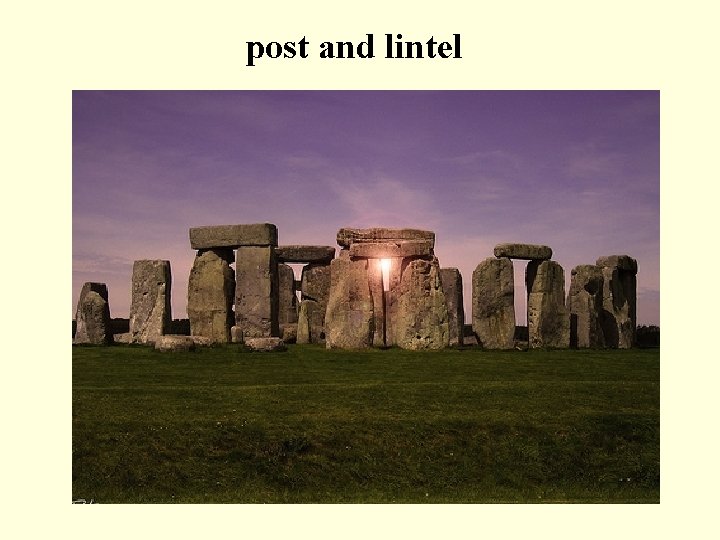
post and lintel
arch
columns (ionic)
Go To Element Slide
Can you create a structure that uses three basic structures of architecture? • On a blank sheet of paper create a building that uses three of the basic structures of architecture that you learned about today. • Before starting decided if – the building will be symmetrical or asymmetrical – sacred or secular – label each structure • Label each structure • No larger than half a page. • Give your building a name (based on function!) • Time allowed: 15 minutes/ 15 points
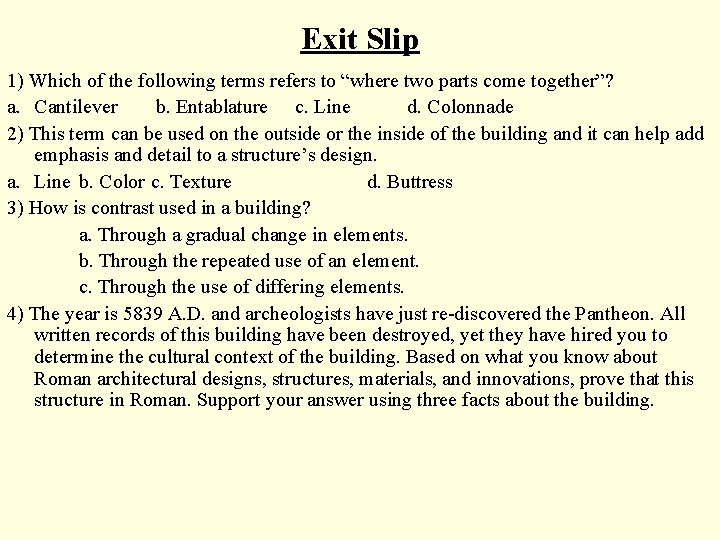
Exit Slip 1) Which of the following terms refers to “where two parts come together”? a. Cantilever b. Entablature c. Line d. Colonnade 2) This term can be used on the outside or the inside of the building and it can help add emphasis and detail to a structure’s design. a. Line b. Color c. Texture d. Buttress 3) How is contrast used in a building? a. Through a gradual change in elements. b. Through the repeated use of an element. c. Through the use of differing elements. 4) The year is 5839 A. D. and archeologists have just re-discovered the Pantheon. All written records of this building have been destroyed, yet they have hired you to determine the cultural context of the building. Based on what you know about Roman architectural designs, structures, materials, and innovations, prove that this structure in Roman. Support your answer using three facts about the building.
Exit Slip Directions • On the bottom/back of your opener • Number your paper 1 -5 • Identify the images you see on the following slide!
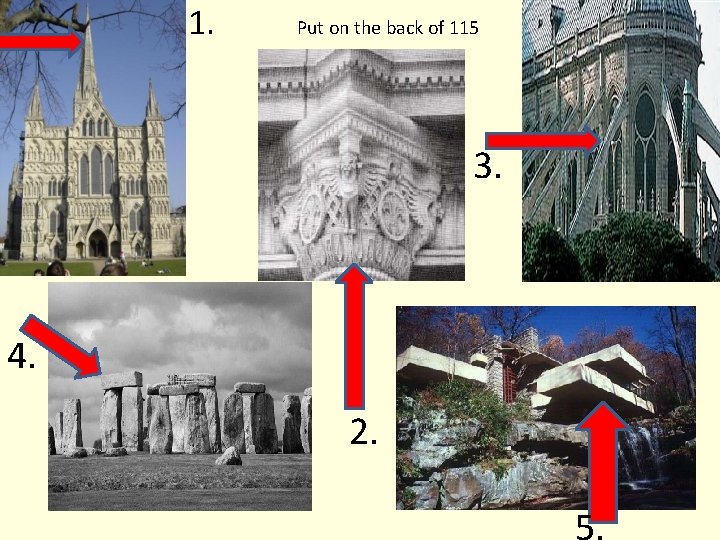
1. Put on the back of 115 3. 4. 2. 5.
Body Check! • • DON’T SIT DOWN! Get into groups of three or four Create the structure I name using your bodies. Creative examples will receive extra credit
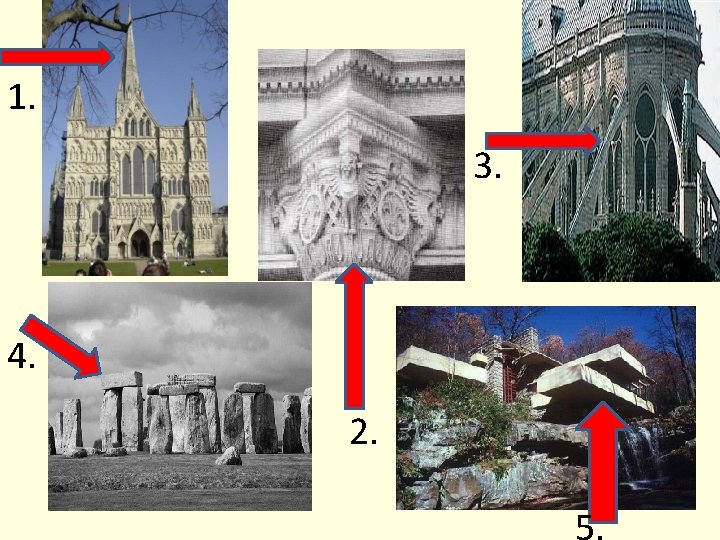
1. 3. 4. 2. 5.
Extended Activities
Architecture Olympics • Complete the following activities, as your teacher describes them, to demonstrate your knowledge of basic architectural structures. • I will read out the directions and take pictures of you once you’ve made your structures to determine who is the gold medalist!
Application: Tower made out of newspaper? What's the tallest tower you can build using only two sheets of newspaper, two half sheets of paper, and five pieces of tape? Here's the challenge: getting the newspaper to stand up with only the materials mentioned above (no staples, glue, or other materials). You can bend, fold, or tear the paper itself. Requirements Your structure must have at least three structures that you learned about today. These structures must be easily visible. Try It Out 1. Now construct your tower. If you think you can make it taller, keep redesigning it until you can't go any higher. 2. When you are finished building, measure the height of your tower. Time Allowed: 15 minutes
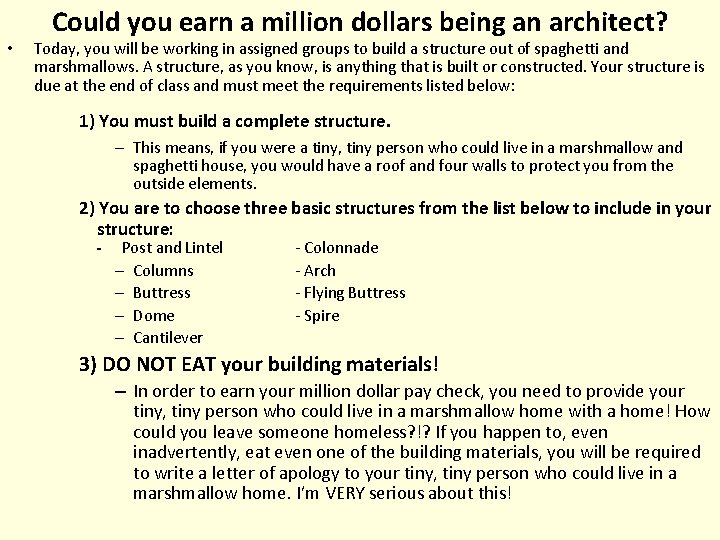
• Could you earn a million dollars being an architect? Today, you will be working in assigned groups to build a structure out of spaghetti and marshmallows. A structure, as you know, is anything that is built or constructed. Your structure is due at the end of class and must meet the requirements listed below: 1) You must build a complete structure. – This means, if you were a tiny, tiny person who could live in a marshmallow and spaghetti house, you would have a roof and four walls to protect you from the outside elements. 2) You are to choose three basic structures from the list below to include in your structure: - Post and Lintel – Columns – Buttress – Dome – Cantilever - Colonnade - Arch - Flying Buttress - Spire 3) DO NOT EAT your building materials! – In order to earn your million dollar pay check, you need to provide your tiny, tiny person who could live in a marshmallow home with a home! How could you leave someone homeless? !? If you happen to, even inadvertently, eat even one of the building materials, you will be required to write a letter of apology to your tiny, tiny person who could live in a marshmallow home. I’m VERY serious about this!
- Slides: 66