
Architecture and Implementation of Lustre at the National
- Slides: 12
Architecture and Implementation of Lustre at the National Climate Computing Research Center Douglas Fuller National Climate Computing Research Center / ORNL LUG 2011
About NCRC • Partnership between Oak Ridge National Laboratory (USDOE) and NOAA (USDOC) • Primary compute and working storage (Lustre!) at ORNL (Oak Ridge, TN) • Primary users at Geophysical Fluid Dynamics Laboratory (Princeton, NJ) • Operational in September 2010 • Upgrades through 2012, scheduled operations through 2014 2 Managed by UT-Battelle for the U. S. Department of Energy LUG 2011
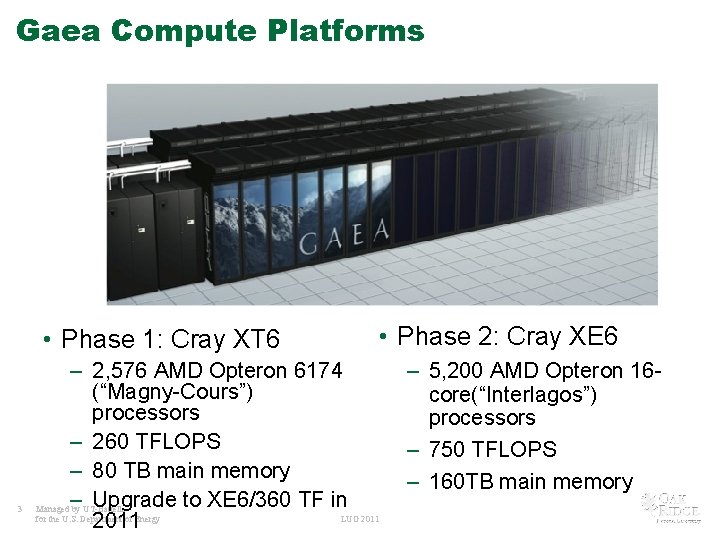
Gaea Compute Platforms • Phase 2: Cray XE 6 • Phase 1: Cray XT 6 3 – 2, 576 AMD Opteron 6174 (“Magny-Cours”) processors – 260 TFLOPS – 80 TB main memory – Upgrade to XE 6/360 TF in 2011 Managed by UT-Battelle for the U. S. Department of Energy LUG 2011 – 5, 200 AMD Opteron 16 core(“Interlagos”) processors – 750 TFLOPS – 160 TB main memory
File System Design: Requirements • The obvious (capability, capacity, consistency, cost) • Consistent performance – More production-oriented workload – High noise from compute and auxiliary functions • Resiliency – Local component failures (nothing new) – Compute partition failures – WAN connectivity issues 4 Managed by UT-Battelle for the U. S. Department of Energy LUG 2011
System Specification • Capability: projections from previous systems – – Aggregate daily data production Current code I/O duty cycles Overhead from auxiliary operations Delivered I/O from two primary partitions • Capacity: fit the use cases that need performance – – 5 Scratch Hot dataset cache Semi-persistent library Staging and buffering for WAN transfer Managed by UT-Battelle for the U. S. Department of Energy LUG 2011
System Specification • Consistency: use cases increase variability – Some demand capability (scratch, hot cache) • Significantly more random access – Some are more about capacity (library, staging) • More sequential access • Cost: Always an issue – On a fixed budget, I/O robs compute – Capability costs compute resources (more I/O nodes) 6 Managed by UT-Battelle for the U. S. Department of Energy LUG 2011
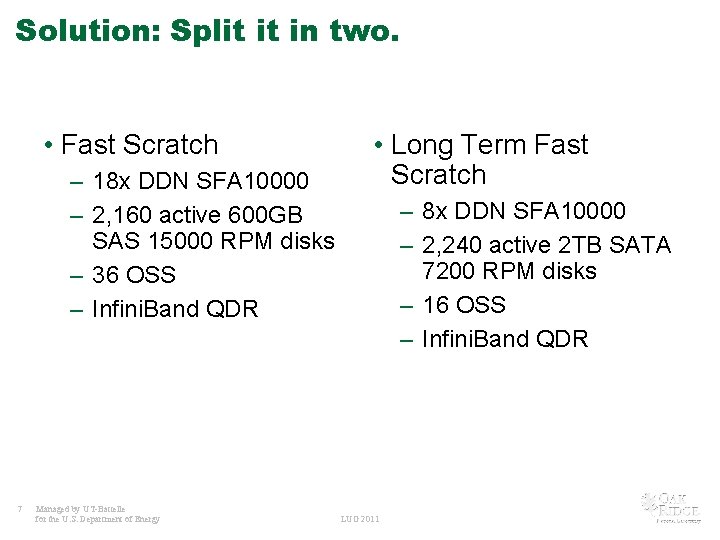
Solution: Split it in two. • Fast Scratch – 18 x DDN SFA 10000 – 2, 160 active 600 GB SAS 15000 RPM disks – 36 OSS – Infini. Band QDR 7 Managed by UT-Battelle for the U. S. Department of Energy • Long Term Fast Scratch – 8 x DDN SFA 10000 – 2, 240 active 2 TB SATA 7200 RPM disks – 16 OSS – Infini. Band QDR LUG 2011
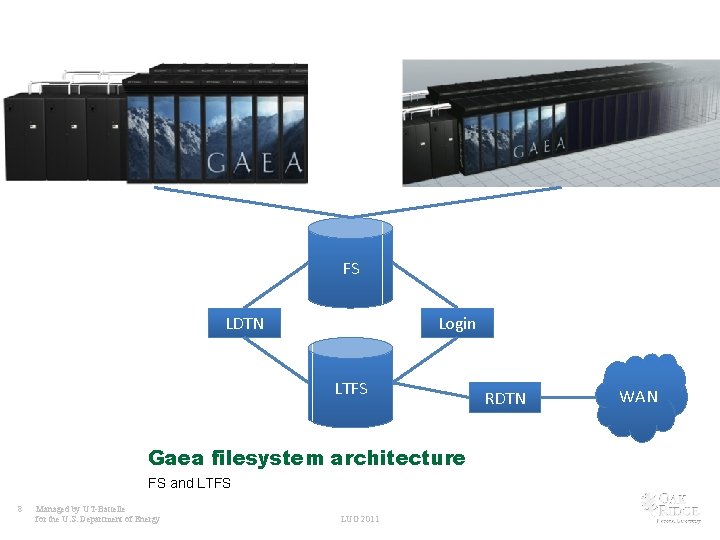
FS LDTN Login LTFS Gaea filesystem architecture FS and LTFS 8 Managed by UT-Battelle for the U. S. Department of Energy LUG 2011 RDTN WAN
Implications • Compute platform sees fast disk (FS) – Data staging is (hopefully) sequential and in the background • Data staging done to bulk storage – Reduces cost for increased capacity • Requires data staging step • Leverage synergies where possible – Cross-connect between switches for redundancy – Combine data staging and some post-processing 9 Managed by UT-Battelle for the U. S. Department of Energy LUG 2011
Data Movers • Local data transfer nodes (LDTN) – 16 x servers with dual Infini. Band – ORNL-developed staging parallel/distributed cp – Also handles simple post-processing duties • Remote data transfer nodes (RDTN) – 8 x servers with Infini. Band 10 Gb Ethernet – Wide area transfer with Grid. FTP • Implies significant data handling overhead for workflow 10 Managed by UT-Battelle for the U. S. Department of Energy LUG 2011
Thank You Questions
Lustre on Cray XT/XE Systems • Individual compute nodes act as Lustre clients • lnd for internal network (ptllnd, gnilnd) • I/O nodes can serve as OSS nodes (“internal”) or route lnet to external network (“external”) • External configuration used at NCRC – Improves flexibility – Enables availability to other systems 12 Managed by UT-Battelle for the U. S. Department of Energy LUG 2011