
Architectural Side Channels in Cloud Computing Eran Tromer
![A typical software implementation of AES char p[16], k[16]; // plaintext and key int](https://slidetodoc.com/presentation_image_h2/3ece971b7ade546ddc80f45cb0bbc714/image-17.jpg "A typical software implementation of AES char p[16], k[16]; // plaintext and key int")
![Experimental results [Osvik Shamir Tromer 05] • Synchronous attack on Open. SLL AES encryption](https://slidetodoc.com/presentation_image_h2/3ece971b7ade546ddc80f45cb0bbc714/image-20.jpg "Experimental results [Osvik Shamir Tromer 05] • Synchronous attack on Open. SLL AES encryption")
![Experimental example: synchronous attack I k[0]=0 x 00 k[5]=0 x 50 Measuring a “black](https://slidetodoc.com/presentation_image_h2/3ece971b7ade546ddc80f45cb0bbc714/image-21.jpg "Experimental example: synchronous attack I k[0]=0 x 00 k[5]=0 x 50 Measuring a “black")
![Experimental results [Osvik Shamir Tromer 05] • Asynchronous attack on AES (independent process doing](https://slidetodoc.com/presentation_image_h2/3ece971b7ade546ddc80f45cb0bbc714/image-26.jpg "Experimental results [Osvik Shamir Tromer 05] • Asynchronous attack on AES (independent process doing")
![Other cache attacks • Convert channels [Hu ‘ 92] • Hardware-assisted – Power trace](https://slidetodoc.com/presentation_image_h2/3ece971b7ade546ddc80f45cb0bbc714/image-28.jpg "Other cache attacks • Convert channels [Hu ‘ 92] • Hardware-assisted – Power trace")
![Other architectural attacks Induced by contention for shared resources: • Data cache [Hu 91][Bernstein](https://slidetodoc.com/presentation_image_h2/3ece971b7ade546ddc80f45cb0bbc714/image-30.jpg "Other architectural attacks Induced by contention for shared resources: • Data cache [Hu 91][Bernstein")
![Vulnerability of public “Cloud Computing” [Ristenpart Tromer Shacham Savage 09] [details omitted from online](https://slidetodoc.com/presentation_image_h2/3ece971b7ade546ddc80f45cb0bbc714/image-35.jpg "Vulnerability of public “Cloud Computing” [Ristenpart Tromer Shacham Savage 09] [details omitted from online")
![Solutions Secure OS mode bitslice [Intel 05] [MR 04] [GO 95] Cacheless ? Efficient](https://slidetodoc.com/presentation_image_h2/3ece971b7ade546ddc80f45cb0bbc714/image-37.jpg "Solutions Secure OS mode bitslice [Intel 05] [MR 04] [GO 95] Cacheless ? Efficient")
![General cryptographic transformations • Fully homomorphic encryption • Obfuscation • Oblivious RAM [Goldreich 87][Goldreich](https://slidetodoc.com/presentation_image_h2/3ece971b7ade546ddc80f45cb0bbc714/image-39.jpg "General cryptographic transformations • Fully homomorphic encryption • Obfuscation • Oblivious RAM [Goldreich 87][Goldreich")

- Slides: 47
Architectural Side Channels in Cloud Computing Eran Tromer MIT Includes joint works with Adi Shamir, Dag Arne Osvik Stefan Savage, Hovav Shacham, Thomas Ristenpart 1 Crypto in the Cloud workshop, MIT August 4, 2009
This talk will not be about • AC 0 circuits • Proofs • Constructions But: • “Computation leaks information” • a whole lot of it! 2
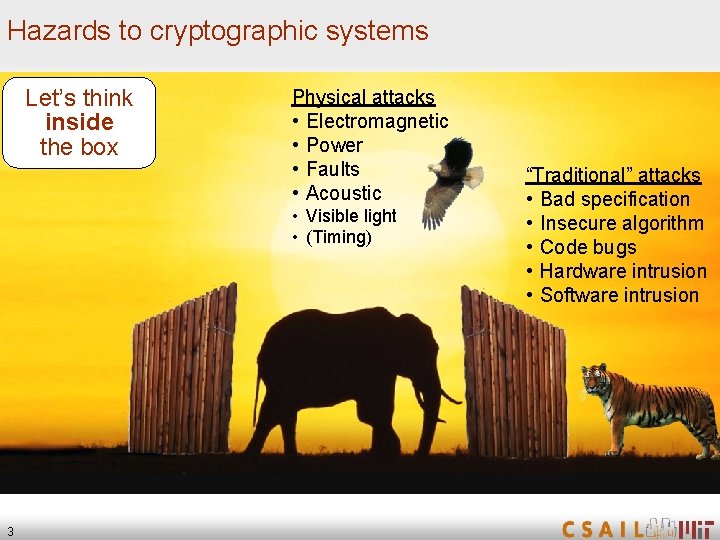
Hazards to cryptographic systems Let’s think inside the box Physical attacks • Electromagnetic • Power • Faults • Acoustic • Visible light • (Timing) 3 “Traditional” attacks • Bad specification • Insecure algorithm • Code bugs • Hardware intrusion • Software intrusion
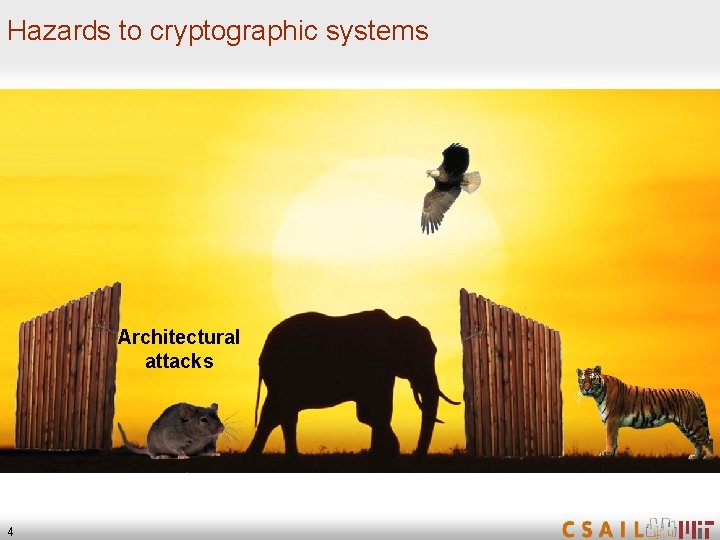
Hazards to cryptographic systems Architectural attacks 4
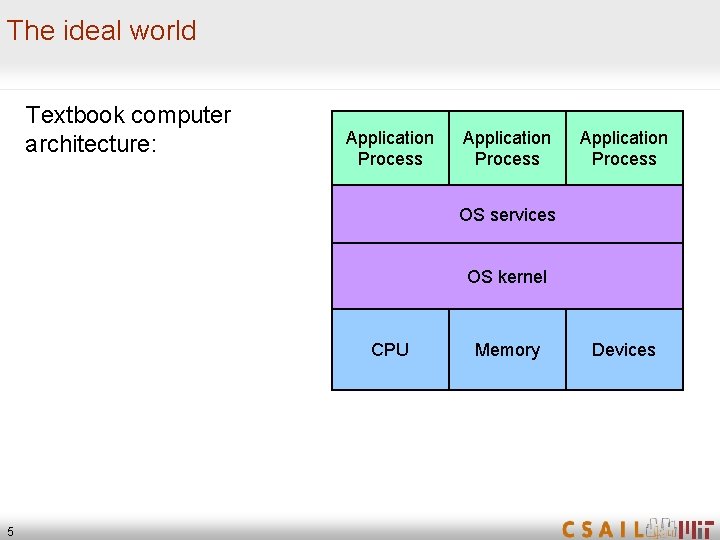
The ideal world Textbook computer architecture: Application Process OS services OS kernel CPU 5 Memory Devices
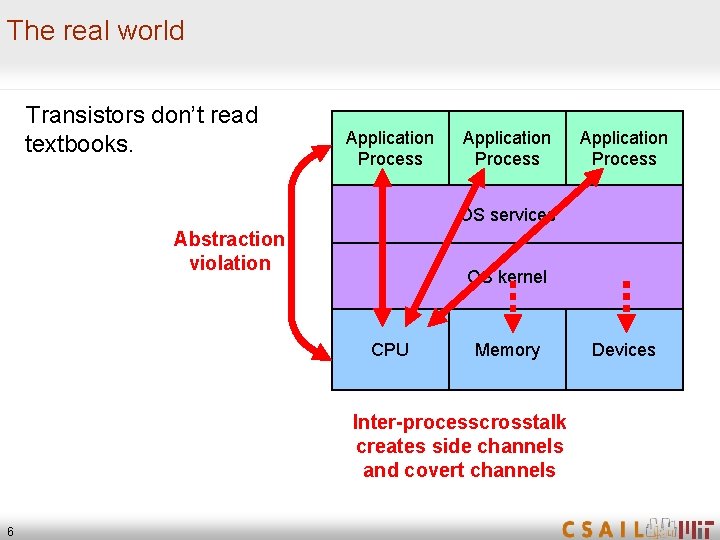
The real world Transistors don’t read textbooks. Application Process OS services Abstraction violation OS kernel CPU Memory Inter-processcrosstalk creates side channels and covert channels 6 Devices
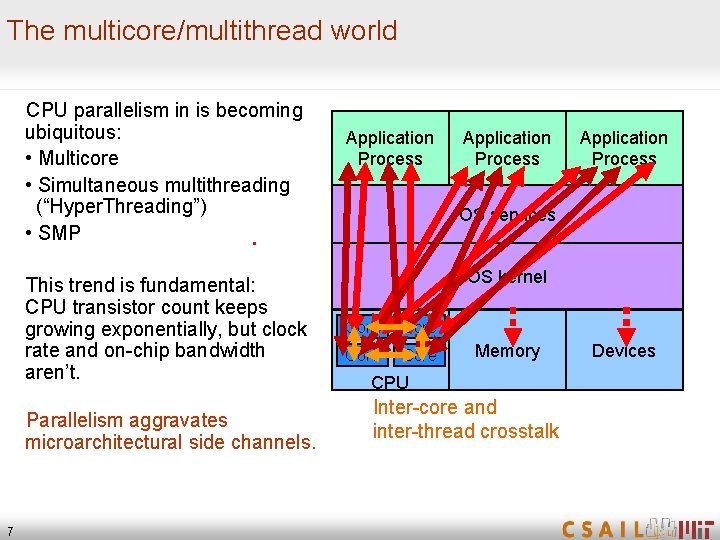
The multicore/multithread world CPU parallelism in is becoming ubiquitous: • Multicore • Simultaneous multithreading (“Hyper. Threading”) • SMP. This trend is fundamental: CPU transistor count keeps growing exponentially, but clock rate and on-chip bandwidth aren’t. Parallelism aggravates microarchitectural side channels. 7 Application Process OS services OS kernel Core Memory CPU Inter-core and inter-thread crosstalk Devices
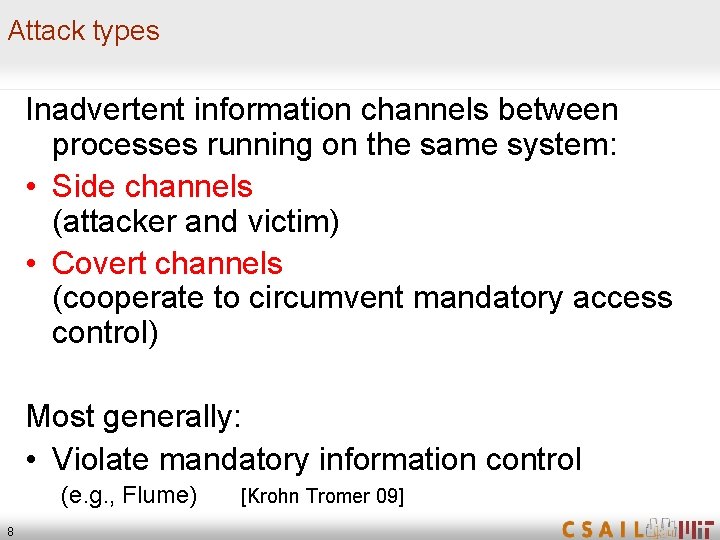
Attack types Inadvertent information channels between processes running on the same system: • Side channels (attacker and victim) • Covert channels (cooperate to circumvent mandatory access control) Most generally: • Violate mandatory information control (e. g. , Flume) 8 [Krohn Tromer 09]
Cache attacks 9
Cache attacks • Pure software • No special privileges • No interaction with the cryptographic code (some variants) • Very efficient (e. g. , full AES key extraction from Linux encrypted partition in 65 milliseconds) • Compromise otherwise well-secured systems (e. g. , see NIST AES process) • “Commoditize” side-channel attacks easily deployed software breaks many common systems 10
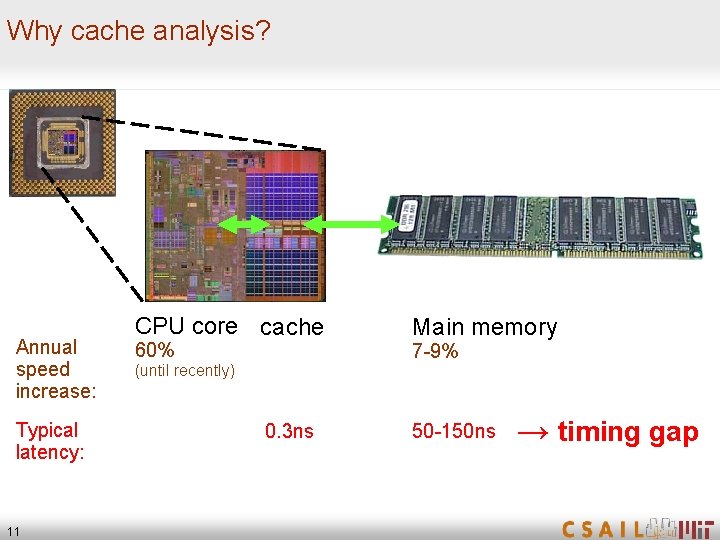
Why cache analysis? Annual speed increase: Typical latency: 11 CPU core cache 60% Main memory 7 -9% (until recently) 0. 3 ns 50 -150 ns → timing gap
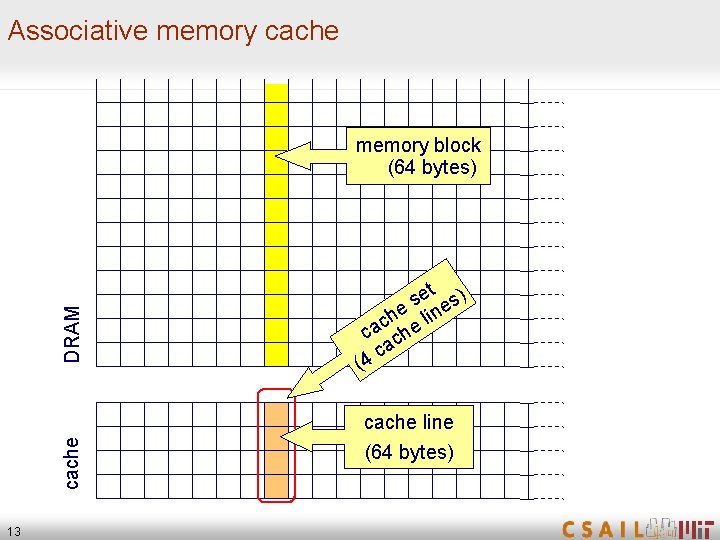
Address leakage • The cache is a shared resource: cache state affects, and is affected by, all processes, leading to crosstalk between processes. • The cached data is subject to memory protection… • But the metadata leaks information about memory access patterns: which addresses are being accessed. 12
Associative memory cache DRAM memory block (64 bytes) et s) s e line h c ca che a 4 c ( cache line 13 (64 bytes)
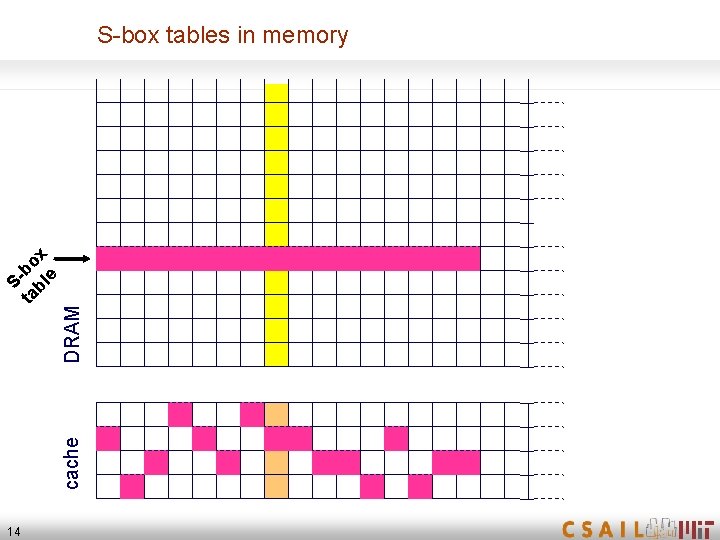
DRAM cache Sta bo bl x e S-box tables in memory 14
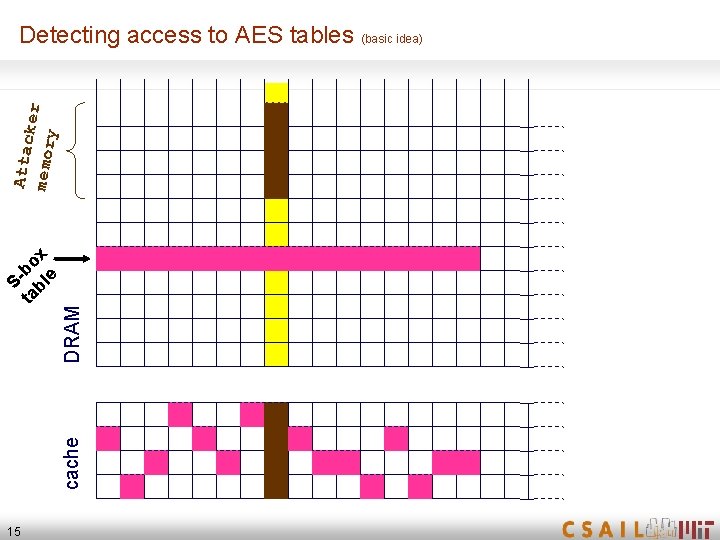
DRAM cache Sta bo bl x e Attac k memor er y Detecting access to AES tables (basic idea) 15
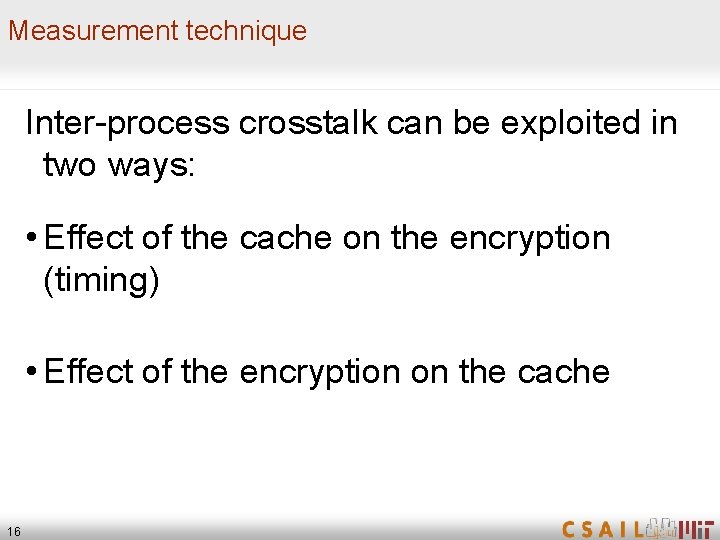
Measurement technique Inter-process crosstalk can be exploited in two ways: • Effect of the cache on the encryption (timing) • Effect of the encryption on the cache 16
A typical software implementation of AES char p[16], k[16]; // plaintext and key int 32 T 0[256], T 1[256], T 2[256], T 3[256]; // lookup tables int 32 Col[4]; // intermediate state. . . /* Round 1 */ Col[0] T 0[p[ 0]©k[ 0]] T 1[p[ 5]©k[ 5]] T 2[p[10]©k[10]] T 3[p[15]©k[15]]; Col[1] T 0[p[ 4]©k[ 4]] T 1[p[ 9]©k[ 9]] T 2[p[14]©k[14]] T 3[p[ 3]©k[ 3]]; Col[2] T 0[p[ 8]©k[ 8]] T 1[p[13]©k[13]] T 2[p[ 2]©k[ 2]] T 3[p[ 7]©k[ 7]]; Col[3] T 0[p[12]©k[12]] T 1[p[ 1]©k[ 1]] T 2[p[ 6]©k[ 6]] T 3[p[11]©k[11]]; lookup index = plaintext key 17
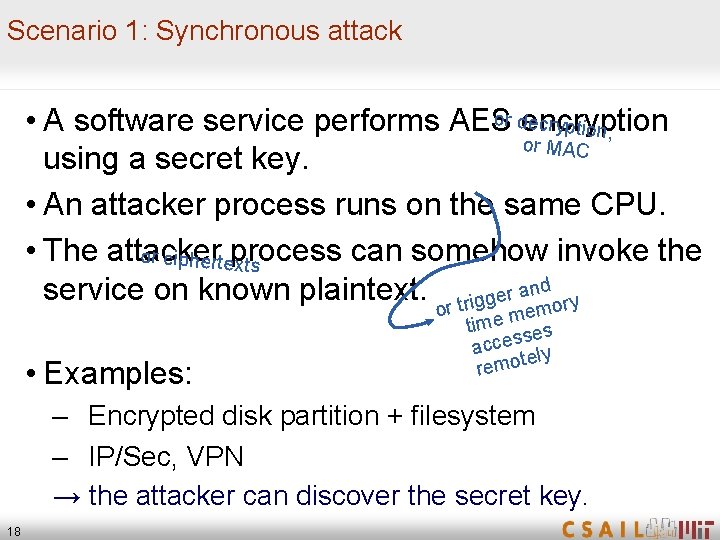
Scenario 1: Synchronous attack or dencryption ecryption, • A software service performs AES or MAC using a secret key. • An attacker process runs on the same CPU. • The attacker can somehow invoke the or cipherteprocess xts service on known plaintext. r trigger andory o • Examples: em it me m es s acces ly te remo – Encrypted disk partition + filesystem – IP/Sec, VPN → the attacker can discover the secret key. 18
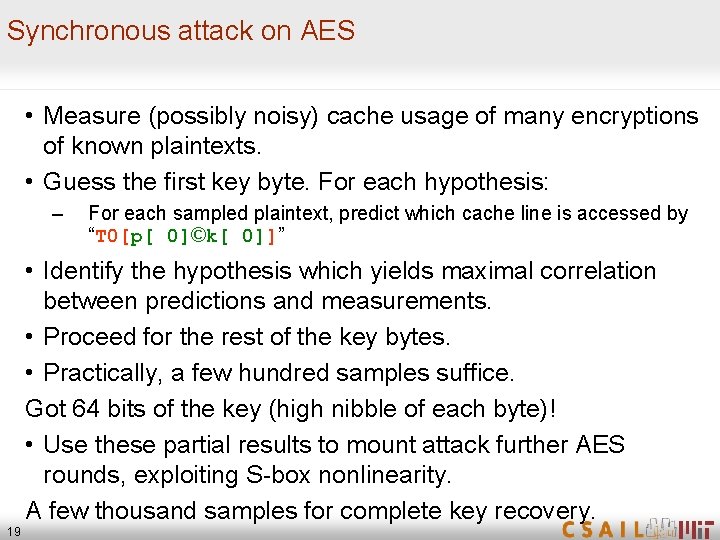
Synchronous attack on AES • Measure (possibly noisy) cache usage of many encryptions of known plaintexts. • Guess the first key byte. For each hypothesis: – For each sampled plaintext, predict which cache line is accessed by “T 0[p[ 0]©k[ 0]]” • Identify the hypothesis which yields maximal correlation between predictions and measurements. • Proceed for the rest of the key bytes. • Practically, a few hundred samples suffice. Got 64 bits of the key (high nibble of each byte)! • Use these partial results to mount attack further AES rounds, exploiting S-box nonlinearity. A few thousand samples for complete key recovery. 19
Experimental results [Osvik Shamir Tromer 05] • Synchronous attack on Open. SLL AES encryption library call: Full key recovery by analyzing 300 encryptions (13 ms) • Synchronous attack on an AES encrypted filesystem (Linux dm-crypt): Full key recovery by analyzing 800 write operations (65 ms) 20
Experimental example: synchronous attack I k[0]=0 x 00 k[5]=0 x 50 Measuring a “black box” Open. SSL encryption on Athlon 64, using 10, 000 samples. Horizontal axis: evicted cache set Vertical axis: p[0] (left), p[5] (right) Brightness: encryption time (normalized) 21
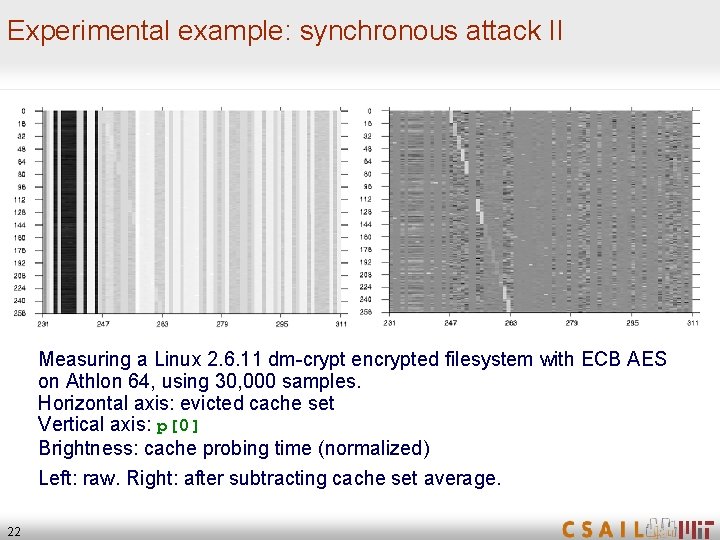
Experimental example: synchronous attack II Measuring a Linux 2. 6. 11 dm-crypt encrypted filesystem with ECB AES on Athlon 64, using 30, 000 samples. Horizontal axis: evicted cache set Vertical axis: p[0] Brightness: cache probing time (normalized) Left: raw. Right: after subtracting cache set average. 22
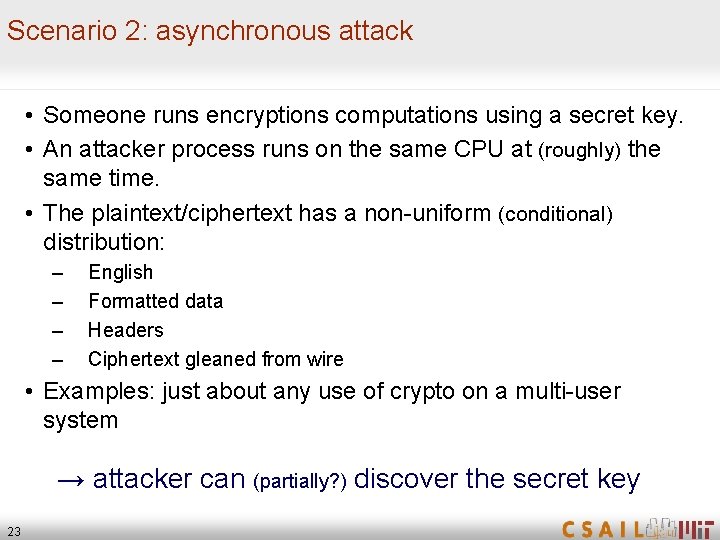
Scenario 2: asynchronous attack • Someone runs encryptions computations using a secret key. • An attacker process runs on the same CPU at (roughly) the same time. • The plaintext/ciphertext has a non-uniform (conditional) distribution: – – English Formatted data Headers Ciphertext gleaned from wire • Examples: just about any use of crypto on a multi-user system → attacker can (partially? ) discover the secret key 23
Asynchronous attack (basic idea) Compare two distributions: • Measured memory accesses statistics. • Predicted memory accesses statistics, under the given plaintext distribution and the key hypothesis. Find key that yields best correlation. 24
“Hyper Attack” • Obtaining parallelism: – Hyper. Threading (simultaneous multithreading) – Multi-core, shared caches, cache coherence – Interrupts • Attack model: – Encryption process is not communicating with anyone (no I/O, no IPC). – No special measurement equipment – No knowledge of either plaintext of ciphertext 25
Experimental results [Osvik Shamir Tromer 05] • Asynchronous attack on AES (independent process doing batch encryption of text): Recovery of 45. 7 key bits in one minute. 26
More attacks! 27
Other cache attacks • Convert channels [Hu ‘ 92] • Hardware-assisted – Power trace [Page ’ 02] • Timing attacks via internal collisions [Tsunoo Tsujihara Minematsu Miyuachi ’ 02] [Tsunoo Saito Suzaki Shigeri Miyauchi ’ 03] • Model-less timing attacks • RSA [Percival ’ 05] 28 [Bernstein ’ 04]
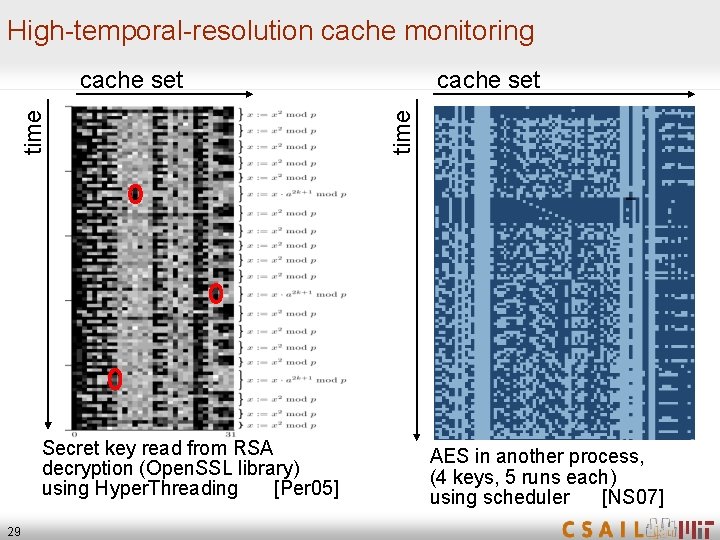
High-temporal-resolution cache monitoring Secret key read from RSA decryption (Open. SSL library) using Hyper. Threading [Per 05] 29 cache set time cache set AES in another process, (4 keys, 5 runs each) using scheduler [NS 07]
Other architectural attacks Induced by contention for shared resources: • Data cache [Hu 91][Bernstein 05][Osvik Shamir. Tromer 05] [Percival 05] • Instruction cache Aciicmez ’ 07] – Exploits difference between code paths – Attacks are analogous to data cache attack • Branch prediction [Aciicmez Schindler Koc ’ 06–’ 07] – Exploits difference in choice of code path – BP state is a shared resource • ALU resources [Aciicmez Seifert ’ 07] – Exploits contention for the multiplication units 30
Implications 31
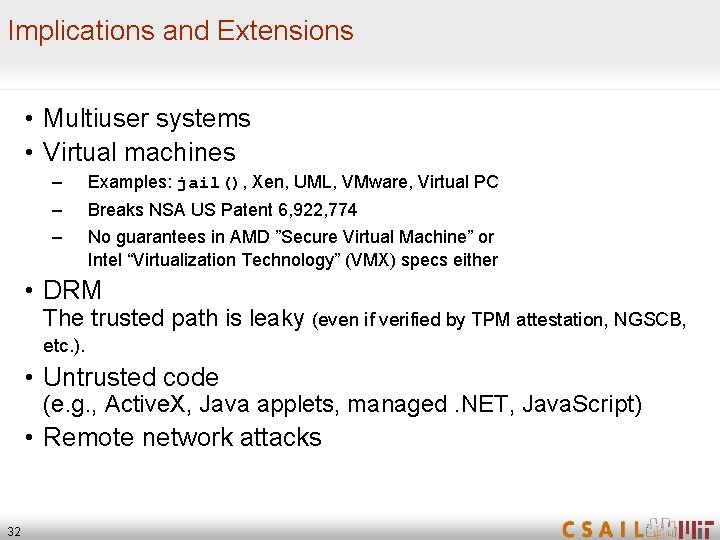
Implications and Extensions • Multiuser systems • Virtual machines – Examples: jail(), Xen, UML, VMware, Virtual PC – – Breaks NSA US Patent 6, 922, 774 No guarantees in AMD ”Secure Virtual Machine” or Intel “Virtualization Technology” (VMX) specs either • DRM The trusted path is leaky (even if verified by TPM attestation, NGSCB, etc. ). • Untrusted code (e. g. , Active. X, Java applets, managed. NET, Java. Script) • Remote network attacks 32
Cloud Computing raining on the parade 33
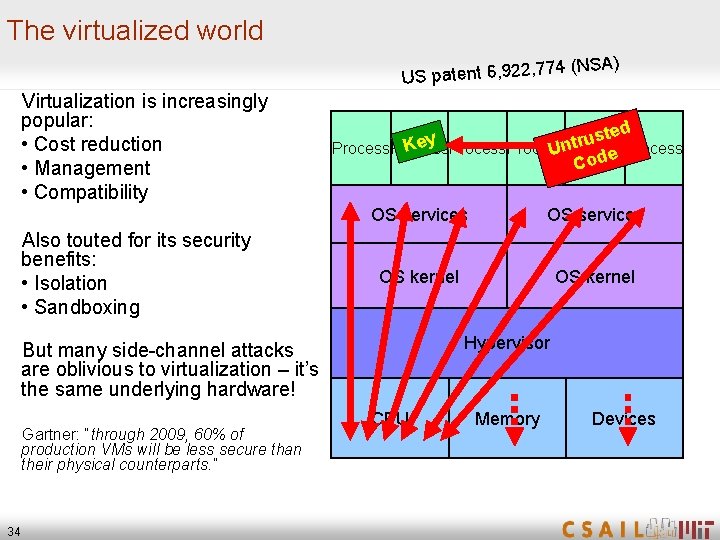
The virtualized world A) , 774 (NS 2 2 , 9 6 t n te a p S U Virtualization is increasingly popular: • Cost reduction • Management • Compatibility Also touted for its security benefits: • Isolation • Sandboxing ed t s u y r Ke Process Unt de Co OS services OS kernel Hypervisor But many side-channel attacks are oblivious to virtualization – it’s the same underlying hardware! Gartner: “through 2009, 60% of production VMs will be less secure than their physical counterparts. ” 34 CPU Memory Devices
Vulnerability of public “Cloud Computing” [Ristenpart Tromer Shacham Savage 09] [details omitted from online version] Process Client 1 Client 2 OS services OS kernel Hypervisor CPU 35 Memory Devices
Countermeasures 36
Solutions Secure OS mode bitslice [Intel 05] [MR 04] [GO 95] Cacheless ? Efficient [ZZLP 04] Ignore 37 Generic
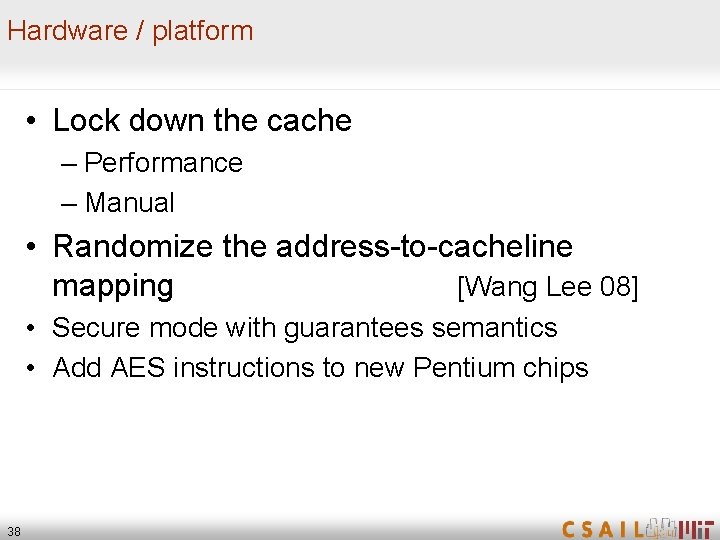
Hardware / platform • Lock down the cache – Performance – Manual • Randomize the address-to-cacheline mapping [Wang Lee 08] • Secure mode with guarantees semantics • Add AES instructions to new Pentium chips 38
General cryptographic transformations • Fully homomorphic encryption • Obfuscation • Oblivious RAM [Goldreich 87][Goldreich Ostrovsky 95] 39
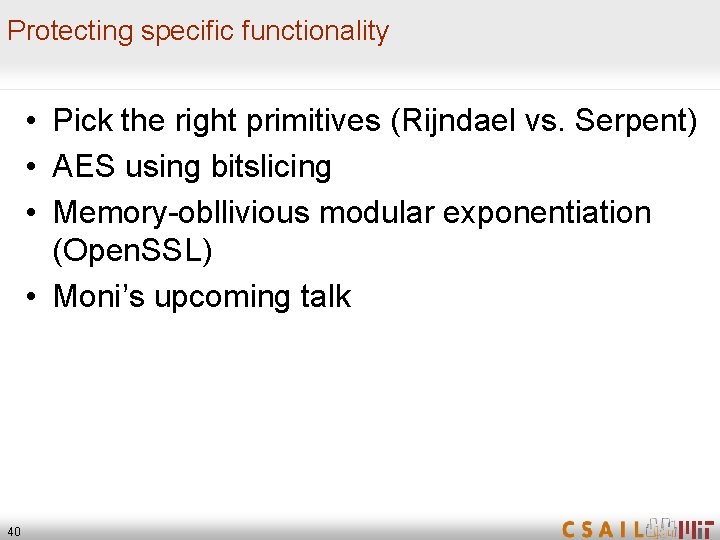
Protecting specific functionality • Pick the right primitives (Rijndael vs. Serpent) • AES using bitslicing • Memory-obllivious modular exponentiation (Open. SSL) • Moni’s upcoming talk 40
Models 41
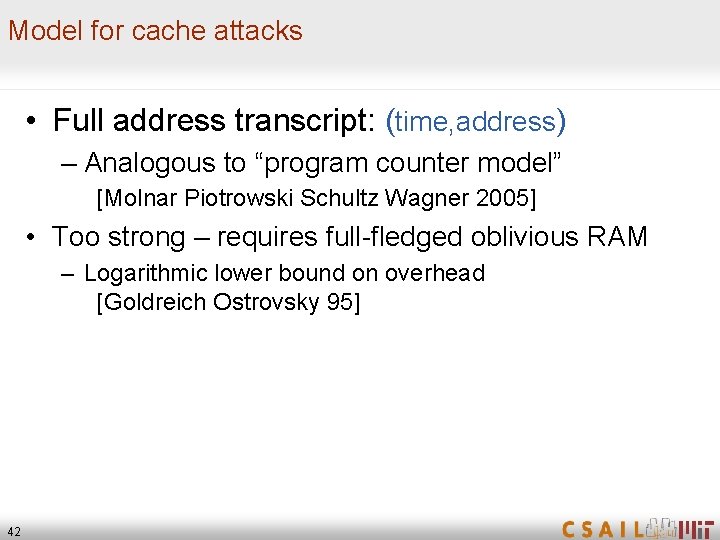
Model for cache attacks • Full address transcript: (time, address) – Analogous to “program counter model” [Molnar Piotrowski Schultz Wagner 2005] • Too strong – requires full-fledged oblivious RAM – Logarithmic lower bound on overhead [Goldreich Ostrovsky 95] 42
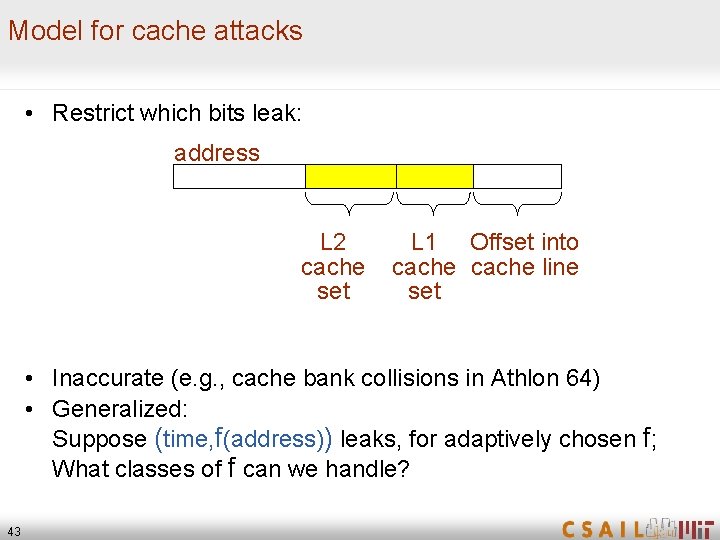
Model for cache attacks • Restrict which bits leak: address L 2 cache set L 1 Offset into cache line set • Inaccurate (e. g. , cache bank collisions in Athlon 64) • Generalized: Suppose (time, f(address)) leaks, for adaptively chosen f; What classes of f can we handle? 43
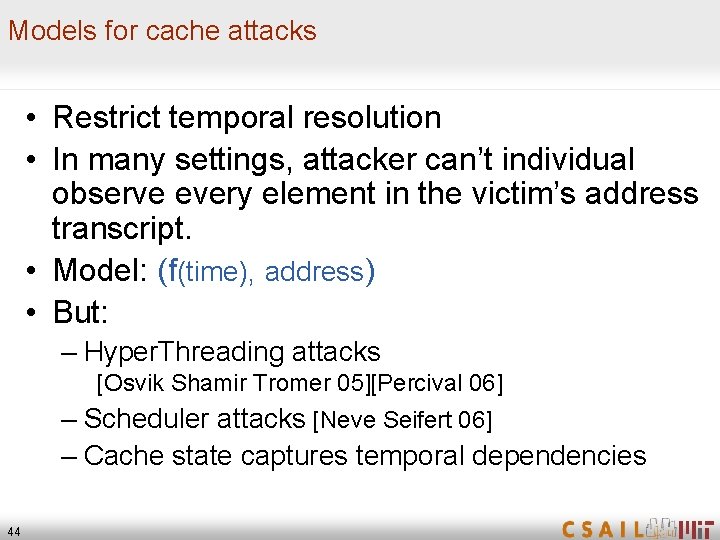
Models for cache attacks • Restrict temporal resolution • In many settings, attacker can’t individual observe every element in the victim’s address transcript. • Model: (f(time), address) • But: – Hyper. Threading attacks [Osvik Shamir Tromer 05][Percival 06] – Scheduler attacks [Neve Seifert 06] – Cache state captures temporal dependencies 44
More models • “High-level” models – Bounded leakage amount – Computationally-bounded leakage – Other recent machinery from physical circuits • Other architectural attacks 45
Open problems • • Find good models (clean, realistic and useful) Fix the hardware More leaky-cache-resilient primitives Transform existing implementations at the system level [work in progress] • Cryptographic program transformation, generalizing Oblivious RAM 46
Thanks! 47