
Archimedes Principle Buoancy A little history In the

Archimedes’ Principle & Buoancy A little history… In the first century BC, the Roman architect Vitruvius related a story of how Archimedes, the Greek scientist, discovered that a goldsmith had tried to cheat King Hiero II… The king had given the goldsmith an exact amount of gold to melt down and make into a crown. When the crown was made and returned to the king, the king was suspicious that the goldsmith had stolen some of the gold and replaced it with an equal weight of another metal. The king turned to Archimedes for help…
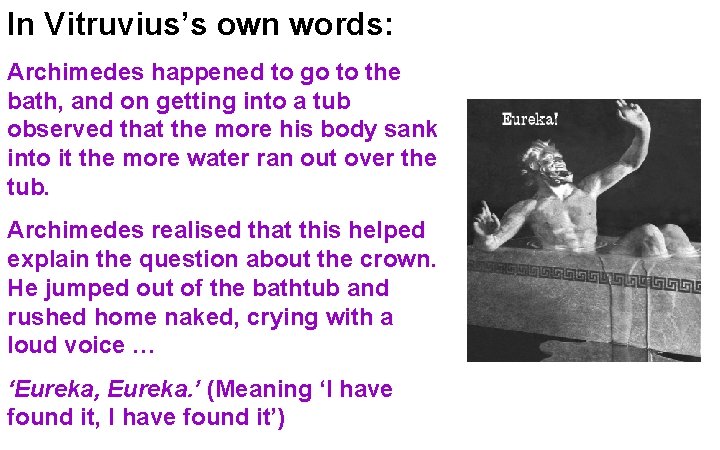
In Vitruvius’s own words: Archimedes happened to go to the bath, and on getting into a tub observed that the more his body sank into it the more water ran out over the tub. Archimedes realised that this helped explain the question about the crown. He jumped out of the bathtub and rushed home naked, crying with a loud voice … ‘Eureka, Eureka. ’ (Meaning ‘I have found it, I have found it’)
So, what, exactly, had he found? He realized that if the bath were completely filled in the beginning, the volume of water that would overflow (that was displaced) would have to equal the volume of the person or object placed into the water!! He now had a way to measure the volume of the irregularlyshaped crown. If another metal had been used, with a different density, then the volume of the crown would change. He discovered that the crown displaced more water than a chunk of gold of equal weight did. Its volume was greater because it contained another metal, less dense than gold!!
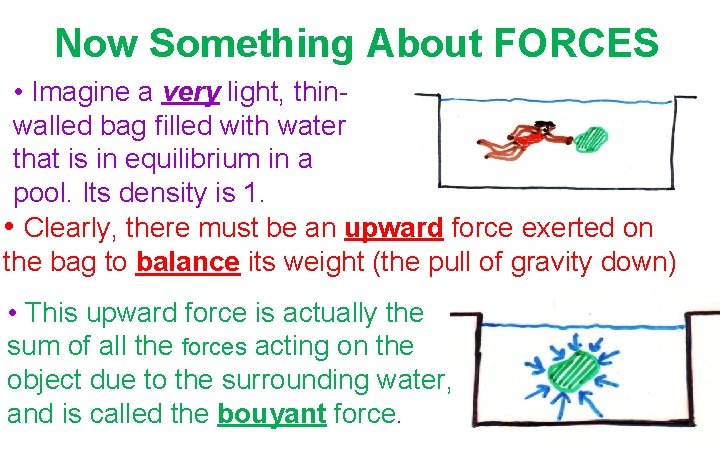
Now Something About FORCES • Imagine a very light, thinwalled bag filled with water that is in equilibrium in a pool. Its density is 1. • Clearly, there must be an upward force exerted on the bag to balance its weight (the pull of gravity down) • This upward force is actually the sum of all the forces acting on the object due to the surrounding water, and is called the bouyant force.
Archimedes’ Principle The magnitude of the buoyant force is given by Archimedes’ Principle. It states that… … a body fully or partially submerged in a fluid is “buoyed up” by a force that is equal to the weight of the displaced fluid.
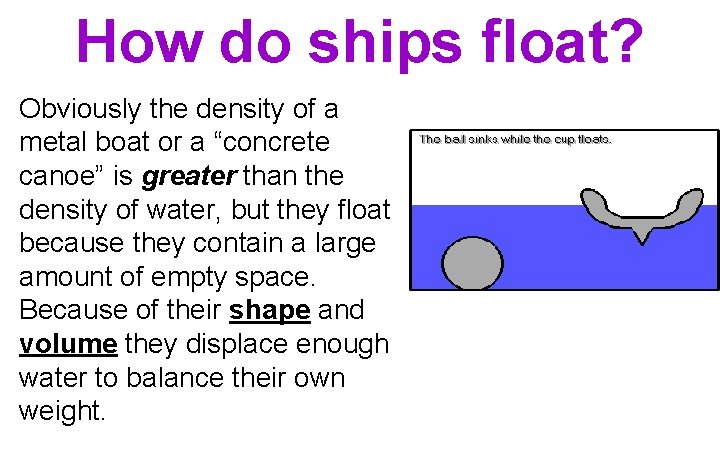
How do ships float? Obviously the density of a metal boat or a “concrete canoe” is greater than the density of water, but they float because they contain a large amount of empty space. Because of their shape and volume they displace enough water to balance their own weight.
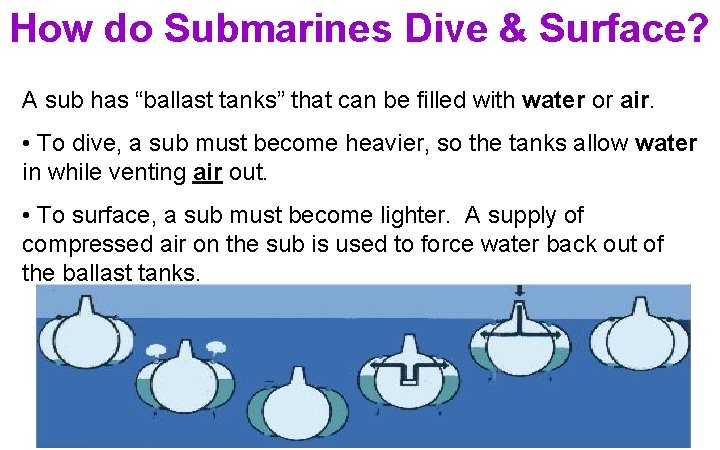
How do Submarines Dive & Surface? A sub has “ballast tanks” that can be filled with water or air. • To dive, a sub must become heavier, so the tanks allow water in while venting air out. • To surface, a sub must become lighter. A supply of compressed air on the sub is used to force water back out of the ballast tanks.
- Slides: 8