
ARCHETYPES MRS BURHENN FIRST WHAT IS AN ARCHETYPE
ARCHETYPES MRS. BURHENN
FIRST, WHAT IS AN ARCHETYPE? § An archetype is defined as a very typical example of a certain person or thing or as an original that has been imitated. § In literature, this refers to characters. § In psychology, this refers to types of personalities.
SOME BRIEF AND BASIC HISTORICAL CONTEXT In the late 1800’s/early 1900 s, an anthropologist named Frazer wrote a book that detailed cultural myths present in both ancient and modern religions. This book inspired research on recurring themes and ideas. In the early to mid 1900’s, a psychologist name Carl Jung developed his theory of the “collective unconscious”. Jung’s theory of the “collective unconscious” suggests that all humans have an inherited a residual unconscious from our pre -civilized ancestors. This inherited unconscious transfers repeated experiences from our ancestors (from myths, legends, etc. ) to us.
HOW DOES THIS APPLY TO LITERATURE? Amongst those “repeated experiences” are repeated personality types, and those are drawn from by authors to develop their characters. These characters fit a mold of some type that comes from a personality mold. These character types occur frequently in myths, legends, and folklore, and evoke strong feelings because they touch on the unconsciousness we inherited. These molds include good guys, bad guys, and everything in between.
BASIC ARCHETYPES Hero Mother figure/Father figure Addict Clown Fatal woman Damsel Innocent Mentor Fool Alter ego Underdog
HERO SUB-CATEGORIES Willing Unwilling Cynical anti-hero Tragic anti-hero Loner
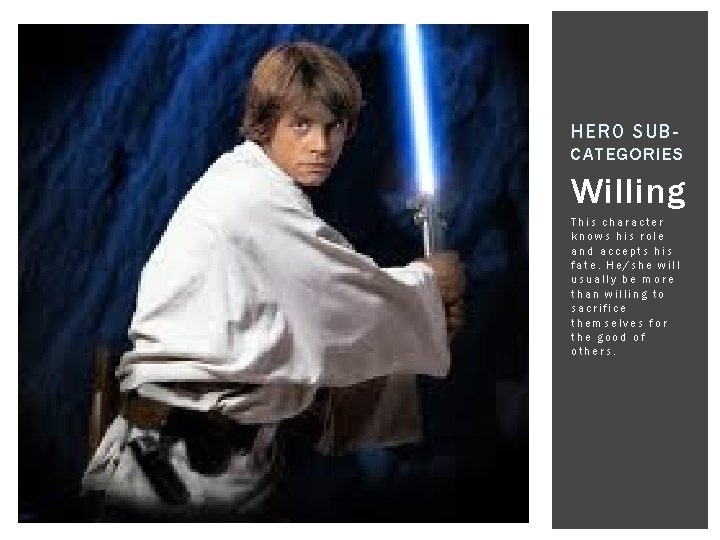
HERO SUBCATEGORIES Willing This character knows his role and accepts his fate. He/she will usually be more than willing to sacrifice themselves for the good of others.
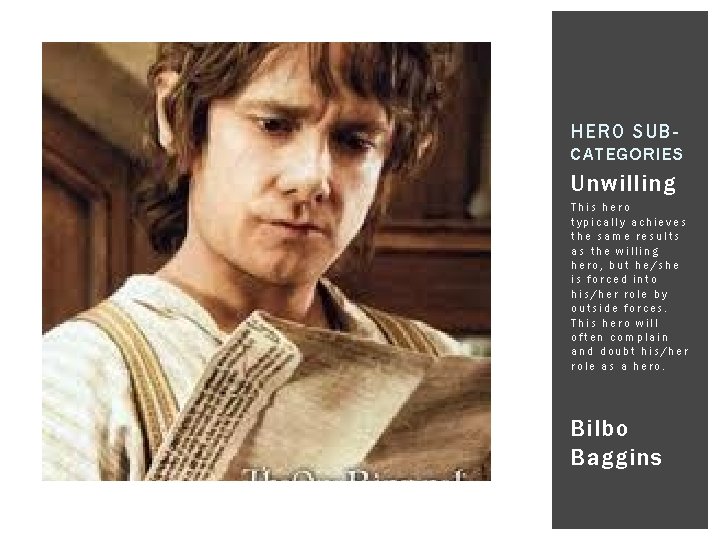
HERO SUBCATEGORIES Unwilling This hero typically achieves the same results as the willing hero, but he/she is forced into his/her role by outside forces. This hero will often complain and doubt his/her role as a hero. Bilbo Baggins
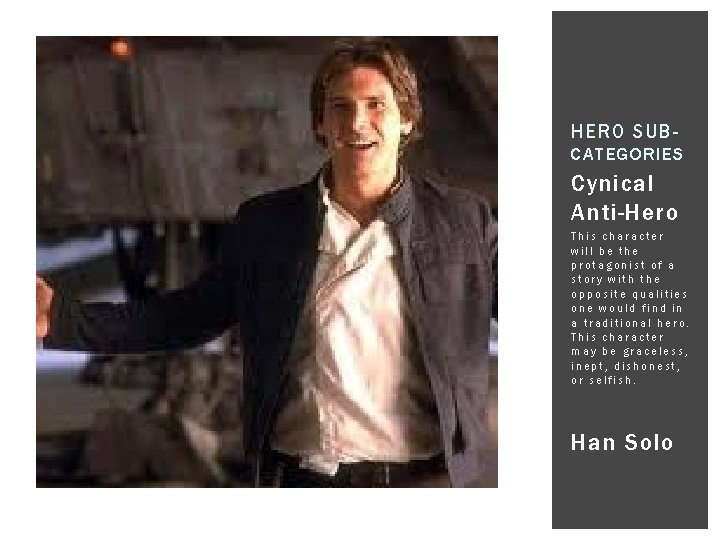
HERO SUBCATEGORIES Cynical Anti-Hero This character will be the protagonist of a story with the opposite qualities one would find in a traditional hero. This character may be graceless, inept, dishonest, or selfish. Han Solo
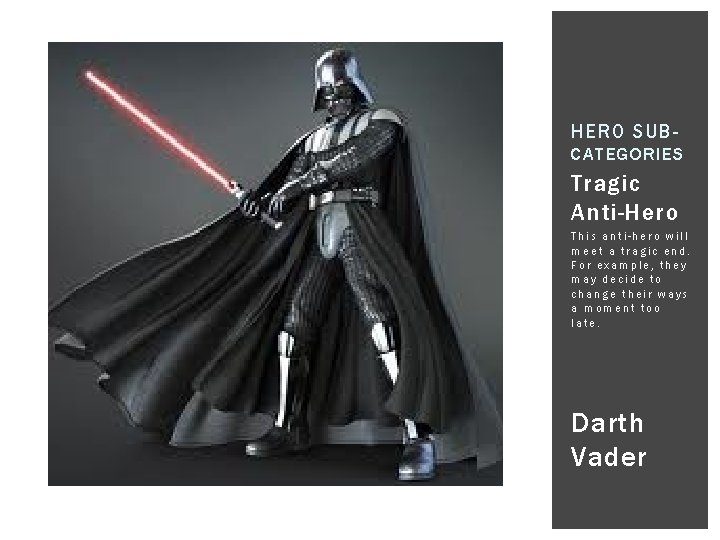
HERO SUBCATEGORIES Tragic Anti-Hero This anti-hero will meet a tragic end. For example, they may decide to change their ways a moment too late. Darth Vader
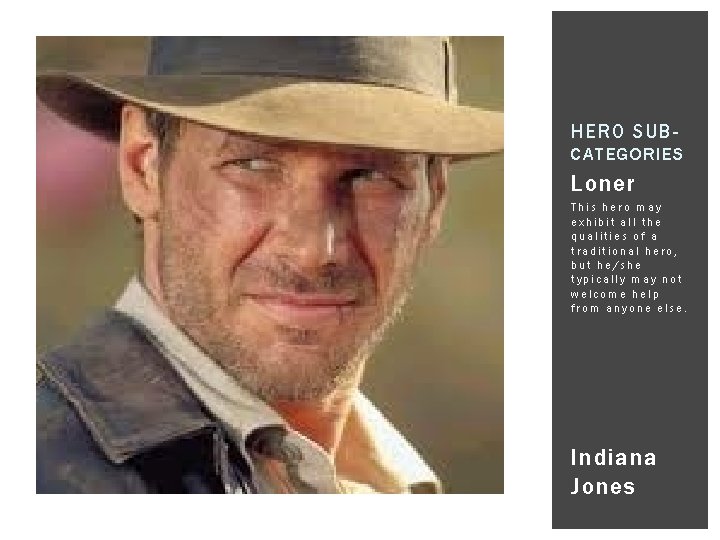
HERO SUBCATEGORIES Loner This hero may exhibit all the qualities of a traditional hero, but he/she typically may not welcome help from anyone else. Indiana Jones
FEMALE ARCHETYPES Damsel Princess Femme Fatale Queen Mother
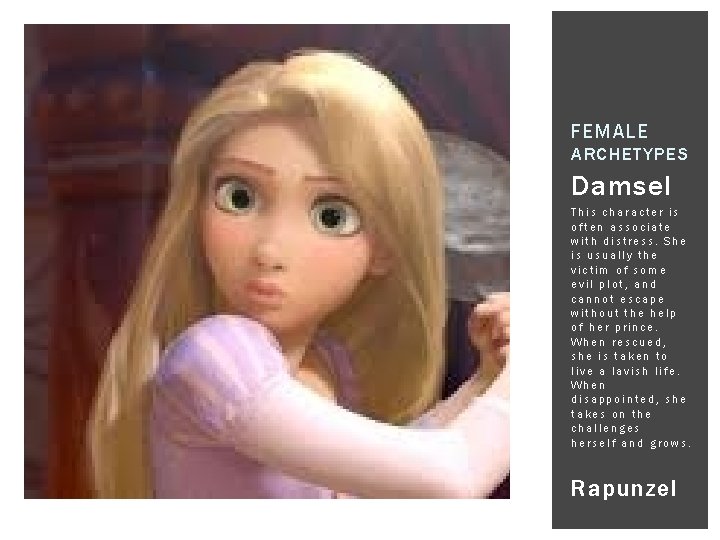
FEMALE ARCHETYPES Damsel This character is often associate with distress. She is usually the victim of some evil plot, and cannot escape without the help of her prince. When rescued, she is taken to live a lavish life. When disappointed, she takes on the challenges herself and grows. Rapunzel
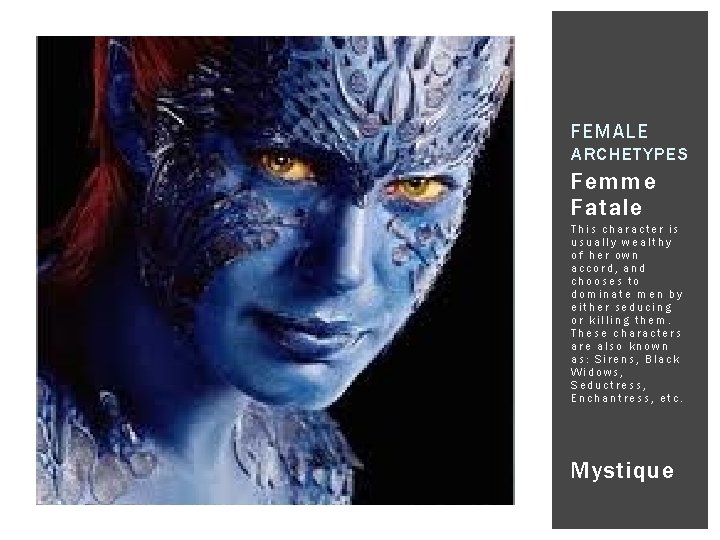
FEMALE ARCHETYPES Femme Fatale This character is usually wealthy of her own accord, and chooses to dominate men by either seducing or killing them. These characters are also known as: Sirens, Black Widows, Seductress, Enchantress, etc. Mystique
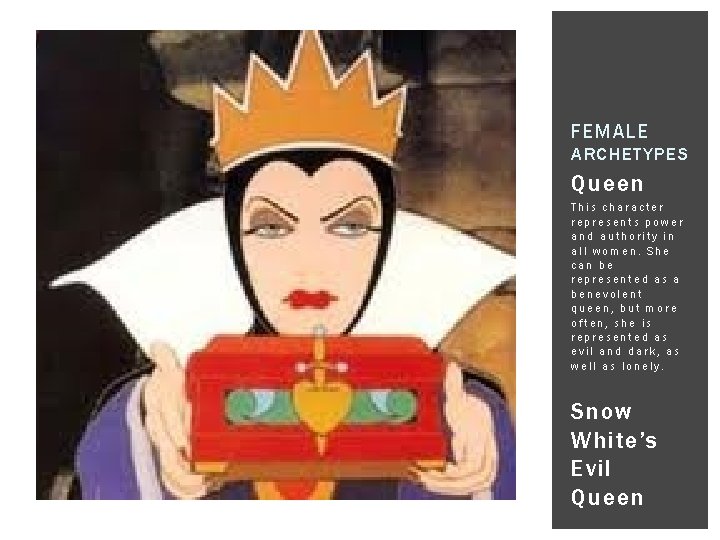
FEMALE ARCHETYPES Queen This character represents power and authority in all women. She can be represented as a benevolent queen, but more often, she is represented as evil and dark, as well as lonely. Snow White’s Evil Queen
MORE COMMON ARCHETYPES Companion Mentor Martyr Guide Warrior Jester Underdog Shadow Destroyer
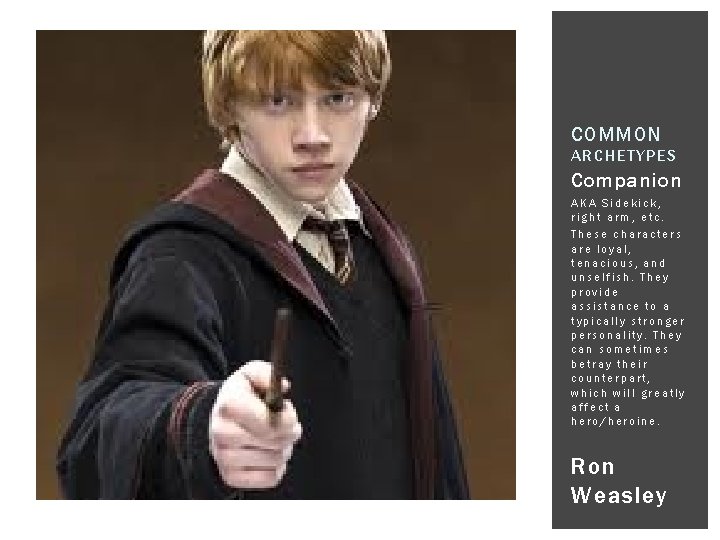
COMMON ARCHETYPES Companion AKA Sidekick, right arm, etc. These characters are loyal, tenacious, and unselfish. They provide assistance to a typically stronger personality. They can sometimes betray their counterpart, which will greatly affect a hero/heroine. Ron Weasley
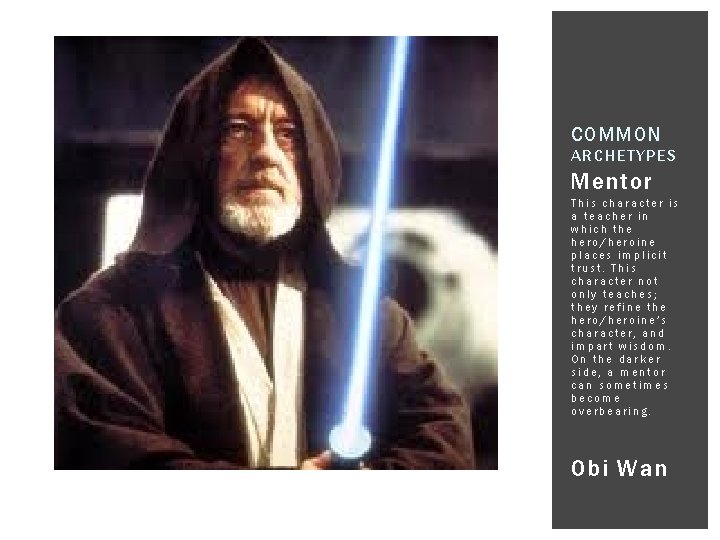
COMMON ARCHETYPES Mentor This character is a teacher in which the hero/heroine places implicit trust. This character not only teaches; they refine the hero/heroine’s character, and impart wisdom. On the darker side, a mentor can sometimes become overbearing. Obi Wan
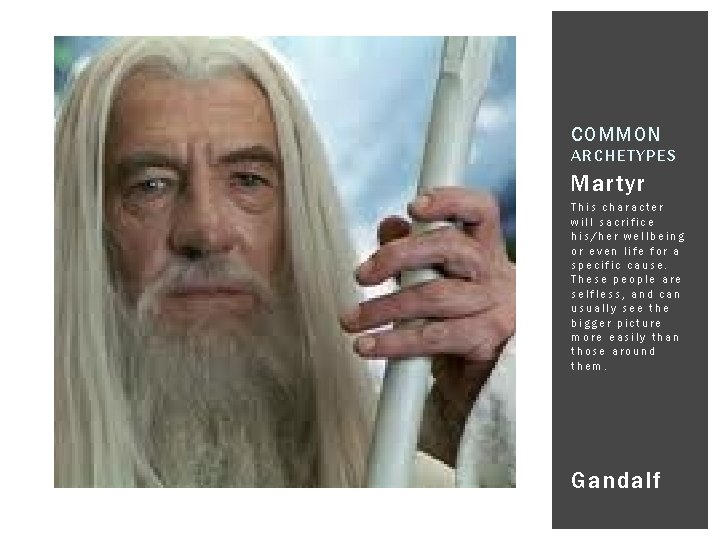
COMMON ARCHETYPES Martyr This character will sacrifice his/her wellbeing or even life for a specific cause. These people are selfless, and can usually see the bigger picture more easily than those around them. Gandalf
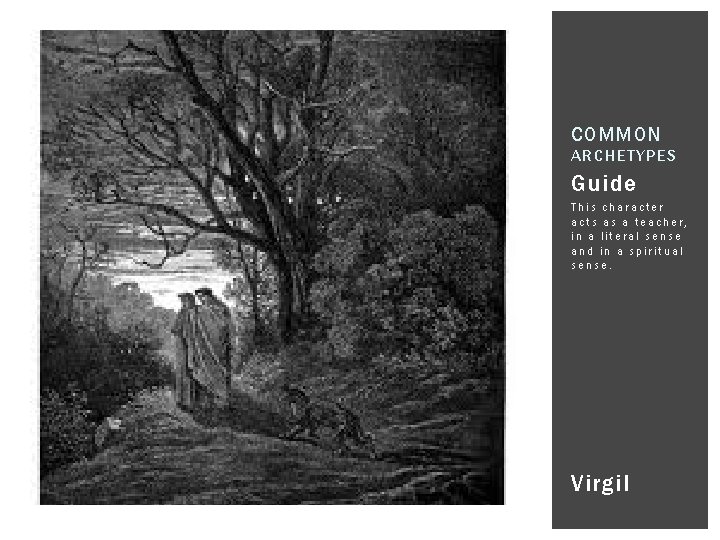
COMMON ARCHETYPES Guide This character acts as a teacher, in a literal sense and in a spiritual sense. Virgil
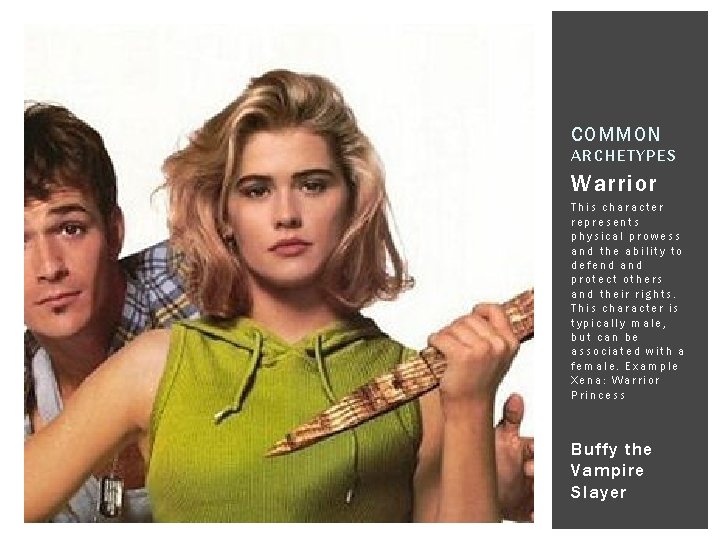
COMMON ARCHETYPES Warrior This character represents physical prowess and the ability to defend and protect others and their rights. This character is typically male, but can be associated with a female. Example Xena: Warrior Princess Buffy the Vampire Slayer
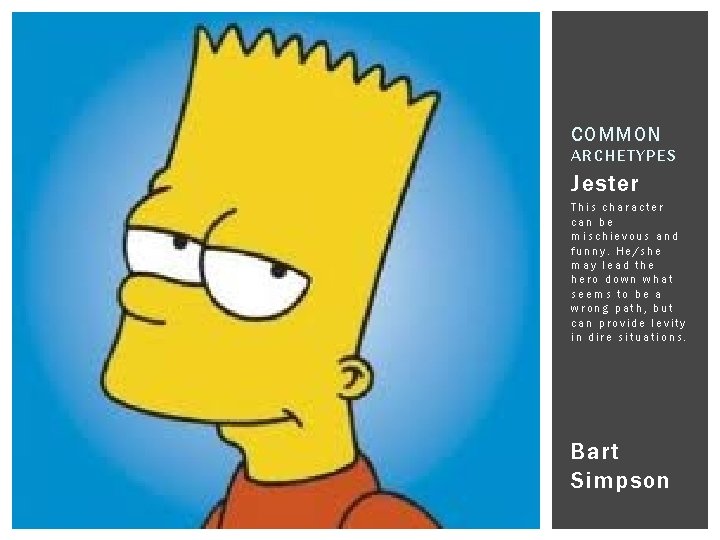
COMMON ARCHETYPES Jester This character can be mischievous and funny. He/she may lead the hero down what seems to be a wrong path, but can provide levity in dire situations. Bart Simpson
COMMON ARCHETYPES Underdog This character is always in the wrong place at the wrong time, but usually win something of value in the end. This is the character you root for. Rudy
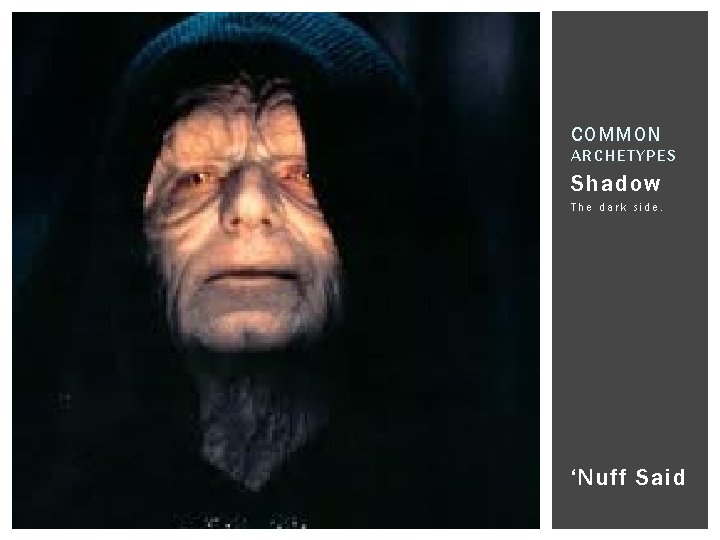
COMMON ARCHETYPES Shadow The dark side. ‘Nuff Said
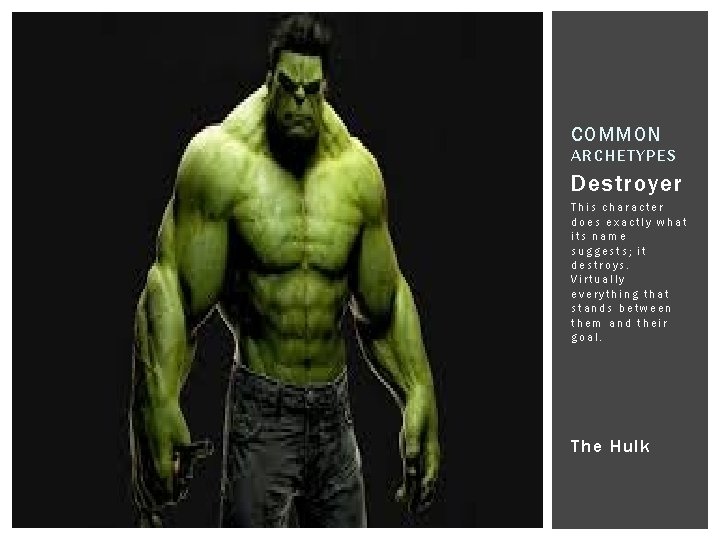
COMMON ARCHETYPES Destroyer This character does exactly what its name suggests; it destroys. Virtually everything that stands between them and their goal. The Hulk
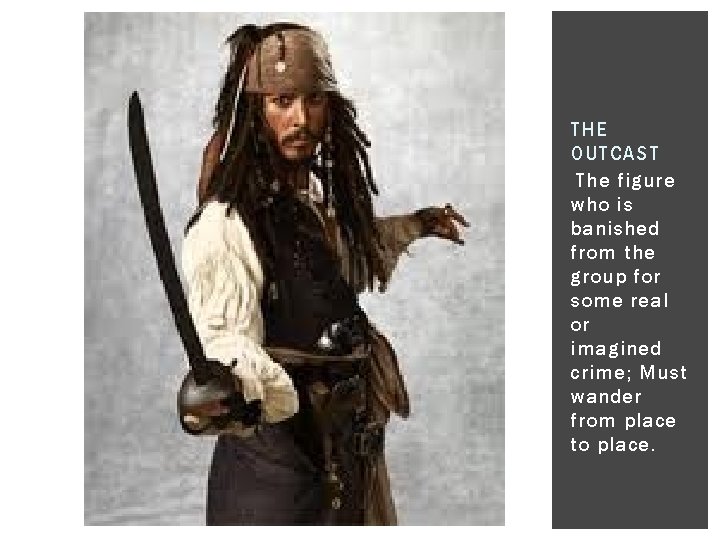
THE OUTCAST The figure who is banished from the group for some real or imagined crime; Must wander from place to place.
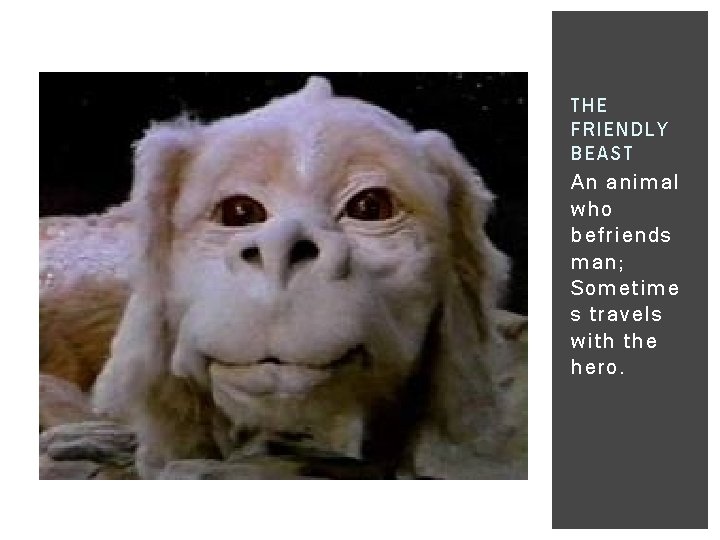
THE FRIENDLY BEAST An animal who befriends man; Sometime s travels with the hero.
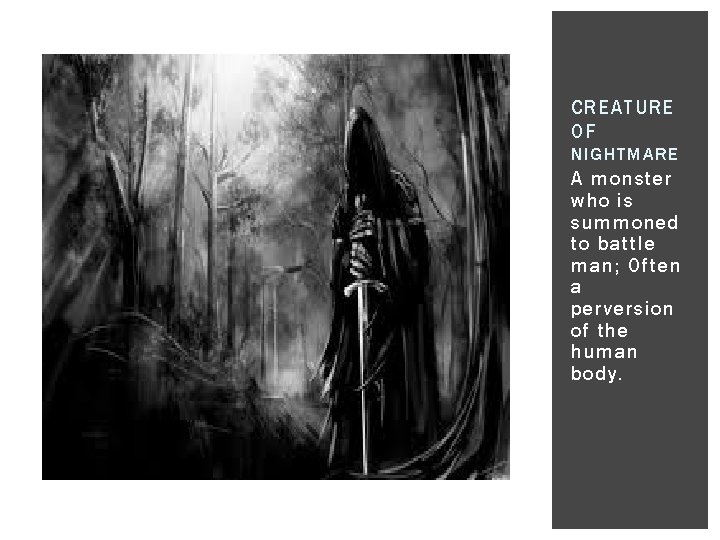
CREATURE OF NIGHTMARE A monster who is summoned to battle man; Often a perversion of the human body.
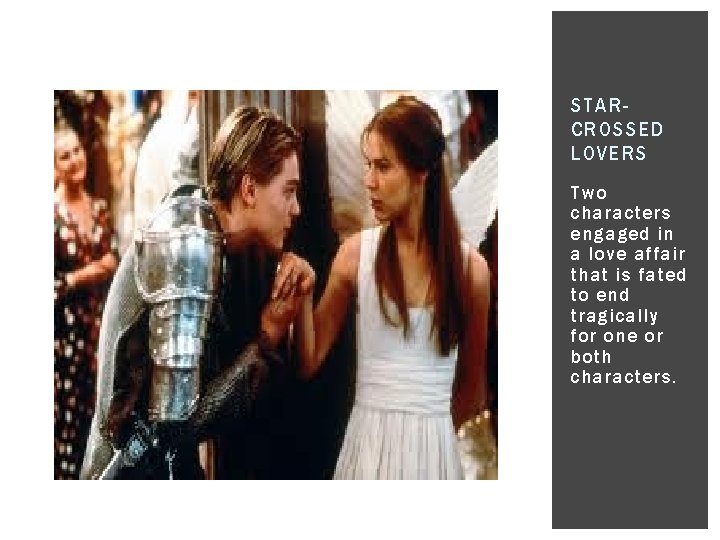
STARCROSSED LOVERS Two characters engaged in a love affair that is fated to end tragically for one or both characters.
BUT WAIT, THERE’S MORE! Archetypes can go beyond characters, to plots, themes, settings, and symbols.
SITUATION ARCHETYPES The Quest – This motif describes the search for someone or some talisman which, when found and brought back, will restore fertility to a wasted land, the desolation of which is mirrored by a leader’s illness and disability. The Task – This refers to a possibly superhuman feat that must be accomplished in order to fulfill the ultimate goal. The Journey – The journey sends the hero in search for some truth of information necessary to restore fertility, justice, and/or harmony to the kingdom. The journey includes the series of trials and tribulations the hero faces along the way. Usually the hero descends into a real or psychological hell and is forced to discover the blackest truths, quite often concerning his faults. Once the hero is at this lowest level, he must accept personal responsibility to return to the world of the living.
SITUATION ARCHETYPES CONTINUED The Initiation – This situation refers to a moment, usually psychological, in which an individual comes into maturity. He or she gains a new awareness into the nature of circumstances and problems and understands his or her responsibility for trying to resolve the dilemma. Typically, a hero receives a calling, a message or signal that he or she must make sacrifices and become responsible for getting involved in the problem. Often a hero will deny and question the calling and ultimately, in the initiation, will accept responsibility. The Ritual – Not to be confused with the initiation, the ritual refers to an organized ceremony that involves honored members of a given community and an Initiate. This situation officially brings the young man or woman into the realm of the community’s adult world.
SITUATION ARCHETYPES CONTINUED The Fall – Not to be confused with the awareness withthin the initiation, this archetype describes a descent in action from a higher to a lower state of being, an experience which might involve defilement, moral imperfection, and/or loss of innocence. This fall is often accompanied by expulsion from a kind of paradise as penalty for disobedience and/or moral transgression. Death and Rebirth – The most common of all situational archetypes, this motif grows out of the parallel between the cycle of nature and the cycle of life. It refers to those situations in which someone or something, concrete and/or metaphysical dies, yet is accompanied by some sign of birth or rebirth. Nature vs. Mechanistic World – Expressed in its simplest form, this refers to situations which suggest that nature is good whereas the forces of technology are bad.
SITUATION ARCHETYPES CONTINUED Battle Between Good and Evil – These situations pit obvious forces which represent good and evil against one another. Typically, good ultimately triumphs over evil despite great odds. The Unhealable Wound – This wound, physical or psychological, cannot be healed fully. This would also indicate a loss of innocence or purity. Often the wounds’ pain drives the sufferer to desperate measures of madness. The Magic Weapon – Sometimes connected with the task, this refers to a skilled individual hero’s ability to use a piece of technology in order to combat evil, continue a journey, or to prove his or her identity as a chosen individual.
SITUATION ARCHETYPES CONTINUED Dragon: In most quests the hero soon meets his or her dragon. This represents the major problem or obstacle of the quest -the opposition that must be overcome in order for the quest to be successful. Father-Son Conflict – Tension often results from separation during childhood or from an external source when the individuals meet as men and where the mentor often has a higher place in the affections of the hero than the natural parent. Sometimes the conflict is resolved in atonement. Innate Wisdom vs. Educated Stupidity – Some characters exhibit wisdom and understanding intuitively as opposed to those supposedly in charge.
TYPES OF ARCHETYPAL JOURNEYS The quest for identity The epic journey to find the promised land/to found the good city The quest for vengeance The warrior’s journey to save his people The search for love (to rescue the princess/damsel in distress) The journey in search of knowledge The tragic quest: penance or self-denial The fool’s errand The quest to rid the land of danger The grail quest (the quest for human perfection)
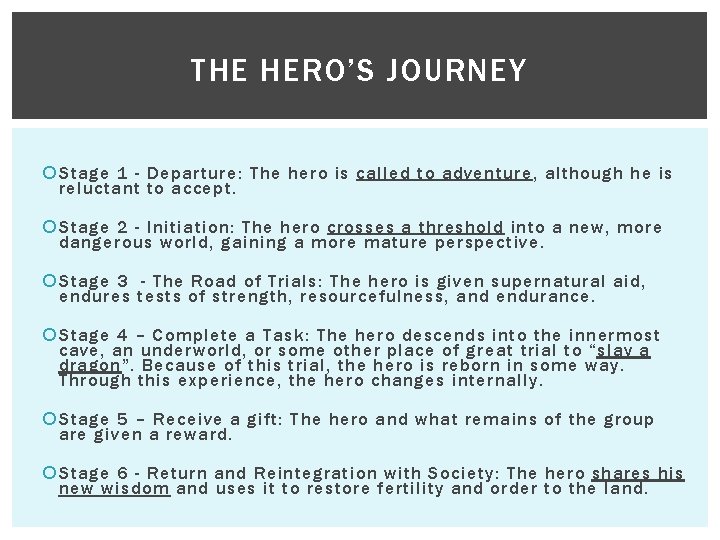
THE HERO’S JOURNEY Stage 1 - Departure: The hero is called to adventure, although he is reluctant to accept. Stage 2 - Initiation: The hero crosses a threshold into a new, more dangerous world, gaining a more mature perspective. Stage 3 - The Road of Trials: The hero is given supernatural aid, endures tests of strength, resourcefulness, and endurance. Stage 4 – Complete a Task: The hero descends into the innermost cave, an underworld, or some other place of great trial to “slay a dragon”. Because of this trial, the hero is reborn in some way. Through this experience, the hero changes internally. Stage 5 – Receive a gift: The hero and what remains of the group are given a reward. Stage 6 - Return and Reintegration with Society : The hero shares his new wisdom and uses it to restore fertility and order to the land.
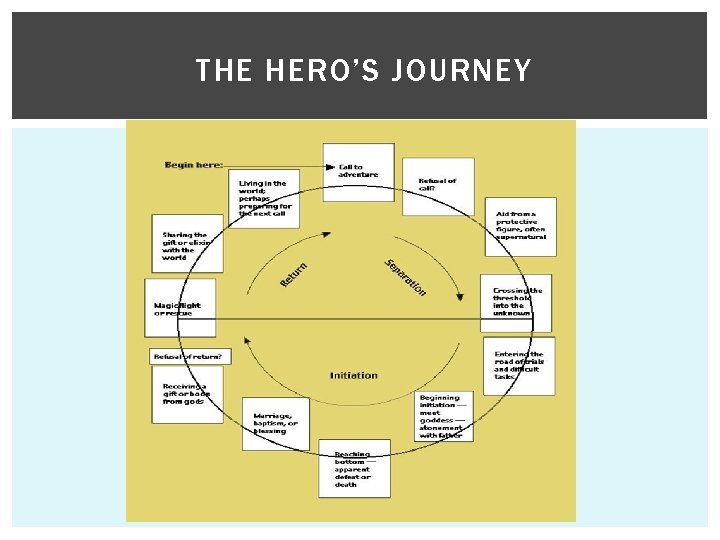
THE HERO’S JOURNEY
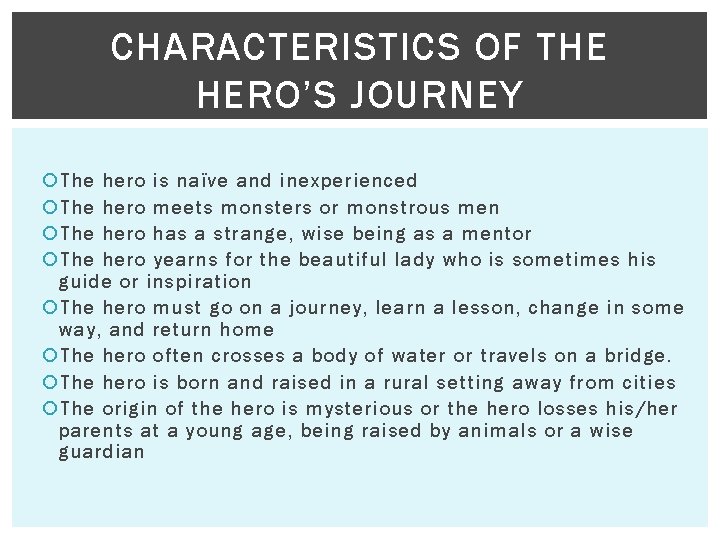
CHARACTERISTICS OF THE HERO’S JOURNEY The hero is naïve and inexperienced The hero meets monsters or monstrous men The hero has a strange, wise being as a mentor The hero yearns for the beautiful lady who is sometimes his guide or inspiration The hero must go on a journey, learn a lesson, change in some way, and return home The hero often crosses a body of water or travels on a bridge. The hero is born and raised in a rural setting away from cities The origin of the hero is mysterious or the hero losses his/her parents at a young age, being raised by animals or a wise guardian
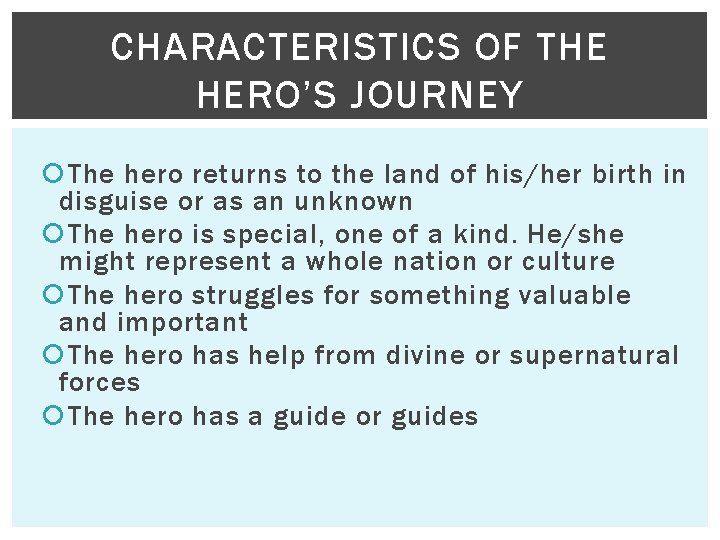
CHARACTERISTICS OF THE HERO’S JOURNEY The hero returns to the land of his/her birth in disguise or as an unknown The hero is special, one of a kind. He/she might represent a whole nation or culture The hero struggles for something valuable and important The hero has help from divine or supernatural forces The hero has a guide or guides
CHARACTERISTICS OF THE HERO’S JOURNEY The hero goes through a rite of passage or initiation, an event that marks a change from an immature to a more mature understanding of the world The hero undergoes some type of ritual or ceremony after his/her initiation The hero has a loyal band of companions The hero makes a stirring speech to his/her companions The hero engages in tests or contests of strength (physical and/or mental) and shows pride in his/her excellence The hero suffers an unhealable wound, sometimes an emotional or spiritual wound from which the hero never completely recovers.
LOCATIONS Threshold- The gateway to the new world that the hero must enter to change and grow. Underworld- The place of death where the hero will encounter the dark side of humanity. Wilderness- The uncivilized area ; Threatens the survival of the hero; Place of great danger River- The water which washes away sin or evil; Symbolizes time passing and the flow of circumstances Crossroads- The place or time of sudden decisions; Hero realizes a change must be made or punishment occurs Maze- The puzzling dilemma or the great uncertainty ; Symbolizes the dangerous monster inside oneself Castle- A strong place of safety; It generally holds the princess or the treasure; May be enchanted or bewitched. Cave- The entry of a dark place that contains mystery or a monster; represents the unconscious mind
SYMBOLIC ARCHETYPES Light vs. Darkness – Light usually suggests hope, renewal, OR intellectual illumination; darkness implies the unknown, ignorance, or despair. Water vs. Desert – Because water is necessary to life and growth, it commonly appears as a birth or rebirth symbol. Water is used in baptism services, which solemnizes spiritual births. Similarly, the appearance of rain in a work of literature can suggest a character’s spiritual birth.
SYMBOLIC ARCHETYPES CONTINUED Heaven vs. Hell – Humanity has traditionally associated parts of the universe not accessible to it with the dwelling places of the primordial forces that govern its world. The skies and mountaintops house its gods; the bowels of the earth contain the diabolic forces that inhabit its universe. Haven vs. Wilderness – Places of safety contrast sharply against the dangerous wilderness. Heroes are often sheltered for a time to regain health and resources. Supernatural Intervention – The gods intervene on the side of the hero or sometimes against him. Fire vs. Ice – Fire represents knowledge, light, life, and rebirth while ice like desert represents ignorance, darkness, sterility, and death.
NUMBERS Three – the Trinity (Father, Son, Holy Ghost); Mind, Body, Spirit, Birth, Life, Death Four – Mankind (four limbs), four elements, four seasons Six – devil, evil Seven – Divinity (3) + Mankind (4) = relationship between man and God, seven deadly sins, seven days of week, seven days to create the world, seven stages of civilization, seven colors of the rainbow, seven gifts of Holy Spirit.
COLORS Black (darkness) – chaos, mystery, the unknown, before existence, death, the unconscious, evil Red – blood, sacrifice; violent passion, disorder, sunrise, birth, fire, emotion, wounds, death, sentiment, mother, Mars, anger, excitement, heat, physical stimulation Green – hope, growth, envy, Earth, fertility, sensation, vegetation, death, water, nature, sympathy , adaptability, growth, Jupiter and Venus, White (light) – purity, peace, innocence, goodness, Spirit, morality, creative force, the direction East , spiritual thought Orange – fire, pride, ambition, egoism, Venus , Blue – clear sky, the day, the sea, height, depth, heaven, religious feeling, devotion, innocence, truth , spirituality, Jupiter, physical soothing and cooling Violet – water, nostalgia, memory, advanced spirituality, Neptune, Gold – Majesty, sun, wealth, corn (life dependency), truth Silver – Moon, wealth
SHAPES Oval – woman, passivity Triangle – communication, between heaven and earth, fire, the number 3, trinity, aspiration, movement upward, return to origins, sight, light Square – pluralism, earth, firmness, stability, construction, material solidity, the number four Rectangle – the most rational, most secure Cross – the Tree of life, axis of the world, struggle, martyrdom, orientation in space Circle – Heaven, intellect, thought, sun, the number two, unity, perfection, eternity, oneness, celestial realm, hearing, sound Spiral – the evolution of the universe, orbit, growth, deepening, cosmic motion, relationship between unity and multiplicity, macrocosm, breath, spirit, water
NATURE Air – activity, creativity, breath, light, freedom (liberty), movement Ascent – height, transcendence, inward journey, increasing intensity Center – thought, unity, timelessness, paradise, creator, infinity, Duality – Yin-Yang, opposites, complements, positive-negative, male-female, life-death Earth – passive, feminine, receptive, solid Descent – unconscious, potentialities of being, animal nature Fire – the ability to transform, love, life, health, control, sun, God, passion, spiritual energy, regeneration Lake – mystery, depth, unconscious Crescent moon – change, transition Mountain – height, mass, loftiness, center of the world, ambition, goals Valley – depression, low-points, evil, unknown
NATURE CONTINUED Sun – Hero, son of Heaven, knowledge, the Divine eye, fire, life force, creative-guiding force, brightness, splendor, active awakening, healing, resurrection, ultimate wholeness Water – passive, feminine Rivers/Streams – life force, life cycle Stars – guidance Wind – Holy Spirit, life, messenger Ice/Snow – coldness, barrenness Clouds/Mist – mystery, sacred Rain – life giver Steam – transformation to the Holy Spirit Cave – feminine Lightning – intuition, inspiration Tree – where we learn, tree of life, tree of knowledge Forest – evil, lost, fear
OBJECTS Feathers – lightness, speed Shadow – our dark side, evil, devil Masks – concealment Boats/Rafts – safe passage Bridge – change, transformation Right hand – rectitude, correctness Left hand – deviousness Feet – stability, freedom Skeleton – mortality Heart – love, emotions Hourglass – the passage of time
FINALLY, It is important to remember that most characters, plots, etc. will not be simply ONE of these things. The best, roundest characters will embody several archetypes. The most dynamic characters will perhaps change from one to another. Intriguing stories will have several situation archetypes.
- Slides: 51