
Archaeology Down to Earth By Robert L Kelly
Archaeology Down to Earth By Robert L. Kelly & David Hurst Thomas 7 th edition
Chapter 1 Meet Some Real Archaeologists
Outline Introduction The Discovery of Deep Time A Brief History of Archaeology at Mid-Twentieth Century Archaeology in the Twenty-First Century Conclusion: Archaeology's Future
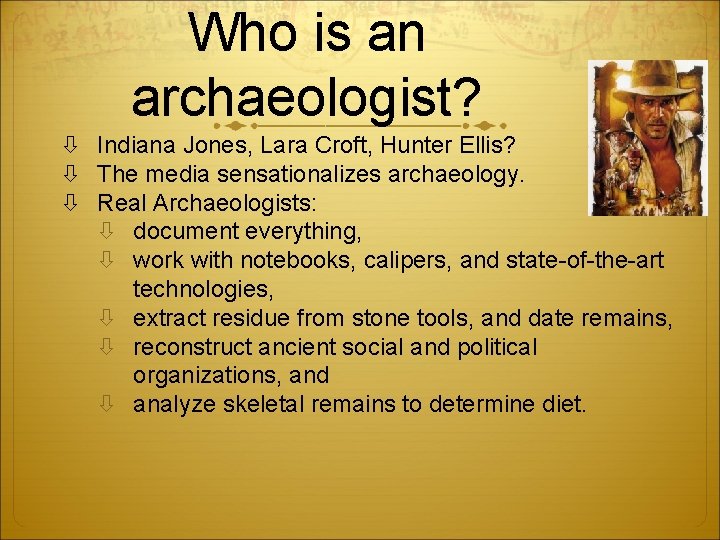
Who is an archaeologist? Indiana Jones, Lara Croft, Hunter Ellis? The media sensationalizes archaeology. Real Archaeologists: document everything, work with notebooks, calipers, and state-of-the-art technologies, extract residue from stone tools, and date remains, reconstruct ancient social and political organizations, and analyze skeletal remains to determine diet.
Introduction Artifacts- ancient objects retrieved from sites that are the primary source of information for archaeologists. Archaeologists “think from things” The best way to introduce archaeology is through its history.

Who Was the First Archaeologist? Most historians list Nabonidus, the last king of the neo-Babylonian Empire as the “first archaeologist. ” Nabonidus rebuilt temples of ancient Babylon and searched the foundations for inscriptions of earlier kings. “Nabonidus looked to the physical residues of antiquity– things – to answer questions about the past. ”(2)
Who Was the First Archaeologist? Scholars grappled with the idea of “the past” Middle Age-Europe recognized a remote past reified through myth and legend, largely through the Bible. During the Renaissance, Francesco Petrarch proposed that the remote past was an ideal of perfection and he looked to antiquity for moral philosophy.
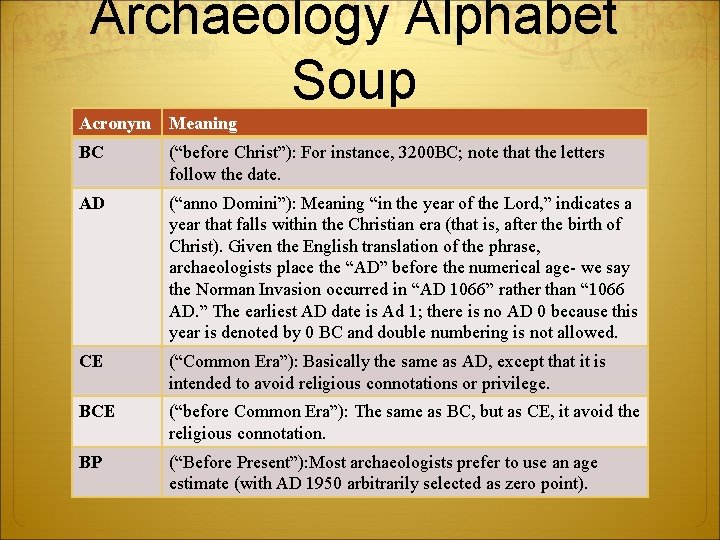
Archaeology Alphabet Soup Acronym Meaning BC (“before Christ”): For instance, 3200 BC; note that the letters follow the date. AD (“anno Domini”): Meaning “in the year of the Lord, ” indicates a year that falls within the Christian era (that is, after the birth of Christ). Given the English translation of the phrase, archaeologists place the “AD” before the numerical age- we say the Norman Invasion occurred in “AD 1066” rather than “ 1066 AD. ” The earliest AD date is Ad 1; there is no AD 0 because this year is denoted by 0 BC and double numbering is not allowed. CE (“Common Era”): Basically the same as AD, except that it is intended to avoid religious connotations or privilege. BCE (“before Common Era”): The same as BC, but as CE, it avoid the religious connotation. BP (“Before Present”): Most archaeologists prefer to use an age estimate (with AD 1950 arbitrarily selected as zero point).
Archaeology can be Controversial People and leaders have used the past to justify their actions in the present, such that accounts of the past conflict with one another. The Society for Antiquaries, dissolved in 1614 and reformed in 1707, was the first of many British scholarly societies interested in the relevance of the past to the present. With the goal to map, record, and preserve national treasures, members of Europe’s leisure classes considered an interest in classical antiquities to be an important ingredient in the“cultivation of taste. ”
The Discovery of Deep Time Up to the 18 th century, archaeological research proceeded in accord with the tradition of Petrarch, clarifying the picture of classical civilizations of the Mediterranean. Lore at the time did not challenge the Christian Bible as an account of the origin of the world and humans. Crude stone tools discovered in England continental Europe, along with bones of longextinct mammals “prove the existence of very ancient man” (Jacques Boucher Crèvecoeur de Perthes, 1778 -1868).
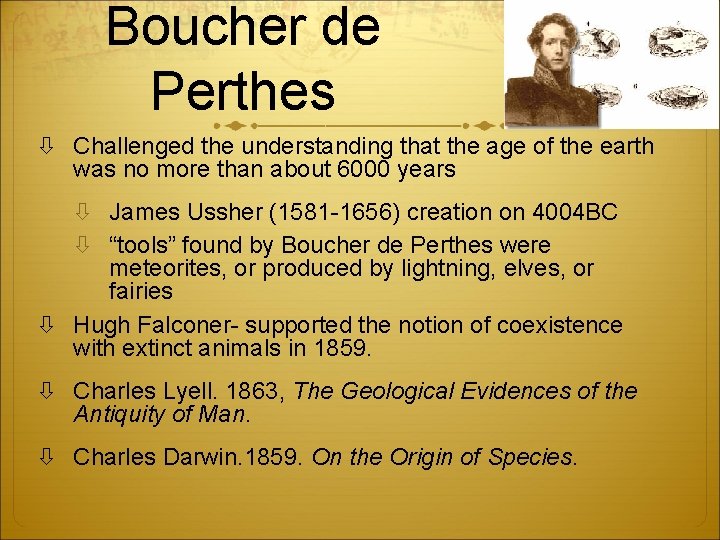
Boucher de Perthes Challenged the understanding that the age of the earth was no more than about 6000 years James Ussher (1581 -1656) creation on 4004 BC “tools” found by Boucher de Perthes were meteorites, or produced by lightning, elves, or fairies Hugh Falconer- supported the notion of coexistence with extinct animals in 1859. Charles Lyell. 1863, The Geological Evidences of the Antiquity of Man. Charles Darwin. 1859. On the Origin of Species.
British Archaeology British archaeology billowed out across two divergent courses: One direction became involved with the problems of remote geological time and the demonstration of longterm human evolution. The other focused on: classical archaeology – the branch of archaeology that studies the “classical studies, ” particularly ancient Greece and Rome, and the Near East.
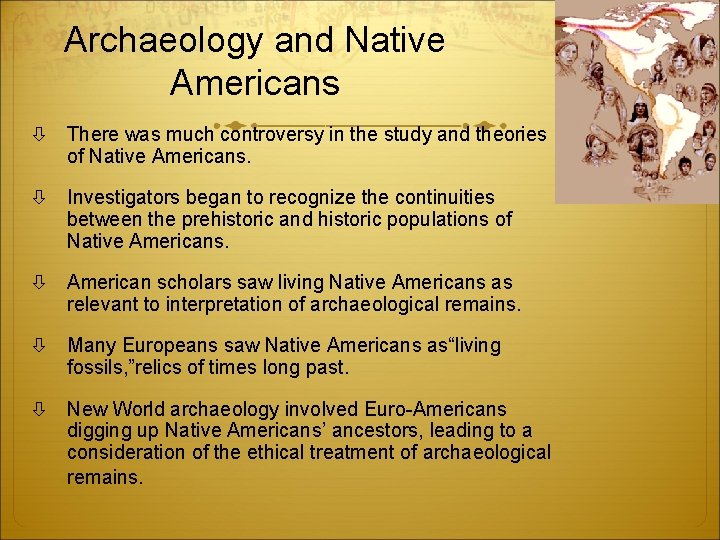
Archaeology and Native Americans There was much controversy in the study and theories of Native Americans. Investigators began to recognize the continuities between the prehistoric and historic populations of Native Americans. American scholars saw living Native Americans as relevant to interpretation of archaeological remains. Many Europeans saw Native Americans as“living fossils, ”relics of times long past. New World archaeology involved Euro-Americans digging up Native Americans’ ancestors, leading to a consideration of the ethical treatment of archaeological remains.
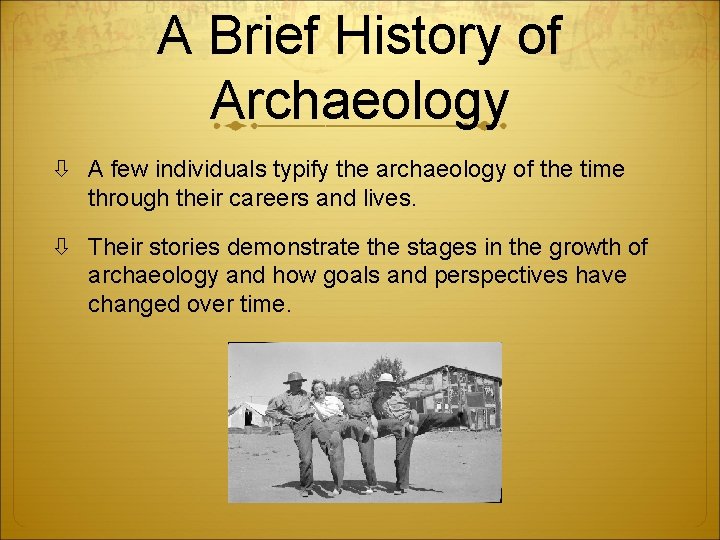
A Brief History of Archaeology A few individuals typify the archaeology of the time through their careers and lives. Their stories demonstrate the stages in the growth of archaeology and how goals and perspectives have changed over time.
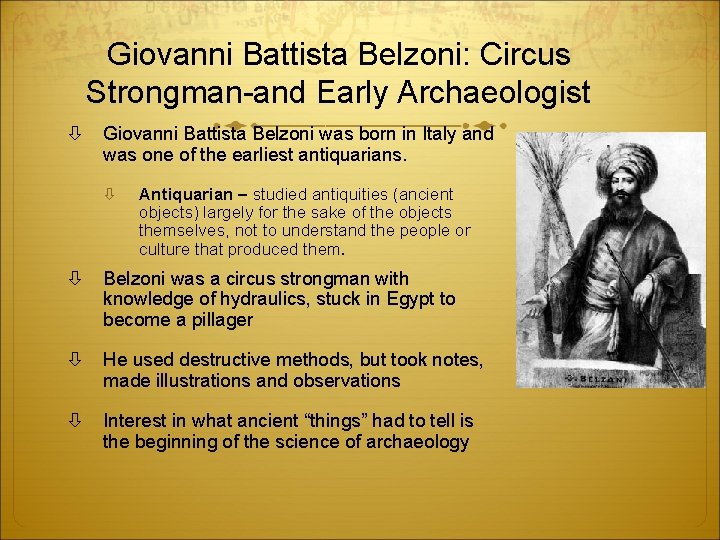
Giovanni Battista Belzoni: Circus Strongman-and Early Archaeologist Giovanni Battista Belzoni was born in Italy and was one of the earliest antiquarians. Antiquarian – studied antiquities (ancient objects) largely for the sake of the objects themselves, not to understand the people or culture that produced them. Belzoni was a circus strongman with knowledge of hydraulics, stuck in Egypt to become a pillager He used destructive methods, but took notes, made illustrations and observations Interest in what ancient “things” had to tell is the beginning of the science of archaeology
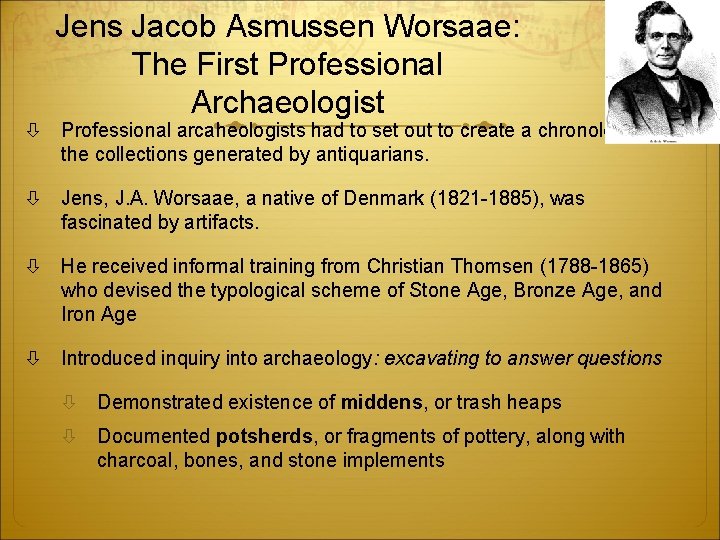
Jens Jacob Asmussen Worsaae: The First Professional Archaeologist Professional arcaheologists had to set out to create a chronology of the collections generated by antiquarians. Jens, J. A. Worsaae, a native of Denmark (1821 -1885), was fascinated by artifacts. He received informal training from Christian Thomsen (1788 -1865) who devised the typological scheme of Stone Age, Bronze Age, and Iron Age Introduced inquiry into archaeology: excavating to answer questions Demonstrated existence of middens, or trash heaps Documented potsherds, or fragments of pottery, along with charcoal, bones, and stone implements
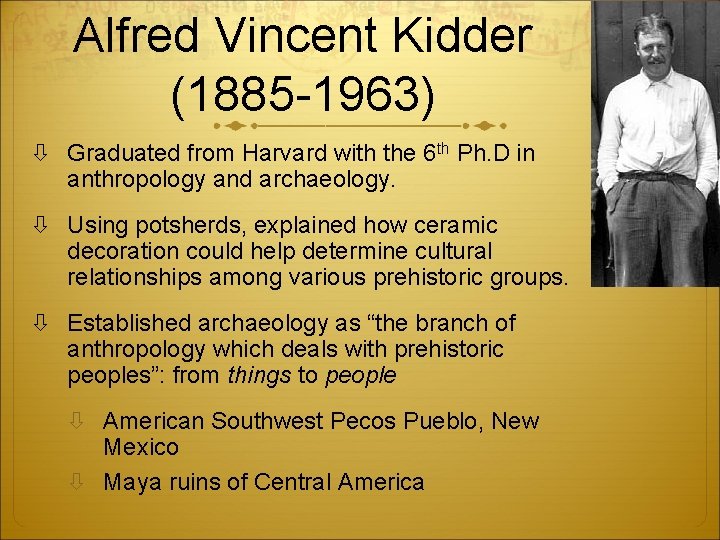
Alfred Vincent Kidder (1885 -1963) Graduated from Harvard with the 6 th Ph. D in anthropology and archaeology. Using potsherds, explained how ceramic decoration could help determine cultural relationships among various prehistoric groups. Established archaeology as “the branch of anthropology which deals with prehistoric peoples”: from things to people American Southwest Pecos Pueblo, New Mexico Maya ruins of Central America
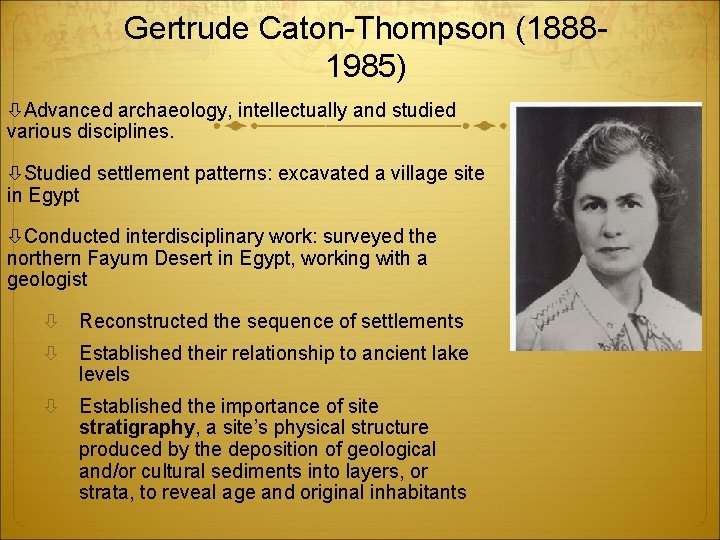
Gertrude Caton-Thompson (18881985) Advanced archaeology, intellectually and studied various disciplines. Studied settlement patterns: excavated a village site in Egypt Conducted interdisciplinary work: surveyed the northern Fayum Desert in Egypt, working with a geologist Reconstructed the sequence of settlements Established their relationship to ancient lake levels Established the importance of site stratigraphy, a site’s physical structure produced by the deposition of geological and/or cultural sediments into layers, or strata, to reveal age and original inhabitants
Mid-Twentieth Century Most professional archaeologists worked with museums, universities, or private sector to preserve cultural heritage. Most were practicing culture history, documenting how material culture changed over time and space. Main goal- tracking the migrations and developments of prehistoric cultures.
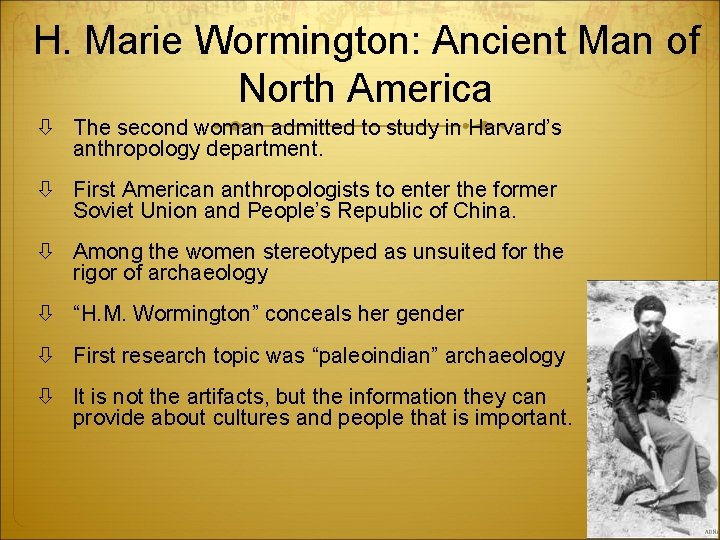
H. Marie Wormington: Ancient Man of North America The second woman admitted to study in Harvard’s anthropology department. First American anthropologists to enter the former Soviet Union and People’s Republic of China. Among the women stereotyped as unsuited for the rigor of archaeology “H. M. Wormington” conceals her gender First research topic was “paleoindian” archaeology It is not the artifacts, but the information they can provide about cultures and people that is important.
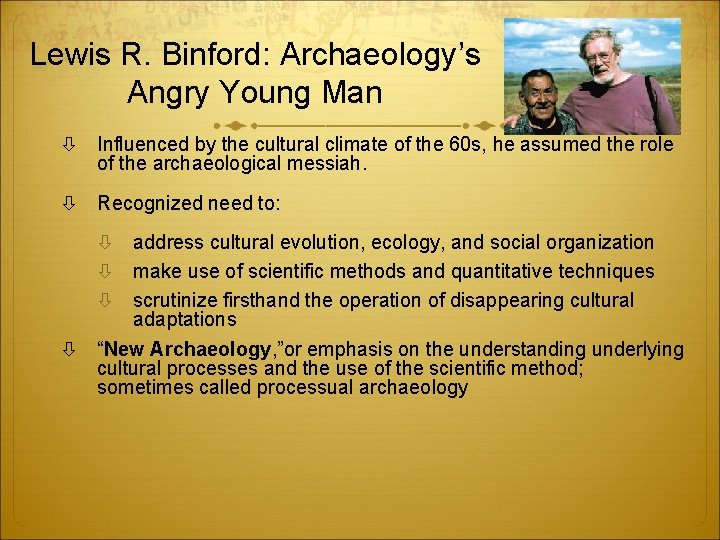
Lewis R. Binford: Archaeology’s Angry Young Man Influenced by the cultural climate of the 60 s, he assumed the role of the archaeological messiah. Recognized need to: address cultural evolution, ecology, and social organization make use of scientific methods and quantitative techniques scrutinize firsthand the operation of disappearing cultural adaptations “New Archaeology, ”or emphasis on the understanding underlying cultural processes and the use of the scientific method; sometimes called processual archaeology
Archaeology in the Twenty-First Century Has several branches growing and intersecting with the others in interesting ways. Today most archaeologists are employed by federal agencies (cultural resource management firms)
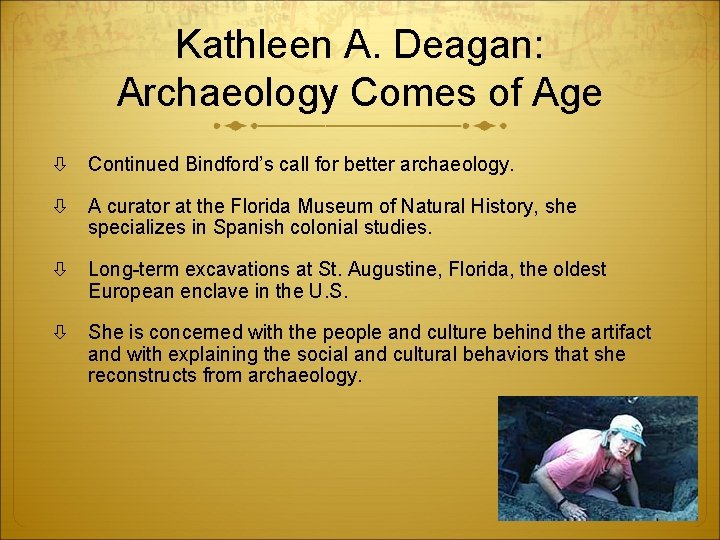
Kathleen A. Deagan: Archaeology Comes of Age Continued Bindford’s call for better archaeology. A curator at the Florida Museum of Natural History, she specializes in Spanish colonial studies. Long-term excavations at St. Augustine, Florida, the oldest European enclave in the U. S. She is concerned with the people and culture behind the artifact and with explaining the social and cultural behaviors that she reconstructs from archaeology.
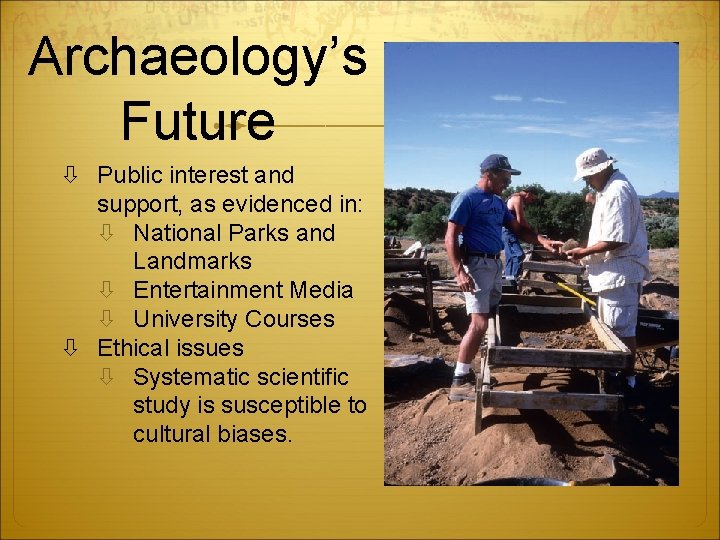
Archaeology’s Future Public interest and support, as evidenced in: National Parks and Landmarks Entertainment Media University Courses Ethical issues Systematic scientific study is susceptible to cultural biases.
Videos on Archaeology Zahi Hawass on Archaeology https: //www. youtube. com/watch? v=NL-P-zji. CZ 4 What is archaeology? https: //www. youtube. com/watch? v=Vj-Oq 8 vk 3 N 4

Quick Quiz
1. Nabonidus, the last king of the neo-Babylonian Empire, is considered the “first archaeologist. ” A. True B. False
Answer: A Most historians list Nabonidus, although he was a pious man, as the first to look to the physical residues of antiquity – things – to answer questions about the past.
2. The media conveys archaeology in a valid way when Indiana Jones is shown fighting Nazis and grabbing gold statues from curse-laden catacombs. a. True b. False
Answer: B The media play up the physically thrilling side of archaeology, the mystery of discovery and potential threats. Archaeologists conduct systematic scientific research.
3. Which of the following is an example of an artifact? A. Metal tools B. Beads and other ornaments C. Pottery D. Religious and sacred items E. All of the above
Answer: E Metal tools, beads and other ornaments, pottery and religious and sacred items are examples of artifacts.
4. Archaeology began as a pastime of the rich, but through the years it developed into a professional scientific discipline. A. True B. False
Answer: A Most professional archaeologists at the mid-twentieth century were affiliated with major museums and universities; joined the private sector, working to protect and conserve America’s cultural heritage. The 20 th century archaeologist was not a collector of personal treasure.
- Slides: 34