
Archaeology 101 The Search for Fact not Truth


- Slides: 12
Archaeology 101 “The Search for Fact, not Truth”
What is Archaeology? • Study of the past via artifacts and research. • Derived from the Latin word for ancient/old and the Greek for study of.
What is Archaeology? • Artifact • Object, such as a tool or weapon, made by human beings. • Archeologist • Scientist who learns about early peoples by studying the objects they left behind • Anthropologist • Scientist who studies how people organize societies.
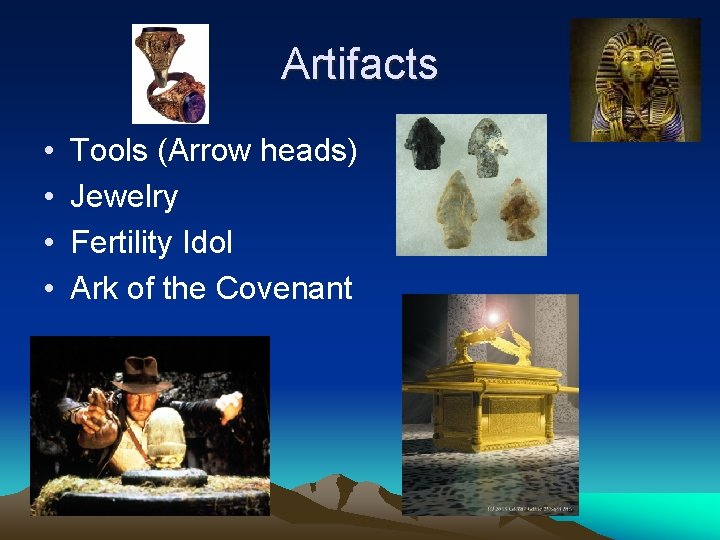
Artifacts • • Tools (Arrow heads) Jewelry Fertility Idol Ark of the Covenant
Time Frames • Paleolithic: Old Stone: Stone age that predates the use of Bronze in tools and the discovery of fire. • Neolithic: New Stone: Stone age made from use of Bronze in tools and the discovery of fire. • Pleistocene: 20, 000 years ago. Ice Age. First Native Americans appear.
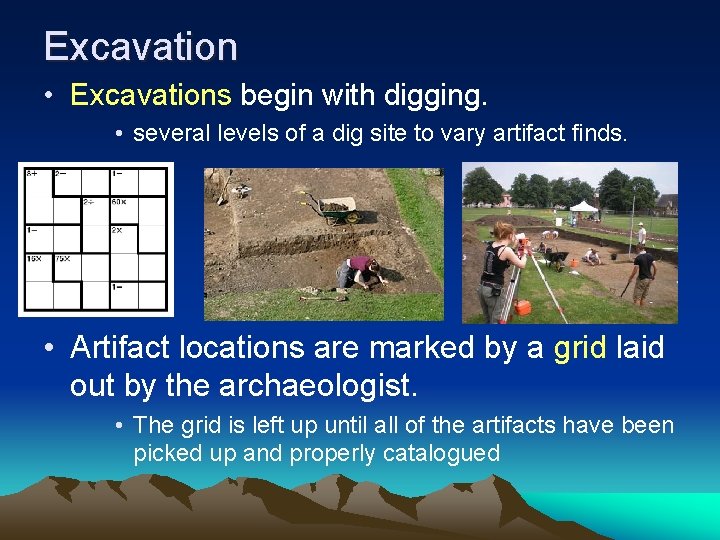
Excavation • Excavations begin with digging. • several levels of a dig site to vary artifact finds. • Artifact locations are marked by a grid laid out by the archaeologist. • The grid is left up until all of the artifacts have been picked up and properly catalogued
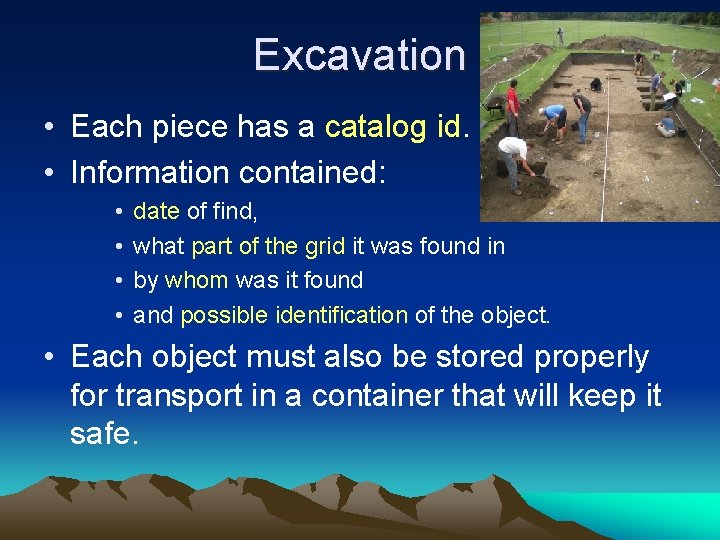
Excavation • Each piece has a catalog id. • Information contained: • • date of find, what part of the grid it was found in by whom was it found and possible identification of the object. • Each object must also be stored properly for transport in a container that will keep it safe.
Research • Research is often conducted in the library. • Field research is designed to find artifacts however, book research allows for archaeologists to get clues for what pieces may be if unknown or where to look. • It is also important to keep up to date on the latest finds.
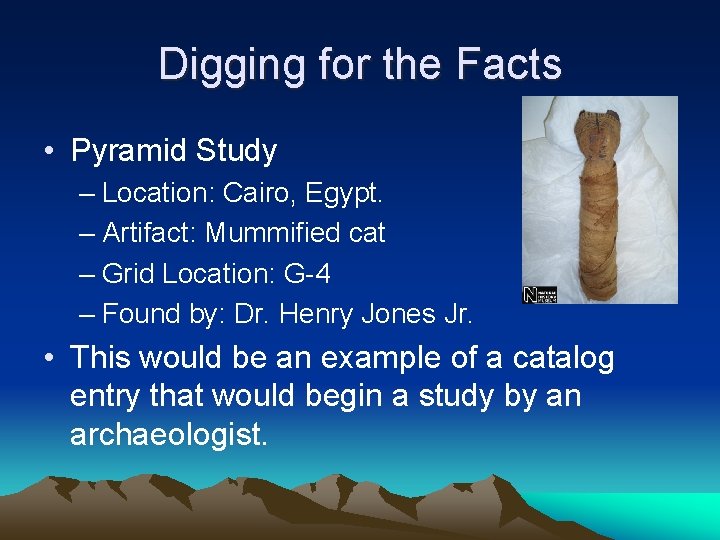
Digging for the Facts • Pyramid Study – Location: Cairo, Egypt. – Artifact: Mummified cat – Grid Location: G-4 – Found by: Dr. Henry Jones Jr. • This would be an example of a catalog entry that would begin a study by an archaeologist.
Study Continued • Library: UPENN Van Pelt. • Books: • Beneath the Sands by Zahi Hawass. • Sticks, Shadows, and Stone by Martin Isler. • Use these books to find out when mummified cats were popular.
Study 1 + Study 2 = Study 3 • Dates: 2000 B. C. E to 1900 B. C. E (hypothetical) • Mummified cats popular towards the apex of the Cheops dynasty (hypothetical) • Thus conclusion can be made that this cat was mummified in this 1, 000 year span. • Depending on location of remains, can discover who’s cat it was.
“Now That’s A History Teacher”