
Archaean magmatism Two characteristic rock types Komatiites ultramafic
- Slides: 21
Archaean magmatism • Two characteristic rock types • Komatiites = ultra-mafic, Mg-rich lavas • TTGs = Tonalites, Trondhjemites & Granodiorites • Archean (US spelling) or Archaean (UK spelling)
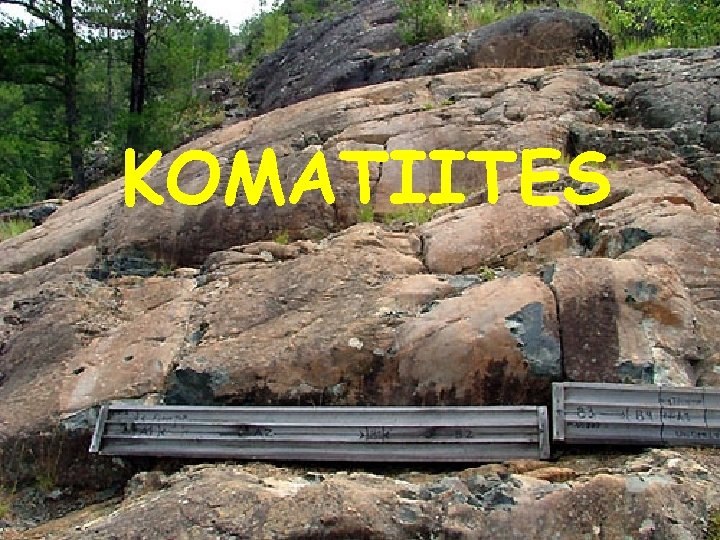
KOMATIITES
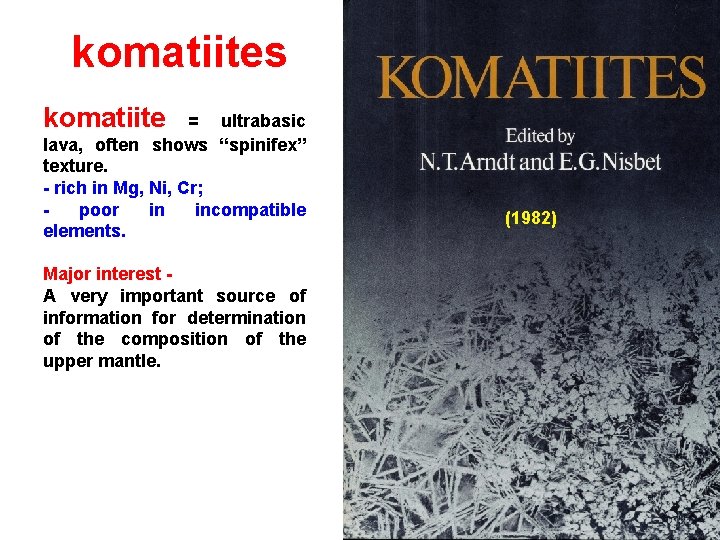
komatiites komatiite = ultrabasic lava, often shows “spinifex” texture. - rich in Mg, Ni, Cr; poor in incompatible elements. Major interest A very important source of information for determination of the composition of the upper mantle. (1982)
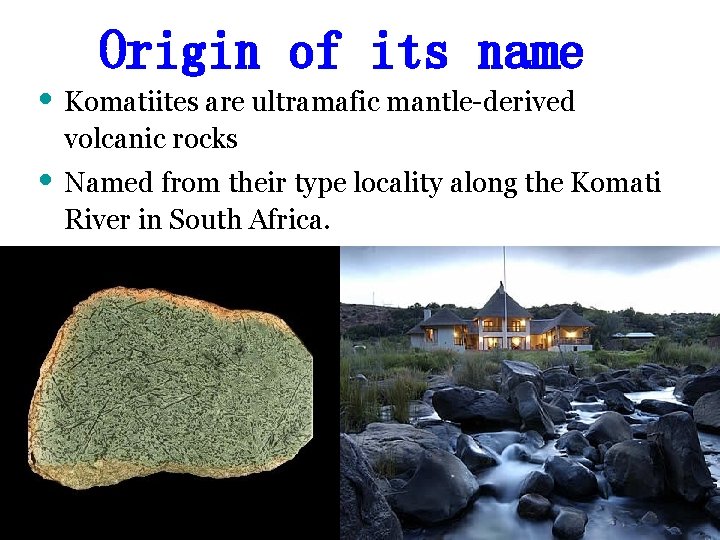
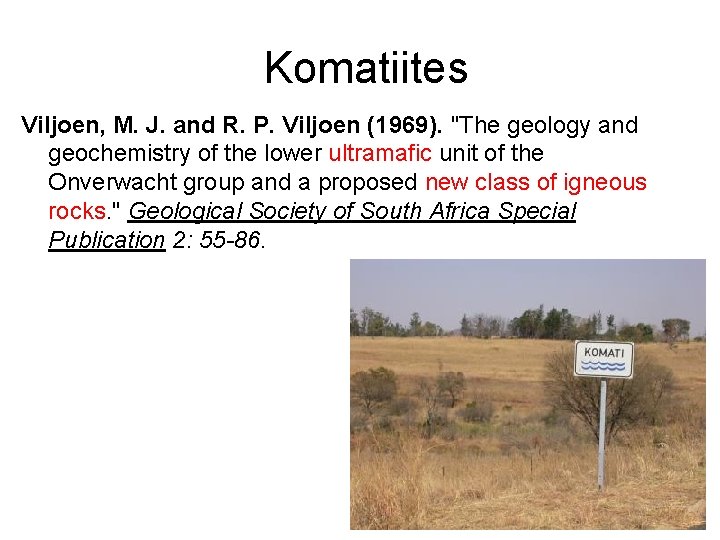
Origin of its name • Komatiites are ultramafic mantle-derived volcanic rocks • Named from their type locality along the Komati River in South Africa.
Komatiites Viljoen, M. J. and R. P. Viljoen (1969). "The geology and geochemistry of the lower ultramafic unit of the Onverwacht group and a proposed new class of igneous rocks. " Geological Society of South Africa Special Publication 2: 55 -86.
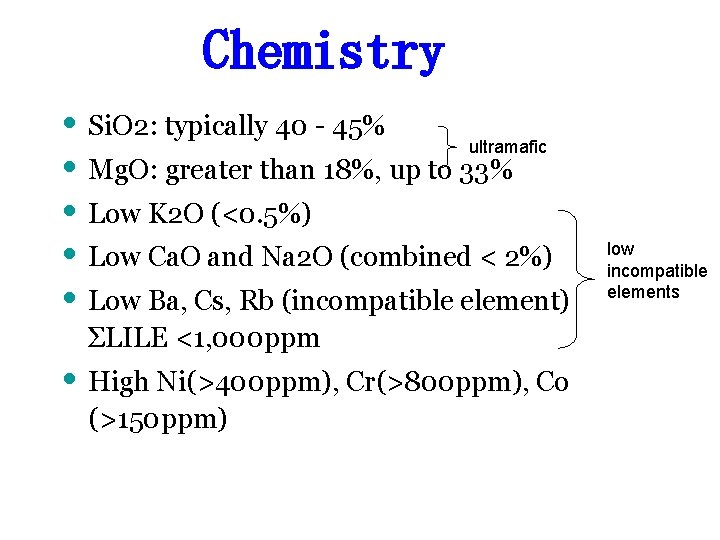
Chemistry • Si. O 2: typically 40 - 45% ultramafic • Mg. O: greater than 18%, up to 33% • Low K 2 O (<0. 5%) • Low Ca. O and Na 2 O (combined < 2%) • Low Ba, Cs, Rb (incompatible element) ΣLILE <1, 000 ppm • High Ni(>400 ppm), Cr(>800 ppm), Co (>150 ppm) low incompatible elements
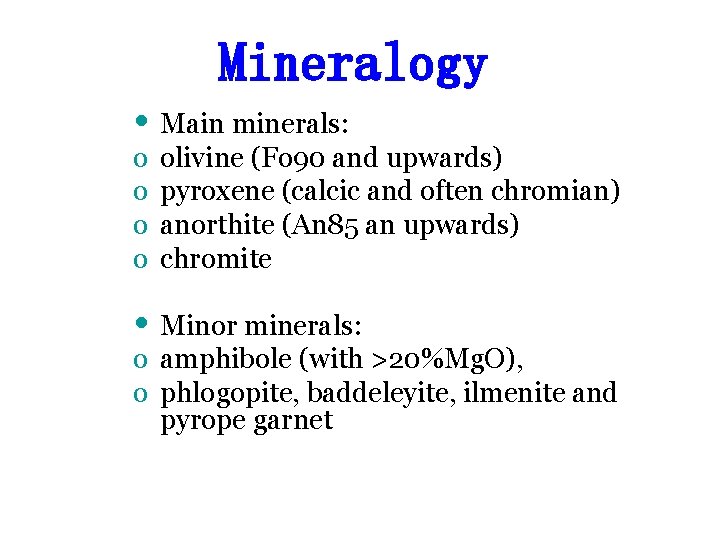
Mineralogy • Main minerals: o o olivine (Fo 90 and upwards) pyroxene (calcic and often chromian) anorthite (An 85 an upwards) chromite • Minor minerals: o amphibole (with >20%Mg. O), o phlogopite, baddeleyite, ilmenite and pyrope garnet
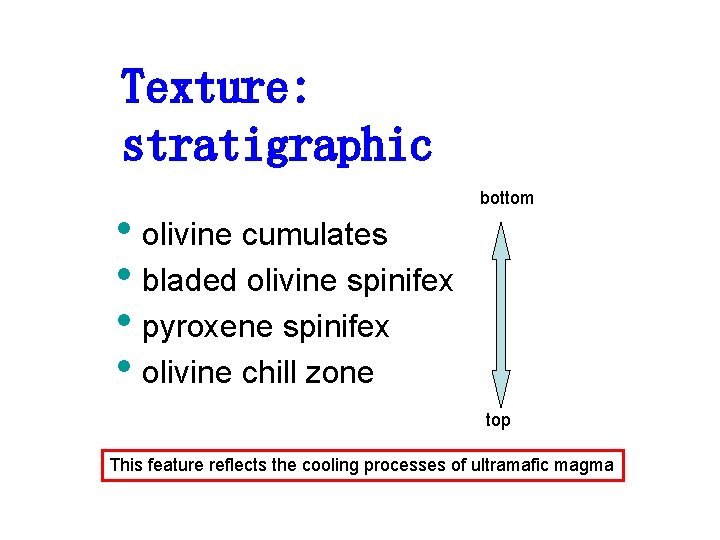
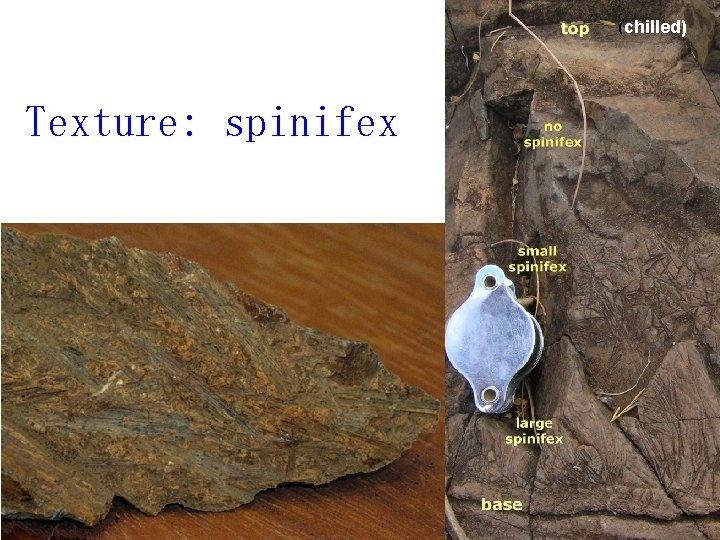
Texture: stratigraphic • olivine cumulates • bladed olivine spinifex • pyroxene spinifex • olivine chill zone bottom top This feature reflects the cooling processes of ultramafic magma
(chilled) Texture: spinifex
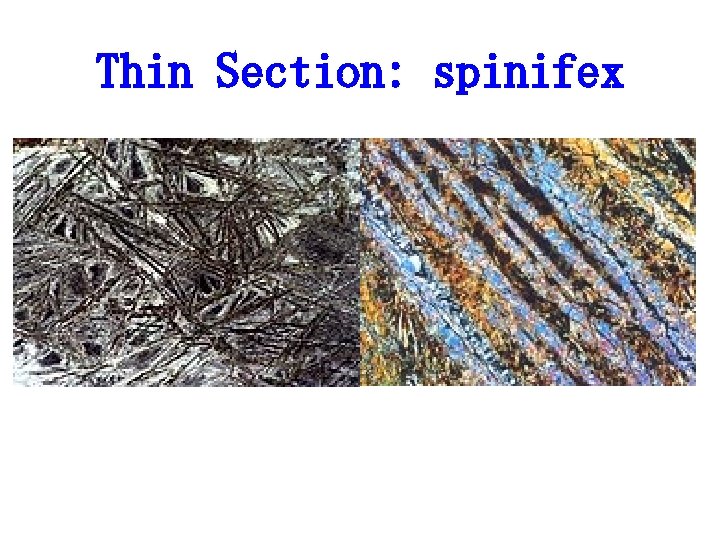
Thin Section: spinifex
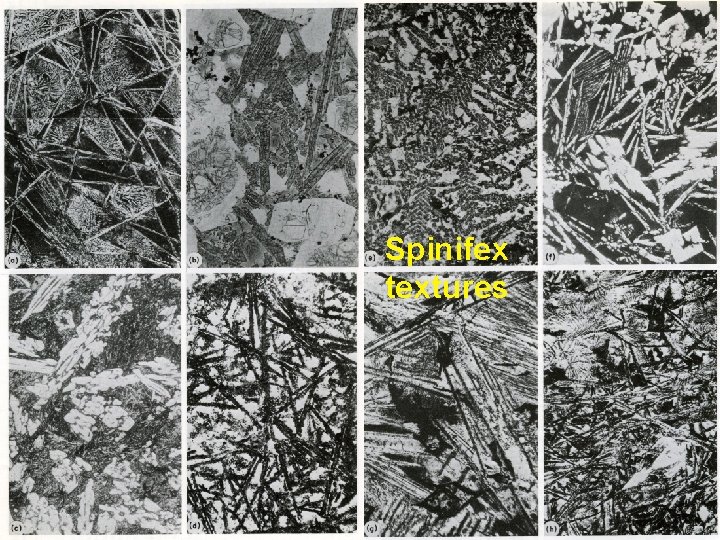
Spinifex • Skeletal ol xl nucleate and grow down from the upper quenched surface of the flow • Olivine in the spinifex zone grew as quench xl in the melt
Spinifex textures
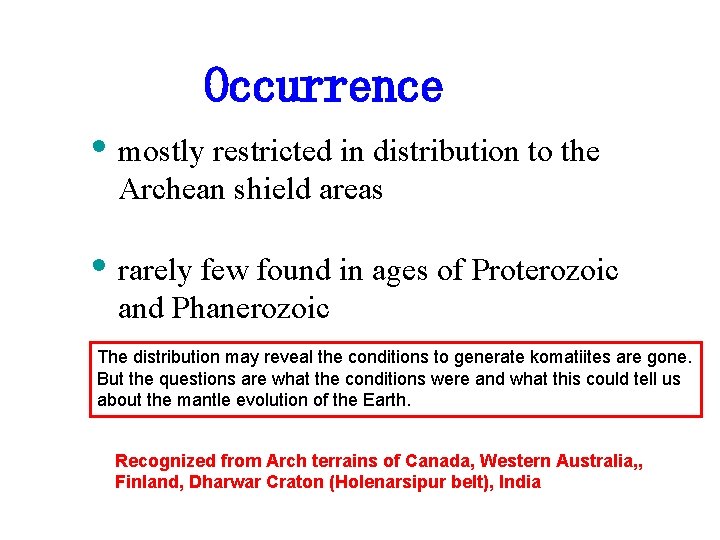
Occurrence • mostly restricted in distribution to the Archean shield areas • rarely few found in ages of Proterozoic and Phanerozoic The distribution may reveal the conditions to generate komatiites are gone. But the questions are what the conditions were and what this could tell us about the mantle evolution of the Earth. Recognized from Arch terrains of Canada, Western Australia, , Finland, Dharwar Craton (Holenarsipur belt), India
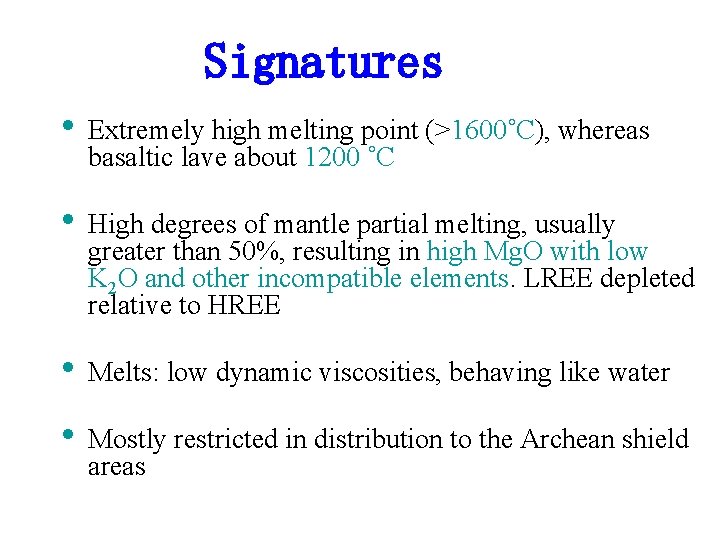
Signatures • Extremely high melting point (>1600˚C), whereas basaltic lave about 1200 ˚C • High degrees of mantle partial melting, usually greater than 50%, resulting in high Mg. O with low K 2 O and other incompatible elements. LREE depleted relative to HREE • Melts: low dynamic viscosities, behaving like water • Mostly restricted in distribution to the Archean shield areas
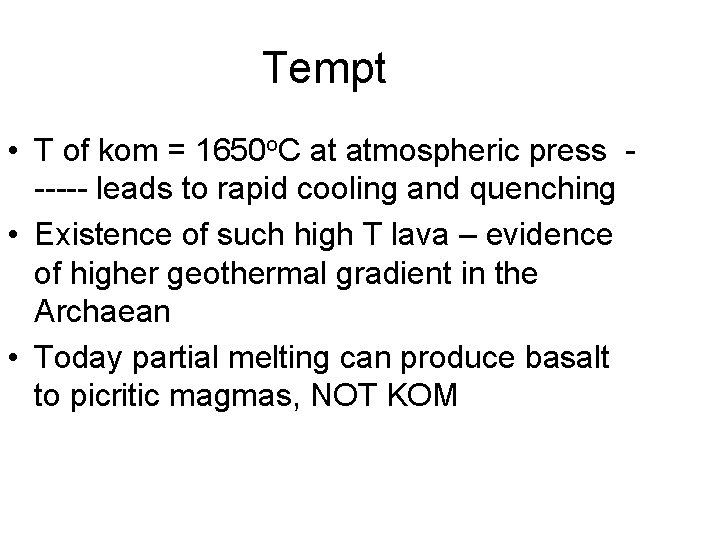
Tempt • T of kom = 1650 o. C at atmospheric press ----- leads to rapid cooling and quenching • Existence of such high T lava – evidence of higher geothermal gradient in the Archaean • Today partial melting can produce basalt to picritic magmas, NOT KOM
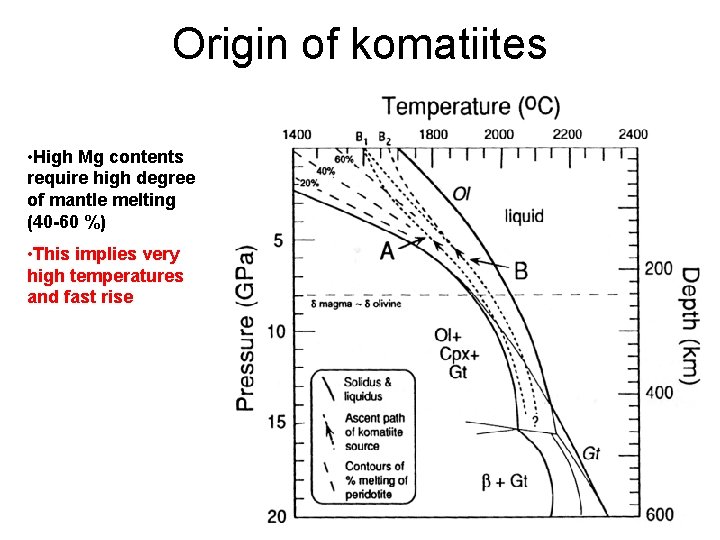
Origin of komatiites • High Mg contents require high degree of mantle melting (40 -60 %) • This implies very high temperatures and fast rise
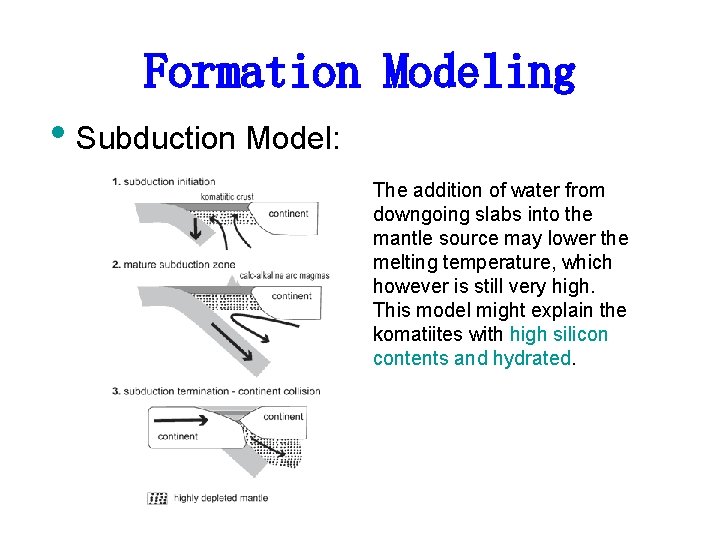
Formation Modeling • Subduction Model: The addition of water from downgoing slabs into the mantle source may lower the melting temperature, which however is still very high. This model might explain the komatiites with high silicon contents and hydrated.
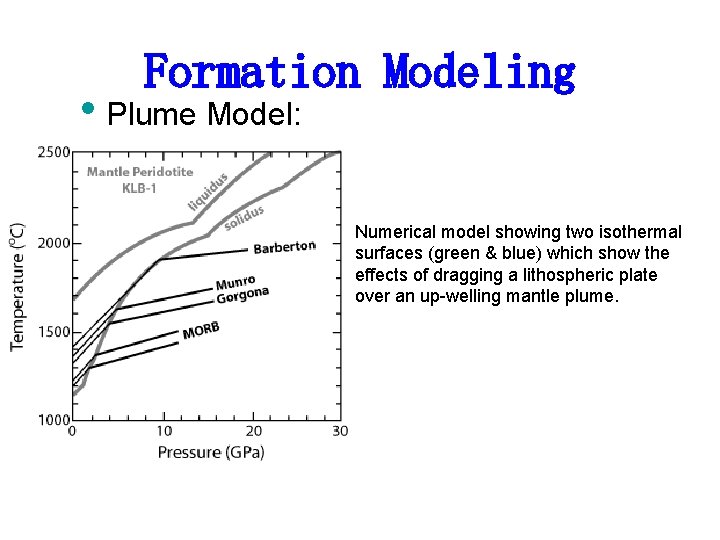
Formation Modeling • Plume Model: Numerical model showing two isothermal surfaces (green & blue) which show the effects of dragging a lithospheric plate over an up-welling mantle plume.
Origin of kom • In Archaean, conditions in the upper mantle must have been capable of producing both basalt and kom • Steeper geotherm would intersect the peridotite solidus over a long distance, producing basalt at shallow depth and kom at great depth • In post-Arch, shallower geotherm would have intersected the solidus over a shorter depth interval and apparently at depths too shallow to produce high-Mg melts (kom)
What are the implications of komatiites? • Probably formed in hot-spot like situations (difficult to arrive to > 1600° elsewhere) • Eventhough, this is hotter than modern hotspots • At least some parts of the Earth were very hot
Implications 1. Chemical composition => high degrees of mantle melting (up to 50%). 2. Textures => rapid cooling. 3. REE typology => role of garnet fractionation in source. Presence of 3 types suggests different depths of origin. 4. Eruption temperature ≈ 1600ºC if magma is dry (but can komatiitic magma be wet in a high degree melting? ). 5. Because grt is stabilized in the mantle relative to px, the solubility of grt in silicate melt is reduced, resulting in magmas with low Al 2 O 3 (Al-depleted komatiite). Because Ca. O varies less with residual mineralogy, the Ca. O/Al 2 O 3 ratio is strongly Pdependent, and a Al 2 O 3 vs Ca. O/Al 2 O 3 plot can be used to estimate the depth of mantle melting 6. Depth of magma segregation depends on the temperature of the source. Late and early Archean komatiites have source temperatures of 1800 -1900ºC and 2000ºC, respectively.