
ARCH SYSTEMS FORM ACTIVE STRUCTURE SYSTEM FORM ACTIVE
![ARCH SYSTEMS [FORM ACTIVE STRUCTURE SYSTEM]](https://slidetodoc.com/presentation_image_h2/4df2e6d7ad619ab383a9f5d3b782db2e/image-1.jpg "ARCH SYSTEMS [FORM ACTIVE STRUCTURE SYSTEM]")
- Slides: 12
ARCH SYSTEMS [FORM ACTIVE STRUCTURE SYSTEM]
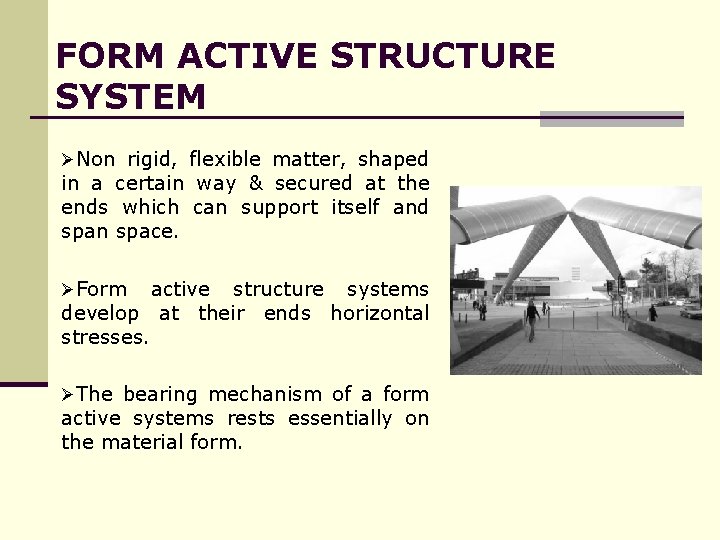
FORM ACTIVE STRUCTURE SYSTEM ØNon rigid, flexible matter, shaped in a certain way & secured at the ends which can support itself and span space. ØForm active structure systems develop at their ends horizontal stresses. ØThe bearing mechanism of a form active systems rests essentially on the material form.
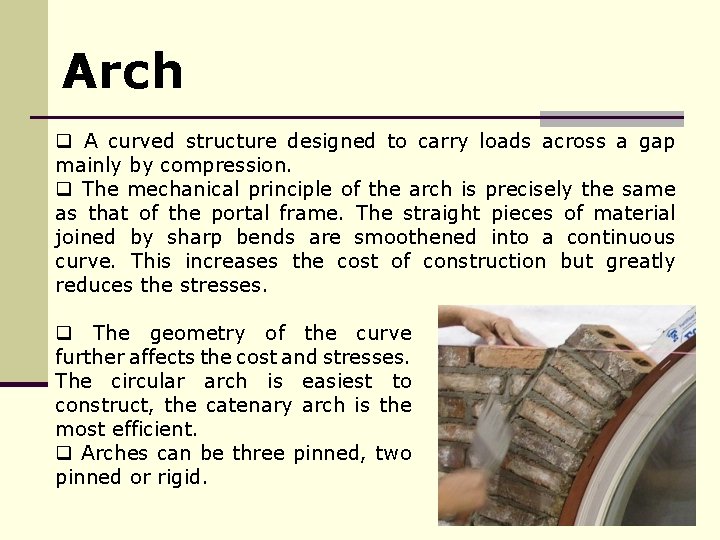
Arch q A curved structure designed to carry loads across a gap mainly by compression. q The mechanical principle of the arch is precisely the same as that of the portal frame. The straight pieces of material joined by sharp bends are smoothened into a continuous curve. This increases the cost of construction but greatly reduces the stresses. q The geometry of the curve further affects the cost and stresses. The circular arch is easiest to construct, the catenary arch is the most efficient. q Arches can be three pinned, two pinned or rigid.
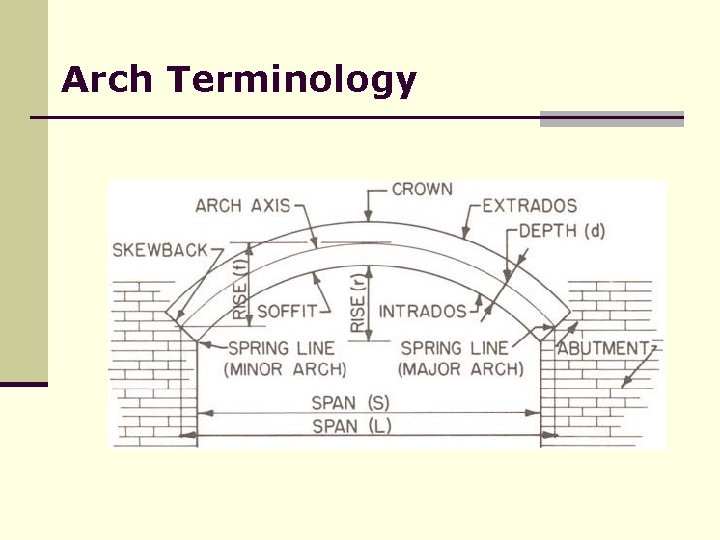
Arch Terminology
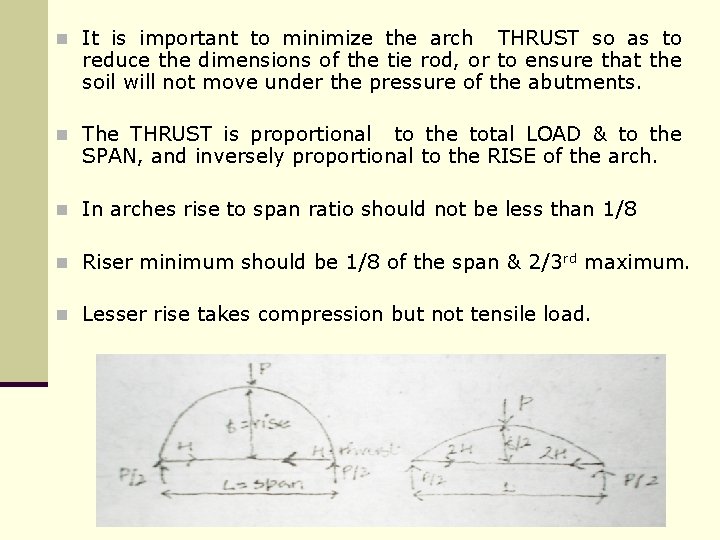
n It is important to minimize the arch THRUST so as to reduce the dimensions of the tie rod, or to ensure that the soil will not move under the pressure of the abutments. n The THRUST is proportional to the total LOAD & to the SPAN, and inversely proportional to the RISE of the arch. n In arches rise to span ratio should not be less than 1/8 n Riser minimum should be 1/8 of the span & 2/3 rd maximum. n Lesser rise takes compression but not tensile load.
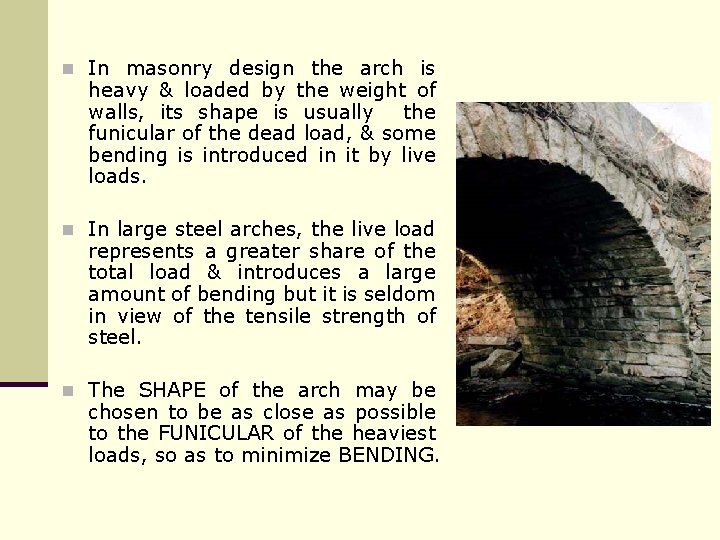
n In masonry design the arch is heavy & loaded by the weight of walls, its shape is usually the funicular of the dead load, & some bending is introduced in it by live loads. n In large steel arches, the live load represents a greater share of the total load & introduces a large amount of bending but it is seldom in view of the tensile strength of steel. n The SHAPE of the arch may be chosen to be as close as possible to the FUNICULAR of the heaviest loads, so as to minimize BENDING.
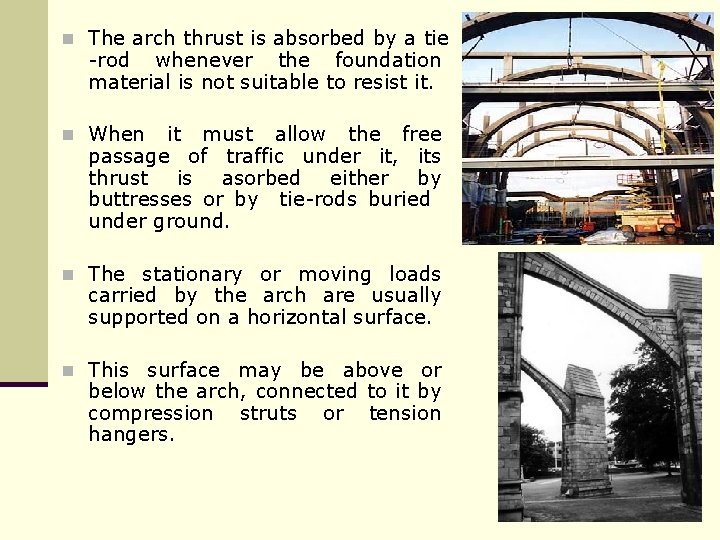
n The arch thrust is absorbed by a tie -rod whenever the foundation material is not suitable to resist it. n When it must allow the free passage of traffic under it, its thrust is asorbed either by buttresses or by tie-rods buried under ground. n The stationary or moving loads carried by the arch are usually supported on a horizontal surface. n This surface may be above or below the arch, connected to it by compression struts or tension hangers.
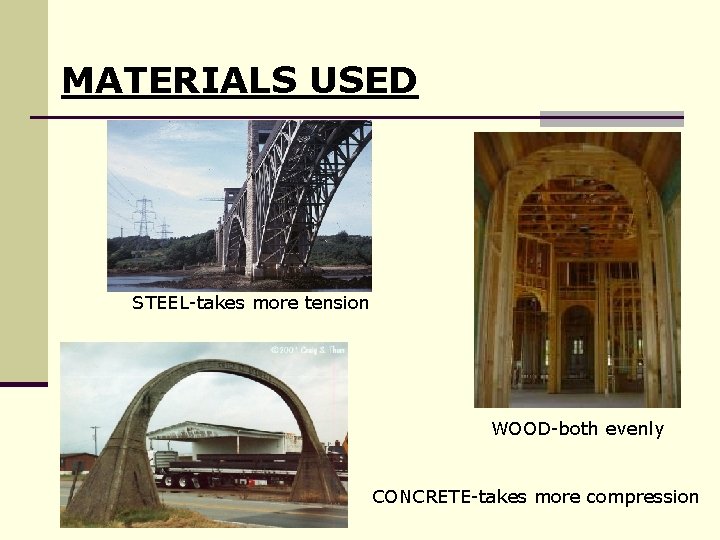
MATERIALS USED STEEL-takes more tension WOOD-both evenly CONCRETE-takes more compression
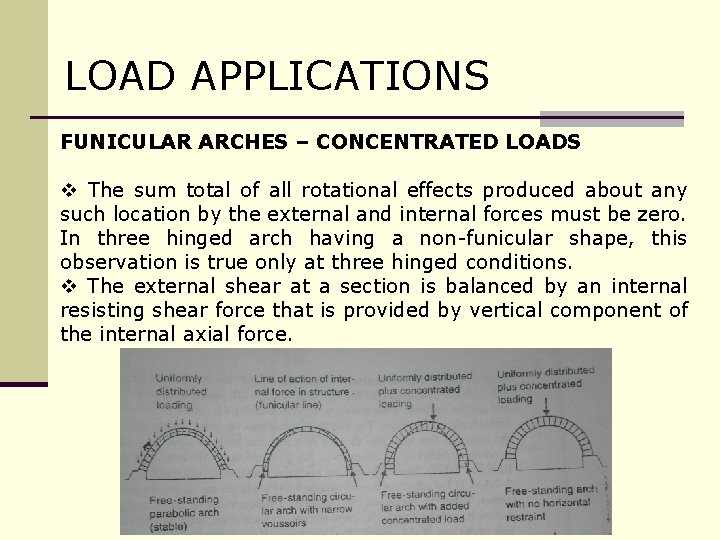
LOAD APPLICATIONS FUNICULAR ARCHES – CONCENTRATED LOADS v The sum total of all rotational effects produced about any such location by the external and internal forces must be zero. In three hinged arch having a non-funicular shape, this observation is true only at three hinged conditions. v The external shear at a section is balanced by an internal resisting shear force that is provided by vertical component of the internal axial force.
DESIGN OF ARCH STRUCTURES The first important consideration when designing a brick arch is whether the arch is structural or non-structural. That is, will the arch be required to transfer vertical loads to abutments or will it be fully supported by a steel angle. While this may seem obvious, confusion often develops because of the many configurations of arch construction. To answer this question, one must consider the two structural requirements necessary for a brick arch to adequately carry vertical loads. First, vertical loads must be carried by the arch and transferred to the abutments. Second, vertical load and lateral thrust from the arch must be resisted by the abutments.
FAILURE MODES 1. Rotation of the arch about the abutment. Rotation occurs when tension develops in the arch. Tension can be reduced by increasing the depth or rise of the arch. If tension develops in the arch, reinforcement can be added to resist the tensile forces. 2. Sliding of the arch at the skewback. Sliding of the arch will depend on the angle of skewback (measured from horizontal) and the vertical load carried by the arch. Reinforcement can be added to avoid sliding at the skewback, as the reinforcement acts as a shear key. 3. Crushing of the masonry. Crushing will occur when compressive stresses in the arch exceed the compressive strength of the brick masonry. If compressive stresses are too large, the arch must be redesigned with a shorter span or a greater arch depth. Compression failure seldom occurs.
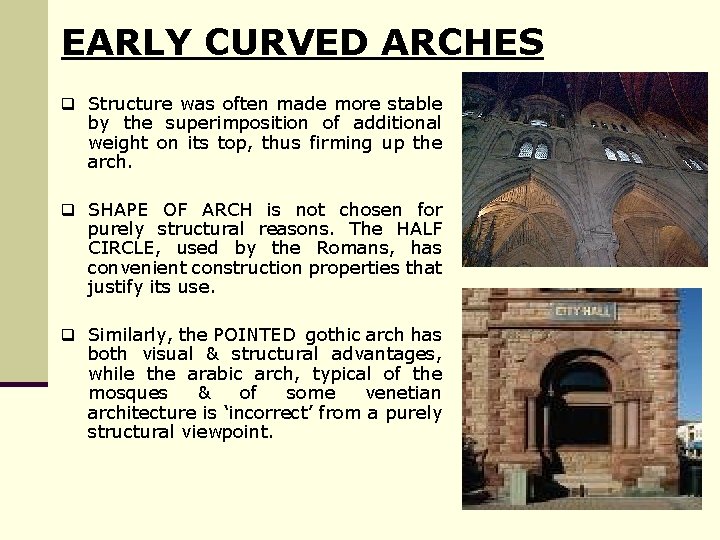
EARLY CURVED ARCHES q Structure was often made more stable by the superimposition of additional weight on its top, thus firming up the arch. q SHAPE OF ARCH is not chosen for purely structural reasons. The HALF CIRCLE, used by the Romans, has convenient construction properties that justify its use. q Similarly, the POINTED gothic arch has both visual & structural advantages, while the arabic arch, typical of the mosques & of some venetian architecture is ‘incorrect’ from a purely structural viewpoint.