
ARCC Handout Teamwork ARCC is the Stanford Medicine
- Slides: 2
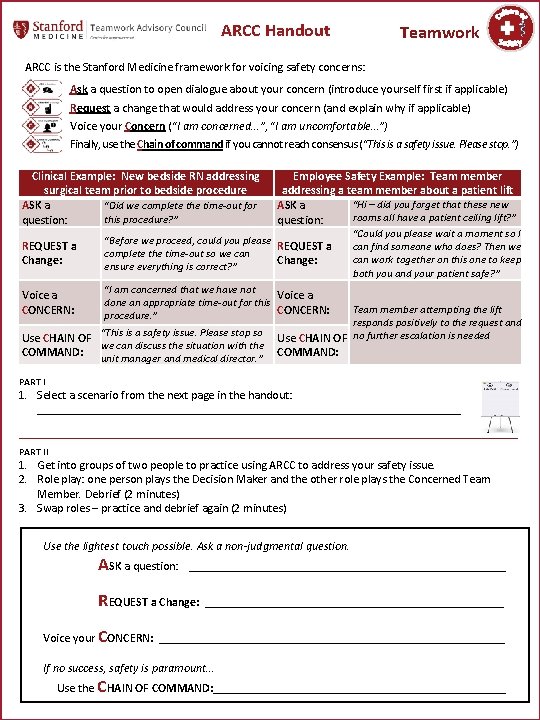
ARCC Handout Teamwork ARCC is the Stanford Medicine framework for voicing safety concerns: Ask a question to open dialogue about your concern (introduce yourself first if applicable) Request a change that would address your concern (and explain why if applicable) Voice your Concern (“I am concerned…”, “I am uncomfortable…”) Finally, use the Chain of command if you cannot reach consensus (“This is a safety issue. Please stop. ”) Clinical Example: New bedside RN addressing surgical team prior to bedside procedure ASK a “Did we complete the time-out for this procedure? ” question: REQUEST a Change: Employee Safety Example: Team member addressing a team member about a patient lift “Hi – did you forget that these new ASK a rooms all have a patient ceiling lift? ” question: “Before we proceed, could you please REQUEST a complete the time-out so we can Change: ensure everything is correct? ” “I am concerned that we have not done an appropriate time-out for this procedure. ” “This is a safety issue. Please stop so Use CHAIN OF we can discuss the situation with the COMMAND: unit manager and medical director. ” Voice a CONCERN: “Could you please wait a moment so I can find someone who does? Then we can work together on this one to keep both you and your patient safe? ” Voice a CONCERN: Team member attempting the lift responds positively to the request and Use CHAIN OF no further escalation is needed COMMAND: PART I 1. Select a scenario from the next page in the handout: ____________________________________ PART II 1. Get into groups of two people to practice using ARCC to address your safety issue. 2. Role play: one person plays the Decision Maker and the other role plays the Concerned Team Member. Debrief (2 minutes) 3. Swap roles – practice and debrief again (2 minutes) Use the lightest touch possible. Ask a non-judgmental question. ASK a question: ___________________________ REQUEST a Change: _________________________ Voice your CONCERN: _____________________________ If no success, safety is paramount… Use the CHAIN OF COMMAND: _________________________
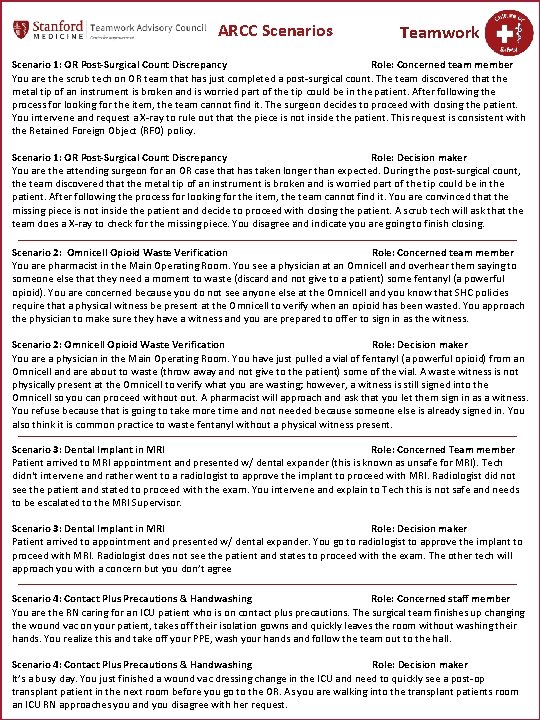
ARCC Scenarios Teamwork Scenario 1: OR Post-Surgical Count Discrepancy Role: Concerned team member You are the scrub tech on OR team that has just completed a post-surgical count. The team discovered that the metal tip of an instrument is broken and is worried part of the tip could be in the patient. After following the process for looking for the item, the team cannot find it. The surgeon decides to proceed with closing the patient. You intervene and request a X-ray to rule out that the piece is not inside the patient. This request is consistent with the Retained Foreign Object (RFO) policy. Scenario 1: OR Post-Surgical Count Discrepancy Role: Decision maker You are the attending surgeon for an OR case that has taken longer than expected. During the post-surgical count, the team discovered that the metal tip of an instrument is broken and is worried part of the tip could be in the patient. After following the process for looking for the item, the team cannot find it. You are convinced that the missing piece is not inside the patient and decide to proceed with closing the patient. A scrub tech will ask that the team does a X-ray to check for the missing piece. You disagree and indicate you are going to finish closing. Scenario 2: Omnicell Opioid Waste Verification Role: Concerned team member You are pharmacist in the Main Operating Room. You see a physician at an Omnicell and overhear them saying to someone else that they need a moment to waste (discard and not give to a patient) some fentanyl (a powerful opioid). You are concerned because you do not see anyone else at the Omnicell and you know that SHC policies require that a physical witness be present at the Omnicell to verify when an opioid has been wasted. You approach the physician to make sure they have a witness and you are prepared to offer to sign in as the witness. Scenario 2: Omnicell Opioid Waste Verification Role: Decision maker You are a physician in the Main Operating Room. You have just pulled a vial of fentanyl (a powerful opioid) from an Omnicell and are about to waste (throw away and not give to the patient) some of the vial. A waste witness is not physically present at the Omnicell to verify what you are wasting; however, a witness is still signed into the Omnicell so you can proceed without out. A pharmacist will approach and ask that you let them sign in as a witness. You refuse because that is going to take more time and not needed because someone else is already signed in. You also think it is common practice to waste fentanyl without a physical witness present. Scenario 3: Dental Implant in MRI Role: Concerned Team member Patient arrived to MRI appointment and presented w/ dental expander (this is known as unsafe for MRI). Tech didn't intervene and rather went to a radiologist to approve the implant to proceed with MRI. Radiologist did not see the patient and stated to proceed with the exam. You intervene and explain to Tech this is not safe and needs to be escalated to the MRI Supervisor. Scenario 3: Dental Implant in MRI Role: Decision maker Patient arrived to appointment and presented w/ dental expander. You go to radiologist to approve the implant to proceed with MRI. Radiologist does not see the patient and states to proceed with the exam. The other tech will approach you with a concern but you don’t agree Scenario 4: Contact Plus Precautions & Handwashing Role: Concerned staff member You are the RN caring for an ICU patient who is on contact plus precautions. The surgical team finishes up changing the wound vac on your patient, takes off their isolation gowns and quickly leaves the room without washing their hands. You realize this and take off your PPE, wash your hands and follow the team out to the hall. Scenario 4: Contact Plus Precautions & Handwashing Role: Decision maker It’s a busy day. You just finished a wound vac dressing change in the ICU and need to quickly see a post-op transplant patient in the next room before you go to the OR. As you are walking into the transplant patients room an ICU RN approaches you and you disagree with her request.