
Arc simulations using Aleph Paul S Crozier Breakdown
Arc simulations using Aleph Paul S. Crozier Breakdown Physics Workshop @ CERN May 7, 2010 Sandia National Laboratories is a multi-program laboratory operated by Sandia Corporation, a wholly owned subsidiary of Lockheed Martin company, for the U. S. Department of Energy’s National Nuclear Security Administration under contract DE-AC 04 -94 AL 85000.
Presentation outline 1. 2. 3. 4. 5. 6. What is the “state-of-the-art” in arc modeling? Comparison with CERN simulations Thermal BC at anode Fowler-Nordheim BC at cathode Scale-up Small parameter sweep study
State-of-the-art in arc modeling Literature survey summary of prior arc modeling efforts: • Continuum models, no particles • Ionization events not explicitly modeled • Simplistic electrodes • Conservation of energy, momentum, mass Other particle simulation effort: group at CERN doing 1 D particle model of vacuum arc breakdown
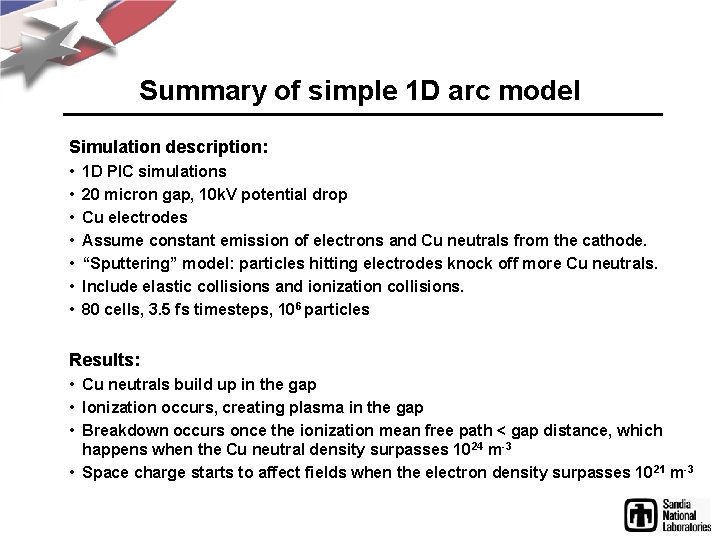
Summary of simple 1 D arc model Simulation description: • • 1 D PIC simulations 20 micron gap, 10 k. V potential drop Cu electrodes Assume constant emission of electrons and Cu neutrals from the cathode. “Sputtering” model: particles hitting electrodes knock off more Cu neutrals. Include elastic collisions and ionization collisions. 80 cells, 3. 5 fs timesteps, 106 particles Results: • Cu neutrals build up in the gap • Ionization occurs, creating plasma in the gap • Breakdown occurs once the ionization mean free path < gap distance, which happens when the Cu neutral density surpasses 1024 m-3 • Space charge starts to affect fields when the electron density surpasses 10 21 m-3
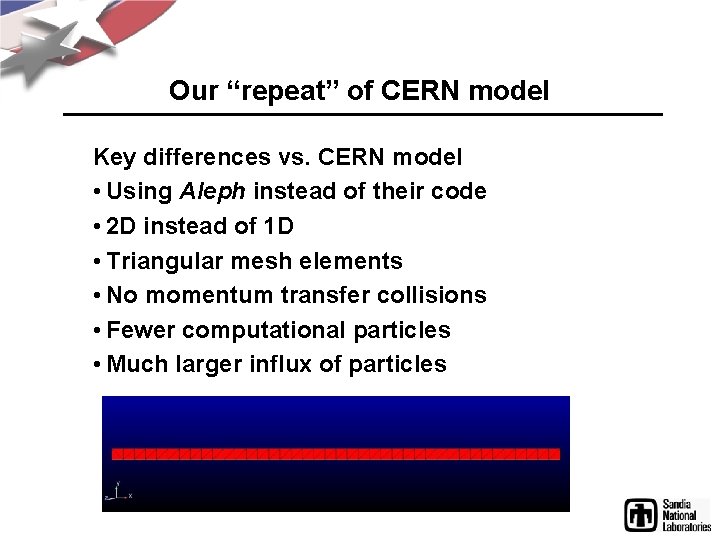
Our “repeat” of CERN model Key differences vs. CERN model • Using Aleph instead of their code • 2 D instead of 1 D • Triangular mesh elements • No momentum transfer collisions • Fewer computational particles • Much larger influx of particles
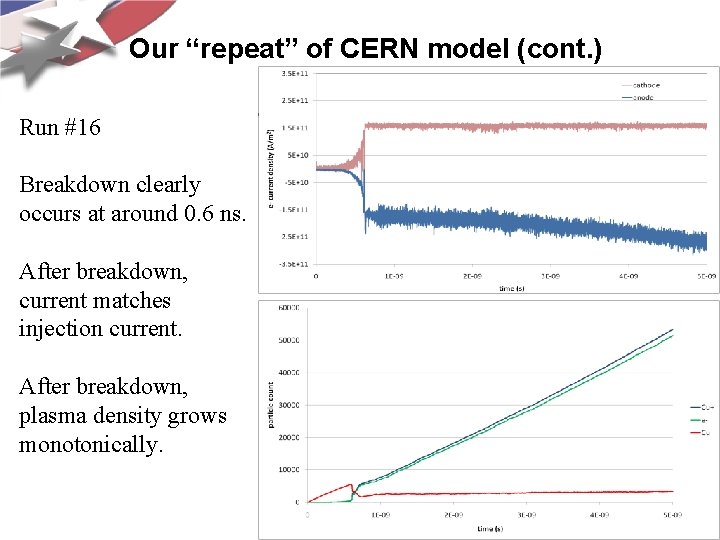
Our “repeat” of CERN model (cont. ) Run #16 Breakdown clearly occurs at around 0. 6 ns. After breakdown, current matches injection current. After breakdown, plasma density grows monotonically.
Better comparison with CERN results “Exact” match of all BCs --- using personal communication information from CERN group. Matched voltage BCs, influx rates, sputter rates, etc. Remaining differences: • Using Aleph instead of their code • “Quasi-1 D” instead of 1 D • Triangular mesh elements • No momentum transfer collisions • Fewer computational particles • Mixed particle weighting
Better influx value • Revised values given on April 7, 2010: – I_e = 2. 376*10^6 A/cm^2, – Electron injection flux of F_e = 1. 483*10^25 1/s/cm^2. – Neutral injection flux is 1/100 th of this, F_e = 1. 483*10^23 1/s/cm^2. • Works much better now!
New simulations with latest info from CERN Run #37 • Includes e- + Cu momentum transfer collisions. • Increased injection rates to match CERN’s. • Particle weighting = 108 Run #38 • Same as run #37, except: – Particle weighting = 107 – Also doing 4 repeats (a, b, c, d) for stats
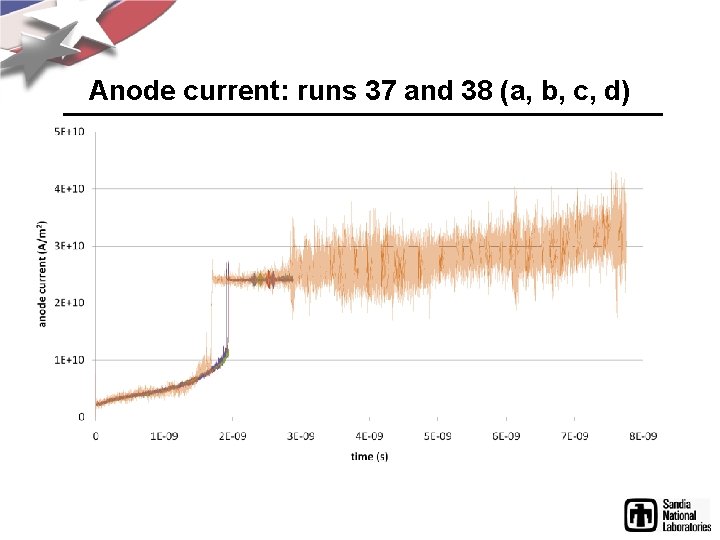
Anode current: runs 37 and 38 (a, b, c, d)
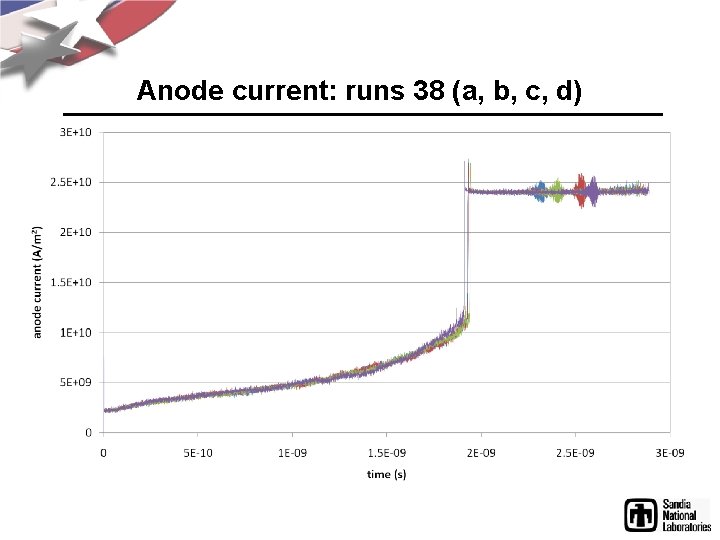
Anode current: runs 38 (a, b, c, d)
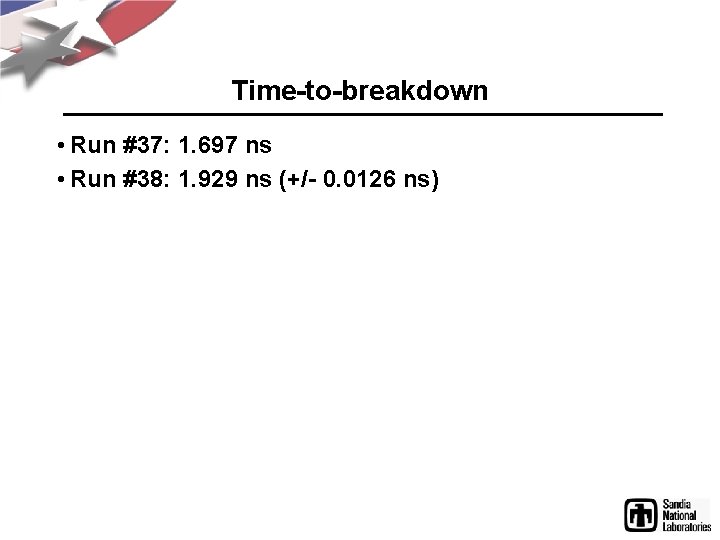
Time-to-breakdown • Run #37: 1. 697 ns • Run #38: 1. 929 ns (+/- 0. 0126 ns)
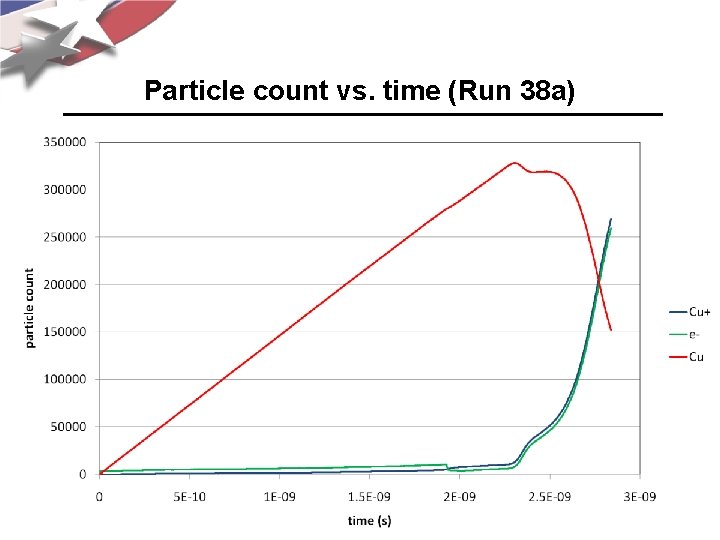
Particle count vs. time (Run 38 a)
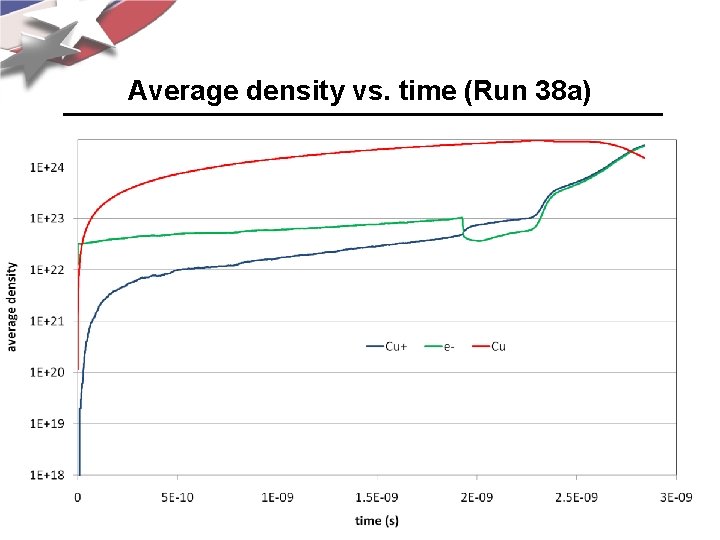
Average density vs. time (Run 38 a)
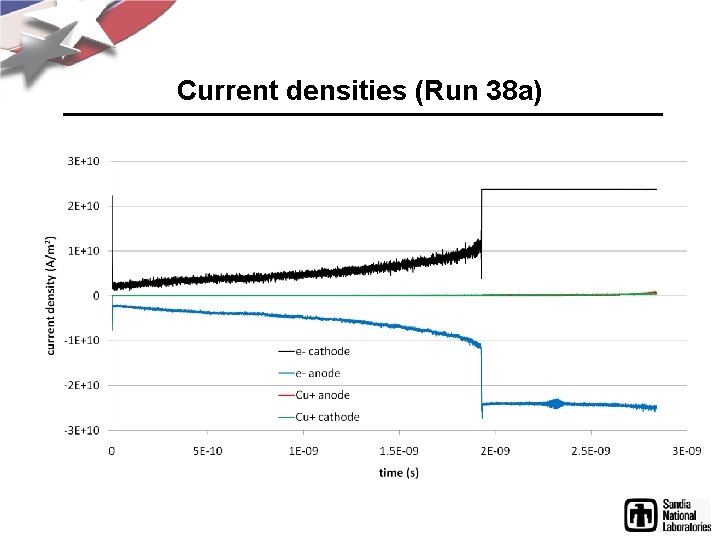
Current densities (Run 38 a)
Density vs x and t (Run 37)
Potential vs x and t (Run 37)
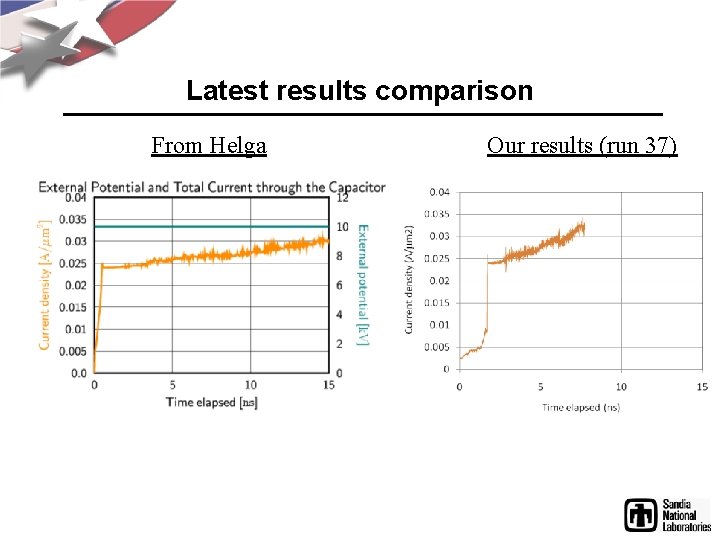
Latest results comparison From Helga Our results (run 37)
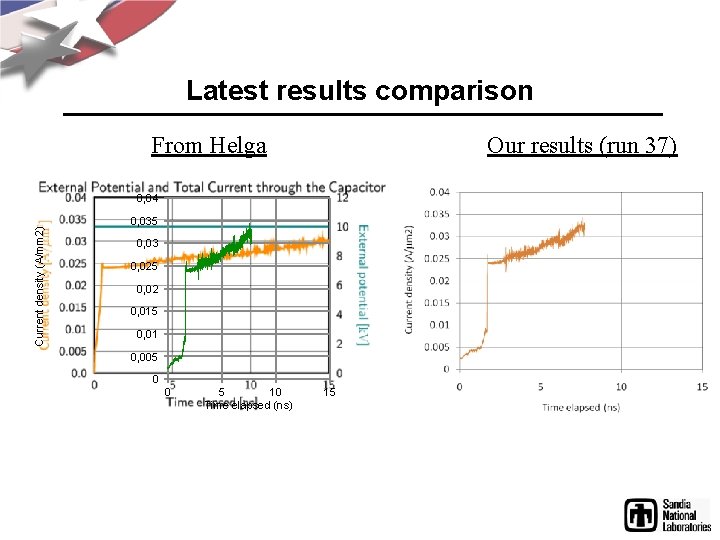
Latest results comparison From Helga Our results (run 37) Current density (A/mm 2) 0, 04 0, 035 0, 03 0, 025 0, 02 0, 015 0, 01 0, 005 0 0 5 10 Time elapsed (ns) 15
Thermal BC at the anode Run #20: no sputtering at the anode --- use thermal emission model instead. Result: anode quickly overheated (>10, 000 K) to the point of making thermal model numerically unstable. Conclusion: power into the anode (2 x 10¹³ W/m 2) unrealistically high. Try again with lower power.
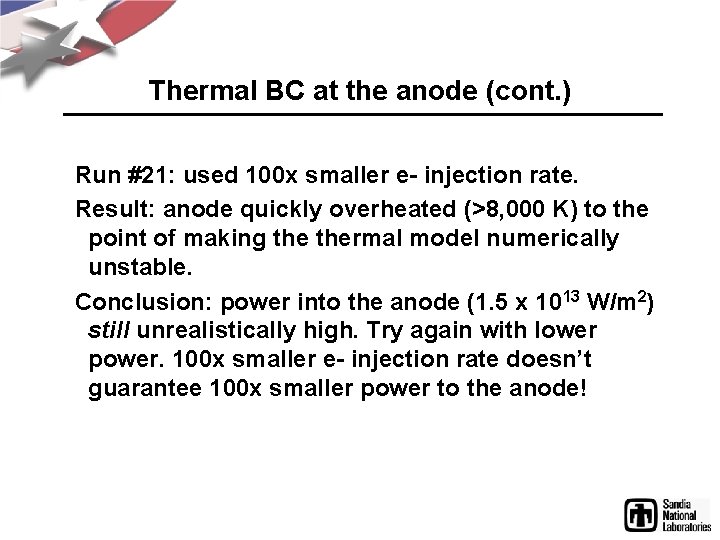
Thermal BC at the anode (cont. ) Run #21: used 100 x smaller e- injection rate. Result: anode quickly overheated (>8, 000 K) to the point of making thermal model numerically unstable. Conclusion: power into the anode (1. 5 x 10¹³ W/m 2) still unrealistically high. Try again with lower power. 100 x smaller e- injection rate doesn’t guarantee 100 x smaller power to the anode!
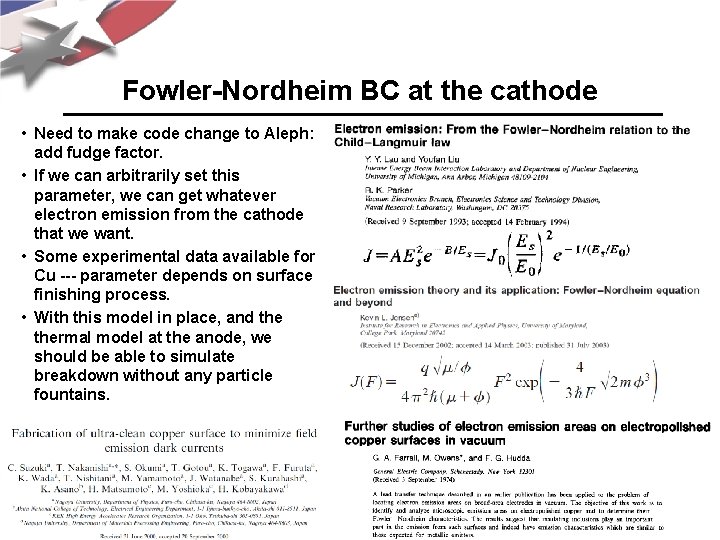
Fowler-Nordheim BC at the cathode • Need to make code change to Aleph: add fudge factor. • If we can arbitrarily set this parameter, we can get whatever electron emission from the cathode that we want. • Some experimental data available for Cu --- parameter depends on surface finishing process. • With this model in place, and thermal model at the anode, we should be able to simulate breakdown without any particle fountains.
Scale-up to “macroscopic” gap • Used 100 x the gap size 2 mm • Didn’t see breakdown, even after 14. 3 million timesteps, 0. 35 ps each = 5 ms. • But Cu neutral density in the gap climbed to over 1026 m 3 ! • Why no breakdown? – Influx rate too high? – Timestep too large? – Cells too large? – Particle weighting too high?
Small parameter study Base case: • Quick breakdown (0. 6 ns) • 300, 000 timesteps = 1 ns simulation • 1. 7 hours to completion on a single 2. 8 GHz proc. Test cases: 1. 10 x as many computational particles 2. Mixed particle weightings 3. Momentum transfer
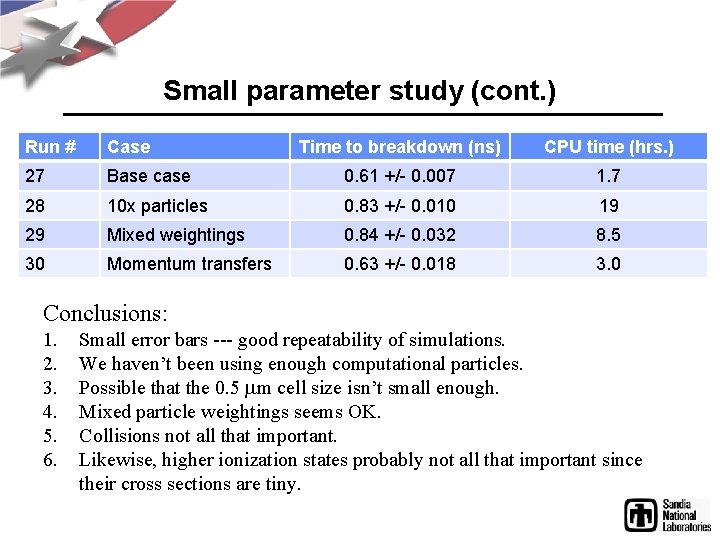
Small parameter study (cont. ) Run # Case Time to breakdown (ns) CPU time (hrs. ) 27 Base case 0. 61 +/- 0. 007 1. 7 28 10 x particles 0. 83 +/- 0. 010 19 29 Mixed weightings 0. 84 +/- 0. 032 8. 5 30 Momentum transfers 0. 63 +/- 0. 018 3. 0 Conclusions: 1. 2. 3. 4. 5. 6. Small error bars --- good repeatability of simulations. We haven’t been using enough computational particles. Possible that the 0. 5 mm cell size isn’t small enough. Mixed particle weightings seems OK. Collisions not all that important. Likewise, higher ionization states probably not all that important since their cross sections are tiny.
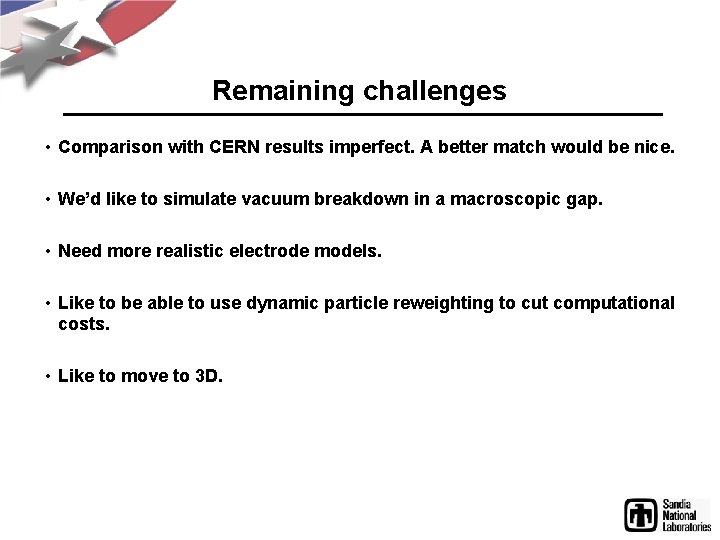
Remaining challenges • Comparison with CERN results imperfect. A better match would be nice. • We’d like to simulate vacuum breakdown in a macroscopic gap. • Need more realistic electrode models. • Like to be able to use dynamic particle reweighting to cut computational costs. • Like to move to 3 D.
- Slides: 26