
ARC SequentialSamplingBased Kriging Method with Dynamic Basis Selection
ARC Sequential-Sampling-Based Kriging Method with Dynamic Basis Selection WCSMO INTERNET CONFERENCE Liang Zhao, Kyung K Choi and Ikjin Lee Mechanical and Industrial Engineering The University of Iowa David Gorsich US Army RDECOM - TARDEC

Motivation ARC v In complex engineering applications, usually only a limited number of experiments are carried out and engineers have to recover the true model by using meta-modeling method. v Among current meta-modeling method, Kriging is a popular one. However it has some limitation on the prediction accuracy. NVH Durability Crashworthiness Manufacturing Process MEMS 2
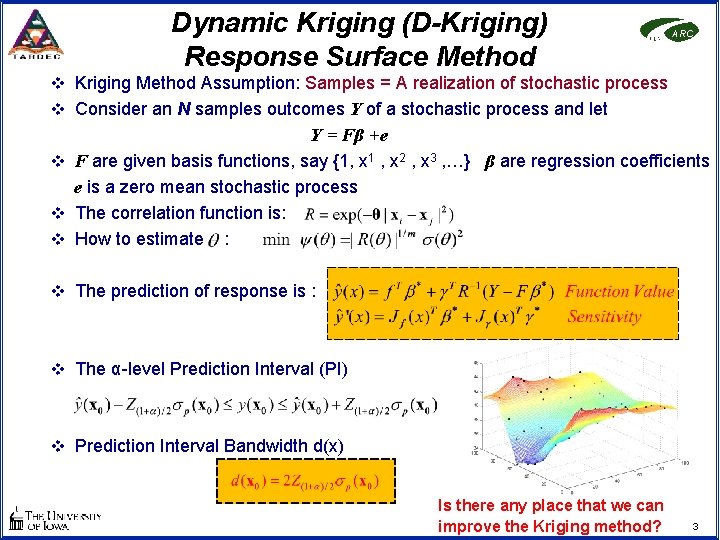
Dynamic Kriging (D-Kriging) Response Surface Method ARC v Kriging Method Assumption: Samples = A realization of stochastic process v Consider an N samples outcomes Y of a stochastic process and let Y = Fβ +e v F are given basis functions, say {1, x 1 , x 2 , x 3 , …} β are regression coefficients e is a zero mean stochastic process v The correlation function is: v How to estimate : v The prediction of response is : v The α-level Prediction Interval (PI) v Prediction Interval Bandwidth d(x) Is there any place that we can improve the Kriging method? 3
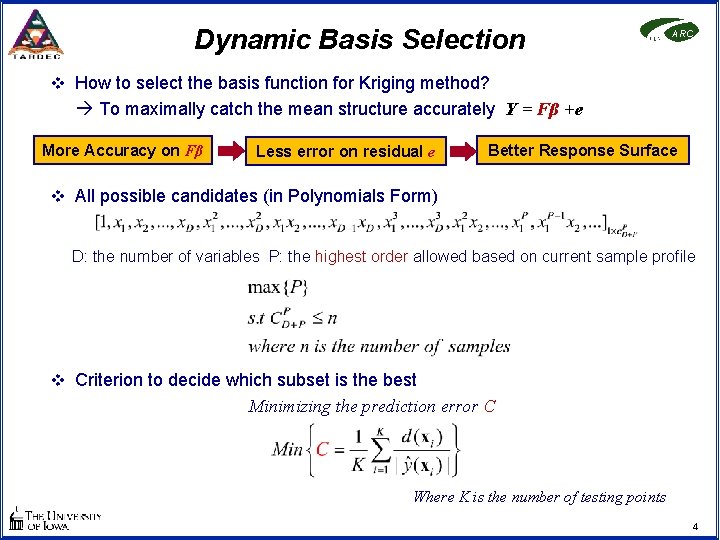
Dynamic Basis Selection ARC v How to select the basis function for Kriging method? To maximally catch the mean structure accurately Y = Fβ +e More Accuracy on Fβ Less error on residual e Better Response Surface v All possible candidates (in Polynomials Form) D: the number of variables P: the highest order allowed based on current sample profile v Criterion to decide which subset is the best Minimizing the prediction error C Where K is the number of testing points 4
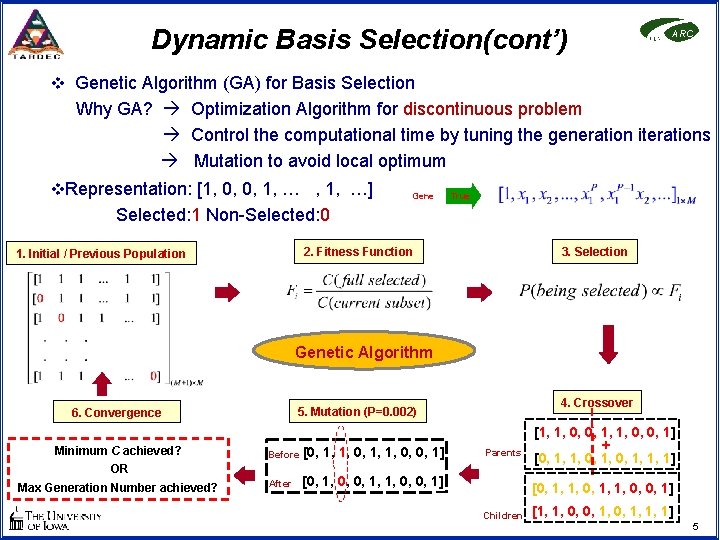
Dynamic Basis Selection(cont’) ARC v Genetic Algorithm (GA) for Basis Selection Why GA? Optimization Algorithm for discontinuous problem Control the computational time by tuning the generation iterations Mutation to avoid local optimum v. Representation: [1, 0, 0, 1, …] Gene True Selected: 1 Non-Selected: 0 2. Fitness Function 1. Initial / Previous Population 3. Selection Genetic Algorithm Minimum C achieved? Before [0, 1, 1, 0, 0, 1] After [0, 1, 0, 0, 1] OR Max Generation Number achieved? 4. Crossover 5. Mutation (P=0. 002) 6. Convergence Parents [1, 1, 0, 0, 1] + [0, 1, 1, 1] [0, 1, 1, 0, 0, 1] Children [1, 1, 0, 0, 1, 1, 1] 5
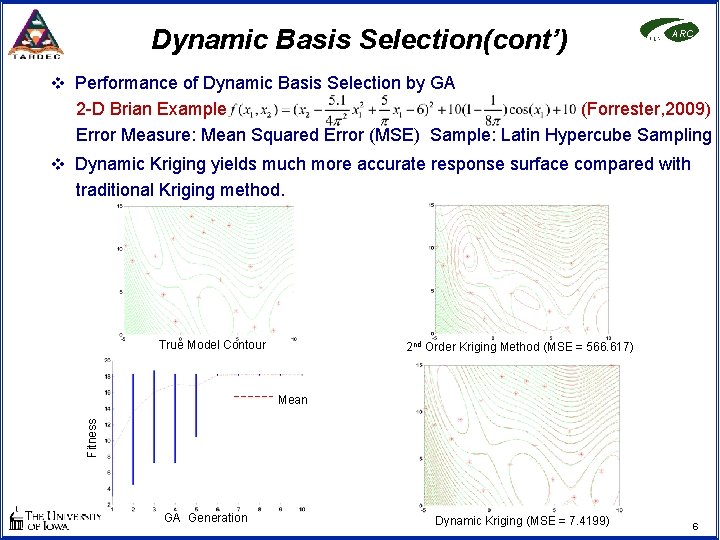
Dynamic Basis Selection(cont’) ARC v Performance of Dynamic Basis Selection by GA 2 -D Brian Example (Forrester, 2009) Error Measure: Mean Squared Error (MSE) Sample: Latin Hypercube Sampling v Dynamic Kriging yields much more accurate response surface compared with traditional Kriging method. True Model Contour 2 nd Order Kriging Method (MSE = 566. 617) Fitness Mean GA Generation Dynamic Kriging (MSE = 7. 4199) 6
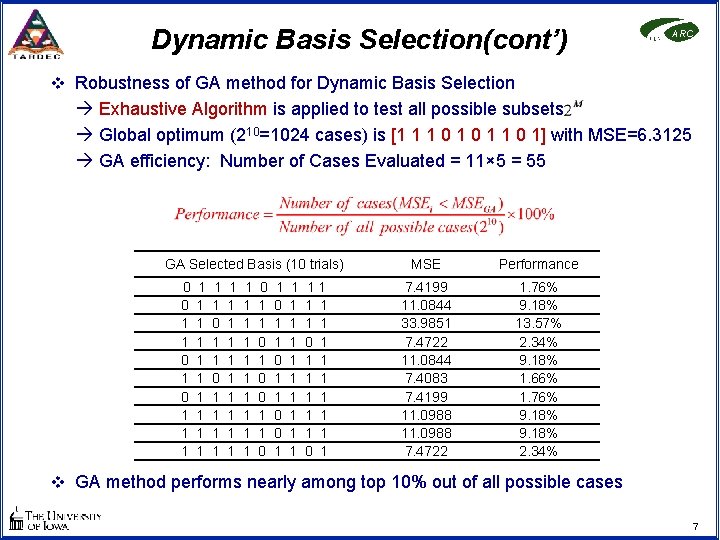
Dynamic Basis Selection(cont’) ARC v Robustness of GA method for Dynamic Basis Selection Exhaustive Algorithm is applied to test all possible subsets Global optimum (210=1024 cases) is [1 1 1 0 1] with MSE=6. 3125 GA efficiency: Number of Cases Evaluated = 11× 5 = 55 GA Selected Basis (10 trials) 0 0 1 1 1 1 1 0 1 1 1 1 1 1 1 0 1 0 0 1 1 0 0 1 1 11 1 1 0 1 1 1 0 1 MSE Performance 7. 4199 11. 0844 33. 9851 7. 4722 11. 0844 7. 4083 7. 4199 11. 0988 7. 4722 1. 76% 9. 18% 13. 57% 2. 34% 9. 18% 1. 66% 1. 76% 9. 18% 2. 34% v GA method performs nearly among top 10% out of all possible cases 7
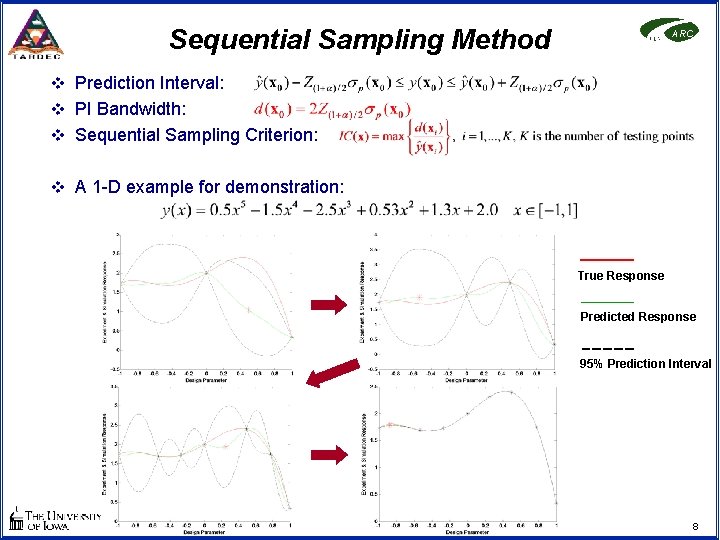
Sequential Sampling Method ARC v Prediction Interval: v PI Bandwidth: v Sequential Sampling Criterion: v A 1 -D example for demonstration: True Response Predicted Response 95% Prediction Interval 8

Sequential Sampling Method(cont’) ARC v Comparison between Sequential Sampling & Latin Hypercube Sampling (LHS) 2 -D Brian Example LHS Kriging(2 nd order) < SS Kriging (2 nd order) < SS Dynamic Kriging ACCURACY LHS Kriging(2 nd order) MSE = 9. 52 (best of 100 trials) SS-Kriging (2 nd order) MSE = 0. 41 SS-Dynamic Kriging MSE = 0. 06 9
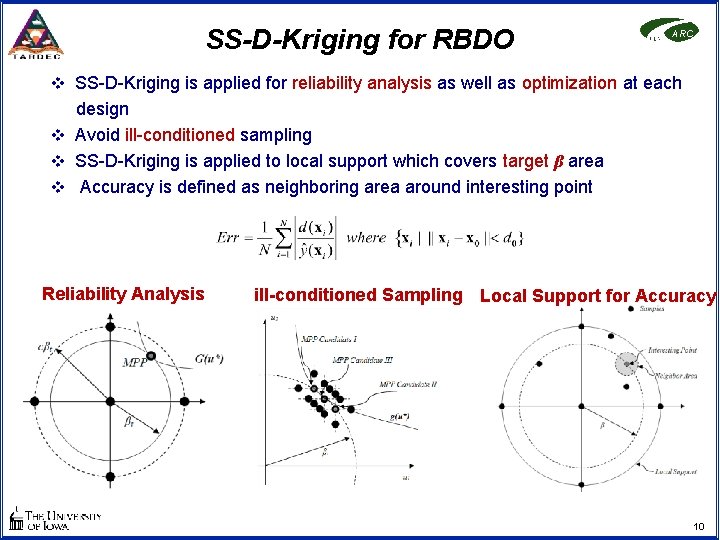
SS-D-Kriging for RBDO ARC v SS-D-Kriging is applied for reliability analysis as well as optimization at each design v Avoid ill-conditioned sampling v SS-D-Kriging is applied to local support which covers target β area v Accuracy is defined as neighboring area around interesting point Reliability Analysis ill-conditioned Sampling Local Support for Accuracy 10
Conclusions ARC v Response surface method provides function values and sensitivity when sensitivity information is not available v Kriging method with Dynamic Basis Selection by Genetic Algorithm yields more accurate response surface compared with traditional Kriging method v Sequential sampling method identifies the weak point in the domain and converges faster than Latin hypercube sampling method v SS-Dynamic Kriging provides more accurate meta model compared with other meta-modeling method. 11

ARC THANK YOU 12
- Slides: 12