
Arc Consistency CPSC 322 CSP 3 Textbook 4
Arc Consistency CPSC 322 – CSP 3 Textbook § 4. 5 February 2, 2011

Lecture Overview • Solving Constraint Satisfaction Problems (CSPs) - Recap: Generate & Test - Recap: Graph search - Arc consistency 2

Course Overview Course Module Environment Problem Type Static Deterministic Stochastic Representation Reasoning Technique Arc Consistency Constraint Satisfaction Variables + Search Constraints Logic Sequential Planning We’ll now focus on CSP Logics Bayesian Networks Search STRIPS Search Variable Elimination Uncertainty Decision Networks Variable Elimination Markov Processes Value Iteration Decision Theory 3
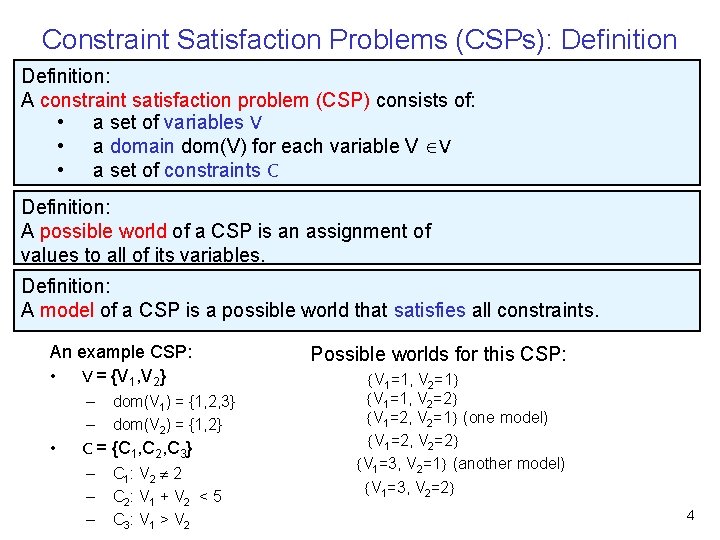
Constraint Satisfaction Problems (CSPs): Definition: A constraint satisfaction problem (CSP) consists of: • a set of variables V • a domain dom(V) for each variable V V • a set of constraints C Definition: A possible world of a CSP is an assignment of values to all of its variables. Definition: A model of a CSP is a possible world that satisfies all constraints. An example CSP: • V = {V 1, V 2} – – • dom(V 1) = {1, 2, 3} dom(V 2) = {1, 2} C = {C 1, C 2, C 3} – – – C 1 : V 2 2 C 2 : V 1 + V 2 < 5 C 3 : V 1 > V 2 Possible worlds for this CSP: {V 1=1, V 2=1} {V 1=1, V 2=2} {V 1=2, V 2=1} (one model) {V 1=2, V 2=2} {V 1=3, V 2=1} (another model) {V 1=3, V 2=2} 4
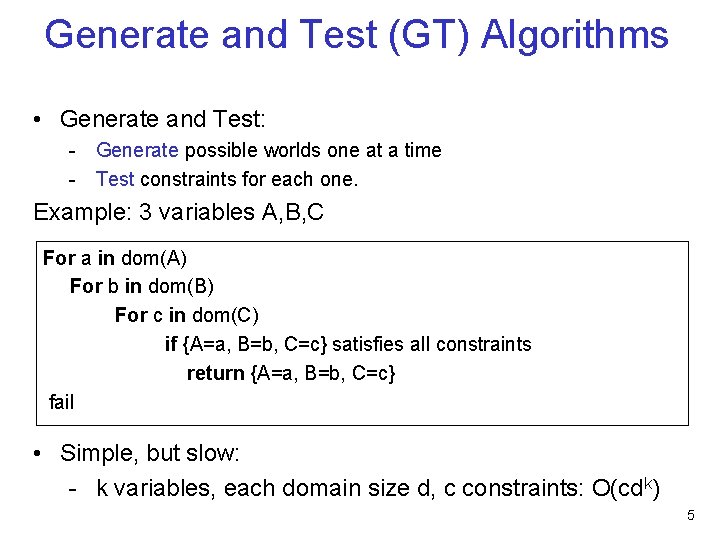
Generate and Test (GT) Algorithms • Generate and Test: - Generate possible worlds one at a time - Test constraints for each one. Example: 3 variables A, B, C For a in dom(A) For b in dom(B) For c in dom(C) if {A=a, B=b, C=c} satisfies all constraints return {A=a, B=b, C=c} fail • Simple, but slow: - k variables, each domain size d, c constraints: O(cdk) 5

Lecture Overview • Solving Constraint Satisfaction Problems (CSPs) - Recap: Generate & Test - Recap: Graph search - Arc consistency 6

Backtracking algorithms • Explore search space via DFS but evaluate each constraint as soon as all its variables are bound. • Any partial assignment that doesn’t satisfy the constraint can be pruned. • Example: - 3 variables A, B, C, each with domain {1, 2, 3, 4} - {A = 1, B = 1} is inconsistent with constraint A B regardless of the value of the other variables Prune! 7
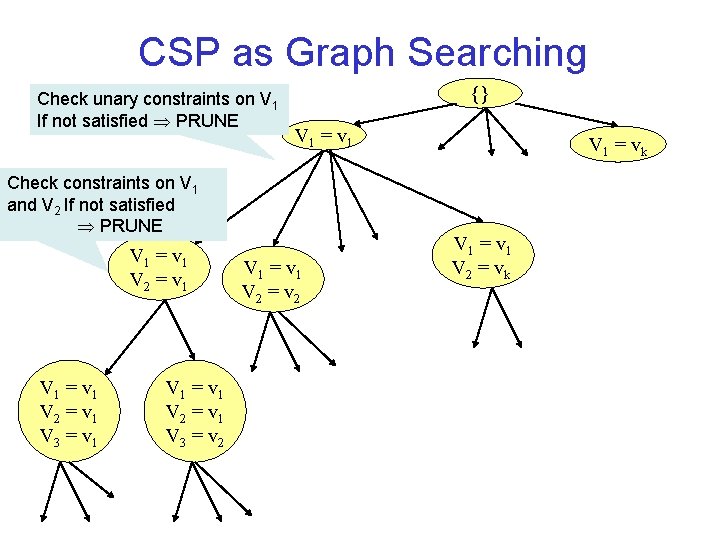
CSP as Graph Searching Check unary constraints on V 1 If not satisfied PRUNE {} V 1 = v 1 Check constraints on V 1 and V 2 If not satisfied PRUNE V 1 = v 1 V 2 = v 1 V 3 = v 1 V 1 = v 1 V 2 = v 1 V 3 = v 2 V 1 = v 1 V 2 = v 2 V 1 = v k V 1 = v 1 V 2 = v k
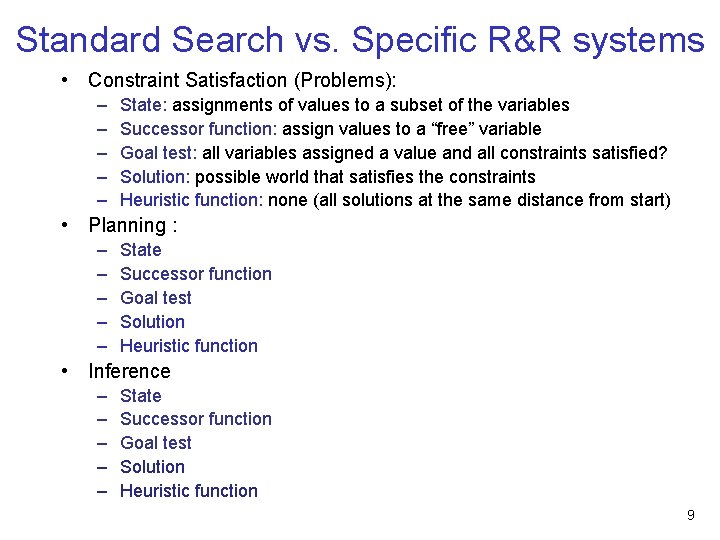
Standard Search vs. Specific R&R systems • Constraint Satisfaction (Problems): – – – State: assignments of values to a subset of the variables Successor function: assign values to a “free” variable Goal test: all variables assigned a value and all constraints satisfied? Solution: possible world that satisfies the constraints Heuristic function: none (all solutions at the same distance from start) • Planning : – – – State Successor function Goal test Solution Heuristic function • Inference – – – State Successor function Goal test Solution Heuristic function 9
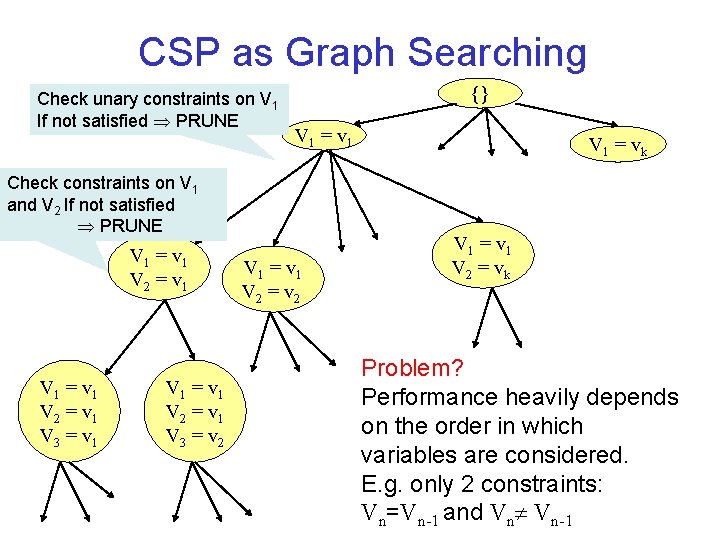
CSP as Graph Searching Check unary constraints on V 1 If not satisfied PRUNE {} V 1 = v 1 Check constraints on V 1 and V 2 If not satisfied PRUNE V 1 = v 1 V 2 = v 1 V 3 = v 1 V 1 = v 1 V 2 = v 1 V 3 = v 2 V 1 = v 1 V 2 = v 2 V 1 = v k V 1 = v 1 V 2 = v k Problem? Performance heavily depends on the order in which variables are considered. E. g. only 2 constraints: Vn=Vn-1 and Vn Vn-1
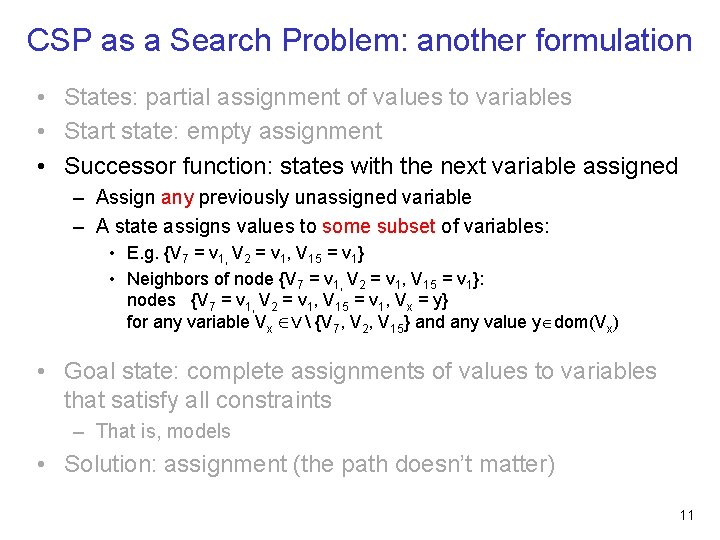
CSP as a Search Problem: another formulation • States: partial assignment of values to variables • Start state: empty assignment • Successor function: states with the next variable assigned – Assign any previously unassigned variable – A state assigns values to some subset of variables: • E. g. {V 7 = v 1, V 2 = v 1, V 15 = v 1} • Neighbors of node {V 7 = v 1, V 2 = v 1, V 15 = v 1}: nodes {V 7 = v 1, V 2 = v 1, V 15 = v 1, Vx = y} for any variable Vx V {V 7, V 2, V 15} and any value y dom(Vx) • Goal state: complete assignments of values to variables that satisfy all constraints – That is, models • Solution: assignment (the path doesn’t matter) 11
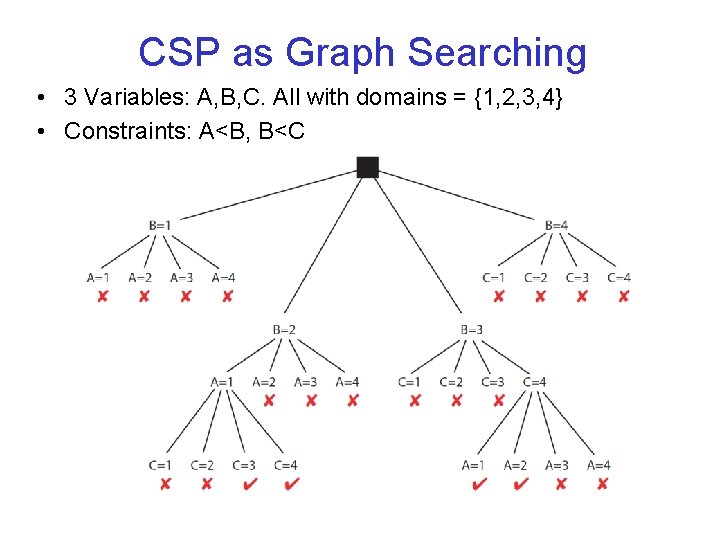
CSP as Graph Searching • 3 Variables: A, B, C. All with domains = {1, 2, 3, 4} • Constraints: A<B, B<C
Selecting variables in a smart way • Backtracking relies on one or more heuristics to select which variables to consider next - E. g, variable involved in the highest number of constraints - Can also be smart about which values to consider first 13
Learning Goals for solving CSPs so far • Verify whether a possible world satisfies a set of constraints (i. e. , whether it is a model, a solution) • Implement the Generate-and-Test Algorithm. Explain its disadvantages. • Solve a CSP by search (specify neighbors, states, start state, goal state). Compare strategies for CSP search. Implement pruning for DFS search in a CSP. 14

Lecture Overview • Solving Constraint Satisfaction Problems (CSPs) - Recap: Generate & Test - Recap: Graph search - Arc consistency 15
Can we do better than Search? Key idea • prune the domains as much as possible before “searching” for a solution. Def. : A variable is domain consistent if no value of its domain is ruled impossible by any unary constraints. • Example: dom(V 2) = {1, 2, 3, 4}. V 2 2 • Variable V 2 is not domain consistent. - It is domain consistent once we remove 2 from its domain. • Trivial for unary constraints. Trickier for k-ary ones. 16
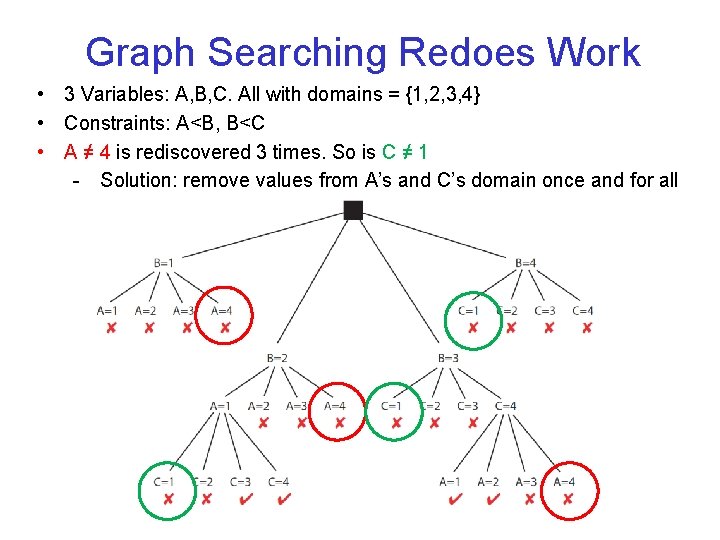
Graph Searching Redoes Work • 3 Variables: A, B, C. All with domains = {1, 2, 3, 4} • Constraints: A<B, B<C • A ≠ 4 is rediscovered 3 times. So is C ≠ 1 - Solution: remove values from A’s and C’s domain once and for all
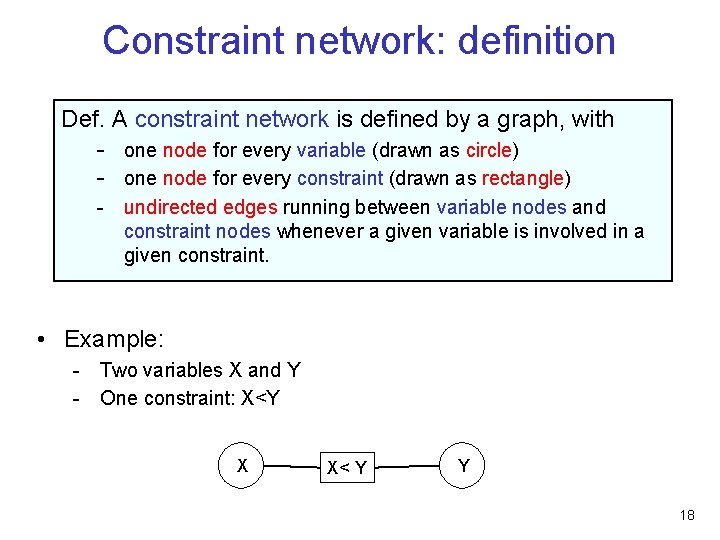
Constraint network: definition Def. A constraint network is defined by a graph, with - one node for every variable (drawn as circle) - one node for every constraint (drawn as rectangle) - undirected edges running between variable nodes and constraint nodes whenever a given variable is involved in a given constraint. • Example: - Two variables X and Y - One constraint: X<Y X X< Y Y 18
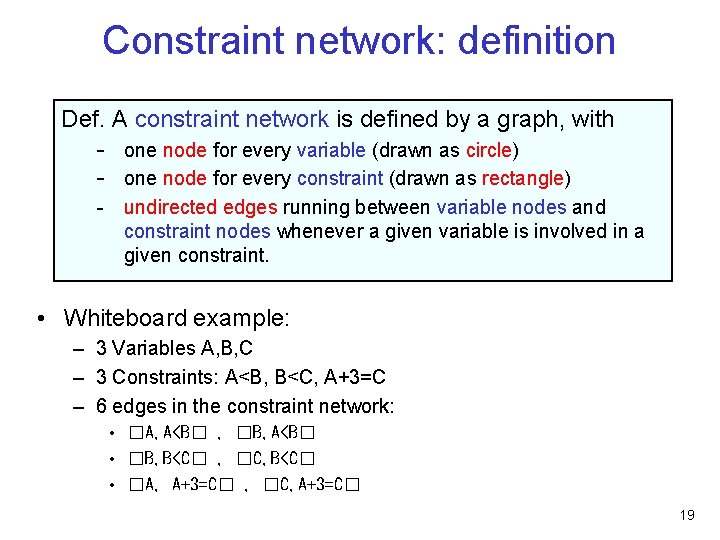
Constraint network: definition Def. A constraint network is defined by a graph, with - one node for every variable (drawn as circle) - one node for every constraint (drawn as rectangle) - undirected edges running between variable nodes and constraint nodes whenever a given variable is involved in a given constraint. • Whiteboard example: – 3 Variables A, B, C – 3 Constraints: A<B, B<C, A+3=C – 6 edges in the constraint network: • �A, A<B� , �B, A<B� • �B, B<C� , �C, B<C� • �A, A+3=C� , �C, A+3=C� 19
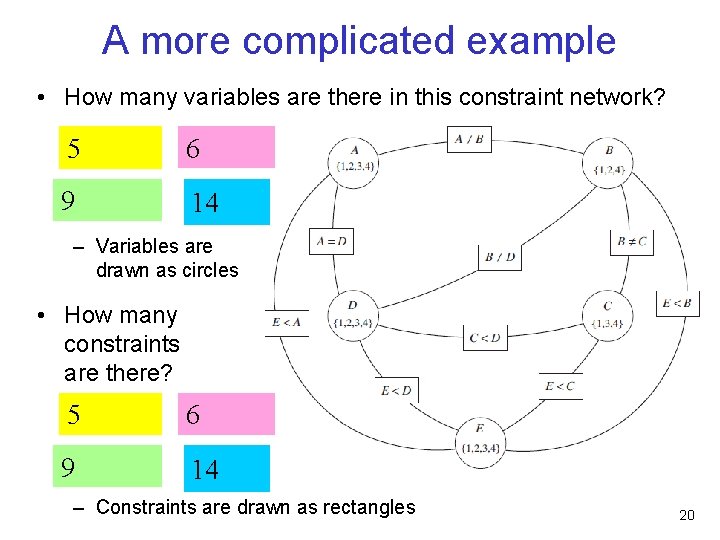
A more complicated example • How many variables are there in this constraint network? 5 6 9 14 – Variables are drawn as circles • How many constraints are there? 5 6 9 14 – Constraints are drawn as rectangles 20
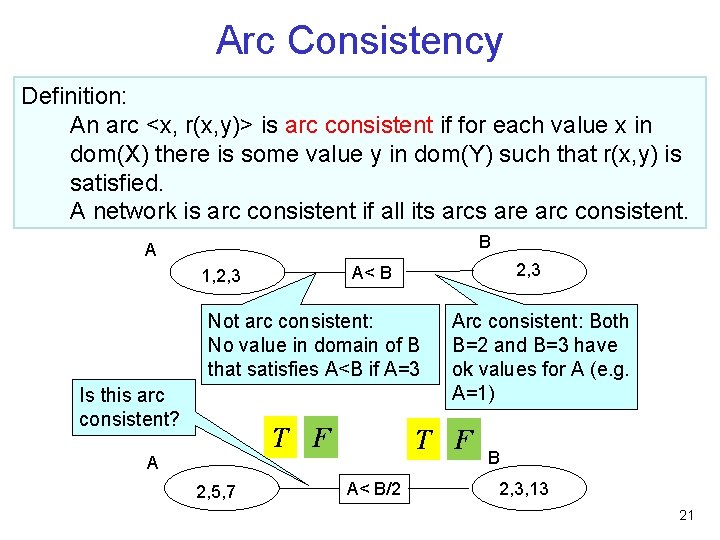
Arc Consistency Definition: An arc <x, r(x, y)> is arc consistent if for each value x in dom(X) there is some value y in dom(Y) such that r(x, y) is satisfied. A network is arc consistent if all its arcs are arc consistent. B A 2, 3 A< B 1, 2, 3 Not arc consistent: No value in domain of B that satisfies A<B if A=3 Is this arc consistent? T F A 2, 5, 7 Arc consistent: Both B=2 and B=3 have ok values for A (e. g. A=1) T F A< B/2 B 2, 3, 13 21
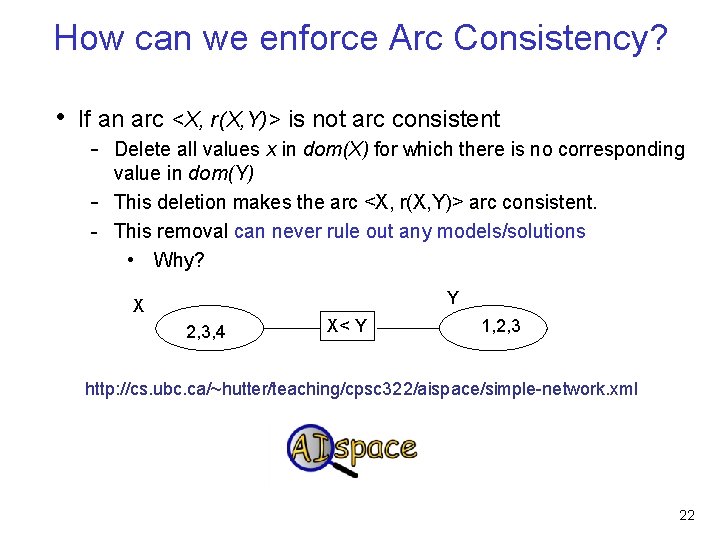
How can we enforce Arc Consistency? • If an arc <X, r(X, Y)> is not arc consistent - Delete all values x in dom(X) for which there is no corresponding value in dom(Y) - This deletion makes the arc <X, r(X, Y)> arc consistent. - This removal can never rule out any models/solutions • Why? Y X 2, 3, 4 X< Y 1, 2, 3 http: //cs. ubc. ca/~hutter/teaching/cpsc 322/aispace/simple-network. xml 22
Arc Consistency Algorithm: high level strategy • Consider the arcs in turn, making each arc consistent • Reconsider arcs that could be made inconsistent again by this pruning • See “simple problem 1” in AIspace for an example: 23
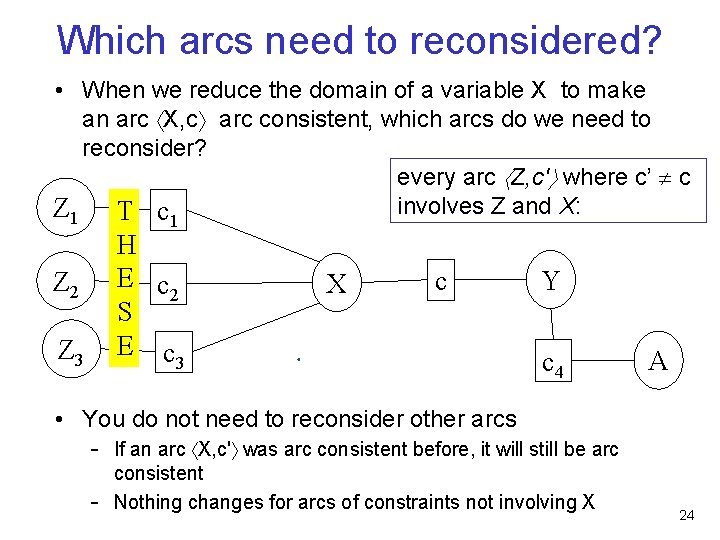
Which arcs need to reconsidered? • When we reduce the domain of a variable X to make an arc X, c arc consistent, which arcs do we need to reconsider? every arc Z, c' where c’ c involves Z and X: Z 1 T c 1 H E c 2 S E c 3 Z 2 Z 3 X c Y c 4 A • You do not need to reconsider other arcs - If an arc X, c' was arc consistent before, it will still be arc - consistent Nothing changes for arcs of constraints not involving X 24
Which arcs need to reconsidered? • Consider the arcs in turn, making each arc consistent • Reconsider arcs that could be made inconsistent again by this pruning • Trace on “simple problem 1” and on “scheduling problem 1”, trying to predict - which arcs are not consistent and which arcs need to be reconsidered after each removal 25
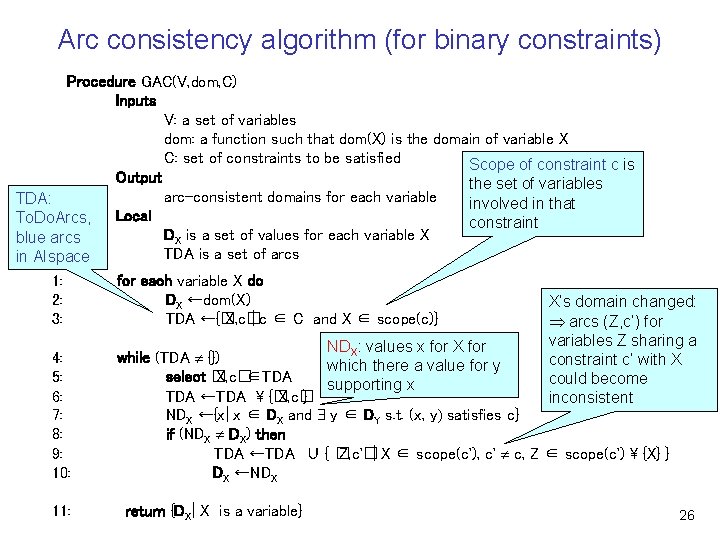
Arc consistency algorithm (for binary constraints) Procedure GAC(V, dom, C) Inputs V: a set of variables dom: a function such that dom(X) is the domain of variable X C: set of constraints to be satisfied Scope of constraint c is Output the set of variables arc-consistent domains for each variable TDA: involved in that Local To. Do. Arcs, constraint DX is a set of values for each variable X blue arcs TDA is a set of arcs in AIspace 1: 2: 3: for each variable X do DX ←dom(X) TDA ←{� X, c� | c ∈ C and X ∈ scope(c)} 4: 5: 6: 7: 8: 9: 10: NDX: values x for X for while (TDA {}) which there a value for y select � X, c�∈TDA supporting x TDA ←TDA {� X, c� } NDX ←{x| x ∈ DX and y ∈ DY s. t. (x, y) satisfies c} if (NDX DX) then TDA ←TDA ∪ { � Z, c'�| X ∈ scope(c'), c' c, Z ∈ scope(c') {X} } DX ←NDX 11: return {DX| X is a variable} X’s domain changed: arcs (Z, c’) for variables Z sharing a constraint c’ with X could become inconsistent 26
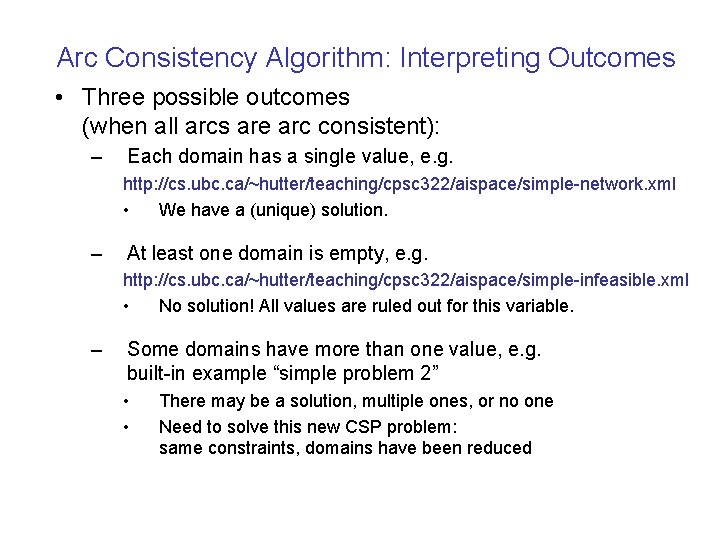
Arc Consistency Algorithm: Interpreting Outcomes • Three possible outcomes (when all arcs are arc consistent): – Each domain has a single value, e. g. http: //cs. ubc. ca/~hutter/teaching/cpsc 322/aispace/simple-network. xml • We have a (unique) solution. – At least one domain is empty, e. g. http: //cs. ubc. ca/~hutter/teaching/cpsc 322/aispace/simple-infeasible. xml • No solution! All values are ruled out for this variable. – Some domains have more than one value, e. g. built-in example “simple problem 2” • • There may be a solution, multiple ones, or no one Need to solve this new CSP problem: same constraints, domains have been reduced
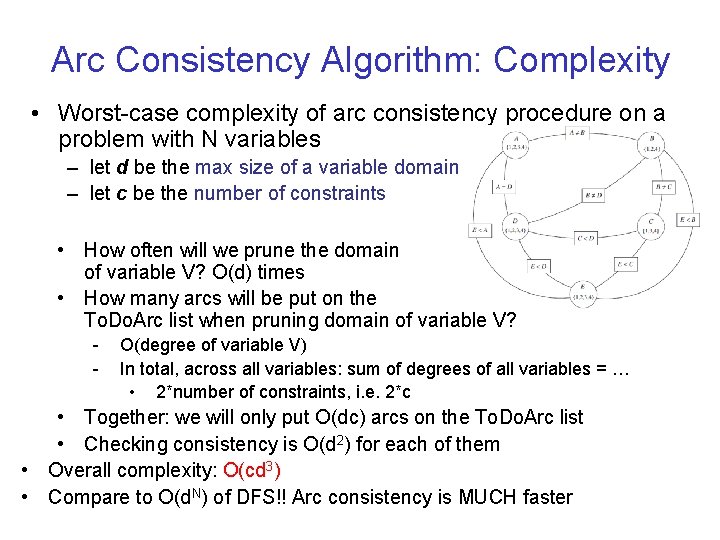
Arc Consistency Algorithm: Complexity • Worst-case complexity of arc consistency procedure on a problem with N variables – let d be the max size of a variable domain – let c be the number of constraints • How often will we prune the domain of variable V? O(d) times • How many arcs will be put on the To. Do. Arc list when pruning domain of variable V? - O(degree of variable V) In total, across all variables: sum of degrees of all variables = … • 2*number of constraints, i. e. 2*c • Together: we will only put O(dc) arcs on the To. Do. Arc list • Checking consistency is O(d 2) for each of them • Overall complexity: O(cd 3) • Compare to O(d. N) of DFS!! Arc consistency is MUCH faster
Learning Goals for arc consistency • Define/read/write/trace/debug the arc consistency algorithm. • Compute its complexity and assess its possible outcomes • Arc consistency practice exercise is on Web. CT • Coming up: Domain splitting – I. e. , combining arc consistency and search – Read Section 4. 6 • Also coming up: local search, Section 4. 8 • Assignment 1 is due next Monday
- Slides: 29