
Arborist Operations MIOSHA Compliance Safety Adapted from a
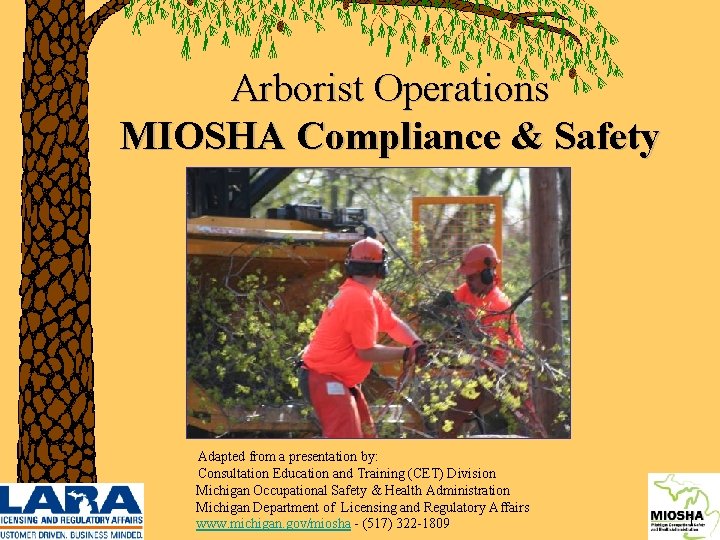
Arborist Operations MIOSHA Compliance & Safety Adapted from a presentation by: Consultation Education and Training (CET) Division Michigan Occupational Safety & Health Administration Michigan Department of Licensing and Regulatory Affairs www. michigan. gov/miosha - (517) 322 -1809 1

Receive MIOSHA CET Training and Division Announcements via Email! MIOSHA CET has established an electronic mailing list (listserv) to inform subscribers of upcoming MIOSHA training programs and announcements. If you would like to be added to this list, please visit: www. michigan. gov/mioshatraining If you need further assistance, please contact: MIOSHA Consultation Education and Training Division (517) 322 -1809 2

The MIOSHA Green Industry Alliance Formed in 2008, members of the Alliance Include: • Arboriculture Society of Michigan (ASM) • Michigan Green Industry Association (MGIA) • Michigan Nursery and Landscape Association (MNLA) • Michigan Turfgrass Foundation (MTF) • MIOSHA Compliance, Education & Training (CET) • Tree Care Industry Association (TCIA) • Utility Line Clearance Coalition (ULCC) Further information on the Alliance Partners appears at the end of this program. 3
Industry Standards Please refer to: ANSI Z 133. 1 - 2006 for Arboricultural Operations – Safety Requirements (available in Spanish) for additional details on safe work practices and techniques concerning line clearance tree trimming. 4
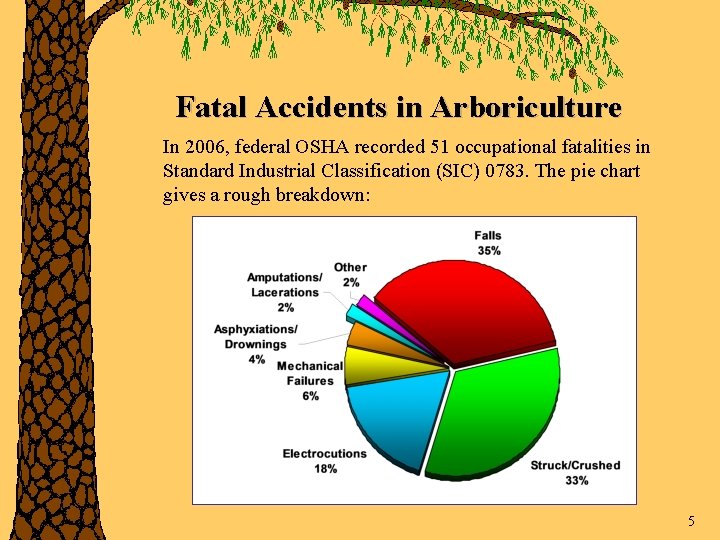
Fatal Accidents in Arboriculture In 2006, federal OSHA recorded 51 occupational fatalities in Standard Industrial Classification (SIC) 0783. The pie chart gives a rough breakdown: 5

What is the difference between “Tree Trimming (Arboriculture)” and “Logging”? Here is MIOSHA’s rule of thumb…if trees are being harvested mainly as a product to sell, it’s Logging and you’re regulated by Part 51. If the trees are being removed as a service. . . it’s tree trimming (Arboriculture) and you’re regulated by Part 53. 6
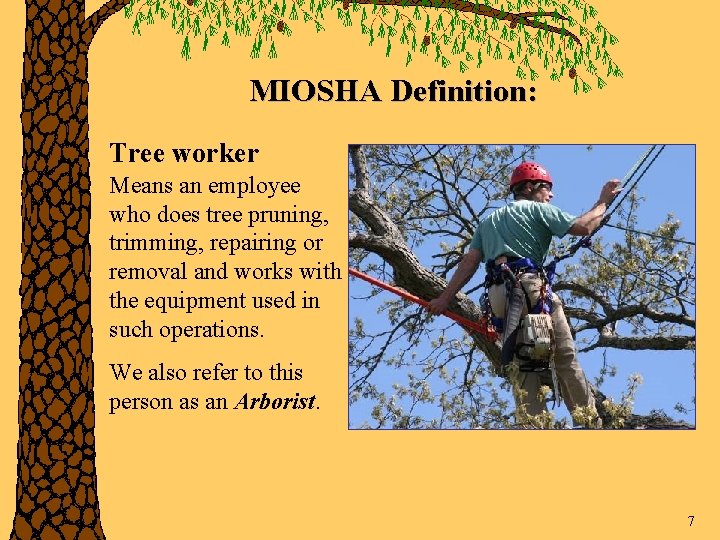
MIOSHA Definition: Tree worker Means an employee who does tree pruning, trimming, repairing or removal and works with the equipment used in such operations. We also refer to this person as an Arborist. 7
Employer Responsibilities An employer shall: R. 5311(a)* Provide training to each new employee regarding the requirements of Part 53, the job hazards and safeguards before starting an assigned job. A job briefing shall be conducted before any tree job involving unusual hazards is begun. R. 5311(b) Not allow a tool or equipment to be used which is not guarded according to State standards, has a defective guard or is otherwise unsafe. R. 5311(c) Develop rescue procedures such as, but not limited to, removal of injured, stricken or electrically shocked employees from work positions aloft. * - refers to specific clauses within MIOSHA Part 53 8
Employee Responsibilities An employee shall: R. 5312(a) Report any tool, equipment or safeguard which is defective. R 5312(b) Use personal protective equipment prescribed by the State safety standards. 9
Employee Responsibilities An employee shall not: R. 5312(c) remove a guard except for authorized operational or maintenance purposes. The guard shall be replaced or equivalent guarding provided before the equipment is returned for normal use. R. 5312(d) operate any equipment unless trained in the operating procedures, hazards and safeguards and has been authorized to do so. 10
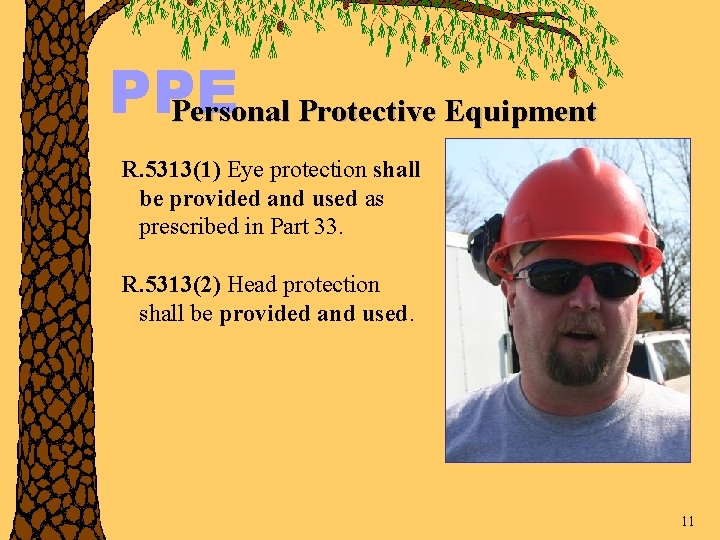
PPE Personal Protective Equipment R. 5313(1) Eye protection shall be provided and used as prescribed in Part 33. R. 5313(2) Head protection shall be provided and used. 11
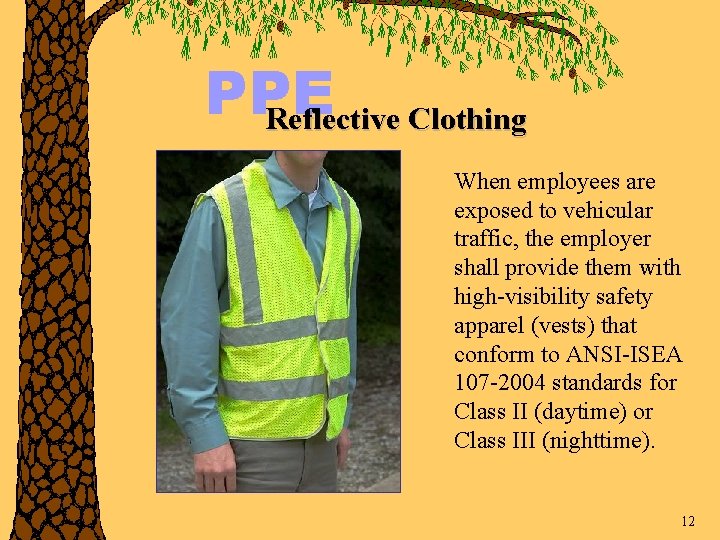
PPE Reflective Clothing When employees are exposed to vehicular traffic, the employer shall provide them with high-visibility safety apparel (vests) that conform to ANSI-ISEA 107 -2004 standards for Class II (daytime) or Class III (nighttime). 12
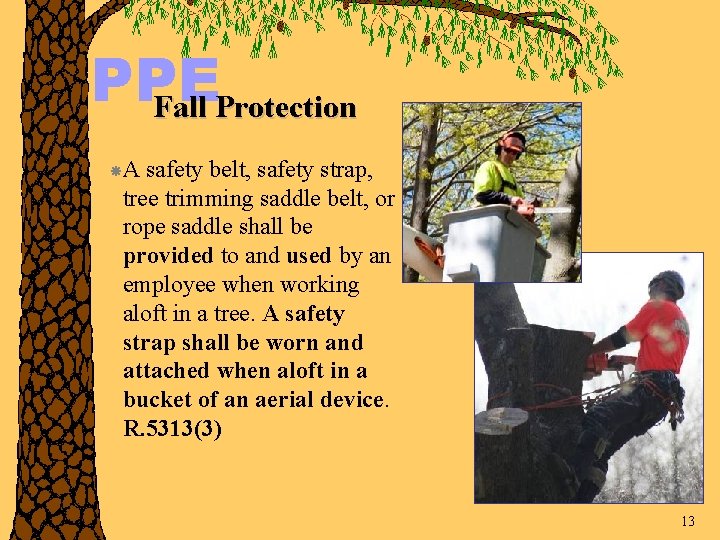
PPE Fall Protection A safety belt, safety strap, tree trimming saddle belt, or rope saddle shall be provided to and used by an employee when working aloft in a tree. A safety strap shall be worn and attached when aloft in a bucket of an aerial device. R. 5313(3) 13
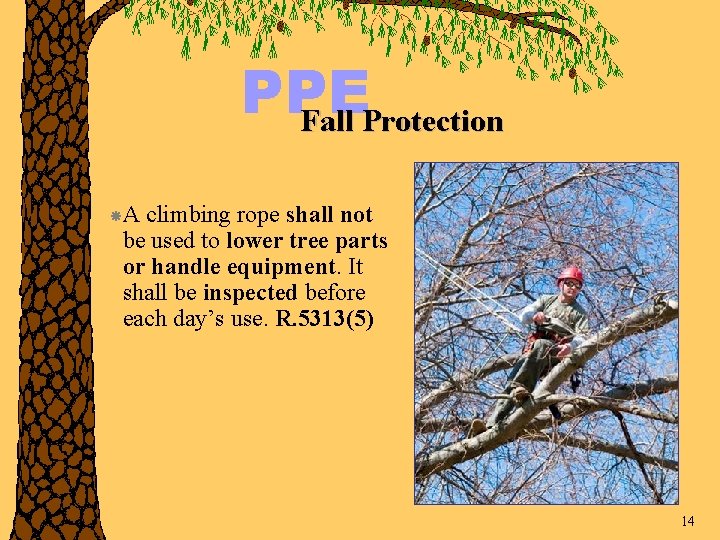
PPE Fall Protection A climbing rope shall not be used to lower tree parts or handle equipment. It shall be inspected before each day’s use. R. 5313(5) 14
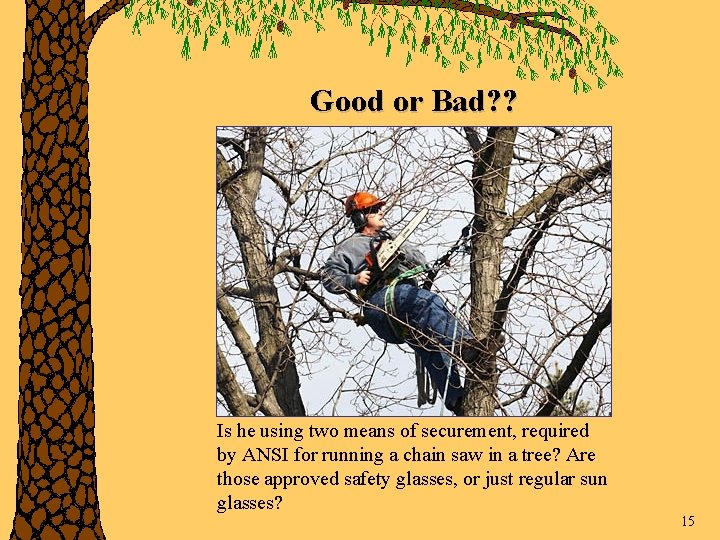
Good or Bad? ? Is he using two means of securement, required by ANSI for running a chain saw in a tree? Are those approved safety glasses, or just regular sun glasses? 15
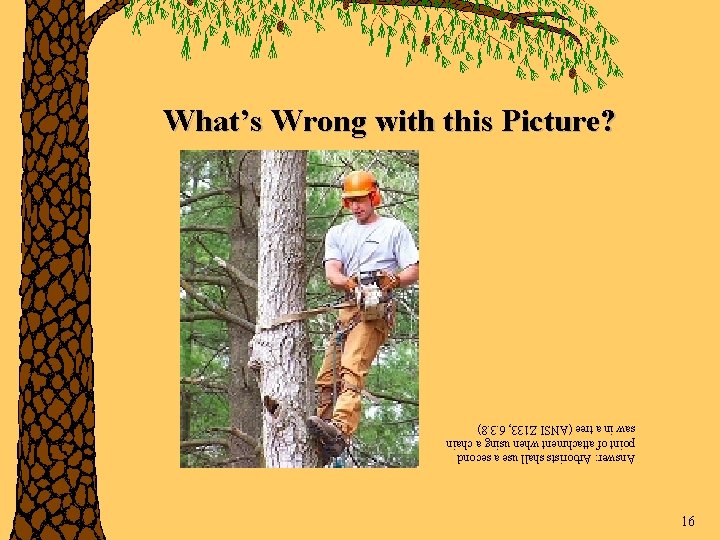
16 Answer: Arborists shall use a second point of attachment when using a chain saw in a tree (ANSI Z 133, 6. 3. 8) What’s Wrong with this Picture?
Chain Saw Injuries There were over 28, 500* chain saw injuries in 1999 according to the U. S. Consumer Product Safety Commission. The average injury required 110 stitches. 36% of injuries were to the legs and knees. The estimated cost per injury in 2000 was over $12, 000. Worker’s compensation costs are estimated at over $350 million annually. * These statistics are based on professional cutters – not the average consumer or construction worker doing some site clearing. 17
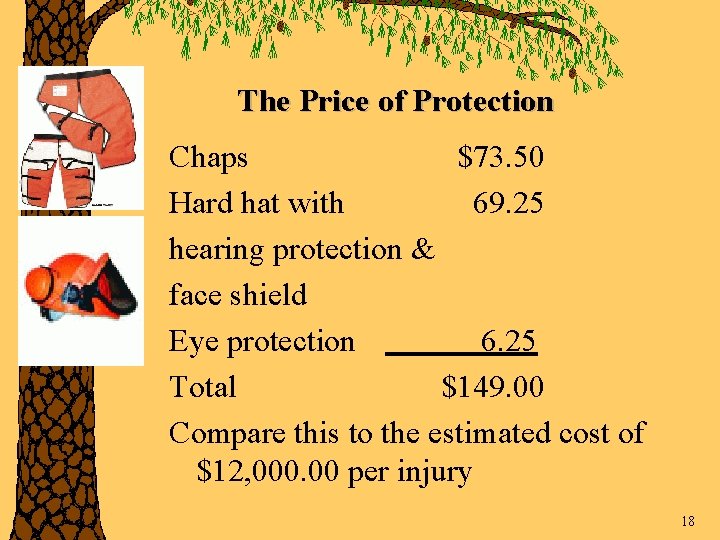
The Price of Protection Chaps $73. 50 Hard hat with 69. 25 hearing protection & face shield Eye protection 6. 25 Total $149. 00 Compare this to the estimated cost of $12, 000. 00 per injury 18
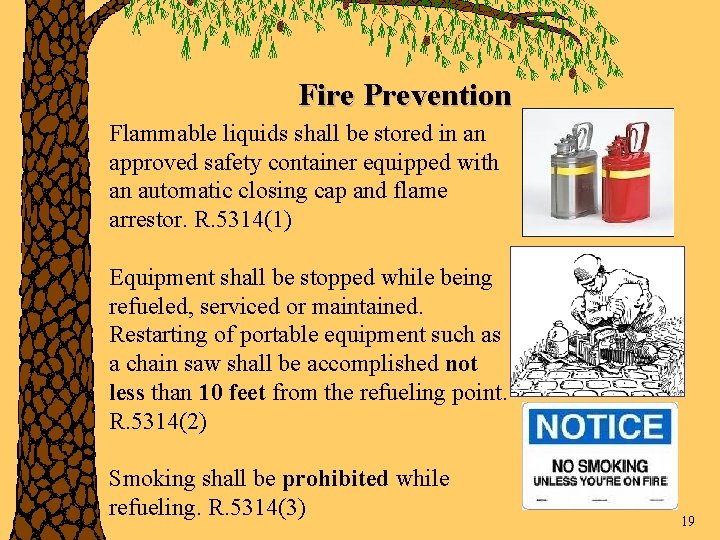
Fire Prevention Flammable liquids shall be stored in an approved safety container equipped with an automatic closing cap and flame arrestor. R. 5314(1) Equipment shall be stopped while being refueled, serviced or maintained. Restarting of portable equipment such as a chain saw shall be accomplished not less than 10 feet from the refueling point. R. 5314(2) Smoking shall be prohibited while refueling. R. 5314(3) 19
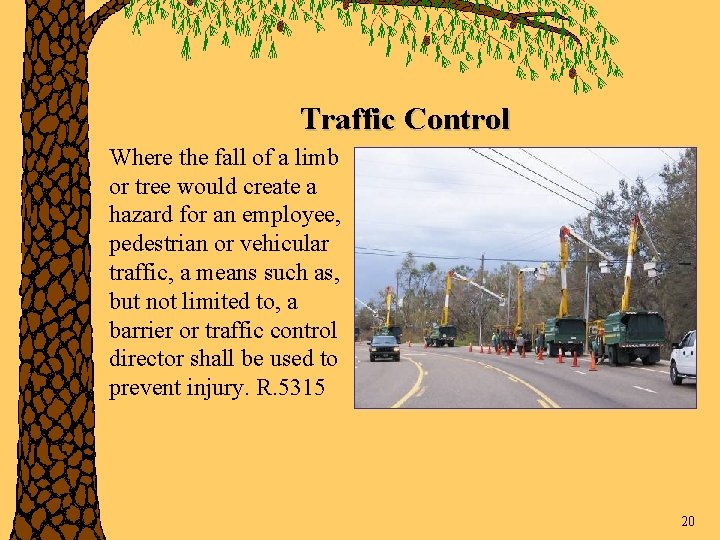
Traffic Control Where the fall of a limb or tree would create a hazard for an employee, pedestrian or vehicular traffic, a means such as, but not limited to, a barrier or traffic control director shall be used to prevent injury. R. 5315 20
Electrical Hazards: What Standard Applies? MIOSHA uses this rule of thumb: If the employee works for the utility owner or operator, or if his/her employer contracts for the utility, then Part 86 applies. If the arborist is being paid to prune or maintain trees for someone other than the utility and his/her exposure to electrical hazards is incidental, then Part 53 applies. 21
Electrical Hazards An electric conductor or communication line shall be considered energized unless the utility system’s operator or owner indicates otherwise and they have visibly grounded the conductor or line. R. 5321(1) A tree worker or qualified line clearance tree trimmer shall not make a direct contact with an energized conductor. R. 5321(3) 22
Definition: Qualified line clearance arborist Means an employee trained to work in the proximity of energized conductors such as, but not limited to, an employee for an electric power or communications company. 23
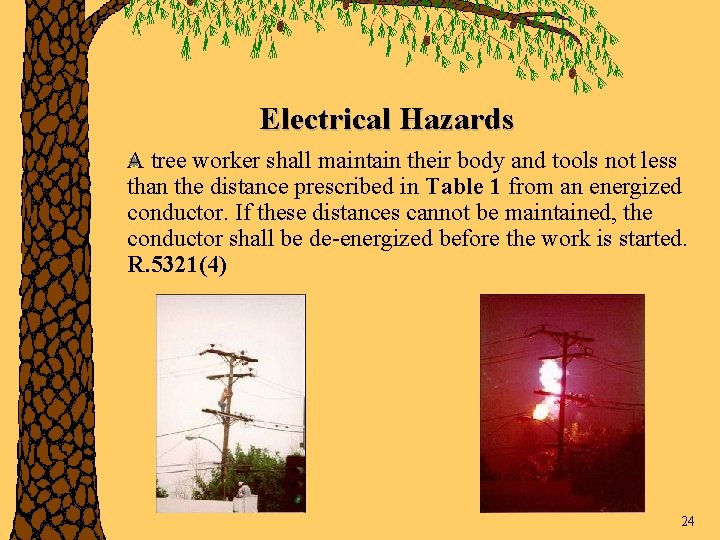
Electrical Hazards A tree worker shall maintain their body and tools not less than the distance prescribed in Table 1 from an energized conductor. If these distances cannot be maintained, the conductor shall be de-energized before the work is started. R. 5321(4) 24
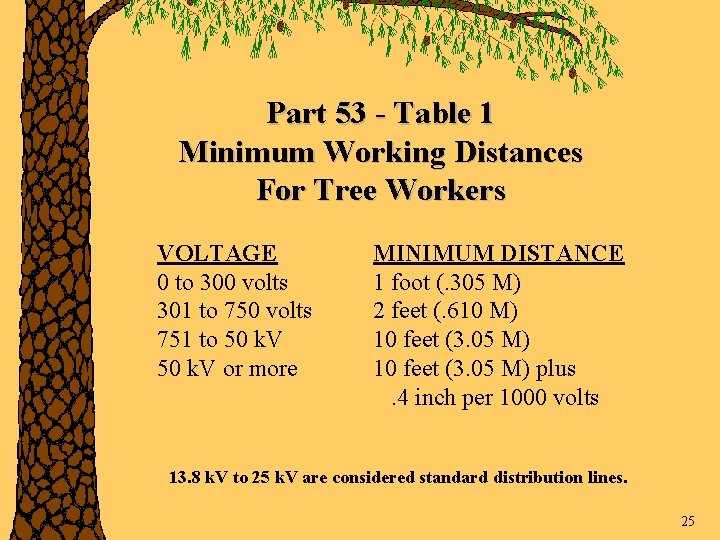
Part 53 - Table 1 Minimum Working Distances For Tree Workers VOLTAGE 0 to 300 volts 301 to 750 volts 751 to 50 k. V or more MINIMUM DISTANCE 1 foot (. 305 M) 2 feet (. 610 M) 10 feet (3. 05 M) plus. 4 inch per 1000 volts 13. 8 k. V to 25 k. V are considered standard distribution lines. 25
Electrical Hazards A qualified line clearance tree trimmer shall maintain their body and tools not less than the distance prescribed in Table 2 from an energized conductor, except the trimmer may remove branches hanging on a conductor using approved insulated tools and equipment when the voltage is below 10 k. V. R. 5321(5) 26
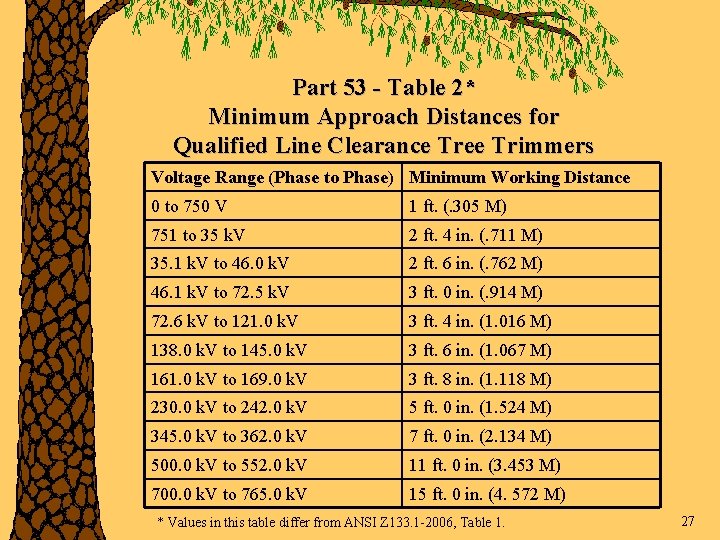
Part 53 - Table 2* Minimum Approach Distances for Qualified Line Clearance Tree Trimmers Voltage Range (Phase to Phase) Minimum Working Distance 0 to 750 V 1 ft. (. 305 M) 751 to 35 k. V 2 ft. 4 in. (. 711 M) 35. 1 k. V to 46. 0 k. V 2 ft. 6 in. (. 762 M) 46. 1 k. V to 72. 5 k. V 3 ft. 0 in. (. 914 M) 72. 6 k. V to 121. 0 k. V 3 ft. 4 in. (1. 016 M) 138. 0 k. V to 145. 0 k. V 3 ft. 6 in. (1. 067 M) 161. 0 k. V to 169. 0 k. V 3 ft. 8 in. (1. 118 M) 230. 0 k. V to 242. 0 k. V 5 ft. 0 in. (1. 524 M) 345. 0 k. V to 362. 0 k. V 7 ft. 0 in. (2. 134 M) 500. 0 k. V to 552. 0 k. V 11 ft. 0 in. (3. 453 M) 700. 0 k. V to 765. 0 k. V 15 ft. 0 in. (4. 572 M) * Values in this table differ from ANSI Z 133. 1 -2006, Table 1. 27
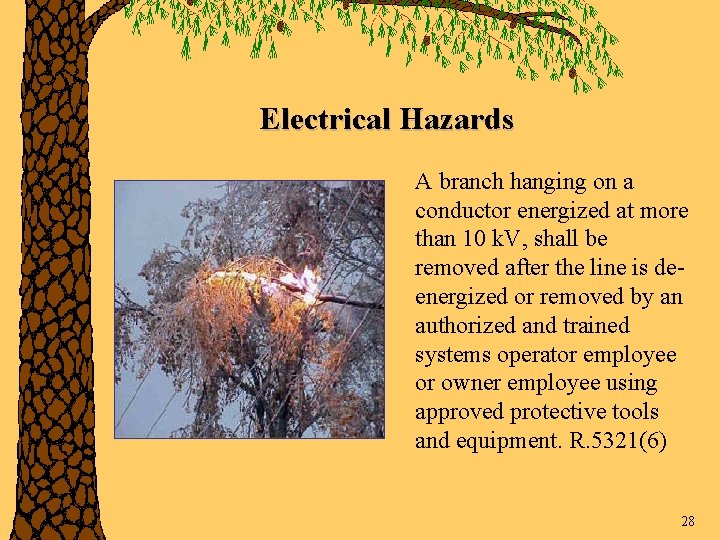
Electrical Hazards A branch hanging on a conductor energized at more than 10 k. V, shall be removed after the line is deenergized or removed by an authorized and trained systems operator employee or owner employee using approved protective tools and equipment. R. 5321(6) 28
Under Part 86 A second line-clearance tree trimmer within normal (unassisted) voice communication shall be present if: A line-clearance trimmer is to approach more closely than 10 feet of any conductor or electric apparatus energized at more than 750 volts Branches or limbs being removed are closer to lines energized at more than 750 volts than the distances listed in Table R-6 Roping is necessary to remove branches or limbs from such conductors or apparatus. R. 1910. 269(r)1)(ii)(A-C) Please refer to Part 86 for complete rules of tree trimming around power lines. 29
Work Practices 30
Climbing in Storm Conditions • An employee shall not climb a tree during a storm or high wind or when covered in ice or snow, except when performing emergency service. R. 5331(5) 31
Pruning & Trimming • If another employee is present, a verbal warning shall be given by the employee aloft before dropping a limb. R. 5332(1) • A separate work rope, controlled by an employee on the ground, shall be used to lower limbs which cannot be dropped. The work rope shall not use the same crotch over which the climbing rope is run. R. 5332(2) • Whenever an employee is aloft in excess of 15 feet (4. 572 M), a second employee or supervisor shall be within vocal hearing distance of the treed employee. R. 5332(4) 32
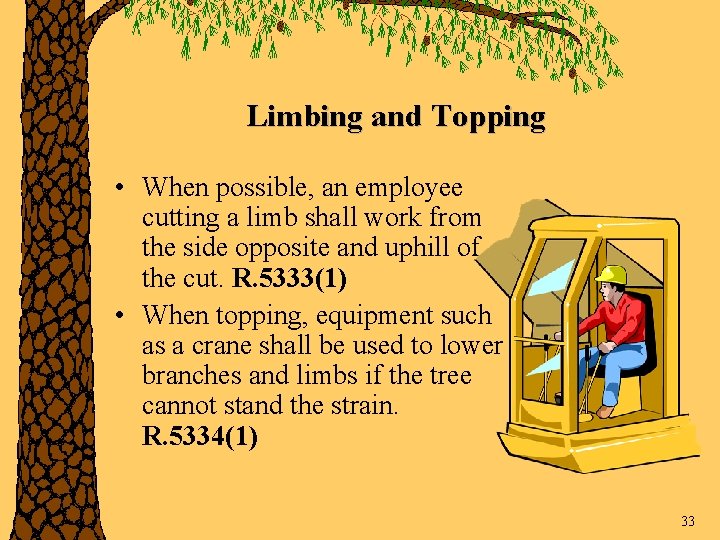
Limbing and Topping • When possible, an employee cutting a limb shall work from the side opposite and uphill of the cut. R. 5333(1) • When topping, equipment such as a crane shall be used to lower branches and limbs if the tree cannot stand the strain. R. 5334(1) 33
Before Felling A Tree… Assess All Hazards • Surrounding obstructions and hazards • Tree defects, dead limbs, etc. • Wind force and direction • Characteristics of the terrain and immediate work area • Tree lean • Weight distribution in the tree canopy • Overhead hazards & electrical conductors • Felling plan • Escape Route 34
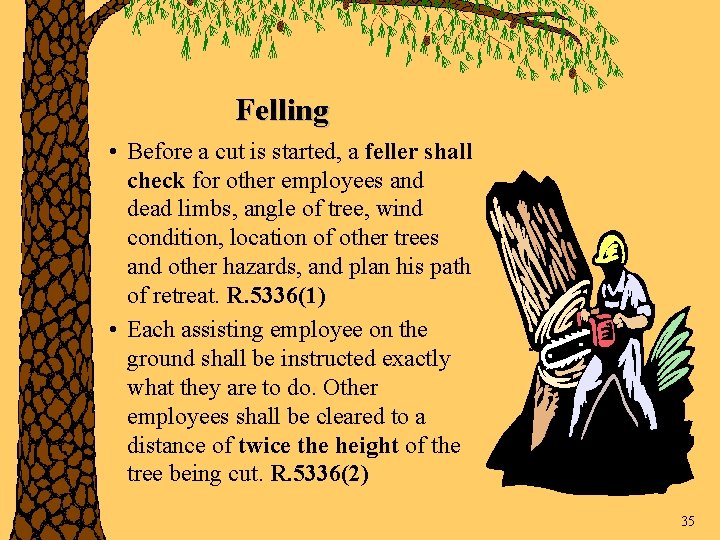
Felling • Before a cut is started, a feller shall check for other employees and dead limbs, angle of tree, wind condition, location of other trees and other hazards, and plan his path of retreat. R. 5336(1) • Each assisting employee on the ground shall be instructed exactly what they are to do. Other employees shall be cleared to a distance of twice the height of the tree being cut. R. 5336(2) 35
Felling The saw shall be shut off before the feller starts the retreat. R. 5336(6) Where a tree is likely to slide or roll, a feller shall cut from the uphill side. R. 5336(7) Just before the tree is ready to fall, an audible warning shall be given. R. 5336(8) If there is a danger of a tree falling the wrong way, such a means as wedges, block and tackle or rope shall be used to control the fall. R. 5336(9) 36
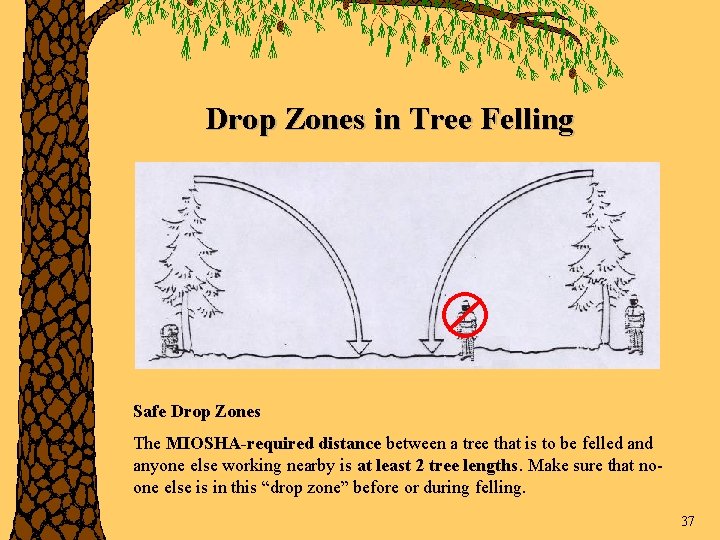
Drop Zones in Tree Felling Safe Drop Zones The MIOSHA-required distance between a tree that is to be felled anyone else working nearby is at least 2 tree lengths. Make sure that noone else is in this “drop zone” before or during felling. 37
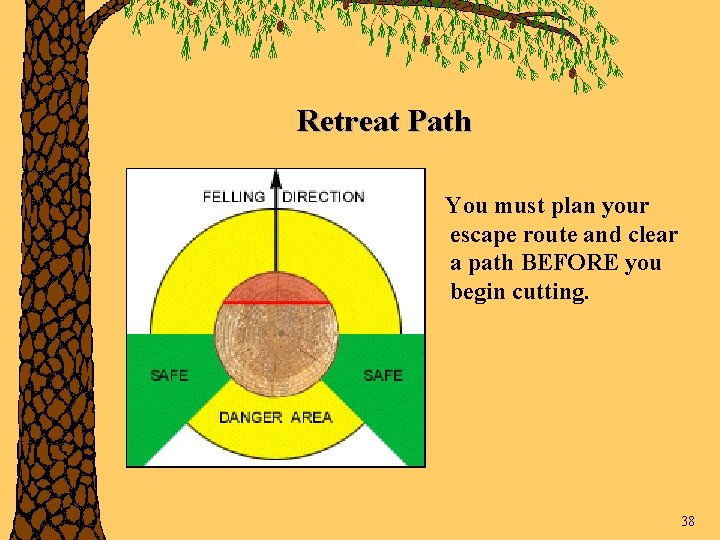
Retreat Path You must plan your escape route and clear a path BEFORE you begin cutting. 38
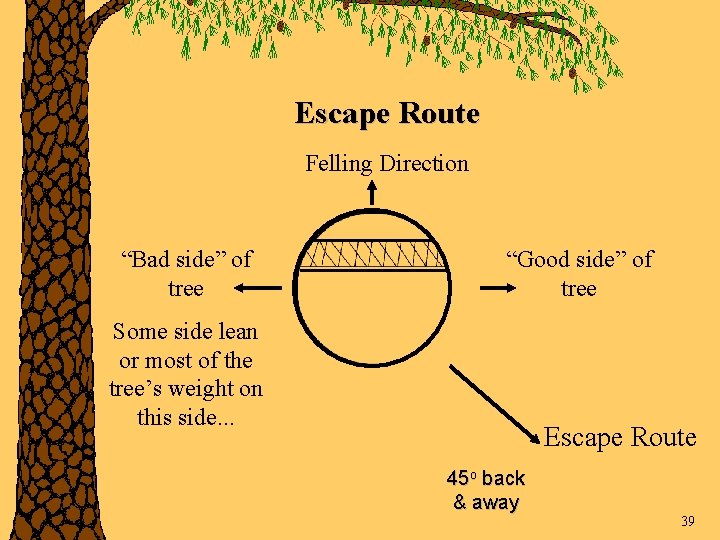
Escape Route Felling Direction “Bad side” of tree “Good side” of tree Some side lean or most of the tree’s weight on this side. . . Escape Route 45 o back & away 39

Felling Hazards Barber Chair Ø The splitting of the butt of the log during the latter part of the fall. The tree often remains attached to the stump, thus creating a danger zone and ruining much of the log. Ø Caused by a Dutchman notch (discussed later in this program), no notch, or excessive front lean. Throwback ØLimbs or other material thrown back toward the logger when the falling tree contacts standing trees or fallen trees. ØCaused by not felling the tree in a clear path or onto a clear landing. Lodged Tree (also called A Hung Tree) ØA cut tree that has not fallen completely to the ground, but is lodged or leaning against another tree. This is extremely dangerous. Do NOT work in the presence of hung trees. They should be pushed or pulled down by a machine. ØCaused by poor judgment of felling path or inaccurate cutting. 40
“Open Face” Felling • Generally, the safest of all felling techniques is the “open face” technique. The “face cut” or “notch” is formed with a steeply angled, downward cut and a second cut angled slightly upward to meet the first cut, creating a notch opening of between 70 and 90 degrees. • The open face cut allows the tree to be controlled all the way to the ground without the hinge being broken. 41
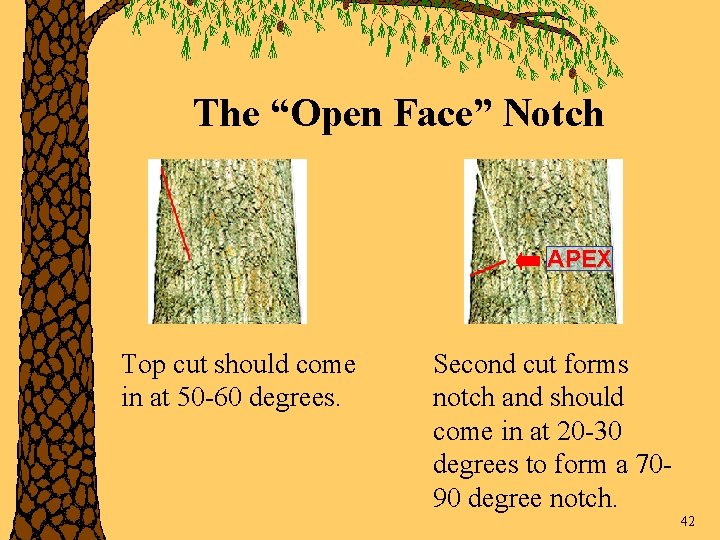
The “Open Face” Notch APEX Top cut should come in at 50 -60 degrees. Second cut forms notch and should come in at 20 -30 degrees to form a 7090 degree notch. 42
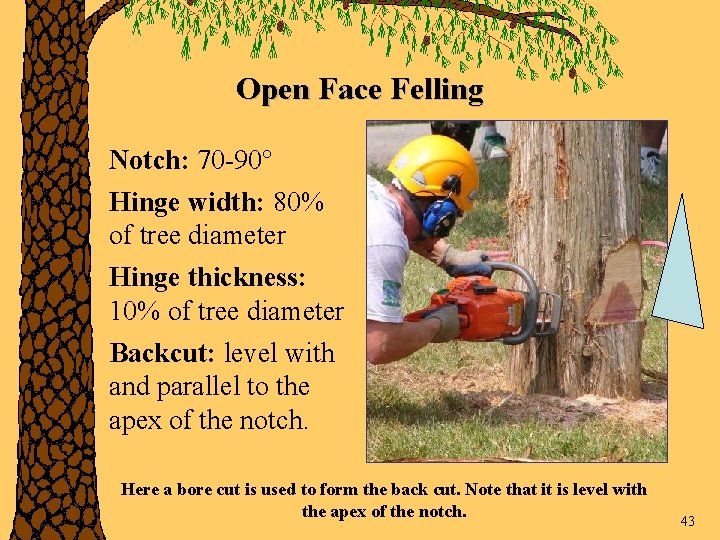
Open Face Felling Notch: 70 -90° Hinge width: 80% of tree diameter Hinge thickness: 10% of tree diameter Backcut: level with and parallel to the apex of the notch. Here a bore cut is used to form the back cut. Note that it is level with the apex of the notch. 43
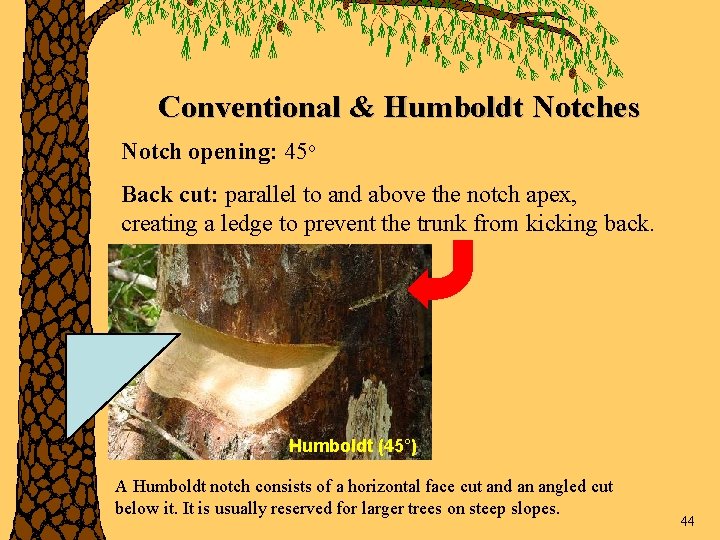
Conventional & Humboldt Notches Notch opening: 45 o Back cut: parallel to and above the notch apex, creating a ledge to prevent the trunk from kicking back. Humboldt (45°) A Humboldt notch consists of a horizontal face cut and an angled cut below it. It is usually reserved for larger trees on steep slopes. 44
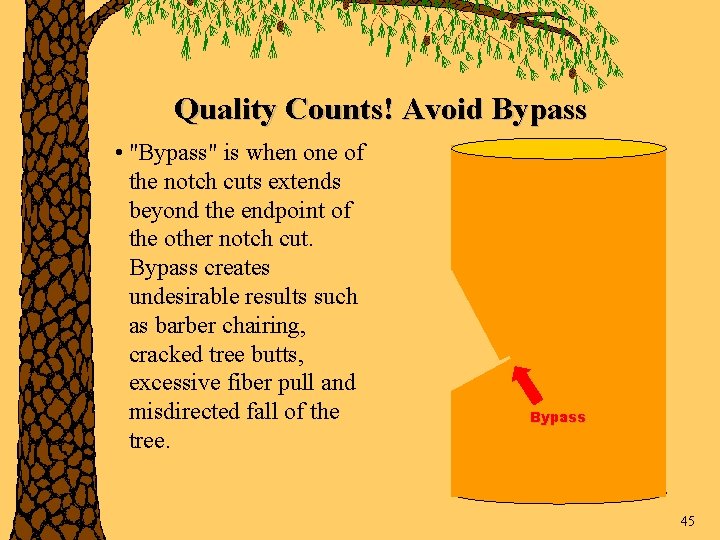
Quality Counts! Avoid Bypass • "Bypass" is when one of the notch cuts extends beyond the endpoint of the other notch cut. Bypass creates undesirable results such as barber chairing, cracked tree butts, excessive fiber pull and misdirected fall of the tree. Bypass 45
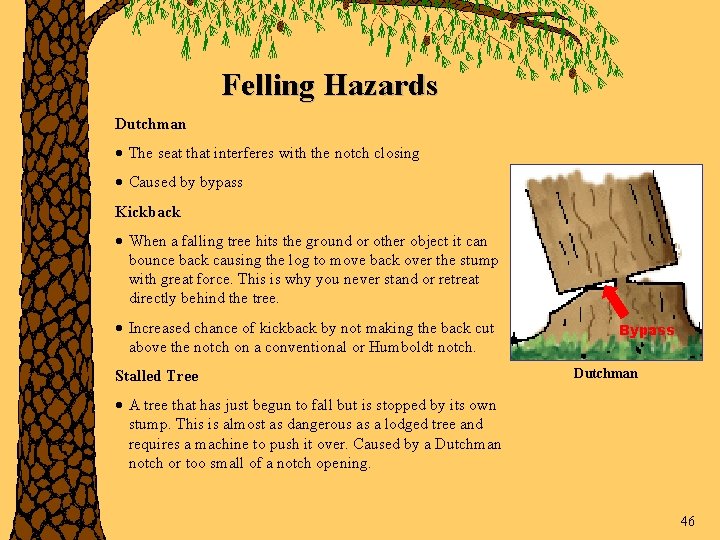
Felling Hazards Dutchman · The seat that interferes with the notch closing · Caused by bypass Kickback · When a falling tree hits the ground or other object it can bounce back causing the log to move back over the stump with great force. This is why you never stand or retreat directly behind the tree. · Increased chance of kickback by not making the back cut above the notch on a conventional or Humboldt notch. Stalled Tree Bypass Dutchman · A tree that has just begun to fall but is stopped by its own stump. This is almost as dangerous as a lodged tree and requires a machine to push it over. Caused by a Dutchman notch or too small of a notch opening. 46
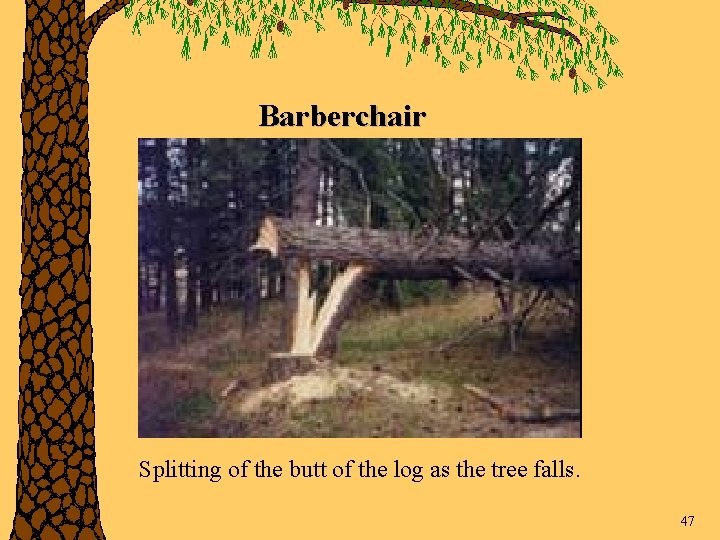
Barberchair Splitting of the butt of the log as the tree falls. 47
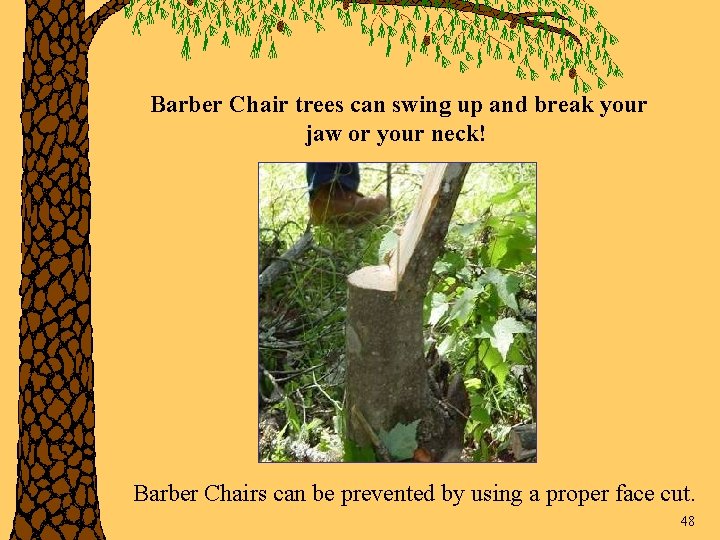
Barber Chair trees can swing up and break your jaw or your neck! Barber Chairs can be prevented by using a proper face cut. 48
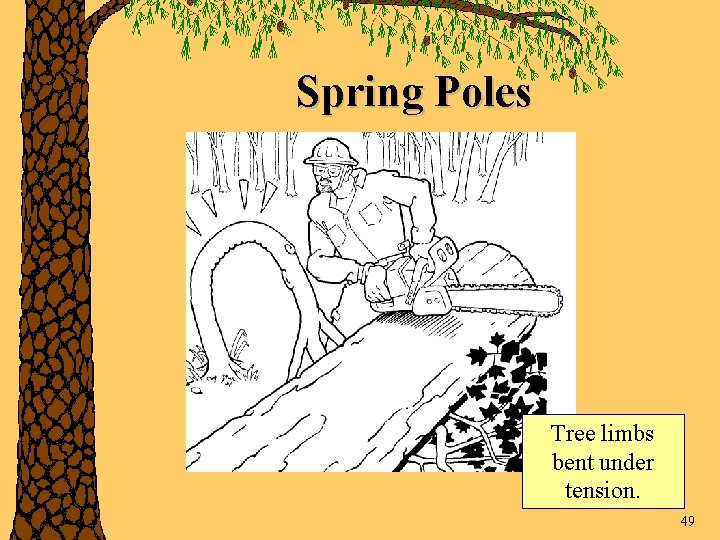
Spring Poles Tree limbs bent under tension. 49
Spring Poles are Dangerous! Rules for operating around spring poles: 1 – Avoid if at all possible. Do not work anywhere near them. 2 – If you cannot avoid them, the first option to make them safe is with mechanical equipment. Either use equipment to remove the tree/log causing the spring pole, or use a harvester to cut the spring pole. 3 – If mechanical equipment is not available, and if you MUST work near a spring pole, then it must be made safe. Use the information in the next slide as a last resort! 50
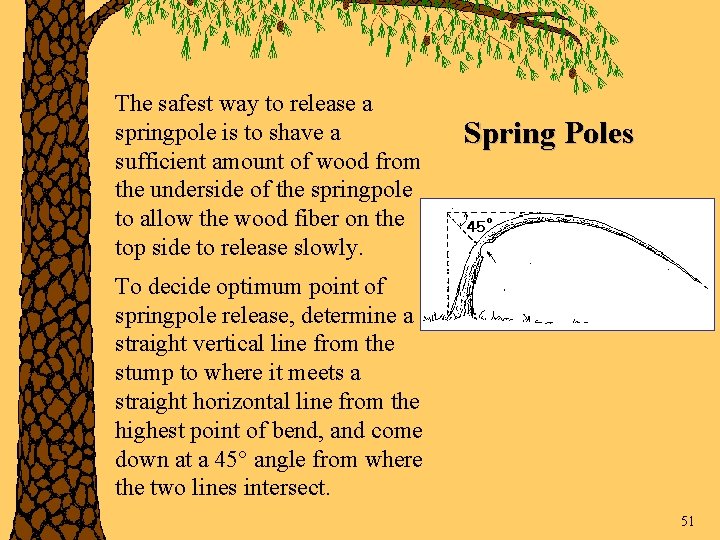
The safest way to release a springpole is to shave a sufficient amount of wood from the underside of the springpole to allow the wood fiber on the top side to release slowly. Spring Poles To decide optimum point of springpole release, determine a straight vertical line from the stump to where it meets a straight horizontal line from the highest point of bend, and come down at a 45° angle from where the two lines intersect. 51
Felling • A back cut shall leave sufficient hinge wood (the fiber between notch apex and back cut) to guide the tree’s fall in the desired direction and to hold the tree to the stump during most of its fall. A back cut shall be about 2 inches (50. 8 mm) above the undercut and as level as possible (See figure 1). R. 5336(4)* * This standard provides guidance on the conventional and Humboldt felling techniques. Open-face felling came into widespread practice after this guidance was written. 52
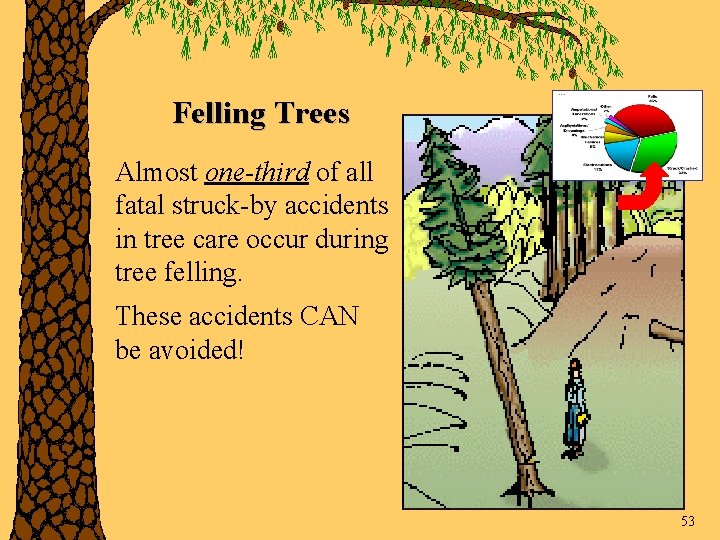
Felling Trees Almost one-third of all fatal struck-by accidents in tree care occur during tree felling. These accidents CAN be avoided! 53
Hurt at Work? ? • You've carefully thought out all the angles. • You've done it a thousand times. • It comes naturally to you. • You know what you're doing, its what you've been trained to do your whole life. • Nothing could possibly go wrong, right? 54
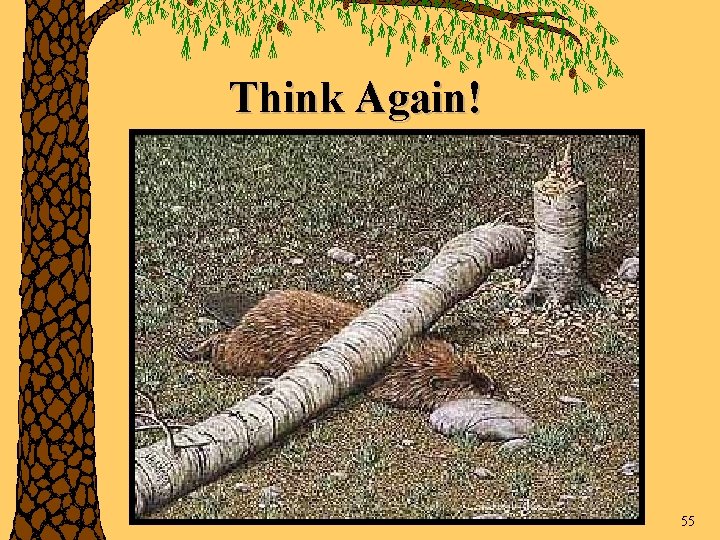
Think Again! 55
Accidents can happen to anyone. Training helps reduce accidents! 56
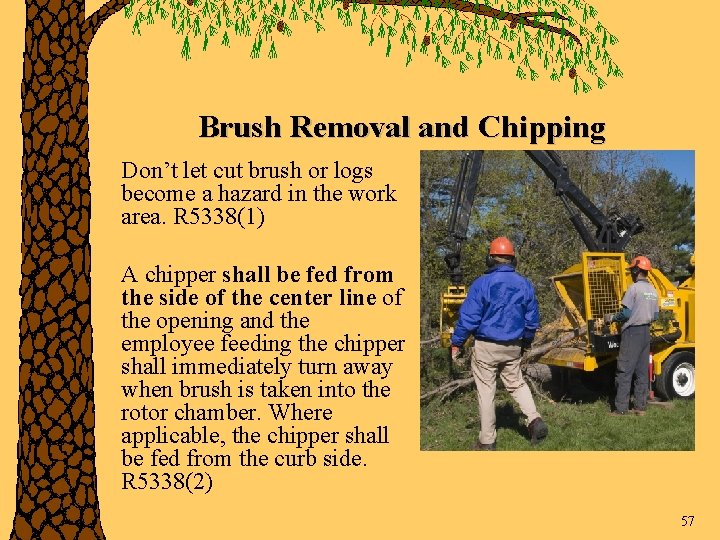
Brush Removal and Chipping Don’t let cut brush or logs become a hazard in the work area. R 5338(1) A chipper shall be fed from the side of the center line of the opening and the employee feeding the chipper shall immediately turn away when brush is taken into the rotor chamber. Where applicable, the chipper shall be fed from the curb side. R 5338(2) 57
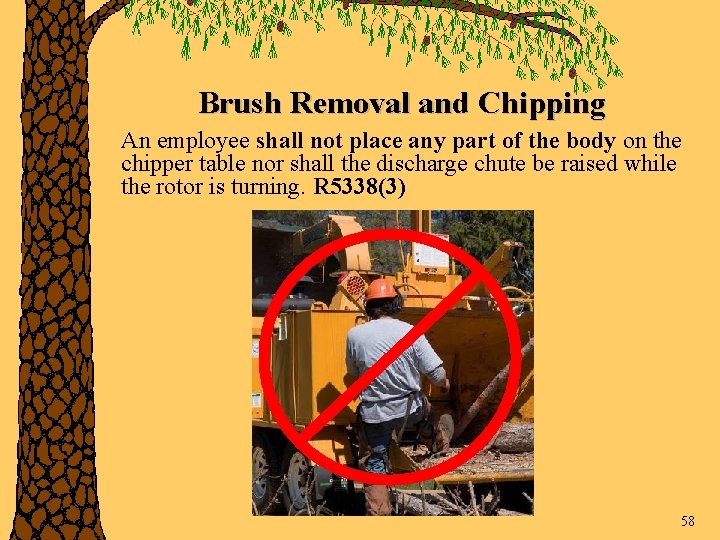
Brush Removal and Chipping An employee shall not place any part of the body on the chipper table nor shall the discharge chute be raised while the rotor is turning. R 5338(3) 58
Brush Removal and Chipping Foreign material, such as stones, bottles, nails or sweepings, shall not be fed into the chipper. R 5338(4) An employee feeding a chipper shall not wear attire such as, clothing with loose sleeves, gauntlet gloves, watches or rings. Rings covered by gloves or tape will be considered to be in compliance. R 5338(5) 59
Tools And Equipment 60
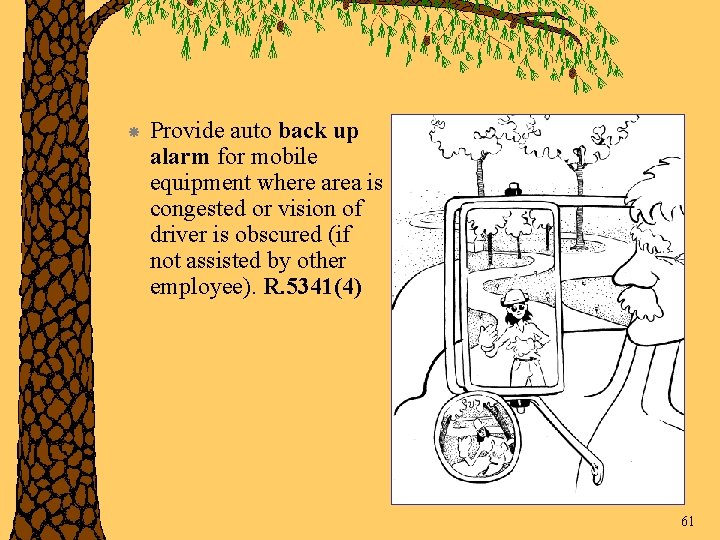
Provide auto back up alarm for mobile equipment where area is congested or vision of driver is obscured (if not assisted by other employee). R. 5341(4) 61
Mobile Equipment • Provide slip resistant surface, work platforms or steps. R. 5341(8) • Provide pad or traction for outrigger feet. R. 5341(9) • Require outriggers to be extended when lifting or digging. R. 5341(10) 62
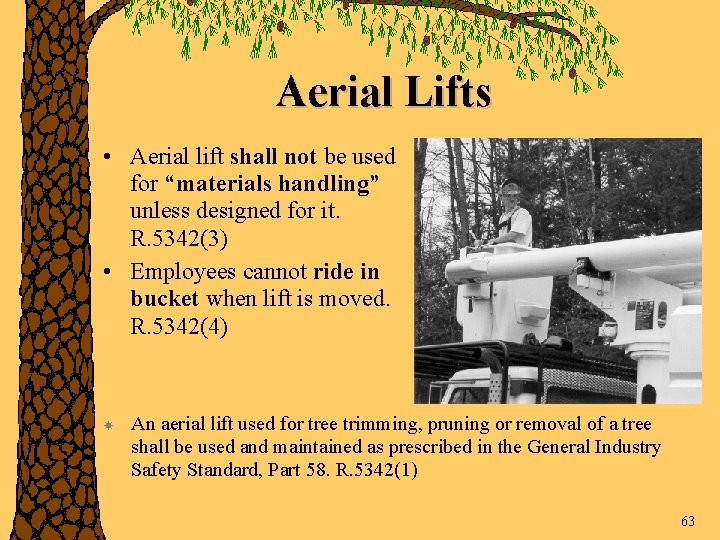
Aerial Lifts • Aerial lift shall not be used for “materials handling” unless designed for it. R. 5342(3) • Employees cannot ride in bucket when lift is moved. R. 5342(4) An aerial lift used for tree trimming, pruning or removal of a tree shall be used and maintained as prescribed in the General Industry Safety Standard, Part 58. R. 5342(1) 63
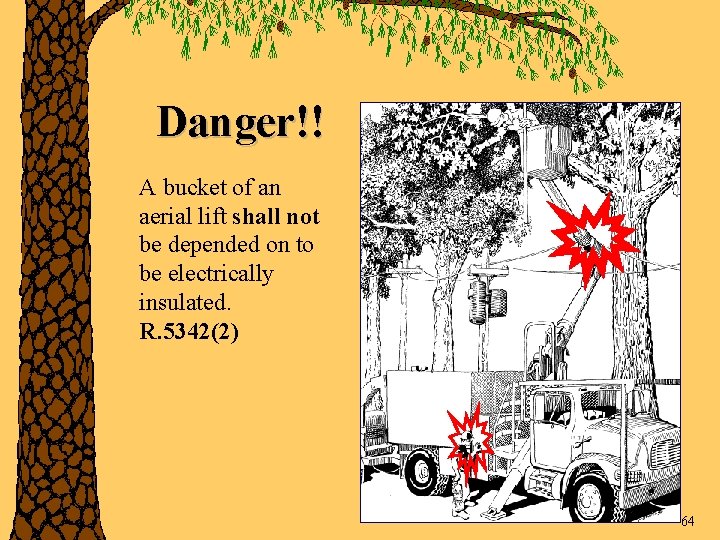
Danger!! A bucket of an aerial lift shall not be depended on to be electrically insulated. R. 5342(2) 64
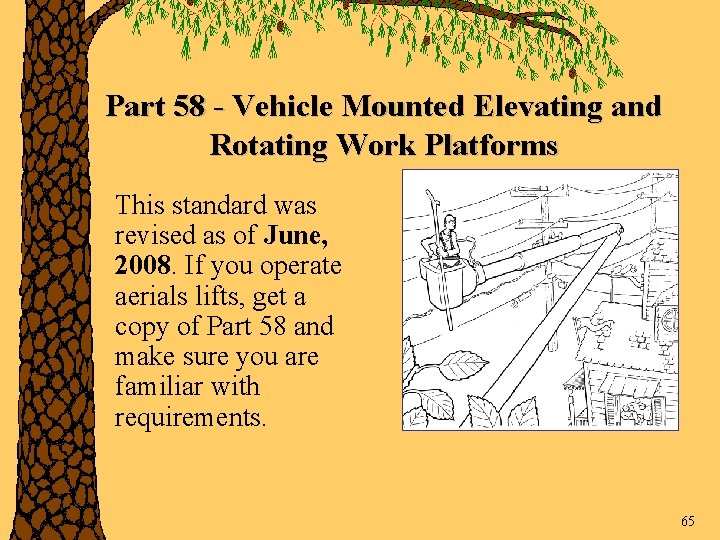
Part 58 - Vehicle Mounted Elevating and Rotating Work Platforms This standard was revised as of June, 2008. If you operate aerials lifts, get a copy of Part 58 and make sure you are familiar with requirements. 65
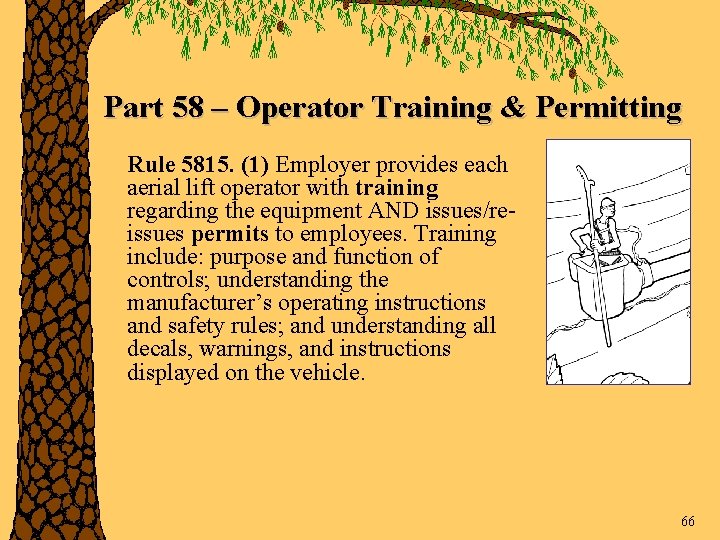
Part 58 – Operator Training & Permitting Rule 5815. (1) Employer provides each aerial lift operator with training regarding the equipment AND issues/reissues permits to employees. Training include: purpose and function of controls; understanding the manufacturer’s operating instructions and safety rules; and understanding all decals, warnings, and instructions displayed on the vehicle. 66
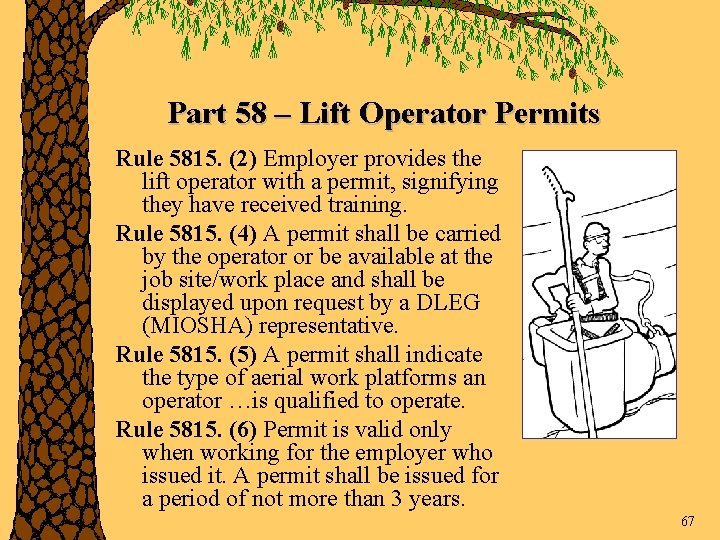
Part 58 – Lift Operator Permits Rule 5815. (2) Employer provides the lift operator with a permit, signifying they have received training. Rule 5815. (4) A permit shall be carried by the operator or be available at the job site/work place and shall be displayed upon request by a DLEG (MIOSHA) representative. Rule 5815. (5) A permit shall indicate the type of aerial work platforms an operator …is qualified to operate. Rule 5815. (6) Permit is valid only when working for the employer who issued it. A permit shall be issued for a period of not more than 3 years. 67
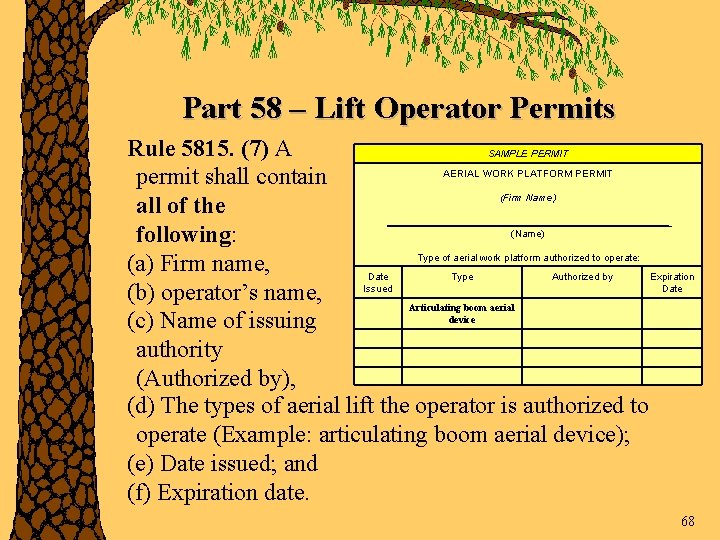
Part 58 – Lift Operator Permits Rule 5815. (7) A SAMPLE PERMIT AERIAL WORK PLATFORM PERMIT permit shall contain (Firm Name) all of the __________________________ (Name) following: Type of aerial work platform authorized to operate: (a) Firm name, Date Type Authorized by Expiration Issued Date (b) operator’s name, Articulating boom aerial device (c) Name of issuing authority (Authorized by), (d) The types of aerial lift the operator is authorized to operate (Example: articulating boom aerial device); (e) Date issued; and (f) Expiration date. 68
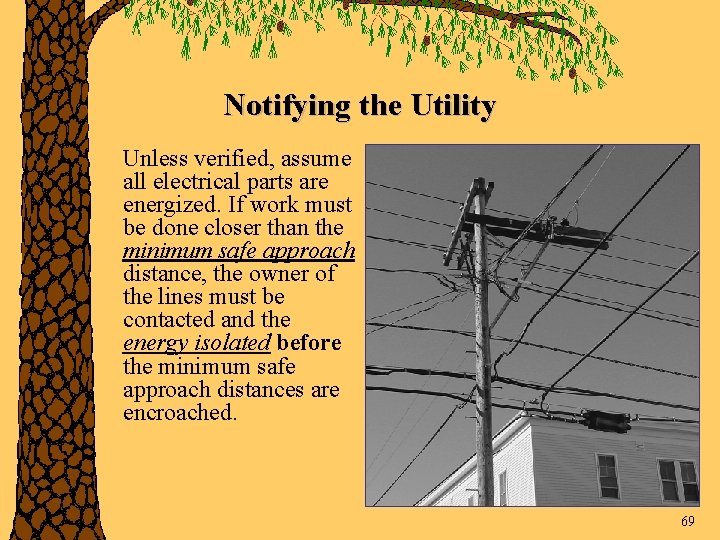
Notifying the Utility Unless verified, assume all electrical parts are energized. If work must be done closer than the minimum safe approach distance, the owner of the lines must be contacted and the energy isolated before the minimum safe approach distances are encroached. 69
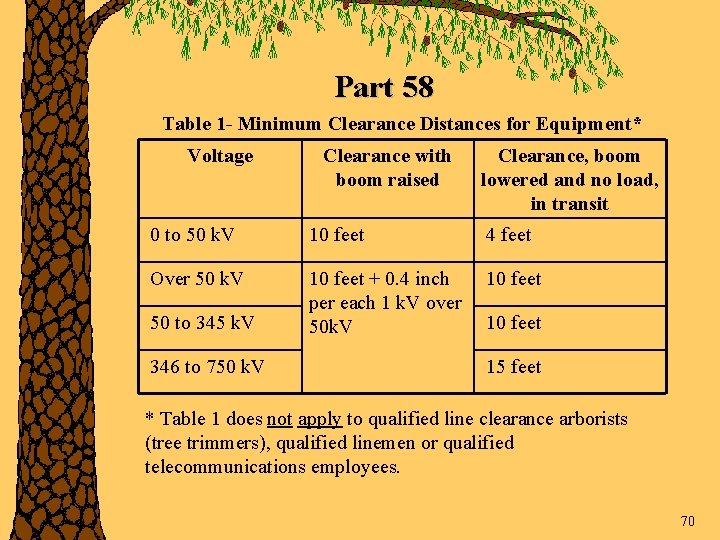
Part 58 Table 1 - Minimum Clearance Distances for Equipment* Voltage Clearance with boom raised Clearance, boom lowered and no load, in transit 0 to 50 k. V 10 feet 4 feet Over 50 k. V 10 feet + 0. 4 inch per each 1 k. V over 50 k. V 10 feet 50 to 345 k. V 346 to 750 k. V 10 feet 15 feet * Table 1 does not apply to qualified line clearance arborists (tree trimmers), qualified linemen or qualified telecommunications employees. 70
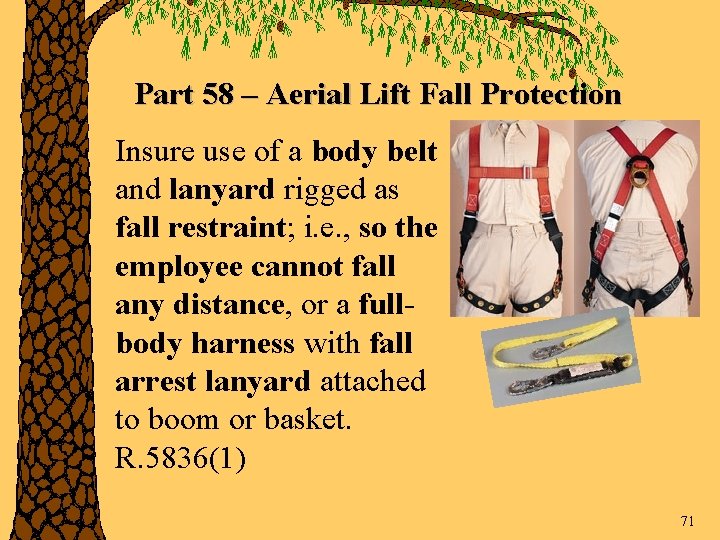
Part 58 – Aerial Lift Fall Protection Insure use of a body belt and lanyard rigged as fall restraint; i. e. , so the employee cannot fall any distance, or a fullbody harness with fall arrest lanyard attached to boom or basket. R. 5836(1) 71
Part 58 – Aerial Lift Inspection & Maint. Rule 5831(1)(a) Each aerial work platform shall be inspected, maintained, repaired, and kept in proper working condition in accordance with the manufacturer’s or owner’s operating/maintenance/repair manual(s). Rule 5831(1)(b) Any aerial work platform found not to be in a safe operating condition shall be removed from service until repaired. All repairs shall be made by an authorized person. Rule 5831(1)(c) If the aerial work platform is rated and used as an insulated aerial device, the electrical insulating components shall be tested for compliance with the rating of the aerial work platform in accordance with ANSI A 92. 2 - 2002. 72
Noise Exposure and Hearing Protection, Part 380 73
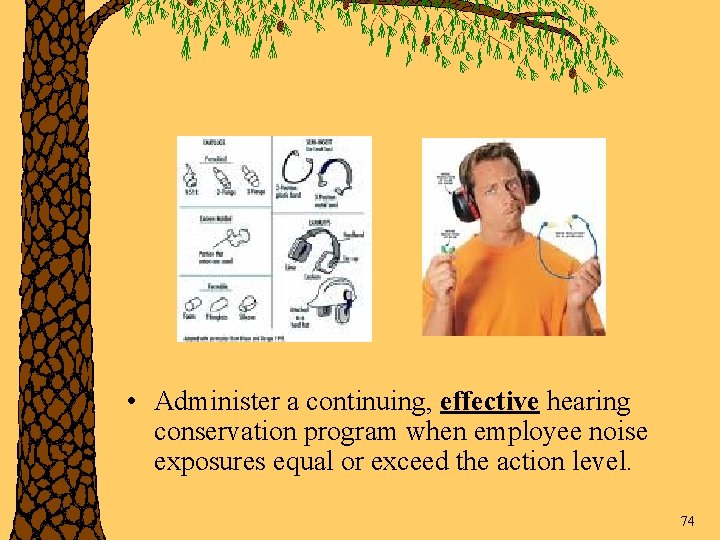
• Administer a continuing, effective hearing conservation program when employee noise exposures equal or exceed the action level. 74
Hearing Conservation Program To be fully compliant, the employer must: • Conduct noise monitoring (dosimeter testing) • Establish and maintain an audiometric (hearing) testing program with baseline and annual testing. • Provide at no cost to employees a selection of hearing protection (i. e. , at least two types) • Provide employee training on: – Effects of noise on hearing; purpose of hearing protection; and instructions on selection, fitting, use and care of hearing protection; purpose of audiometric testing and explanation of test procedures • Post a copy of the standard • Keep records of employee exposure and audiometric tests 75
Hearing Conservation Program q. Most employers do not have the equipment or expertise to conduct noise monitoring (dosimeter testing) on their own. q. In order to assist employers, a MIOSHA CET consultant can perform monitoring; or CET offers a "self-program" where they show the employer how to use the dosimeter and lend them the equipment. 76
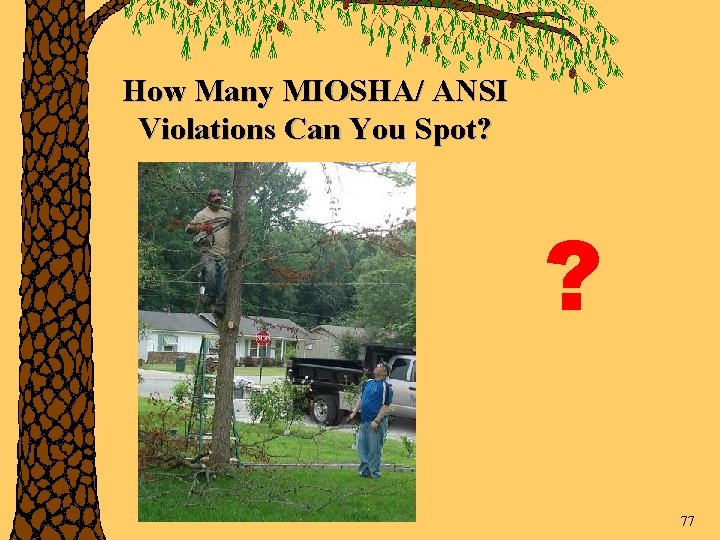
How Many MIOSHA/ ANSI Violations Can You Spot? ? 77
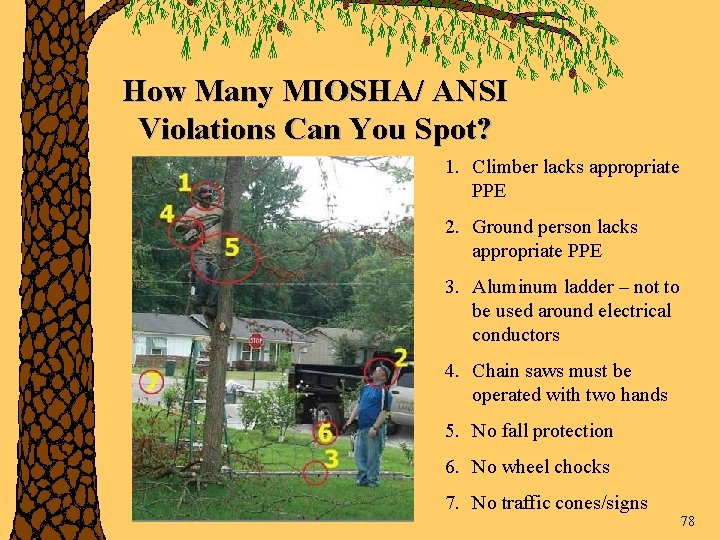
How Many MIOSHA/ ANSI Violations Can You Spot? 1. Climber lacks appropriate PPE 2. Ground person lacks appropriate PPE 3. Aluminum ladder – not to be used around electrical conductors 4. Chain saws must be operated with two hands 5. No fall protection 6. No wheel chocks 7. No traffic cones/signs 78
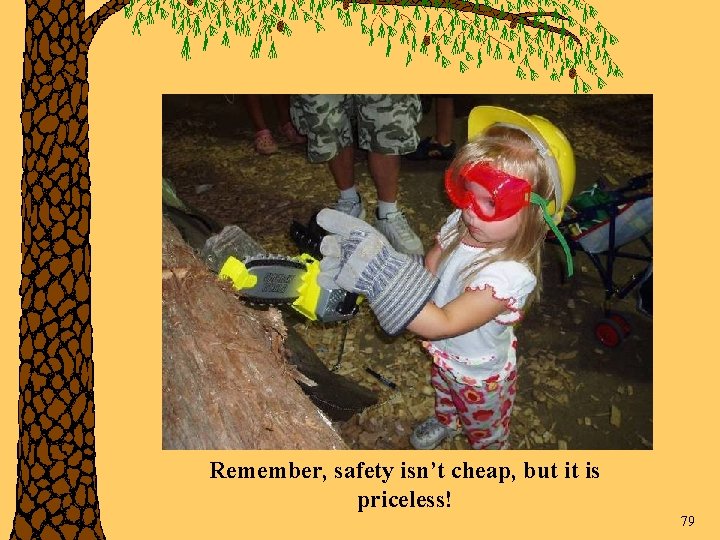
Remember, safety isn’t cheap, but it is priceless! 79

Green Industry Alliance Links Arboriculture Society of Michigan (ASM) www. asm-isa. org Michigan Green Industry Association (MGIA) www. landscape. org Michigan Nursery and Landscape Association (MNLA) www. mnla. org Michigan Turfgrass Foundation (MTF) www. michiganturfgrass. org MIOSHA www. michigan. gov/dleg Tree Care Industry Association (TCIA) www. tcia. org Utility Line Clearance Coalition (ULCC) www. theulcc. com 80
Thank You for Viewing this Presentation! Michigan Occupational Safety & Health Administration Consultation Education & Training Division 7150 Harris Drive, P. O. Box 30643 Lansing, Michigan 48909 -8143 For further information or to request consultation, education and training services, call (517) 322 -1809 www. michigan. gov/lara 81
- Slides: 81