
Arbitrary ReadWrite 111318 Buffer Overflow and Controlflow Hijacking

Arbitrary Read/Write 11/13/18
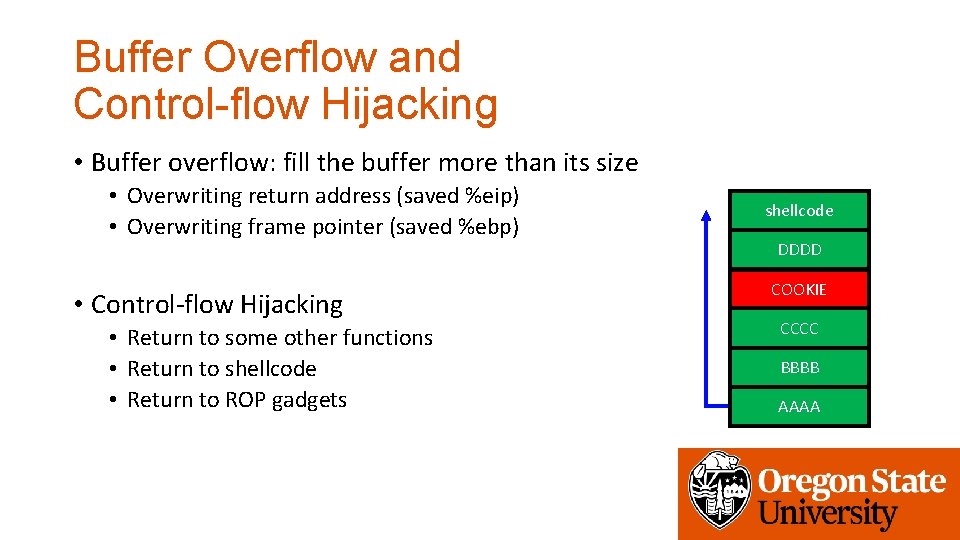
Buffer Overflow and Control-flow Hijacking • Buffer overflow: fill the buffer more than its size • Overwriting return address (saved %eip) • Overwriting frame pointer (saved %ebp) • Control-flow Hijacking • Return to some other functions • Return to shellcode • Return to ROP gadgets shellcode RETURN ADDR DDDD SAVED %ebp COOKIE CCCC BUFFER BBBB BUFFER AAAA BUFFER
Control-flow Hijacking • Return/jump/call to some other functions • Return/jump/call to shellcode • Return/jump/call to ROP gadgets • Attack targets • • Return address Global offset table (GOT) Function pointer Jump table
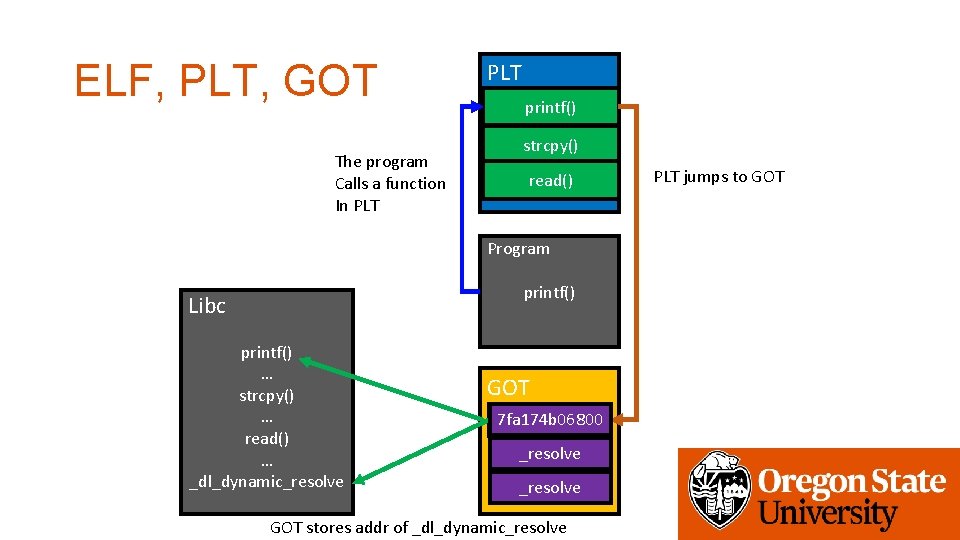
ELF, PLT, GOT The program Calls a function In PLT printf() strcpy() read() Program printf() Libc printf() … strcpy() … read() … _dl_dynamic_resolve GOT 7 fa 174 b 06800 _resolve GOT stores addr of _dl_dynamic_resolve PLT jumps to GOT
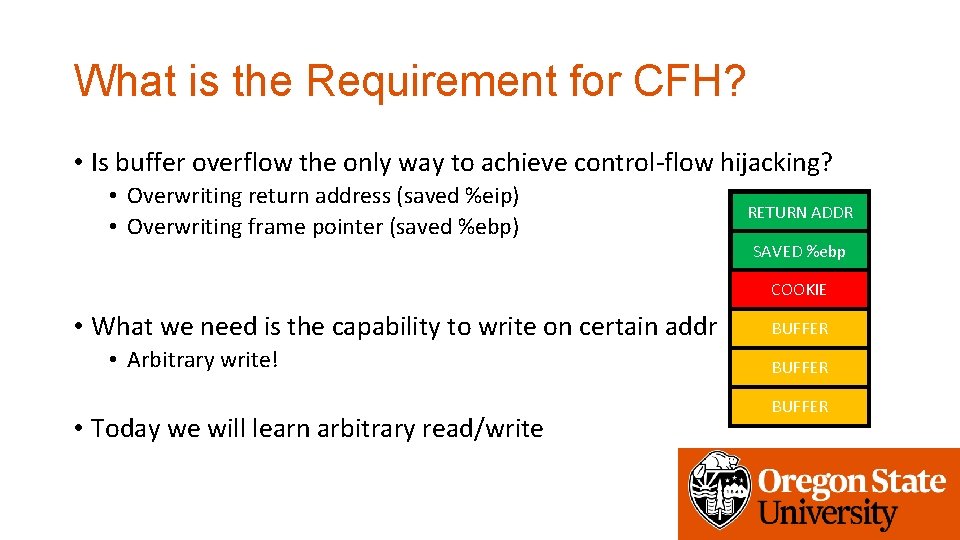
What is the Requirement for CFH? • Is buffer overflow the only way to achieve control-flow hijacking? • Overwriting return address (saved %eip) • Overwriting frame pointer (saved %ebp) RETURN ADDR SAVED %ebp COOKIE • What we need is the capability to write on certain addr • Arbitrary write! • Today we will learn arbitrary read/write BUFFER
Attack Primitives • Arbitrary Read • Read from any address, any number of bytes • The attacker must know the address • Example: • Read 100 bytes from 0 xffffd 100 (somewhere in the stack) • Read 100 bytes from 0 x 8048500 (somewhere in the code section) • Can this break: • Stack-Cookie? • ASLR? • DEP?
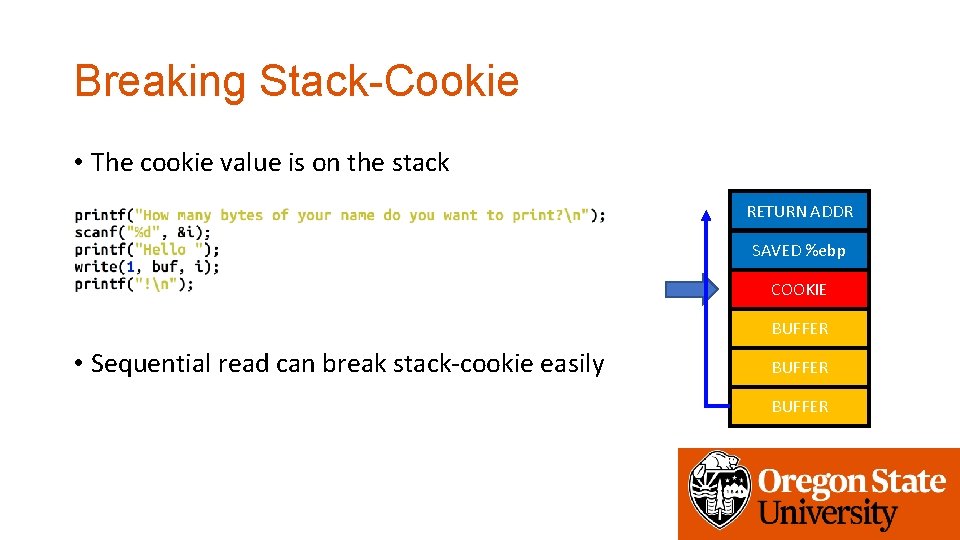
Breaking Stack-Cookie • The cookie value is on the stack RETURN ADDR SAVED %ebp COOKIE BUFFER • Sequential read can break stack-cookie easily BUFFER
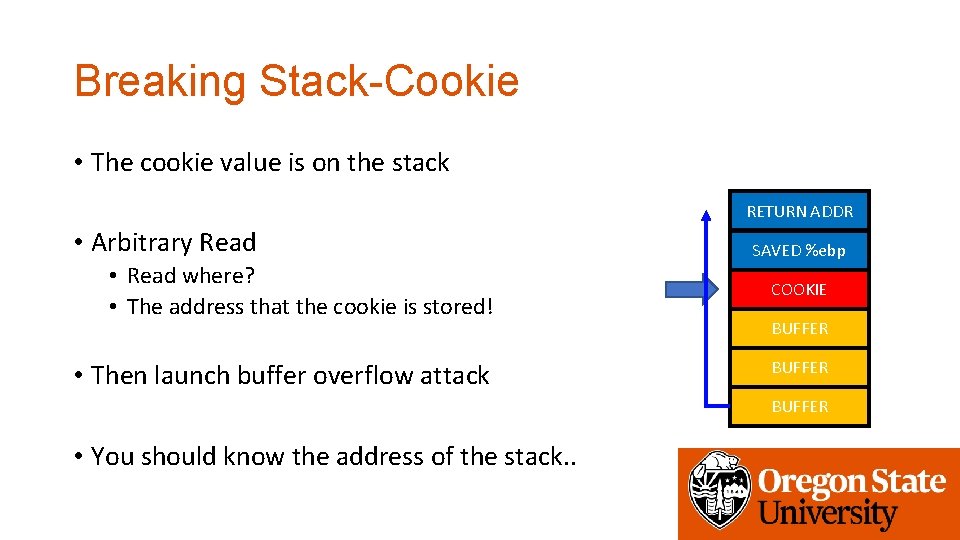
Breaking Stack-Cookie • The cookie value is on the stack RETURN ADDR • Arbitrary Read • Read where? • The address that the cookie is stored! • Then launch buffer overflow attack SAVED %ebp COOKIE BUFFER • You should know the address of the stack. .
Breaking ASLR • Arbitrary Read • Read anywhere if you know the address… • Read where? • Non-PIE: Code section is fixed 0 x 8048000 ~ 0 x 804 a 000 • 0 x 401000 ~ and 0 x 601000 in 64 bit • Stack – random • Library – random • Heap – random • Code section is the only fixed location
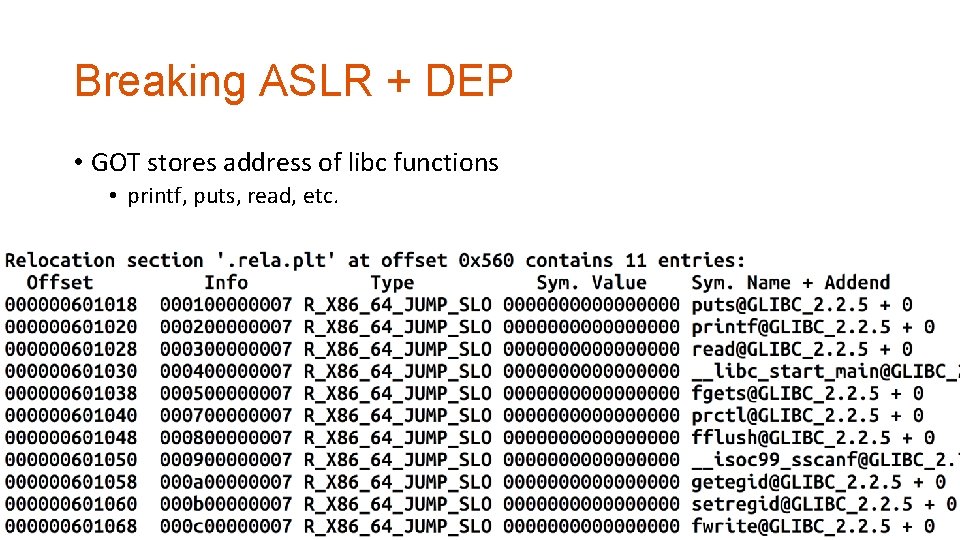
Breaking ASLR + DEP • GOT stores address of libc functions • printf, puts, read, etc.
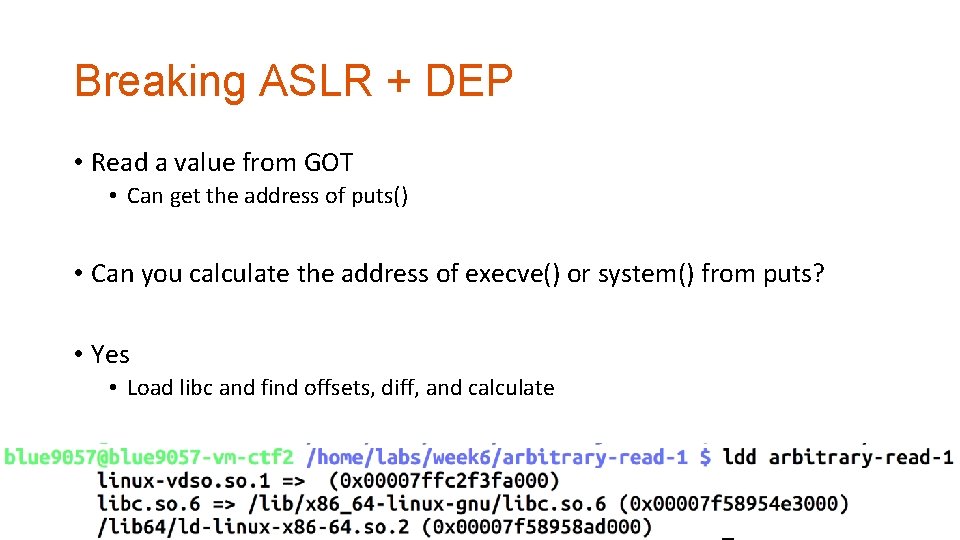
Breaking ASLR + DEP • Read a value from GOT • Can get the address of puts() • Can you calculate the address of execve() or system() from puts? • Yes • Load libc and find offsets, diff, and calculate
Attacking Global Offset Table • Read the address in GOT • Leak the address of puts() • Calculate the address of execve() or system() from the offset
Attack Primitives • Arbitrary Write • Write on any address, any number of bytes • The attacker must know the address • Example: • Write 100 bytes of data to 0 xffffd 100 (somewhere in the stack) • Write 100 bytes of data to 0 x 8048500 (somewhere in the code section) • Can achieve control-flow hijacking • Overwrite return address • Overwrite frame pointer • Overwriting GOT
Attacking Global Offset Table • Read the address in GOT • Leak the address of printf() • Calculate the address of system() from the offset • Write that address system() to printf’s GOT • What will happen a program calls printf?
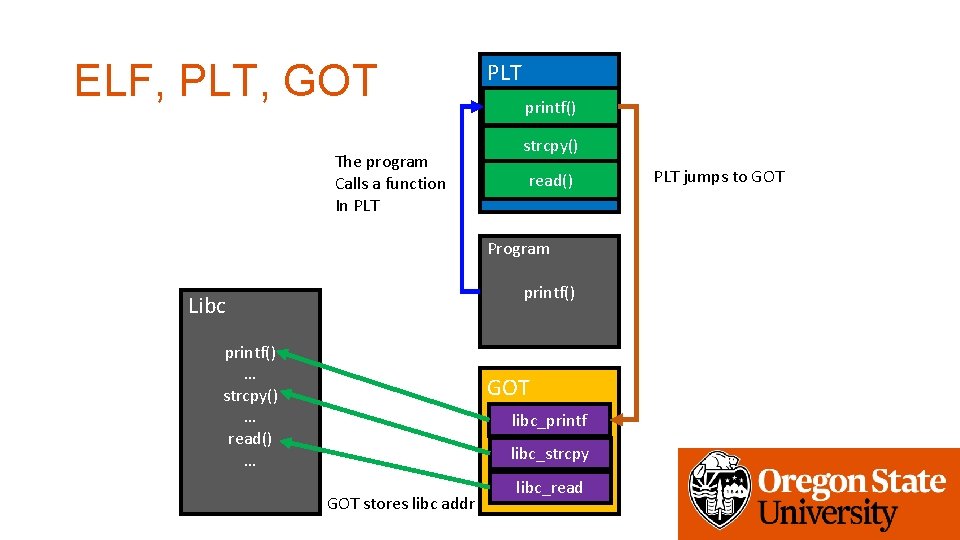
ELF, PLT, GOT The program Calls a function In PLT printf() strcpy() read() Program printf() Libc printf() … strcpy() … read() … GOT libc_printf libc_strcpy GOT stores libc addr libc_read PLT jumps to GOT
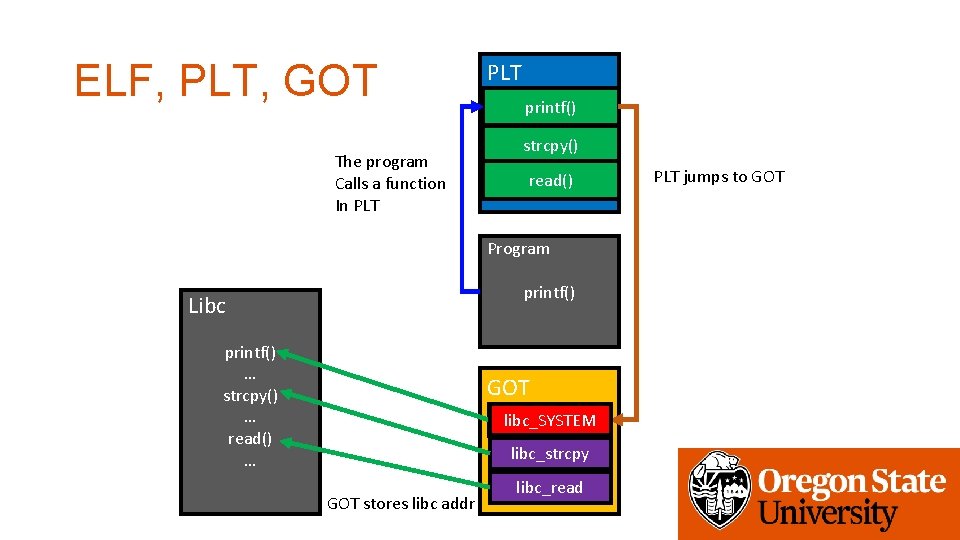
ELF, PLT, GOT The program Calls a function In PLT printf() strcpy() read() Program printf() Libc printf() … strcpy() … read() … GOT libc_SYSTEM libc_printf libc_strcpy GOT stores libc addr libc_read PLT jumps to GOT
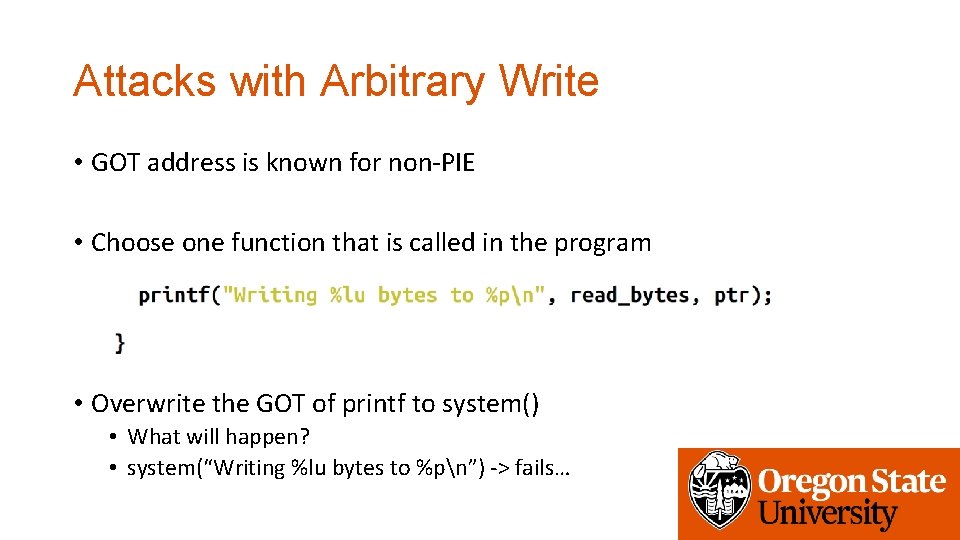
Attacks with Arbitrary Write • GOT address is known for non-PIE • Choose one function that is called in the program • Overwrite the GOT of printf to system() • What will happen? • system(“Writing %lu bytes to %pn”) -> fails…
Arbitrary-Read-1 • Use an arbitrary read vulnerability to leak the address of libc function in GOT • Calculate the address of execve() in libc • Exploit the buffer overflow vulnerability to launch a shell!
Arbitrary-Write-1 • Change the GOT of printf to to ‘please_execute_me()’ via arbitrary write capability! • Printf after the buffer overflow vulnerability will run that function for you.
Arbitrary-Write-2 • Program contains both arbitrary-read and arbitrary-write vulnerability. • Exploit arbitrary read to get the address of libc function • Then calculate the address of system() • Exploit arbitrary write to overwrite the GOT of printf to system() • printf("Writing %lu bytes to %pn”); • system(“Writing %lu bytes to %pn”);
Assignment: Week-5 • Please solve challenges in the /home/labs/week 5 directory • Hosted in vm-ctf 2 • Two more challenges • Rop-leak-got-32 • Rop-leak-got-64 • Similar to arbitrary-read-1 • Due: 11/27 4: 00 pm
Assignment: Week-6 • Please solve challenges in the /home/labs/week 6 directory • Hosted in vm-ctf 2 • Due: 11/29 23: 59 pm
- Slides: 22