
Arabic OPI Testing at DLIFLC A Brief History
Arabic OPI Testing at DLIFLC A Brief History and Current Status Thomas S. Parry, Ph. D. Dean, Proficiency Standards DLIFLC 1
Overview of the OPI at DLIFLC • Carefully conducted face-to-face interview with two trained testers for 20 -40 minutes • Speech sample rated against the ILR descriptions • Test will show what the examinee can and cannot do with the language Proficiency Standards Division DLIFLC 2
OPI Test Structure • Phase 1: Warm-up • Phase 2: Core of the test characterized by iterative. . – Level checks (to show what the examinee can do) – Probes (to show what the examinee cannot do) • Phase 3: Wind-down Proficiency Standards Division DLIFLC 3

The DLIFLC Examinee Population • Second language learners who learn Arabic at DLIFLC or elsewhere • Heritage speakers of Arabic (09 L Program) • Native speakers of Arabic (FPS) Proficiency Standards Division DLIFLC 4
Uses of the OPI at DLIFLC • Hiring or personnel placement • Selecting individuals for assignments • Placing individuals for continued language instruction • Determining eligibility for proficiency pay Proficiency Standards Division DLIFLC 5
Rating Factors for the OPI • Structural control • Lexical control • Delivery – Pronunciation and Fluency • Socio-cultural appropriateness • Discourse type produced Proficiency Standards Division DLIFLC 6

Testing Arabic at DLIFLC • From the inception of OPI testing at DLIFLC in 1981, testing has only been in MSA • MSA testing is still done as it has been for more than 30 years • Shifting mission requirements after 9 -11: The new model for testing Arabic with a focus on dialect assessment • In the last two years, the movement has been to increase Arabic testing in dialect Proficiency Standards Division DLIFLC 7
Factors Driving Assessment in Dialects • Assuring mission readiness for deploying military members to specific geographic areas • Increasing need for skilled listeners to work voice intercept targets in dialect • Implementation of new foreign language pay incentives Proficiency Standards Division DLIFLC 8
Issues and Challenges Associated with Testing Dialects • What type of Arabic test to administer? – Learners: dialect only up through level 2 – Heritage: dialect and MSA beginning at level 2+ – Native: dialect and MSA • DLIFLC testers focused on dialect must know how to conduct a full-continuum test • The socio-cultural context as a rating factor is extremely important in conducting and rating lower-level tests Proficiency Standards Division DLIFLC 9
Issues and Challenges Associated with Testing Dialects • When testing full-continuum Arabic for higher-level (above level 2) in which any dialect is acceptable: – How does one determine structural and lexical accuracy? – To what degree will education and experience level of the tester(s) influence rating accuracy? • For dialect-only tests (below level 2+) it may be necessary to construct rating factor grids for each dialect to assure tester norming Proficiency Standards Division DLIFLC 10
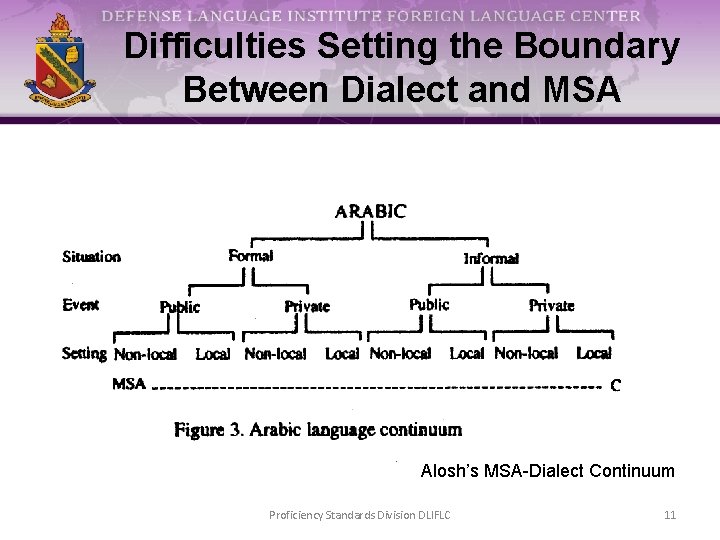
Difficulties Setting the Boundary Between Dialect and MSA Alosh’s MSA-Dialect Continuum Proficiency Standards Division DLIFLC 11
Examinee OPI Options Currently in 2012 • MSA • Levantine dialect • Iraqi dialect Coming in 2013 • Egyptian dialect • Moroccan dialect • Sudanese dialect Proficiency Standards Division DLIFLC 12
Testing Options for Dialect Assessment at DLIFLC • Test MSA only – Not practical since most DLIFLC examinees are second language learners who achieve up to level 2 proficiency • Test dialect only – Practical for second language students graduating from second language programs of study • Test continuum (dialect with MSA) – Necessary when testing heritage and native speakers to get the most accurate indication of proficiency Proficiency Standards Division DLIFLC 13
Questions/Discussion Proficiency Standards Division DLIFLC 14
- Slides: 14