
Arab Republic of Egypt Ministry of Electricity Energy
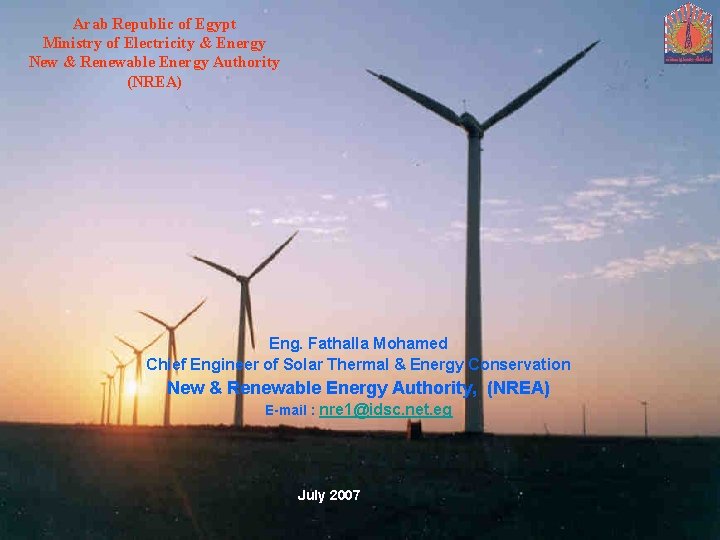
Arab Republic of Egypt Ministry of Electricity & Energy New & Renewable Energy Authority (NREA) Eng. Fathalla Mohamed Chief Engineer of Solar Thermal & Energy Conservation New & Renewable Energy Authority, (NREA) E-mail : nre 1@idsc. net. eg July 2007
Primary Energy Resources • The electricity sector policies depend on 3 main Pillars: Ø Diversifying electric energy resources. Ø Improving Energy efficiency and maximizing energy conservation measures. Ø Enhancing the role of renewable energy (RE) in the electric energy mix. Consequently, RE Strategy was formulated in 1980 s as an integral element of national energy planning in Egypt
New & Renewable Energy Authority ØIn 1986, the New & Renewable Energy Authority (NREA) was established to: ü Provide the institutional framework of implementing R. E. strategy. üAct as the national focal point to introduce and promote R. E. technologies to Egypt on a commercial scale.
Mandate of NREA Ø RE resources assessment and planning for utilization. Ø Research, development, demonstration, testing and evaluation of the different technologies. Ø Application of matured technologies & implementation of RE main activities (wind and solar energies, testing & certification). Ø Conducting tests to evaluate performance, issuing licensing certificates. Ø Rendering of consultancy services in the field of RE. Ø Training, information dissemination and capacity building. Ø Transfer of technology, development of local industry. Presently, the strategy targets to satisfy 3% of the electric energy demand from renewables, mainly solar & wind, by 2010.
NREA’s Activities Ø The activities are concentrated into : – Wind Energy. – Solar Energy. – Capacity Building.
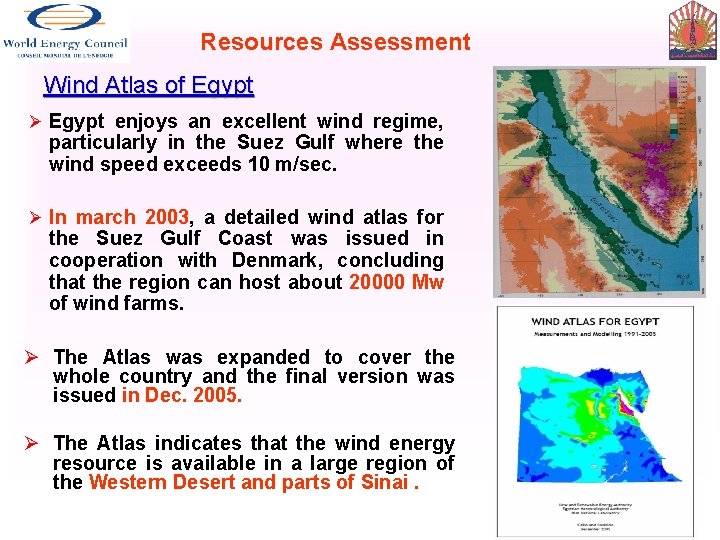
Resources Assessment Wind Atlas of Egypt Ø Egypt enjoys an excellent wind regime, particularly in the Suez Gulf where the wind speed exceeds 10 m/sec. Ø In march 2003, a detailed wind atlas for the Suez Gulf Coast was issued in cooperation with Denmark, concluding that the region can host about 20000 Mw of wind farms. Ø The Atlas was expanded to cover the whole country and the final version was issued in Dec. 2005. Ø The Atlas indicates that the wind energy resource is available in a large region of the Western Desert and parts of Sinai.
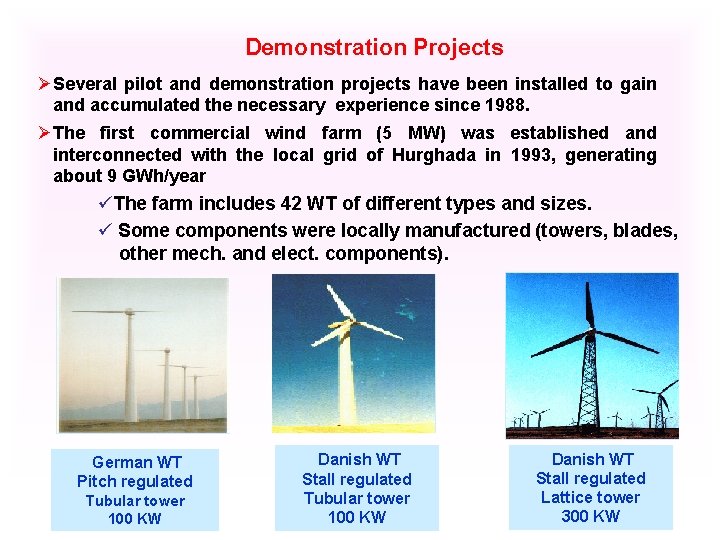
Demonstration Projects ØSeveral pilot and demonstration projects have been installed to gain and accumulated the necessary experience since 1988. ØThe first commercial wind farm (5 MW) was established and interconnected with the local grid of Hurghada in 1993, generating about 9 GWh/year üThe farm includes 42 WT of different types and sizes. ü Some components were locally manufactured (towers, blades, other mech. and elect. components). German WT Pitch regulated Tubular tower 100 KW Danish WT Stall regulated Lattice tower 300 KW
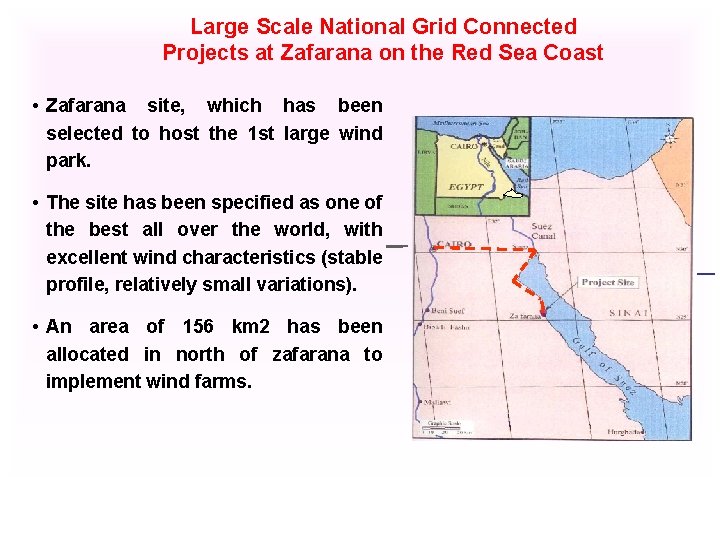
Large Scale National Grid Connected Projects at Zafarana on the Red Sea Coast • Zafarana site, which has been selected to host the 1 st large wind park. • The site has been specified as one of the best all over the world, with excellent wind characteristics (stable profile, relatively small variations). • An area of 156 km 2 has been allocated in north of zafarana to implement wind farms.
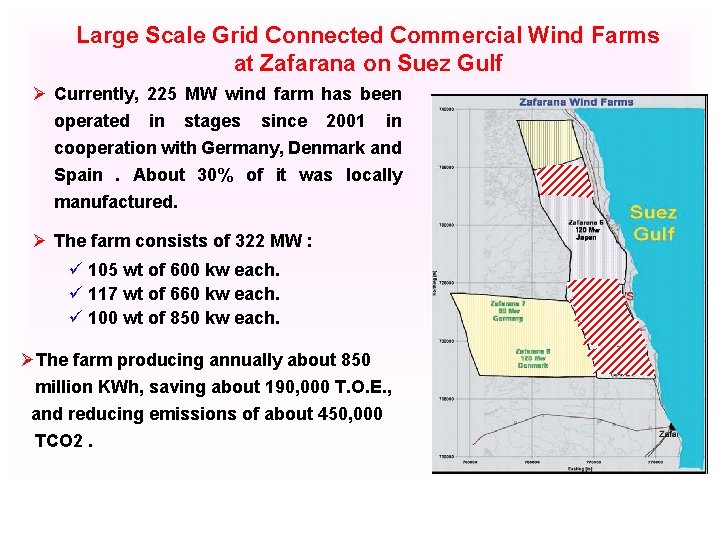
Large Scale Grid Connected Commercial Wind Farms at Zafarana on Suez Gulf Ø Currently, 225 MW wind farm has been operated in stages since 2001 in cooperation with Germany, Denmark and Spain. About 30% of it was locally manufactured. Ø The farm consists of 322 MW : ü 105 wt of 600 kw each. ü 117 wt of 660 kw each. ü 100 wt of 850 kw each. ØThe farm producing annually about 850 million KWh, saving about 190, 000 T. O. E. , and reducing emissions of about 450, 000 TCO 2.
On Going Projects A- At Zafarana on Suez Gulf Ø 80 MW in cooperation with German government, in addition to a role for the private sector in the O&M out of contract of 5 years. The contract was signed in July 2006 and it is expected to operate the project by end of 2007. Ø 120 MW in cooperation with the Japanese Government. The contract was signed in Feb. 2007. Ø 120 MW in cooperation with Danish Government. The contract was signed in Feb. 2007.
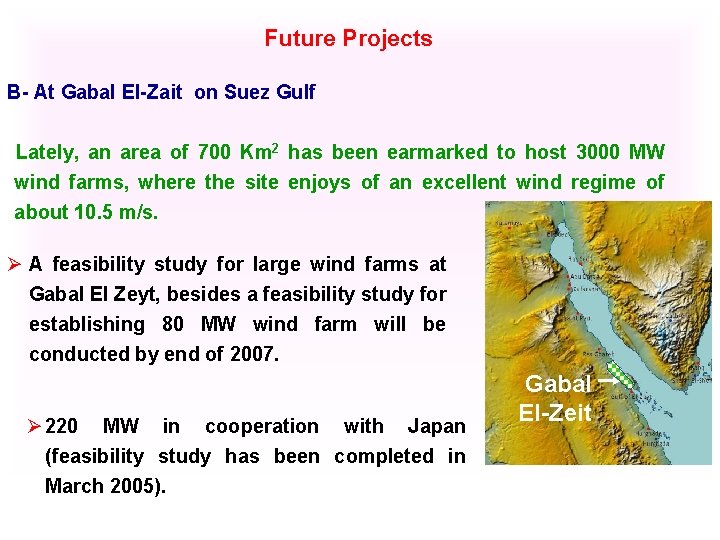
Future Projects B- At Gabal El-Zait on Suez Gulf Lately, an area of 700 Km 2 has been earmarked to host 3000 MW wind farms, where the site enjoys of an excellent wind regime of about 10. 5 m/s. Ø A feasibility study for large wind farms at Gabal El Zeyt, besides a feasibility study for establishing 80 MW wind farm will be conducted by end of 2007. Ø 220 MW in cooperation with Japan (feasibility study has been completed in March 2005). Gabal El-Zeit
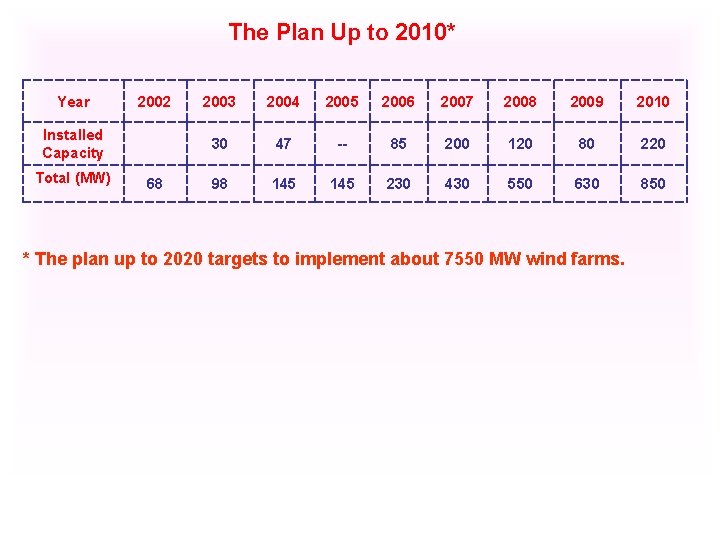
The Plan Up to 2010* Year 2002 Installed Capacity Total (MW) 68 2003 2004 2005 2006 2007 2008 2009 2010 30 47 -- 85 200 120 80 220 98 145 230 430 550 630 850 * The plan up to 2020 targets to implement about 7550 MW wind farms.
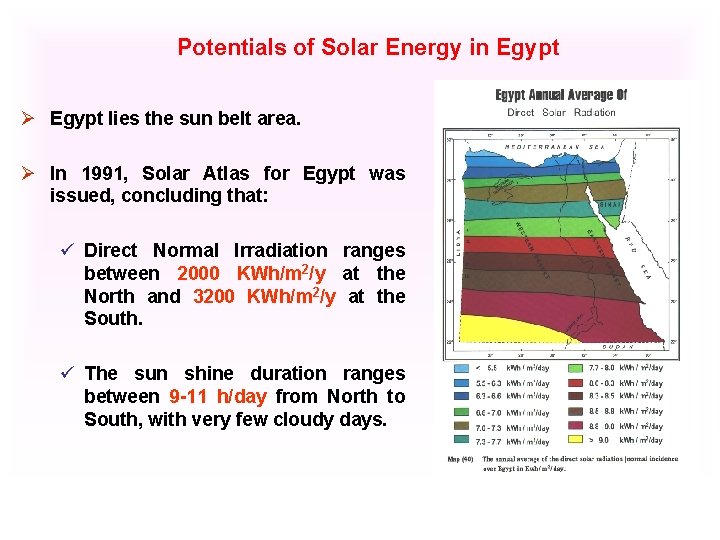
Potentials of Solar Energy in Egypt Ø Egypt lies the sun belt area. Ø In 1991, Solar Atlas for Egypt was issued, concluding that: ü Direct Normal Irradiation ranges between 2000 KWh/m 2/y at the North and 3200 KWh/m 2/y at the South. ü The sun shine duration ranges between 9 -11 h/day from North to South, with very few cloudy days.
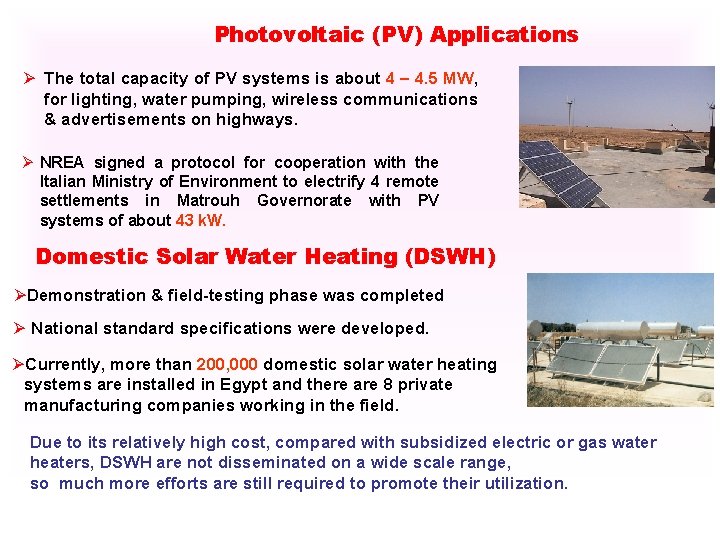
Photovoltaic (PV) Applications Ø The total capacity of PV systems is about 4 – 4. 5 MW, for lighting, water pumping, wireless communications & advertisements on highways. Ø NREA signed a protocol for cooperation with the Italian Ministry of Environment to electrify 4 remote settlements in Matrouh Governorate with PV systems of about 43 k. W. Domestic Solar Water Heating (DSWH) ØDemonstration & field-testing phase was completed Ø National standard specifications were developed. ØCurrently, more than 200, 000 domestic solar water heating systems are installed in Egypt and there are 8 private manufacturing companies working in the field. Due to its relatively high cost, compared with subsidized electric or gas water heaters, DSWH are not disseminated on a wide scale range, so much more efforts are still required to promote their utilization.
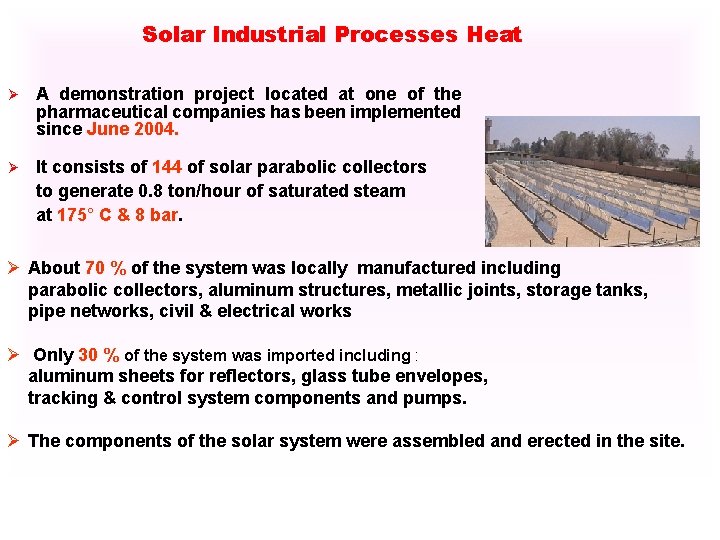
Solar Industrial Processes Heat Ø A demonstration project located at one of the pharmaceutical companies has been implemented since June 2004. Ø It consists of 144 of solar parabolic collectors to generate 0. 8 ton/hour of saturated steam at 175° C & 8 bar. Ø About 70 % of the system was locally manufactured including parabolic collectors, aluminum structures, metallic joints, storage tanks, pipe networks, civil & electrical works Ø Only 30 % of the system was imported including : aluminum sheets for reflectors, glass tube envelopes, tracking & control system components and pumps. Ø The components of the solar system were assembled and erected in the site.
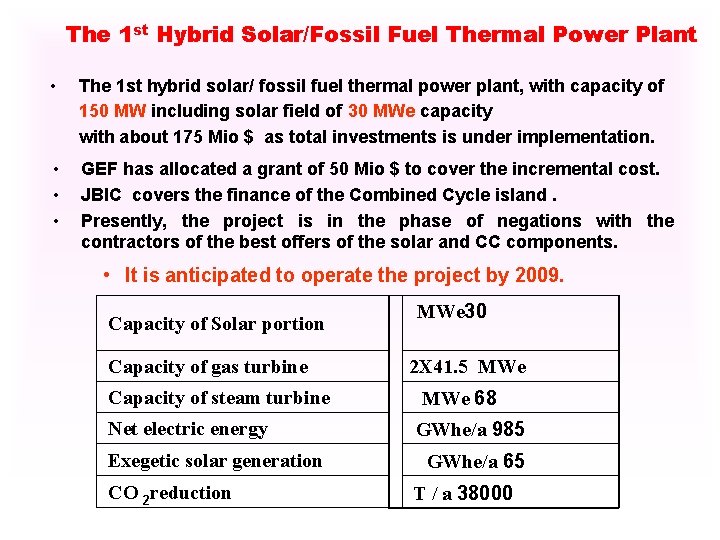
The 1 st Hybrid Solar/Fossil Fuel Thermal Power Plant • The 1 st hybrid solar/ fossil fuel thermal power plant, with capacity of 150 MW including solar field of 30 MWe capacity with about 175 Mio $ as total investments is under implementation. • • • GEF has allocated a grant of 50 Mio $ to cover the incremental cost. JBIC covers the finance of the Combined Cycle island. Presently, the project is in the phase of negations with the contractors of the best offers of the solar and CC components. • It is anticipated to operate the project by 2009. Capacity of Solar portion MWe 30 Capacity of gas turbine 2 X 41. 5 MWe Capacity of steam turbine MWe 68 Net electric energy GWhe/a 985 Exegetic solar generation GWhe/a 65 CO 2 reduction T / a 38000
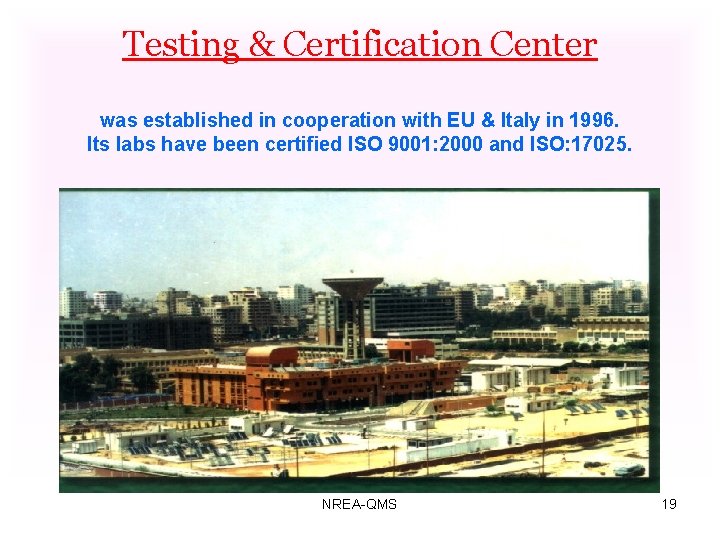
Testing & Certification Center was established in cooperation with EU & Italy in 1996. Its labs have been certified ISO 9001: 2000 and ISO: 17025. NREA-QMS 19
Specialized Laboratories • • Solar Thermal Testing Laboratory Photovoltaic Laboratory Biomass Laboratory Energy Conservation Laboratories NREA-QMS 20
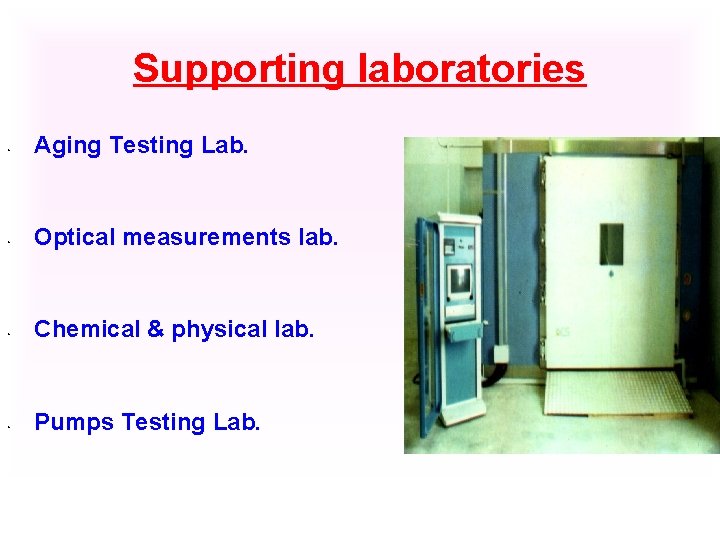
Supporting laboratories • Aging Testing Lab. • Optical measurements lab. • Chemical & physical lab. • Pumps Testing Lab.
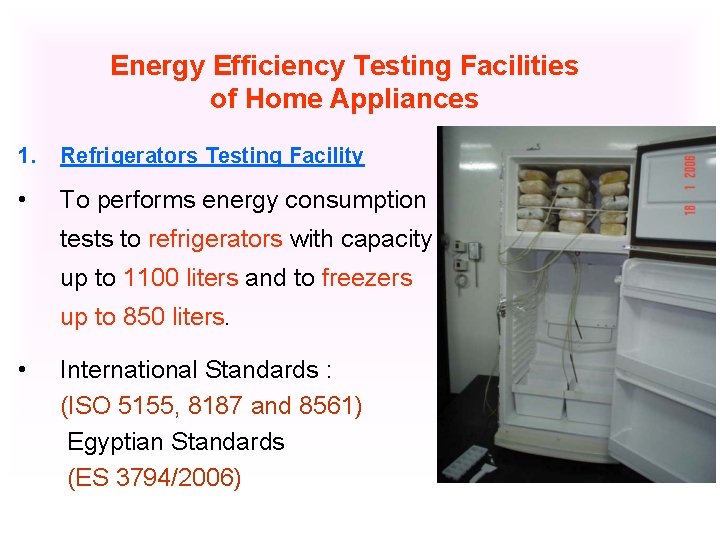
Energy Efficiency Testing Facilities of Home Appliances 1. Refrigerators Testing Facility • To performs energy consumption tests to refrigerators with capacity up to 1100 liters and to freezers up to 850 liters. • International Standards : (ISO 5155, 8187 and 8561) Egyptian Standards (ES 3794/2006)
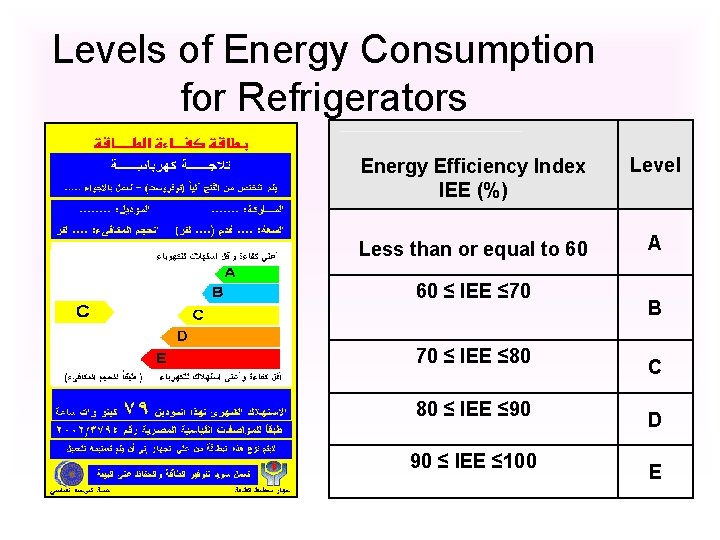
Levels of Energy Consumption for Refrigerators Energy Efficiency Index IEE (%) Level Less than or equal to 60 A 60 ≤ IEE ≤ 70 70 ≤ IEE ≤ 80 80 ≤ IEE ≤ 90 90 ≤ IEE ≤ 100 B C D E
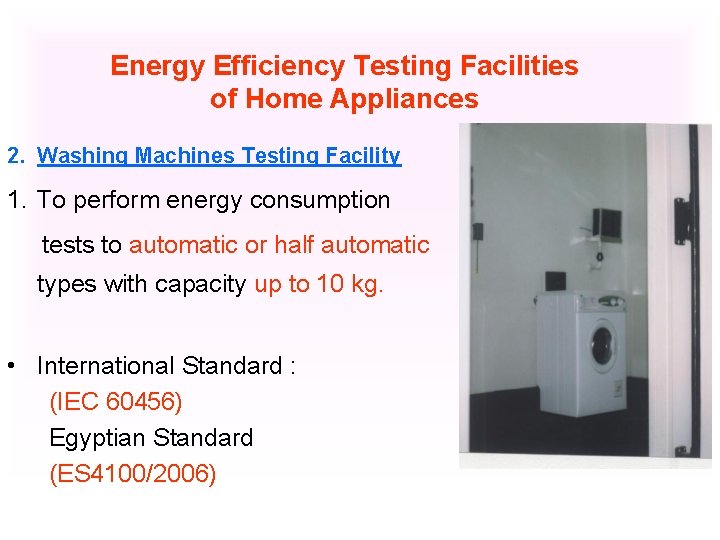
Energy Efficiency Testing Facilities of Home Appliances 2. Washing Machines Testing Facility 1. To perform energy consumption tests to automatic or half automatic types with capacity up to 10 kg. • International Standard : (IEC 60456) Egyptian Standard (ES 4100/2006)
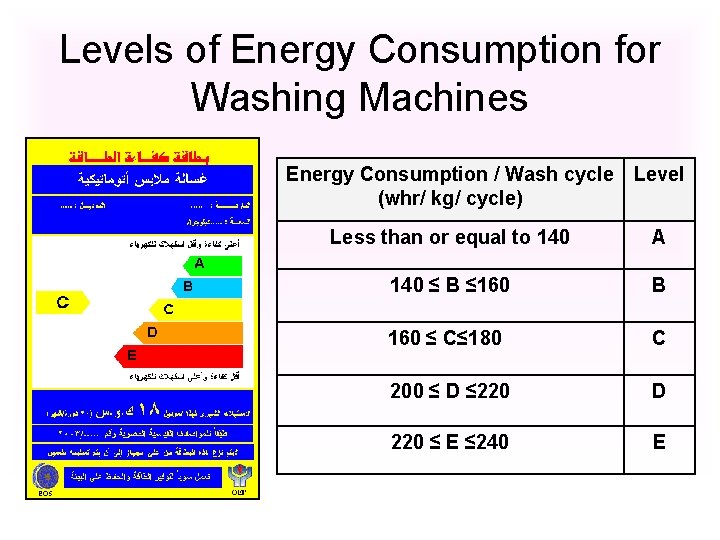
Levels of Energy Consumption for Washing Machines Energy Consumption / Wash cycle Level (whr/ kg/ cycle) Less than or equal to 140 A 140 ≤ B ≤ 160 B 160 ≤ C≤ 180 C 200 ≤ D ≤ 220 D 220 ≤ E ≤ 240 E
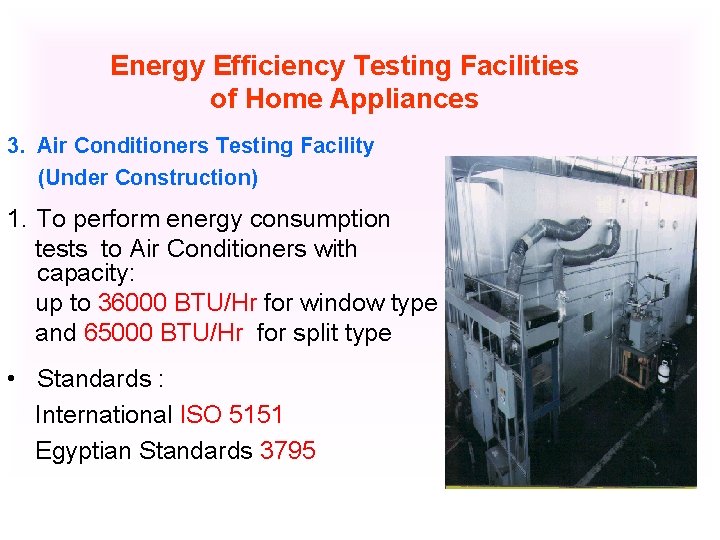
Energy Efficiency Testing Facilities of Home Appliances 3. Air Conditioners Testing Facility (Under Construction) 1. To perform energy consumption tests to Air Conditioners with capacity: up to 36000 BTU/Hr for window type and 65000 BTU/Hr for split type • Standards : International ISO 5151 Egyptian Standards 3795
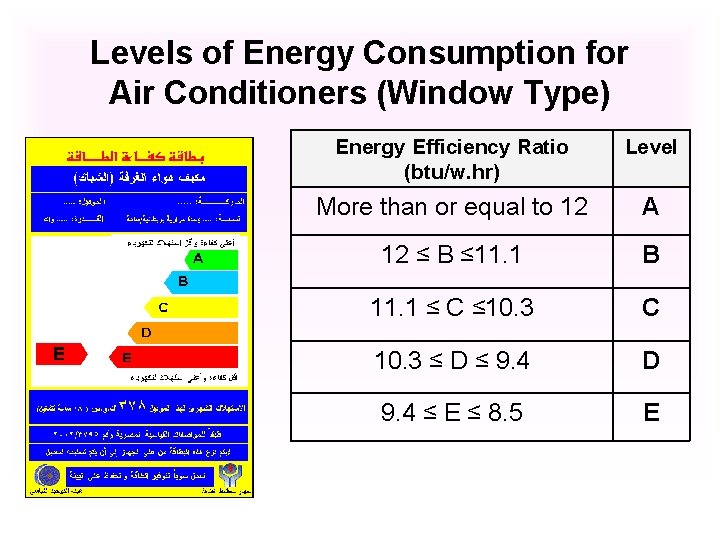
Levels of Energy Consumption for Air Conditioners (Window Type) Energy Efficiency Ratio (btu/w. hr) Level More than or equal to 12 A 12 ≤ B ≤ 11. 1 B 11. 1 ≤ C ≤ 10. 3 C 10. 3 ≤ D ≤ 9. 4 D 9. 4 ≤ E ≤ 8. 5 E
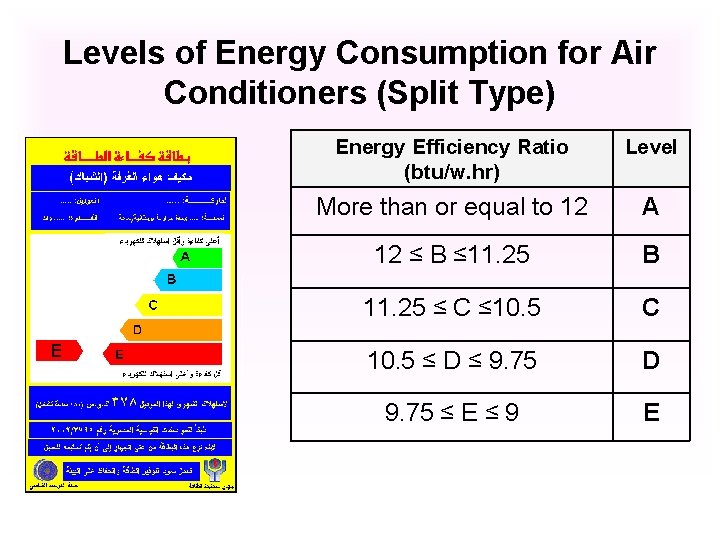
Levels of Energy Consumption for Air Conditioners (Split Type) Energy Efficiency Ratio (btu/w. hr) Level More than or equal to 12 A 12 ≤ B ≤ 11. 25 B 11. 25 ≤ C ≤ 10. 5 C 10. 5 ≤ D ≤ 9. 75 D 9. 75 ≤ E ≤ 9 E
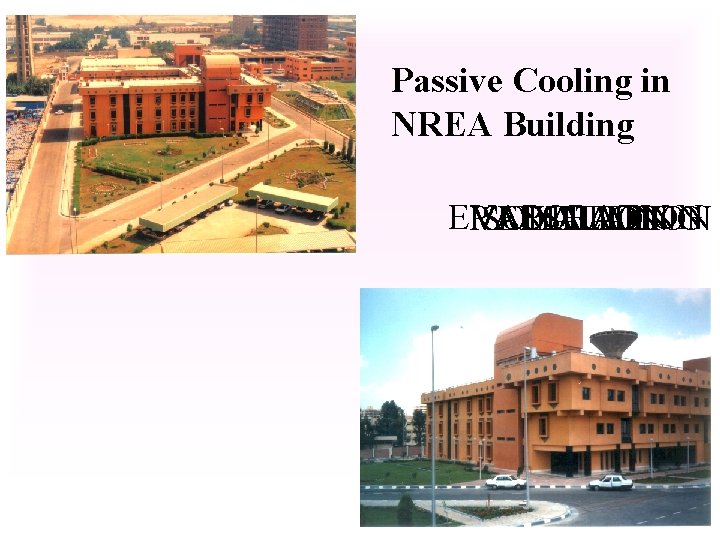
Passive Cooling in NREA Building EVAPORATION ISOLATION RADIATION VENTILATION SHADING
Due to : Ø The Existing Testing & Certification Center. Ø The skillful human resources associated and developed over the last 20 years. Ø The available equipment in the research facilities affiliated to the electricity and energy sector. Ø The remarkable accumulated expertise in the field. Ø The experience in the RE projects development, evaluation, implementation and O&M.
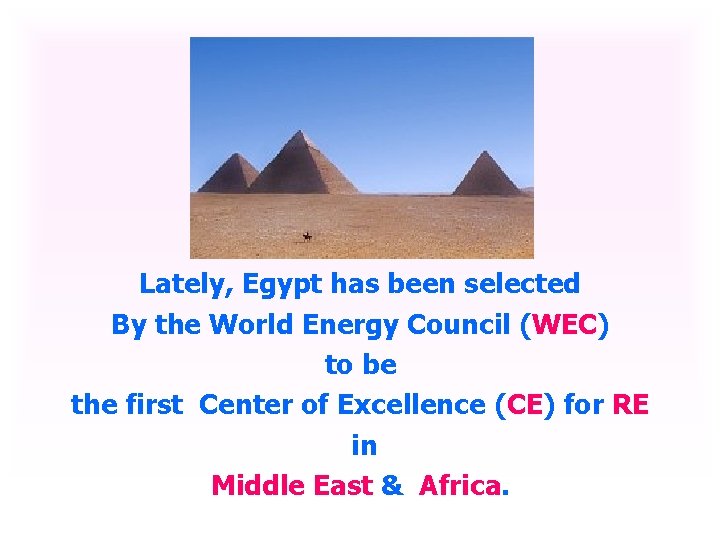
Lately, Egypt has been selected By the World Energy Council (WEC) to be the first Center of Excellence (CE) for RE in Middle East & Africa.
NREA Web Site : www. nrea. gov. eg Email : nre 1@idsc. net. eg THANK YOU FOR LISTENING
- Slides: 32