
Aquatic Invasive Species and Ballast Water Management Nicole
Aquatic Invasive Species and Ballast Water Management Nicole A. Dobroski Marine Invasive Species Program California State Lands Commission
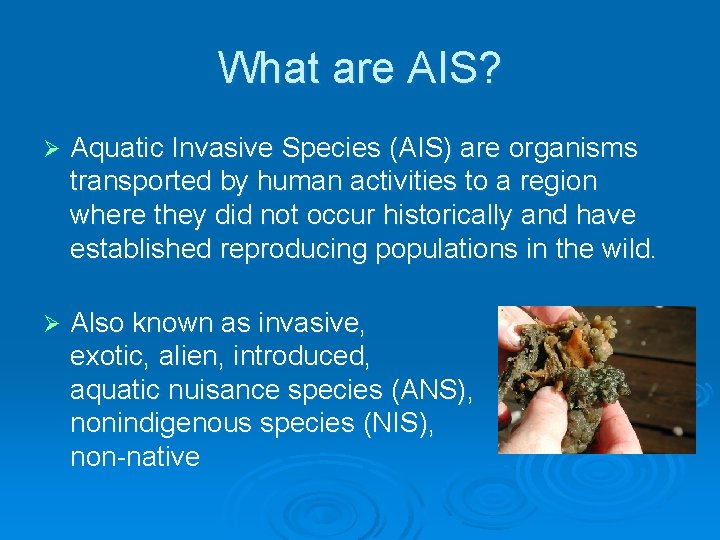
What are AIS? Ø Aquatic Invasive Species (AIS) are organisms transported by human activities to a region where they did not occur historically and have established reproducing populations in the wild. Ø Also known as invasive, exotic, alien, introduced, aquatic nuisance species (ANS), nonindigenous species (NIS), non-native
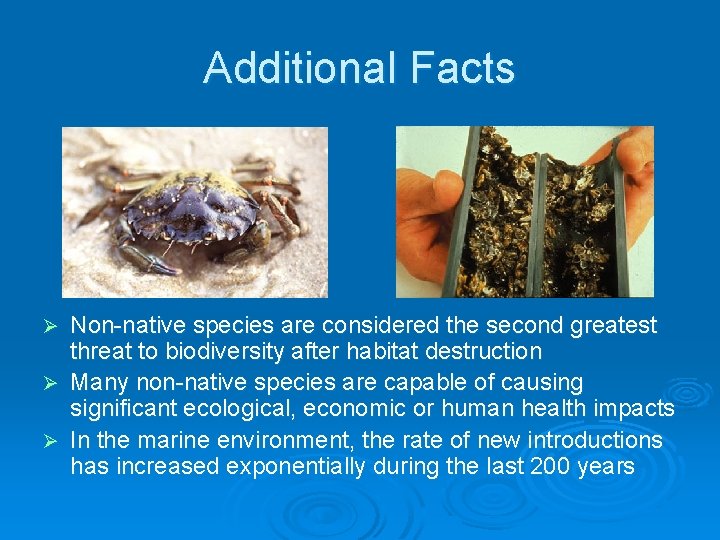
Additional Facts Non-native species are considered the second greatest threat to biodiversity after habitat destruction Ø Many non-native species are capable of causing significant ecological, economic or human health impacts Ø In the marine environment, the rate of new introductions has increased exponentially during the last 200 years Ø
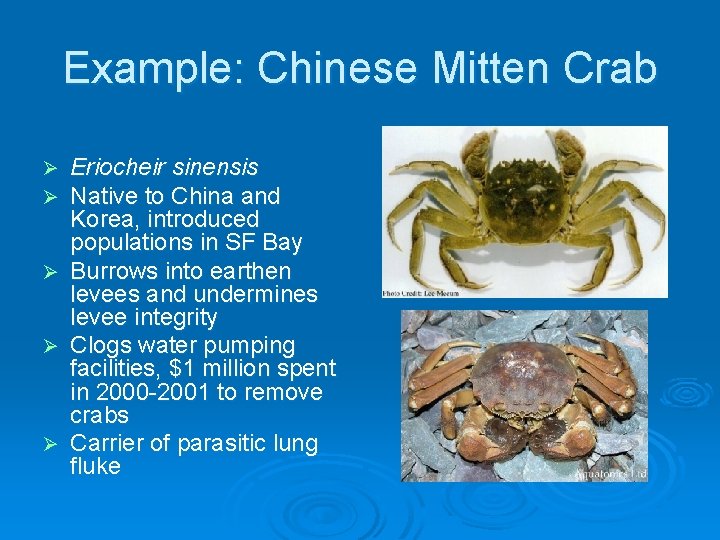
Example: Chinese Mitten Crab Ø Ø Ø Eriocheir sinensis Native to China and Korea, introduced populations in SF Bay Burrows into earthen levees and undermines levee integrity Clogs water pumping facilities, $1 million spent in 2000 -2001 to remove crabs Carrier of parasitic lung fluke

Example: Overbite Clam Ø Ø Ø Corbula amurensis Detected in SF Bay in 1986 Native to Asia Very high feeding/filtration rate Decline in copepod species associated with spread of clam, may be associated with decline of Delta smelt
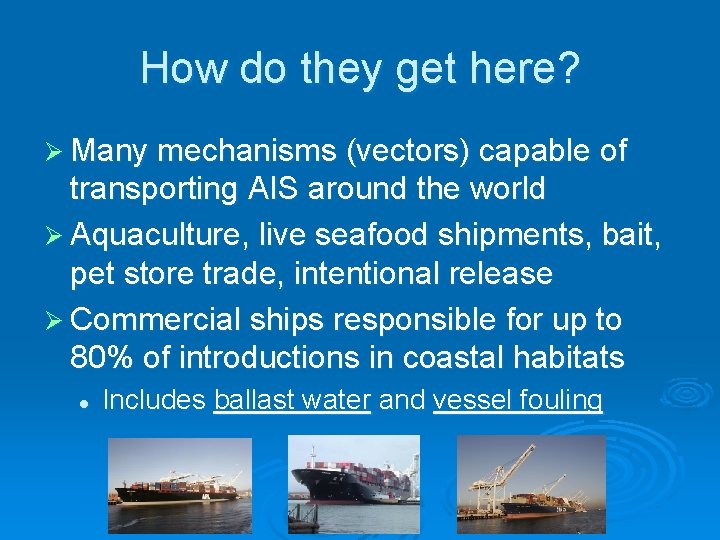
How do they get here? Ø Many mechanisms (vectors) capable of transporting AIS around the world Ø Aquaculture, live seafood shipments, bait, pet store trade, intentional release Ø Commercial ships responsible for up to 80% of introductions in coastal habitats l Includes ballast water and vessel fouling
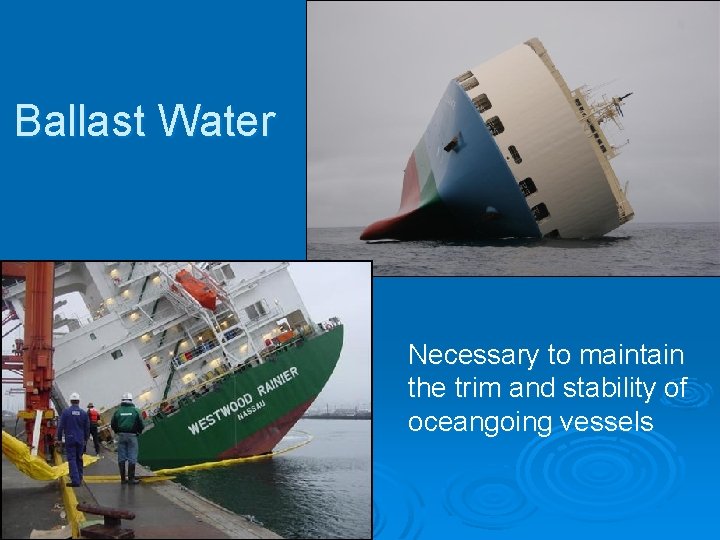
Ballast Water Necessary to maintain the trim and stability of oceangoing vessels
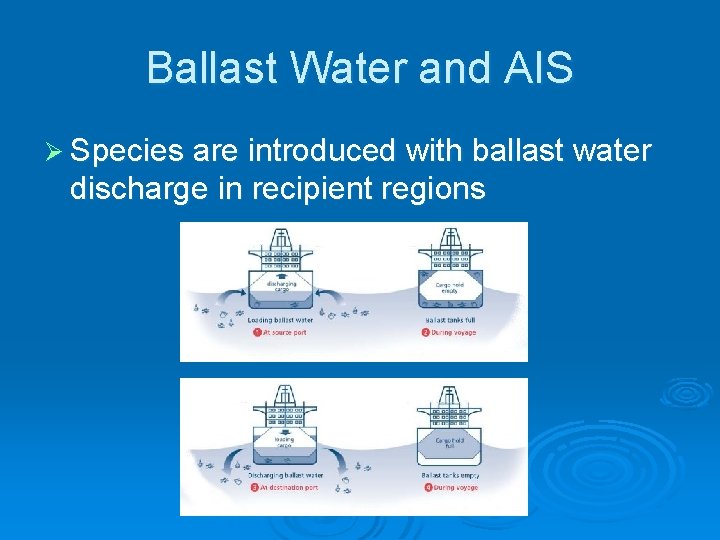
Ballast Water and AIS Ø Species are introduced with ballast water discharge in recipient regions
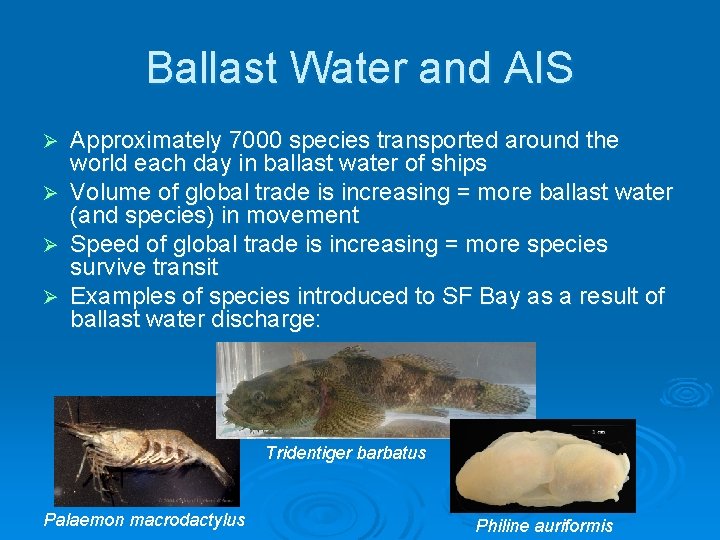
Ballast Water and AIS Ø Ø Approximately 7000 species transported around the world each day in ballast water of ships Volume of global trade is increasing = more ballast water (and species) in movement Speed of global trade is increasing = more species survive transit Examples of species introduced to SF Bay as a result of ballast water discharge: Tridentiger barbatus Palaemon macrodactylus Philine auriformis
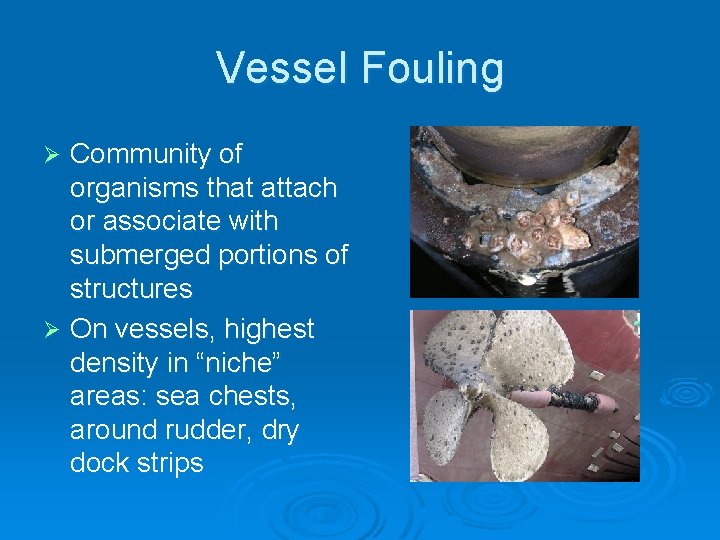
Vessel Fouling Community of organisms that attach or associate with submerged portions of structures Ø On vessels, highest density in “niche” areas: sea chests, around rudder, dry dock strips Ø
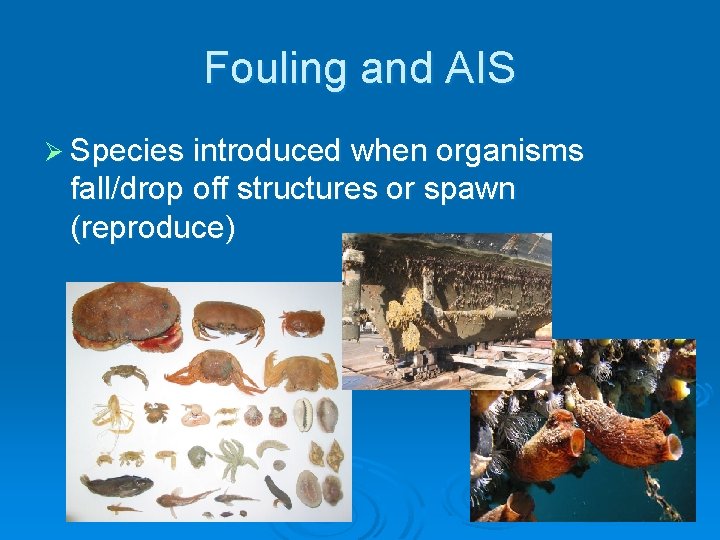
Fouling and AIS Ø Species introduced when organisms fall/drop off structures or spawn (reproduce)
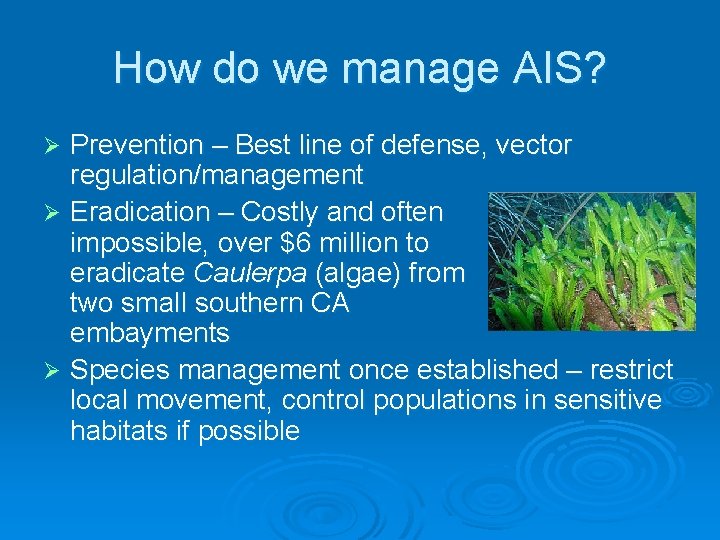
How do we manage AIS? Prevention – Best line of defense, vector regulation/management Ø Eradication – Costly and often impossible, over $6 million to eradicate Caulerpa (algae) from two small southern CA embayments Ø Species management once established – restrict local movement, control populations in sensitive habitats if possible Ø
International Regulations International Convention for the Control and Management of Ships’ Ballast Water and Sediments. Ø Adopted by IMO in February 2004 Ø Becomes effective one year after ratification by 30 countries representing 35% of world shipping tonnage. Ø Establishes performance standards for ballast water discharge. Ø As of September 2007, 10 countries representing 3. 42% of world shipping tonnage have signed convention. Ø
Federal Legislation Ø Nonindigenous Aquatic Nuisance Prevention and Control Act of 1990 Ø National Invasive Species Act of 1996 – required USCG to develop voluntary (and in 2004 mandatory) ballast management guidelines for vessels entering US waters l Also – vessel BW management plan, reporting & recordkeeping, safety exemption Ø New legislation proposed, nothing has passed to date.
California Laws & Regulations 1999 - Ballast Water Management for Control of Nonindigenous Species Act Ø 2003 - Marine Invasive Species Act established the Marine Invasive Species Program Ø 2006 – Coastal Regulations, Coastal Ecosystems Protection Act (required establishment of performance standards) Ø 2007 – Performance Standards Regulations, AB 740 (addressing vessel fouling) recently signed by Governor Ø
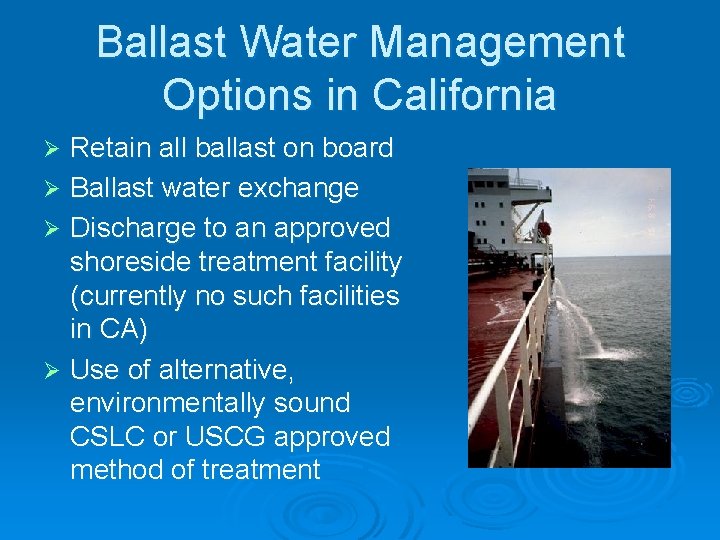
Ballast Water Management Options in California Retain all ballast on board Ø Ballast water exchange Ø Discharge to an approved shoreside treatment facility (currently no such facilities in CA) Ø Use of alternative, environmentally sound CSLC or USCG approved method of treatment Ø
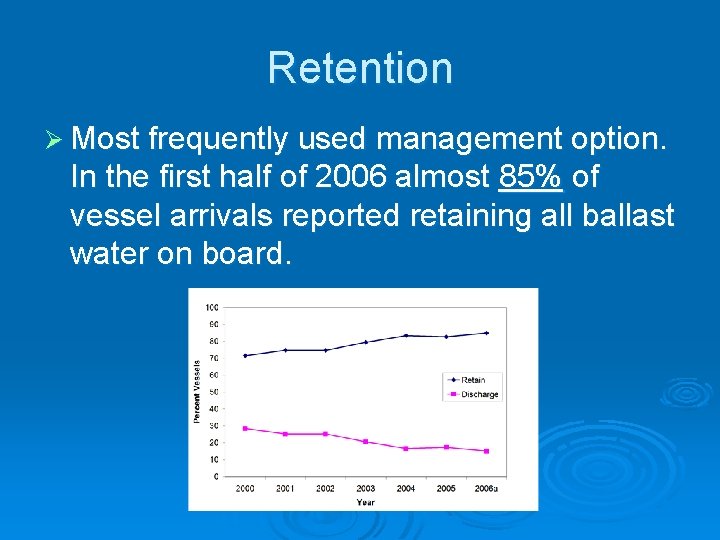
Retention Ø Most frequently used management option. In the first half of 2006 almost 85% of vessel arrivals reported retaining all ballast water on board.
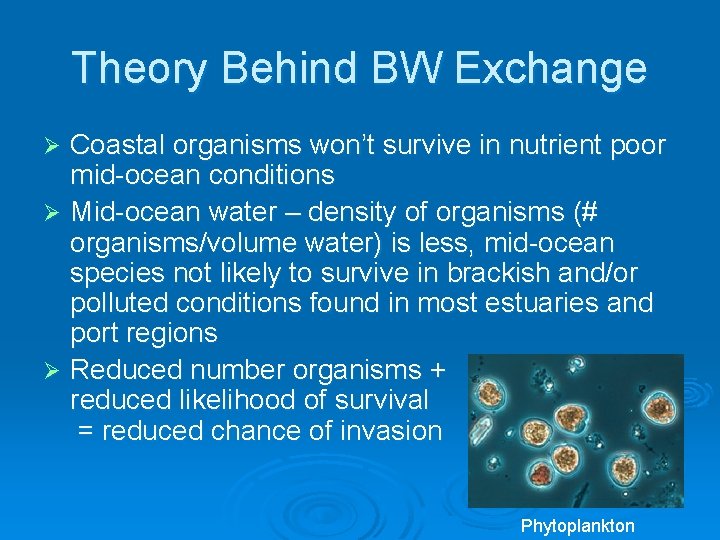
Theory Behind BW Exchange Coastal organisms won’t survive in nutrient poor mid-ocean conditions Ø Mid-ocean water – density of organisms (# organisms/volume water) is less, mid-ocean species not likely to survive in brackish and/or polluted conditions found in most estuaries and port regions Ø Reduced number organisms + reduced likelihood of survival = reduced chance of invasion Ø Phytoplankton
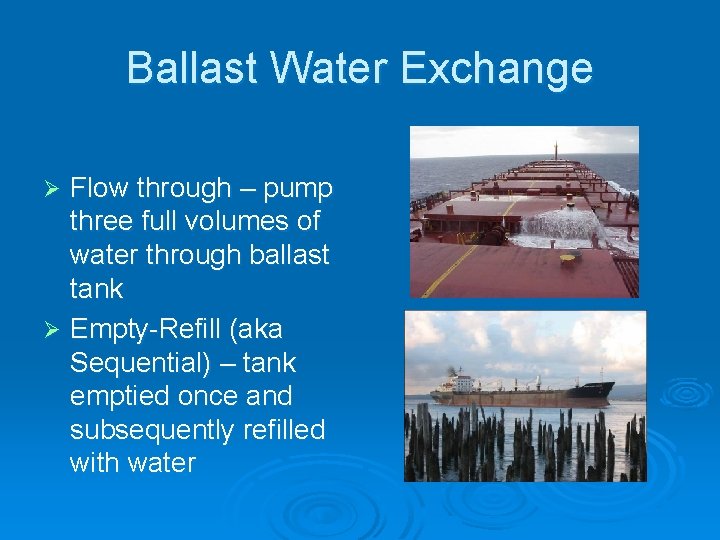
Ballast Water Exchange Flow through – pump three full volumes of water through ballast tank Ø Empty-Refill (aka Sequential) – tank emptied once and subsequently refilled with water Ø
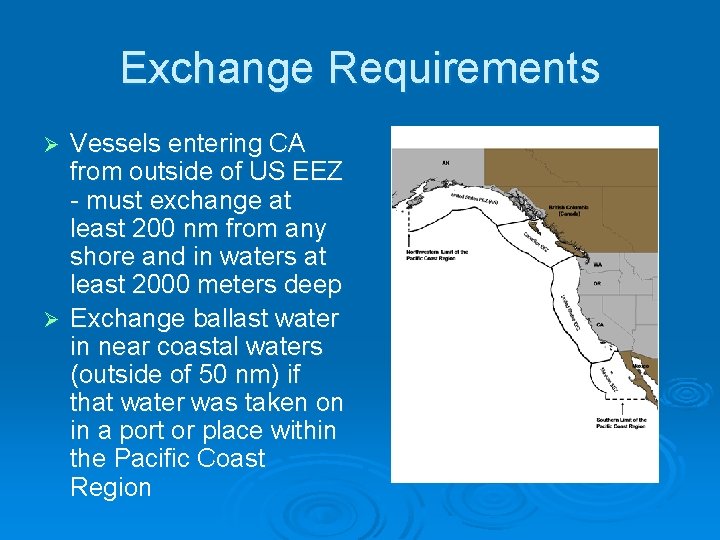
Exchange Requirements Vessels entering CA from outside of US EEZ - must exchange at least 200 nm from any shore and in waters at least 2000 meters deep Ø Exchange ballast water in near coastal waters (outside of 50 nm) if that water was taken on in a port or place within the Pacific Coast Region Ø
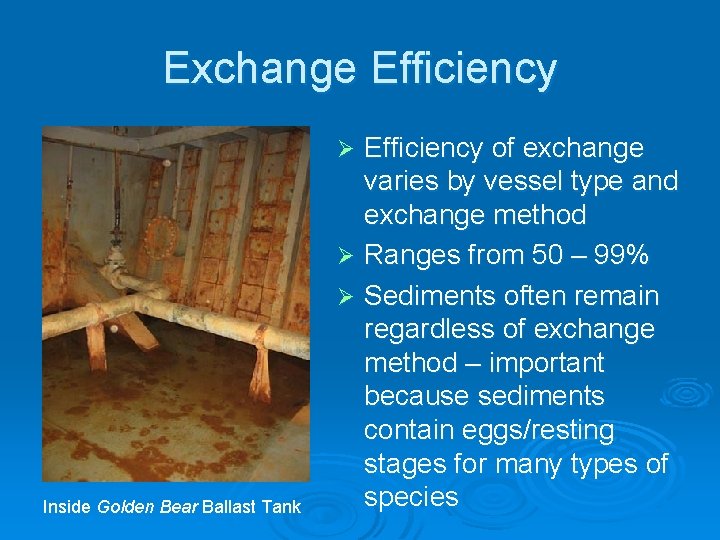
Exchange Efficiency of exchange varies by vessel type and exchange method Ø Ranges from 50 – 99% Ø Sediments often remain regardless of exchange method – important because sediments contain eggs/resting stages for many types of species Ø Inside Golden Bear Ballast Tank
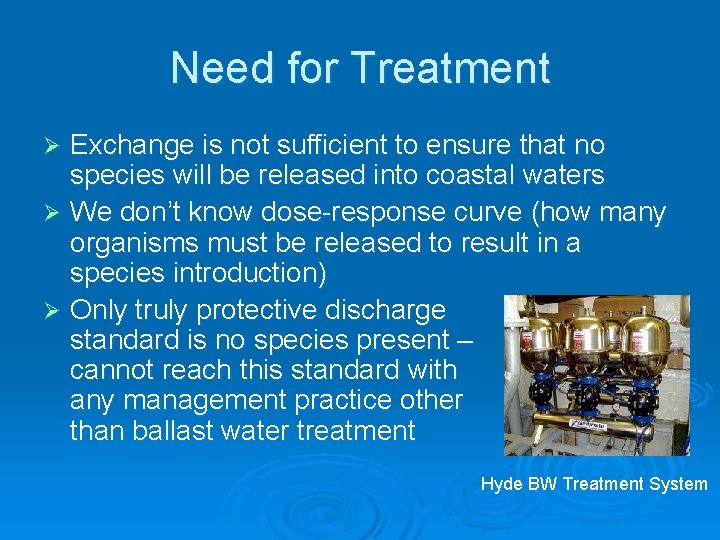
Need for Treatment Exchange is not sufficient to ensure that no species will be released into coastal waters Ø We don’t know dose-response curve (how many organisms must be released to result in a species introduction) Ø Only truly protective discharge standard is no species present – cannot reach this standard with any management practice other than ballast water treatment Ø Hyde BW Treatment System
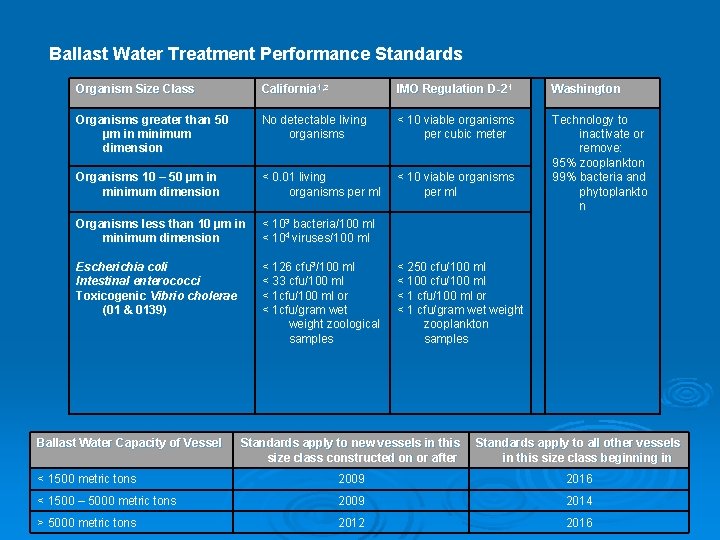
Ballast Water Treatment Performance Standards Organism Size Class California 1, 2 IMO Regulation D-21 Washington Organisms greater than 50 µm in minimum dimension No detectable living organisms < 10 viable organisms per cubic meter Organisms 10 – 50 µm in minimum dimension < 0. 01 living organisms per ml < 10 viable organisms per ml Technology to inactivate or remove: 95% zooplankton 99% bacteria and phytoplankto n Organisms less than 10 µm in minimum dimension < 103 bacteria/100 ml < 104 viruses/100 ml Escherichia coli Intestinal enterococci Toxicogenic Vibrio cholerae (01 & 0139) < 126 cfu 3/100 ml < 33 cfu/100 ml < 1 cfu/100 ml or < 1 cfu/gram wet weight zoological samples Ballast Water Capacity of Vessel < 250 cfu/100 ml < 100 cfu/100 ml < 1 cfu/100 ml or < 1 cfu/gram wet weight zooplankton samples Standards apply to new vessels in this size class constructed on or after Standards apply to all other vessels in this size class beginning in < 1500 metric tons 2009 2016 < 1500 – 5000 metric tons 2009 2014 > 5000 metric tons 2012 2016
How does this apply to you? What can you do? Ø Educate yourself – seminars, journal articles, news, talk with experts Ø Be familiar with the law – international, federal, states Ø Follow Best Management Practices (BMPs) Ø Get involved – testing programs, demonstration projects Ø Environmental Stewardship - responsibility for environmental quality shared by all those whose actions affect the environment
Questions ? Photo courtesy of the Smithsonian Environmental Research Center
- Slides: 25