
Aquarius Intraday Liquidity Monitoring Reporting BCBS 248 overview

Aquarius Intraday Liquidity Monitoring & Reporting
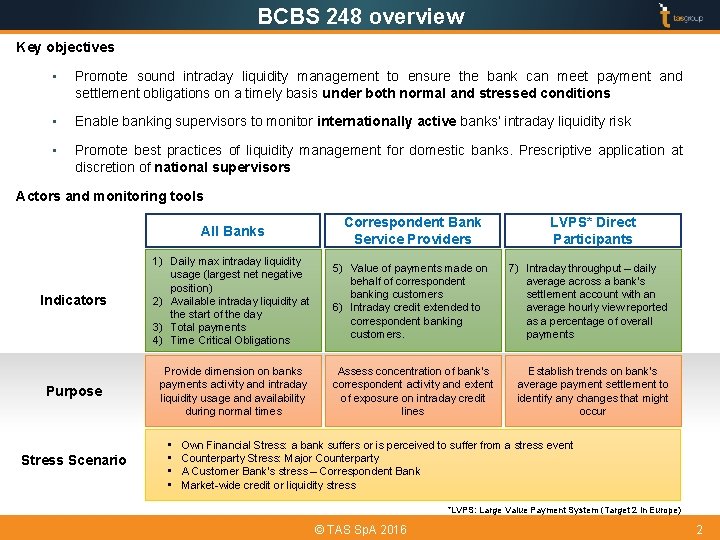
BCBS 248 overview Key objectives • Promote sound intraday liquidity management to ensure the bank can meet payment and settlement obligations on a timely basis under both normal and stressed conditions • Enable banking supervisors to monitor internationally active banks’ intraday liquidity risk • Promote best practices of liquidity management for domestic banks. Prescriptive application at discretion of national supervisors Actors and monitoring tools All Banks Correspondent Bank Service Providers Indicators 1) Daily max intraday liquidity usage (largest negative position) 2) Available intraday liquidity at the start of the day 3) Total payments 4) Time Critical Obligations 5) Value of payments made on behalf of correspondent banking customers 6) Intraday credit extended to correspondent banking customers. Purpose Provide dimension on banks payments activity and intraday liquidity usage and availability during normal times Assess concentration of bank’s correspondent activity and extent of exposure on intraday credit lines Stress Scenario • • LVPS* Direct Participants 7) Intraday throughput – daily average across a bank’s settlement account with an average hourly view reported as a percentage of overall payments Establish trends on bank’s average payment settlement to identify any changes that might occur Own Financial Stress: a bank suffers or is perceived to suffer from a stress event Counterparty Stress: Major Counterparty A Customer Bank’s stress – Correspondent Bank Market-wide credit or liquidity stress *LVPS: Large Value Payment System (Target 2 in Europe) © TAS Sp. A 2016 2
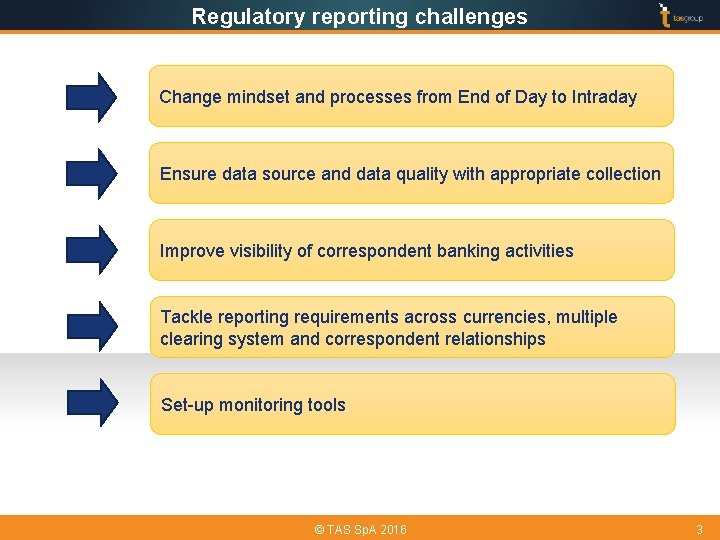
Regulatory reporting challenges Change mindset and processes from End of Day to Intraday Ensure data source and data quality with appropriate collection Improve visibility of correspondent banking activities Tackle reporting requirements across currencies, multiple clearing system and correspondent relationships Set-up monitoring tools © TAS Sp. A 2016 3

Intraday Liquidity Strategy Key Operational Elements 1 2 3 4 5 6 Data Collection To measure expected daily gross liquidity inflows and outflows (Cash & Securities) To monitor intraday liquidity positions against expected activities and available resources To acquire sufficient intraday funding to meet intraday objectives To have the ability to manage and mobilise collateral as necessary to obtain intraday funds Robust capability to manage the timing of liquidity outflows in line with intraday objectives • Payment details, Clearing and Settlement Systems specifications • Counterparties • Timing and cut offs • Relevant deadlines • Currencies & Jurisdictions • Bank legal structure (subsidiaries, branches) • Clearing/Settlement Systems • Bank Payment Systems • • To be prepared to deal with unexpected disruptions to intraday liquidity flows © TAS Sp. A 2016 Cash Credit Lines Collaterals Unencumbered Assets 4

Our Objectives From intraday analysis to active management to reduce risks and cost of buffers through prompt detection of unexpected surplus or deficits and intraday funding optimisation Leverage on intraday payments intelligence: • Assessing the impact of flows against intraday volumes • Reconsidering mandates requirements (i. e. urgency) Provide value added services to correspondent customers such as intraday monitoring reports © TAS Sp. A 2016 5
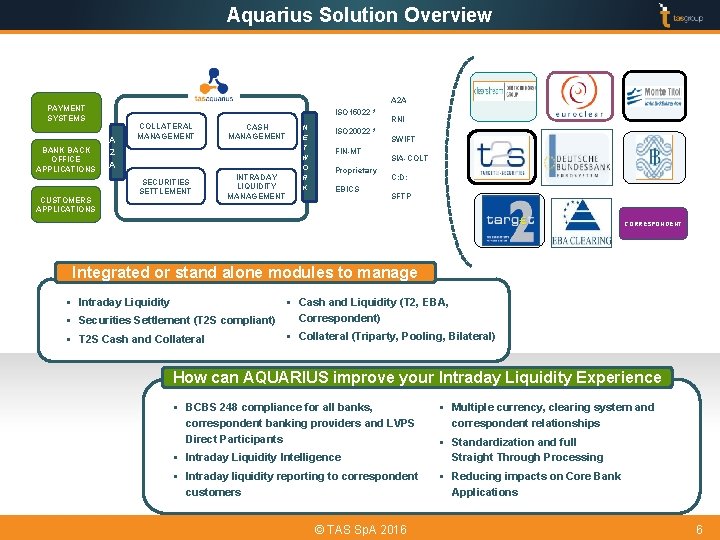
Aquarius Solution Overview A 2 A PAYMENT SYSTEMS BANK BACK OFFICE APPLICATIONS CUSTOMERS APPLICATIONS ISO 15022 * A 2 A COLLATERAL MANAGEMENT SECURITIES SETTLEMENT CASH MANAGEMENT INTRADAY LIQUIDITY MANAGEMENT N E T W O R K ISO 20022 * FIN-MT Proprietary EBICS RNI SWIFT SIA-COLT C: D: SFTP CORRESPONDENT Integrated or stand alone modules to manage § Intraday Liquidity § Cash and Liquidity (T 2, EBA, Correspondent) § Securities Settlement (T 2 S compliant) § Collateral (Triparty, Pooling, Bilateral) § T 2 S Cash and Collateral How can AQUARIUS improve your Intraday Liquidity Experience § BCBS 248 compliance for all banks, correspondent banking providers and LVPS Direct Participants § Multiple currency, clearing system and correspondent relationships § Intraday Liquidity Intelligence § Standardization and full Straight Through Processing § Intraday liquidity reporting to correspondent customers § Reducing impacts on Core Bank Applications © TAS Sp. A 2016 6
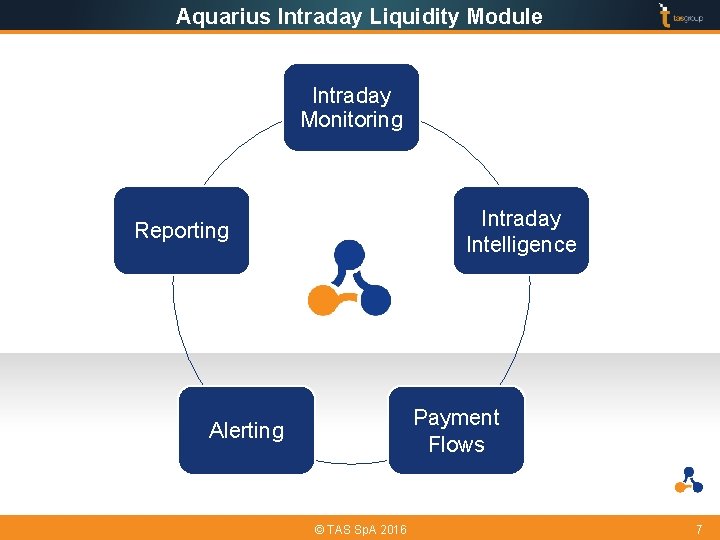
Aquarius Intraday Liquidity Module Intraday Monitoring Intraday Intelligence Reporting Payment Flows Alerting © TAS Sp. A 2016 7
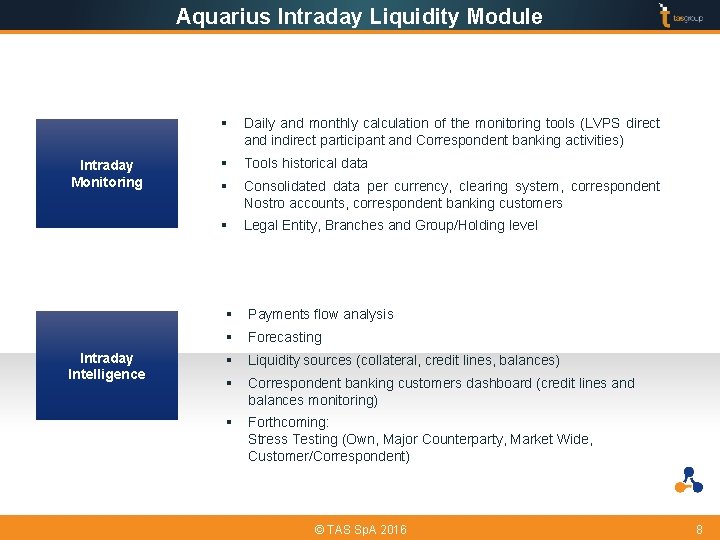
Aquarius Intraday Liquidity Module Intraday Monitoring Intraday Intelligence § Daily and monthly calculation of the monitoring tools (LVPS direct and indirect participant and Correspondent banking activities) § Tools historical data § Consolidated data per currency, clearing system, correspondent Nostro accounts, correspondent banking customers § Legal Entity, Branches and Group/Holding level § Payments flow analysis § Forecasting § Liquidity sources (collateral, credit lines, balances) § Correspondent banking customers dashboard (credit lines and balances monitoring) § Forthcoming: Stress Testing (Own, Major Counterparty, Market Wide, Customer/Correspondent) © TAS Sp. A 2016 8
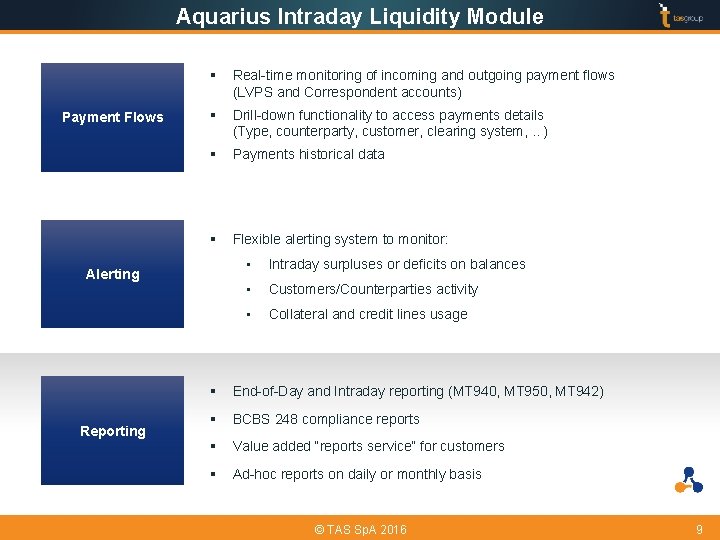
Aquarius Intraday Liquidity Module Payment Flows § Real-time monitoring of incoming and outgoing payment flows (LVPS and Correspondent accounts) § Drill-down functionality to access payments details (Type, counterparty, customer, clearing system, . . ) § Payments historical data § Flexible alerting system to monitor: Alerting Reporting • Intraday surpluses or deficits on balances • Customers/Counterparties activity • Collateral and credit lines usage § End-of-Day and Intraday reporting (MT 940, MT 950, MT 942) § BCBS 248 compliance reports § Value added “reports service” for customers § Ad-hoc reports on daily or monthly basis © TAS Sp. A 2016 9
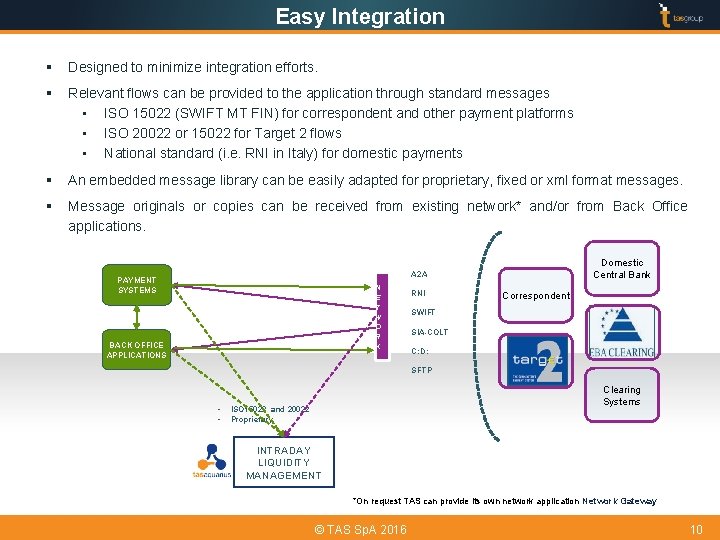
Easy Integration § Designed to minimize integration efforts. § Relevant flows can be provided to the application through standard messages • ISO 15022 (SWIFT MT FIN) for correspondent and other payment platforms • ISO 20022 or 15022 for Target 2 flows • National standard (i. e. RNI in Italy) for domestic payments § An embedded message library can be easily adapted for proprietary, fixed or xml format messages. § Message originals or copies can be received from existing network* and/or from Back Office applications. Domestic Central Bank A 2 A PAYMENT SYSTEMS N E T W O R K BACK OFFICE APPLICATIONS RNI Correspondent SWIFT SIA-COLT C: D: SFTP • • Clearing Systems ISO 15022 and 20022 Proprietary INTRADAY LIQUIDITY MANAGEMENT *On request TAS can provide its own network application Network Gateway © TAS Sp. A 2016 10
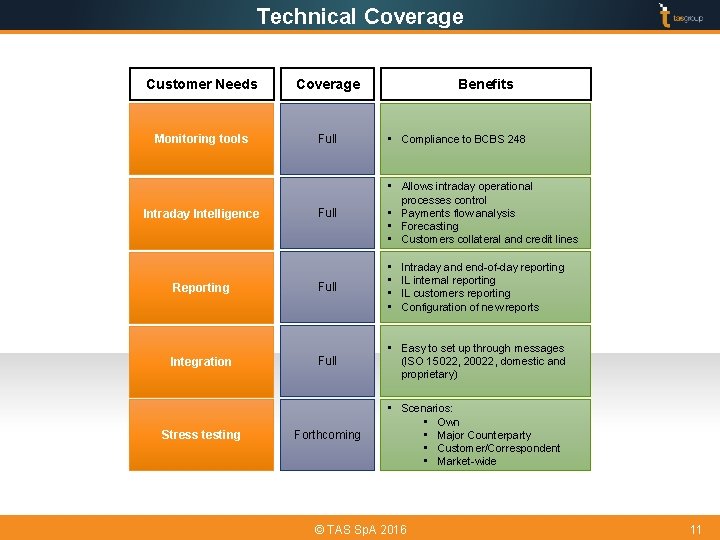
Technical Coverage Customer Needs Coverage Monitoring tools Full • Compliance to BCBS 248 Full • Allows intraday operational processes control • Payments flow analysis • Forecasting • Customers collateral and credit lines Full • • Full • Easy to set up through messages (ISO 15022, 20022, domestic and proprietary) Forthcoming • Scenarios: • Own • Major Counterparty • Customer/Correspondent • Market-wide Intraday Intelligence Reporting Integration Stress testing Benefits Intraday and end-of-day reporting IL internal reporting IL customers reporting Configuration of new reports © TAS Sp. A 2016 11
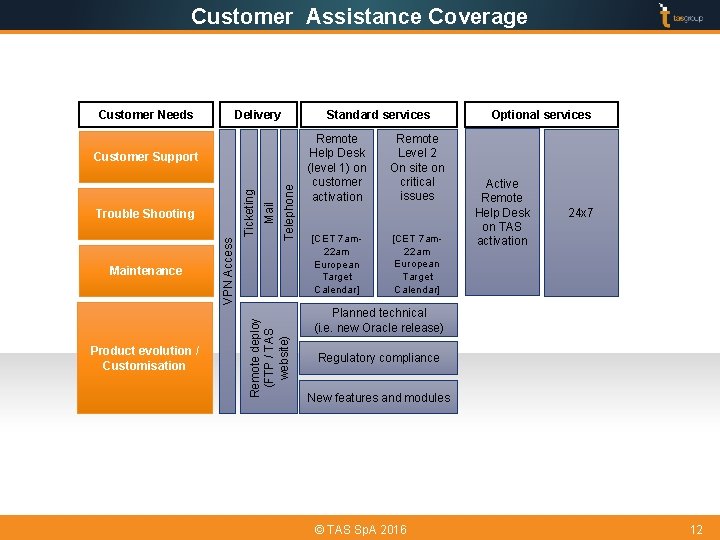
Customer Assistance Coverage Delivery Customer Needs Standard services Maintenance Product evolution / Customisation Mail Telephone VPN Access Trouble Shooting Remote deploy (FTP / TAS website) Ticketing Customer Support Remote Help Desk (level 1) on customer activation [CET 7 am 22 am European Target Calendar] Remote Level 2 On site on critical issues [CET 7 am 22 am European Target Calendar] Optional services Active Remote Help Desk on TAS activation 24 x 7 Planned technical (i. e. new Oracle release) Regulatory compliance New features and modules © TAS Sp. A 2016 12

! s U t c Conta Aquarius Intraday Liquidity Monitoring & Reporting TAS Capital Markets & Treasury CMT@tasgroup. eu www. tasgroup. eu © 2016, TAS Sp. A. All information contained herein is the property under copyright of TAS Sp. A and its subsidiaries. It may not be published or disclosed in whole or in part to any other party without the express written permission of TAS Sp. A. This prohibition is void in case of information published or lawfully disclosed by sources other than the TAS. Disclaimer: TAS Group has taken every possible precaution in preparing this document. However, TAS Group does not accept any responsibility for errors or omissions. Similarly, TAS does not assume any liability for damage caused by any use of the information contained in this document. All information herein is subject to change without notice.
- Slides: 13