
Aquaculture in Lebanon Ibrahim AlHawi Anjar Aquaculture Center
Aquaculture in Lebanon Ibrahim Al-Hawi Anjar Aquaculture Center -Ministry of Agriculture Lebanon, 2005
Background • Fish Production: 4, 000 tons • Aquaculture Production: 600 tons • The annual per capita consumption: 3. 25 kg
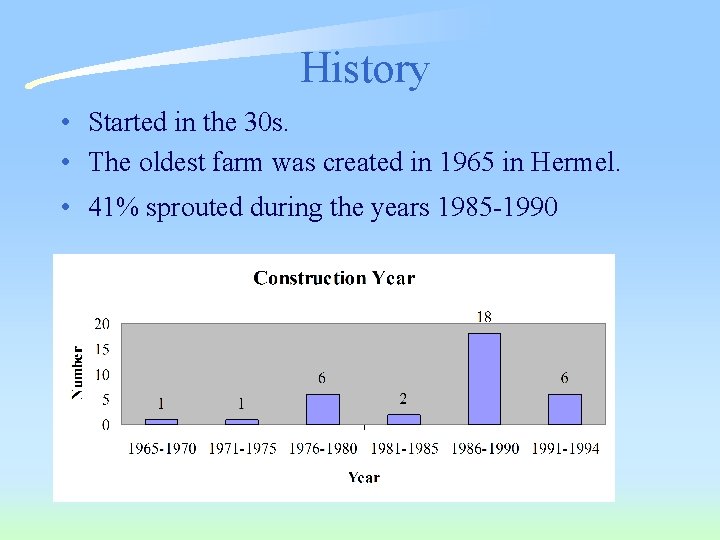
History • Started in the 30 s. • The oldest farm was created in 1965 in Hermel. • 41% sprouted during the years 1985 -1990
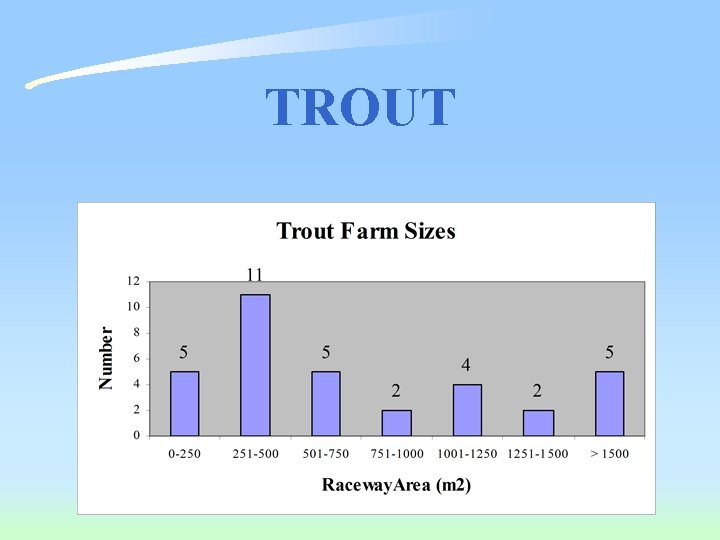
Human resources • • • There about 150 farms or holdings. It is in most cases a family business. Most hire a full time labourer to take care of daily farming activities of the farm. Main raisers are organized into 4 main coops There are restaurants owners (30)
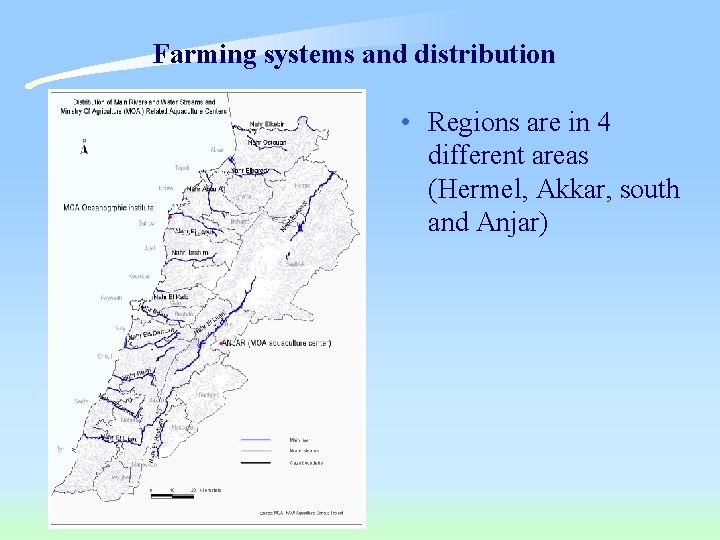
Farming systems and distribution • Regions are in 4 different areas (Hermel, Akkar, south and Anjar)
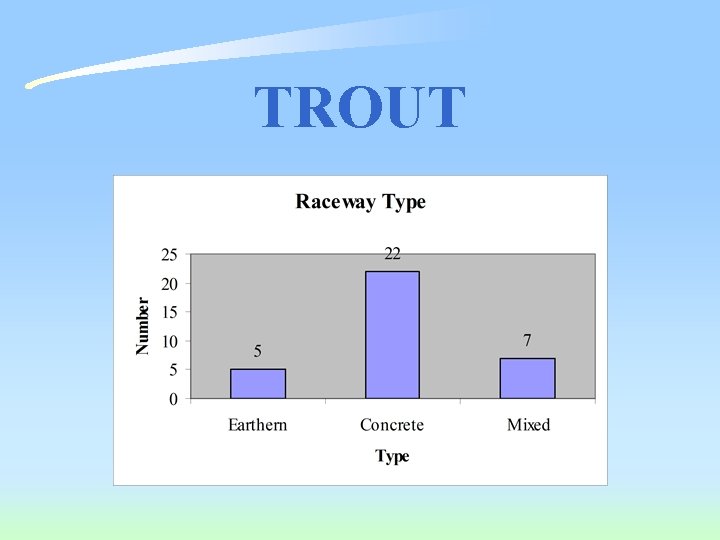
TROUT • Introduced: early 1960’s. • Production: around 600 tons/year by 150 farms • Semi Intensified System
TROUT
TROUT • Water requirement: Water flows of at least 2 -8 cu. m/minute • Water Quality: + Water temperature: 7 -18°C + Oxygen Content: 6 - 9 mg/l
TROUT + Egg Imports: 5, 000 certified eyed eggs (3, 200, 000 Winter - 1, 800, 000 Summer) + Egg sources: Denmark, South Africa & USA + Average Yield: 30 kg/m 2 Feed Imports: 800 tons/year
TROUT
TROUT Diseases: + Nutritional and environmental + Bacterial + Fungal + Protozoans
TILAPIA Existing Facilities • Pilot project of choueifat: Private Sector: Operational Hatchery & Growout Facilities
TILAPIA Major Challenges: • Sub-Optimal Temperature: ( Optimum: > 25°C ) • High electricity costs ($0. 133/k. Wh) • Unstable power supply
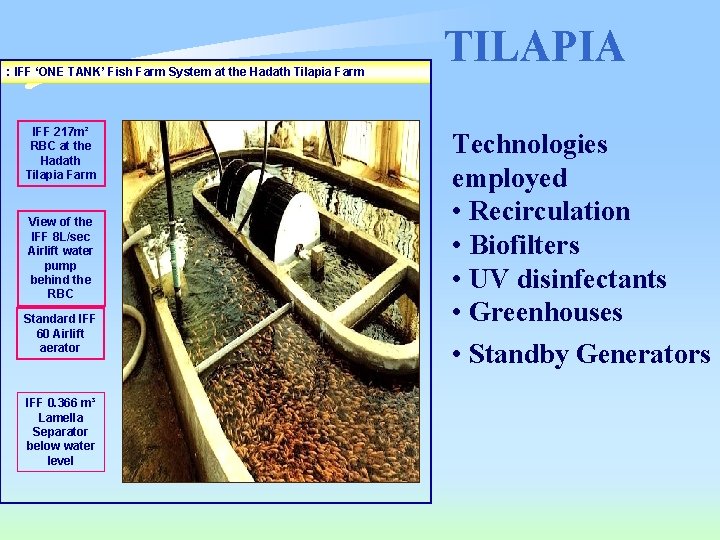
: IFF ‘ONE TANK’ Fish Farm System at the Hadath Tilapia Farm IFF 217 m² RBC at the Hadath Tilapia Farm View of the IFF 8 L/sec Airlift water pump behind the RBC Standard IFF 60 Airlift aerator IFF 0. 366 m³ Lamella Separator below water level TILAPIA Technologies employed • Recirculation • Biofilters • UV disinfectants • Greenhouses • Standby Generators
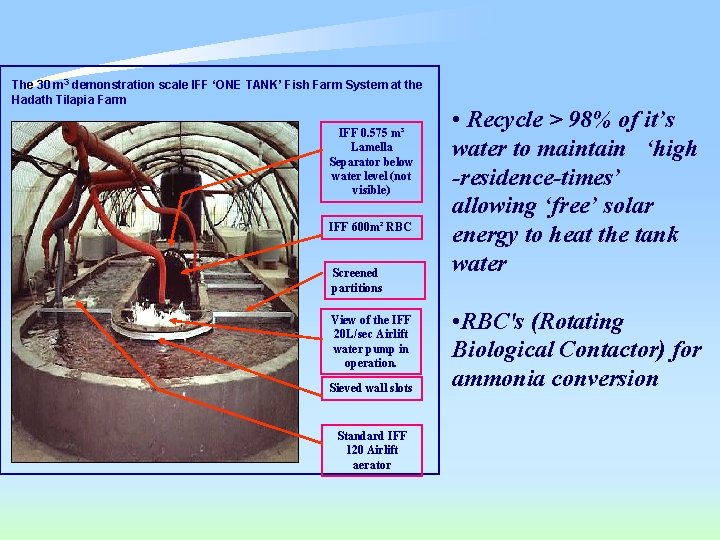
The 30 m 3 demonstration scale IFF ‘ONE TANK’ Fish Farm System at the Hadath Tilapia Farm IFF 0. 575 m³ Lamella Separator below water level (not visible) IFF 600 m² RBC Screened partitions View of the IFF 20 L/sec Airlift water pump in operation. Sieved wall slots Standard IFF 120 Airlift aerator • Recycle > 98% of it’s water to maintain ‘high -residence-times’ allowing ‘free’ solar energy to heat the tank water • RBC's (Rotating Biological Contactor) for ammonia conversion
• Marine aquaculture is absent (one shrimp farm (Litopenaeus vannamei) • Pilot project for Seabass and Seabream
Market • the total amount of imported fish, whether live, fresh or frozen (including crustaceans and molluscs) amounts to 14000 tons (US $35. 6 million). • Canned and prepared fish stuff imports are at 1608 tons with a value of US $ 4. 6 million representing mainly prepared or preserved fish; caviar and caviar substitutes prepared from fish eggs. • Turkey is the number one exporting country (17% of the total imports), followed by Egypt (9%), Argentina (7%), the United Kingdom (7%), India (6%) and Oman (5%) (Annex 6).
Trout Marketing • Market not selective: No grading or packaging. • Sold chilled whole or eviscerated. • Farm Price is $2 -3/kg • Retail price is $3 -5/kg. • Restaurants/Farms (10$/kg) • Marketable size: 250 -350 g.
Ministry of Agriculture Aquaculture Facilities 1. Batroun (Institute of Oceanography and Fisheries) 2. Chouaifat (Aquaculture Centre) 3. Anjar (Fish Farming Centre) 4. Hermel (Fish Farming Centre)
Regulations • No licensing requirement for the establishment of farms from MOA. • Aquaculture farms establishment is regulated by the Ministry of Environment which requests an EIA study. • Start up of such enterprises is subject to local authorities Mayor (at Mohafazat level) where such farms are treated as classified enterprises subject to the Mayor licensing. • Current related regulations are under revision by MOA
Research • Anjar: Aquaculture research projects involve trout growing and technology transfer. • NCMR under the NCSR is responsible for marine aquaculture research. • American University of Beirut • The Lebanese University in collaboration with NCMR and Anjar center. • Balamand University is a private one that conducts research studies on marine aquaculture. • The government’s Oceanographic Institute of Batroun in North Lebanon
Issues and Trends • Aquaculture sector production and productivity in Lebanon can be boosted in relation to water availability and quality, the favourable growing conditions (temperature, . . ). • Aside from Morocco Lebanon is the only Arab country growing Trout. • Farming practices and technologies used needs to be enhanced. Investments are needed to develop the sector along with the support infrastructure. • Research is needed: feed conversion, health management and different growing techniques.
Issues and Trends • Legislations and regulations pertaining to aquaculture production, establishment of enterprises and its effects on environment needs to be developed and enforced. • Comprehensive accurate statistics and adapt concerning the sector is needed. Lack of funds and human resources are the two factors leading such gaps.

Thank you
- Slides: 24