
AQA Trilogy Science Knowledge Organisers for All Topics

- Slides: 4
AQA Trilogy Science Knowledge Organisers for All Topics The information on each page is a summary of key information needed for each topic. It does not cover all content and is not intended as a replacement to other study resources. Please email Mr Allen (callen@swatrust. co. uk) if you spot any mistakes or potential improvements.
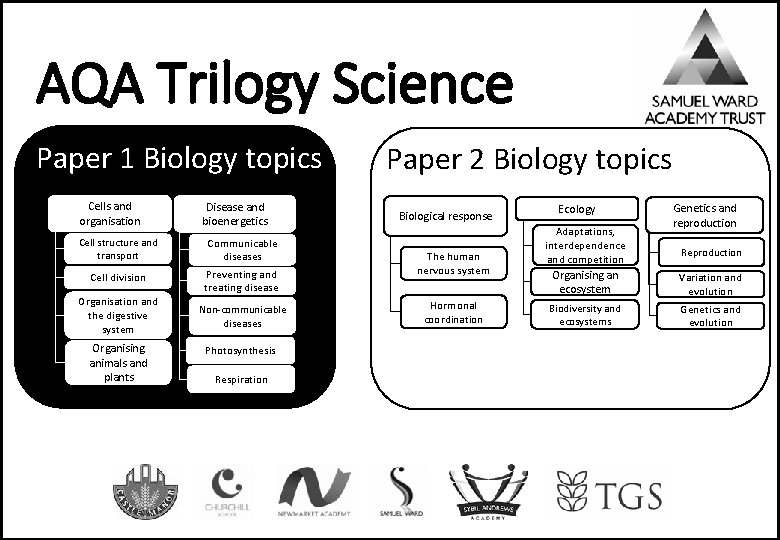
AQA Trilogy Science Paper 1 Biology topics Paper 2 Biology topics Cells and organisation Disease and bioenergetics Cell structure and transport Communicable diseases Preventing and treating disease The human nervous system Adaptations, interdependence and competition Organising an ecosystem Non-communicable diseases Hormonal coordination Biodiversity and ecosystems Cell division Organisation and the digestive system Organising animals and plants Photosynthesis Respiration Biological response Ecology Genetics and reproduction Reproduction Variation and evolution Genetics and evolution
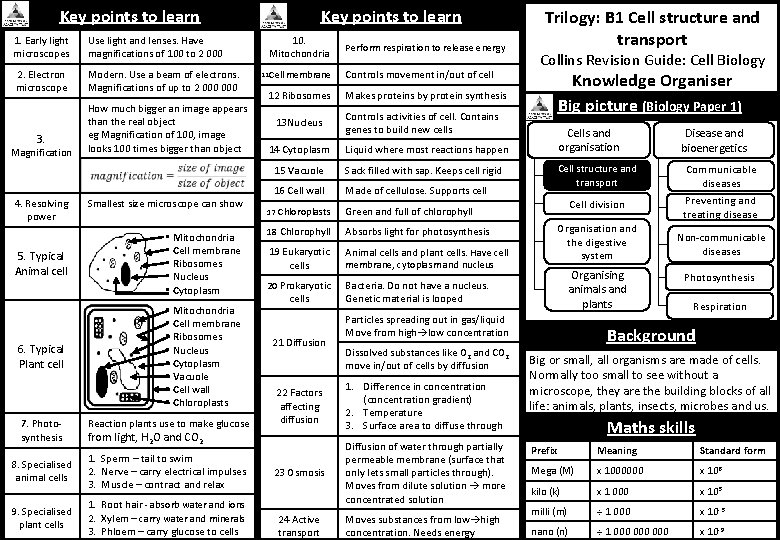
Key points to learn 1. Early light microscopes Use light and lenses. Have magnifications of 100 to 2 000 2. Electron microscope Modern. Use a beam of electrons. Magnifications of up to 2 000 3. Magnification 4. Resolving power 5. Typical Animal cell 6. Typical Plant cell 7. Photosynthesis How much bigger an image appears than the real object eg Magnification of 100, image looks 100 times bigger than object Smallest size microscope can show • Mitochondria • Cell membrane • Ribosomes • Nucleus • Cytoplasm • Vacuole • Cell wall • Chloroplasts Reaction plants use to make glucose Key points to learn 10. Mitochondria 11 Cell membrane 12 Ribosomes 13 Nucleus 14 Cytoplasm 8. Specialised animal cells 9. Specialised plant cells 1. Root hair - absorb water and ions 2. Xylem – carry water and minerals 3. Phloem – carry glucose to cells Controls movement in/out of cell Liquid where most reactions happen 16 Cell wall Made of cellulose. Supports cell Chloroplasts Absorbs light for photosynthesis 19 Eukaryotic cells Animal cells and plant cells. Have cell membrane, cytoplasm and nucleus 20 Prokaryotic Bacteria. Do not have a nucleus. Genetic material is looped 21 Diffusion Disease and bioenergetics Cell structure and transport Communicable diseases Preventing and treating disease Cell division Organisation and the digestive system Organising animals and plants Particles spreading out in gas/liquid Move from high low concentration Dissolved substances like O 2 and CO 2 move in/out of cells by diffusion 22 Factors affecting diffusion 1. Difference in concentration (concentration gradient) 2. Temperature 3. Surface area to diffuse through 23 Osmosis Diffusion of water through partially permeable membrane (surface that only lets small particles through). Moves from dilute solution more concentrated solution 24 Active transport Cells and organisation Green and full of chlorophyll 18 Chlorophyll cells Knowledge Organiser Big picture (Biology Paper 1) Controls activities of cell. Contains genes to build new cells Sack filled with sap. Keeps cell rigid 17 Collins Revision Guide: Cell Biology Makes proteins by protein synthesis 15 Vacuole from light, H 2 O and CO 2 1. Sperm – tail to swim 2. Nerve – carry electrical impulses 3. Muscle – contract and relax Perform respiration to release energy Trilogy: B 1 Cell structure and transport Moves substances from low high concentration. Needs energy Non-communicable diseases Photosynthesis Respiration Background Big or small, all organisms are made of cells. Normally too small to see without a microscope, they are the building blocks of all life: animals, plants, insects, microbes and us. Maths skills Prefix Meaning Standard form Mega (M) x 1000000 x 106 kilo (k) x 1 000 x 103 milli (m) 1 000 x 10 -3 nano (n) 1 000 000 x 10 -9