
AQA POWER AND CONFLICT POETRY KAMIKAZE BY BEATRICE
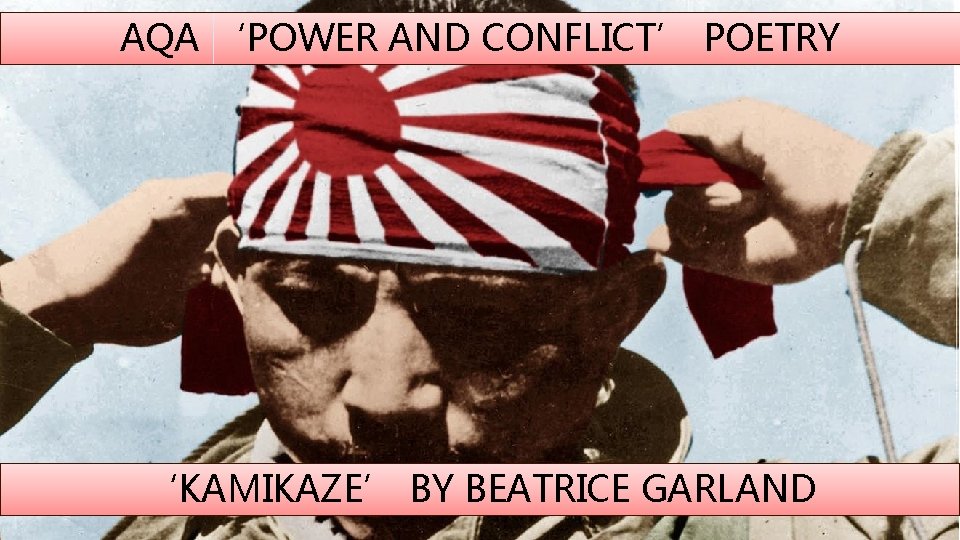
AQA ‘POWER AND CONFLICT’ POETRY ‘KAMIKAZE’ BY BEATRICE GARLAND
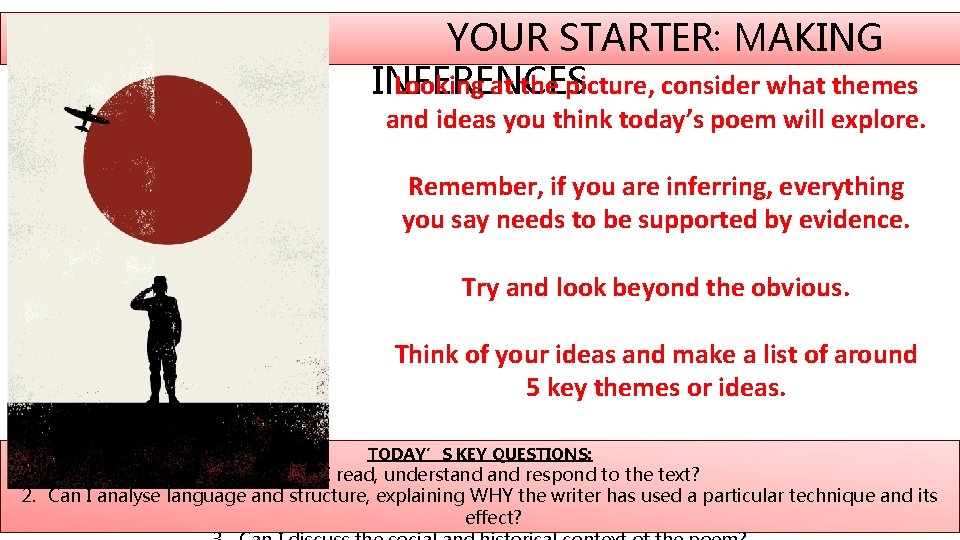
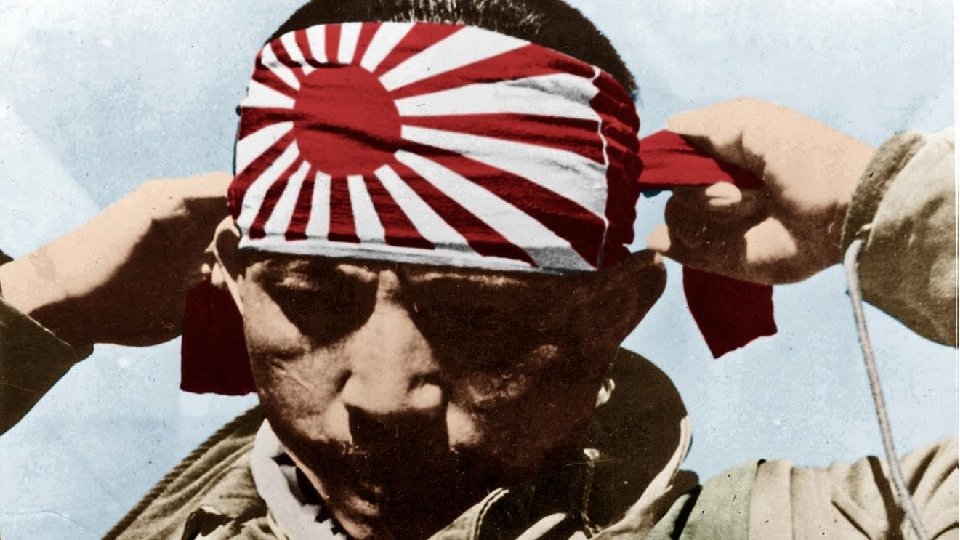
YOUR STARTER: MAKING Looking at the picture, consider what themes INFERENCES and ideas you think today’s poem will explore. Remember, if you are inferring, everything you say needs to be supported by evidence. Try and look beyond the obvious. Think of your ideas and make a list of around 5 key themes or ideas. TODAY’S KEY QUESTIONS: 1. Can I read, understand respond to the text? 2. Can I analyse language and structure, explaining WHY the writer has used a particular technique and its effect?
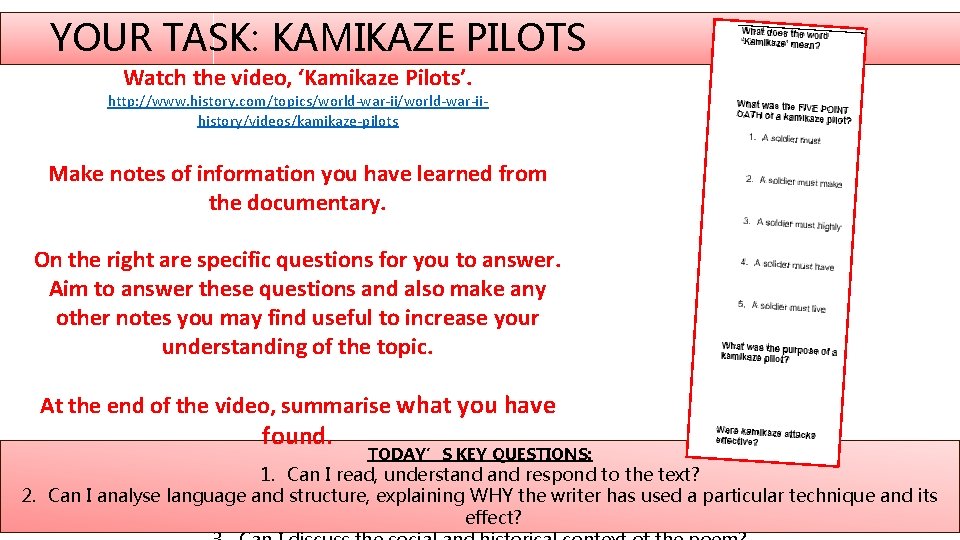
YOUR TASK: KAMIKAZE PILOTS Watch the video, ‘Kamikaze Pilots’. http: //www. history. com/topics/world-war-iihistory/videos/kamikaze-pilots Make notes of information you have learned from the documentary. On the right are specific questions for you to answer. Aim to answer these questions and also make any other notes you may find useful to increase your understanding of the topic. At the end of the video, summarise what you have found. TODAY’S KEY QUESTIONS: 1. Can I read, understand respond to the text? 2. Can I analyse language and structure, explaining WHY the writer has used a particular technique and its effect?
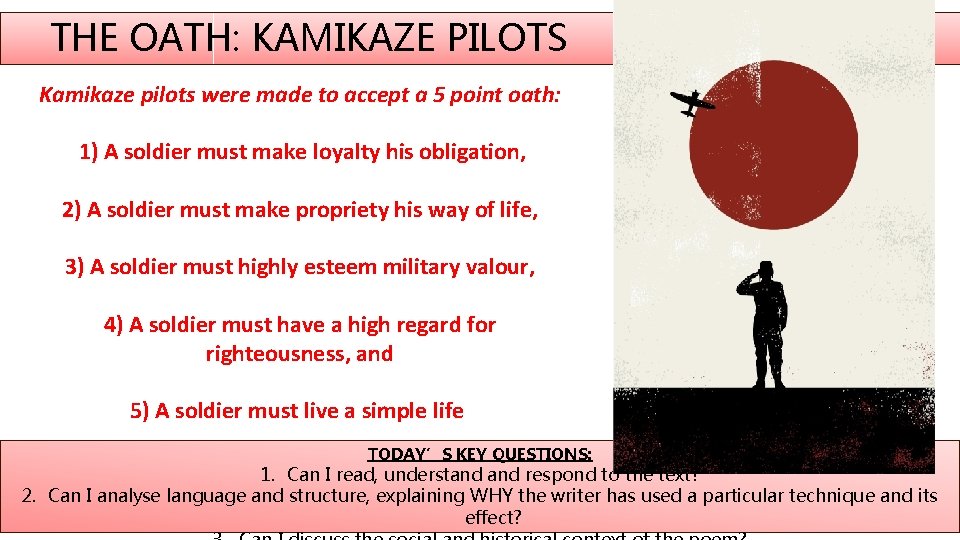
THE OATH: KAMIKAZE PILOTS Kamikaze pilots were made to accept a 5 point oath: 1) A soldier must make loyalty his obligation, 2) A soldier must make propriety his way of life, 3) A soldier must highly esteem military valour, 4) A soldier must have a high regard for righteousness, and 5) A soldier must live a simple life TODAY’S KEY QUESTIONS: 1. Can I read, understand respond to the text? 2. Can I analyse language and structure, explaining WHY the writer has used a particular technique and its effect?
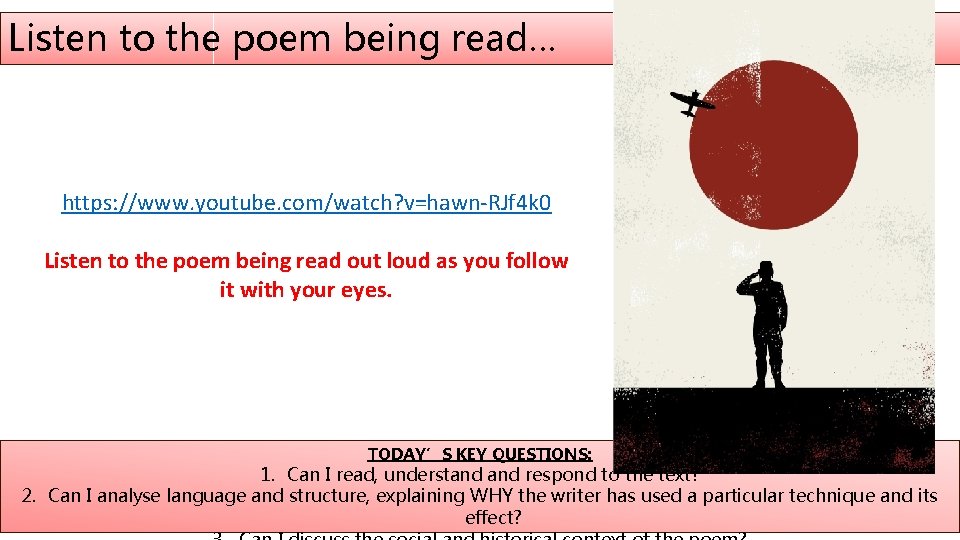
Listen to the poem being read… https: //www. youtube. com/watch? v=hawn-RJf 4 k 0 Listen to the poem being read out loud as you follow it with your eyes. TODAY’S KEY QUESTIONS: 1. Can I read, understand respond to the text? 2. Can I analyse language and structure, explaining WHY the writer has used a particular technique and its effect?
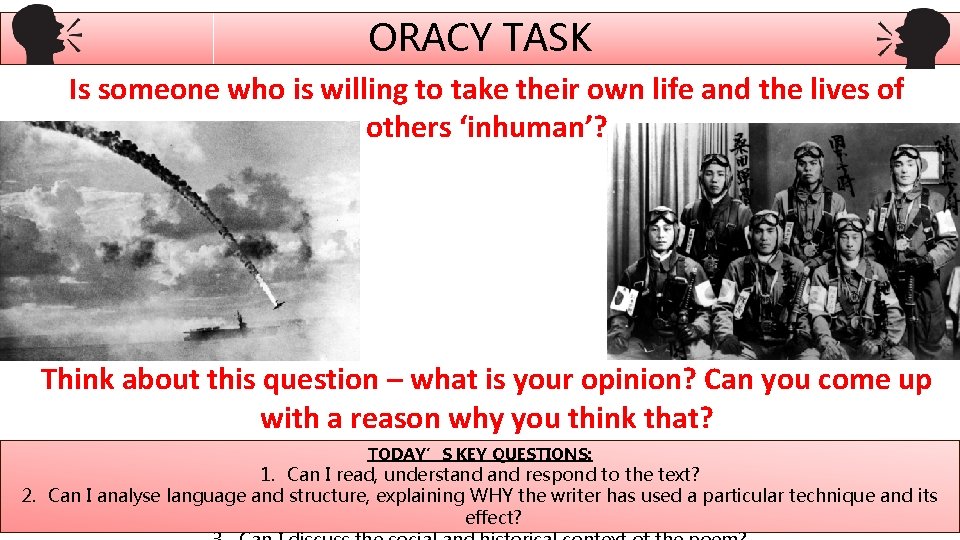
ORACY TASK Is someone who is willing to take their own life and the lives of others ‘inhuman’? Think about this question – what is your opinion? Can you come up with a reason why you think that? TODAY’S KEY QUESTIONS: 1. Can I read, understand respond to the text? 2. Can I analyse language and structure, explaining WHY the writer has used a particular technique and its effect?
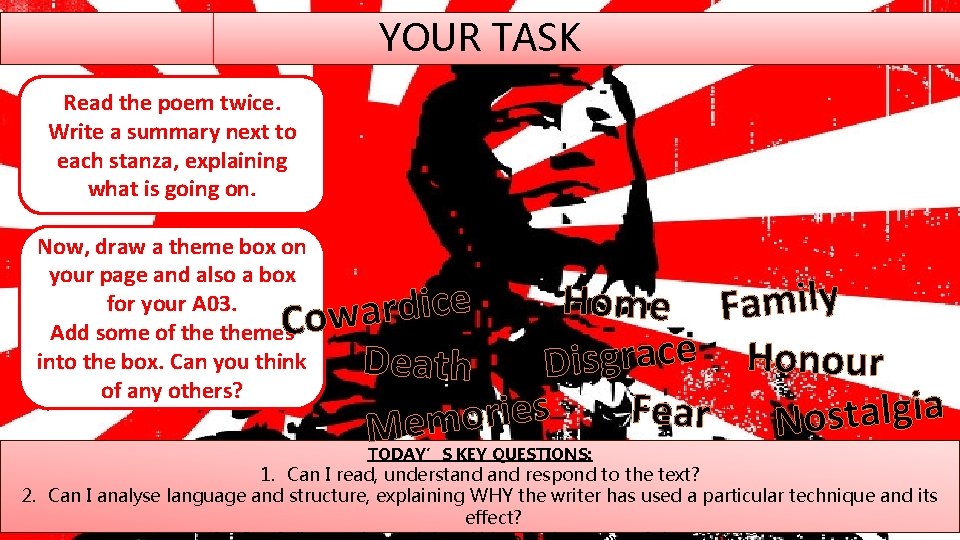
YOUR TASK Read the poem twice. Write a summary next to each stanza, explaining what is going on. Now, draw a theme box on your page and also a box for your A 03. Add some of themes into the box. Can you think of any others? y l i H e o m c m i a e F d r Cowa e c a r Honour g s Death i D a i s F g e e l i a a r r t s o No Mem TODAY’S KEY QUESTIONS: 1. Can I read, understand respond to the text? 2. Can I analyse language and structure, explaining WHY the writer has used a particular technique and its effect?
STANZA ONE What is the significance of the noun ‘incantations’? How and why are they ‘powerful’? Why do you think the poem begins in the third person? What could this signify? How is ‘sunrise’ significant? Consider the nationality of the kamikaze pilots. The journey of this kamikaze pilot is only just beginning but how does Garland create a sense of finality in this stanza? Her father embarked at sunrise with a flask of water, a samurai sword in the cockpit, a shaven head full of powerful incantations and enough fuel for a one-way journey into history What is the purpose of the enjambment in this stanza? What could it represent? ‘…journey into history’ – What does this suggest about the beliefs of the kamikaze pilots? TODAY’S KEY QUESTIONS: 1. Can I read, understand respond to the text? 2. Can I analyse language and structure, explaining WHY the writer has used a particular technique and its effect?
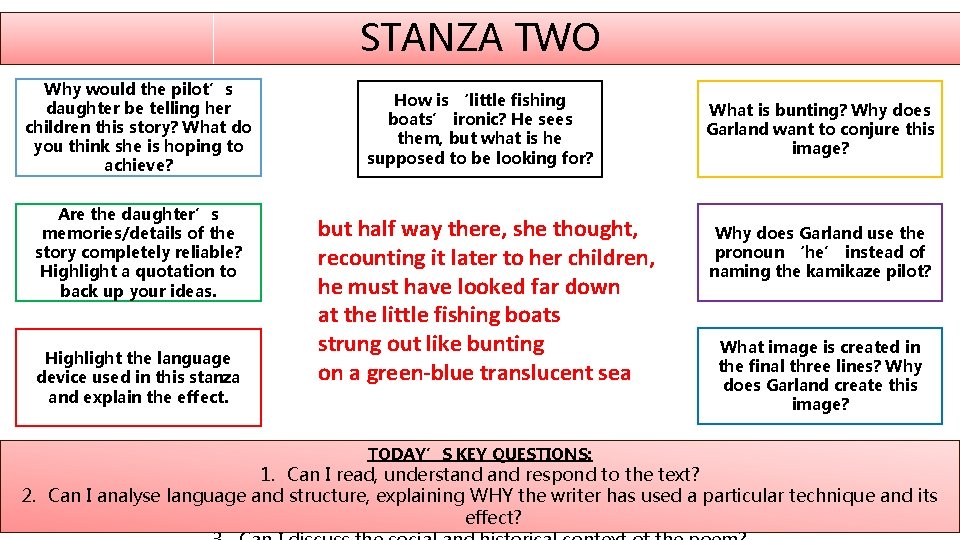
STANZA TWO Why would the pilot’s daughter be telling her children this story? What do you think she is hoping to achieve? Are the daughter’s memories/details of the story completely reliable? Highlight a quotation to back up your ideas. Highlight the language device used in this stanza and explain the effect. How is ‘little fishing boats’ ironic? He sees them, but what is he supposed to be looking for? but half way there, she thought, recounting it later to her children, he must have looked far down at the little fishing boats strung out like bunting on a green-blue translucent sea TODAY’S KEY QUESTIONS: What is bunting? Why does Garland want to conjure this image? Why does Garland use the pronoun ‘he’ instead of naming the kamikaze pilot? What image is created in the final three lines? Why does Garland create this image? 1. Can I read, understand respond to the text? 2. Can I analyse language and structure, explaining WHY the writer has used a particular technique and its effect?
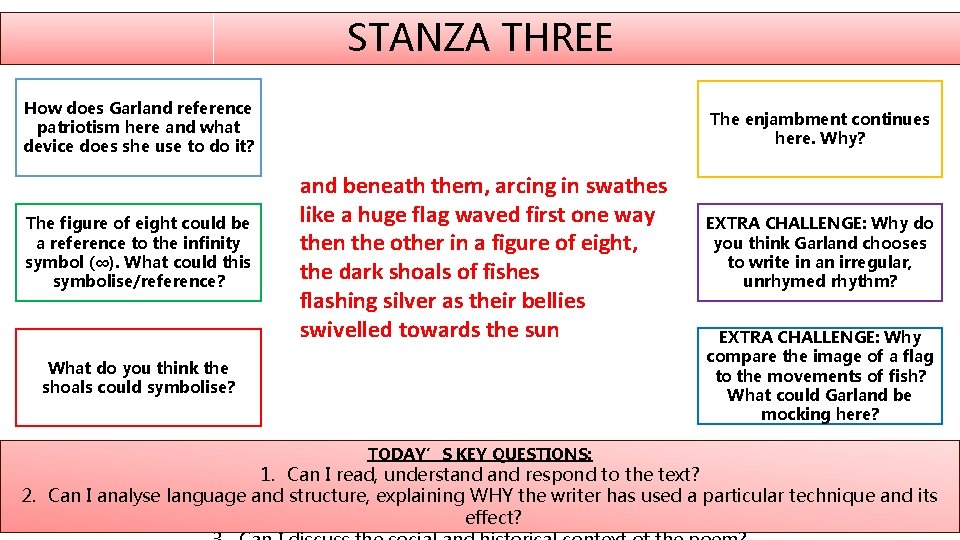
STANZA THREE How does Garland reference patriotism here and what device does she use to do it? The figure of eight could be a reference to the infinity symbol (∞). What could this symbolise/reference? The enjambment continues here. Why? and beneath them, arcing in swathes like a huge flag waved first one way then the other in a figure of eight, the dark shoals of fishes flashing silver as their bellies swivelled towards the sun What do you think the shoals could symbolise? TODAY’S KEY QUESTIONS: EXTRA CHALLENGE: Why do you think Garland chooses to write in an irregular, unrhymed rhythm? EXTRA CHALLENGE: Why compare the image of a flag to the movements of fish? What could Garland be mocking here? 1. Can I read, understand respond to the text? 2. Can I analyse language and structure, explaining WHY the writer has used a particular technique and its effect?
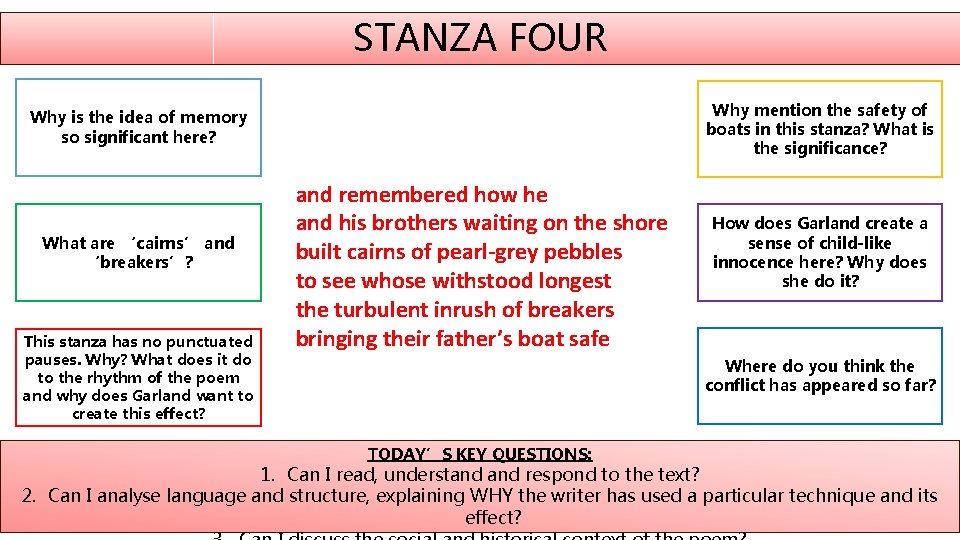
STANZA FOUR Why mention the safety of boats in this stanza? What is the significance? Why is the idea of memory so significant here? What are ‘cairns’ and ‘breakers’? This stanza has no punctuated pauses. Why? What does it do to the rhythm of the poem and why does Garland want to create this effect? and remembered how he and his brothers waiting on the shore built cairns of pearl-grey pebbles to see whose withstood longest the turbulent inrush of breakers bringing their father’s boat safe How does Garland create a sense of child-like innocence here? Why does she do it? Where do you think the conflict has appeared so far? TODAY’S KEY QUESTIONS: 1. Can I read, understand respond to the text? 2. Can I analyse language and structure, explaining WHY the writer has used a particular technique and its effect?
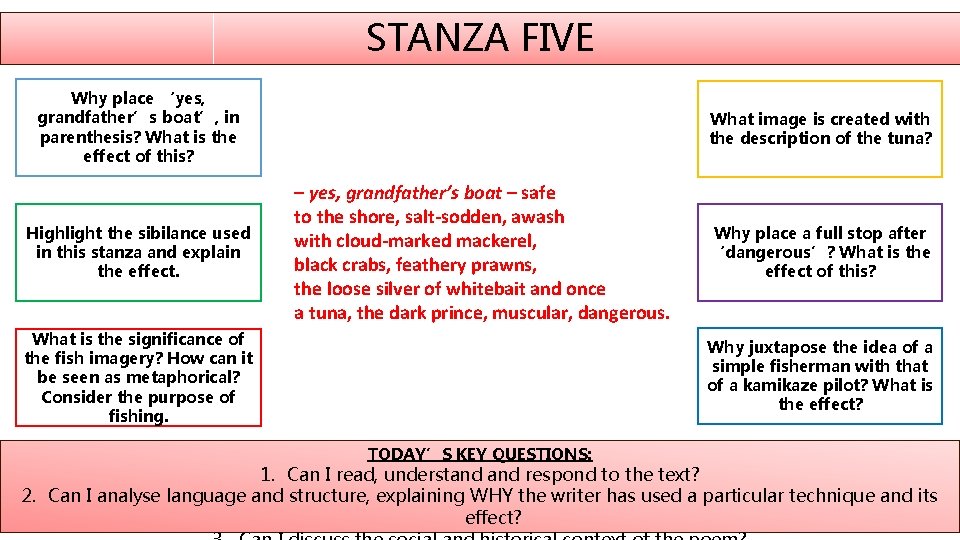
STANZA FIVE Why place ‘yes, grandfather’s boat’, in parenthesis? What is the effect of this? Highlight the sibilance used in this stanza and explain the effect. What image is created with the description of the tuna? – yes, grandfather’s boat – safe to the shore, salt-sodden, awash with cloud-marked mackerel, black crabs, feathery prawns, the loose silver of whitebait and once a tuna, the dark prince, muscular, dangerous. What is the significance of the fish imagery? How can it be seen as metaphorical? Consider the purpose of fishing. Why place a full stop after ‘dangerous’? What is the effect of this? Why juxtapose the idea of a simple fisherman with that of a kamikaze pilot? What is the effect? TODAY’S KEY QUESTIONS: 1. Can I read, understand respond to the text? 2. Can I analyse language and structure, explaining WHY the writer has used a particular technique and its effect?
STANZA SIX Where is the power and conflict in this stanza? Highlight examples and explain why you have chosen them? The italics represent a switch to a first person perspective. Why does Garland do this? What kind of person is the speaker’s mother? Why do you think the pilot turned around? Was he scared? Or do you think he wasn’t ready to say goodbye? And though he came back my mother never spoke again in his presence, nor did she meet his eyes and the neighbours too, they treated him as though he no longer existed, only we children still chattered and laughed Is the pilot’s head the only one full of ‘powerful incantations? ’ Who else has been culturally conditioned? What is Garland saying about children in this stanza? TODAY’S KEY QUESTIONS: 1. Can I read, understand respond to the text? 2. Can I analyse language and structure, explaining WHY the writer has used a particular technique and its effect?
STANZA SEVEN What is the poet suggesting about the power of choices and consequences in the final two lines? What is Garland saying happens when youthful innocence disappears? Should love be sacrificed because the pilot returned? How does Garland present the man who left and the man who returned as two different entities through the eyes of the speaker? till gradually we too learned to be silent, to live as though he had never returned, that this was no longer the father we loved. And sometimes, she said, he must have wondered which had been the better way to die. Which would have been the better way to die? EXTRA CHALLENGE: How significant is it that the pilot himself does not have a voice? What tone is created in this stanza? TODAY’S KEY QUESTIONS: 1. Can I read, understand respond to the text? 2. Can I analyse language and structure, explaining WHY the writer has used a particular technique and its effect?
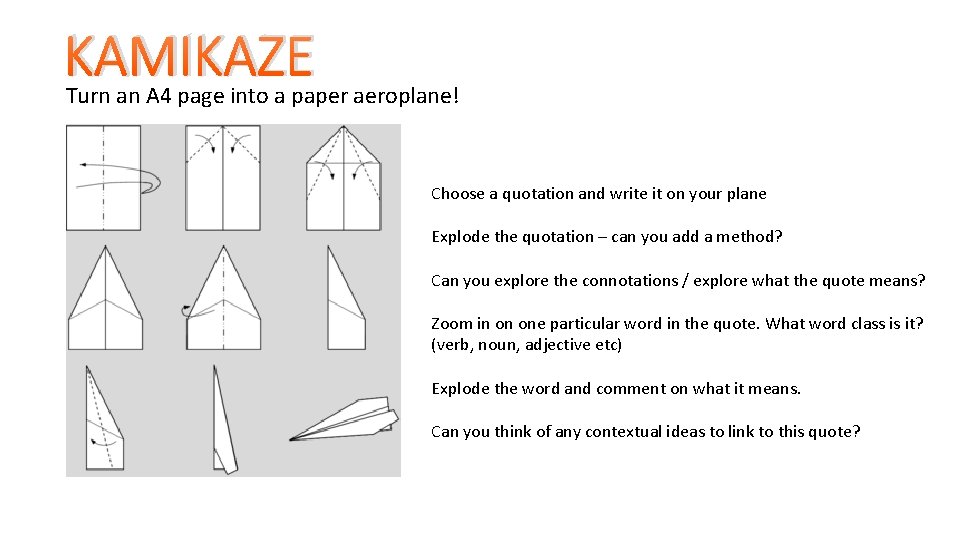
KAMIKAZE Turn an A 4 page into a paper aeroplane! Choose a quotation and write it on your plane Explode the quotation – can you add a method? Can you explore the connotations / explore what the quote means? Zoom in on one particular word in the quote. What word class is it? (verb, noun, adjective etc) Explode the word and comment on what it means. Can you think of any contextual ideas to link to this quote?
- Slides: 16